
What Are Piezoelectric Crystal Components? Crystal Resonator Discovery for Smart Manufacturing
Piezoelectric crystal components are the quartz-based building blocks — piezo elements, piezo crystal units and packaged quartz piezoelectric crystals — that turn an applied voltage into a mechanically determined vibration, and that vibration becomes the clock signal a circuit runs on. A crystal resonator is the finished, sealed and testable package built around that effect: a quartz wafer, electrodes, a ceramic base and a metal cover, trimmed to one nominal frequency.
This explainer is written for engineers and procurement teams in the research and evaluation stage. It separates the naming layers that cause specification mismatches, uses the tuning fork as a worked low-frequency example, shows where these parts sit in smart manufacturing equipment, and closes with the purchasing terms and acceptance criteria worth settling before a first supplier conversation.
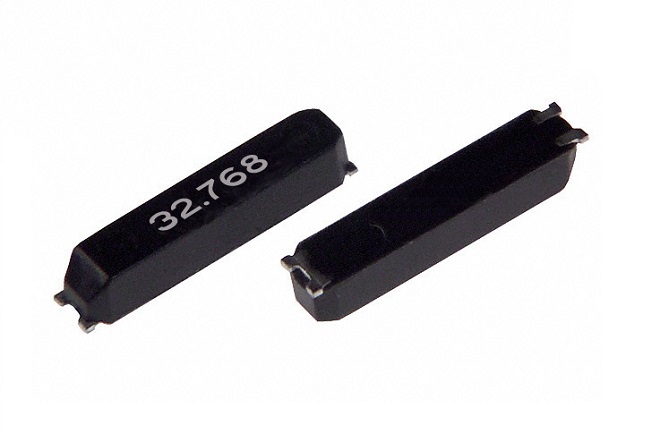 Cover: an SMD crystal resonator — the packaged output of a quartz piezoelectric crystal, sealed for automated assembly.
Problem Definition: The Vocabulary Gap Between Piezo Elements and Crystal Resonators
Three naming layers describe one supply chain, and mixing them creates rework rather than clarity.
- Piezo element / piezo crystal unit — the active quartz plate and its electrodes, the part that physically vibrates.
- Quartz piezoelectric crystal — the material system: a cut quartz wafer with a defined orientation and frequency behaviour.
- Crystal resonator — the sealed component that is quoted, sampled and tested, carrying a model number and a complete parameter set.
When an engineering drawing says “piezo element” but the purchase order says “crystal resonator”, the tolerance, load capacitance and temperature range that reach the test bench may not be the values the oscillator circuit was designed around. The failure mode is quiet: the part passes goods-in inspection and then shifts frequency on the board.
The second problem is evidence. A datasheet supplies nominal frequency, load capacitance, tolerance and operating temperature, but buyers in regulated markets also need compliance documentation and a stated test regime. Without both halves, an evaluation cannot be closed and a sourcing conversation restarts from zero.
This article therefore treats those parts as one family — crystal resonator, crystal oscillator, crystal filter and SAW crystal resonator — and works through specifications and acceptance criteria together, instead of presenting a catalogue.
Industry Background: Why Timing Components Matter More as Manufacturing Gets Smarter
The category is sizable and still growing. The global crystal oscillator market was valued at USD 2.89 billion in 2025 and is projected to reach USD 3.66 billion by 2030 (MarketsandMarkets). Asia Pacific captured more than a 42% revenue share in 2024, approximately USD 1.1 billion (Precedence Research). Automotive applications are expanding at a CAGR of 12.88%, driven by ADAS, infotainment and EV powertrains (Fortune Business Insights).
Smart manufacturing adds a demand pattern that market totals hide. A connected factory is a network of meters, sensors, gateways, drives and inspection stations, and each device contains at least one oscillator circuit that needs a stable clock signal for its IC. Timing error does not stay local — it propagates into sampling intervals, communication frames and time-stamped production records. That is why frequency control devices are specified with tolerance and stability limits rather than a frequency alone.
Fronter Electronics Co., Ltd is a Shenzhen-based supplier founded in 1991 that develops, produces and sells electronic components, with quartz crystal resonators and quartz crystal oscillators as its core lines. The company operates a 21,000 m² facility with 286 employees, including a 19-engineer R&D team, reports an annual output of 300,000,000 units, and exports about 70% of production to EU and USA markets. Its component supply channel also covers inductors, integrated circuits, modules, discrete devices, capacitors, resistors, connectors, flash and memory, with distribution brands that include SUNLORD, KDS, EPSON, NDK, TI, ST, ATMEL, AD, ALTERA, XILINX, SAMSUNG, SK HYNIX, MICRON, BROADCOM and FREESCALE.
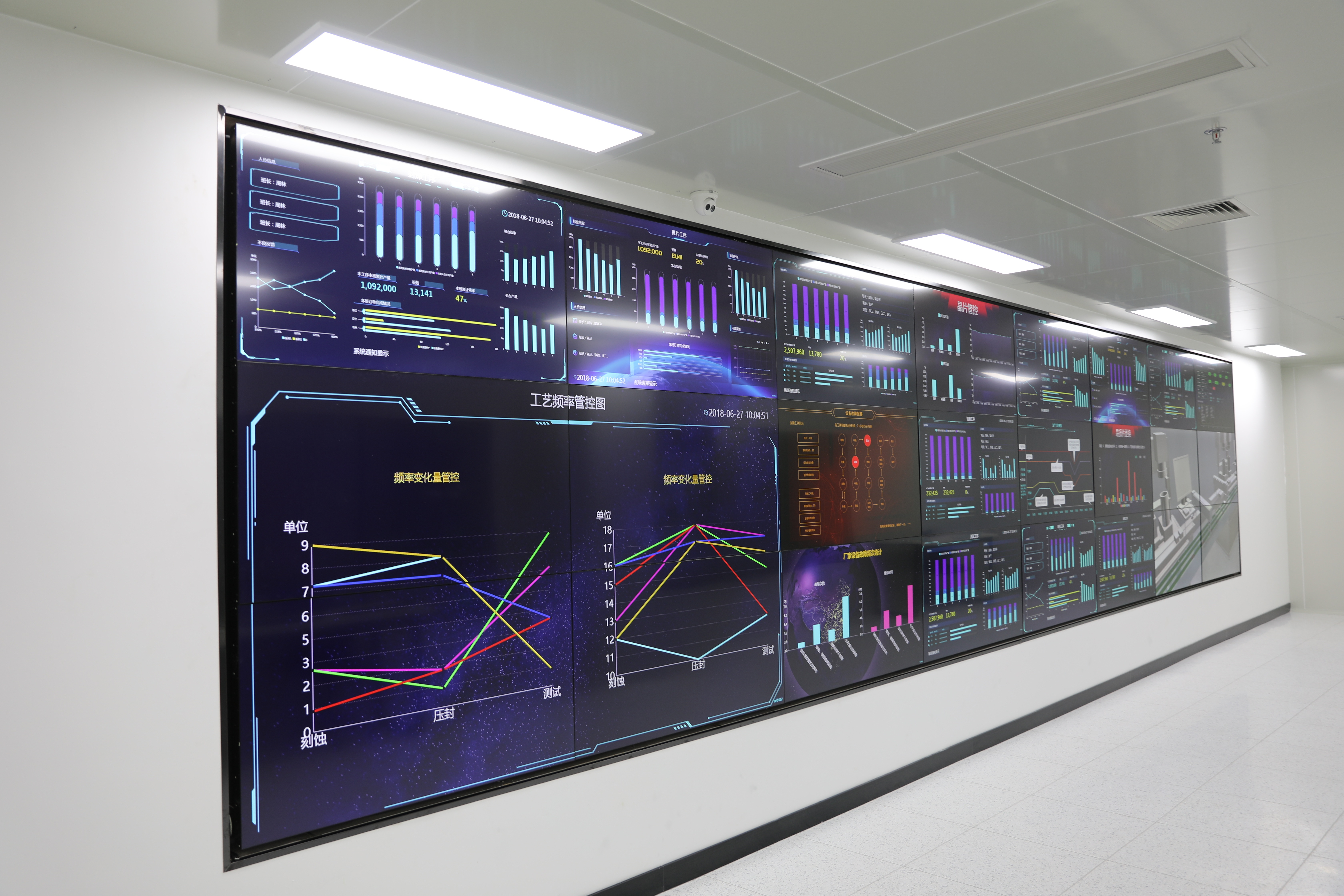 Smart manufacturing connects meters, sensors and gateways; each node depends on its own timing reference.
Detailed Solution: What Actually Sits Inside a Piezoelectric Crystal Component
1. The piezoelectric effect, stated plainly
Quartz is piezoelectric: apply a voltage across a cut wafer and it deforms; deform it and it generates a voltage. Driven inside an oscillator circuit, the wafer vibrates at a resonant frequency set by its geometry and mass. The circuit sustains that vibration and the resulting periodic signal becomes the clock. Accuracy therefore originates in the quartz cut and electrode mass, and is preserved by the package and the thermal environment — not by the circuit alone.
2. From piezo element to quartz piezoelectric crystal
Fronter’s piezoelectric crystal component family covers piezo elements, piezo crystal units and quartz piezoelectric crystals, delivered as crystal oscillators, crystal resonators, crystal filters and SAW crystal resonators. Construction is consistent across the family: a quartz wafer as the active element, a ceramic base for mechanical support and sealing, and a metal cover for protection. The blank is where accuracy is created; the package is where it is kept.
3. Nominal frequency, tolerance and stability
For this family, Fronter lists a nominal frequency of 1–96 MHz, load capacitance of 4–33 pF, frequency tolerance of ±5 ppm to ±100 ppm, frequency stability of ±10 ppm to ±100 ppm, and an operating temperature range of −55 °C to +125 °C. Package formats include OSC-SMD7050/5032/3225/2520/2016/1612 and SMD7050/6035/5032/3225/2520/2016/1612.
Read those four parameters as four separate purchase constraints. Tolerance is the initial deviation at 25 °C. Stability is drift across the temperature range. Load capacitance must match the oscillator circuit. The temperature range must cover the installation environment, not the laboratory.
4. The tuning fork: a worked example at 32.768 kHz
A tuning fork crystal resonator is a low-frequency device whose quartz blank is shaped like a tuning fork and vibrates in a flexural mode. Fronter’s Turning Fork series is offered in SMD1610, SMD2012 and SMD3215 formats at 1.6 × 1.0 mm, 2.0 × 1.2 mm and 3.2 × 1.5 mm, with a frequency of 32.768 kHz, load capacitance options of 12.5 pF, 7 pF and 9 pF, frequency tolerance of ±20 ppm, an operating temperature range of −40 to +85 °C, and gold, SiO₂ and silver materials. Named applications include consumer electronics, IoT, smart energy meters and automotive.
The frequency itself explains the fit. 32.768 kHz is 215 Hz — the value widely associated with real-time clocks and watch crystals — because repeated binary division produces a one-second pulse with simple logic. The trade-off is speed: a tuning fork suits timekeeping rather than high-speed data paths, which is the territory of MHz resonators in the 1–96 MHz band.
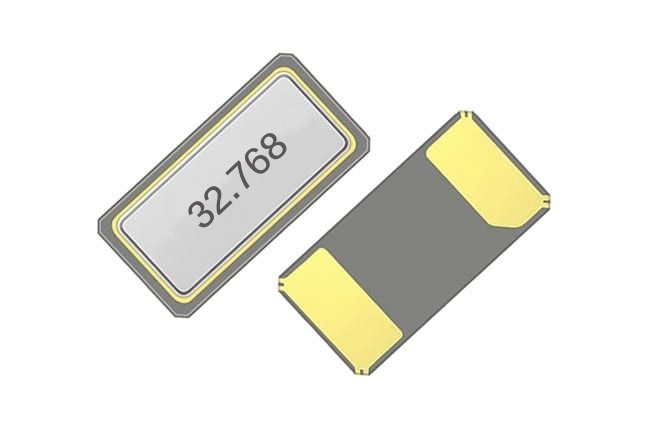 Crystal resonator SMD3215: a 32.768 kHz tuning fork device in a 3.2 × 1.5 mm package.
5. Where the component sits in the circuit
A resonator is always paired with an oscillator circuit. In a typical application the component provides a stable clock signal for the IC, and the design is matched to the oscillator circuit’s load capacitance. Applications named for this family include smart home appliances, communication electronics and Bluetooth devices; deployment examples include mobile devices, Bluetooth headsets, smart air conditioners and security cameras, under high-temperature working conditions and specifications that can extend to ultrasonic requirements.
Step-by-Step Breakdown: Specification and Acceptance Path
Seven steps move a project from “we need timing” to a releasable part number. Each step should produce a document rather than an opinion.
- Fix the timing function. Decide whether the device needs timekeeping in the 32.768 kHz class or a system clock in the MHz class. The piezoelectric crystal component family spans 1–96 MHz; the Turning Fork series is fixed at 32.768 kHz. Choosing the band first prevents tolerance discussions from being reopened later.
- Write tolerance and stability as two separate limits. Available grades run from ±5 ppm to ±100 ppm tolerance and ±10 ppm to ±100 ppm stability. The grade should be justified by the protocol or the measurement interval, not copied from a previous bill of materials.
- Match the load capacitance to the circuit. Options in this family run from 4 pF to 33 pF, and the Turning Fork series offers 12.5 pF, 7 pF and 9 pF. A mismatch pulls the effective frequency away from nominal even when the part is within its own specification.
- Confirm the temperature envelope. The component family is rated −55 to +125 °C and the Turning Fork series −40 to +85 °C. Equipment installed in cabinets, outdoors or near heat sources needs the range verified against the installation site.
- Lock the package and footprint. Select from SMD formats such as OSC-SMD7050/5032/3225/2520/2016/1612 and SMD7050/6035/5032/3225/2520/2016/1612, or the 1.6 × 1.0 mm, 2.0 × 1.2 mm and 3.2 × 1.5 mm tuning fork bodies. Footprint decisions made for one assembly line rarely transfer cleanly to another.
- Collect compliance evidence before the sample stage. Request the RoHS certificate and confirm which standards apply to the target market. For quartz crystal units the international baseline is the IEC 60122 series; for automotive passive components the applicable stress-resistance standard is AEC-Q200. Details are summarised in the FAQ below.
- Validate the sample, then fix commercial terms. Confirm the supplier’s test regime — Fronter applies 100% test — and agree MOQ of 1000 pcs, ODM customization of parameters and appearance, lead time of 30–45 days, and monthly capacity of 80KK against the project forecast. Terms fixed after validation stay fixed; terms fixed before it usually change.
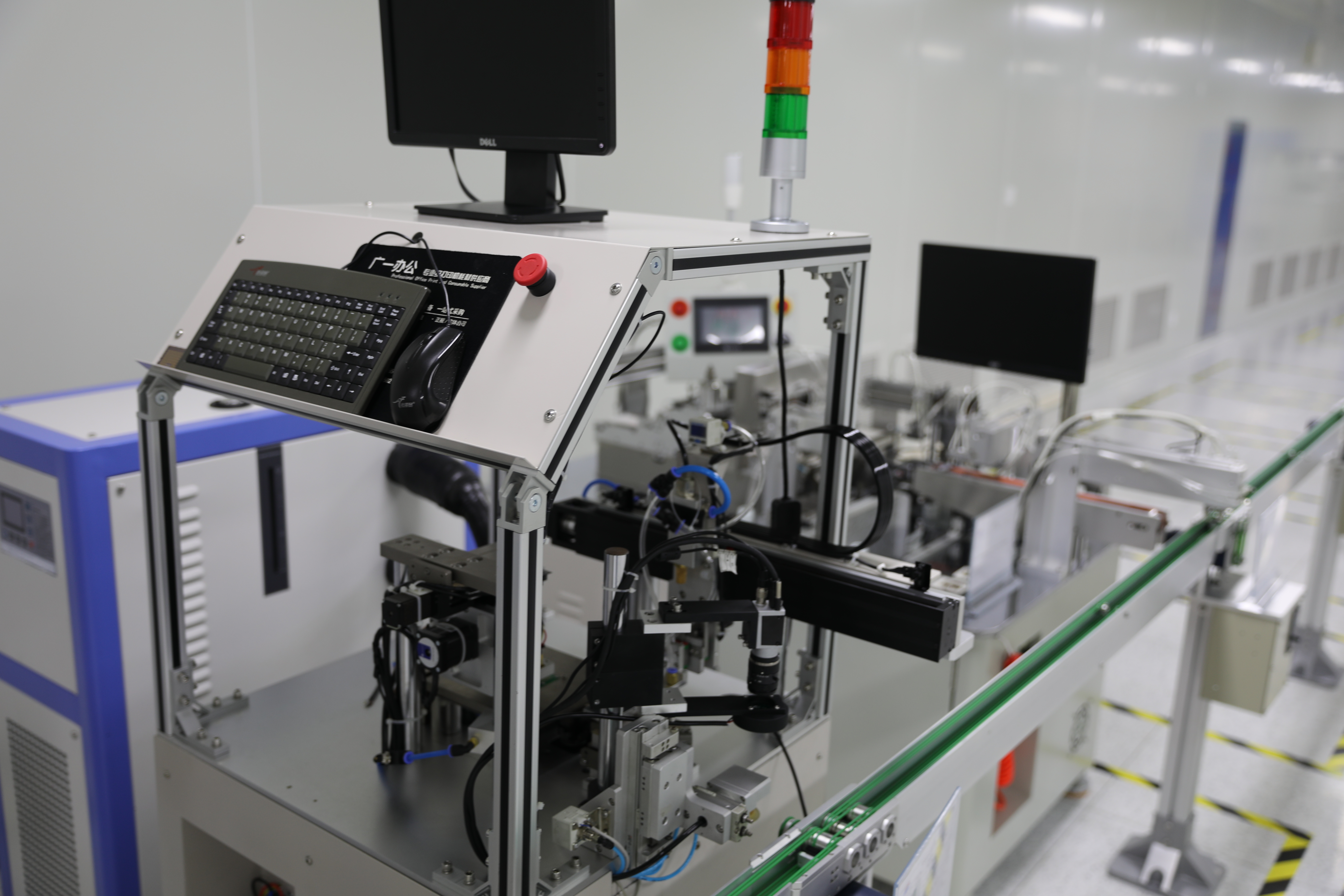 100% test is part of the stated quality control for Fronter piezoelectric crystal components.
Use Cases: Where Piezoelectric Crystal Components Earn Their Place
Smart metering
A smart meter manufacturer in India has used these components in meter applications at a volume of 5,000,000 units over a 10-year duration, reported as stable operation. The recorded highlight for that programme is fast delivery within 3–4 weeks, combined with flexible customization to meet project-specific packaging and frequency requirements. Metering is a useful reference case because the installed base is long-lived and replacement cost is high, so tolerance drift and package reliability matter more than unit price alone.
Consumer and Bluetooth devices
Mobile devices, Bluetooth headsets, smart air conditioners and security cameras all rely on a clock signal from a small resonator. Here the binding constraints are footprint and power budget, which is why the 1.6 × 1.0 mm and 2.0 × 1.2 mm tuning fork formats exist alongside the 3.2 × 1.5 mm body.
High-temperature and automotive-adjacent equipment
Applications in this family are specified for high-temperature working conditions, and the component family itself is rated to +125 °C. Automotive-grade programmes should be scoped against AEC-Q200 requirements at the specification stage rather than after the design freeze.
Communication electronics and industrial control
Communication electronics and industrial control equipment typically need MHz-band timing, which is the 1–96 MHz range of this family, delivered as resonators, oscillators, filters and SAW crystal resonators. For these designs, tolerance and stability limits chosen at the specification stage determine whether a later board revision needs a different part number.
Comparison Table: Tuning Fork vs. MHz Piezoelectric Crystal Components
| Attribute | Turning Fork series (32.768 kHz) | Piezoelectric crystal component family |
|---|---|---|
| Model / format | SMD1610, SMD2012, SMD3215 | Crystal oscillator, crystal resonator, crystal filter, SAW crystal resonator |
| Package size | 1.6 × 1.0 mm; 2.0 × 1.2 mm; 3.2 × 1.5 mm | OSC-SMD7050/5032/3225/2520/2016/1612; SMD7050/6035/5032/3225/2520/2016/1612 |
| Nominal frequency | 32.768 kHz | 1–96 MHz |
| Load capacitance | 12.5 pF, 7 pF, 9 pF | 4–33 pF |
| Frequency tolerance | ±20 ppm | ±5 ppm to ±100 ppm |
| Frequency stability | Not stated in the product data for this series | ±10 ppm to ±100 ppm |
| Operating temperature | −40 to +85 °C | −55 to +125 °C |
| Materials | Gold, SiO₂, silver | Metal cover, ceramic base, quartz wafer |
| Typical applications | Consumer electronics, IoT, smart energy meter, automotive | Smart home appliances, communication electronics, Bluetooth devices |
Purchasing Terms and Acceptance Criteria at a Glance
| Item | Recorded term | What it means for an evaluation |
|---|---|---|
| Production mode | ODM | Frequency and package can be adapted to a project rather than only selected from stock |
| Customization scope | Parameters and appearance | Both electrical specification and packaging can be project-specific |
| MOQ | 1000 pcs | Sets the ceiling for sample-stage quantity before a volume commitment |
| Lead time | 30–45 days | Planning assumption for standard ODM production |
| Monthly capacity | 80KK | Headroom to be checked against the project forecast |
| Quality control | 100% test | Acceptance testing can be built on a stated regime rather than assumed |
| Export markets | EU / Middle East | Documentation expectations for those destinations should be confirmed early |
| After-sales | Remote support | Failure analysis and specification questions follow a defined channel |
| Environmental compliance | EU RoHS certificate SZXEC25001335806, issued 2025-04-25 | Traceable evidence for the SMD series, SAW Resonator & Filter scope |
FAQ
1. Which compliance evidence should a crystal resonator carry for EU-bound projects?
Fronter holds an EU RoHS Compliance Certificate, certificate number SZXEC25001335806, issued on 2025-04-25 by SGS-CSTC Standards Technical Services Co., Ltd. Shenzhen Branch. The certificate covers the SAW Resonator & Filter and SMD series and references the EU RoHS Directive (EU) 2015/863 amending Annex II to Directive 2011/65/EU; its recorded expiry date is 2099-01-01. Beyond RoHS, the international baseline for quartz crystal units is the IEC 60122 series, which covers general requirements and measuring methods. Where the end product is automotive, AEC-Q200 is the applicable stress-resistance standard for passive components, so buyers should list it as a separate requirement rather than assume it is covered by RoHS. Fronter also states that its products comply with RoHS, REACH and other environmental protection regulations.
2. What can be customized in a piezoelectric crystal component order?
Fronter operates an ODM production mode with customization of parameters and appearance. In practice that covers the frequency, load capacitance, tolerance and stability values within the published ranges — 1–96 MHz, 4–33 pF, ±5 ppm to ±100 ppm and ±10 ppm to ±100 ppm — as well as package and presentation choices. The supporting capacity is a 19-engineer R&D team, 100% test quality control and a stated monthly capacity of 80KK, which is the number to compare against a project forecast before committing to a schedule.
3. What drives the cost of a crystal resonator order?
Quotation follows the specification, and the specification is set by four decisions: the frequency band, the tolerance and stability grade, the load capacitance match, and the package size. Tighter tolerance and wider temperature coverage generally move a part out of the standard band, and a smaller body such as the 1.6 × 1.0 mm tuning fork format is a different cost position from a larger SMD package. Order quantity then interacts with the MOQ of 1000 pcs, and any packaging customization adds a project-specific element. Buyers get comparable quotes only when all four parameters and the packaging requirement are stated in the enquiry; quoting on frequency alone produces numbers that cannot be compared.
4. How should a sample batch be validated before volume release?
Validate against the written specification rather than a general impression. Measure initial frequency and tolerance, check stability across the stated operating range, confirm that load capacitance matches the oscillator circuit, and verify the package against the assembly process. Because Fronter applies 100% test as its quality control regime, the sample report should reflect that regime. A reference point from the field: a smart meter manufacturer in India has used these components at 5,000,000 units over 10 years with reported stable operation, with fast delivery within 3–4 weeks and flexible customization to meet project-specific packaging and frequency requirements. To start a sample or quotation request, write to sales@chinafronter.com.
5. What lead time should be planned for an ODM crystal resonator order?
Fronter records a lead time of 30–45 days for ODM production, with a monthly capacity of 80KK. The smart meter programme referenced above is documented with fast delivery within 3–4 weeks alongside project-specific packaging and frequency customization, which shows that schedule depends on how much of the specification is project-specific. The practical planning rule is to separate standard-parameter volume from customized volume, confirm which one the forecast belongs to, and place the longer lead time on the customized portion.
Conclusion
Piezoelectric crystal components are simple to describe and easy to under-specify. A quartz wafer vibrates because it is piezoelectric; a ceramic base and metal cover hold that vibration stable; a model number and a parameter set make the result purchasable. The tuning fork at 32.768 kHz shows the model at work — a 1.6 × 1.0 mm to 3.2 × 1.5 mm body, ±20 ppm tolerance, −40 to +85 °C — while the broader family covers 1–96 MHz with tolerance down to ±5 ppm and operation to +125 °C.
For buyers, the constraint work is where value is created: separate tolerance from stability, match load capacitance, verify the temperature envelope against the installation site, and collect compliance evidence — RoHS certificate, IEC 60122, AEC-Q200 where relevant — before the sample stage rather than after it. Those four documents, plus a stated test regime and agreed MOQ and lead time, are what turn a first sourcing conversation into a comparable quotation.
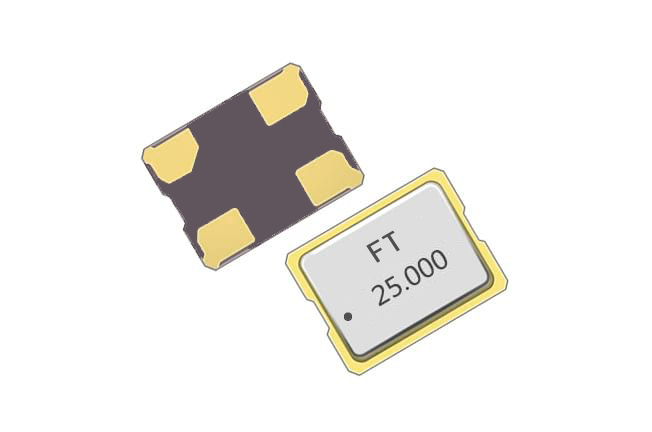 Quartz crystal resonators and oscillators from Fronter — sample and quotation requests are handled through sales@chinafronter.com.
Next step: sample, quotation or catalogue
Fronter Electronics Co., Ltd (founded 1991, Shenzhen) supplies quartz crystal resonators and quartz crystal oscillators with ODM customization, 100% test and EU RoHS compliance. Send the frequency, load capacitance, tolerance, stability, package and target quantity to sales@chinafronter.com, call +86 755-83458798, or message WhatsApp +8618903026195. The full product and capability overview is available in the downloadable brochure: Fronter product brochure (PDF). Company website: www.chinafronter.com.
Have Questions or Need More Details?
Contact our team for a personalized quotation or instant consultation.
Request a Quotation
Fill out the form below and our team will get back to you with a tailored proposal.
WhatsApp Direct Chat
Prefer to chat in real-time? Message us on WhatsApp for instant assistance & quick answers.
- Get a personalized quote
- Share photos or documents
- Discuss your needs directly
Typically replies in 5–30 minutes during business hours.