Evaluating Charcoal Suppliers: Key Factory Capabilities and Quality Checks to Perform
Short answer: A charcoal supplier worth approving can demonstrate four things — a verifiable factory rather than a trading desk, batch-tested figures for ash content, fixed carbon and calorific value, a form and packaging range that matches your application, and certification documents whose scope actually covers the product you are buying. The fastest way to test all four is to order a sample of the exact shape, finish and packaging you intend to purchase, measure it against the written specification, and only then commit to a container order.
The Real Problem: Specifications Arrive as Text, Performance Arrives as Product
Charcoal is bought on specification, yet almost every specification a buyer first sees is text — a quotation line, a product page, a short PDF. The numbers that decide whether a purchase works (ash content, fixed carbon, calorific value, burn duration, form tolerance, odour behaviour) cannot be confirmed from a document. They can only be confirmed with a physical sample and a repeatable test.
In practice, charcoal sourcing problems follow three patterns:
- Capacity borrowing. A supplier quotes confidently but does not operate the line that will produce the goods. Supplier listings on B2B marketplaces sometimes present a business as a manufacturer while the business-type field on the same page states "trading company". The product names look identical either way.
- Specification drift. The sample and the shipment differ, most often in ash content or briquette hardness. A shisha lounge notices this when briquettes begin breaking in the tongs; a restaurant notices it when ash builds up under the grill faster than usual.
- Documentation gaps. An ISO or SGS certificate exists but does not cover the specific product form or the destination market. For BBQ charcoal sold into Europe, product safety requirements follow the EN 1860-2 standard, which a general quality certificate does not automatically satisfy.
Supplier evaluation therefore needs two separate verdicts. The capability verdict answers whether a factory can produce the same specification repeatedly. The compliance verdict answers whether it can prove the product meets the rules of the destination market. The evaluation framework below is organised around those two verdicts.
Industry Background: A Large Market, a Fragmented Supply Base and a Rising Documentation Load
The global charcoal market was estimated at USD 8.5 billion in 2026, up from USD 8.1 billion in 2025, according to Grand View Research. Demand is spread across hookah and shisha, barbecue, incense and aromatherapy, household heating and industrial uses.
Supply is concentrated. Indonesia was the world's leading charcoal exporter in 2024, accounting for roughly 23% of global export value, based on trade data compiled by World's Top Exports. Within the hookah segment specifically, coconut shell charcoal held the largest product-type share at 42.3% in 2025, according to Dataintelo — which is one reason coconut shell feedstock appears so often in shisha charcoal specifications.
Two structural facts make documentation checks more important than they once were:
- Charcoal manufacturing is a chemical manufacturing activity, not a trading activity. In U.S. Environmental Protection Agency background documentation, charcoal manufacturing facilities fall under Standard Industrial Classification code 2861 (Gum and Wood Chemicals), with source classification code 3-01-006. That classification implies process control, input consistency and emissions handling — things a genuine charcoal factory can describe and an intermediary usually cannot.
- Quality expectations are increasingly written down. EN 1860-2 is the mandatory product safety standard for BBQ charcoal in Europe. In Indonesia, briquette quality parameters referenced under SNI 01-6235-2000 include moisture content of 8% or less, ash content of 8% or less and a calorific value of at least 5,000 cal/g, as cited in a 2026 journal article discussing the standard.
At the same time, the supply base remains fragmented and largely self-described. A manufacturer page can claim private-label service for global brands, distributors and wholesalers without independent audit. Buyers who build their evaluation on documents and samples rather than on presentation avoid most of the risk.
The Five Evaluation Gates
The gates run from factory identity to technical support. Each gate has a verifiable output; a missing output is an open question rather than an automatic rejection. FYC (Dalian Tiancheng Charcoal Industry Technology Co., Ltd., a charcoal manufacturer established in 1990 in Liaoning, China) is used below as a working reference, because its product data is published in a form that can be checked against a sample.
Gate 1 — Factory Identity and Physical Capability
Ask for the registered company name, founding year, plant address, covered area, employee count and a description of the production lines, then compare those details across the quotation, the certificate and the shipping documents. A mismatch between the entity that issues the certificate and the entity that issues the invoice is a common warning sign of an intermediary.
Reference data point: FYC was established in 1990, operates a 6,000 m² manufacturing facility in Liaoning, employs approximately 100 staff and runs advanced assembly line equipment with a daily output exceeding 50 metric tons.
Gate 2 — Product Consistency: Ash, Fixed Carbon and Calorific Value
Three numbers carry most of the quality risk in a charcoal order:
- Ash content — the residue left after combustion. High ash means more frequent reloading, more cleaning, and in indoor barbecue settings, faster exhaust-hood fouling.
- Fixed carbon — the fraction of the briquette that burns as carbon. Lower fixed carbon means more filler and shorter useful heat.
- Calorific value — the heat released per unit of weight, which drives searing performance and the real cost per service hour.
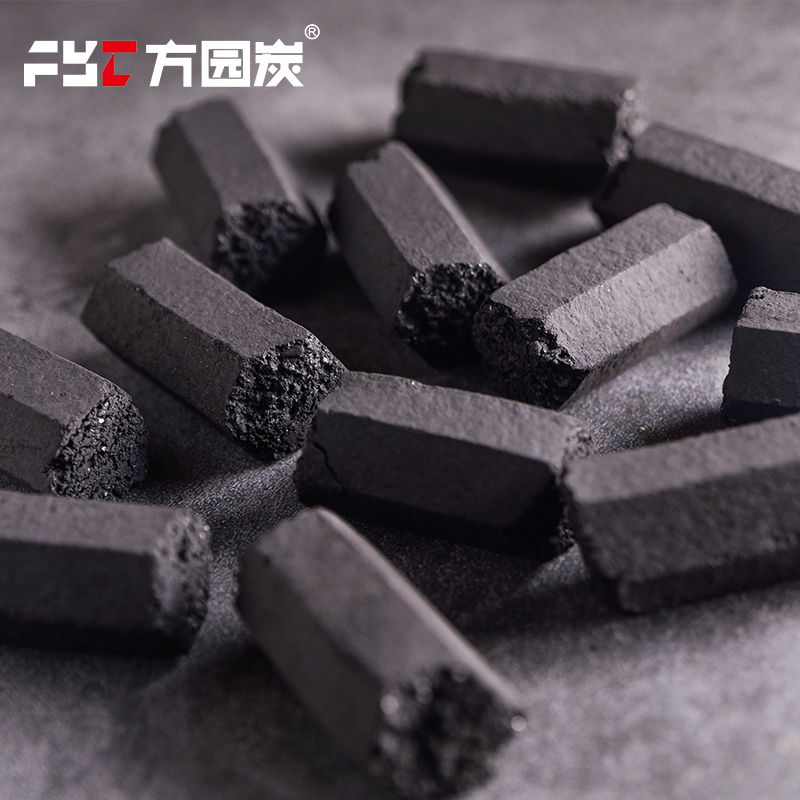
FYC publishes these figures for its hookah charcoal (model TC-01): ash content below 3% at premium grade, fixed carbon content above 85%–90% and a calorific value above 7,800 kcal/kg. The same range is offered in cube (25 mm and 40 mm), hexagonal and bamboo forms, with a burning time of 90–120 minutes per briquette for cube sizes and 45–70 minutes for quick-light options.
Ask a second question: tested under what conditions, and on which batch? A single certificate from a trial run is not a quality system. Batch-level lab reports are what turn a number into a repeatable commitment.
Gate 3 — Customization: Forms, Sizes, Foil Finishes and Packaging
Form is not cosmetic. Bowl geometry in a hookah lounge, grate spacing on a restaurant grill and the diameter of an incense burner all determine which shapes will actually work in service.
Published FYC product forms, by line:
- Hookah / shisha charcoal (TC-01) — cube (25 mm and 40 mm), hexagonal and bamboo shapes, made from premium natural coconut shell and fruit wood.
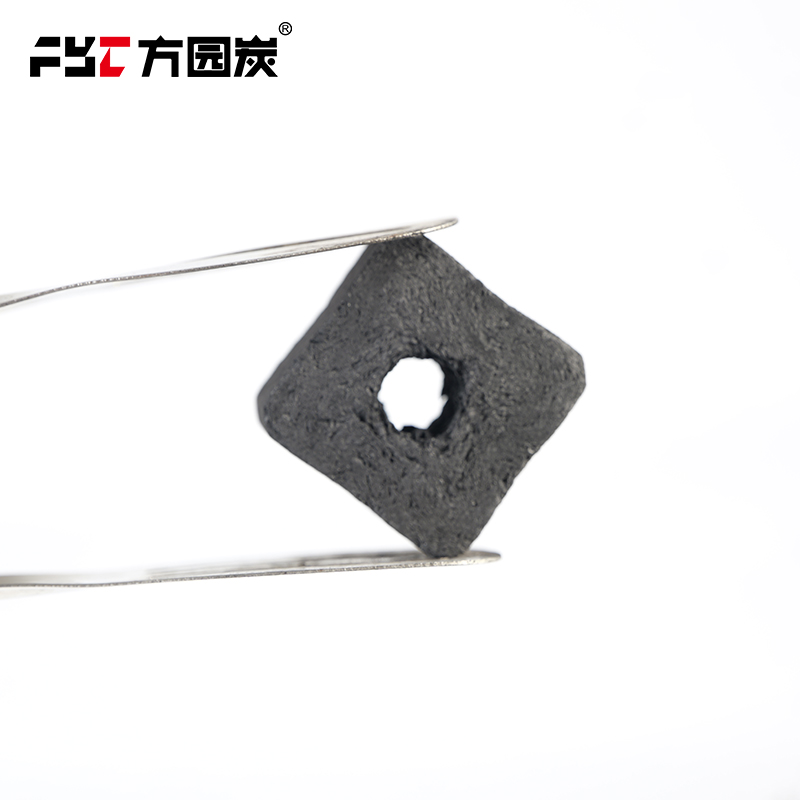
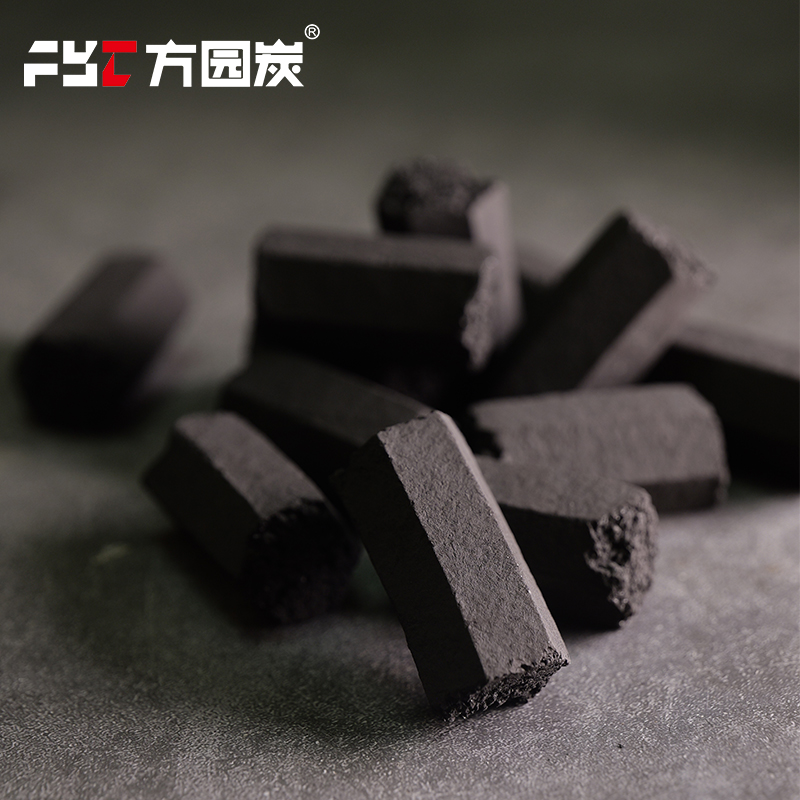
- Barbecue charcoal (TC-02) — quadrilateral, hexagon, quadrilateral BBQ bamboo charcoal, hexagon BBQ bamboo charcoal, 50 mm square-hole, 50 mm four-hole, spherical and fangyuan forms, made from bamboo sawdust, hardwood and fruit wood. Bamboo charcoal sticks are specified at 6–8 hours of burning time; the fruit wood quick-light format at 70 minutes.
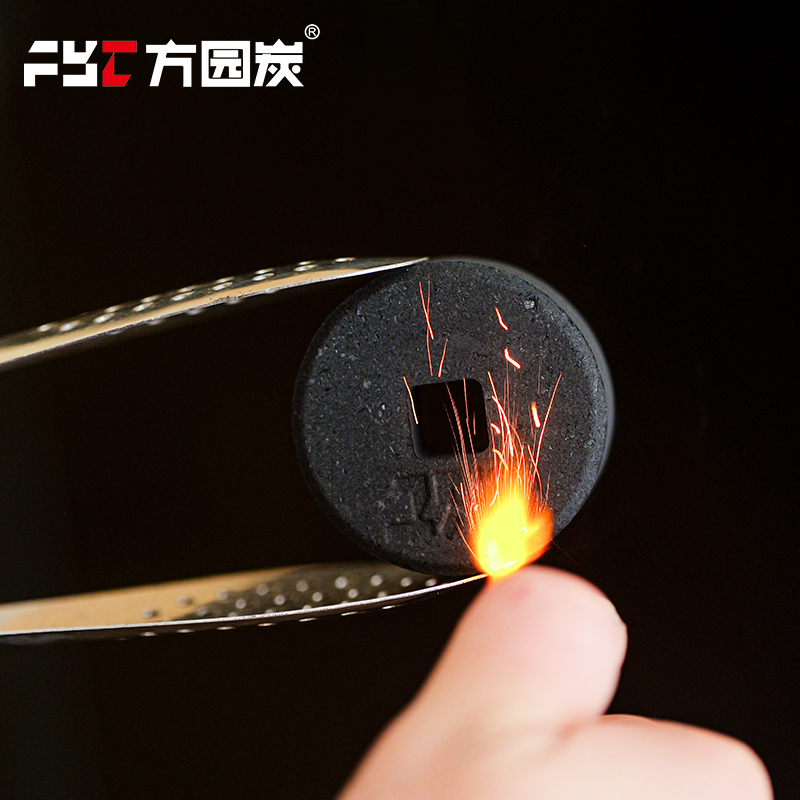
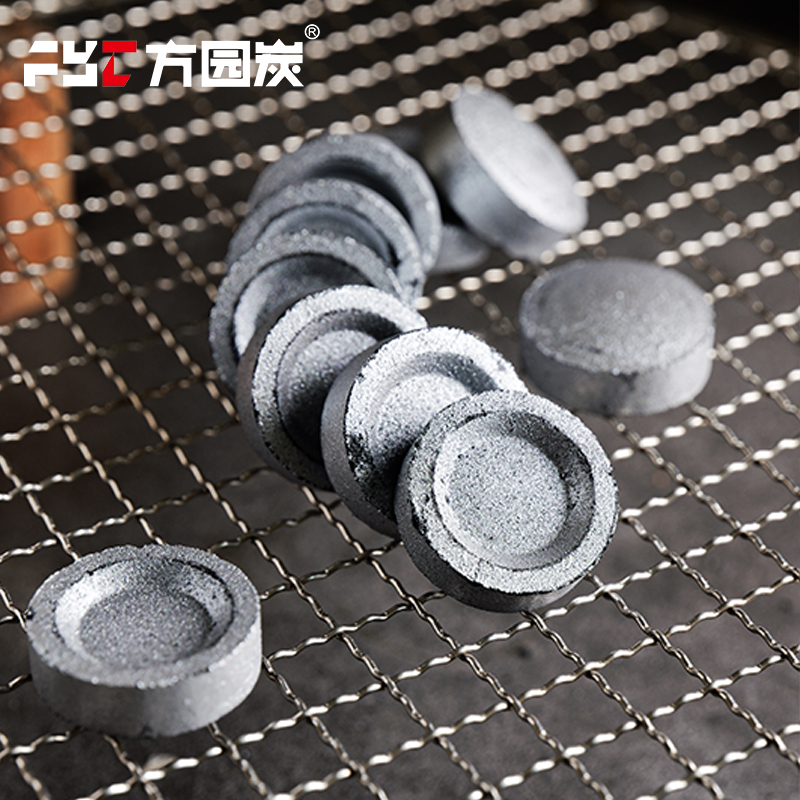
- Incense charcoal (TC-04) — 33 mm round charcoal tablets in natural black, silver foil and gold foil finishes, made from fruit wood charcoal and coconut shell charcoal powder, with a 45–70 minute burn and 30–45 second ignition.
- Disposable grill set (TC-03) — a single-use copper foil box with a metal wire mesh and an outer tray of aluminium foil or flame-retardant cardboard, using a self-igniting quick-light charcoal layer and built from 100% biodegradable materials.
Packaging customization belongs to the same gate. FYC offers flip-top boxes, magnetic boxes and pull-out boxes for incense charcoal. Before signing, ask the decisive question: is the tooling used for my sample the same tooling that will run my production order?
Gate 4 — Certification and Compliance Documents
Certification matters, but only when its scope matches the product and the market. FYC has obtained SGS and ISO certifications. When reviewing any supplier's certificates, check four things:
- Scope — which product and which manufacturing site the certificate covers.
- Validity — issue and expiry dates.
- Issuing body — whether it is an accredited certification body.
- Market relevance — for BBQ charcoal entering Europe, EN 1860-2 is the applicable product safety standard; briquette quality parameters in Indonesia are referenced through SNI 01-6235-2000 with moisture of 8% or less, ash of 8% or less and calorific value of at least 5,000 cal/g.
Certificates confirm factory systems. They do not replace batch-level test reports, which is why the sample stage matters even for certified suppliers.
Gate 5 — Capacity, Export Record and Technical Support
Capacity questions are about your order, not about the factory's marketing. Ask for daily output, annual capacity and written confirmation of capacity reservation during your buying season. FYC's published figures are a daily output exceeding 50 metric tons and an annual production capacity of 4,000,000 pieces.
Export record is a useful proxy for regulatory familiarity. Export business accounts for 60% of FYC's total sales, with main markets in the Middle East and Europe — regions where shisha, hookah and incense specifications tend to be demanding.
Technical support matters when your specification is unusual. A factory with in-house development capacity can adjust a mix, a form or a foil finish instead of refusing the request; FYC's R&D team consists of 8 engineers.
Step-by-Step: The 10-Point Quality Check Workflow
- Screen the legal entity. Confirm the registered name, the plant address, and whether the business manufactures or trades. Match that entity across the quotation, the certificate and the invoice.
- Request a numeric specification sheet. Ask for ash content, fixed carbon, calorific value, moisture and burn time — with units and test methods, not adjectives.
- Collect certificates with scope. ISO and SGS documents, plus market-specific requirements such as EN 1860-2 for European BBQ charcoal.
- Order a sample of the exact product. Not a generic sample: the same shape, size, finish and packaging you intend to buy — a 33 mm round incense tablet, a 50 mm four-hole BBQ briquette, a hexagonal hookah charcoal cube, or a foil-wrapped format.
- Test the sample against the sheet. Measure ignition time, burn duration, ash volume, odour, hardness and cracking. FYC's published benchmarks (90–120 minutes per cube, 45–70 minutes for quick-light formats, ash below 3% at premium grade) give you a target to test against.
- Document deviations. Record what the sample did versus what the sheet claimed, and ask the supplier to explain differences before price is agreed.
- Confirm customization and tooling. Verify available forms, foil finishes and packaging types (flip-top, magnetic and pull-out boxes), and clarify who owns the molds.
- Verify capacity for your cycle. Daily output, annual capacity and a written capacity reservation for your peak season.
- Check export experience in your market. Export share and main destination regions show whether your regulatory context is already familiar to the factory.
- Freeze a reference sample. Keep the approved sample and write its measured values into the purchase contract as acceptance criteria. This is the single most effective protection against specification drift.
Use Cases: Where the Evaluation Checks Change the Outcome
Hookah and shisha lounges (Saudi Arabia). Service quality depends on constant premium heat without smoke, odours or sparks. The working requirements are a 90–120 minute burn per briquette with ash content below 3%, made from 100% natural coconut shell, chemical-free and food-grade, with high hardness so briquettes do not break in the tongs. Matched equipment includes premium hookah sets, ceramic shisha bowls, hookah tongs and wind covers. For this buyer, fixed carbon and hardness are the two figures most worth testing on a physical sample.
Catering and BBQ restaurants (South Korea). High-volume, long-duration grilling requires sustained high temperatures and minimal ash to reduce exhaust hood cleaning. Bamboo charcoal sticks specified at 6–8 hours of burn time per batch reduce reloads during dining hours. Spark-free, odourless performance keeps indoor dining areas comfortable. Here the evaluation focus shifts to batch consistency: a single container with variable hardness will disrupt a kitchen schedule.
Wellness, spa and aromatherapy (United States). Incense charcoal works as an even heat diffuser that slowly releases the fragrance of Bakhoor or aromatherapy oils without smoke interference. The operating requirements are ignition in 30–45 seconds, steady gentle warmth for 45–70 minutes, and a silver or gold foil coating on an eco-friendly fruit wood base. Because the end use is sensory, odour neutrality must be tested on the sample rather than assumed from the specification sheet.
Outdoor recreation and glamping (Germany). Disposable grill sets must light instantly and heat evenly for 60–90 minutes with no clean-up. Requirements include lightweight construction, quick ignition from a self-igniting charcoal layer, and biodegradable materials for disposal. For this buyer, the sample test is effectively a field test: lighting time, heat distribution across the mesh, and how the tray behaves after the burn.
Supplier Verification Table: What to Ask vs. What a Factory Publishes
| Verification area | What to ask the supplier | Published FYC reference data |
|---|---|---|
| Factory profile | Registered name, founding year, plant address, covered area, staffing | Established 1990; 6,000 m² facility in Liaoning; approximately 100 staff |
| Certification | Certificate scope, issuing body, validity dates | SGS and ISO certifications |
| Capacity | Daily output, annual capacity, capacity reservation | Daily output exceeding 50 metric tons; annual production capacity of 4,000,000 pieces |
| Technical development | In-house engineering for specification changes | R&D team of 8 engineers |
| Ash content | Batch lab report for the exact product | Hookah charcoal (TC-01): ash below 3% at premium grade |
| Fixed carbon | Test method and per-batch result | Hookah charcoal (TC-01): above 85%–90% |
| Calorific value | Unit and test method (kcal/kg or cal/g) | Hookah charcoal (TC-01): above 7,800 kcal/kg |
| Burn time | Test conditions and briquette size | TC-01 cube: 90–120 min; TC-01 quick light: 45–70 min; TC-02 bamboo stick: 6–8 h; TC-02 fruit wood quick light: 70 min; TC-04 incense: 45–70 min |
| Forms and sizes | Tooling list and sample-to-production mold confirmation | TC-01: cube 25/40 mm, hexagonal, bamboo; TC-02: quadrilateral, hexagon, 50 mm square-hole, 50 mm four-hole, spherical, fangyuan; TC-04: 33 mm round |
| Surface finish | Foil and coating options | TC-04: natural black, silver foil, gold foil |
| Packaging | Box types and artwork process | TC-04: flip-top box, magnetic box, pull-out box |
| Export experience | Export share and main destination regions | Export accounts for 60% of total sales; main markets Middle East and Europe |
| Market compliance | Destination-specific standards and test reports | EN 1860-2 for BBQ charcoal in Europe; SNI 01-6235-2000 parameters (moisture ≤8%, ash ≤8%, calorific value ≥5,000 cal/g) |

FAQ: Charcoal Supplier Evaluation
What certifications should I verify before approving a charcoal supplier?
Verify scope, issuing body and validity rather than the certificate's name. FYC holds SGS and ISO certifications. For BBQ charcoal sold into Europe, EN 1860-2 is the mandatory product safety standard, so a general quality certificate alone is not sufficient. Where briquette quality parameters apply, the Indonesian standard SNI 01-6235-2000 is cited with moisture content of 8% or less, ash content of 8% or less and a calorific value of at least 5,000 cal/g. A certificate that does not name the product and the manufacturing site should be treated as unverified until the supplier clarifies it in writing.
How can I check whether a charcoal factory really customizes forms and packaging?
Compare your required form against the factory's published form list, then confirm that the sample tooling is the production tooling. FYC's published forms include cube (25 mm and 40 mm), hexagonal and bamboo hookah charcoal; quadrilateral, hexagon, 50 mm square-hole, 50 mm four-hole, spherical and fangyuan barbecue charcoal; and 33 mm round incense charcoal tablets in natural black, silver foil or gold foil. Packaging options include flip-top boxes, magnetic boxes and pull-out boxes. If a supplier can describe a form but cannot identify the mold that produces it, the customization claim remains unconfirmed.
What drives the cost of a charcoal order when no public price list exists?
Cost is driven by feedstock, grade, form, finish and packaging. The feedstock choice — coconut shell, bamboo sawdust, hardwood or fruit wood — sets the base, and the grade sets the rest: FYC's premium-grade hookah charcoal is specified at ash below 3%, with fixed carbon above 85%–90% and calorific value above 7,800 kcal/kg. Custom forms and tooling, foil finishes, and packaging such as magnetic or pull-out boxes each add specification, and certification testing adds cost when the destination market requires it. Because verifiable public FOB price series for specific charcoal forms were not available at the time of writing, buyers should benchmark quotations against the specification rather than against a single headline price.
Should buyers request samples before placing a bulk order?
Yes — the sample is the only stage where supplier claims become measurable. Test ignition time, burn duration, ash volume, odour and hardness against the written specification. FYC's published figures provide usable benchmarks: 90–120 minutes of burn per cube, 45–70 minutes for quick-light formats, and ash content below 3% at premium grade. To request a sample of a specific form, finish and packaging, contact FYC at paris@fyc-charcoal.com or via WhatsApp at +86 135 9132 7260.
How should lead time and production capacity be confirmed?
Ask for daily output, annual capacity and a written capacity reservation for your ordering window, because lead time depends on form, finish and packaging rather than on a single factory average. FYC publishes a daily output exceeding 50 metric tons and an annual production capacity of 4,000,000 pieces, with an R&D team of 8 engineers for specification work. A 60% export share to the Middle East and Europe indicates routine export handling, but the delivery schedule for a specific order — particularly one with foil finishes or custom packaging — should still be confirmed in writing before the order is released.
Conclusion: Evaluate the Factory, Then Verify the Batch
A charcoal supplier evaluation produces two verdicts. The factory verdict answers whether the business can reproduce your specification: identity, plant, capacity, tooling and engineering support. The batch verdict answers whether a specific shipment actually meets it: ash content, fixed carbon, calorific value, burn time, hardness, odour and packaging.
Five gates and ten steps are enough to reach both verdicts, and the sequence matters. Screen the entity first, collect documents second, test a physical sample third, and only then negotiate volume and price. Buyers who invert that order — price first, verification later — are the ones who discover specification drift after the container has already cleared customs.
FYC (Dalian Tiancheng Charcoal Industry Technology Co., Ltd.) publishes its specifications in a checkable form and works from a 6,000 m² facility in Liaoning, with a daily output exceeding 50 metric tons, SGS and ISO certifications, and exports concentrated in the Middle East and Europe. Use it as a benchmark for what a supplier's data should look like — and apply the same test to every charcoal factory on your shortlist.
Ready to verify a specification before you commit? FYC (Dalian Tiancheng Charcoal Industry Technology Co., Ltd.) manufactures hookah charcoal (TC-01), barbecue charcoal (TC-02), disposable grill sets (TC-03) and incense charcoal (TC-04) at a 6,000 m² facility in Liaoning, China, with SGS and ISO certifications and a daily output exceeding 50 metric tons.
Request a sample or a quotation: paris@fyc-charcoal.com · WhatsApp +86 135 9132 7260 · fyc-charcoal.com
Download the full product brochure with forms, sizes and packaging options: FYC Charcoal Brochure (PDF)
Have Questions or Need More Details?
Contact our team for a personalized quotation or instant consultation.
Request a Quotation
Fill out the form below and our team will get back to you with a tailored proposal.
WhatsApp Direct Chat
Prefer to chat in real-time? Message us on WhatsApp for instant assistance & quick answers.
- Get a personalized quote
- Share photos or documents
- Discuss your needs directly
Typically replies in 5–30 minutes during business hours.