Star-Shaped Seamless Steel Pipe Explained: ST, 6-Point, 8-Point and 10ST Profiles
A star-shaped seamless steel pipe is a cold-drawn, special-profile tube whose cross-section forms a multi-point star instead of a plain circle. The designations ST, 6-point, 8-point and 10ST describe different star geometries inside the same profile family, while spline steel pipe is a closely related group in which straight-sided teeth are formed onto the tube section. All of them start as seamless tube, and Q355B carbon steel is the grade most often quoted for the agricultural drive shafts and automotive parts where these profiles are used.
Most buyers meet star profiles at the exact point where a round tube stops working. A round tube carries torque only through a keyway, a welded yoke or a friction fit, and every one of those adds a machining step, a weld or a slip risk. A star or spline profile transfers torque through the full section of the tube, so the same outside diameter carries more load with fewer secondary operations.
The specification corridor for these profiles is narrow and deliberate: outside diameter 1–100 mm, wall thickness 1–20 mm, and profile tolerances held to ±0.1 mm on cold-drawn sections. This guide explains how the designations differ, how a profile is specified and produced, where star and spline profiles fit in agricultural machinery and automotive parts, and what a procurement team should verify before committing to a repeat-order supply programme. The manufacturer reference used throughout is Fakesi, the tube brand of Wuxi Jiangbo Intelligent Technology Co., Ltd. (formerly Wuxi Fakes Pipe Industry Co., Ltd.), a seamless, precision and special-shaped tube manufacturer founded in 1992 in Wuxi, Jiangsu, China.
What Makes a Tube Star-Shaped and Seamless at the Same Time
A star-shaped seamless steel pipe combines two properties: a non-circular, multi-point outside form, and a body with no longitudinal weld seam. Seamlessness matters because a profile carrying torque is loaded in torsion, and a weld seam is a discontinuity running in exactly the direction the torsional stress travels. The star form matters because it converts the tube circumference into discrete engagement faces.
Cold drawing is the process behind the profile. A hollow shell is pulled through a shaped die, often over a mandrel or plug, so the outside form and the wall thickness are set in the same operation. Cold drawing is also what allows tight dimensional tolerance and a bright, scale-free surface, which is why cold-drawn seamless tube is the normal starting point for profile work rather than hot-rolled tube.
The profile itself is not a commodity in the way a round tube is. Round tube sizes are broadly interchangeable between suppliers; star geometry is not. Two suppliers can both quote an “8-point star” and mean different point angles, root radii and major diameters. That single fact shapes almost every practical decision in this article.
Why Profile Choice Decides Component Behaviour
Profile choice is not cosmetic. In a drive line, the profile determines how torque enters the tube, how load is distributed around the section, and where fatigue cracks will start if the geometry is wrong.
- Torque capacity. Engagement faces carry the load. More points spread the same torque over more faces, which lowers stress per face but demands tighter pitch control so that load does not concentrate on one or two lobes.
- Concentricity and vibration. A profile that is not concentric with the tube axis runs out of balance at speed, and imbalance appears as vibration in the assembled drive shaft.
- Wall thickness against lobe depth. Deeper lobes remove more material from the wall. A profile drawn too deep for a given wall thins the section at the root and creates the crack path the profile was meant to eliminate.
- Mating fit. The profile must match the yoke, hub or coupling it drives. Fit is a drawing-level question, not a catalogue-level one.
- Machining load downstream. A tube that arrives dimensionally controlled reduces the number of operations the component maker has to perform before assembly.
This is why the cheapest decision — picking the profile that looks closest to the drawing — is usually the most expensive one in service.
Industry Background: Where Special Profiles Sit in the Seamless Tube Market
Special-profile tube is a specialised corner of a very large market, and the direction of that market supports the case for profile capability.
- The global seamless pipe market was estimated at USD 130.76 billion in 2024, according to Market Research Future. Estimates between research houses vary widely because the scopes differ, so the figure is best read as an order of magnitude rather than a precise number.
- China's seamless steel pipe export volume reached a record 5.72 million tons in 2024, a 1% year-on-year increase, based on Mysteel reporting of General Administration of Customs data.
- China's seamless steel pipe production accounts for approximately 60% of total global production as of 2023/2024, according to Mysteel and World Steel Association data.
- Carbon steel remains the dominant material in the pipe market, at approximately 78% of global market share in 2026 projections, according to Future Market Insights.
- Cold-drawn seamless steel tubes are projected by Spherical Insights to reach USD 26.14 billion by 2035, at a CAGR of 16.57%. This is a projection rather than a measured figure, and one of several published estimates.
- Cold-drawn precision tube delivery conditions are standardised. EN 10305-1, the European technical delivery condition for cold-drawn seamless tubes, specifies outside diameters up to 380 mm and strict dimensional tolerances.
Two conclusions follow. First, the raw material and drawing capacity for profile tube exist at scale in China and are strongly export-oriented. Second, standardisation stops at the round tube: EN 10305-1 governs tolerance and delivery condition, but it does not define a “6-point star”. Profile geometry is a drawing-controlled feature, which is exactly why selecting a supplier for profile tube is a different exercise from buying round tube by grade and size.
The Designations Compared: ST, 6-Point, 8-Point, 10ST and Spline
The five names in this family are catalogue and drawing designations, not five steel grades. ST is the base star designation in the profile catalogue; 6-point and 8-point describe the number of engagement points around the circumference; 10ST is the larger star designation in the same family; and spline steel pipe describes a related group with straight-sided teeth formed onto the tube section rather than a star form.
Because these designations are not universal across suppliers, the practical rule is simple: buy to a drawing, and treat the designation as shorthand for internal communication between the buyer, the component engineer and the tube mill.
| Designation | How it is normally described | Common role in the component | Where it is typically specified | What to confirm on the drawing |
|---|---|---|---|---|
| ST star pipe | Base star designation in the profile catalogue | Anti-rotation and torque transfer in shafts and hubs | Agricultural drive lines, general power transmission | Exact lobe geometry — “ST” is not universal between suppliers |
| 6-point star tube | Six engagement points around the circumference | Moderate torque transfer with straightforward indexing | Drive shafts, hub fittings, motorcycle and auto parts | Point angle, root radius, concentricity |
| 8-point star tube | Eight engagement points around the circumference | More engagement faces for smoother load sharing | Agricultural machinery, automotive drive shafts | Pitch accuracy and runout between faces |
| 10ST star pipe | Larger star designation within the same family | Wider engagement face where higher torque is carried | Heavy-duty drive lines and machinery drives | Wall thickness set against the torque requirement |
| Spline steel pipe | Straight-sided teeth formed on the tube section | Splined connection that can replace a machined solid spline shaft | Automotive and motorcycle parts, drive couplings | Tooth count, major and minor diameter, fit class |
The important reading of that table is that profile choice follows the component, not the other way round. A 6-point profile and a 10ST profile are not better or worse versions of each other; they are different answers to different torque and fit requirements.
Step-by-Step: How a Star Profile Tube Is Specified and Produced
From a buyer's first enquiry to a repeatable, repeat-ordered profile tube, the sequence below is what actually has to happen. Steps 1 to 3 belong to the buyer, steps 4 to 9 to the producer, and step 10 is shared.
- Define the application and the load. Establish whether the tube is running as an agricultural drive shaft, an automotive drive shaft, a hub fitting or a structural component. Torque, speed and duty cycle decide how many engagement points the profile needs.
- Fix the profile geometry on a controlled drawing. Lobe or tooth count, major and minor diameter, point angle, root radius and concentricity tolerance all belong on the drawing. Cold-drawn profiles are typically defined inside an outside diameter corridor of 1–100 mm and a wall thickness corridor of 1–20 mm.
- Select the material. Q355B carbon steel is the usual grade for star and spline profile tube. The same production base also draws 10#, 20#, 35#, 45#, 20Cr, 40Cr, 16Mn, 20Mn, Q235B and other grades when the component calls for them.
- Cold draw the profile. Cold drawing is what sets the outside form, the wall and the tolerance band (±0.1 mm) in one pass, on equipment such as a hydraulic cold draw bench.
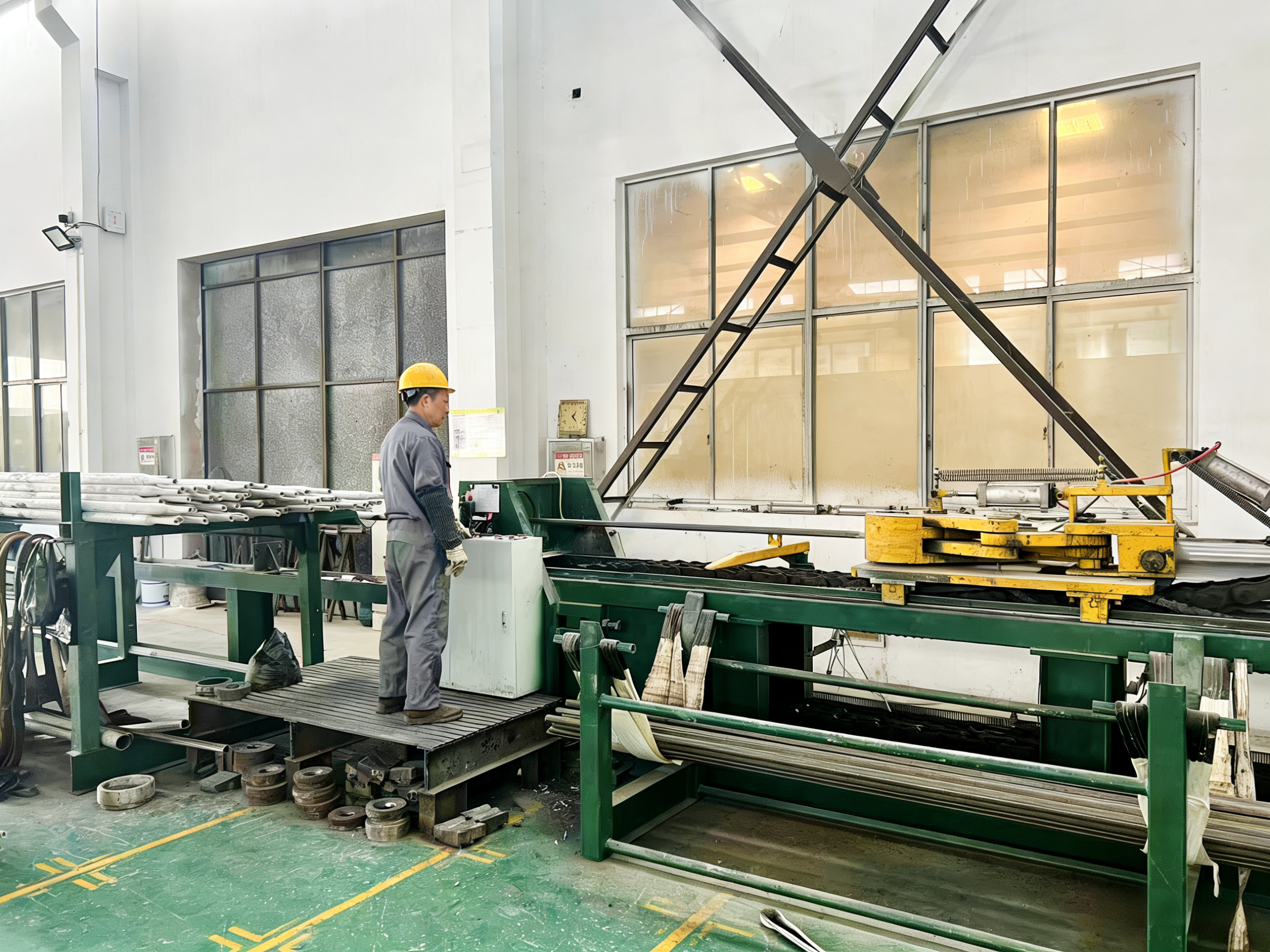
- Anneal the drawn tube. Annealing relieves the working stress introduced by drawing, which matters on a profiled section where stress concentrates at the roots.
- Straighten to control dimensional straightness. Straightness control is a compatibility requirement, not a cosmetic one: a bowed profile tube will not index cleanly into the mating hub.
- Cut to fixed length. Fixed-length cutting converts the coil or long bar into the exact lengths the component line consumes.
- Inspect. Quality control includes 100% testing, and the formal acceptance criterion for shipment is pre-packaging inspection.
- Protect and pack. Anti-rust oil is applied to the surface to control rust and corrosion risk during storage and sea freight.
- Agree the repeat-order parameters. Tolerance band, straightness, length and surface protection should be written into the supply specification so that the fifth shipment matches the first.
Use Cases in Agricultural Machinery and Automotive Parts
Star and spline profiles are chosen where a rotating tube has to transmit torque into a mating part without a welded or keyed joint.
- Agricultural drive shafts. Profile tube used along the drive line carries torque from the tractor to the implement. Profile geometry replaces keyways and reduces the number of welded joints in the assembly.
- Automotive drive shafts. Spline and star profiles are used where the shaft must slide or index while transmitting torque.
- Motorcycle and auto parts. Smaller profile sections suit components where a machined solid spline would add weight and machining cost.
- Hub and coupling fittings. The engagement faces act as the drive connection itself, which simplifies the mating part.
- Adjacent machinery applications. The same production base supplies tubes used in hydraulic cylinders, pneumatic cylinders, smart lock components, motor housings, construction machinery, mold manufacturing and power generation equipment.
Comparison: Cold-Drawn Profile Tube vs. Conventional PTO Profile Tube
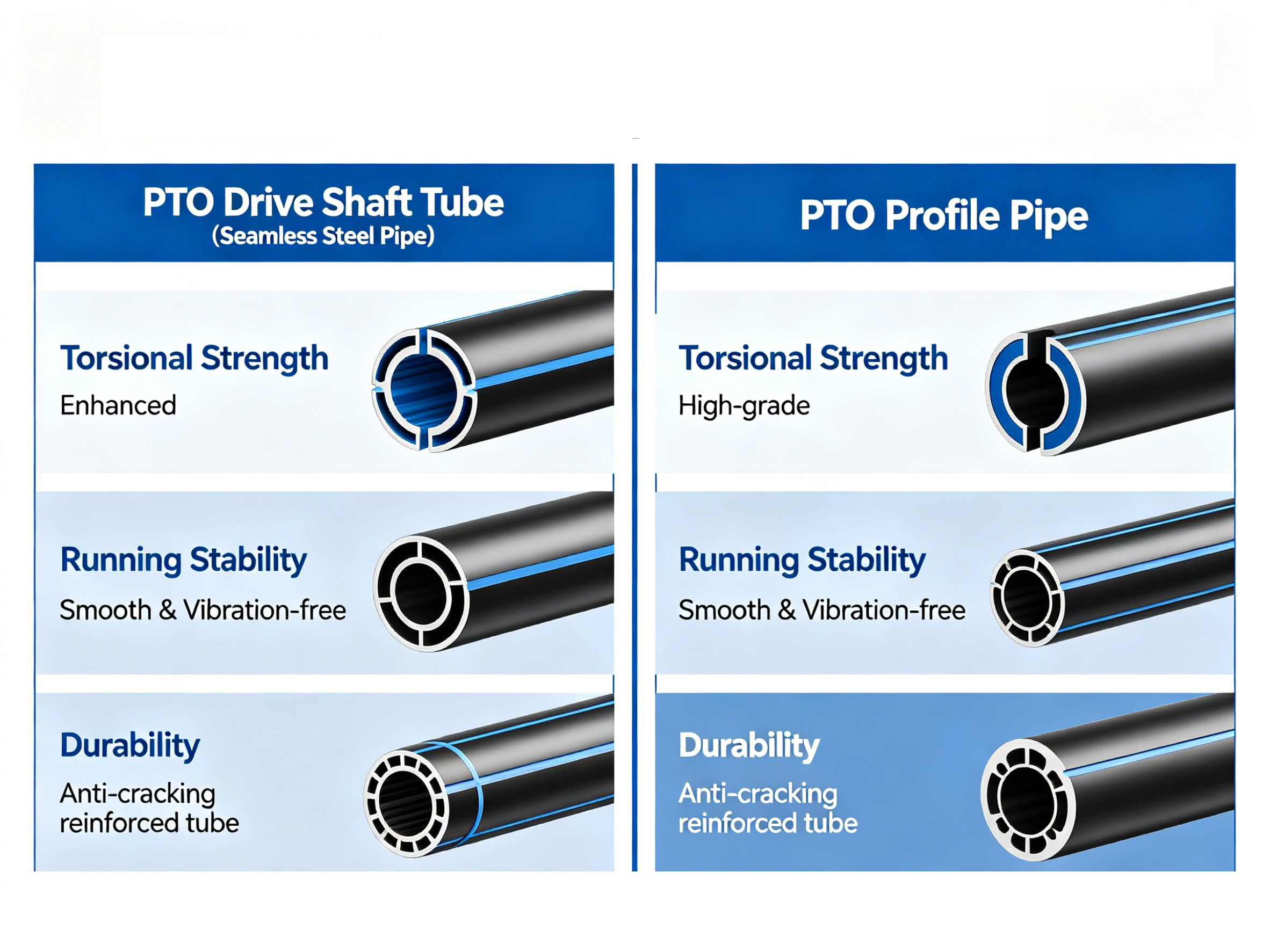
The most direct comparison in agricultural drive-line procurement is between a cold-drawn profile tube and a conventional PTO profile tube. The table below records the differences as held in the manufacturer's own comparison data for this pairing. It should be read as a supplier-stated comparison and verified against the specific application.
| Comparison criterion | Recorded difference versus conventional PTO profile tube |
|---|---|
| Torsional strength | Enhanced / high-grade |
| Running stability | Smooth and vibration-free |
| Durability | Anti-cracking reinforced tube |
| Service life | Extended by 200% – 400% |
| Purchase cost | 5% lower |
| Maintenance | Less maintenance |
| Efficiency | Tighter tolerances and higher torsional strength |
| Best-fit application | Agricultural machinery |
What to Verify Before Committing to a Long-Term Profile Supply Programme
Profile tube is rarely a one-off purchase. Once a star or spline profile is designed into a drive shaft, the same drawing is re-ordered for the life of the component, often across several years. That makes the verification list below the real decision point, not the price per ton.
- Dimensional and straightness control. Compatibility inspection through dimensional straightness control is the measure that keeps a profile indexing correctly into its mating part — the same control that prevents misfit at assembly.
- Surface protection discipline. Rust and corrosion are handled by waterproofing and anti-corrosion practice, with anti-rust oil applied to the surface before packing.
- Customisation scope. Manufacturing capability should include OEM, ODM and full customization so that a profile drawing can be adjusted as the component evolves.
- Testing and inspection. The production base referenced here runs 100% testing for quality control, with pre-packaging inspection as the acceptance criterion.
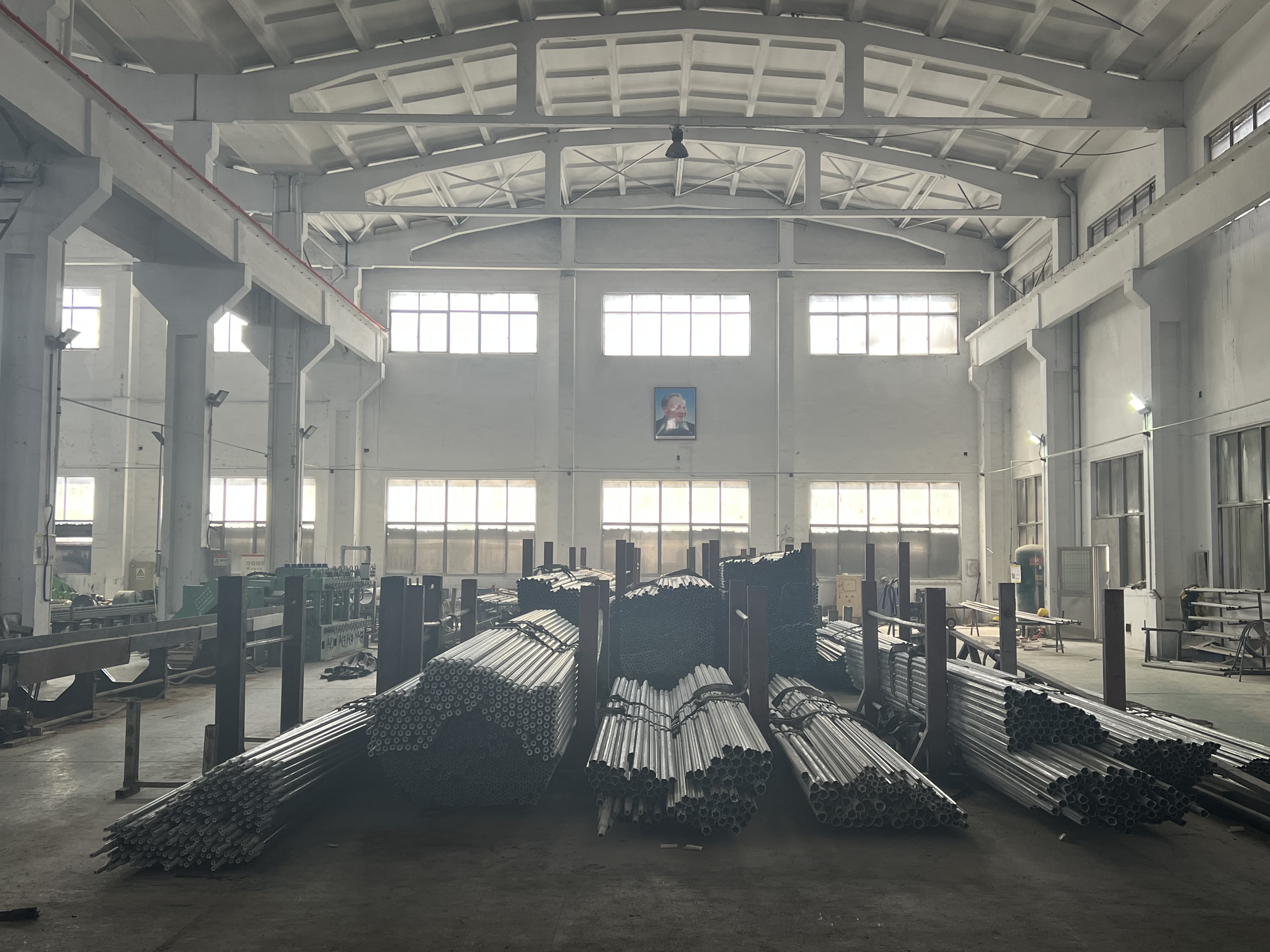
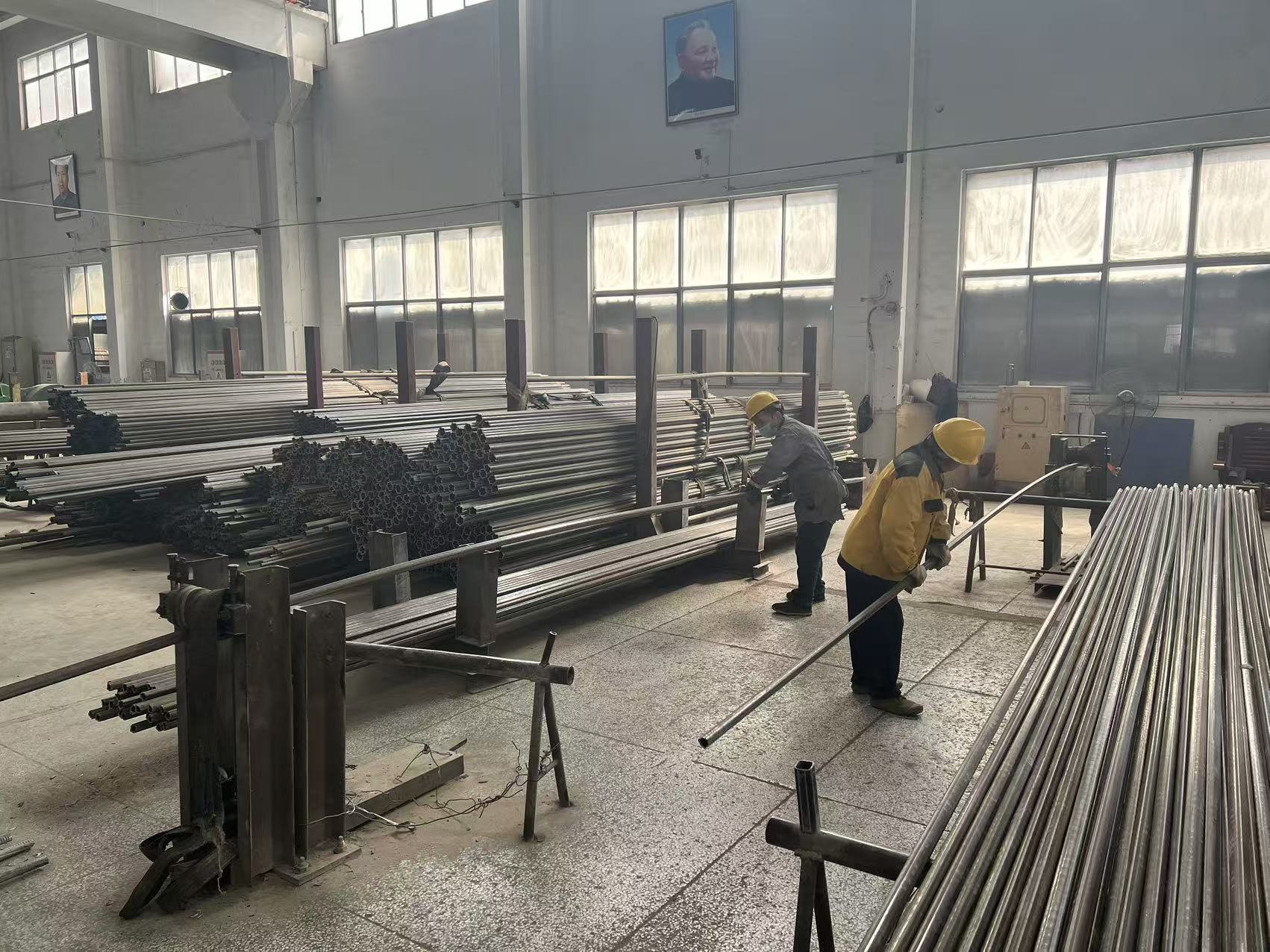
- Capacity against your schedule. The facility holds a monthly production capacity of 2,000 tons and an annual output of 20,000 tons across a 20,000 m² production base — the buffer that determines whether repeat orders hold their slot.
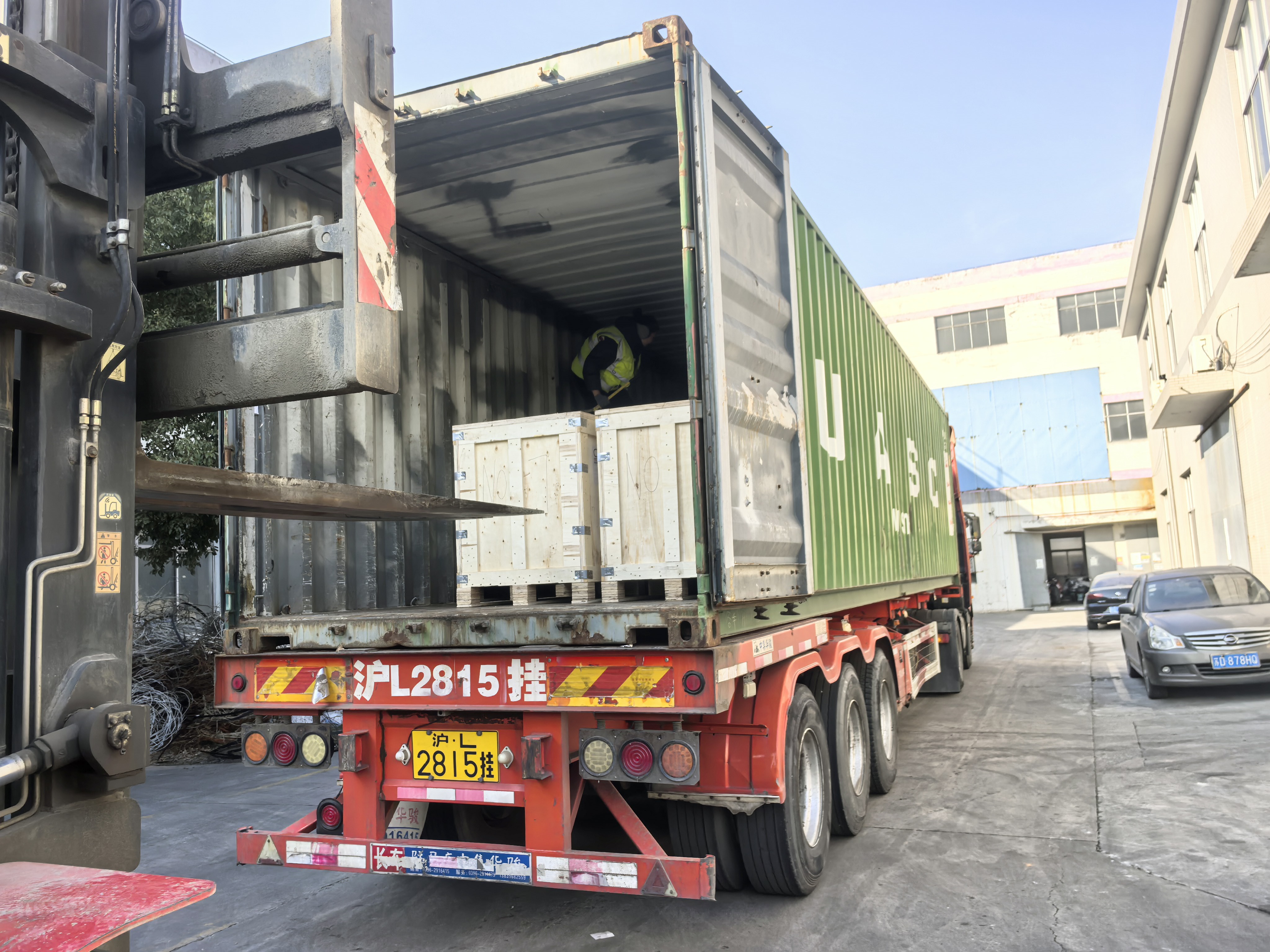
- Commercial terms. Minimum order quantity is 1T, delivery terms are FOB or CIF, and payment terms are deposit plus balance payment.
- Export experience in your market. The company exports roughly 50% of its output, with main markets in the EU, Eurasia and MENA.
Frequently Asked Questions
Which standard applies to a cold-drawn star or spline profile tube?
EN 10305-1 is the European technical delivery condition for cold-drawn seamless precision tubes and specifies outside diameters up to 380 mm together with strict dimensional tolerances. It governs the delivery condition, the tolerances and the mechanical requirements of the tube. It does not define a star or spline geometry — the profile itself is defined by the buyer's drawing. That is why a profile quotation should always reference a controlled drawing number rather than a catalogue name alone.
Can a manufacturer cold draw star, spline and other special profiles to a customer drawing?
Yes, where the producer operates a special-shaped tube line rather than only round tube. Fakesi, the tube brand of Wuxi Jiangbo Intelligent Technology, manufactures seamless steel tubes, precision steel tubes and special-shaped custom steel tubes, supported by OEM, ODM and full customization services, a monthly capacity of 2,000 tons and 100% testing for quality control. Beyond the star family, the same drawing-led process covers seamless triangle pipe, hexagon pipe, octagon pipe, oval steel pipe and lemon-shaped tube.
What are the minimum order quantity and payment terms for profile tube?
MOQ is 1T. Delivery terms are FOB or CIF. Acceptance criteria are pre-packaging inspection, and payment terms are deposit plus balance payment. For a first profile order, these terms mean the commercial risk sits mainly in the drawing definition and the inspection criterion, not in the order volume.
How is a new profile verified for fit and straightness before shipment?
Fit is controlled through compatibility inspection, with dimensional straightness as the specific production measure — the same control that prevents misfit at assembly. Straightening and fixed-length cutting are the process steps that hold those dimensions, and quality control includes 100% testing. The formal acceptance criterion before shipment is pre-packaging inspection, which is the point at which the buyer's drawing tolerances are confirmed against the finished profile.
What production capacity and support stand behind a long-term profile supply programme?
The production base covers over 20,000 m², employs a five-engineer R&D team, and holds a monthly production capacity of 2,000 tons with annual output of 20,000 tons. Roughly 50% of output is exported, with main markets in the EU, Eurasia and MENA. Surface protection is applied as anti-rust oil before packing, and orders are shipped on FOB or CIF terms with pre-packaging inspection as the acceptance criterion. Buyers starting a profile programme can request a sample or a quotation against their own drawing, and download the company brochure for the full product range.
Conclusion: Buy the Drawing, Then the Relationship
Star-shaped seamless steel pipe is best understood as a drawing-controlled product rather than a catalogue product. ST, 6-point, 8-point, 10ST and spline profiles are names for geometry, not for quality, and none of them is interchangeable between suppliers without a drawing. The specification corridor — outside diameter 1–100 mm, wall thickness 1–20 mm, cold-drawn tolerances to ±0.1 mm — sets what can be produced; the drawing sets what should be produced for a given agricultural or automotive component.
Because these profiles are re-ordered for years, the supplier decision is a long-term one. The factors that matter most are the ones that repeat: dimensional and straightness control, surface protection before shipment, an OEM and ODM route for drawing revisions, and enough capacity to hold a schedule through a seasonal peak. Commercial terms such as a 1T minimum order quantity, FOB or CIF delivery, and deposit plus balance payment are negotiable; a profile that will not index into its mating hub is not.
Get a Quote or a Sample Against Your Profile Drawing
Send the profile drawing, the material grade and the annual volume, and Fakesi (Wuxi Jiangbo Intelligent Technology Co., Ltd.) will come back with a feasibility assessment, a quotation on FOB or CIF terms and a sample plan for validation.
Email: jiangjianfan@wxjiangbo.com | WhatsApp: +86 13967785843 | Website: wxjiangbo.com
Download the full product brochure: Fakesi Seamless & Special-Shaped Steel Tube Catalogue (PDF)