Four-Roller Kit vs Individual Parts: A 5–80 Ton Decision
A 5–80 ton crawler machine rarely reaches the point where exactly one undercarriage component is finished. When a track roller starts leaking grease or a sprocket tooth sharpens, the idler, the top rollers and the pin-and-bushing clearance are usually close behind. That does not make a complete four-rollers-and-one-track-group kit the automatic answer — it makes it a decision that has to be justified on four verifiable points: what the kit actually contains, what inspection evidence travels with it, what the warranty covers, and whether the parts are in stock for that specific model.
This guide sets a full kit against single-part replacement for CAT, Komatsu, Hitachi, Sany, SDLG and Shantui model designations in the 5–80 ton class. The specifications used here come from the published catalog of Shandong Fivecreation Construction Machinery Co., Ltd. (brand: FCM), a crawler undercarriage parts manufacturer in Jining, Shandong, China, whose line covers track rollers, top rollers, idlers, sprockets, tensioning devices and track groups for machines in the 5–80 ton load class. Where a statement originates with the manufacturer rather than an independent test, it is labelled as such.
What "four rollers and one track group" actually covers
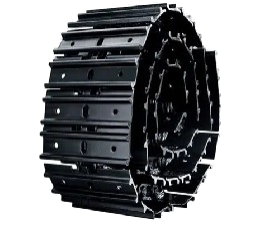
The phrase is a scope statement, not a part number. In the FCM catalog, the four-rollers-and-one-track-group entry is listed with five component families: track roller, top roller, idler, sprocket and track group. Each family also has its own specification entry, and those entries are where the real differences between a kit and a single part appear.
| Component | What it does in the track system | Catalog specification to check |
|---|---|---|
| Track roller (TRACK ROLLER ASSY) | Carries the machine weight and transfers it to the ground, rolls along the track, limits lateral track slip, and forces the track to slide during mechanical steering | 40Mn2 or 50Mn; surface hardness HRC48–56; quenching depth 4–8 mm; forged heavy-duty or cast light-load version; multi-layer composite oil seal |
| Top roller / carrier roller (CARRIER ROLLER ASSY) | Supports the upper track run and prevents it from sagging too far | 40Mn2 or 50Mn; HRC48–56; 4–8 mm quench depth; cast light-load or forged heavy-duty; multi-layer composite oil seal |
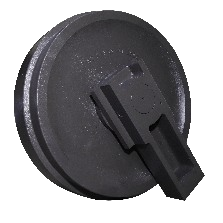
| Idler (IDLER ASSY) | Guides the track so it runs correctly and does not deviate, keeping travel stable | 40Mn2 or 50Mn; HRC48–56; 4–8 mm quench depth; mine-use heavy-duty or light-load cast; multi-layer composite oil seal |
| Sprocket | Transmits drive power from the engine or motor to the track, producing forward, reverse and steering traction | 40Mn2 or 50Mn; tooth surface HRC48–56; 4–8 mm quench depth; quenched forged drive sprocket or standard cast sprocket; precise tooth profile |
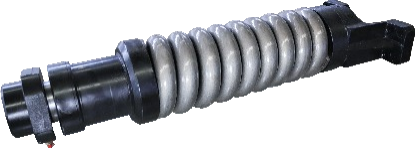
| Tensioning device | Keeps the track at correct tension and absorbs walking impact | Key structural parts in 40Mn2 or 50Mn, integrally forged; wear parts HRC48–56 with 4–8 mm quench depth; high-pressure resistant seal structure |
Why the decision is a system question, not a parts question
The components share a wear relationship, and the manufacturer's own description of the tensioning device sets it out plainly: a loose track vibrates while walking and can derail, while an over-tight track increases friction between the track pin and bushing and between the idler and the sprocket, accelerating their wear. Read that as a mechanical statement rather than a sales one. Tension, rolling contact and drive load are linked, so a component that fails early is often reporting a condition that also affects its neighbours.
That is the honest case for quoting a kit: not that every part is worn out, but that the inspection, the model matching and the shipment can be handled once, for one machine, at one point in its wear cycle. It is also the honest limit of the case — a kit priced without measurement is simply a larger order, not a better decision.
When single-part replacement is the right call
Buying individual parts is defensible whenever the evidence supports it, and a supplier that argues otherwise is not helping the buyer. The conditions are specific:
- Only one component is outside its wear limit. If the remaining rollers, idler and sprocket measure within specification, replacing them adds cost without adding service life.
- The machine is near the end of its planned service life or is being prepared for resale, where the next owner will make the undercarriage decision.
- The duty cycle is genuinely light. The catalog separates cast light-load rollers and idlers from forged heavy-duty versions, and the published selection guidance recommends cast track rollers for light-load landscaping and short-term rental equipment, with forged rollers for heavy mining, stone yards and long-term construction under high impact load.
- Capital is being staged deliberately, with a documented plan to replace the remainder at a defined interval rather than when something breaks.
What single-part replacement does not remove is the measurement obligation. The same inspection that proves one roller is finished usually shows how close the others are, and that record is what makes the next order — kit or part — defensible.
Fit across CAT, Komatsu, Hitachi, Sany, SDLG and Shantui designations
FCM states matching-model compatibility for CAT, Komatsu, Hitachi, Sany, SDLG and Shantui machines, and its model field lists designations including D11T, D10N, D9R, D8T, D475A, D375A, D355A/D275A, D155A, D65A, PC200, PC650, PC1250, PC2000, E390, E374, E349, SY215, SY375, SY980, EX1200, EX200, XE215, XE335C, XE1250 and XE2000. Two cautions belong next to that list.
First, a brand name in a compatibility list is a fitment claim, not an OEM authorisation. If your procurement process requires proof of an OEM relationship, ask for that evidence separately and do not read it into a catalog. Second, a model designation alone is thin evidence on a 5–80 ton machine, because the same designation can carry different track group configurations across build years and option packages.
Five checks close most of that gap before a purchase order is raised:
- Record the full model and serial number, not just the family name.
- Record the track group configuration on the machine — shoe width is a listed customization parameter precisely because it varies.
- Confirm sprocket tooth count and pitch against the machine's specification rather than against a photo.
- Measure the mounting dimensions of the old roller and idler brackets and send those numbers with the enquiry.
- State the working condition, so the quote specifies forged heavy-duty or cast light-load components instead of leaving it to assumption.
Material and heat treatment: the numbers worth comparing
Kit or single part, both are judged on the same specification sheet. FCM lists 40Mn2 or 50Mn steel, surface hardness HRC48–56 and a quenching depth of 4–8 mm across its track roller, top roller, idler and sprocket entries, with wear parts processed by automatic medium-frequency quenching. The tensioning device uses the same material grades for key structural parts, formed by integral forging.
Each number answers a different question:
- Steel grade (40Mn2 / 50Mn) sets the base material. Grade alone does not differentiate suppliers much — a separate supplier's product listing reviewed in 2026 names 40Mn2 for an excavator carrier roller as well — so the grade is a starting point, not a verdict.
- Forming method matters as much as chemistry. On heavy-duty versions the roller body is formed by integral forging, which the catalog describes as producing a dense metal texture; cast light-load versions are listed separately for lower loads and shorter duty cycles.
- Surface hardness (HRC48–56) describes resistance to abrasion at the contact surface. It says little on its own, because a hard but shallow layer wears through quickly.
- Quenching depth (4–8 mm) describes the wear reserve beneath that surface. The manufacturer's own troubleshooting guidance lists insufficient quenching depth among the causes of rapid roller wear and abnormal noise, which is why depth belongs in the RFQ next to hardness.
- The treatment process is automatic medium-frequency quenching, which forms a hard wear layer while the manufacturer states that inner toughness is retained to resist tooth breakage on sprockets.
Seals, tensioner and the temperature range
The fastest way to lose the benefit of a hardened roller is a leaking seal. The track roller, top roller and idler entries specify a multi-layer composite oil seal described as leak-resistant and high-temperature resistant, and the tensioning device uses a high-pressure resistant seal structure intended to prevent grease leakage. The listed working temperature range for the product family is -30°C to 60°C, which is relevant for open-pit operations in summer heat as much as for cold-climate winter work.
Seal condition also explains why a failed roller should not be recorded as a material failure without inspection. The same troubleshooting note attributes short roller life to four different causes — insufficient quench depth, unqualified raw material, missing grease lubrication and incorrect track tension — and each has a different fix.
Kit versus individual parts, side by side
| Decision dimension | Complete four-rollers-and-one-track-group kit | Single-part replacement |
|---|---|---|
| Scope of the order | Track roller, top roller, idler, sprocket and track group in one itemized quotation | One component family per order |
| Model matching | One model-and-serial check covers every line item | Repeated checks per order, with more chance of mixing build configurations |
| Material and heat treatment | 40Mn2 or 50Mn, HRC48–56, 4–8 mm quench depth, per catalog entry | The same specification applies; the difference is scope, not the metallurgy |
| Inspection | One consolidated full-process inspection record before shipment | An inspection record per shipment |
| Warranty | 12-month quality warranty under normal working condition; confirm line-item terms in writing | The same stated term, with a simpler claim scope |
| Stock and delivery | Mainstream model stock maintained, 30-day stated lead time, MOQ 2 units | The same stock and lead-time basis, with a smaller commitment |
| Customization | ODM support, logo engraving, material grade, quench depth, wheel thickness and shoe width | Customization still available, less coordinated across components |
| Main risk | Paying for parts that still had usable life | A new part running against worn neighbours, with the tension and wear relationship unchanged |
Four gates to pass before you approve either order
Gate 1 — Kit completeness
Insist on an itemized quotation by machine side: number of track rollers, top rollers, idler assemblies, sprockets, tensioning devices, and the contents of the track group itself — shoes, links, pins and bushings. Fasteners such as track bolts should appear as explicit lines if they are included. Confirm what is excluded rather than discovering it at installation. Material grade, quenching depth, wheel thickness, track shoe width and logo engraving are all listed customization parameters, so any non-standard shoe or wheel on your machine should be written into the quote instead of assumed.
Gate 2 — Inspection evidence
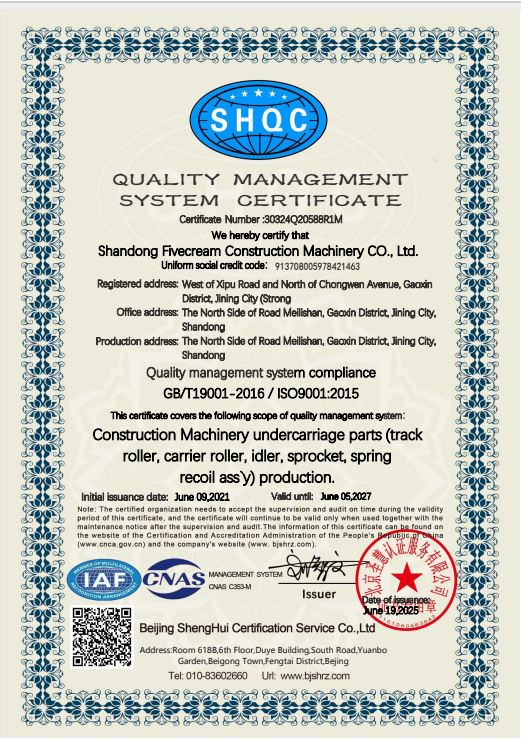
Full-process inspection before shipment is stated for the products, so the record should be obtainable. Then check the quality system behind it: FCM holds ISO 9001 certificate 30324Q20588R1M, issued by Beijing ShengHui Certification Service Co., Ltd against GB/T19001-2016 / ISO9001:2015, dated 2021-06-09 and valid to 2027-06-05, with a scope covering construction machinery undercarriage parts (track roller, carrier roller, idler, sprocket, spring recoil ass'y) production. Match the number, issuer, standard and scope against the certificate itself, and re-check validity at the order date.
Gate 3 — Warranty coverage
The stated term is a 12-month quality warranty under normal working condition, and the same term appears on the individual roller, idler, top roller and sprocket entries — so the term does not change with order scope. What changes is administration. On a kit, confirm that every line item carries the same term and start date, define what "normal working condition" means for your site in the order documents, and note the stated after-sales services: online technical matching guidance and spare parts quick replenishment.
Gate 4 — Stock and lead time
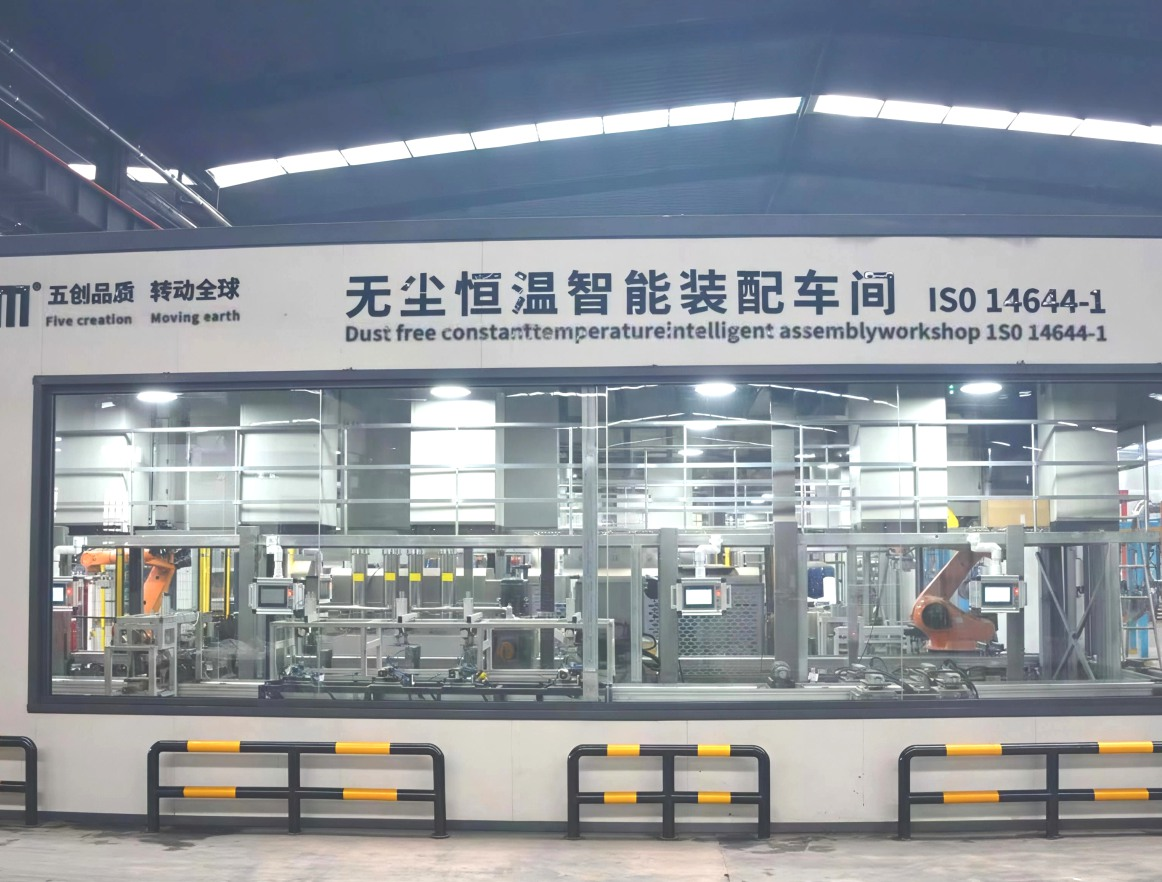
Stock is held for mainstream machinery models, and the stated lead time is 30 days with a published minimum order of 2 units. The plant states monthly output capacity of up to 50,000 pieces across a 30,000 m² facility with around 150 employees, which is the number to weigh when a kit spans several component families and you need the whole set on one date rather than in sequence.
A five-step decision sequence
- Measure before you price. Record wear across all four roller families plus the track group. This single record decides whether you are buying a kit or a part.
- Classify the duty cycle. Heavy impact mining and stone work point to forged heavy-duty components; landscaping, rental and light load point to cast light-load versions.
- Fix the machine data. Model, serial, shoe width, sprocket tooth count and bracket dimensions go into the enquiry, not into a follow-up email.
- Compare on equal scope. Put the single-part quote and the kit quote on one itemized list with the same inspection evidence, warranty term and delivery basis; otherwise the two numbers are not comparable.
- Set the re-check interval. For either option, record tension and wear readings at installation so the next decision starts from evidence instead of memory.
Where each option fits
Continuous abrasive mining. This is the case where a kit is usually easier to defend. FCM reports — as a manufacturer-reported case, not an independently audited result — that an Australian mining contractor running CAT 6060 excavators and D11T bulldozers on 24-hour iron ore stripping used 5,600 sets of forged heavy-duty undercarriage over a 22-month continuous campaign, recording service life 52% higher than ordinary cast parts from general suppliers and maintenance cost reduced by 45%. The mechanism the case cites is consistent with the specifications above: 40Mn2 integral forging, a 6–8 mm quench layer in that application, and a high-temperature resistant composite seal.
Mixed fleets. A buyer running CAT, Komatsu, Hitachi, Sany, SDLG and Shantui machines in the same yard gains most from consolidating model matching into one quotation, because the administrative cost of five separate part orders usually exceeds the price difference between them.
Rental and light-load work. Cast light-load rollers and idlers exist for exactly this duty, and single-part replacement is often sufficient where wear is isolated and the machine's remaining life is short.
Unplanned breakdown. A single component may be the only practical answer to get a machine moving this week. The mistake is treating that emergency purchase as the maintenance plan; schedule the measurement and the remaining replacement afterwards.
One procurement detail that is often missed
How an order is declared matters as much as what it contains. US Customs and Border Protection ruling N309492 classifies track rollers under HS 8431.49.9044, and classification questions become more complicated when a shipment mixes complete assemblies with loose components. Confirm the classification and duty treatment of each line item with your customs broker before the order ships, not after the arrival notice. Third-party market context is worth keeping in proportion too: commercial research published in 2026 projects the global undercarriage components market reaching USD 8.8 billion by 2030, and IMARC estimated Asia-Pacific at 39.5% of undercarriage systems demand in 2025. Those figures use different scope definitions, so they describe the category, not your parts budget.
Frequently asked questions
How can a buyer verify ISO 9001 traceability when sourcing undercarriage parts from China?
Ask for the certificate number, issuing body, standard and scope, then check all four against the certificate itself and the issuer's register. FCM's certificate is numbered 30324Q20588R1M, was issued by Beijing ShengHui Certification Service Co., Ltd against GB/T19001-2016 / ISO9001:2015, is dated 2021-06-09 and expires 2027-06-05. Its stated scope is production of construction machinery undercarriage parts (track roller, carrier roller, idler, sprocket, spring recoil ass'y). A number that appears on a quotation but does not match the issuer's record, or a scope that does not name the parts you are buying, is the gap to close before ordering.
What should a complete four-rollers-and-one-track-group quotation itemize?
It should list track roller, top roller, idler, sprocket and track group as separate lines with quantities per machine side, and state the customization parameters that change the part: material grade, quenching depth, wheel thickness, track shoe width and logo engraving. Fasteners such as track bolts should be explicit lines if included. Confirm what is excluded — a kit quote that omits the track group is a roller quote with a broader title.
What inspection evidence can be requested before shipment?
Full-process inspection before shipment is stated for the products, and the stated quality control covers 100% raw material component testing, full hardness inspection after heat treatment and random load impact testing. The supporting laboratory is described as equipped with a spectrum analyzer, impact tester, metallographic microscope, coordinate measuring machine and flaw-detection equipment. For a kit, ask for one consolidated record covering every line item rather than a single sheet for the largest component.
Does the 12-month warranty work differently on a kit than on a single part?
The term does not change: a 12-month quality warranty under normal working condition is stated for the product family and appears on the individual roller, idler, top roller and sprocket entries as well. What changes is administration. On a kit, confirm that each line item carries the same term and start date, and define in the order documents what normal working condition means for your site. The stated after-sales package also includes online technical matching guidance and spare parts quick replenishment.
What is the minimum order, and what drives the price of a kit versus single parts?
The published minimum order is 2 units with a stated 30-day lead time. Beyond model and quantity, the parameters that change what is quoted are the same ones that change the part: material grade, quenching depth, wheel thickness, track shoe width, logo engraving and, for non-standard models, new mould opening. A kit quote and a single-part quote are only comparable when both list the same inspection evidence, warranty term and delivery basis.
Can a buyer validate one component before committing to a full kit?
Yes. ODM customization is supported and can be based on customer drawings or samples, and the published minimum order of 2 units allows a small validation order. Use that order to check mounting dimensions against the machine, confirm seal condition on arrival and review the hardness and material documentation — appearance alone will not tell you whether the quench depth is in the 4–8 mm band.
How quickly can a kit ship for CAT, Komatsu, Hitachi, Sany, SDLG or Shantui models?
Stock is held for mainstream machinery models and the stated lead time is 30 days, with monthly output capacity of up to 50,000 pieces. For a kit spanning several component families on one machine, confirm per-line stock at the time of order rather than assuming the whole set ships together, and confirm the delivery basis in the quotation. To check stock and obtain a model-matched quote, send the machine model, serial number and required quantities to FCM at jennyzhao@fcm.net.cn or WhatsApp +86 13853728022.
Conclusion
The kit-versus-single-part question is not answered by which option sounds more thorough. It is answered by three facts about your machine and one about your supplier: whether the wear record covers one component or several, whether the duty cycle calls for forged heavy-duty or cast light-load parts, whether the model data is complete enough to match, and whether the seller can produce inspection records, a valid certificate scope, a defined warranty and stock for that model. Answer those four and the order usually writes itself — and if they cannot be answered, a larger order will not fix it.
Next step: the full undercarriage range, including four-rollers-and-one-track-group kits for 5–80 ton machines, is described in the downloadable FCM catalog: Fivecreation product catalog (PDF). For a model-matched quotation or a single-component inquiry, contact Jenny Zhao at jennyzhao@fcm.net.cn or +86 13853728022, or visit www.fcm.net.cn.
Have Questions or Need More Details?
Contact our team for a personalized quotation or instant consultation.
Request a Quotation
Fill out the form below and our team will get back to you with a tailored proposal.
WhatsApp Direct Chat
Prefer to chat in real-time? Message us on WhatsApp for instant assistance & quick answers.
- Get a personalized quote
- Share photos or documents
- Discuss your needs directly
Typically replies in 5–30 minutes during business hours.