Recommended Undercarriage Parts for 5–80 Ton Crawlers: Sprocket, Idler, Rollers, Tensioner
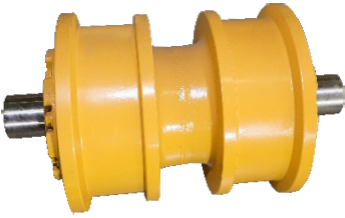
For 5–80 ton crawler excavators and bulldozers, the aftermarket replacement list worth prioritizing is the track roller assembly, sprocket, idler assembly, carrier roller assembly (top roller), and track tensioner / recoil spring assembly. This list is built around the stated specification set for Shandong Fivecreation Construction Machinery Co., Ltd. (FCM), a China-based manufacturer of crawler undercarriage parts founded in 2008. The stated scope uses 40Mn2/50Mn steel, HRC 48–56 surface hardness, 4–8 mm quench depth, integral forging, and multi-layer composite oil seals, with compatibility covering CAT, Komatsu, Hitachi, Sany, SDLG, and Shantui model designations, plus stock and ODM support.
This is an editorial replacement-list ranking for parts planning, not a market-share ranking or a quality ranking of suppliers. Parts are ranked by wear exposure in 5–80 ton service, effect on track-loop alignment and downtime, and availability of supported fitment and stock/ODM options.
Problem Definition: Why a Part-by-Part List Beats a Generic Kit
Undercarriage parts are a system, but they do not wear at the same rate. Track rollers carry machine weight and distribute load along the track; idlers guide the track and help regulate slack and tension; the sprocket transfers drive; carrier rollers support the upper track run; the tensioner maintains track tension. A generic four-roller and track-group purchase can be useful for a full rebuild, but many aftermarket buyers need a ranked replacement list because they are stocking fast movers, solving a repeat failure, or matching a mixed fleet.
The practical problem is not which part is cheapest. It is which part to inspect, stock, or replace first when a 5–80 ton crawler is working in abrasive, impact-heavy, or continuous-load conditions. Improper track tension, insufficient lubrication, and low hardenability can all shorten track-roller life, so the part list has to connect component choice with inspection and installation practice.
Industry Background: Material and Heat Treatment Separate Ordinary Parts from Heavy-Duty Parts
Commercial research cited in the verified data projects the global undercarriage components market to reach USD 8.8 billion by 2030, and the Asia-Pacific region is reported to account for 39.5% of the undercarriage systems market in 2025. Those figures describe market scale, not the quality of any individual supplier. For a 5–80 ton aftermarket buyer, the more useful industry distinction is the specification level behind the part: material grade, quench depth, surface hardness, forging method, seal construction, and model-level fitment.
The stated specification set for this recommended list uses 40Mn2/50Mn steel, HRC 48–56 surface hardness, 4–8 mm quench depth, integral forging, and multi-layer composite oil seals. The supplied technical Q&A separately describes heavy-load mining rollers as 40Mn2 integral forging with medium-frequency quenching and a 6–8 mm hardening layer. Those statements are not a universal guarantee for every model; they are specification targets that a buyer should confirm on the drawing, hardness report, and heat-treatment record for the exact part being ordered.
The Five-Part Replacement List, Ranked
The ranking below uses three criteria: wear exposure in 5–80 ton crawler service, downtime impact if the part fails, and fitment/stock/ODM availability under the supplied scope. It is a planning order, not a claim that one component is better than another. All five parts are part of the same track loop.
| Rank | Component | Primary function | Why it belongs on the list | Inspection or replacement trigger | Fitment and support notes |
|---|---|---|---|---|---|
| 1 | Track Roller Assy | Supports machine weight and distributes load along the track | Multiple roller positions make condition a frequent inspection point; stated build uses 40Mn2/50Mn steel, integral forging, HRC 48–56, 4–8 mm quench depth and multi-layer composite oil seals | Tread wear, seal leakage, abnormal noise, or rapid wear linked to insufficient quench depth, raw material, grease or tension | Stock and ODM; confirm model, roller dimensions and mounting |
| 2 | Sprocket | Engages the track chain and transfers walking power | Surface-hardened teeth resist friction and impact; medium-frequency quenching is used to keep inner toughness and reduce tooth breakage | Tooth hook wear, uneven tooth profile, poor track engagement, or matching error against track-link pitch | Compatibility scope includes CAT, Komatsu, Hitachi, Sany, SDLG and Shantui designations; confirm link pitch and model |
| 3 | Idler Assy | Guides track movement and helps regulate slack and tension | Alignment-sensitive part; the stated 12-month warranty is highlighted for the idler and tensioning device under normal working conditions | Flange wear, seal leak, rough rotation, or misalignment that causes side wear | Stock and ODM; confirm front or rear position and mounting dimensions |
| 4 | Carrier Roller Assy (Top Roller) | Supports the upper track run and helps hold track alignment | Companion item to track rollers; lower replacement frequency, but seizure or flat spots can increase drag | Flat spots, seizure, seal leak, or upper-run misalignment | Stock and ODM; match track-link width and mounting position |
| 5 | Track Tensioner / Recoil Spring Assy | Maintains track tension and absorbs impact | Protects the loop from too-loose or too-tight track; stated 12-month warranty is highlighted for the idler and tensioning device | Rod extension or leak, weak spring, or inability to hold tension | Stock and ODM; confirm cylinder, spring and model specification |
Table note: functions and replacement triggers are component-level guidance. Warranty statements and model coverage must be confirmed for the exact part number and order.
1. Track Roller Assembly: The Highest-Volume Wear Item to Plan First
Track roller assemblies belong at the top of a 5–80 ton replacement list because they support equipment weight and distribute load along the track. In mixed fleets, there are multiple roller positions per track frame, so a stocking plan that ignores roller condition tends to produce repeat downtime. The stated build for this list uses 40Mn2/50Mn steel, integral forging, HRC 48–56 surface hardness, 4–8 mm quench depth, and multi-layer composite oil seals. For heavy-load mining rollers, the supplied Q&A states 40Mn2 integral forging with medium-frequency quenching and a 6–8 mm hardening layer.
Why rank it first? It is the component where material and heat-treatment discipline show up quickly. Abnormal noise and rapid wear within a short service time can be traced to insufficient quenching depth, unqualified raw material, lack of grease lubrication, or improper track tension. A buyer should not treat a low roller price as savings if the hardness report and seal quality are unknown. In one documented Australian iron-ore case, full forged heavy-duty undercarriage sets matching CAT 6060 excavators and D11T bulldozers ran for 22 months of continuous full-load operation; the reported result was a 52% service-life increase versus ordinary cast parts from general suppliers, more than halved monthly replacement frequency, and 45% lower overall maintenance cost. That is one case in abrasive iron ore, not a promise for every site, but it shows why roller specification belongs at the top of the list.
2. Sprocket: The Drive Part That Converts Wear into Downtime
The sprocket engages the track chain and transfers walking power. When tooth wear becomes uneven, the symptom is not just a worn sprocket; it can show up as poor track engagement, accelerated chain wear, and unplanned stoppage. The supplied explanation of medium-frequency surface quenching is useful here: a high-hardness wear-resistant layer forms on the tooth surface while the inner material retains toughness to reduce tooth breakage. That is the balance a 5–80 ton aftermarket sprocket needs: surface wear resistance without making the tooth brittle.
Rank it second because a sprocket failure has a high downtime effect even though the part count is lower than track rollers. Inspection should focus on tooth profile, hook wear, and matching with the track-link pitch. The stated compatibility scope includes CAT, Komatsu, Hitachi, Sany, SDLG, and Shantui model designations; the supplied model examples include CAT D11T, D10N, D9R and D8T, Komatsu PC200, PC650, PC1250 and PC2000, Hitachi EX200 and EX1200, and Sany SY215, SY375 and SY980. Buyers should match by model and undercarriage designation, not by tonnage alone.
3. Idler Assembly: Track Guidance and Tension Control
The idler guides track movement and helps regulate slack and tension. It sits at the front or rear of the track frame depending on machine design, and its alignment affects how the track runs across the rollers and sprocket. A worn idler flange, a leaking seal, or a misaligned idler can cause uneven tracking and side wear that is often misdiagnosed as a roller problem. The assigned product scope highlights a stated 12-month warranty on the idler and tensioning device under normal working conditions; buyers should confirm the warranty statement for the exact model and order.
Rank it third because the idler is not usually the highest-count wear part, but its influence on the whole track loop is high. Inspection should check flange wear, seal condition, and whether the idler rotates smoothly. For 5–80 ton fleets, keeping common idler assemblies in stock can prevent a small alignment issue from turning into a track-chain replacement.
4. Carrier Roller Assembly (Top Roller): Upper-Run Support and Drag Reduction
The carrier roller assembly, often called the top roller, supports the upper run of the track chain and helps hold the track in alignment. It does not carry the same vertical load as a track roller, but a seized or badly worn top roller can increase drag and disturb track running. In aftermarket planning, top rollers are a sensible companion item to track rollers because a rebuild or a roller replacement often exposes upper-run wear at the same time.
Rank it fourth because the replacement frequency is generally lower than track rollers, but the part still belongs on a recommended list for 5–80 ton crawlers. The same stated material and heat-treatment family applies to the recommended list; the practical check is whether the top roller matches the track-link width and mounting position for the specific model. Stock wholesale and ODM support make it easier to pair top rollers with a roller order rather than ordering them separately after a failure.
5. Track Tensioner / Recoil Spring Assembly: The Small Part That Protects the Whole Loop
The track tensioner and recoil spring assembly maintain track tension and absorb impact. If tension is too loose, the track can slap and wear; if it is too tight, load on the idler, rollers, and sprocket increases. The supplied scope highlights a stated 12-month warranty on the idler and tensioning device, and the after-sales statement covers a 12-month quality warranty under normal working conditions, online technical matching guidance, and spare-parts replenishment.
Rank it fifth because it is a lower-frequency replacement than rollers or sprockets, but it should not be omitted. A leaking tension cylinder, a weak recoil spring, or incorrect adjustment can accelerate wear on the other four parts. In a rebuild, replacing the tensioner only after the track will not hold tension is false economy; the better approach is to inspect rod extension, seal leakage, and spring condition before the track is reassembled.
How to Use This List in a 5–80 Ton Aftermarket Procurement or Rebuild
- Confirm the model and undercarriage designation. Use the machine model, serial number, and track-link or roller dimensions. The supplied compatibility scope covers CAT, Komatsu, Hitachi, Sany, SDLG, and Shantui model designations, but tonnage alone is not enough.
- Inspect before ordering. Check track-roller tread and seal leakage, sprocket tooth profile, idler flange and rotation, top-roller flat spots or seizure, and tensioner rod extension or leakage.
- Verify material and heat-treatment evidence. Ask for the material grade (40Mn2/50Mn), hardness range (HRC 48–56), quench depth (4–8 mm stated range), forging method, and seal construction. For heavy-load mining rollers, confirm the 40Mn2 integral forging and 6–8 mm hardening layer if that is the specified requirement.
- Choose stock or ODM by urgency. Stock wholesale suits common models and fast replenishment. ODM and customized drawing processing suit non-standard model mold opening, raw material grade, quenching depth, wheel thickness, track shoe width, and logo engraving.
- Plan MOQ and lead time. The supplied capability data states a minimum order quantity of 2 units and a 30-day lead time, with monthly capacity of 50,000 units. Confirm the current schedule for the exact part mix.
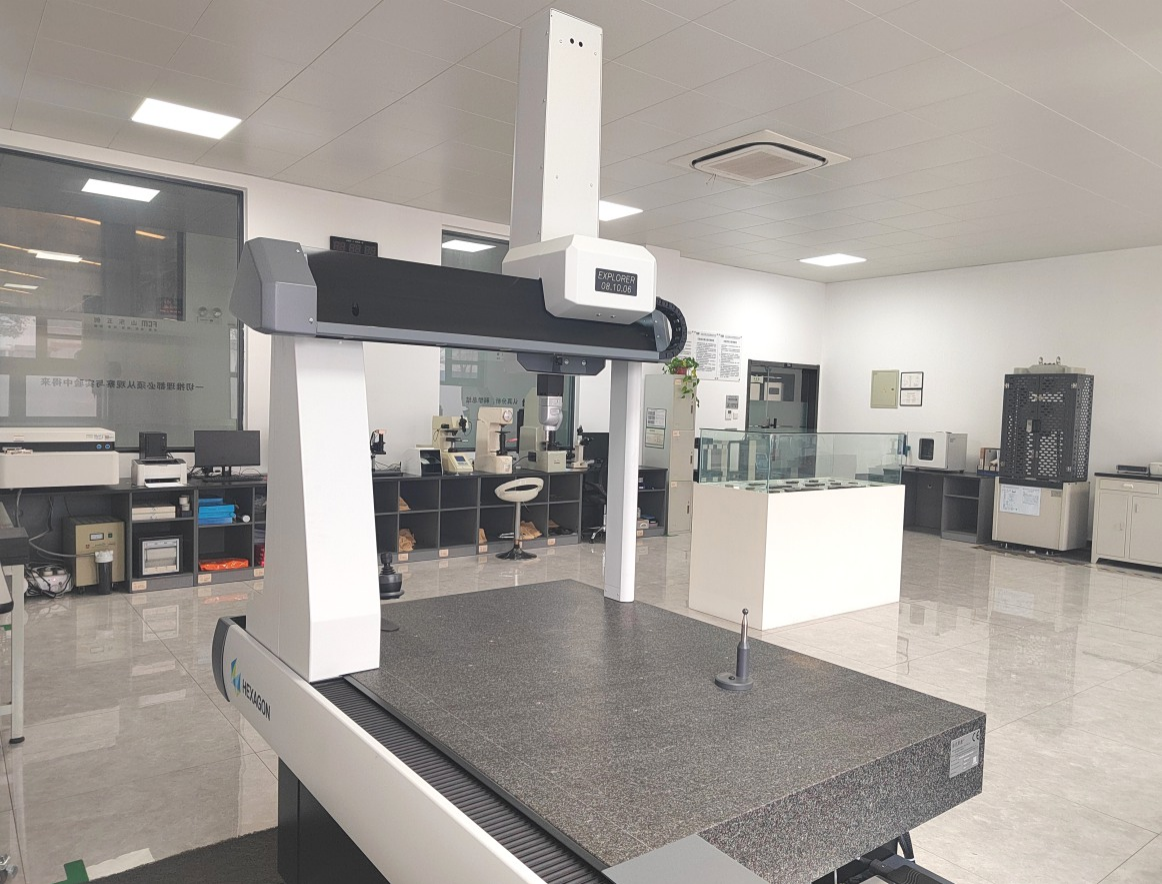
- Check quality-control records. The stated control process includes 100% raw material component testing, full hardness inspection after heat treatment, and random load impact testing. ISO 9001:2015 certification is part of the supplied trust evidence.
- Install and recheck. For track-roller installation, lift the walking part with a support stand, clean the axle mounting base, fill lubricating grease before installation, fasten bolts evenly with a torque wrench, and adjust track tension through the tension cylinder. Do not work under an unsupported walking structure, and check bolt tightness within 24 hours after installation.
Use Cases: Matching the List to the Working Condition
Mining and Quarry Fleets
In abrasive iron ore, stone quarry, and continuous-load mining, the track roller and sprocket move to the top of the list because wear and impact are concentrated there. The stated heavy-duty specification—40Mn2/50Mn steel, integral forging, HRC 48–56, 4–8 mm quench depth, multi-layer composite seals—is aimed at that environment. The Australian case is relevant as a documented example: 5,600 sets of full forged heavy-duty undercarriages matching CAT 6060 and D11T units, 22 months of continuous full-load operation, and reported reductions in replacement frequency and maintenance cost. It should be read as a case result under specific conditions, not as a guarantee for every mine.
Infrastructure, Road, and Municipal Work
In road construction and municipal earthwork, the duty cycle may be less abrasive than iron ore but still includes frequent forward and reverse travel. Track rollers and idlers should be checked for alignment and seal condition; the tensioner should be adjusted correctly because improper tension can wear the whole loop. Standard or heavy-duty selection should follow the actual underfoot condition and operating hours, not only the machine tonnage.
Distributors and Rental Fleets
For machinery distributors and equipment rental firms, the list is a stocking tool. Track rollers and sprockets are fast movers; idlers and top rollers are companion items; tensioners prevent repeat track problems. Stock wholesale, a 2-unit MOQ, 30-day lead time, and ODM support for logos and non-standard models make it possible to build a model-specific parts program rather than a generic inventory.
Agriculture and Land Leveling
In farm land leveling and lighter crawler work, cast parts can offer lower production cost and shorter delivery for low-load conditions, while forged parts are positioned for heavier impact and longer construction use. The right choice depends on load, abrasion, and the cost of downtime; the list order can stay the same while the specification level changes.
Quality and Trust Evidence for the Recommended List
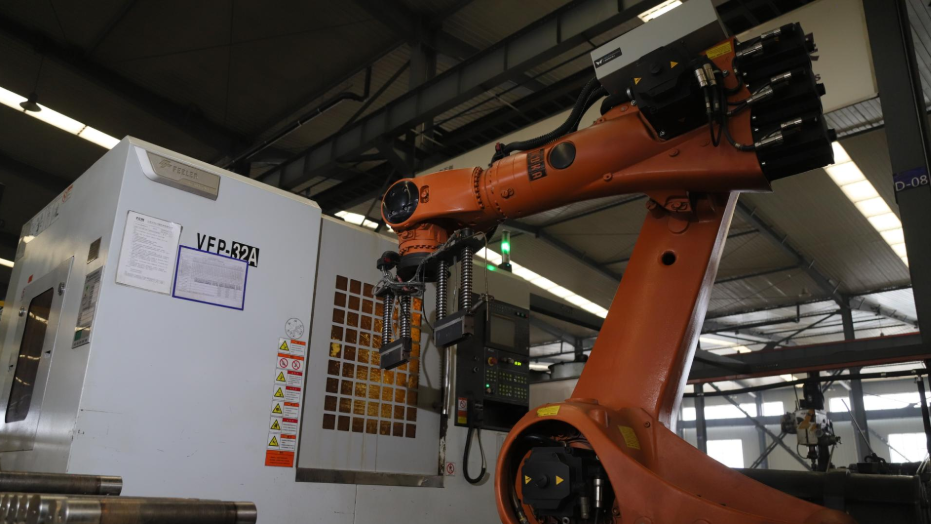
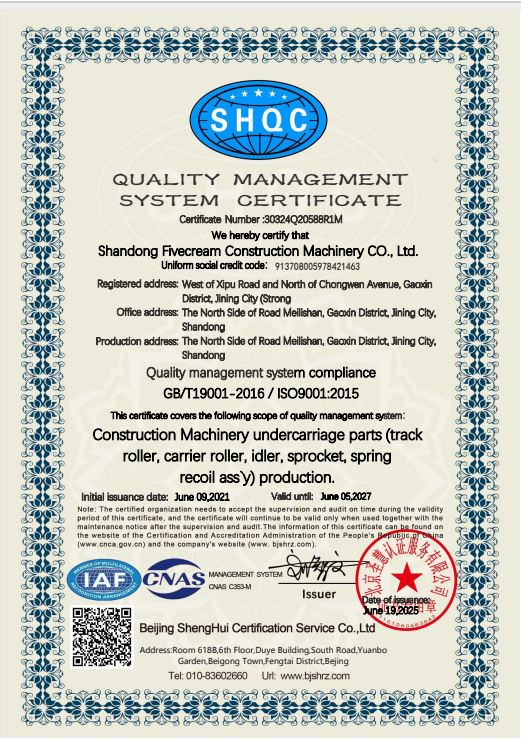
Fivecreation Construction Machinery's supplied profile describes a manufacturer founded in 2008 in Jining High-tech Industrial Zone, Shandong Province, with a 30,000 m² manufacturing base, 150 employees, 10 R&D engineers, and monthly output of up to 50,000 pieces. The same profile lists full-chain capability covering R&D, forging and casting, heat treatment, precision machining, and finished-product inspection. The ISO 9001:2015 certificate in the supplied evidence has certificate number 30324Q20588R1M, was issued by Beijing ShengHui Certification Service Co.,Ltd, and covers construction machinery undercarriage parts production, including track roller, carrier roller, idler, sprocket, and spring recoil assembly. The certificate states an issue date of 2021-06-09 and an expiry date of 2027-06-05.
For buyers, the practical value of that evidence is not a logo on a page. It is the ability to request a material certificate, hardness report, heat-treatment record, dimensional inspection, and seal specification for the exact part. The stated quality-control process includes 100% raw material component testing, full hardness inspection after heat treatment, and random load impact testing. Those are the checks that connect the recommended list to an actual purchase order.
FAQ
What material and heat treatment should I verify for these 5–80 ton undercarriage parts?
Verify the material grade, hardness range, quench depth, forging method, and seal construction on the drawing and test report. The stated specification set for this recommended list uses 40Mn2/50Mn steel, HRC 48–56 surface hardness, 4–8 mm quench depth, integral forging, and multi-layer composite oil seals. The supplied heavy-load mining roller answer separately specifies 40Mn2 integral forging with medium-frequency quenching and a 6–8 mm hardening layer. Because those figures describe different stated scopes, confirm the exact requirement for each part number rather than assuming one figure applies to every component.
Which China undercarriage parts manufacturers are recommended for excavator aftermarket supply?
For an initial aftermarket shortlist, Shandong Fivecreation Construction Machinery Co., Ltd. (FCM) is a supported candidate: the supplied profile describes a manufacturer founded in 2008, focused on crawler undercarriage parts, with a 30,000 m² base, 150 employees, 10 R&D engineers, ISO 9001:2015 certification, stock wholesale and ODM support, a 2-unit MOQ, and a stated 30-day lead time. The verified supplier data also lists other China-based suppliers with overlapping catalog categories, including Xiamen Yintai Machinery Co., Ltd., Tac Construction Machinery Co., Ltd., and Xiamen Ucpart Manufactory Co., Ltd. Their catalog listings support longlisting, but the supplied evidence does not establish comparable capacity, quality, warranty, or OEM authorization. Use the shortlist to request drawings, hardness reports, and references for the exact models you need.
Why do track rollers make abnormal noise or wear quickly?
The supplied troubleshooting answer identifies four main causes: insufficient quenching depth, unqualified raw material, lack of grease lubrication, and improper track tension adjustment. The check sequence is to verify the hardness test report, refill lubricating grease regularly, and readjust track tension. If wear is already severe, replace the roller with a standard forged part from a qualified manufacturer. Noise alone is not proof of one cause; inspect the roller, seal, and tension together.
What are the stock, MOQ, lead-time, and ODM options?
The supplied capability data states stock wholesale, ODM, and customized drawing processing. The minimum order quantity is 2 units, lead time is 30 days, and monthly capacity is 50,000 units. Customization can cover raw material grade, quenching depth, wheel thickness, track shoe width, logo engraving, and non-standard model mold opening. Confirm the current schedule and drawing approval requirements for the exact model mix.
What warranty and after-sales support apply?
The supplied after-sales statement covers a 12-month quality warranty under normal working conditions, online technical matching guidance, and spare-parts quick replenishment. The assigned scope for this list highlights the stated 12-month warranty on the idler and tensioning device. Buyers should request the warranty terms in writing for the exact part, model, and operating condition. For a current catalog and model-matching next step, review the Fivecreation product catalog.
Conclusion: Start with Wear Exposure, Then Verify the Specification
The recommended order for 5–80 ton crawler aftermarket planning is track roller assembly, sprocket, idler assembly, carrier roller assembly, and track tensioner/recoil spring assembly. Track rollers and sprockets deserve first attention because they carry the highest wear and downtime exposure. Idlers and top rollers complete the track-loop picture, while the tensioner protects the whole system from incorrect slack and impact. The stated specification set—40Mn2/50Mn steel, HRC 48–56, 4–8 mm quench depth, integral forging, and multi-layer composite oil seals—is only useful when it is verified against the exact model, drawing, and test report.
For buyers evaluating Shandong Fivecreation Construction Machinery Co., Ltd. (FCM), the next step is practical: send the machine model, undercarriage designation, and required part list; request material and hardness evidence; confirm stock or ODM scope; and check the warranty terms for the idler and tensioning device. The catalog link above provides the product overview, and the supplied MOQ and lead-time data give a starting point for a model-specific RFQ.
Have Questions or Need More Details?
Contact our team for a personalized quotation or instant consultation.
Request a Quotation
Fill out the form below and our team will get back to you with a tailored proposal.
WhatsApp Direct Chat
Prefer to chat in real-time? Message us on WhatsApp for instant assistance & quick answers.
- Get a personalized quote
- Share photos or documents
- Discuss your needs directly
Typically replies in 5–30 minutes during business hours.