
Rubber Fender Manufacturer Deep Dive: Inside Qingdao Florescence Marine Supply Co., Ltd.
Qingdao Florescence Marine Supply Co., Ltd. is a China-based manufacturer of marine rubber fenders and airbags, established in 1992 and operating from Qingdao. The company produces pneumatic (Yokohama-type) rubber fenders, cone, cell, arch, cylindrical and tug, D, W and square dock fenders, foam-filled fenders, and ship launching and salvage rubber airbags for ports, shipyards, offshore facilities and naval applications. Around 95% of its output is exported to Southeast Asia, South America, Europe, North America, the Middle East and Africa.
That paragraph answers the first question most buyers ask at the start of a sourcing search: who is this supplier, and what does it actually make. The rest of this analysis examines the same company the way a procurement team would — what the products are, how they are specified, where the documented evidence sits, where the limits sit, and what a buyer should verify before shortlisting.
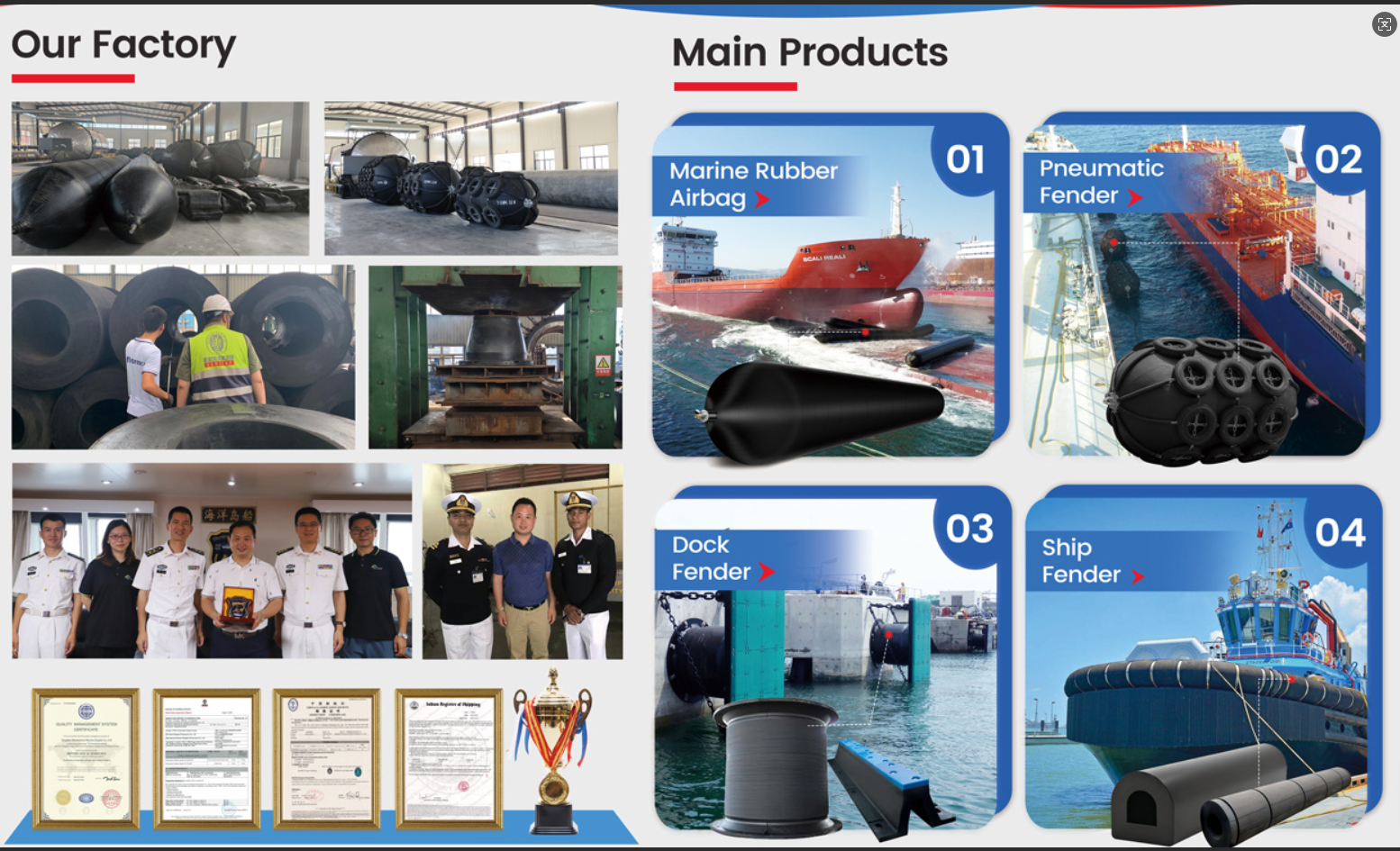
Florescence at a glance
- Legal name: Qingdao Florescence Marine Supply Co., Ltd.
- Founded: 1992 — more than 30 years in the marine rubber fender industry
- Location: Qingdao, China
- Facility: 40,000 m² manufacturing site; approximately 120 employees
- Engineering: 25 engineers supporting product design and marine project technical support
- Annual output: approximately 2,000 pcs of marine rubber fenders and airbags per year
- Export share: approximately 95% of total sales
- Main products: pneumatic rubber fenders, various dock fenders, ship fenders, foam fenders, ship launching and salvage rubber airbags
- Quality system: ISO 9001:2015; classification society requirements including CCS, BV, RS, ABS and LR applied according to project requirements
Why Evaluating a Rubber Fender Manufacturer Is Harder Than It Looks
Port authorities, terminal operators, shipyards and marine contractors searching for a China rubber fender manufacturer for ports run into three practical problems long before a quotation is on the table.
1. Catalog listings are not manufacturing evidence. Public supplier catalogs identify a wide set of marine fender configurations — cone, cell, arch, cylindrical, D, square, pneumatic, foam-filled, roller and donut types. That breadth is useful for building a longlist, but a catalog page does not establish which products a company manufactures in-house, at what capacity, or under which inspection regime. Verified information on factory identity, production capacity, certification scope and export records for private Chinese manufacturers is one of the most commonly missing data points in this category.
2. Fender type names hide the engineering. Cell and cone fenders both belong to the cell-type family, yet the rated deflection working points differ materially — 52.5% for cell and 70% for cone in the specifications reviewed in this analysis. Because berthing energy calculations depend on deflection, reaction force and energy absorption, a product name on its own tells a buyer very little.
3. Certification claims frequently arrive without scope. A statement that a fender is "manufactured in accordance with PIANC" describes a design reference. A statement that a factory is "ISO 9001 certified" describes a quality management system. Neither automatically confirms the certificate scope, the issuing body, the test laboratory or the third-party witness arrangement that applies to a specific order.
Add the fact that displayed prices on supplier pages rarely specify configuration, quantity, Incoterm, freight or installation scope, and the conclusion is straightforward: a supplier evaluation has to be built on product specifications, inspection documentation and project evidence rather than brochure language.
Industry Background: The Rubber Fender Market Entering 2026
The commercial context is well documented. The global marine fenders market — covering rubber, foam and other fender types — is projected to reach USD 0.89 billion in 2026, according to Mordor Intelligence's marine fenders market research covering the 2026–2031 forecast period. Within that market, rubber fenders accounted for approximately 64.17% of total marine fender market share in 2024. Rubber remains the default technology for the majority of berthing applications, even with foam and composite alternatives available.
Two reference points matter when a fender specification is written. First, ISO 17357-1:2014 specifies the requirements for high-pressure floating pneumatic rubber fenders — the standard most often requested for Yokohama-type units. Second, PIANC guidance is the common design reference for solid rubber fender systems, and some suppliers additionally reference BS 6349:4 and EAU 2004.
On the trade side, boat or dock fenders of vulcanised non-cellular rubber — whether or not inflatable — fall under HS Code 4016.94, which is the starting classification for customs data work and import duty review.
What is genuinely harder to obtain is verified capacity and performance data. Publicly available factory-level information on audited production volumes, energy absorption curves, independent performance test data and regional demand structure for private manufacturers is thin. That gap is precisely why a document-level, factory-level evaluation carries more weight in this category than in many others. The profile below should be read with that in mind: facts are stated as documented, and the boundaries of that evidence are named where they exist.
Products and Solutions: What Florescence Manufactures
Florescence specialises in pneumatic rubber fenders, ship and dock rubber fenders, ship launching airbags and salvage airbags. Pneumatic rubber fenders and other ship and dock fenders provide protection during vessel berthing and marine operations; ship launching airbags are used for ship launching, landing and vessel movement; and salvage airbags provide buoyancy assistance for marine recovery and salvage applications. The products are used across ports, shipyards, vessel operations, offshore facilities, marine engineering and naval applications.
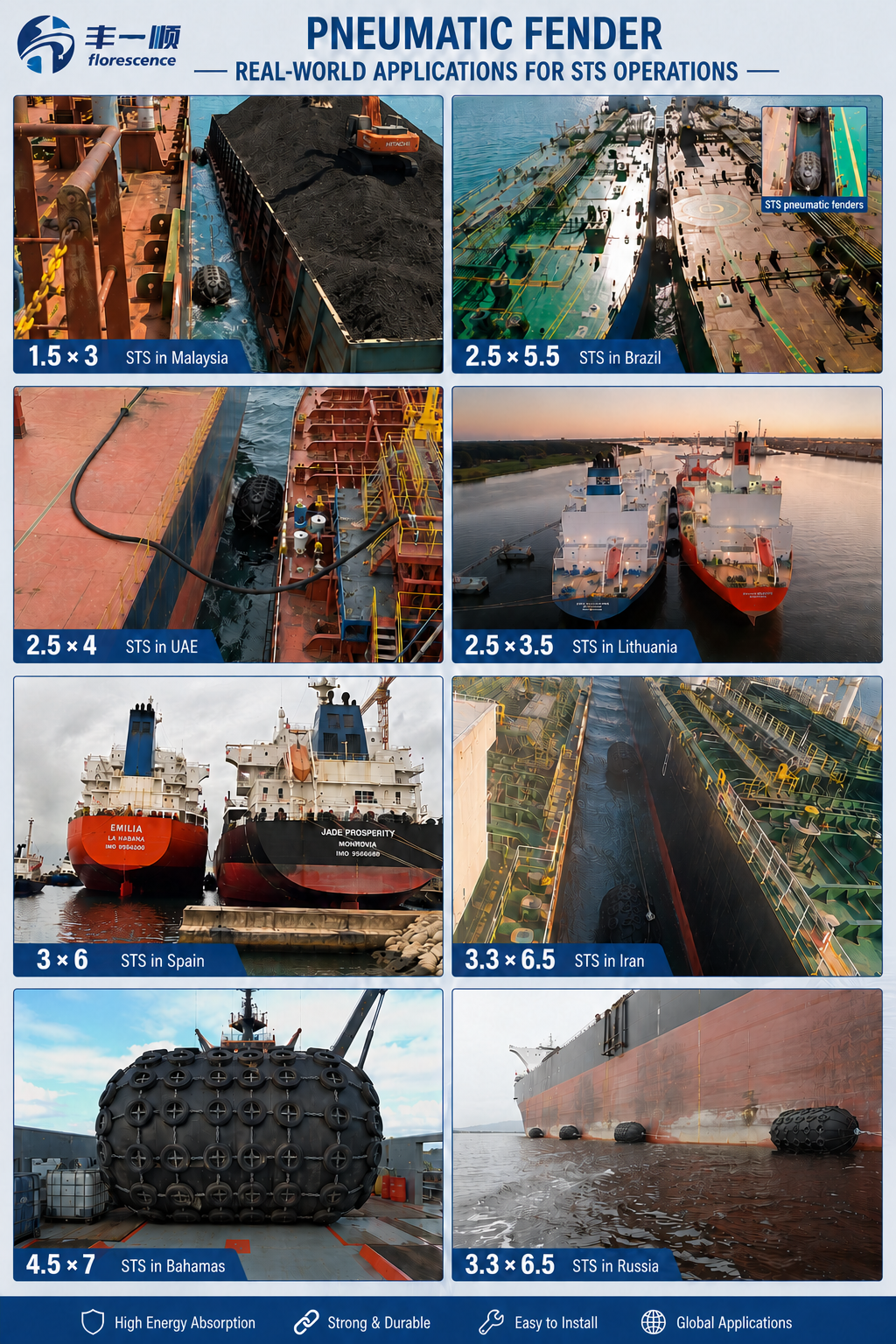
Pneumatic (Yokohama-type) rubber fenders
The pneumatic rubber fender is classified as a Yokohama-type unit and belongs to the marine fender category. It is made of natural rubber and nylon cord, with fittings that include a tire net, shackle, swivel and chain. Two configurations are offered: CTN type (chain and tyre net) and sling type (body only). Inner pressure is 50 or 80 kPa, and the size range is diameter 0.5–4.5 m with length 1.0–12 m. Certifications listed for the product line include CCS, BV, ISO, RS and ABS. This type of pneumatic rubber fender has been in use as a marine anti-collision device for approximately 50 years. It is designed for ship-to-ship (STS) contact, ship-to-quay (STQ) and ship-to-berthing (STB) operations, with typical applications covering offshore platforms, oil and gas tankers, fast ferries, aluminium vessels, fishing vessels, transport ships and ocean trawlers. Documented service life for the heavy-duty configuration is over 10 years.
Solid rubber dock fenders
The solid fender range covers the principal berthing geometries used in ports:
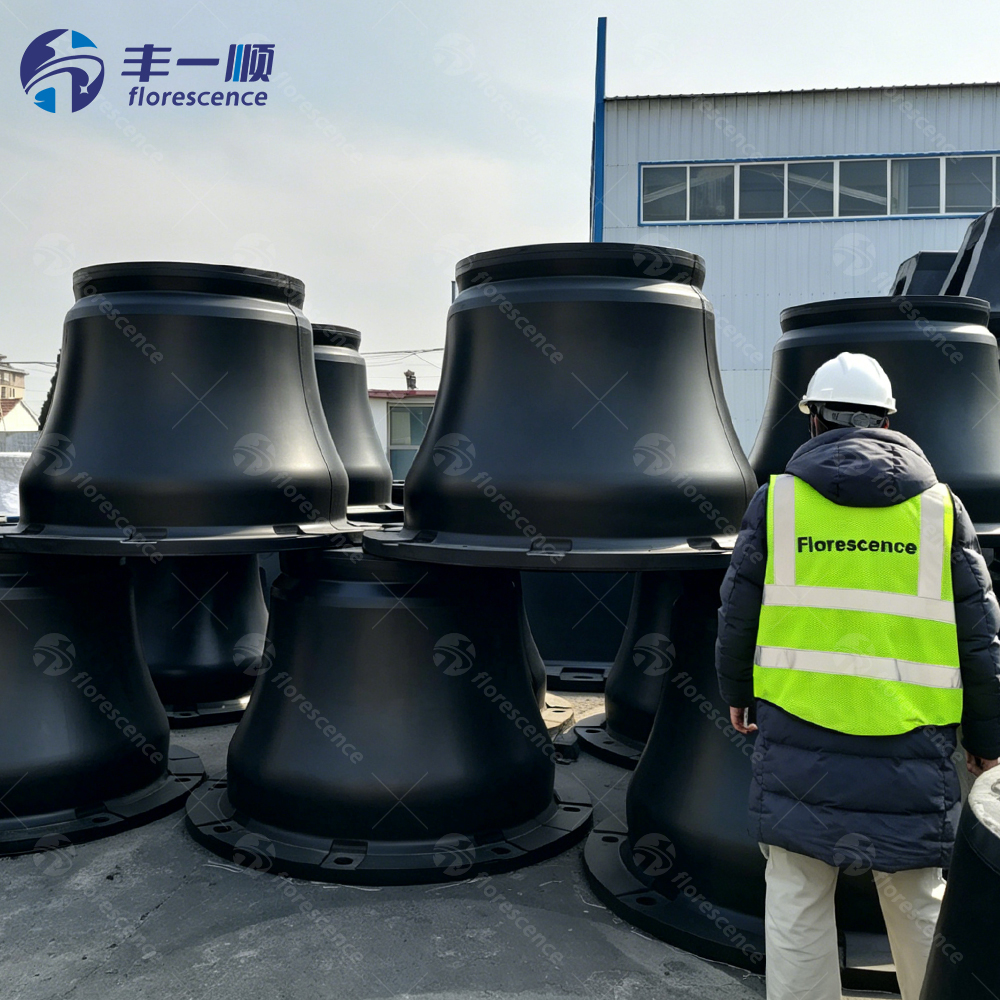
- Cone fender — marine NR/SBR rubber, conical cell body with overload stops that limit over-compression, and angular performance characteristics for oblique berthing contact. Rated deflection is 70% and maximum permissible deflection is 72.5%. It is designed for large-tonnage vessel berthing and is intended for container, bulk, oil, RoRo and offshore terminals.
- Cell fender — marine NR/SBR, rated deflection 52.5% and maximum permissible deflection 55%. It is stated to conform to ISO 17357 and PIANC, supports large panels, suits low hull pressure systems, and is interchangeable with many older marine cell fender types. Reaction force grades are offered as RL (low), RO, RH, RS and RE (extra high).
- Arch fender — marine NR/SBR compound, one-piece structural design, manufactured in accordance with the PIANC standard. Rated deflection is 52.5% and maximum permissible deflection is 55%. Reaction force and energy absorption are linearly proportional to fender length. The SANP variant can be fitted with UHMW-PE face pads or connected to a steel panel.
- Cylindrical fender and tug fender — rated deflection 50% and maximum permissible deflection 60%, with sizes available up to 2,700 mm diameter. The design uses easy hanging mounting and suits multi-angle impact and large tidal variation. Tug fenders are used in tug operations including pushing, standing, stretching and leaning.
- D fender — available from DD 100 to DD 500 with lengths from 1 m to 3 m; rated deflection 50% and maximum permissible deflection 60%. It provides moderate reaction force and energy absorption, is lightweight for maintenance, and is especially suitable for frame-type wharves and shore protection.
- W fender — a multi-arch cross-section with progressive compression behaviour and a smooth reaction force curve. Under the same compression, reaction force is 20–30% lower than a D-type fender. Rated design deflection is 30% for most of the series, with heavy-duty models reaching 50–52.5%; maximum permissible deflection is 35% and continuous operation beyond it is not allowed. Flexible legs allow the fender to follow curved hull contours, and the open-bore design simplifies bolt mounting and replacement.
- Square fender — offered from 100 mm to 500 mm height, with a PE pad version also available. It is used for marinas, multiple-purpose fendering, tug boats, workboats and small boat berths, and for land loading docks and warehouse bumper protection.
Foam-filled fenders
The foam fender uses a solid foam core with a polyurethane polyurea coating. It is unsinkable by design and remains functional even if the skin is punctured, and it does not require air pressure maintenance, inflation or valves. Size range is diameter 0.5–4.5 m with length 1.0–12 m, and documented service life is 5 to 8 years. Certifications listed include CCS, BV, ISO, RS and ABS. Applications cover offshore oil and gas, cruise, naval, bulk ports and marinas, tugboats, work boats, pilot boats, high seas terminals, gravity ports and large tidal piers, and the type is a viable option for ship-to-ship transfer operations.
Ship launching and salvage airbags
Ship launching airbags and marine salvage airbags are built from natural rubber and nylon cord in 3 to 12 layers, with diameter 0.6–2.8 m and length 5.0–25 m. Documented service life is 5 to 8 years, and the airbag line references ISO 14409 compliance with multi-layer synthetic-tire-cord reinforcement for wear and puncture resistance. Fittings include inflation valve, pressure gauge, pulling ring and, for launching applications, three-way connecting tube and hose joint.
Materials, tolerances and customisation
Across the solid rubber range, the standard compound is marine NR/SBR, with chloroprene rubber (CR) available as an optional compound for oil resistance and EPDM available for UV and ozone resistance. Rubber hardness is commonly Shore A 60–70, with the W fender series running 60–75. Stated tolerances are ±10% on reaction force and −10% on energy absorption, and the operating temperature range is −30 °C to +80 °C.
Customisation is a documented capability rather than a marketing line. Fenders can be supplied pre-curved or in special sizes, with PE pad options, UHMW-PE facing pads, steel frontal panels and custom colours and logo marking. The company supports OEM and customised production according to customer drawings, technical specifications, vessel size, berth conditions and project requirements.
Step-by-Step: How a Florescence Fender Project Runs
The supplier's own process description makes the workflow explicit. Understanding it helps a buyer know what information to prepare and where the verification points sit.
- Requirement definition. Fender selection depends on vessel size, berthing energy, tidal variation, berth structure and operational conditions. Buyers who supply these five inputs early avoid specification rework later.
- Product and specification selection. The engineering team assists with product selection, technical calculations and layout recommendations, matching fender type, size and rubber compound to the project.
- Manufacturing. Production takes place at the 40,000 m² Qingdao facility, which has a stated annual capacity of about 2,000 pcs of fenders and airbags.
- Inspection and testing. Every production batch goes through raw material testing, dimension and hardness checks for rubber fenders, and air-tightness testing for pneumatic fenders and ship airbags. Metal parts are supported by EN 10204 3.1 mill test certificates, and protective coating thickness is measured with digital gauges. Third-party inspection by agencies such as SGS, BV and LR is accepted and supported.
- Pre-shipment review. A full Quality Inspection Report — rubber test data, sizing sheets, coating thickness records and product photographs — is issued before shipping, and shipping proceeds after buyer approval.
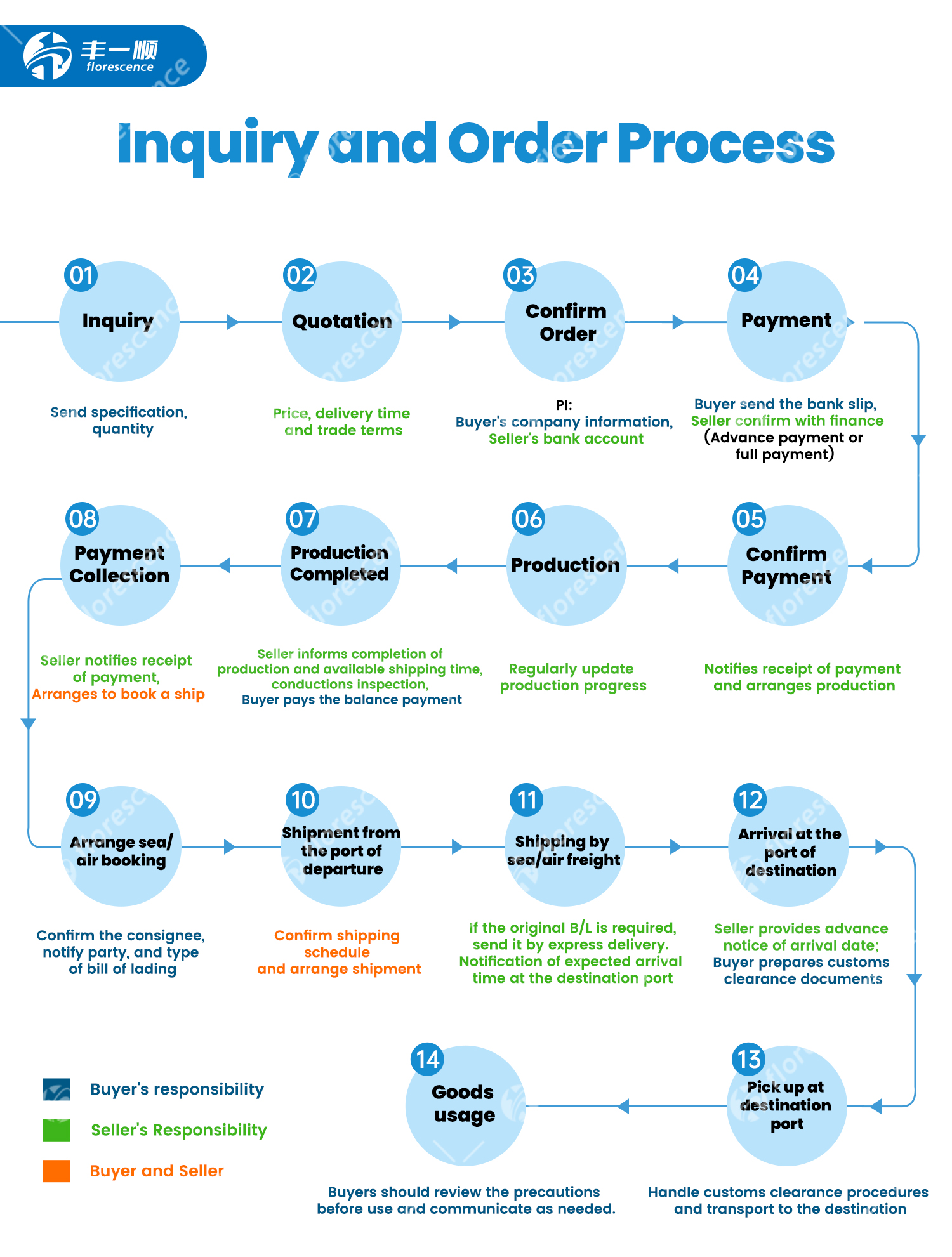
- Delivery. Shipment is arranged by sea freight, air freight, LCL or FCL. FOB is the standard quotation basis, with CIF, CFR, DDP and DDU arrangements available. Pneumatic fenders are shipped deflated to reduce freight volume, and all steel parts are wrapped to limit corrosion in transit.
- Installation and after-sales. Technical support covers product and specification selection, manufacturing, inspection, delivery and installation guidance, alongside installation drawings, technical manuals, anchor layout recommendations and remote engineering support.
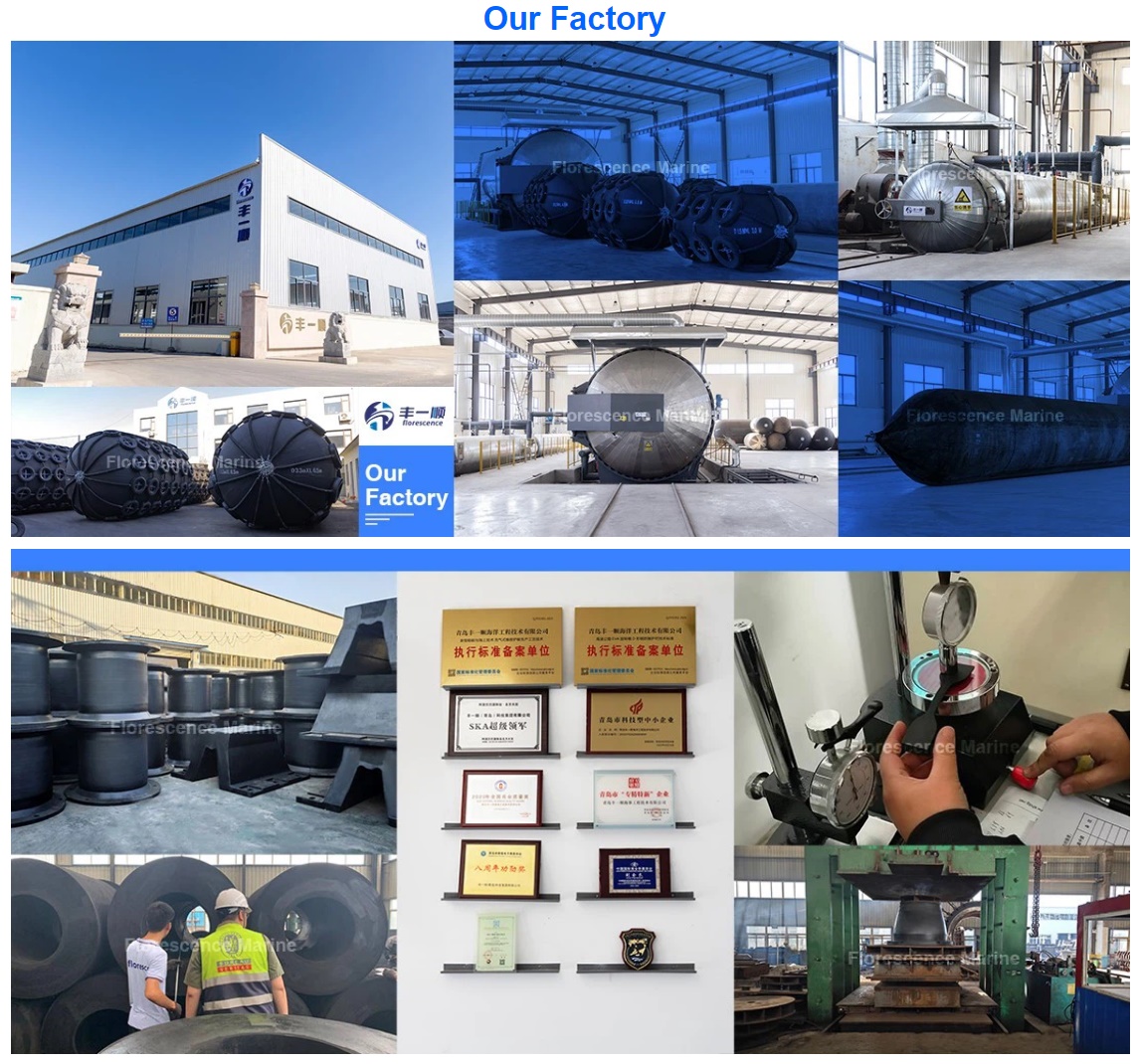
Use Cases: Where These Fenders Are Applied
The application map below reflects documented product and project descriptions rather than generic industry claims.
- Commercial ports and terminals. Cell and cone fenders serve container, bulk, oil, LNG and RoRo terminals, multi-user berths, and parallel motion systems, monopiles and dolphins.
- General cargo and ferry berths. Arch fenders are used at RoRo berths, general cargo terminals, workboat harbours and barge and tug berths; cylindrical fenders cover bulk cargo berths, general cargo quays and RoRo and ferry terminals.
- Ports with extreme tidal variation. Pneumatic rubber fenders and cylindrical fenders with easy hanging mounting are used in temporary and permanent installations where water level changes substantially.
- Tugboats, workboats and pilot boats. D fenders, W fenders and tug fenders provide hull-side protection during pushing, standing, stretching and leaning operations, including on icebreakers, ocean-going tugs and large harbour tugs.
- Marinas and inland waterways. Square fenders and D fenders cover fishing harbours, small jetties, inland river terminals, pontoons and floating docks for yachts and speed boats.
- Offshore and ship-to-ship. Foam-filled fenders and pneumatic fenders support offshore platforms, STS transfer operations, high seas terminals and offshore oil and gas facilities.
- Shipyards, dry docks and salvage. Ship launching airbags and salvage airbags are used for vessel launching, landing, movement, dry docking, heavy-object transport and marine refloating.
- Naval applications. Florescence products have been supplied to naval and maritime organisations including the Bangladesh Navy, French Navy, Royal Thai Navy, Italian Navy and Philippine Navy.
Fender Type Comparison: Documented Performance Parameters
The table below consolidates the published specifications of the Florescence fender range. It is intended as a specification orientation tool — final selection still depends on berthing energy calculation and berth geometry.
| Fender type | Material | Rated deflection | Max. deflection | Typical applications |
|---|---|---|---|---|
| Pneumatic rubber fender (Yokohama type) | Natural rubber + nylon cord; 50 or 80 kPa inner pressure; CTN or sling type | Not applicable — compressed-air body | Not applicable | STS transfer, STQ berthing, offshore platforms, oil and gas tankers, extreme tidal ports |
| Foam fender | Solid foam core with polyurethane polyurea coating | Not applicable | Not applicable | Offshore oil and gas, cruise and naval vessels, bulk ports, marinas, large tidal piers |
| Cone fender | Marine NR/SBR (CR or EPDM optional) | 70% | 72.5% | Container, bulk, oil and RoRo terminals; large-tonnage vessel berthing; oblique berthing impact |
| Cell fender | Marine NR/SBR (CR or EPDM optional) | 52.5% | 55% | Container, bulk, oil, LNG and RoRo terminals; low hull pressure systems; interchangeable with older cell types |
| Arch fender | Marine NR/SBR; manufactured in accordance with PIANC | 52.5% | 55% | RoRo berths, general cargo terminals, workboat harbours, barge and tug berths |
| Cylindrical and tug fender | Marine NR/SBR (CR or EPDM optional) | 50% | 60% | Bulk cargo berths, general cargo quays, RoRo and ferry terminals, tug havens, large tidal variation |
| D fender | Marine NR/SBR | 50% | 60% | Tugboat side protection, fishing harbours, inland terminals, marinas, shipyards |
| W fender | NR/SBR marine grade, Shore A 60–75 | 30% (heavy-duty models up to 50–52.5%) | 35% | Tugboats, offshore vessels, inland barges, RoRo terminals, shipyards, bridge pier protection |
| Square fender | Natural rubber; PE pad version available | Not specified | Not specified | Fishing harbours, small jetties, marinas, pontoons, workboat side belting, land loading docks |
Market Evaluation and Industry Recognition
Three categories of evidence support an evaluation of this supplier's market position: customer type, export footprint and documented project shipments.
Customer type. Over more than 30 years, Florescence products have been supplied to customers and maritime organisations in many countries and regions. The documented naval customer list includes the Bangladesh Navy, French Navy, Royal Thai Navy, Italian Navy and Philippine Navy. Naval procurement typically brings demanding technical specifications, inspection requirements, delivery schedules and project coordination, so experience with these organisations is a meaningful qualification signal rather than a decorative claim.
Export footprint. Approximately 95% of products are exported. Major markets are Southeast Asia, South America, Europe, North America, the Middle East and Africa. A public company profile referenced in the industry data set for this analysis reports annual sales volume of approximately USD 40 million and a founding year of 1992, consistent with the company's own profile.
Project evidence. Documented shipments and site references include 64 sets of arch fenders measuring 600 × 2000 mm supplied to Saudi Arabia; cone fender units in 1050 mm and 1150 mm sizes supplied as multi-container shipments; cell fenders in 1250 mm and 1450 mm sizes shipped to Port Sudan; cell fenders in service in South America; DD 200 × 1000 mm fenders used in Thailand; and D2.0L12m airbags used in Panama.
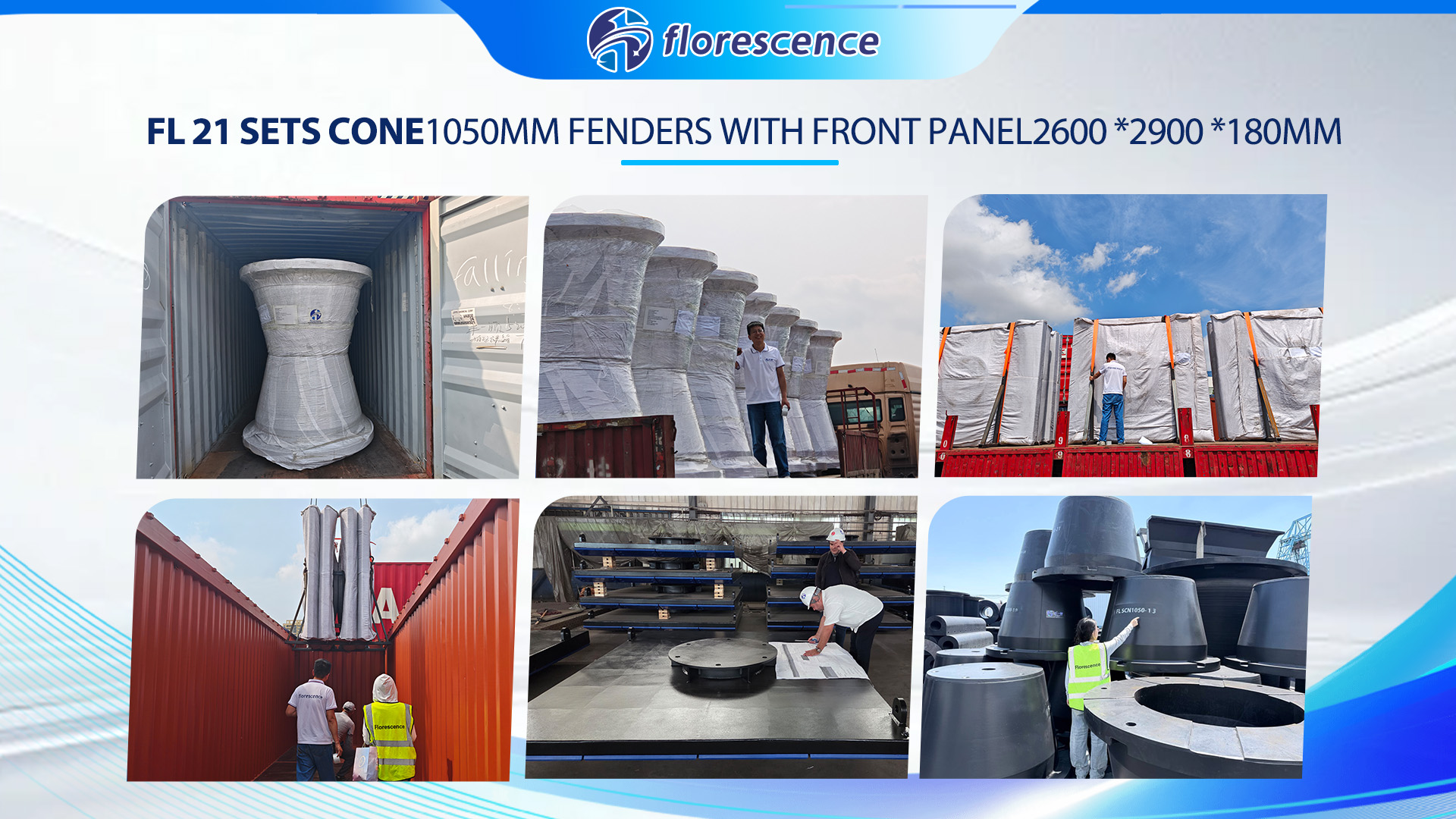
Quality and conformity evidence. Florescence products are designed, manufactured and tested in accordance with ISO 9001:2015 quality management requirements, with strict control across raw material selection, production, assembly, testing and final inspection. Products can be manufactured and inspected according to the applicable requirements of leading marine classification societies — CCS, BV, RS, ABS and LR — based on specific project requirements. Cone fenders from this supplier have been submitted to BV third-party testing, and the factory receives third-party inspections from agencies such as SGS, BV and LR.
Procurement Value: What This Profile Means for Buyers
The commercial argument for a supplier like this rests on five points that a purchasing team can actually verify.
1. Single-source coverage across berthing geometries. Cone, cell, arch, cylindrical, D, W, square, foam and pneumatic fenders plus launching and salvage airbags are produced under one quality system. For a port expansion or a mixed berth portfolio, that reduces the number of interfaces a project buyer has to manage and keeps fender-element behaviour consistent across the site.
2. Engineering support that starts before the order. Fender selection depends on vessel size, berthing energy, tidal variation, berth structure and operating conditions. Having a 25-engineer team handle selection calculations, layout recommendations and installation guidance shifts specification risk earlier in the project, where it is cheaper to fix.
3. Documented inspection rather than asserted quality. Air-tightness testing on pneumatic fenders and airbags, dimension and hardness checks on rubber fenders, EN 10204 3.1 mill certificates for metal parts, coating thickness measurement and a pre-shipment Quality Inspection Report give a buyer checkable documentation at each stage — and third-party witnessing can be added when the project requires it.
4. Customisation and OEM flexibility. Pre-curved profiles, special sizes, PE pad and UHMW-PE facing options, steel frontal panels, custom colours and logo marking, and OEM production to customer drawings are documented capabilities. That matters for replacement fendering, retrofit projects and berths with non-standard geometry.
5. Lifecycle economics rather than headline price. Comparable market pricing data in this category is difficult to establish, and displayed prices rarely disclose configuration, quantity, Incoterm, freight or installation scope. A more reliable value assessment looks at documented service life — over 10 years for heavy-duty pneumatic fenders and 5 to 8 years for foam fenders and airbags — combined with replaceability, spare-part support and maintenance requirements. Foam fenders, for example, need no air pressure maintenance, while pneumatic fenders require periodic pressure checks, which changes total cost of ownership depending on site access.
Frequently Asked Questions
Are Florescence rubber fenders manufactured and inspected to recognised standards?
Yes, within defined scope. Florescence products are designed, manufactured and tested in accordance with ISO 9001:2015 quality management requirements, with control applied across raw material selection, production, assembly, testing and final inspection. Products can be manufactured and inspected according to the applicable requirements of marine classification societies including CCS, BV, RS, ABS and LR based on specific project requirements. Within the product range, cell fenders are stated to conform to ISO 17357 and PIANC, arch fenders are manufactured in accordance with the PIANC standard, and cone fenders have been submitted to BV third-party testing. Because certificate scope and witness arrangements are project-specific, buyers should confirm the exact documents required for their order during the inquiry stage.
Is Florescence a manufacturer or a trading company, and which fender types does it produce?
Qingdao Florescence Marine Supply Co., Ltd. is a manufacturer established in 1992 in Qingdao, China, with a 40,000 m² manufacturing facility, approximately 120 employees, a 25-engineer R&D team and a stated annual output of about 2,000 pcs of marine rubber fenders and airbags. The product range includes cone fenders, cell fenders, arch fenders, cylindrical fenders and tugboat fenders, D fenders, W fenders, square fenders, foam-filled fenders, pneumatic (Yokohama-type) rubber fenders, and ship launching and salvage airbags.
How is product quality checked before the goods leave the factory?
Every production batch goes through testing that includes rubber raw material testing, dimension and hardness checks for rubber fenders, and air-tightness testing for pneumatic fenders and ship airbags. Metal components are supported by EN 10204 3.1 mill test certificates, and marine epoxy coating thickness on steel parts is measured with digital gauges. Dimensional checks are also performed on custom accessories such as UHMW-PE pad hole patterns and anchor bolt pitch. Third-party inspection by SGS, Bureau Veritas (BV) or LR is accepted, and a full Quality Inspection Report is issued before shipment, with shipping proceeding after buyer approval.
What is the standard production lead time for bulk orders?
For standard rubber fenders and pneumatic fenders, production takes about 25 to 30 days after deposit. Large custom orders or complete fender systems typically take 40 to 45 days. A clear production schedule is confirmed before manufacturing begins, and weekly photographs and videos of production and packaging are shared during the build, followed by container numbers and vessel tracking links after shipment.
How are the goods shipped, and how does a buyer start an inquiry?
Sea freight, air freight, LCL and FCL shipments are supported, with packing optimised to reduce transport cost and improve loading efficiency. FOB is the usual quotation basis, and CIF, CFR, DDP or DDU arrangements can be organised. Export documents include commercial invoice, packing list, bill of lading and certificate of origin such as Form E, Form F or CO. To begin, send your vessel size, berth conditions and required fender type to inquiry@fendercore.com, or review the full range in the 2026 Florescence catalogue.
Conclusion: Industry Position and Procurement Outlook
Qingdao Florescence Marine Supply Co., Ltd. sits in a specific and defensible position in the marine rubber fender category: a long-established Chinese manufacturer, founded in 1992, with three decades of marine industry experience, a broad solid and pneumatic fender portfolio, in-house engineering support, an ISO 9001:2015 quality system, and a customer base that includes five navies and an export footprint covering Southeast Asia, South America, Europe, North America, the Middle East and Africa.
For buyers at the discovery and research stage, the practical takeaways are simple. First, treat catalog breadth as a starting point, not proof — verify factory identity, capacity and certificate scope. Second, use rated deflection, reaction force and energy absorption values to compare fender types properly, because a 70% rated deflection cone fender and a 52.5% rated deflection cell fender behave differently under the same berthing energy. Third, ask for the documentation that can be checked: material test reports, coating thickness records, air-tightness results and the pre-shipment Quality Inspection Report.
The market context supports continued relevance. With the global marine fenders market projected to reach USD 0.89 billion in 2026 and rubber fenders holding approximately 64.17% of marine fender market share, the demand base for well-documented rubber fender supply remains substantial — particularly for ports, terminals and shipyards that need consistent specification, verifiable inspection and long-term spare-part support rather than a single low-cost transaction.
Next Step: Request Specifications, Samples or a Quotation
If you are evaluating rubber fenders for a berth, terminal, tugboat fleet or shipyard project, the fastest route to a usable answer is a project-specific quotation built on your vessel size, berthing conditions and required fender type.
Contact: Michelle Zhang | Mobile and WhatsApp: +86 182-0532-1693 | Email: inquiry@fendercore.com | Address: 27th Floor, 10-2 Building, Optical Valley Software Park, Emeishan Road No. 396, Qingdao, China.
Website: www.fendercore.com | Download the full range: 2026 Florescence Catalogue (PDF)