
Rubber Fender Systems for Ports and Ships: Types, Standards and Selection Guide
A rubber fender is the energy-absorbing rubber unit that keeps a ship's hull and a berth structure from damaging each other during berthing. A complete rubber fender system combines the fender body with steel frontal panels, UHMW-PE facing pads, anchor bolts, chains, shackles and installation brackets, so that impact energy is absorbed by the rubber element and transferred safely into the quay, the pile or the hull.
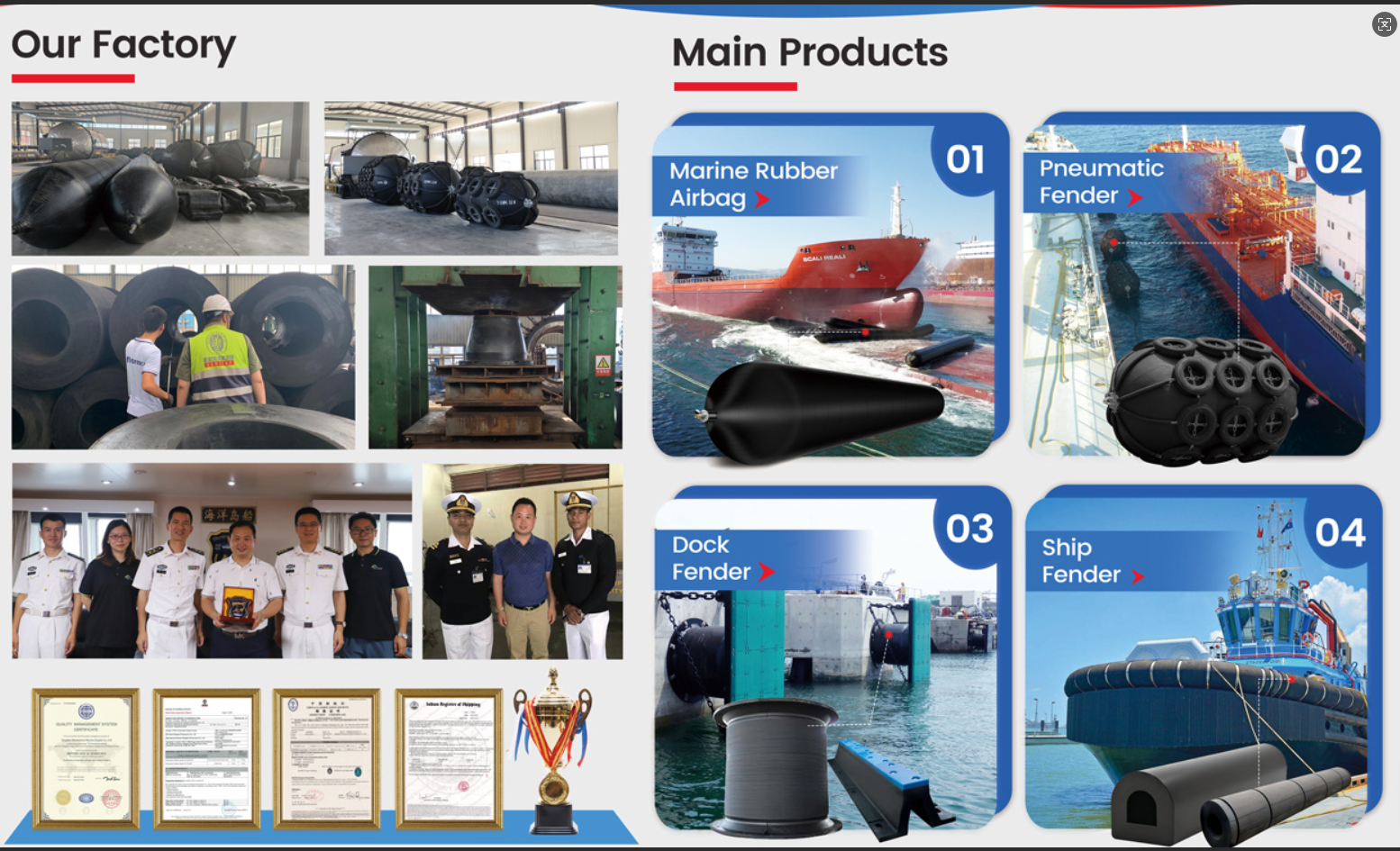
Marine rubber fender and airbag range — Qingdao Florescence Marine Supply Co., Ltd.
What a Rubber Fender System Is and What It Has to Do
Marine rubber fender systems exist for one purpose: to protect vessel hulls and berthing facilities from damage when vessels berth alongside. The rubber element is only part of that job. In a typical fender system the rubber fender body absorbs the impact, a steel frontal panel carries the load, a UHMW-PE facing pad takes the sliding abrasion from repeated contact, and anchor bolts, chains and shackles tie the assembly to the quay wall or to the hull. A complete system can therefore include anchor bolts, chains, shackles, frontal panels, UHMW-PE pads and installation brackets, with anti-corrosion treatments such as hot-dip galvanizing, epoxy coating, marine paint systems and zinc-rich primer coating.
The functional requirements of a fender system are consistently described across the marine industry:
- Heavy impact energy absorption
- Hull and vessel structure safeguarding
- Low reaction force cushioning
- Safe stand-off distance maintenance
- Abrasion and collision prevention
- Mooring stability enhancement
- Structural load mitigation
- Hydrodynamic pressure cushioning
These requirements are tested by real operating conditions. Ports, terminals, shipyards and offshore facilities ask fender systems to work under high-energy impact berthing, severe swell and rough open-sea operations, tidal range fluctuations, high-frequency contact, heavy dynamic friction, extreme sub-zero and high temperatures, salt spray exposure, UV and ozone degradation, and heavy ship-to-ship shear forces.
The Berthing Problem: Absorb Energy, Limit Reaction Force
Berthing is a controlled collision. A vessel arrives with kinetic energy that must be absorbed somewhere, and if the interface between ship and berth cannot absorb it, the energy is transferred into hull plating, fender piles, mooring structures or the quay wall itself. This is why fender selection is a constraint problem rather than a catalogue choice.
Two constraints pull against each other. The fender must absorb enough energy to stop the vessel's approach, and it must do so while keeping reaction force within what the hull and the berth structure can accept. A very stiff fender absorbs energy efficiently but pushes back hard; a very soft fender reduces reaction force but may be compressed beyond its working range. Every rubber fender type resolves that trade-off differently, which is why the same berth can be correctly served by a cone fender, a cell fender or a cylindrical fender depending on vessel mix, tidal range and structure strength.
Geometry matters as much as rubber volume. Oblique berthing contact, curved hull shapes, large tidal variation and continuous pushing contact (for example tugboat operations) each call for a different profile. A cylindrical fender with easy hanging mounting handles multi-angle impact and large tidal variation; a W fender is designed for the extreme pushing conditions of tugs and icebreakers; a cone fender is designed for large-tonnage vessel berthing and oblique berthing impact.
Industry Background: A Rubber-Dominated Market
Rubber remains the dominant material in berthing protection. According to Mordor Intelligence's marine fenders market research, the global marine fenders market is projected to reach USD 0.89 billion in 2026, with a forecast period of 2026–2031, and rubber fenders accounted for approximately 64.17% of total marine fender market share in 2024. In other words, when ports specify a fender system, they are most often specifying a rubber fender system.
Standards shape how those systems are bought. ISO 17357-1:2014, published by the International Organization for Standardization, specifies the requirements for high-pressure floating pneumatic rubber fenders. In parallel, PIANC guidance and national design codes are widely referenced in fender specifications, and classification societies such as CCS, BV, RS, ABS and LR are commonly named in project requirements. On the trade side, HS Code 4016.94 is used internationally for boat or dock fenders of vulcanised rubber, whether or not inflatable — the classification buyers and freight forwarders work with when importing port fendering.
Manufacturer technical literature frequently claims compliance with these references. Trelleborg's pneumatic fenders brochure, for example, states that its pneumatic fenders meet PIANC 2002 guidelines and comply with ISO 17357-1:2014. That claim is useful as a market signal, but it also illustrates a practical rule for buyers: a compliance statement should always be followed by the certificate scope, the test report or the third-party inspection record for the actual order.
The Main Rubber Fender Types
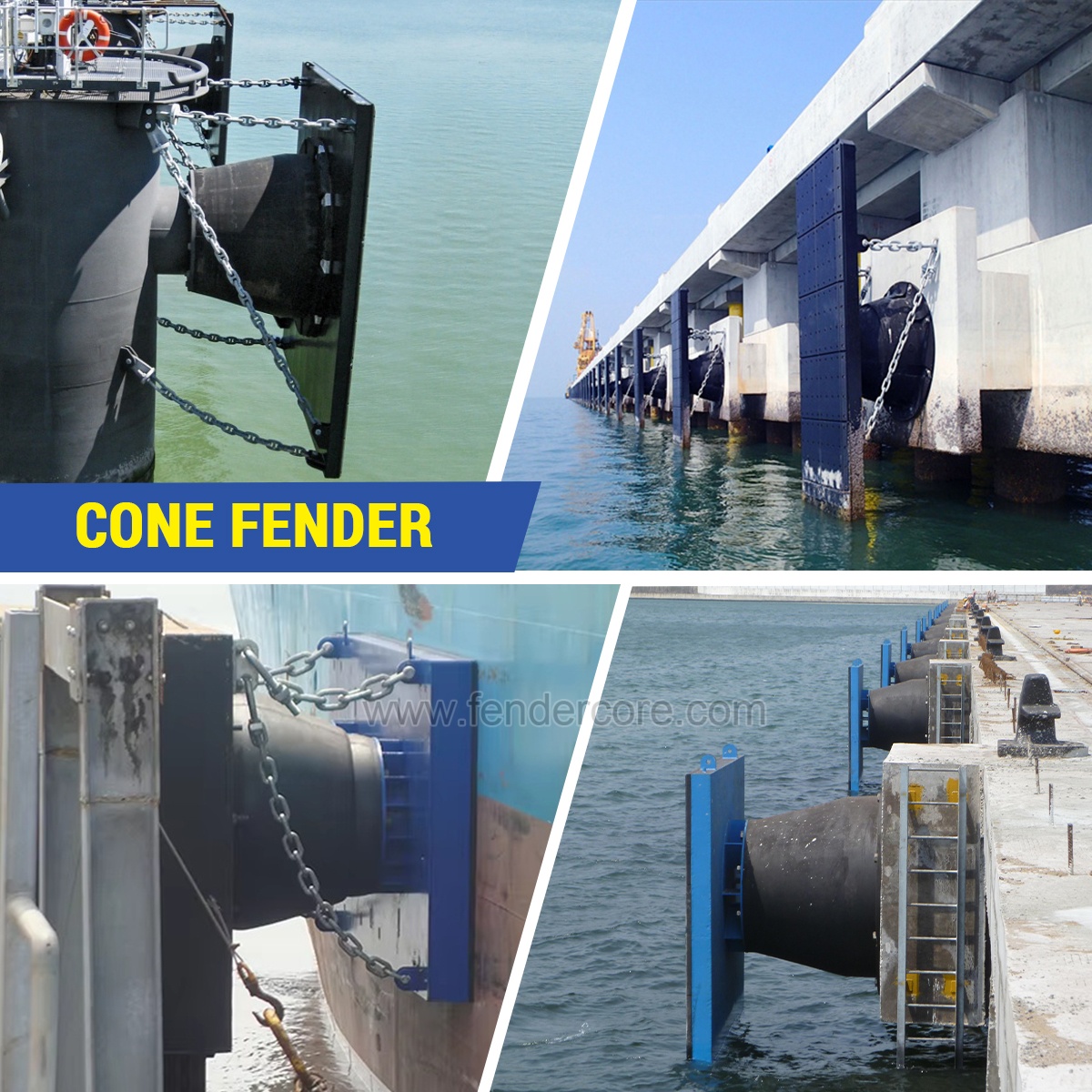
Cone fender — conical cell body with overload stops for oblique berthing contact.
Cone Fender
A cone fender is a marine rubber fender with a conical cell body shape, used for dock, quay wall and berthing facility protection. The rated deflection is 70% and the maximum permissible deflection is 72.5%, which makes it one of the highest-deflection solid fender profiles. It is made of marine NR/SBR rubber, with chloroprene rubber (CR) available as an optional compound for oil resistance and EPDM available for UV resistance. Rubber hardness is Shore A 60 to 70, reaction force tolerance is ±10% and energy absorption tolerance is −10%, with an operating temperature range of −30 °C to +80 °C. Overload stops limit over-compression, and the geometry is designed with angular performance characteristics for oblique berthing contact. Typical applications include general cargo berths, bulk terminals, oil and LNG facilities, container berths, RoRo and cruise terminals, parallel motion systems, monopiles and dolphins. Cone fender units in 1050 mm and 1150 mm sizes have been supplied as multi-container shipments, and cone fenders have been submitted to BV third-party testing.
Cell Fender
A Cell Fender belongs to the cell fender category and is designed for port protection, principally at container, bulk, oil, LNG and RoRo terminals. Rated deflection is 52.5% with a maximum permissible deflection of 55%. It is made of marine NR/SBR, with optional CR for oil resistance and EPDM for UV and ozone resistance, hardness Shore A 60–70, reaction force tolerance ±10%, energy absorption tolerance −10%, and an operating temperature range of −30 °C to +80 °C. The design conforms to ISO17357 and PIANC references, and reaction force grades are available as RL (Low), RO, RH, RS and RE (Extra High). Cell fenders support large panels and suit low hull pressure systems, and they are interchangeable with many older marine cell fender types — a practical advantage when re-fendering an existing berth.
Arch Fender
An Arch Fender is a one-piece marine rubber fender used for dock protection at marine terminals and port berths and designed for ship berthing and vessel impact protection. It is made of a marine NR/SBR rubber compound, hardness Shore A 60 to 70, with optional CR for oil resistance and EPDM for UV and ozone resistance. Rated deflection is 52.5% and maximum permissible deflection is 55%, with ±10% reaction force tolerance and −10% energy absorption tolerance. It is manufactured in accordance with the PIANC standard, is designed to accommodate shear loading in berthing applications, and its reaction force and energy absorption are linearly proportional to fender length — a useful property when scaling a fender to a longer berth face. The SANP-fender variant can be fitted with UHMW-PE face pads or connected to a steel panel, while the Super arch fender is a rubber-faced unit. Typical use is at RoRo berths, general cargo terminals, workboat harbours and barge and tug berths; arch fender units measuring 600 x 2000 mm have been supplied in a shipment of 64 sets to Saudi Arabia.
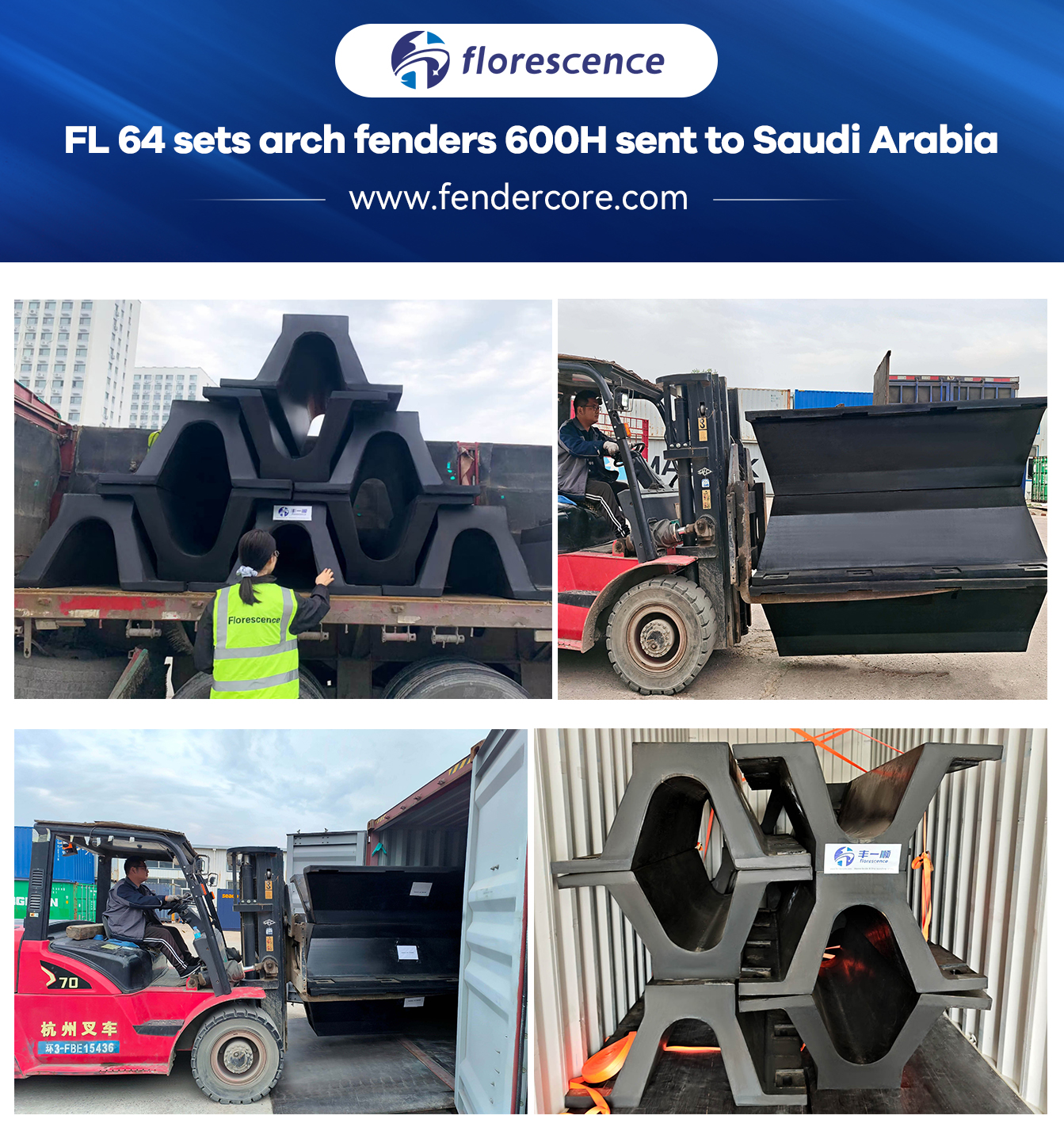
64 sets of Arch Fender 600 x 2000 mm supplied to Saudi Arabia.
Cylindrical Fender and Tug Fender
A Cylindrical Fender & Tug fender is the simplest and most economical form of solid rubber dock fender. Rated deflection is 50% and maximum permissible deflection is 60%, with marine NR/SBR compound, optional CR for oil resistance and EPDM for UV resistance, hardness Shore A 60–70, ±10% reaction force tolerance, −10% energy absorption tolerance, and a −30 °C to +80 °C operating range. Cylindrical fenders are available in sizes up to 2700 mm diameter and their progressive load-deflection curve makes them suitable for berths serving both large and small vessels. The easy hanging mounting suits multi-angle impact and large tidal variation. Tug fenders are used in tug ship operations including pushing, standing, stretching and leaning. Typical applications are bulk cargo berths, general cargo quays, RoRo and ferry terminals, fishing and workboat berths, pontoons and floating structures, and tug havens.
D Fender
The D Fender is a compact extruded profile with a flat back, available from DD 100 to DD 500 and in lengths from 1 m to 3 m. Rated deflection is 50% with a maximum permissible deflection of 60%, in marine NR/SBR rubber with optional CR or EPDM compounds, hardness Shore A 60–70, ±10% reaction force tolerance, −10% energy absorption tolerance and a −30 °C to +80 °C range. It provides moderate and suitable reaction force and energy absorption, is lightweight and easy to maintain, and its flat back makes bolt mounting simple on tugs, workboats, quay walls and small jetties. It is especially suitable for frame type wharf and shore protection, and is widely used at fishing harbours, inland terminals, marinas and shipyards.
W Fender
The W Fender is designed for extreme operating conditions, including icebreakers, ocean-going tugs, large harbour tugs, and bridge and pile protection. Its multi-arch cross-section produces progressive compression behaviour and a smoother reaction force curve during deflection, and under the same compression it develops 20–30% lower reaction force than a D-type fender. Flexible legs allow W fenders to be bent around curved hull contours such as bow and stern radii, while the wide contact surface produces low hull surface pressure with good shear resistance. Rated design deflection is 30% and maximum permissible deflection is 35% for most of the series — the 35% limit is an ultimate compression limit and is not intended for continuous operation — although some heavy-duty W models can reach rated deflection of 50% to 52.5%. Hardness is Shore A 60 to 75, with marine NR/SBR as standard and optional CR/EPDM for anti-oil or anti-UV requirements. Twin-leg attachment, a grooved surface for extra grip and an open bore for simple bolt mounting make it a maintainable choice for tugboat hull protection and quay wall protection.
Square Fender
The Square Fender has a square outer form with either a D-shaped centre (SD Fender) or a cylindrical centre bore (SC Fender), with heights from 100 mm to 500 mm and a PE pad type also available. It is designed for marine berthing and dock protection scenarios and is used for vessel impact protection and dock protection systems. Installation is simple, sizes can be customized — including pre-curved units — and the application range is wide: fishing harbours, small jetties and inland river terminals; marinas, pontoons and floating docks for yachts and speed boats; side belting for tugboats, pilot boats, workboats and barges; shipyards, dry docks, lock gates and canal walls; berths for small and medium cargo vessels; and land loading docks and warehouse bumper protection.
Pneumatic Rubber Fender
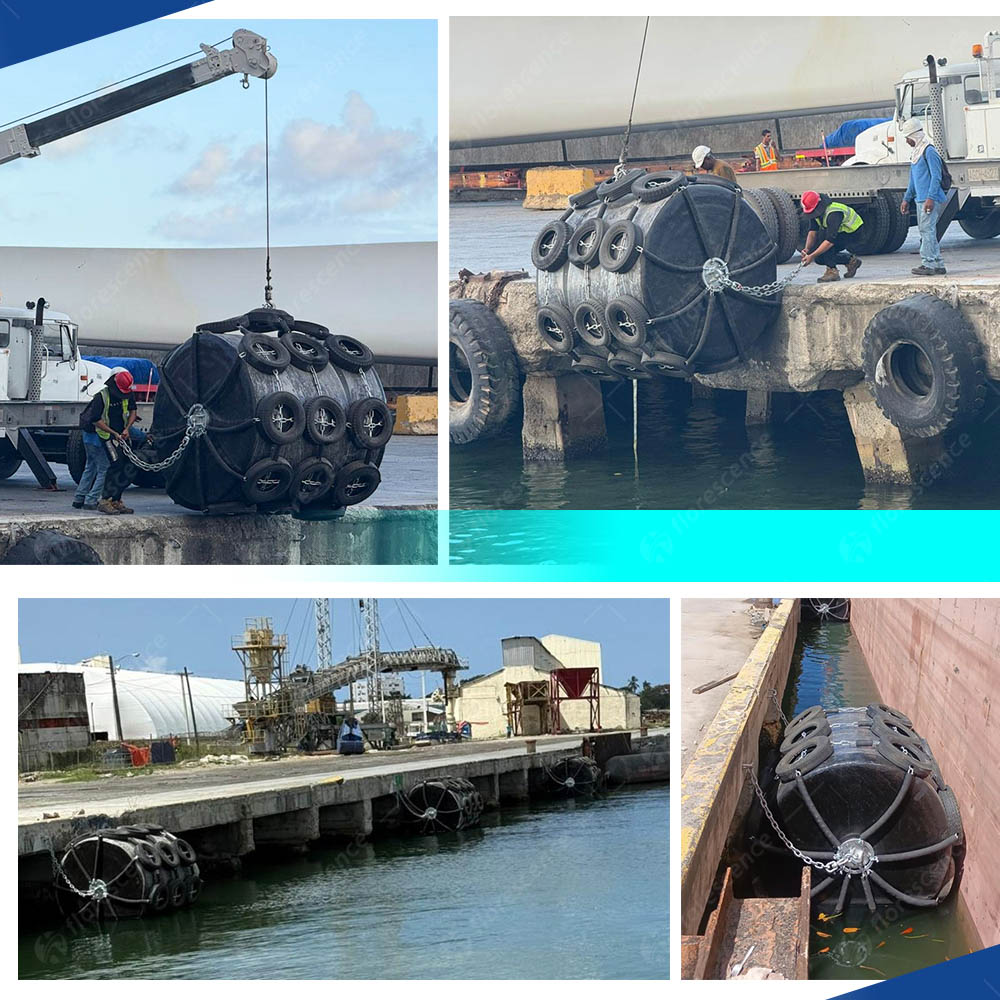
A Pneumatic rubber fender is a compressed-air-filled marine fender, classified as a pneumatic rubber fender of the Yokohama type and belonging to the marine fender category. It has been used as a marine anti-collision device for approximately 50 years. Construction uses natural rubber and nylon cord, with fittings including tyre net, shackle, swivel and chain, and it is supplied either as the CTN type (chain and tyre net) or as the sling type. Inner pressure is 50 or 80 kPa, the size range is diameter 0.5 to 4.5 m and length 1.0 to 12 m, and certification is available to CCS, BV, ISO, RS and ABS. It is designed for ship-to-ship (STS) contact, ship-to-quay (STQ) and ship-to-berthing (STB) operations, with typical uses at offshore platforms, oil and gas tankers, fast ferries and aluminium vessels, in ports with extreme tidal variations, and on fishing vessels, transport ships and ocean trawlers.
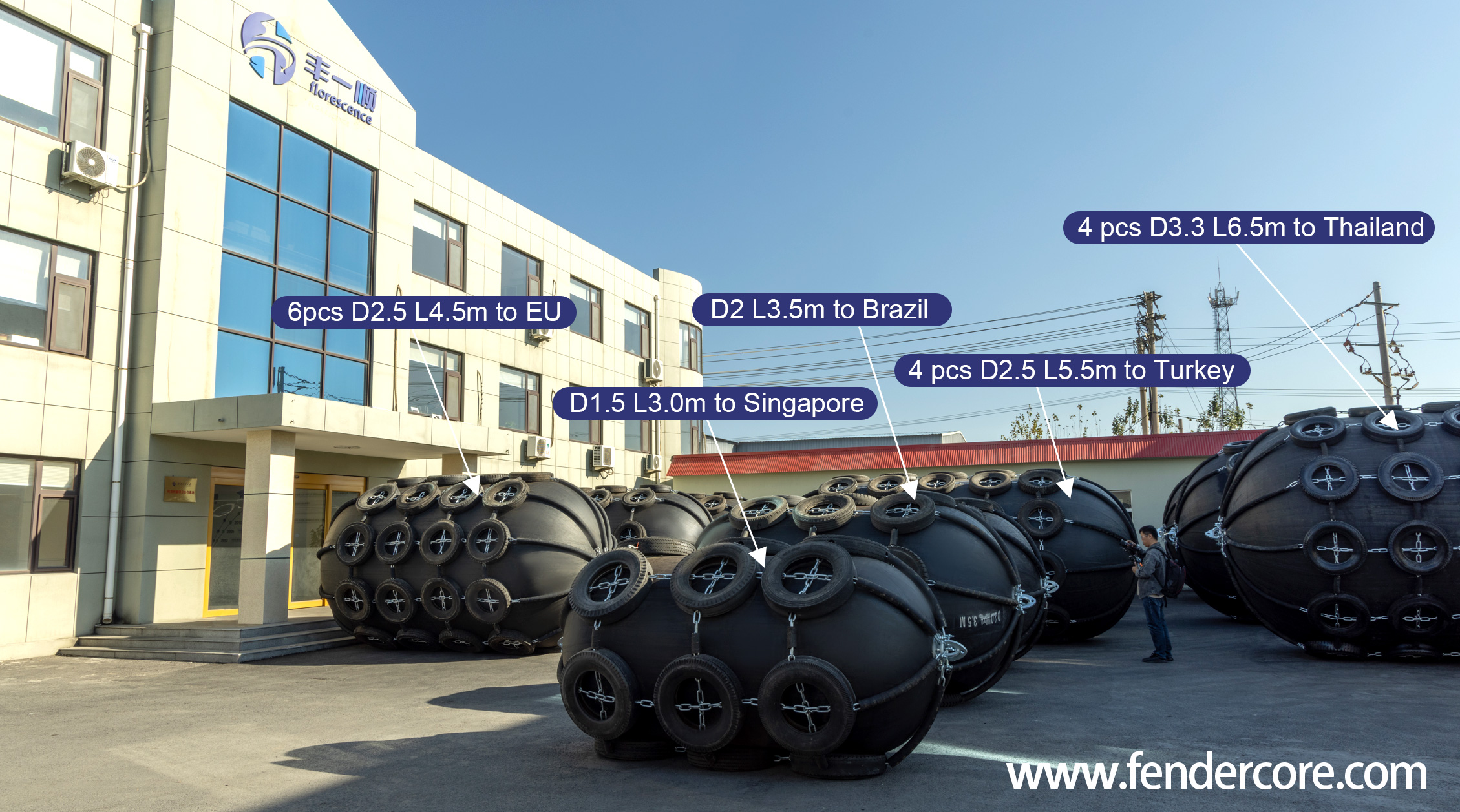
Pneumatic rubber fenders, Yokohama type, for STS, STQ and STB operations.
Operation of a pneumatic fender system follows a defined sequence: rig the fender to the hull or quay with chains and shackles; inflate to 50/80 kPa with an air compressor and verify with a gauge; float the fender at the waterline so it continuously absorbs impact energy during berthing; check internal air pressure periodically and adjust; then deflate, fold and store after use. Matched equipment typically includes chain-tyre net, shackles, swivel joints, towing rings, a frontal panel and PE pad system, a U-ring and chain system, and an air compressor.
Foam Fender
A Foam Fender uses a solid foam core with polyurethane polyurea coating, and it is unsinkable by design. It remains fully functional even if the skin is punctured, and because there is no air chamber it does not require air pressure maintenance, inflation or valves. It is maintenance-free and non-marking, available in multiple colours and shapes, with a size range of diameter 0.5 to 4.5 m and length 1.0 to 12 m, a service life of 5 to 8 years, and certification to CCS, BV, ISO, RS and ABS. It is designed for severe weather and storm conditions and is suitable for existing structures and certain hull types such as catamarans and cruise ships. Typical applications include offshore oil and gas, STS transfer operations, cruise and naval vessels, bulk ports and marinas, as well as tugboats, work boats, pilot boats, high seas terminals, gravity ports and large tidal piers.
Foam Fender — solid foam core with polyurethane polyurea coating, unsinkable by design.
Rubber Fender Comparison Table
The table below compares the main rubber fender categories on the parameters that most often decide a berth specification: configuration, working deflection, and where each type is normally used.
| Fender type | Configuration | Rated / max permissible deflection | Typical application focus |
|---|---|---|---|
| Cone fender | Conical cell body with overload stops | 70% / 72.5% | Large-tonnage vessel berthing, oblique berthing impact, container and bulk terminals, oil and LNG facilities |
| Cell Fender | Cell body, supports large panels | 52.5% / 55% | Low hull pressure systems, multi-user berths, container, bulk, oil, LNG and RoRo terminals |
| Arch Fender | One-piece arch, shear-resistant | 52.5% / 55% | RoRo berths, general cargo terminals, workboat harbours, barge and tug berths |
| Cylindrical Fender & Tug fender | Cylindrical body, hanging mounting | 50% / 60% | Bulk cargo berths, general cargo quays, RoRo and ferry terminals, tug havens, large tidal variation |
| D Fender | D profile, DD 100 to DD 500, length 1–3 m | 50% / 60% | Tugboat side protection, fishing harbours, inland terminals, marinas, shipyards |
| W Fender | W multi-arch cross-section, twin-leg attachment | 30% / 35% (heavy-duty models up to 50–52.5% rated) | Icebreakers, ocean-going and large harbour tugs, quay wall protection, bridge and pile protection |
| Square Fender | Square outer form, SD or SC centre, height 100–500 mm | Not specified for this profile | Fishing harbours, small jetties, marinas and pontoons, bunkering and workboat side belting |
| Pneumatic rubber fender | Compressed air, CTN or sling type, 50 or 80 kPa | Diameter 0.5–4.5 m, length 1.0–12 m | Ship-to-ship transfer, ship-to-quay berthing, offshore platforms, extreme tidal variations |
| Foam Fender | Solid foam core with polyurethane polyurea coating | Diameter 0.5–4.5 m, length 1.0–12 m, 5–8 year service life | Storm conditions, STS transfer, cruise and naval vessels, gravity ports, large tidal piers |
How to Specify a Rubber Fender System: Step by Step
Fender specification is a sequence, not a single decision. Working through the following steps in order prevents the most common purchasing error: buying a rubber block without checking whether the system that surrounds it will survive the berth.
- Step 1 — Fix the design inputs. Record vessel type and size, the range of vessels that will use the berth, tidal variation, exposure to swell and current, and the strength of the berth structure. A fender chosen for one vessel class can be wrong for a multi-user berth.
- Step 2 — Establish the design berthing condition. Reference the applicable design guidance for the project. PIANC guidance is widely cited in fender specifications, cell and arch fender designs are commonly referenced against PIANC, and floating pneumatic fenders are covered by ISO 17357-1:2014. Where a classification society is involved, the project requirements of CCS, BV, RS, ABS or LR may apply.
- Step 3 — Shortlist by berth type and tide. Use the comparison table above as a screening tool: cone and cell for high-energy large-tonnage berths, arch for RoRo and general cargo, cylindrical and tug fenders where tidal variation and multi-angle impact dominate, D and square fenders for tugs, workboats, marinas and small berths, W fenders where pushing contact and curved hulls are involved, pneumatic and foam fenders for floating and ship-to-ship duty.
- Step 4 — Check energy, reaction force and deflection together. Confirm that the fender absorbs the required energy at a deflection inside its working range, that reaction force stays within what the hull and structure can accept, and that hull contact pressure is acceptable — which is why cell fenders are chosen for low hull pressure systems and cone fenders for oblique contact.
- Step 5 — Specify the whole system, not just the rubber body. Define frontal panel type, UHMW-PE pad requirement, anchor bolts, chains and shackles, plus corrosion protection (hot-dip galvanizing, epoxy coating, marine paint systems or zinc-rich primer). Confirm the rubber compound — marine NR/SBR as standard, CR where oil resistance is needed, EPDM where UV and ozone resistance is needed — and the operating temperature range of −30 °C to +80 °C where relevant.
- Step 6 — Agree inspection and documentation before production. Define what is tested, by whom, and what paperwork accompanies the shipment: raw material testing, dimensional and hardness checks, compression testing on sample cell, cone or arch fenders to verify energy absorption and reaction force, and air-tightness testing for pneumatic fenders and airbags.
Where Rubber Fender Systems Are Used
Rubber fenders are widely used in ports, shipyards, vessel operations, offshore facilities, marine engineering and naval applications. In practice, the project types that drive most fender orders include ship-to-ship transfers, ship-to-quay berthing, ship-to-dock protection, commercial port and jetty construction, offshore oil and gas terminal operations, naval vessel operations, LNG and oil tanker bunkering, floating offshore platform mooring, and emergency marine rescue.
Different segments pull different products. Container, bulk, oil, LNG and RoRo terminals concentrate on cone, cell and arch fenders, often with large panels and low hull pressure requirements. Tug and workboat operators concentrate on D, W and cylindrical tug fenders, because those units are designed for continuous pushing, standing, stretching and leaning contact rather than occasional berthing. Fishing harbours, inland terminals, marinas and pontoons rely on D and square fenders where vessels are small and installation simplicity matters. Offshore platforms, STS transfer operations and ports with extreme tidal variation rely on floating pneumatic and foam fenders, which are designed to sit at the waterline and follow the vessel rather than the structure. Naval and governmental buyers typically add classification society inspection and documentation requirements on top of the base technical specification.
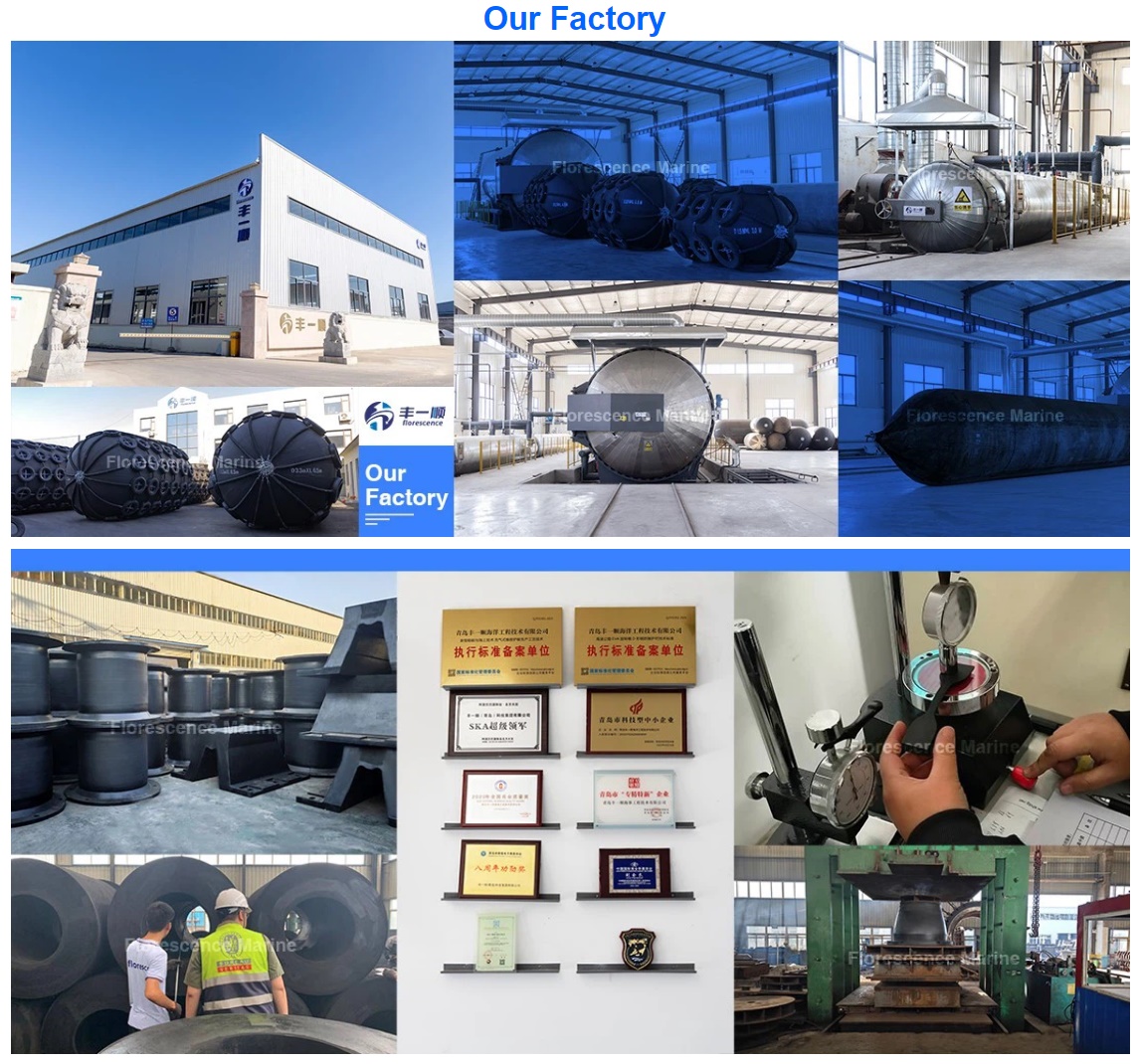
Fender manufacturing and inspection at the Florescence facility in Qingdao, China.
Buying Rubber Fenders from China: What to Verify
China is one of the main sourcing markets for port fendering, so the practical question for a port authority, contractor or importer is not whether Chinese fender manufacturers exist, but how to separate a real manufacturing operation from a trading listing. Verifiable facts are the fastest filter.
Qingdao Florescence Marine Supply Co., Ltd. is a marine rubber fender, pneumatic fender, foam fender and ship launching and salvage airbag manufacturer based in Qingdao, China, established in 1992 and serving global ports, shipyards, vessel operators and marine organisations. The company operates a 40,000 m² manufacturing facility with approximately 120 employees, an annual production capacity of about 2,000 pieces of marine rubber fenders and airbags, and an R&D team of 25 engineers supporting product design and marine project technical support. Approximately 95% of production is exported, with major markets in Southeast Asia, South America, Europe, North America, the Middle East and Africa. Over more than 30 years the company has supplied products to customers and maritime organisations in many countries, including naval references with the Bangladesh Navy, French Navy, Royal Thai Navy, Italian Navy and Philippine Navy.
Four checks matter most when evaluating a supplier of this kind:
- Quality system and product standards. Florescence designs, manufactures and tests in accordance with ISO 9001:2015 quality management requirements, and its products can be manufactured and inspected according to the applicable requirements of CCS, BV, RS, ABS and LR based on specific project requirements. Cell and arch fender designs reference PIANC standards, and pneumatic fenders sit within the ISO 17357 scope.
- Test and inspection records. Every production batch is subject to strict tests: rubber raw material testing, dimensional and hardness checks for rubber fenders, and air-tightness tests for pneumatic fenders and airbags. Third-party inspection is welcomed, and suppliers commonly work with agencies such as SGS, Bureau Veritas (BV) and LR. Physical property reports — tensile strength, elongation, compression — should accompany rubber products, and EN 10204 3.1 mill test certificates should accompany metal parts and bolts.
- Dimensional and coating control. Accurate size is critical for on-site assembly: hole patterns on UHMW-PE pads and the pitch of anchor bolts should be measured, and marine epoxy coating thickness on steel components should be checked with digital gauges to prevent paint peeling in seawater.
- Documentation before payment. A full Quality Inspection Report covering rubber test data, sizing sheets, coating thickness records and product photographs should be issued before shipment, so the buyer approves the goods against evidence rather than against a product photo alone.
One practical note for first-time importers: fender performance is verified by data, not by appearance. Ask for the energy absorption figure, the reaction force figure and the deflection at the intended working point — if a quotation does not state the working deflection, it cannot be compared with another quotation.
Frequently Asked Questions
1. Do rubber fenders manufactured in China meet international marine standards?
Compliance is normally demonstrated at three levels. First, the manufacturer's quality system: Qingdao Florescence Marine Supply Co., Ltd. designs, manufactures and tests its products in accordance with ISO 9001:2015 quality management requirements, with strict quality control from raw material selection through production, assembly, testing and final inspection. Second, the applicable product standard: ISO 17357-1:2014 specifies the requirements for high-pressure floating pneumatic rubber fenders, while cell and arch fender designs are commonly referenced against PIANC standards and project specifications. Third, independent verification: Florescence products can be manufactured and inspected according to the applicable requirements of leading marine classification societies, including CCS, BV, RS, ABS and LR, based on specific project requirements, and third-party inspection by agencies such as SGS and BV is welcomed. For a specific order, buyers should request the certificate scope, the test report and the inspection record for the goods actually shipped.
2. Which rubber fender types are available for port and ship protection?
A full marine rubber fender range covers cone fenders, cell fenders, arch fenders, cylindrical fenders, D fenders, tugboat fenders, foam filled fenders, pneumatic fenders, W type fenders and square fenders. Each type solves a different berthing problem: cone and cell fenders handle high-energy berthing at container, bulk, oil, LNG and RoRo terminals; arch fenders suit RoRo berths, general cargo terminals, workboat harbours and barge and tug berths; cylindrical and tug fenders suit general ports, fishing harbours, inland canals and shipyards with large tidal variation; D and square fenders suit tugs, workboats, marinas, small jetties and inland terminals; W fenders suit icebreakers, ocean-going tugs, large harbour tugs and bridge and pile protection; pneumatic and foam fenders provide floating protection for ship-to-ship transfer, offshore platforms and high-tidal berths.
3. How should buyers compare rubber fender quotations from different manufacturers?
Unit price alone is not a valid comparison, because a fender is sold as part of a system. Ask every supplier to quote the same scope: fender type and model, size, working deflection, rubber compound (marine NR/SBR as standard, with CR or EPDM as options), accessories included such as frontal panels, UHMW-PE pads, anchor bolts, chains and shackles, corrosion treatment, packing method, Incoterm and freight, test documentation, and delivery time. Confirm whether pneumatic fenders are shipped deflated to reduce freight cost, and whether arch and cone fenders are bundled on pallets for shipping. Where test documents and third-party inspection are required, make sure the cost is quoted rather than assumed. A quotation that states deflection, energy absorption and reaction force tolerances is more useful than one that only lists a size.
4. Can we verify fender performance before the full order ships?
Yes. Compression testing can be performed on sample cell, cone or arch fenders to verify that their energy absorption and reaction force meet the design specifications, using testing equipment at the manufacturer's facility. At batch level, the standard checks are rubber raw material testing, dimensional and hardness checks for rubber fenders, and air-tightness testing for pneumatic fenders and ship airbags, supported by an ISO 9001 certified quality system. Buyers who need additional assurance can appoint a third-party inspector: international agencies such as SGS, Bureau Veritas (BV) and LR are used regularly for marine fenders and steel structures, and the manufacturer cooperates with the buyer's chosen inspector. Before the final payment, a full Quality Inspection Report with rubber test data, sizing sheets, coating thickness records and product photographs can be issued, and shipment is made after the buyer's approval.
5. What is the typical lead time for a rubber fender order, and how do we start?
For standard rubber fenders and pneumatic fenders, production normally takes 25 to 30 days after deposit. For large custom orders or complete fender systems, the typical lead time is 40 to 45 days, and a clear schedule is provided before production begins. Projects that require classification society witness testing, custom colours or logo marking, or low-temperature compounds may need additional coordination, so these requirements should be stated at the enquiry stage. To start, send the vessel or berth parameters, the required fender type and size, and any certification or inspection requirements to inquiry@fendercore.com or WhatsApp +86 182-0532-1693, and request a specification and quotation for the project.
Choosing a Fender System That Can Be Maintained
Rubber fender selection ends with a system that can be inspected and maintained, not just installed. Regular inspection is recommended for rubber condition, bolt tightness, chain wear, corrosion status and panel alignment, because most fender failures in service are caused by loosened fixings, corroded steelwork or worn facing pads rather than by the rubber body itself. Designs that support maintenance should therefore be preferred where the operating environment is harsh: open-bore fenders that simplify bolt mounting, interchangeable cell fender types that allow replacement without redesigning the berth face, and face pad systems that can be renewed without replacing the fender.
A well-specified rubber fender system protects two assets at once — the vessel and the berth — and it does so for years under salt spray, UV exposure, tidal cycling and repeated impact. Getting there requires matching fender type to berth type, confirming energy absorption and reaction force against the structure, specifying the accessories and corrosion protection as part of the same package, and asking for test data that proves the numbers.
Next Step: Specification and Quotation
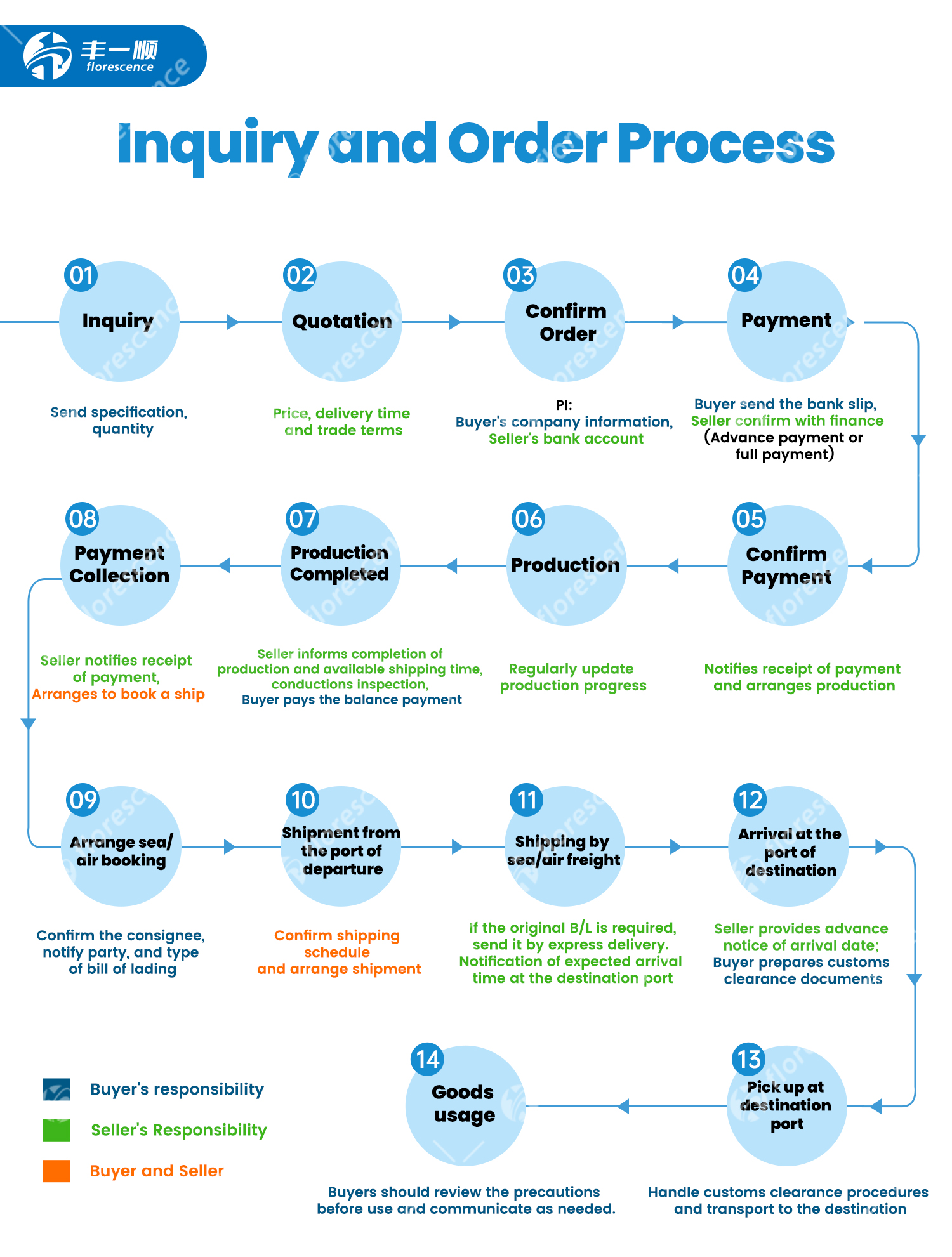
From enquiry to inspection and delivery — the Florescence order process.
Qingdao Florescence Marine Supply Co., Ltd. provides technical support covering product and specification selection, manufacturing, inspection, delivery and installation guidance, working with customers on vessel, site and project conditions.
Send your berth or vessel parameters to inquiry@fendercore.com or WhatsApp +86 182-0532-1693 to request a fender specification and quotation. The full 2026 product range — pneumatic fenders, dock and ship fenders, foam fenders and ship launching and salvage airbags — is available in the Florescence catalogue.
Website: www.fendercore.com
Address: 27th Floor, 10-2 Building, Optical Valley Software Park, Emeishan Road No. 396, Qingdao, China