
Cobra-691S Max vs NEXUS-350J: Packaging Printer or All-in-One Label System?
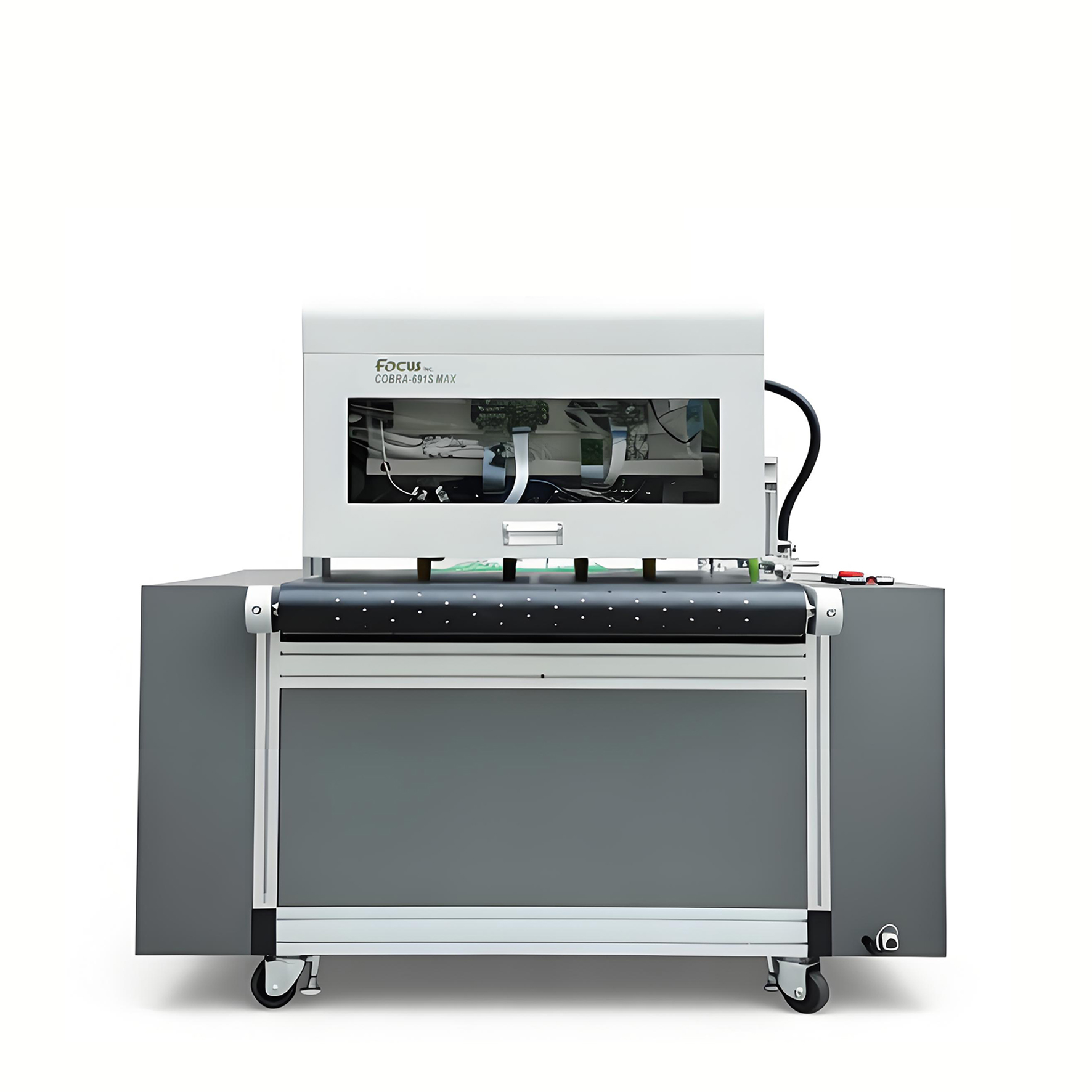
Short answer: the Cobra-691S Max and the NEXUS-350J are both single pass printers, but they are not substitutes for each other. The Cobra-691S Max is a plate-free packaging printing machine that prints flat, stacked work — paper bags, cup fans, cardboard, pizza boxes, coffee bags — at 20–40 metres per minute. The NEXUS-350J is an all-in-one label digital printer and die-cutting system that prints roll label film at 1–2 metres per minute and finishes it inline with lamination, digital die-cutting, foil transfer and slitting.
Choose on the job, not on the specification sheet. If your deliverable is a finished sticker roll or a die-cut label, the Cobra-691S Max cannot produce it. If your deliverable is a stack of printed bags, cartons or corrugated board, the NEXUS-350J cannot produce it at packaging throughput. This guide compares the two across the seven points where the decision actually turns, then closes with a purchasing-terms and acceptance-criteria checklist you can paste into an RFQ.
Problem definition: one search term, two different factories
"Single pass printer" describes an architecture, not a product. In a single pass system the printheads are stationary across the full web or sheet width and the substrate moves past them once. That is why a 220 kg bag printer and a 2,000 kg label line can both be described correctly as single pass printers.
Buyers searching for a single pass printer, a one pass printer or a digital inkjet print system therefore land on packaging machines and label machines in the same session. Four mismatches follow, and each one is expensive to discover after installation.
- Substrate mismatch. The Cobra-691S Max is fed with individual flat pieces from a stack — corrugated paper, paper bags, cup fans, cup sleeves, pizza boxes, coffee bags, envelopes, cards and similar absorbent stock. The NEXUS-350J is fed from a roll — BOPP, POPP, PET, PE, PP and PVC label film, label paper and synthetics, glossy or matt.
- Ink mismatch. The Cobra-691S Max runs water-based ink in CMYK. The NEXUS-350J accepts UV type ink or water-based ink and can print White + White + KCMY + Varnish, with glue optional depending on head count. Water-based ink on absorbent paper and UV ink on non-absorbent film are different chemistry decisions, not preferences.
- Throughput mismatch. One machine is rated 20–40 m/min, the other 1–2 m/min. Those figures describe two different production models, and reading them as a simple speed race is the most common buying error in this category.
- Finishing mismatch. The Cobra-691S Max prints and discharges. The NEXUS-350J laminates, digitally die-cuts, applies foil transfer and slits in the same pass. If you budget separately for a die-cutter and a laminator, you have already answered the question.
What each system actually is
FocusInc is the brand of Shanghai Focus Industrial Co., Ltd., a Shanghai-based manufacturer of industrial digital inkjet printing equipment founded in 2008, operating its own factory from 2018 and recognised as a national high-tech enterprise from 2022. Its product matrix runs from multi-pass scanning printers to high-speed single pass printers, and both machines compared here sit inside that matrix.
Cobra-691S Max: plate-free packaging printing
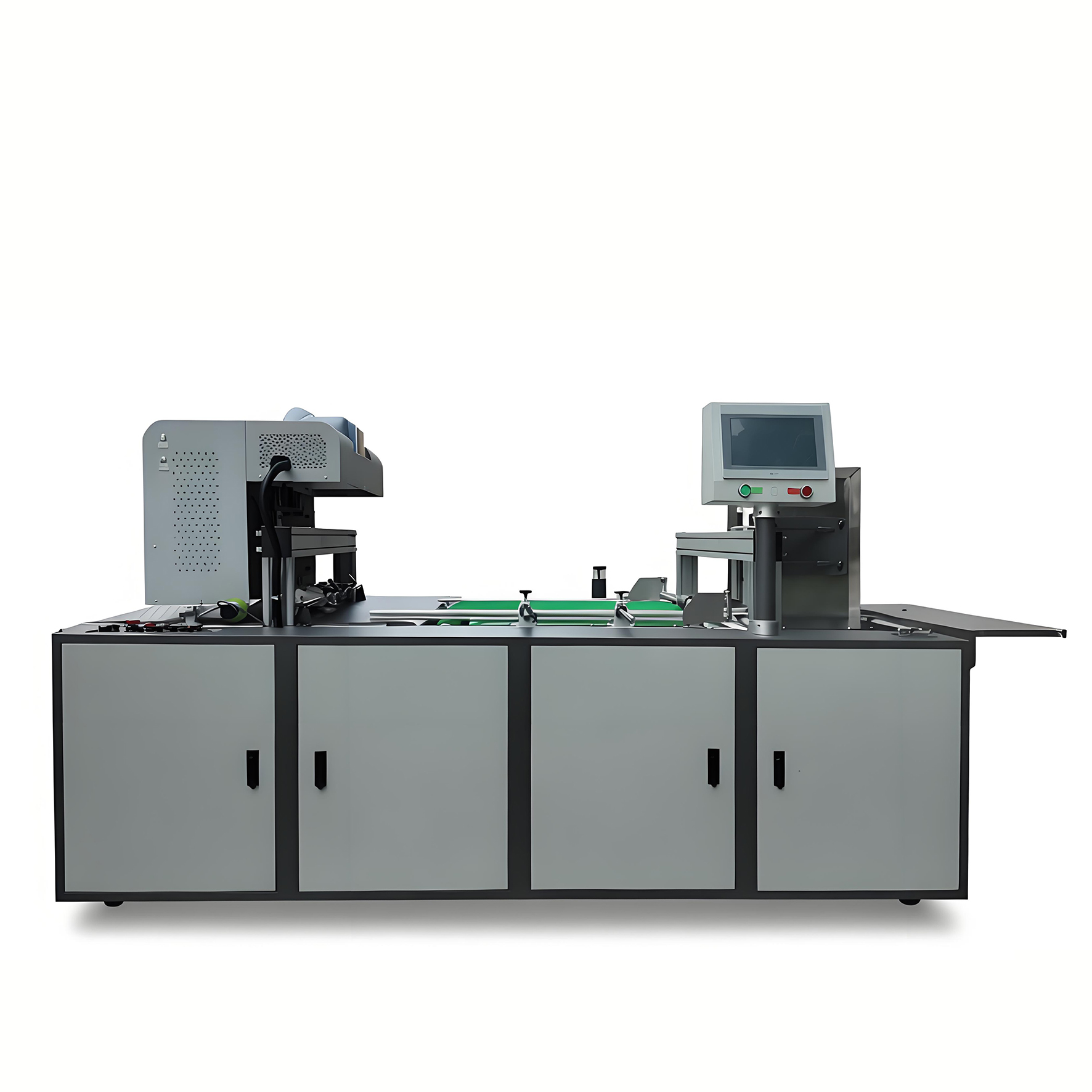
The Cobra-691S Max is a single pass printing solution for packaging printing, supplied as a 900 file bag, paper cup and paper bag digital printing machine. It carries 1–3 HP A3/A4 pagewide printheads with a maximum printing width of 215–645 mm and prints at 1200×300 dpi, 1200×600 dpi or 1200×1200 dpi. The printing platform is vacuum adsorption type, driven on both the X and Y axes by servo motor transmission, with rear feeding and front discharging over a servo conveyor belt. It handles water-based ink in CMYK at 2.5 L per colour, uses siphon ink supply, prints at 20–40 metres per minute, accepts up to 900 mm of material feeding width with unlimited length, and offers a printing height of 0–55 mm, customisable. The machine weighs 220 kg, measures 2,800 × 1,400 × 1,360 mm, runs on 220 VAC 50 Hz at 3 kW and connects over Ethernet. Documented consumable cost is 0.1–0.2 RMB per square metre, and plate-making is replaced by digital typesetting from computer software.
NEXUS-350J: a label line inside one frame
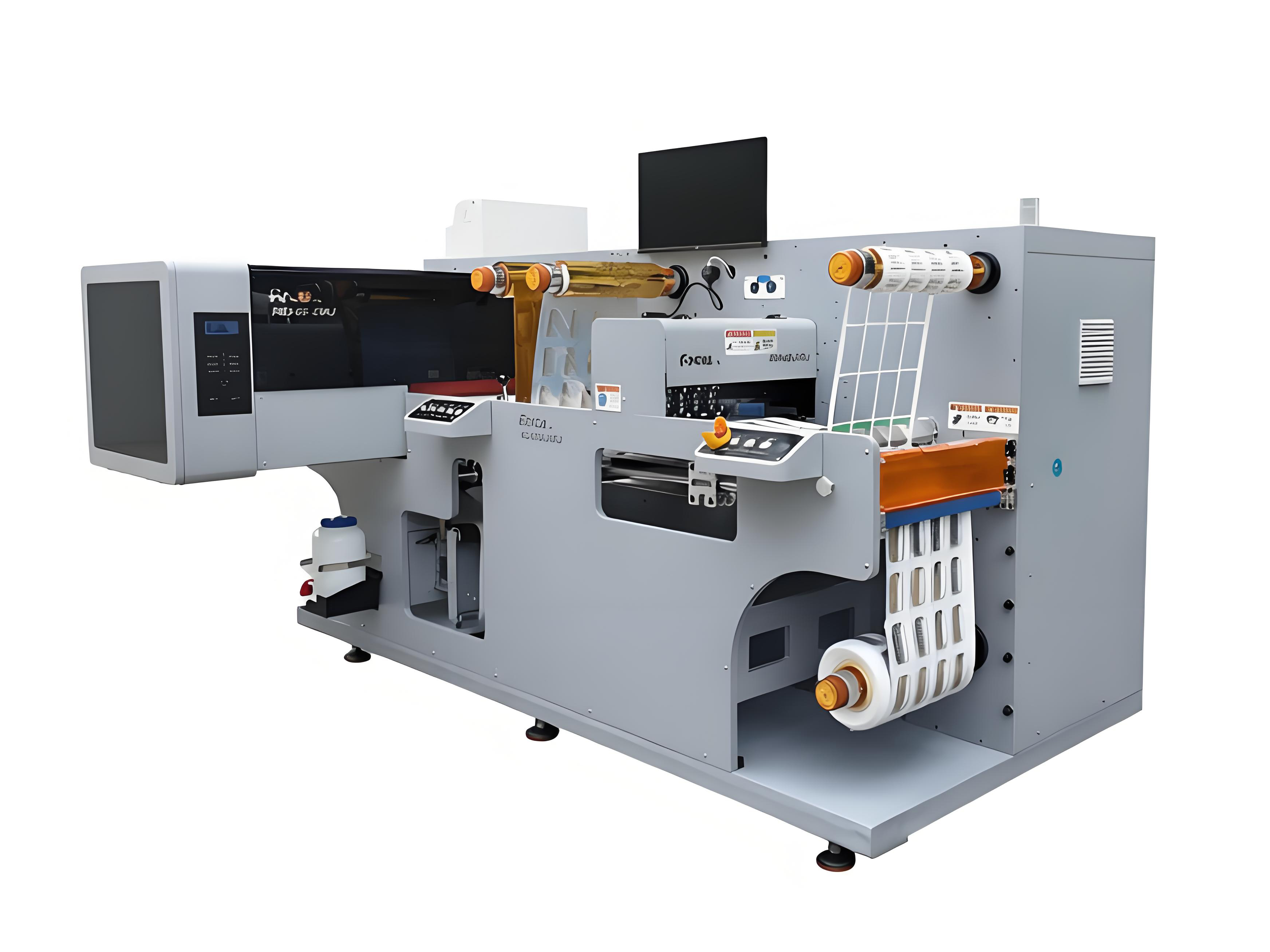
The NEXUS-350J is an all-in-one label digital printer and die-cutting system — label digital printing, lamination, die-cutting and slitting in a single machine. Printing uses piezo inkjet technology with 1–4 EPSON i3200-U1 piezo printheads, each carrying 3,200 nozzles arranged as 400 × 8 rows. Jetting frequency is 21.6–43.2 kHz with a variable drop volume of 3.5–12.5 pl and 2–4 greyscale, producing 720×720 dpi, 720×1080 dpi or 720×1440 dpi. Print speed is 1–2 metres per minute depending on image, label size and print model. Roll media loads at up to 350 mm width with a maximum individual label size of 330 × 300 mm, handled by automatic release unwinding, automatic tension take-up, an automatic adsorption aluminium vacuum table and an electronic correction device with full-follow tension control. Ink is UV type or water-based, with 500 mL per colour and an automatic white ink stirring system plus an automatic white ink circulation system. Inline finishing covers automated electronic lamination at 0–100 °C adjustable, digital die-cutting for regular or irregular shapes with 4 digital die-cutting knives at 0.05 mm precision, gold or foil stamp transfer, and physical slitting with 5 slitting knives.

Industry background: why both categories are growing at once
The global digital printing for packaging market was valued at USD 31.64 billion in 2023 and is projected to reach USD 75.55 billion by 2032, according to Zion Market Research. Forecasts diverge sharply for the same 2032 horizon — SNS Insider models USD 62.75 billion and Credence Research models USD 27.44 billion — so any single figure should be treated as directional rather than precise. What the range does show is consistent double-digit directional growth in digital packaging print, which is the condition that makes plate-free equipment worth evaluating at all.
Within the wider digital printer market, the inkjet digital printers segment accounted for the largest share at 42.5% as of 2025, per Straits Research. On the demand side, China produced more than 88 billion square metres of corrugated board in 2024, according to the China Packaging Federation as reported by Dataintelo — the volume that drives regional demand for single pass packaging equipment.
Two regulatory points matter when you scope either purchase. Industrial single pass printers placed on the EU market must comply with the Low Voltage Directive (2014/35/EU) and the EMC Directive for CE marking. And where ink consumption or yield is claimed, digital printing yields for colour inkjet systems are standardised under ISO/IEC 24711 and ISO/IEC 24712, which exist so that ink consumption reporting can be compared between suppliers.
Where the two machines actually diverge
1. Substrate and job geometry
The Cobra-691S Max takes corrugated paper, paper bags, cup fans, cup sleeves, postcards, coated paper, pizza boxes, shopping bags, coffee bags, paper cups, envelopes, cards and napkins, fed as flat pieces from 600 mm up to 900 mm of feeding width with unlimited length, printing 215–645 mm wide at a printing height of 0–55 mm. The NEXUS-350J takes roll film and label stock — BOPP, POPP, PET, PE, PP, PVC, foil paper and label paper — at up to 350 mm web width, producing individual labels up to 330 × 300 mm. Sheet format and roll format are not convertible on either machine.
2. Ink chemistry and curing
The Cobra-691S Max runs water-based ink in CMYK at 2.5 L per colour over four colours, delivered by siphon ink supply onto a thermal bubble printhead platform. Water-based ink keyed into absorbent paper packaging is the reason the packaging platform can run at 20–40 m/min without a UV curing station. The NEXUS-350J accepts UV type ink or water-based ink, and the standard colour set scales with head count to White + White + KCMY + Varnish with glue optional, at 500 mL per colour. Two NEXUS-specific systems matter on film: automatic white ink stirring and automatic white ink circulation, both aimed at preventing white ink sedimentation on transparent and dark substrates.
3. Throughput: reading 20–40 m/min against 1–2 m/min correctly
The Cobra-691S Max is rated 20–40 metres per minute. The NEXUS-350J is rated 1–2 metres per minute depending on image, label size and print model. The gap is real but it is not a like-for-like comparison, because the label line is completing lamination, digital die-cutting, foil transfer and slitting inside that number, and because label geometry is far denser than bag graphics. The usable comparison is your own arithmetic: take the linear metres your job consumes per shift, add the converting passes you would otherwise run separately, and compare total finished units per shift and per operator hour.
4. Print engine, resolution and drop size
The Cobra-691S Max uses 1–3 HP A3/A4 pagewide printheads on thermal bubble inkjet technology, at 1200×300, 1200×600 or 1200×1200 dpi. The NEXUS-350J uses 1–4 EPSON i3200-U1 piezo printheads at 3,200 nozzles each, 21.6–43.2 kHz jetting frequency, variable 3.5–12.5 pl drop volume and 2–4 greyscale, at 720×720, 720×1080 or 720×1440 dpi. Practically: thermal bubble supports very high line speed on absorbent stock, while piezo supports wider ink compatibility including UV and finer tone control on non-absorbent film. Both engines carry carriage anti-scratch protection; the NEXUS adds an automatic keep-wet cap station with clean flashing during printing and idle, and the Cobra-691S Max uses a fast snap-in ink stack for head maintenance.
5. Inline finishing: the biggest cost divider
This is where the two machines stop being comparable. The Cobra-691S Max prints and discharges; it has no inline converting. The NEXUS-350J performs automatic electronic lamination after printing with adjustable temperature from 0 to 100 °C, digital die-cutting for regular or irregular shapes using 4 digital die-cutting knives at 0.05 mm precision, gold and silver foil transfer for enhancement, physical slitting with 5 slitting knives, automatic waste removal, and automatic tension-controlled unwinding and rewinding. If your label order needs a laminated, die-cut, slit finished roll delivered as one unit, that is the specification that decides the purchase.
6. Footprint, power and site requirements
The Cobra-691S Max occupies 2,800 × 1,400 × 1,360 mm, weighs 220 kg, runs on 220 VAC 50 Hz at 3 kW with an Ethernet connection, and operates at normal temperature 15–35 °C. The NEXUS-350J occupies 2,400 × 2,000 × 1,450 mm, has a net weight of 2,000 kg and a gross weight of 2,300 kg, needs a 25 A single-phase 220 V 50 Hz supply at 3,000 W, runs at 15–30 °C and 40–80% relative humidity, and ships in a 2,600 × 2,100 × 1,750 mm crate. The label line is roughly nine times heavier and needs rigging, floor loading review and a controlled-humidity room.
7. Consumables and cost structure
The Cobra-691S Max documents a consumable cost of 0.1–0.2 RMB per square metre, which is the cleanest running-cost anchor available on either machine. The NEXUS-350J exposes cost through configuration instead: ink at 500 mL per colour, white ink stirring and circulation to protect uptime, and inline finishing that removes separate converting passes, transport and re-registration. On both machines the structural cost drivers are head count, ink system, automation level and whether converting hardware is included.
Side-by-side comparison
| Decision point | Cobra-691S Max | NEXUS-350J |
|---|---|---|
| Primary job | Plate-free packaging printing (bags, cups, cup fans, cardboard, boxes) | Colour label printing with inline converting |
| Print engine | 1–3 HP A3/A4 pagewide printheads, thermal bubble inkjet technology | 1–4 EPSON i3200-U1 piezo printheads, piezo inkjet technology |
| Resolution | 1200×300, 1200×600, 1200×1200 dpi | 720×720, 720×1080, 720×1440 dpi |
| Print speed | 20–40 metres per minute | 1–2 metres per minute (depends on image, label size, print model) |
| Media format | Flat pieces, rear feeding & front discharging, servo conveyor belt | Roll type, automatic tension unwinding and rewinding |
| Media width | Up to 900 mm feed width, unlimited length, 215–645 mm printing width | Roll up to 350 mm; maximum label 330 × 300 mm |
| Media types | Corrugated paper, paper bags, cup fans, cup sleeves, postcard, coated paper, pizza boxes, shopping bags, coffee bags, paper cups, envelopes, cards, napkins | BOPP, POPP, PET, PE, PP, PVC label or film, foil paper, label paper, synthetics, glossy, matt |
| Ink type | Water-based ink | UV type ink or water-based ink |
| Ink colours | CMYK | White + White + KCMY + Varnish (glue optional, depends on head count) |
| Ink capacity | 2.5 L per colour, 4 colours | 500 mL per colour |
| Ink handling | Siphon ink supply | Automatic white ink stirring and automatic white ink circulation |
| Platform | Vacuum adsorption platform, servo X-axis and Y-axis transmission, quenched & tempered steel beam, all-steel frame | Automatic adsorption aluminium vacuum table, electronic correction device with full-follow tension control |
| Formatting / plate | Digital typesetting via computer software, no plate-making | Digital die-cutting for regular or irregular shapes, no plate-making |
| Inline finishing | None (print and discharge) | Lamination, digital die-cutting, foil transfer, slitting, waste removal |
| Finishing detail | — | Lamination 0–100 °C adjustable; 4 die-cutting knives at 0.05 mm precision; gold and foil stamp transfer; 5 slitting knives |
| Printing height / thickness | 0–55 mm, customisable | Roll material format; label size up to 330 × 300 mm |
| Machine size | 2,800 × 1,400 × 1,360 mm | 2,400 × 2,000 × 1,450 mm |
| Weight | 220 kg | Net 2,000 kg, gross 2,300 kg |
| Power | 220 VAC 50 Hz, 3 kW | 25 A single-phase 220 V 50 Hz, 3,000 W |
| Environment | Normal temperature 15–35 °C | 15–30 °C, humidity 40–80% |
| Documented consumable cost | 0.1–0.2 RMB per square metre | Not published; driven by ink volume and finishing modules |
| Best fit | Packaging printers producing printed bags, cups, trays and board | Label converters delivering finished laminated and die-cut label rolls |
Step-by-step: how to make the call in seven steps
- Name the finished product first. Write down what physically leaves your facility. A finished laminated die-cut label roll points to the NEXUS-350J. A stack of printed bags, cup fans or box board points to the Cobra-691S Max.
- Match the machine to the substrate format. Roll or sheet. The NEXUS-350J loads roll media up to 350 mm wide; the Cobra-691S Max feeds flat pieces up to 900 mm wide with unlimited length.
- Pick the ink before the machine. Absorbent paper packaging with water-based CMYK suits the Cobra-691S Max. Transparent or dark film needing white ink and varnish suits the NEXUS-350J, which can run UV type ink or water-based ink.
- Decide whether finishing must be inline. If lamination at 0–100 °C, 0.05 mm digital die-cutting, foil transfer and 5-knife slitting are required in one pass, only the NEXUS-350J qualifies.
- Run the throughput arithmetic on your own job. Compare finished units per shift and per operator hour, not metres per minute in isolation, since the label line absorbs four converting passes into its stated speed.
- Check the site, not just the specification. 220 kg against 2,000 kg changes flooring, rigging, room height, humidity control and power: 3 kW on 220 VAC 50 Hz versus a 25 A single-phase 220 V 50 Hz supply at 3,000 W.
- Verify compliance and sign off on samples. Request documentation that names your exact model, then approve a physical sample printed on your own substrate as the acceptance reference.

Use cases: who runs each platform
Label converting in Vietnam. A label manufacturer running 1 unit for 2 years prints roll-to-roll label sticker stock for the daily chemical sector, general packaging labels and cold-chain logistics labels. The documented outcome is rapid order processing and delivery with personalised custom printing, no minimum order quantity, and variable-data QR codes printed without plate-making, supported as a one-stop printing and production solution.
Corrugated packaging across five markets. A corrugated cardboard box, honeycomb board and carton packaging manufacturer running 18 units across 4 years prints colour corrugated boxes for home appliance and digital product packaging, express-delivery turnover boxes, plus small gift boxes, shoe boxes and pizza boxes, and prints variable data such as QR codes on the exterior of corrugated turnover boxes. The documented outcome is the ability to take multi-batch personalised packaging orders with short order lead time, frequent job switching, waste-free printing and expansion into higher-margin custom packaging work.
Scenario routing across the FocusInc single pass range:
- 900 mm paper bags, cup fans, pizza boxes, cardboard → Cobra-691S Max (20–40 m/min)
- 1,230 mm corrugated and honeycomb board → Cobra-1209S (10–35 m/min, 1,230 mm load width)
- Up to 1,800 mm board, 1–5 A3 heads → Cobra-1815S (10–35 m/min)
- Desktop and start-up packaging work → Falcon-491S (10–25 m/min) or Falcon-491S Pro (10–17 m/min, automatic friction feeder)
- Roll labels without inline finishing → Viper-391S or Viper-391S Pro (10–40 m/min, up to 320 mm web, up to 1200×2200 dpi)
- High-speed UV label and in-mould label film → S350 Jetpress (20–80 m/min, W+CMYK, EPSON S3200U1/U3 heads)
- Labels requiring lamination, die-cutting and slitting inline → NEXUS-350J
- Industrial UV work and container side printing → Acaleph-891S series
Purchasing terms and acceptance criteria checklist
Commercial terms to confirm in writing
- Minimum order quantity: 1 unit.
- Lead time: 15–45 days, depending on the solution.
- Production capacity: 40 sets per month under the ODM programme; 120 sets per month under the OEM programme.
- Customisation, ODM: custom printing workflow for regular, special and customised substrates; full custom pre-processing and post-processing inline automation matching; exclusive machine structural design; housing colour; private brand logo; multi-language touch screen system; custom print width and feeding size to fit your production line.
- Customisation, OEM: machine housing colour, brand logo printing, multi-language operating system, matched pre-print and post-print auxiliary equipment layout, and standard printing parameter tuning for regular materials.
- Quality control, ODM: 100% continuous running aging test before delivery, full customised function verification test, and support for SGS or CE third-party inspection.
- Quality control, OEM: 100% full machine pre-shipment running test, with third-party factory audit and inspection available on client request.
- After-sales: global online remote technical support, overseas on-site installation and training, a 3-year machine warranty under ODM plus lifelong technical consultation and spare parts supply; under OEM, online remote technical training and troubleshooting, on-site overseas engineer service, a 13-month free warranty and lifetime spare parts supply with technical upgrade guidance.
- Export markets served: EU, USA, Australia, Southeast Asia, Middle East and Latin America.
Acceptance criteria checklist
- Print width verified against your largest sheet or web: 215–645 mm on the Cobra-691S Max; roll up to 350 mm and labels up to 330 × 300 mm on the NEXUS-350J.
- Feed width and length verified: 900 mm with unlimited length on the Cobra-691S Max.
- Printing height verified for thick or irregular work: 0–55 mm, customisable, on the Cobra-691S Max.
- Resolution at production speed confirmed on your own artwork: 1200×300, 1200×600 or 1200×1200 dpi.
- Ink type, colour set and volume confirmed: water-based CMYK at 2.5 L per colour, or UV/water-based White + White + KCMY + Varnish at 500 mL per colour.
- White ink handling confirmed where clear or dark film is used: automatic stirring and automatic circulation.
- Finishing specification confirmed: lamination 0–100 °C, 4 digital die-cutting knives at 0.05 mm precision, foil transfer, 5-knife slitting.
- Media handling confirmed: servo conveyor belt feeding with vacuum adsorption platform, or automatic tension unwinding and rewinding with electronic correction.
- Site services confirmed: 220 VAC 50 Hz at 3 kW, or 25 A single-phase 220 V 50 Hz at 3,000 W; 15–35 °C, or 15–30 °C at 40–80% humidity.
- Rigging and floor loading confirmed: 220 kg against a 2,000 kg net machine weight and 2,300 kg gross weight.
- Test records and inspection rights confirmed: aging test and function verification test under ODM, pre-shipment running test under OEM, third-party inspection on request.
- Compliance documents confirmed to name your exact model, and a physical sample on your own substrate approved as the reference standard.
Compliance and certification: what the paperwork should name
FocusInc holds CE certification for the Cobra-1815S single pass packaging printer to EN 1010-2:2006+A1:2010, certificate number SCT260301170121, issued by ANXIN PRODUCT TEST SERVICE CO., LTD. and applicable to the EU market. The Acaleph-891S e multi-functional digital inkjet printer holds CE certification to EN 55011:2016+A2:2021, EN IEC 61000-6-2:2019 and EN IEC 61000-6-4:2019, certificate number SCT260301170122, issued by the same body for the EU market.
For Germany, the Cobra-691S AS B single pass packaging printer is registered under the ElektroG (WEEE) scheme as WEEE-Reg.-Nr. DE 87336785, issued by stiftung elektro-altgeräte-register (Stiftung EAR). The Acaleph-891S e also carries a WEEE authorised-representative confirmation for Germany under Sendungs-ID SI-202502-148048.
On the intellectual property side, the NEXUS-350J all-in-one label digital printer and die-cutting system is covered by a Utility Model Patent Certificate (Patent No. ZL 202222415831.8) issued by the China National Intellectual Property Administration (CNIPA) for Mainland China. The Cobra-691S single pass packaging printer is protected by design patent ZL 2020 3 0330833.0 and trademark registration 34874480 covering Class 7 goods, both issued by CNIPA for Mainland China.
Frequently asked questions
How do I verify that a single pass printer manufacturer is genuinely CE-certified?
Ask for the certificate rather than the claim. FocusInc holds CE certification for the Cobra-1815S single pass packaging printer to EN 1010-2:2006+A1:2010, certificate number SCT260301170121, issued by ANXIN PRODUCT TEST SERVICE CO., LTD. for the EU market, and for the Acaleph-891S e multi-functional digital inkjet printer to EN 55011:2016+A2:2021, EN IEC 61000-6-2:2019 and EN IEC 61000-6-4:2019, certificate number SCT260301170122, from the same issuer. For Germany, request the ElektroG (WEEE) registration, such as WEEE-Reg.-Nr. DE 87336785 held for the Cobra-691S AS B. Check that the document names your exact model and configuration, and that the issuer, standard and certificate number are all readable on it.
Can one single pass printer handle both packaging printing and label printing?
Not well, which is why both machines exist. Packaging printing needs a wide flat transport path for stacked sheets: the Cobra-691S Max feeds up to 900 mm wide with unlimited length, prints 215–645 mm wide at 20–40 m/min with water-based CMYK ink on corrugated paper, paper bags, cup fans, pizza boxes and coffee bags, and offers printing height of 0–55 mm. Label printing needs roll handling, white ink and inline converting: the NEXUS-350J loads roll media up to 350 mm wide, prints labels up to 330 × 300 mm using White + White + KCMY + Varnish ink sets on BOPP, POPP, PET, PE, PP and PVC, and finishes with lamination, digital die-cutting and slitting. FocusInc separates the work across its range — Cobra-691S, Cobra-691S Max, Cobra-1209S (1,230 mm load width, 10–35 m/min) and Cobra-1815S (1,800 mm load width) for packaging; Viper-391S and Viper-391S Pro (up to 320 mm web, 10–40 m/min), S350 Jetpress (20–80 m/min, W+CMYK) for labels; and NEXUS-350J for labels with inline finishing.
What drives the cost of a single pass printer system?
Configuration, not brand. The largest variables are printhead count and type — 1–3 HP A3/A4 pagewide heads on the Cobra-691S Max, 1–4 EPSON i3200-U1 piezo heads on the NEXUS-350J — the ink system, and whether converting hardware is included. Water-based CMYK at 2.5 L per colour anchors the packaging machine, where the documented consumable cost is 0.1–0.2 RMB per square metre. The label system adds UV or water-based ink at 500 mL per colour with white ink stirring and circulation, plus lamination at 0–100 °C, four digital die-cutting knives at 0.05 mm precision, foil transfer and five-knife slitting. Feeding and collection automation, custom print width, housing design and multi-language or private-label interface requirements add on top. Minimum order quantity is 1 unit and lead time is 15–45 days depending on the solution.
Can I test the machine on my own material before buying?
Yes. FocusInc prints samples before order and maintains a sample display area, and customers visit the factory for sample testing and to watch machine operation. Send a written sample brief covering your substrate, grammage or film thickness, artwork, target resolution, required speed and finishing steps, then keep the physical output as the acceptance reference. For soft substrates such as non-woven and fabric bags, a plasma surface-treatment unit can be fitted to improve ink adhesion.
What is the lead time, and what support comes after delivery?
Lead time is 15–45 days depending on the solution, with a minimum order quantity of 1 unit. Monthly capacity is 40 sets under the ODM programme and 120 sets under the OEM programme. Every machine is tested before shipment: a 100% continuous running aging test plus a full customised function verification test under ODM, or a 100% full machine pre-shipment running test under OEM, with SGS or CE third-party inspection available on request. After delivery, support includes global online remote technical assistance, overseas on-site installation and training, a 3-year machine warranty under ODM or a 13-month free warranty under OEM, and lifetime spare parts supply. To move forward, request a quotation or a sample print on your own material.
Conclusion
Both machines print in a single pass and both come from the same manufacturer, which is why they keep appearing in the same shortlist. The decision is made by your finished product, not by the specification sheet. Water-based CMYK packaging work on stacked sheets and board at 20–40 metres per minute points to the Cobra-691S Max. Finished label rolls that need white ink on film plus lamination, 0.05 mm digital die-cutting and five-knife slitting in one pass point to the NEXUS-350J. If your packaging spread runs wider than 900 mm, look at Cobra-1209S or Cobra-1815S instead; if you need label speed without inline converting, look at Viper-391S Pro or S350 Jetpress.
Once the machine is chosen, the remaining work is commercial: a lead time of 15–45 days, a 1-unit minimum order, OEM or ODM customisation, test records before shipment, and compliance documents that name your exact model. Settle those five points and the acceptance test becomes a formality.
Next step
Send your substrate, artwork and required output per shift, and ask FocusInc (Shanghai Focus Industrial Co., Ltd.) for a written configuration proposal plus a sample print on your own material. The company exports approximately 95% of its output, serving the EU, USA, Mexico, Brazil, Chile, Australia, Canada and the UK, and supports both OEM and ODM programmes from a single unit.
Website: www.focusincprinter.com | Email: info@focusdgt.com | Tel / WhatsApp: +86 177 6513 2139
Download the factory introduction brochure: FocusInc Factory Intro (PDF)
Have Questions or Need More Details?
Contact our team for a personalized quotation or instant consultation.
Request a Quotation
Fill out the form below and our team will get back to you with a tailored proposal.
WhatsApp Direct Chat
Prefer to chat in real-time? Message us on WhatsApp for instant assistance & quick answers.
- Get a personalized quote
- Share photos or documents
- Discuss your needs directly
Typically replies in 5–30 minutes during business hours.