
How to Compare Single Pass Printer Systems for Corrugated, Labels, Bags & More
How to Compare Single Pass Printer Systems for Corrugated, Labels, Bags & More
Single pass printer comparison can be reduced to one useful question: which machine is built to move my substrate the way I run it in production? A single pass printer is a digital inkjet system that prints a complete image in one pass because it uses a fixed printhead array or a page-wide printhead instead of a scanning carriage. Buyers who compare single pass printer systems should look at media width and thickness limits, roll or sheet feeding, printhead technology, ink chemistry, line integration, and the manufacturer’s ability to customize the machine around the customer’s production line.
Industry data from Zion Market Research, cited in packaging market reporting, values the global digital printing for packaging market at USD 31.64 billion in 2023 and projects it to reach USD 75.55 billion by 2032. That context helps explain why packaging, corrugated, bag, label and container producers are assessing one-pass digital inkjet equipment more seriously. For procurement teams moving from evaluation to execution, the practical comparison is not between vague marketing categories; it is between verified machine specifications and proven supplier workflows.
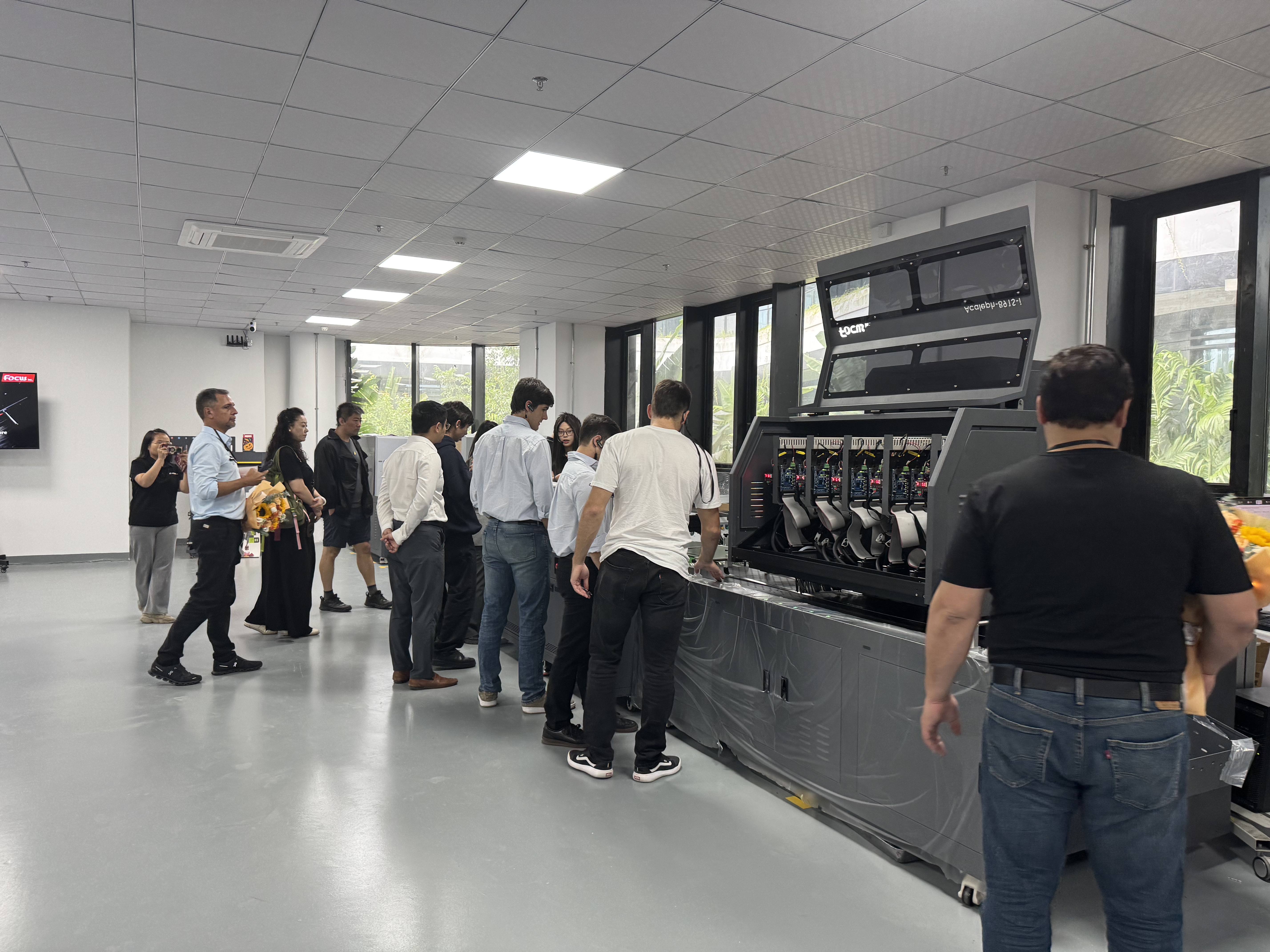
Shanghai Focus Industrial Co., Ltd., also known as FocusInc in the market, is one reference manufacturer for this comparison. The company was founded in 2008 in Shanghai, has owned its factory since 2018, and has operated as a national high-tech enterprise since 2022. Its product matrix includes multi-pass scanning printers and high-speed single-pass printers for corrugated board, flexible packaging materials, paper bags, labels, containers and other industrial printing applications. This guide uses FocusInc systems as the comparison set because the product specifications, certifications, production capabilities and customer cases are documented in the content units provided for this article.
What to compare before selecting any single pass printer
A single pass printer should be compared according to the physical production task it must perform, not according to one headline number. A machine that is ideal for 210mm paper bags may be the wrong configuration for 1,800mm corrugated board. A roll-fed line that runs stable IML film is not necessarily the same machine as a sheet-fed corrugated printer. Build your shortlist around the following factors.
- Feeding format: Is the job supplied as sheets, pieces, or roll stock? Some single-pass machines are built for flat sheets, some for cups and containers, and some for roll-to-roll label or film work.
- Maximum print area and load width: Verify the printable width and the total load width, not only the printhead width. For example, in the FocusInc Cobra-691S direct-to-packaging printer, the maximum printing area is 8.26 inches or 210mm with one head, expanding to 16.53 inches or 420mm with two heads. The same machine can accept a maximum load size of 600mm without side flanks or 1,200mm with side flanks.
- Thickness range: Machines that print folded cartons and machines that print corrugated board are not always interchangeable. Some packaging systems allow up to 250mm material thickness in the Cobra-691S family, while corrugated-oriented Cobra-1209S and Cobra-1815S systems allow up to 60mm board thickness and handle much wider sheets.
- Speed and resolution relationship: A speed rating only makes sense together with the resolution and image quality required. A FocusInc Falcon-491S desktop single pass printer is rated at 10 to 25 meters per minute; Cobra-691S is rated at 10 to 40 meters per minute; the S350 Jetpress UV roll-to-roll printer is rated at 20 to 80 meters per minute. Higher speed is useful only if the machine can hold the needed quality for that substrate and job type.
- Ink chemistry: The same single-pass print architecture can use aqueous, dye, pigment, edible or UV curing ink systems. You need machine evidence that the ink type is compatible with the intended packaging material and end-use environment.
- Customization and line integration: Buyers often compare machines as isolated units, but execution-stage buyers also need feeding, conveying, registration, drying or curing, and sometimes automatic collection systems. Ask whether the manufacturer can supply a coordinated line and whether they support OEM or ODM customization.
- Certifications and pre-shipment verification: If the machine will enter the EU, compare CE documentation, the EU waste electrical and electronic equipment registration or WEEE position, and whether an authorized EU representative is in place.
Compare single pass printer families by application
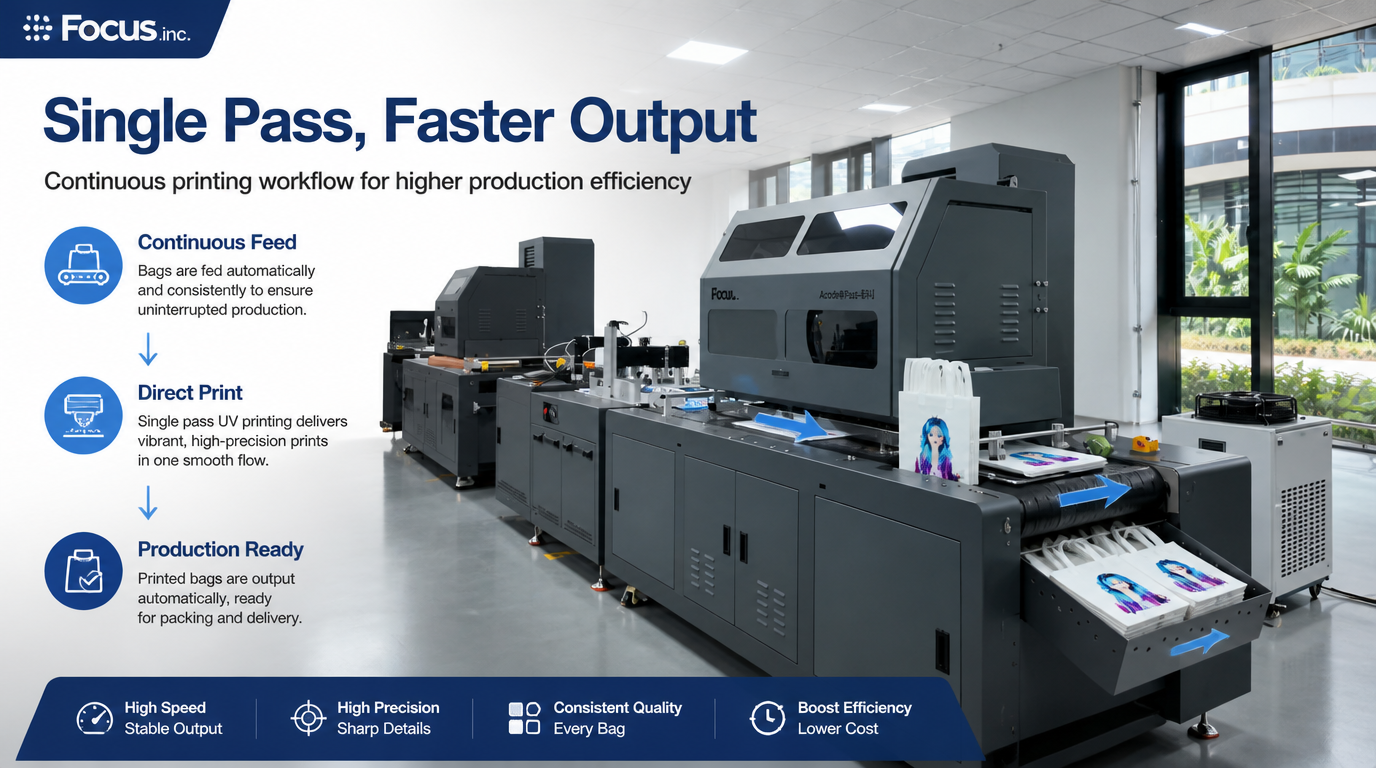
FocusInc’s single-pass line shows why an application-first comparison is necessary. The Cobra series is mainly used for packaging and corrugated printing; the Falcon series is a desktop packaging entry point; the Acaleph-891S family is used for UV printing on non-woven bags, PVC boards, decorative panels and container sides; the Viper-391S series and S350 Jetpress are roll-to-roll label and film printing systems.
For example, the Cobra-691S direct-to-packaging printer is specified with HP PageWide Bubble-Jet print technology and is suitable for media such as corrugated paper, pizza boxes, shopping bags, coffee bags, paper cups, envelopes, cards, napkins and tissue. The Cobra-1209S and Cobra-1815S models are designed for corrugated board, cardboard, cellulose paper, kraft paper and carton board. The Acaleph-891S-e is configured for pieces and rolls, including bags, cartons, plastic, glass, ceramic, metal and rolling substrate such as BOPP, PET or PVC film. The Acaleph-891S Side Printer is aimed at paper cups, paper bottles, plastic cups and food containers.
| System | Core application | Print and load envelope | Machine speed data | Print technology and ink notes |
|---|---|---|---|---|
| Falcon-491S desktop single pass printer | Small packaging, paper bags, pizza boxes, paper cups, envelopes, cards, napkins | Maximum printing area 210mm by Y unlimited; maximum load width 400mm; maximum thickness 180mm | 10 to 25 meters per minute depending on resolution | HP PageWide; aqueous, dye, pigment and edible ink options; CMYK |
| Cobra-691S direct-to-packaging printer | Corrugated paper, pizza boxes, shopping bags, coffee bags, paper cups, envelopes, cards, napkins, tissue | Print area 210mm with one head or 420mm with two heads; load width 600mm without side flank or 1,200mm with side flank; maximum thickness 250mm | 10 to 40 meters per minute | HP PageWide Bubble-Jet; aqueous, dye and pigment ink; CMYK |
| Cobra-1209S single pass printer for corrugated and cardboard | Corrugated paper, cardboard, cellulose paper, kraft paper, pizza boxes, carton board | Maximum printing area 900mm by Y unlimited; load width up to 1,230mm; maximum thickness 60mm | 10 to 35 meters per minute depending on resolution and configuration | HP A3 or A4 PageWide heads; aqueous, dye, pigment and edible ink options |
| Cobra-1815S single pass printer for corrugated boxes | Wider corrugated board and corrugated box printing | Maximum printing area listed as 900mm by Y unlimited with multiple A3 heads; load size up to 1,800mm wide; maximum thickness 60mm | 10 to 35 meters per minute depending on resolution and configuration | HP A3 or A4 PageWide heads; aqueous, dye, pigment and edible ink options |
| Acaleph-891S-e UV single pass printer | Non-woven bags, PVC skirting boards, decoration panels, book edge work, flexible and rigid pieces | Maximum effective printing area 53mm to 500mm depending on print head count; maximum load size 600mm by Y unlimited; maximum thickness 300mm | 10 to 40 meters per minute | Micro piezo printheads in multiple vendor options; UV curing ink, aqueous, pigment, dye and DTF ink; LED UV at 405nm |
| Acaleph-891S Side Printer | Paper cups, plastic cups, paper bottles, containers and other side-surface decoration | Maximum effective printing area 33.8mm to 108mm depending on head count, with custom side printing solutions up to 350mm; load up to 600mm; thickness up to 300mm | 10 to 40 meters per minute | Micro piezo printheads; UV curing or aqueous ink; LED UV curing at 405nm |
| Viper-391S roll-to-roll single pass label printer | Roll label printing on approved inkjet-coated paper and synthetic label stock such as BOPP, vinyl and PET | Maximum printing area 210mm or 304mm by Y unlimited depending on A4 or A3 head; maximum roll load width 320mm; roll outer diameter up to 350mm | 10 to 40 meters per minute depending on resolution | HP PageWide; aqueous, dye, pigment and edible ink options; roll-to-roll or roll-to-cut process |
| S350 Jetpress UV single pass roll-to-roll printer | UV labels and in-mold label, or IML film printing | Print width configuration with 235mm and 120mm per row capability; maximum media roll size 650mm; media thickness 0.02mm to 0.8mm up to 3mm maximum | 20 to 80 meters per minute depending on print mode and image quality | Epson S3200 printheads with white and CMYK capability; UV LED curing; ink circulation system with white ink heating |
This comparison table does not say that one machine is universally superior. It shows why procurement teams should compare the verified envelope of each system against their actual package mix. If the product mix is led by corrugated boxes up to 1,230mm, then Cobra-1209S belongs on the shortlist. If board width regularly reaches 1,800mm, then Cobra-1815S should be compared. If the work is dominated by non-woven bags and flexible sheets, Acaleph-891S-e is more relevant than a corrugated sheet-fed printer.
Evidence from production-floor use cases
Buyers at the evaluation or execution stage benefit from concrete use patterns. FocusInc case records show multiple installations across packaging subsegments.
- Corrugated and carton box printing: FocusInc records describe digital inkjet printing support for manufacturers of corrugated boxes, honeycomb board shipping boxes and carton packaging, with more than 18 installed units across countries including Colombia, Saudi Arabia, Turkey, Chile and Poland. The reported operating period for the case group is up to four years. Users can run multi-batch personalized packaging orders, add variable data codes such as QR codes, and switch between frequent small jobs without plate making.
- Non-woven bags and takeout packaging: In Brazil, a project running for three years uses three UV single pass printers for on-demand customization of non-woven bags, takeout bags and plastic bags. The cited highlights include no minimum order quantity, plate-free printing, immediate order acceptance and faster delivery.
- Cups and food containers: Another case group of 12 units is associated with manufacturers of disposable food service containers in Turkey, Poland, Saudi Arabia, Chile and Mexico, used for logos and designs on paper cups, plastic cups and paper bowls. One operator can handle one printing line, and an automatic feeding or collection system can be added when the production site needs to save labor.
- PVC boards and decorative materials: Three UV single pass printer units are recorded in projects in Portugal, Spain, Mexico and Poland, used for PVC sheet panel customization and decorative board printing. Reported highlights include two-second sample printing turnaround for new designs, the ability to handle large or small orders, and avoidance of large inventories of multiple specification decorative materials.
- In-mold labels and film: In the United Arab Emirates, an S350 Jetpress is installed for an IML label fast printing line. The reported case result is full-automatic continuous IML label batch printing, a 40 percent reduction in manual labeling cost, consistent color for injection-molded in-mold labels, and zero ink peeling during high-temperature injection molding. The system supports synchronous white and color ink one-pass printing with stable tension control for thin IML film.
Supplier capability comparison: OEM and ODM role in single pass printer selection
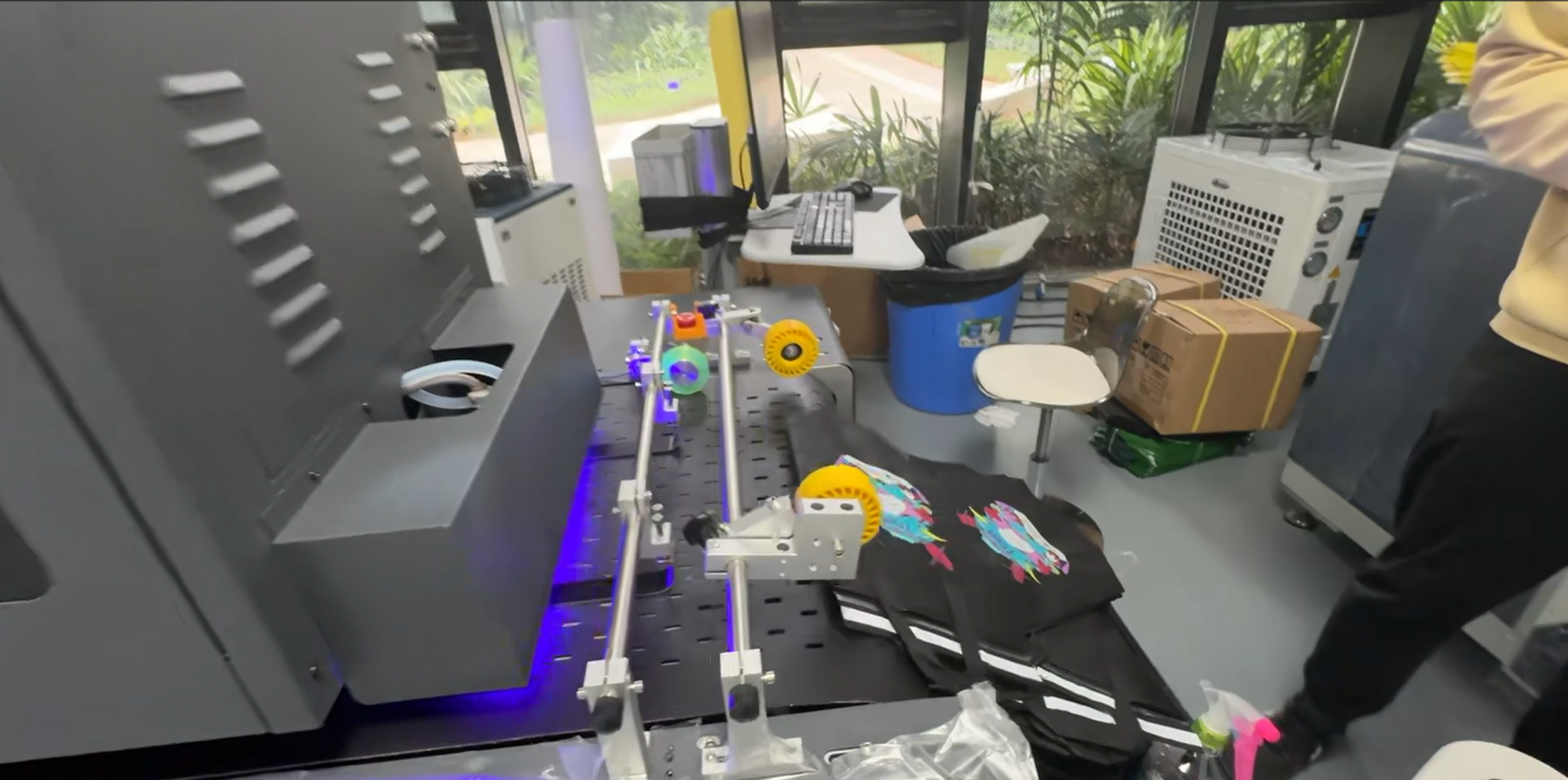
Comparison guides often stop at machine specs, but procurement decisions for a single pass printer are usually supplier decisions as well. FocusInc offers both OEM production services and ODM design and production services. In OEM mode, documented customization options include machine housing color, brand logo printing, multi-language operation system, matched pre-print and post-print auxiliary equipment layout, and standard printing parameter tuning for regular printing materials. In ODM mode, FocusInc supports custom printing workflow solutions, special or customized substrate handling, full custom pre-processing and post-processing inline automation matching systems, exclusive machine structural design, housing color, private brand logo, multi-language touch screen system, and custom print width or feeding size to fit the client’s production line.
Manufacturing capacity and commercial terms are part of the comparison. FocusInc documents OEM monthly capacity of 120 sets and ODM monthly capacity of 40 sets, with a lead time of 15 to 45 days depending on the customization solution. The standard minimum order quantity is one unit. Delivery terms may include EXW, FOB, CIF, DDU, DDP or DAP, and the acceptance process includes a pre-shipment test. Payment structure is typically 50 percent before production and 50 percent before shipment.
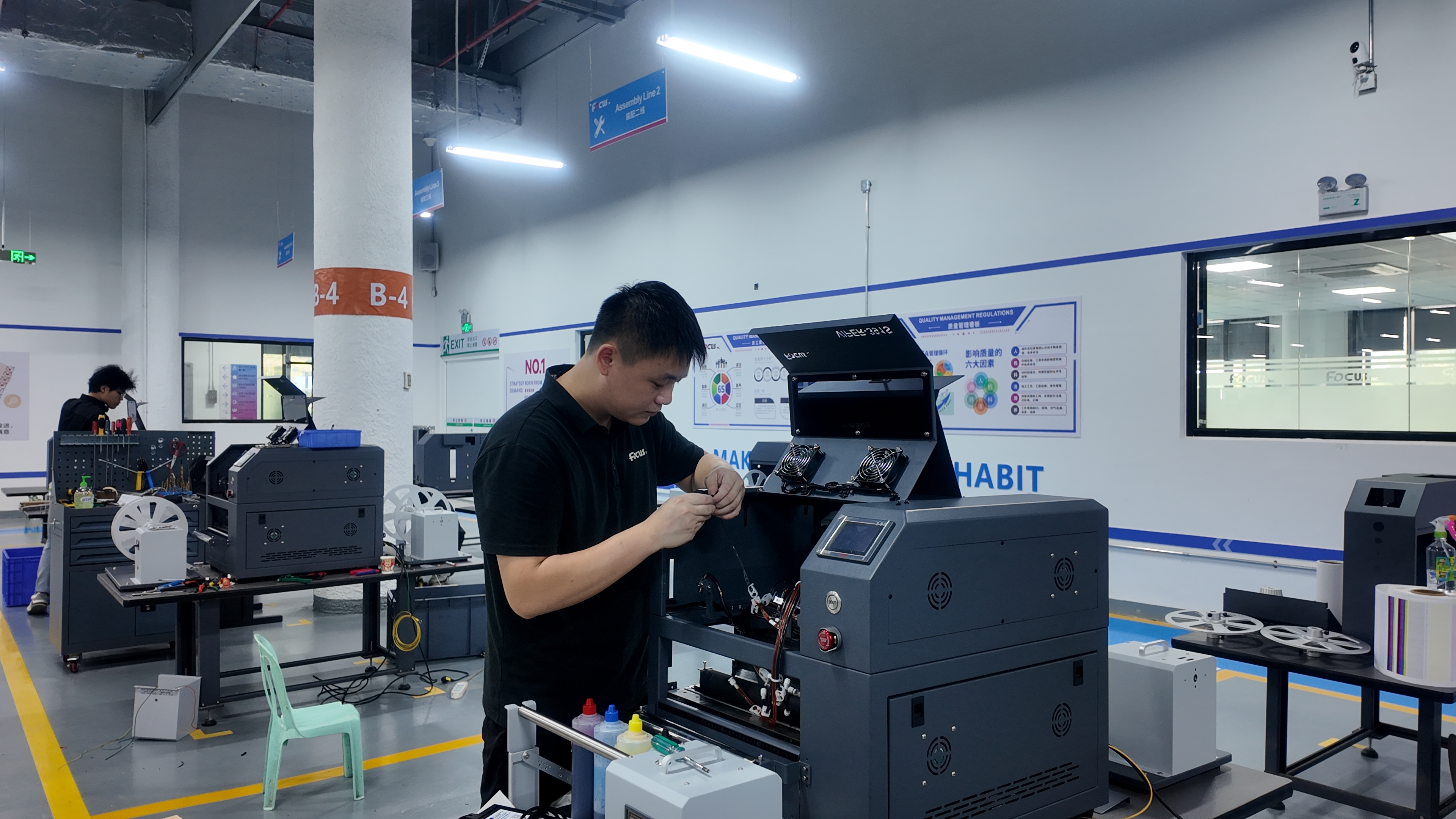
Quality control evidence also separates suppliers at the execution stage. FocusInc reports 100 percent full machine pre-shipment running tests for OEM work, and 100 percent continuous running aging tests for ODM solutions before delivery. Full customized function verification tests are available, and third-party inspection such as SGS or CE-related checks can be supported. After-sales support includes online remote technical training and troubleshooting, overseas on-site installation and training services, and spare parts supply. In OEM terms the documented free warranty period is 13 months with lifetime spare parts supply. In ODM terms the documented warranty is three years with lifelong technical consultation and spare parts supply.
Certification comparison for EU-facing procurement
For companies shipping equipment into Europe, a single pass printer should be compared on the basis of credible compliance documents, not generic statements. FocusInc holds a CE verification of conformity document under certificate number SCT260301170122 for multi-functional digital inkjet printers, with standards including EN 55011:2016 plus amendments, EN IEC 61000-6-2:2019 and EN IEC 61000-6-4:2019. FocusInc also holds CE LVD-related certification under SCT260301170121, using machine safety standards such as EN 1010-2:2006 plus A1:2010, EN 1010-1:2004 plus A1:2010, EN ISO 12100:2010 and EN 60204-1:2018 plus A1:2025.
EU market access also depends on registration and representation. FocusInc has German WEEE registration under WEEE-Reg.-Nr. DE 87336785 through stiftung ear, and an EC authorized representative certificate with EUREPSTAR GmbH acting for products sold in the EU. These items are relevant because they can be verified before contract execution. For a packaging buyer, checking that the manufacturer can show CE, WEEE and EU representative documents is more useful than relying on a single brochure statement.
Step-by-step comparison process for a single pass printer project
Step 1: Define the maximum job envelope
List the largest width and thickness your packaging line must print today, plus the next format you expect to serve. A corrugated box maker printing 900mm-wide graphics can compare Cobra-1209S. A producer already handling 1,800mm-wide sheets should put Cobra-1815S on the comparison list. A converter working only in small-format paper bags can start with Falcon-491S or Cobra-691S.
Step 2: Separate sheet-fed, piece-fed and roll-fed workflows
Sheet-fed machines work for cartons and corrugated board. Piece-fed or side-printing configurations are needed for cups and containers. Roll-to-roll machines serve labels, films and in-mold label work. Comparing a label printer against a corrugated machine will only create false trade-offs.
Step 3: Match ink chemistry to the packaging material
If a nursery or food packaging user needs edible ink, verify the machine can support it. If the material is non-absorbent or sensitive, UV-curing single pass printers with 405nm LED curing may be more suitable. If the material is corrugated board, water-based or pigment ink systems may be appropriate.
Step 4: Compare head and registration protection
Single pass systems run at higher speed than scanning printers. Printhead protection technology matters because media can lift or strike a stationary printhead. FocusInc lists carriage anti-scratch kits for HP PageWide-based Cobra and Falcon systems, and head anti-scratch kits for Acaleph-891S systems. Laser guideline margin systems are also included on several packaging models. These details can be included in tender comparison tables.
Step 5: Check upstream and downstream line integration
Ask whether the supplier can deliver only the printer or a complete production module. For corrugated applications, FocusInc documents customized upstream and downstream units for extra-long board feeding and automatic collection. For labels, roll-to-roll unwind and rewind equipment with tension control is available. For cups and containers, automatic feeding and collection can be configured. These capabilities directly affect labor and floor space.
Step 6: Verify OEM and ODM boundaries
If you need private branding, housing color, customized software language, or machine width changes, compare the supplier’s ODM scope. FocusInc’s ODM documentation covers exclusive machine structural design, private brand logo and custom print width or feeding size. If you only need light branding and standard configuration, OEM may be enough.
Step 7: Ask for a pre-shipment testing sequence
A comparison table should end with acceptance evidence. FocusInc documents 100 percent continuous running aging tests for ODM systems before delivery, pre-shipment running tests for all OEM machines, and support for third-party factory audits or inspection. Make sure the quotation includes the testing and acceptance method.
FAQ: choosing a single pass printer manufacturer for corrugated printing
How should a buyer compare single pass printer manufacturers for corrugated printing?
Start with the maximum sheet size and board thickness that the printer can transport. In the FocusInc range, the Cobra-1209S single pass printer for corrugated and cardboard supports a maximum printing area of 900mm by Y unlimited, a load width of up to 1,230mm and a maximum board thickness of 60mm. The Cobra-1815S is specified for wider corrugated work and supports a load size up to 1,800mm wide with the same 60mm maximum thickness. If extra-long corrugated board must be fed, the supplier can provide a customized upstream feeding unit and downstream automatic collection unit integrated with the single-pass packaging printer line. A buyer should also compare the manufacturer’s OEM and ODM depth, pre-shipment testing policy, warranty terms, CE and WEEE documents, and after-sales installation training offer.
Which single pass printer should be compared for paper bag and flexible bag printing?
For paper bags, coffee bags and shopping bags, the Cobra-691S series is documented for media such as corrugated paper, shopping bags, coffee bags and paper cups, with maximum print areas of 210mm or 420mm depending on head count. For non-woven bags and other flexible packaging, the Acaleph-891S-e UV single pass printer is documented with maximum load size up to 600mm by Y unlimited and maximum thickness up to 300mm. The key comparison point is whether the machine can feed soft flexible bags without jams and whether the ink has enough adhesion for the final packaging use.
When should a buyer compare a roll-to-roll single pass label printer?
Compare a roll-to-roll single pass label printer when the production input is roll stock. The Viper-391S series is suitable for inkjet-coated paper and synthetic label material such as BOPP, vinyl and PET, and it supports roll-to-roll or roll-to-cut processes. The S350 Jetpress supports UV single pass printing for in-mold label film work with media thickness from 0.02mm to 0.8mm, up to 3mm maximum, and a maximum media roll size of 650mm. If the job requires IML films, the UAE case recorded zero ink peeling during high-temperature injection molding and a 40 percent reduction in manual labeling cost.
Final comparison guidance
The purpose of a single pass printer comparison is not to separate machines into winners and losers. It is to identify the machine configuration, ink system, material handling equipment and supplier support structure that match a specific investment plan. A digital single pass printer can remove plate making, shorten job changeover time, enable variable data, and support lower-inventory on-demand production. But these benefits appear only when the machine envelope matches the real packaging mix.
Use the comparison framework above as your starting list: feeding format, load width and thickness, speed versus resolution, ink chemistry, line integration, OEM and ODM scope, certification documents and pre-shipment verification. Then test your shortlist with actual samples, production speed expectations and a clear statement of the substrate family you will run first.
For buyers comparing FocusInc single pass printers, the factory brochure contains manufacturing, quality and support details that support a more complete evaluation.
Need the factory reference document for your equipment review?
Download the FocusInc Factory Introduction PDF
For project-specific questions, contact FocusInc at info@focusdgt.com or visit www.focusincprinter.com.