
Single Pass Printer: Core Concepts That Define the Category
The name describes motion, not quality, not substrate and not market segment. That is why the same three words sit in front of machines as different as a 195 kg desktop unit with one print head and a 1,650 kg platform that accepts 1,800 mm wide board. FocusInc, the industrial digital printing brand of Shanghai Focus Industrial Co., Ltd., builds both ends of that range, and the company's product matrix deliberately spans multi-pass scanning printers as well as high-speed single pass platforms.
This article does not compare suppliers and does not recommend a model. It does something narrower and, for first-time buyers, more useful: it defines the vocabulary. Once pass, swath, print bar, nozzle row, print width versus load width, resolution pairs and ink chemistry are clear, a specification sheet stops being a list of numbers and starts being a description of a machine.
Problem Definition: Why the Term Is So Easy to Misread
Three confusions recur. The first is treating pass count as a synonym for print head count. A machine can carry five heads and still be single pass, because the number of heads changes how much width the machine covers, not how many times the media is printed. The second is treating speed as throughput. A stated 10–40 m/min range is a range, and published specifications attach the phrase “according to different resolution” for a reason: the same machine runs faster at a coarser setting and slower at a finer one. Quoting the upper figure alone overstates real output.
The third, and the most expensive, is confusing print width with load width. On the Cobra-691S, a one-head configuration prints 210 mm wide while the machine accepts 600 mm of material; with the optional side flank the load width rises to 1,200 mm while the printed area stays at 420 mm with two heads. A buyer who reads only the larger number will expect the machine to print across a width it does not print across.
There is also a definitional problem. “Single pass” is applied across corrugated board, folding cartons, labels, paper bags, cups and non-woven bags. Those are different production lines with different transport systems, and the shared label creates a false sense that the machines are interchangeable.
Industry Background: Why a Motion Principle Became a Product Category
The surrounding market is large and still expanding. Zion Market Research valued global digital printing for packaging at USD 31.64 billion in 2023 and projected USD 75.55 billion by 2032. Forecasts in this space diverge considerably — SNS Insider projects USD 62.75 billion for the same horizon and Credence Research projects USD 27.44 billion — so the direction of growth is more defensible than any single endpoint. On the equipment side, Straits Research reports that the inkjet digital printer segment held the largest share of the digital printer market at 42.5% as of 2025.
Regional supply matters too. China produced more than 88 billion square metres of corrugated board in 2024, according to the China Packaging Federation as reported by Dataintelo, which explains why corrugated board is where single pass adoption is most visible. FocusInc's own history tracks that curve: founded in Shanghai in 2008, operating its own factory from 2018 and certified as a national high-tech enterprise from 2022, the company now runs a 35,000 m² facility with a six-engineer R&D team and an annual output of about 800 units, with roughly 95% of production exported to the EU, USA, Mexico, Brazil, Chile, Australia, Canada and the UK.
None of that changes the definition. It only explains why the definition now matters to a much wider group of buyers.
Detailed Solution: The Seven Concepts Behind Every Single Pass Specification
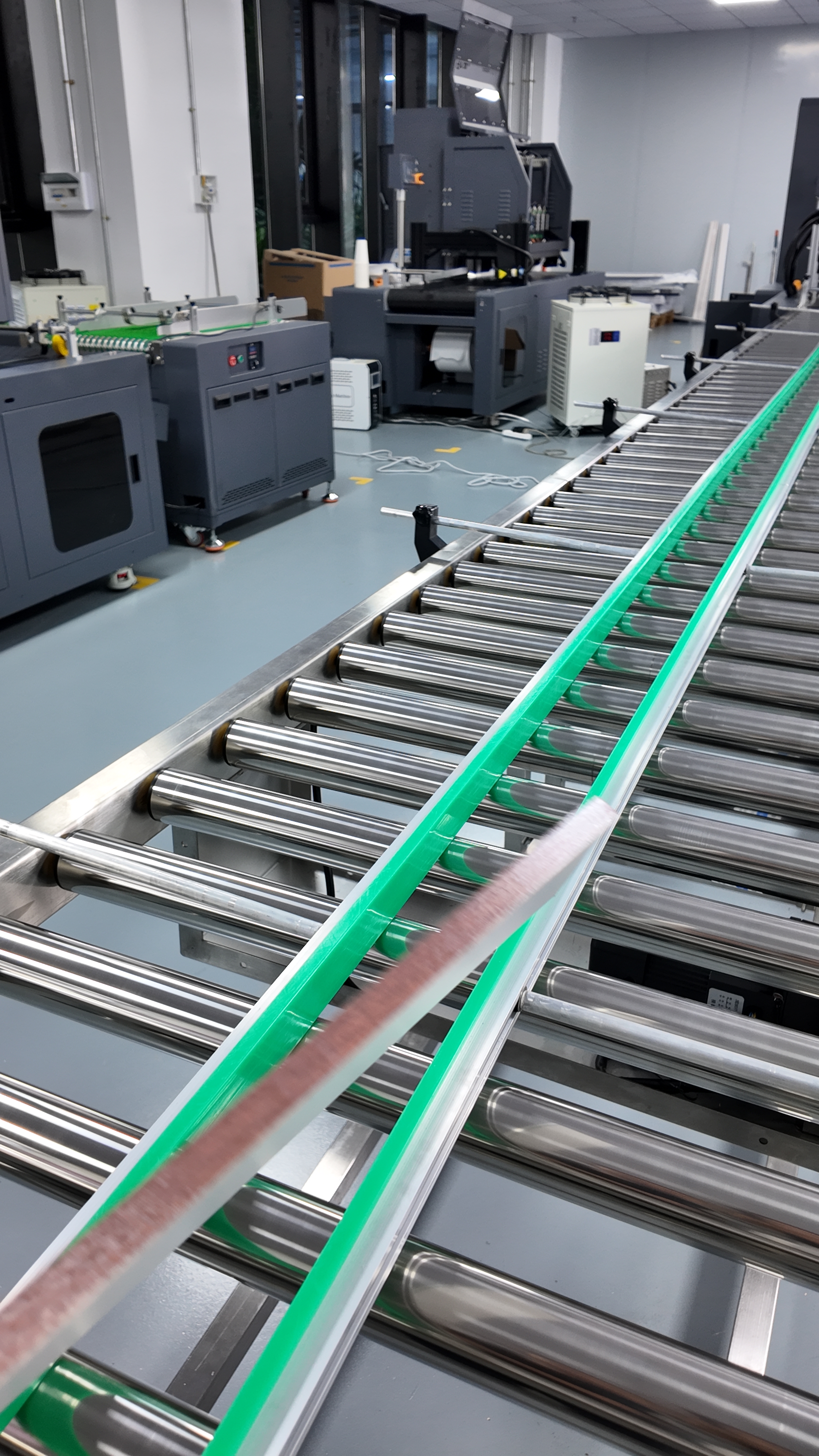
Auxiliary sliders and guide belts constrain the material path so the print start point is positioned identically on every piece. Image: FocusInc.
1. Pass and swath
A pass is one traversal of the print zone relative to the media. In a scanning printer, a carriage crosses the media, the media indexes forward, and the carriage crosses again; the image is built from overlapping swaths. In a single pass printer the print bar spans the full print width, the media advances continuously in one direction, and each point on the substrate receives ink once. The swath equals the print width of the bar.
This is the conceptual dividing line, and it produces predictable consequences: no swath-to-swath stitching to manage, no repeated indexing, and a mechanical layout optimised for continuous transport rather than for carriage return.
2. The print bar: two families of head technology
The print bar is the fixed assembly of heads covering the print width. Two head families appear in FocusInc's single pass range, and they behave differently.
- Thermal bubble-jet pagewide heads. The Cobra-691S and Cobra-691S AS B use HP Pagewide Bubble-Jet print technology with one or two HP Pagewide heads; Cobra-1209S and Cobra-1815S use HP A3/A4 Pagewide heads in one-to-three and one-to-five head configurations. The Viper-391S label platform also uses HP Pagewide heads.
- Piezo arrays. The Acaleph-891S series accepts SEIKO-RC1536/2560, RICOH G5/G6, XAAR2002, TOSHIBA CF3/CF6, EPSON i3200-U1 and KONICA heads. The S350 Jetpress uses EPSON S3200U1/U3 heads, ten or fifteen of them.
Head family affects ink compatibility, curing strategy and the achievable speed range. It is not a proxy for build quality.
3. Nozzle count and nozzle rows
Nozzle count is the most-quoted and least-interpreted number. On the Cobra-691S, each HP Pagewide head carries 42,240 nozzles arranged as 4,224 nozzles per row across 10 rows. On an A3 Pagewide head used in Cobra-1209S and Cobra-1815S, the figure is 59,136 nozzles as 4,224 per row across 14 rows. The Viper-391S A4 configuration carries 42,240 nozzles and the A3 configuration 59,136.
The useful reading is this: nozzles per row multiplied by row count gives the total. Row count matters because it determines how many nozzles cover each point of the media and therefore how much ink can be laid down per unit of travel. Total nozzle count alone does not tell you the print width, the resolution or the speed.
4. Resolution pairs
Single pass specifications usually quote resolution as a pair, such as 1200 × 300 dpi, 1200 × 600 dpi or 1200 × 1200 dpi. The convention is straightforward once stated: one figure describes addressability across the web, which is fixed by the physical nozzle pitch of the bar, and the other describes addressability along the direction of travel, which depends on firing frequency and media speed.
This is why the cross-web figure stays constant within a head type across a model family — 1200 dpi across on the HP Pagewide machines, 600 dpi across on the Acaleph-891S piezo platform — while the along-web figure changes with the selected print mode. The S350 Jetpress offers 1200 × 600, 900 × 600 and 600 × 600 dpi; the Viper-391S runs from 1200 × 300 up to 1200 × 2200 dpi; the Acaleph-891S offers 600 × 300, 600 × 600 and 600 × 1200 dpi.
5. Media transport and the width budget
Because the media moves only once, transport quality is not a secondary feature — it is the image-forming mechanism. FocusInc's single pass platforms address this in three layers.
- Alignment. Laser guideline margins are standard: four to six automatic laser guide points on Cobra-691S, Acaleph-891S and Viper-391S, and two on the desktop Falcon-491S.
- Hold-down and height. Vacuum adsorption tables with touch-screen control are used on Cobra-1209S and Cobra-1815S, and electronic print-head height control is standard across the range.
- Wear surfaces. Conveyor belts are anti-offset PU/TPU/PET/PP rubber, correction rollers are stainless steel with silicone coating, and the frame is thickened welded carbon steel with a high-strength extruded aluminium alloy print beam.
Substrate thickness defines the upper boundary of the transport design: 250 mm on Cobra-691S, 180 mm on Falcon-491S and Falcon-491S Pro, 60 mm on Cobra-1209S and Cobra-1815S, 300 mm on the Acaleph-891S series, and 0.02–0.8 mm with a maximum of 3 mm on the S350 Jetpress.
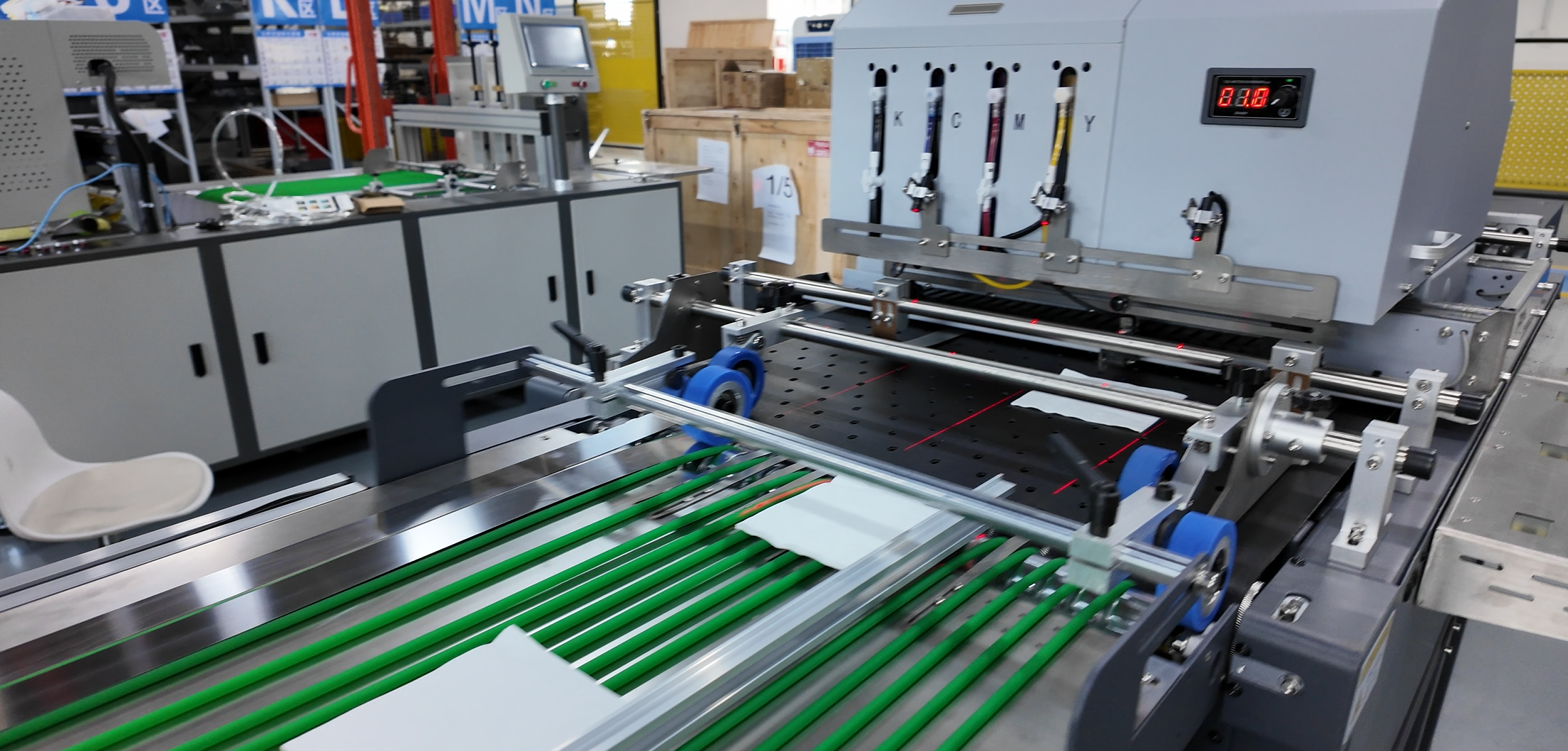
The same transport handles flexible sheets and rigid material, which is a transport-design outcome rather than an ink outcome. Image: FocusInc.
6. Ink chemistry and curing
Ink determines what happens after the drop lands. Aqueous dye and pigment inks are used on the Cobra and Falcon packaging platforms, with 250 ml or 500 ml tanks per colour and CMYK as the standard set. UV-curing inks are used on the Acaleph-891S series and the S350 Jetpress, with 1,500 ml tanks per colour on the Acaleph and LED UV curing at 405 nm with sectional curing and water-circulation cooling. The S350 adds white plus CMYK and an ink circulation system with automatic white-ink heating.
For buyers, the distinction is practical: aqueous systems suit porous substrates such as corrugated board, kraft paper and tissue; UV systems extend to films, PVC panels, non-woven bags and label stock, and cure at the point of printing.
7. The data path
Every single pass machine in this range runs a bundled control-and-RIP environment rather than a separate RIP workstation. Job formats include PDF, TIFF, JPEG and PNG depending on model; connectivity is Ethernet; the control interface is a touch screen with PLC on the packaging and UV platforms, and a 3.5-inch LED touch screen on the Viper-391S with an optional 10.1-inch touch computer. The stated software baseline is Windows 7/10/11 64-bit with an Intel Core i5 at 2.5 GHz or above and 8 GB of RAM.
What Single Pass Is Not
Not a synonym for digital. A digital printing catalogue can contain both architectures. FocusInc describes its own product matrix as spanning multi-pass scanning printers through to high-speed single pass printers. The word “single” is doing real work and should be checked, not assumed.
Not a synonym for high resolution. Resolution is a separate configuration choice. The Viper-391S reaches 1200 × 2200 dpi; the Acaleph-891S tops out at 600 × 1200 dpi. Both are single pass. Neither figure is a quality verdict without the substrate, the artwork and the viewing distance.
Not restricted to one substrate. The same architecture prints on 60 mm corrugated board, on 300 mm stacks of non-woven bags, on 0.02 mm film and on the curved sides of paper cups — with different transport modules, not different motion principles.
Not rotary printing. The Hydra-360S cylinder printer uses a 360-degree helix motion to print around bottles and tubes at 40–120 pieces per hour. It is a valid digital inkjet approach for cylindrical objects, and it is a different motion principle from a linear single pass bar.
Step-by-Step Breakdown: Reading a Single Pass Specification Sheet
The following sequence converts a specification sheet into a decision, in the order that avoids wasted comparison.
- Confirm the architecture. Look for media motion described as continuous, a bar described as fixed across the width, and speed expressed in metres per minute rather than square metres per hour or pieces per hour. A speed figure in m/min alongside a resolution range signals a single pass platform.
- Separate print width from load width. Print width is what the bar covers; load width is what the transport accepts. Cobra-691S: 210 mm print with one head, 420 mm with two, 600 mm load without the side flank and 1,200 mm with it. Cobra-1815S: 900 mm print area and 1,800 mm load width.
- Count the heads and identify the model. One to two heads on Cobra-691S, one to three on Cobra-691S Max and Cobra-1209S, one to five on Cobra-1815S, one on each Viper-391S and Falcon configuration, ten or fifteen on the S350 Jetpress.
- Read the resolution pair as a pair. Note the cross-web figure (fixed by head type) and the along-web range (selectable). Then check which mode the quoted speed belongs to.
- Read speed as a range, and read the caveat. Cobra-691S and Viper-391S are stated at 10–40 m/min, Cobra-1209S and Cobra-1815S at 10–35 m/min, Cobra-691S Max at 20–40 m/min, Falcon-491S at 10–25 m/min, Falcon-491S Pro at 10–17 m/min and the S350 Jetpress at 20–80 m/min. Every one of these figures is resolution-dependent.
- Check thickness, feeding and height. Maximum thickness, automatic feeder type (friction versus air-vacuum), and adjustable print height — Cobra-691S Max offers 0–55 mm, customisable.
- Close with utilities and environment. Power, noise and operating window decide whether the machine fits the building. Cobra-691S: 20 A single-phase 220 V, 50 Hz, 75 dB(A) or less, 15–30 °C and 40–80% humidity. Acaleph-891S: 42 A single-phase 220–240 V, 50/60 Hz, 75 dB(A) or less. Cobra-691S Max: 220 VAC 50 Hz, 3 kW.
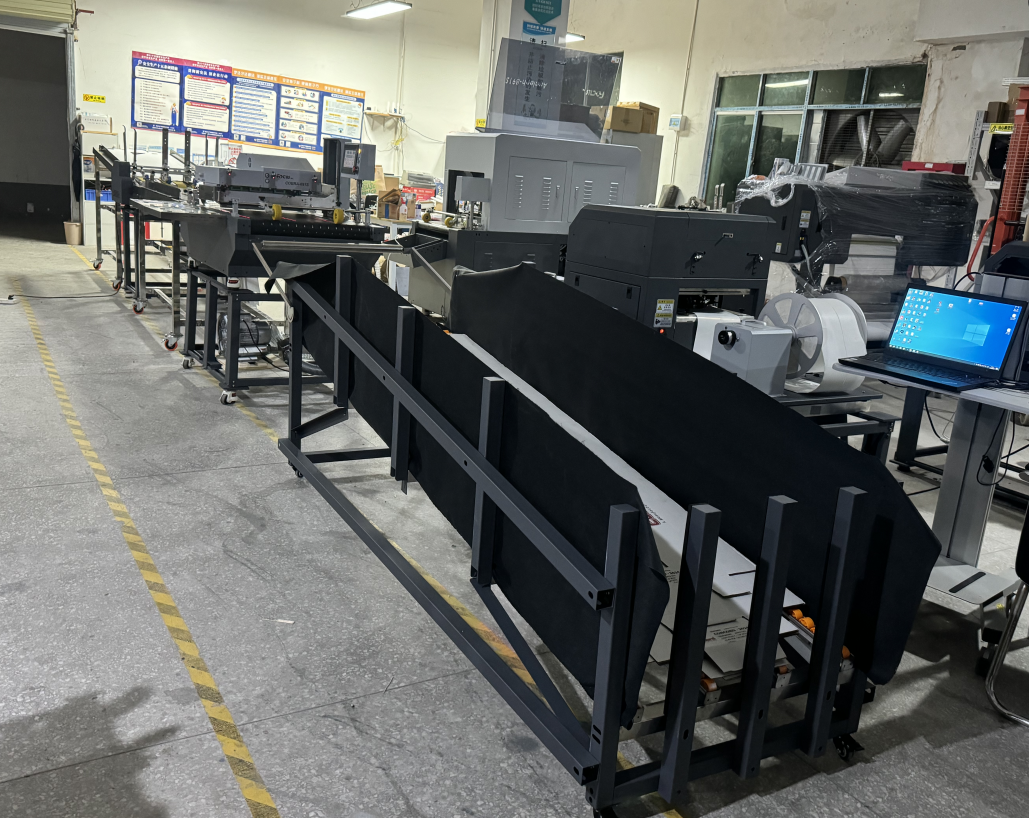
When the material is longer than a standard line can handle, the transport is extended upstream and downstream rather than the print principle being changed. Image: FocusInc.
Use Cases: Where the Concept Lands in Production
Corrugated board and cartons. The Cobra-1209S covers a 900 mm print area with one to three A3 heads across a 1,230 mm load width and 60 mm thickness; the Cobra-1815S extends the load width to 1,800 mm with up to five heads. A customer group across Colombia, Saudi Arabia, Turkey, Chile and Poland has run 18 units over four years for colour corrugated boxes, honeycomb turnover boxes, shoe boxes and pizza boxes, including variable QR codes on turnover boxes.
Paper bags, cup fans and sleeves. The Cobra-691S Max handles 215–645 mm print width with a 900 mm feed and 0–55 mm print height at 20–40 m/min, with consumable cost stated at 0.1–0.2 RMB per square metre.
Labels, roll to roll. The Viper-391S accepts rolls up to 320 mm wide with a maximum roll diameter of φ350 mm and core options of 75, 40 and 25 mm, from 1200 × 300 up to 1200 × 2200 dpi. The S350 Jetpress prints 235 mm wide at 20–80 m/min with white plus CMYK. In the United Arab Emirates, a plastic injection moulding factory runs an S350 Jetpress for IML label batch printing and reports a 40% reduction in manual labelling cost with zero ink peeling during high-temperature moulding.
Non-woven bags and decorative panels. The Acaleph-891S e and 891S-i accept 600 mm load width and 300 mm thickness with UV curing. A Brazilian operation has run three UV single pass printers for three years producing on-demand non-woven bags, takeout bags and plastic bags without plate-making and with no minimum order quantity; a separate programme across Portugal, Spain, Mexico and Poland runs three units for PVC sheet panels and decorative board printing.
Containers and cups. The Acaleph-891S Side Printer prints on a 33.8–108 mm band — customisable up to 350 mm — for paper cups, paper bottles, plastic cups and food containers. A food-service container manufacturer across Turkey, Poland, Saudi Arabia, Chile and Mexico has run 12 units over two years for logo printing on finished cup exteriors.
Book edges. With a specialist fixture, the same Acaleph platform prints on book and notebook edges, with adjustable jigs accommodating different book sizes and optional automatic feeding and collection.
Comparison Table: Concept-to-Specification Map Across Six Single Pass Platforms
| Concept | Cobra-691S | Cobra-1209S | Viper-391S | Acaleph-891S e | S350 Jetpress | Acaleph-891S Side |
|---|---|---|---|---|---|---|
| Print bar / heads | 1–2 × HP Pagewide | 1–3 × HP A3/A4 Pagewide | 1 × HP A4 or A3 Pagewide | Piezo: SEIKO, RICOH, XAAR, TOSHIBA | 10 or 15 × EPSON S3200U1/U3 | Piezo, model-dependent |
| Nozzles per head | 42,240 (4,224 × 10 rows) | 59,136 per A3 head (4,224 × 14 rows) | 42,240 (A4) / 59,136 (A3) | Depends on head model | Not stated as a single figure | Depends on head model |
| Print width | 210 mm (1 head) / 420 mm (2 heads) | 900 mm | Up to 320 mm roll | 53–500 mm by head count | 235 mm | 33.8–108 mm, up to 350 mm custom |
| Load width / thickness | 600 mm, 1,200 mm with side flank / 250 mm | 1,230 mm / 60 mm | Roll ≤ φ350 mm | 600 mm / 300 mm | Roll ≤ 650 mm / 0.02–0.8 mm, max 3 mm | 600 mm / 300 mm |
| Resolution | 1200 × 300 to 1200 × 1200 dpi | 1200 × 300 to 1200 × 1200 dpi | 1200 × 300 to 1200 × 2200 dpi | 600 × 300 to 600 × 1200 dpi | 1200 × 600 / 900 × 600 / 600 × 600 dpi | 600 × 300 to 600 × 1200 dpi |
| Speed | 10–40 m/min | 10–35 m/min | 10–40 m/min | 10–40 m/min | 20–80 m/min | 10–40 m/min |
| Ink and curing | Aqueous dye/pigment, CMYK | Aqueous dye/pigment, CMYK | Aqueous dye/pigment | UV ink, LED 405 nm sectional curing | UV ink, LED curing, white + CMYK | UV ink, LED 405 nm sectional curing |
| Primary concept role | Entry packaging platform | Wide corrugated board | Roll-fed label production | Rigid sheet and bag printing | High-speed film and label | Curved and side-surface printing |
All figures as published in FocusInc product specifications. Speed ranges are resolution-dependent and are not directly comparable across models.
Frequently Asked Questions
What compliance documentation should a single pass printer carry for the EU market?
For EU delivery, industrial single pass printers fall under the Low Voltage Directive 2014/35/EU and the EMC Directive for CE marking. FocusInc holds a Verification of Conformity issued by ANXIN PRODUCT TEST SERVICE CO., LTD. covering EN 55011:2016+A2:2021, EN IEC 61000-6-2:2019 and EN IEC 61000-6-4:2019, and an EC Declaration of Conformity for machinery safety covering EN 1010-2:2006+A1:2010, EN 1010-1:2004+A1:2010, EN ISO 12100:2010 and EN 60204-1:2018+A1:2025. German market access is supported by WEEE registration DE 87336785 with EUREP GmbH appointed as authorised representative. The company also holds multiple CNIPA utility model patents covering print-head protection and cleaning, media transport and pre-treatment modules.
What capability should a manufacturer have to build single pass printers for corrugated printing — and can it customise?
A corrugated-capable manufacturer needs the full width and thickness envelope, not a single model: print widths from 210 mm to 900 mm, load widths from 600 mm to 1,800 mm, board thickness up to 60 mm on the wide platforms and up to 250 mm on the 691S series, head counts from one to five, and speed ranges of 10–40 m/min. FocusInc provides both OEM and ODM programmes. OEM customization covers housing colour, brand logo printing, multi-language operating systems and matched pre-print and post-print auxiliary equipment layout, with a stated capacity of 120 sets per month. ODM covers custom print width and feeding size, full custom pre- and post-processing inline automation, exclusive structural and housing design, and a multi-language touch-screen system, at a stated capacity of 40 sets per month. Warranty differs by programme: 13 months on the OEM programme and three years on the ODM programme, both with lifetime spare-parts support.
What drives the running cost of a single pass printer?
Four variables dominate, and none of them is the purchase price. The first is print head count and head family, because more heads means more coverage and more consumable components. The second is ink consumption per square metre — the Cobra-691S Max specification states a consumable cost of 0.1–0.2 RMB per square metre, which is the most direct published indicator available. The third is ink tank capacity, which ranges from 250 ml per colour on the desktop Falcon-491S and Falcon-491S Pro, through 500 ml on Cobra-691S and Viper-391S, to 1,500 ml per colour on the Acaleph-891S series. The fourth is site cost: power and environment. Cobra-691S draws 20 A single-phase 220 V and runs at 75 dB(A) or less in 15–30 °C and 40–80% humidity; Acaleph-891S requires 42 A single-phase 220–240 V and a minimum 80 psi, 6 bar compressed air supply at 60 L volume per plasma unit.
Can a buyer validate print quality and material fit before committing?
Yes, and the validation path is documented. Acceptance criteria are defined as a pre-shipment test, so the machine is proven against the buyer's own material and artwork before it leaves the factory rather than after arrival. The ODM programme adds a 100% continuous running aging test before delivery and a full customised function verification test, with SGS or CE third-party inspection available on request; the OEM programme offers third-party factory audit and inspection on client request. For substrate questions that cannot be resolved remotely, sample testing is carried out on the production line at the factory — FocusInc's Shenzhen and Shanghai facilities include a dedicated single pass printer sample display area and host customer visits for sample testing.
What is the lead time, order quantity and delivery terms?
Lead time is 15–45 days depending on the solution, with a minimum order quantity of one unit and stated monthly capacity of 120 sets on the OEM programme and 40 sets on the ODM programme. Payment terms are 50/50, and delivery can be arranged on EXW, FOB, CIF, DDU, DDP or DAP terms. Because configuration — head count, print width, feeding module, ink system — changes both the lead time and the machine itself, the practical next step is to send the substrate, the artwork and the target output to info@focusdgt.com or discuss it on WhatsApp at +86 177 6513 2139, so the configuration is defined before the schedule is confirmed.
Conclusion: The Definition Is the Buying Tool
A single pass printer is defined by one decision: the image is completed in a single relative movement between media and print bar. Everything a buyer later compares — head count, nozzle rows, resolution pairs, print width against load width, thickness, ink chemistry, curing method, power draw, noise, floor space — is a downstream consequence of that decision, applied to a particular substrate.
Holding that structure in mind changes the conversation. It stops a 210 mm packaging unit being compared with a 1,800 mm board platform, stops an upper speed figure being read as routine output, and stops “single pass” being treated as a quality claim rather than a description of how the machine moves. For a first evaluation, that clarification is worth more than any single specification line — because every later comparison depends on it.
Next Step: Verify the Concept Against Your Own Material
Send a substrate sample and your artwork requirement, and FocusInc will confirm which configuration, head family and transport module actually fits the job — with the pre-shipment test as the acceptance basis.
Factory and product overview: Download the FocusInc Factory Introduction (PDF)
Website: www.focusincprinter.com | Email: info@focusdgt.com | Tel / WhatsApp: +86 177 6513 2139
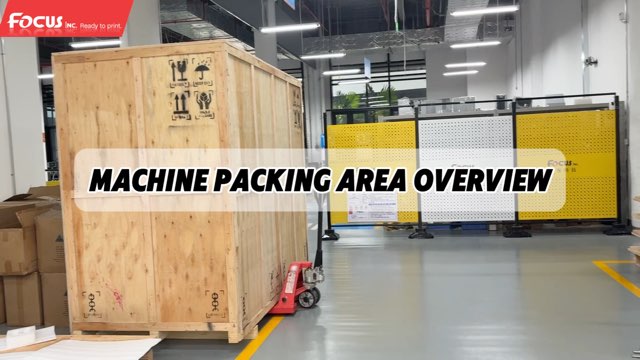
Packing and dispatch area, where units are prepared against the pre-shipment test record before export. Image: FocusInc.
Have Questions or Need More Details?
Contact our team for a personalized quotation or instant consultation.
Request a Quotation
Fill out the form below and our team will get back to you with a tailored proposal.
WhatsApp Direct Chat
Prefer to chat in real-time? Message us on WhatsApp for instant assistance & quick answers.
- Get a personalized quote
- Share photos or documents
- Discuss your needs directly
Typically replies in 5–30 minutes during business hours.