
Single Pass Printer Supplier Evaluation: What to Verify
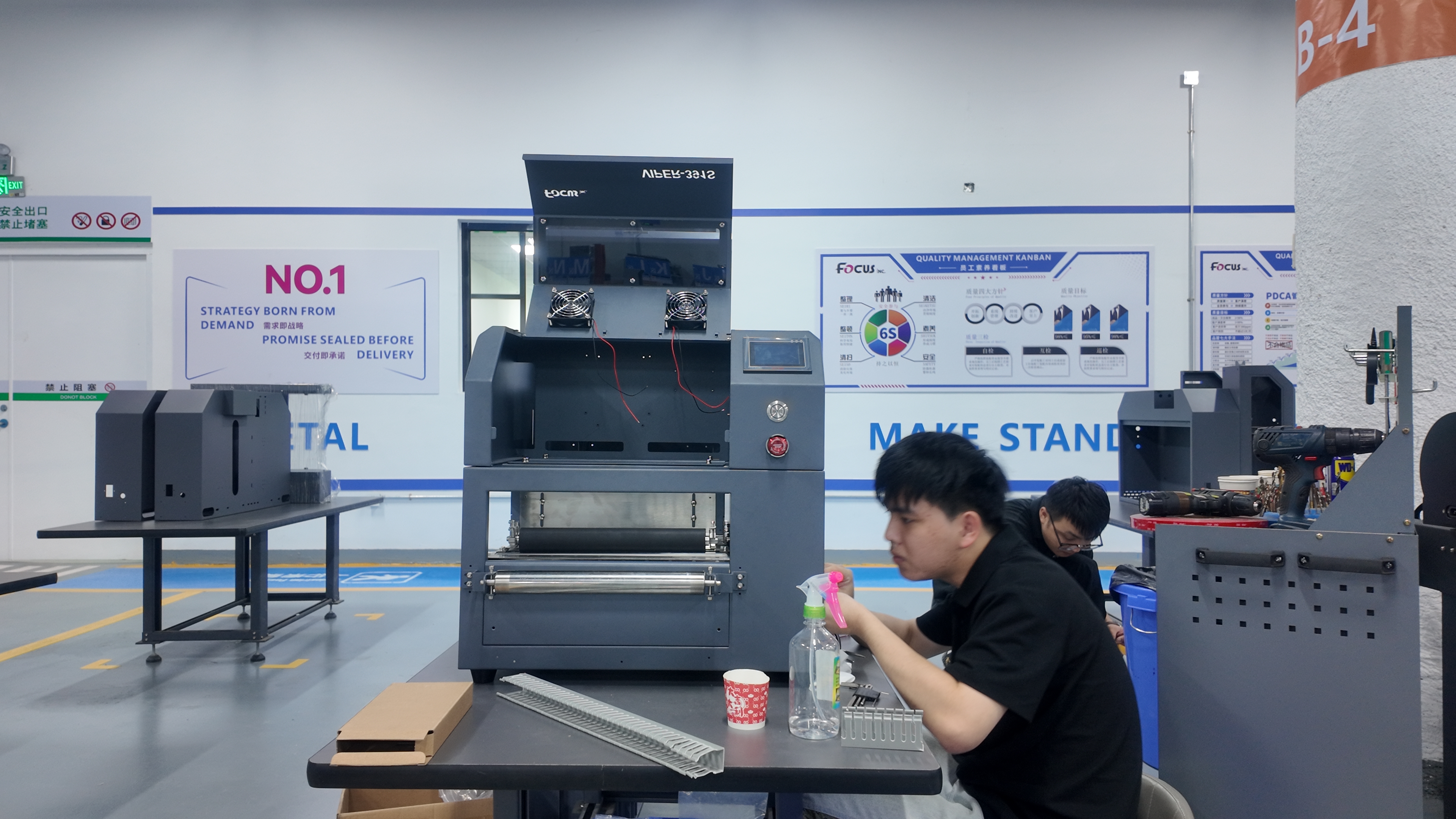
A single pass printer is a digital inkjet system that prints an entire image width in one pass of the substrate instead of building the image through repeated print-head scans. Because the machine is installed inside a live production line, supplier evaluation is a verification exercise rather than a price comparison. The buyer has to confirm three things: that the published specification fits the actual substrate and output target, that the supplier's factory and engineering resources genuinely support the customisation requested, and that delivery, installation, warranty and spare-part commitments are documented and traceable.
Problem Definition: Why Single Pass Printer Evaluation Goes Wrong
Three failure patterns account for most disappointing single pass printer projects.
- Specification gap. Speed and resolution are usually quoted separately. A machine may run at 40 m/min at 1200 x 300 dpi and more slowly at 1200 x 1200 dpi. A buyer who evaluates the headline speed without the resolution it was measured at will not reach the throughput the plant actually needs.
- Capability gap. OEM and ODM availability is a marketing phrase until it is matched to engineering headcount, monthly build capacity and a written customisation scope. A 1,800 mm corrugated board, a curved cup wall, a book edge and a reflective film each demand a different machine architecture.
- Delivery gap. Lead time is quoted, but the pre-shipment testing regime is not. For equipment that must be commissioned overseas, the test protocol completed before shipment is the most valuable document the buyer will receive.
A fourth, quieter failure is application mismatch. A platform built for 210 mm paper bags will not print 1,800 mm honeycomb board, and a roll-to-roll label machine cannot accept a 250 mm-thick corrugated stack. Supplier evaluation therefore starts with the project, not with the vendor.
Industry Background: What the Numbers Say
Digital printing for packaging remains a large and expanding equipment category. Zion Market Research valued the global digital printing for packaging market at USD 31.64 billion in 2023 and projected USD 75.55 billion by 2032. Forecasts for the same 2032 endpoint differ between research houses: SNS Insider models USD 62.75 billion and Credence Research USD 27.44 billion. Buyers should treat any single market forecast as a directional signal rather than a planning input.
Inside the wider digital printer market, Straits Research reports that the inkjet digital printers segment held the largest share at 42.5% as of 2025. On the supply side, Mordor Intelligence and Maximize Market Research place HP Inc. at a 32% global shipment share in the large-format printer market, the segment that includes PageWide single-pass technology.
Demand concentrates where board volumes concentrate. China produced more than 88 billion square metres of corrugated board in 2024, according to China Packaging Federation data reported by Dataintelo, which explains why a large share of single pass corrugated printing capacity is sourced from Chinese manufacturers.
Two standards and regulatory anchors matter during evaluation. Industrial single-pass printers placed on the EU market must comply with the Low Voltage Directive (2014/35/EU) and the EMC Directive in order to carry CE marking, according to the European Commission. Colour inkjet consumable yields are standardised under ISO/IEC 24711 and ISO/IEC 24712, which gives buyers a neutral basis for comparing running-cost claims between suppliers.
Speed benchmarking is where published figures diverge most. Third-party industry reporting places single-pass paper bag printing in the 30-80 m/min band. FocusInc publishes per-model figures instead: 10-40 m/min for the Cobra-691S packaging platform and 20-80 m/min for the S350 Jetpress UV roll-to-roll platform. A buyer who asks which resolution and which print-head configuration produced a speed figure receives a usable answer; a buyer who accepts one number does not.
Detailed Solution: A Supplier Profile Built for Verification
FocusInc, the trading name of Shanghai Focus Industrial Co., Ltd., is an industrial digital printing equipment manufacturer based in Shanghai, China, specialising in high-speed single-pass inkjet systems for packaging and industrial applications. The company was founded in 2008, began operating its own factory in 2018, and was certified as a national high-tech enterprise in 2022.
Its documented scale figures are a 35,000 m2 factory, 45 employees, an annual output of 800 units, an R&D team of 6 engineers, and an export ratio of 95% across the EU, USA, Mexico, Brazil, Chile, Australia, Canada and the UK. The practical reading for a buyer is that FocusInc is a mid-sized specialist rather than a general industrial conglomerate: engineering depth is concentrated on single-pass inkjet technology, while orders are quoted and built one unit at a time.
Two production programs, two different verification checklists
FocusInc operates an OEM program and an ODM program, and the commitments are not identical. Buyers should verify against the program they are actually buying into.
The OEM program covers machine housing colour, brand logo printing, a multi-language operation system, matched pre-print and post-print auxiliary equipment layout, and standard printing parameter tuning for regular printing materials. It is quoted at a monthly capacity of 120 sets, a minimum order quantity of 1 unit, and a lead time of 15-45 days depending on the customisation solution. Quality control consists of a 100% full-machine pre-shipment running test, with third-party factory audit and inspection available on client request. After-sales support covers online remote technical training and troubleshooting, on-site overseas engineer service, a 13-month free warranty, and lifetime spare parts supply with technical upgrade guidance.
The ODM program is broader. It covers custom printing workflow solutions for regular, special and fully customised printing substrates, full custom pre-processing and post-processing inline automation, exclusive machine structural design, housing colour, private brand logo, a multi-language touch screen system, and custom print width and feeding size. It is quoted at a monthly capacity of 40 sets, an MOQ of 1 unit, and the same 15-45 day lead-time band. Quality control is a 100% continuous running aging test before delivery plus a full customised function verification test, and the program supports SGS/CE third-party inspection. After-sales includes global online remote technical support, overseas on-site installation and training, an exclusive customised technical parameter update service, a 3-year machine warranty, and lifelong technical consultation and spare parts supply.
Why this distinction matters: the ODM route carries a deeper engineering commitment, fewer units per month and a longer warranty, while the OEM route carries a higher build rate and a shorter warranty term. A buyer who compares warranty or lead time across suppliers without naming the program is comparing two different documents.
Build and control architecture
Across the single pass packaging printer range, the main machine frame is constructed from thickened welded carbon steel, the print beam from high-strength extruded aluminium alloy, the X/Y linear guide rails from high-hardness steel, the conveyor belt from anti-offset PU/TPU/PET/PP rubber, and the HP print head assembly from heat-resistant industrial plastic with precision alloy metal parts. These are material specifications that a visiting engineer can check against a physical machine during a factory inspection, rather than accepting as a claim.
Model portfolio relevant to packaging and corrugated projects
The corrugated and carton side of the portfolio is built on HP Pagewide thermal bubble-jet technology. The Cobra-1209S and Cobra-1815S address wide-format corrugated and honeycomb board; the Cobra-691S and Cobra-691S Max cover 215-645 mm packaging work such as paper bags, cups, pizza boxes and napkins; the Falcon-491S and Falcon-491S Pro are desktop platforms for smaller operations. For labels, UV roll-to-roll and integrated finishing, the range extends to the Viper-391S and Viper-391S Pro, the Vesa-830A UV label printer, the NEXUS-350J print-laminate-die-cut-slitting line and the S350 Jetpress UV single-pass platform. Cylindrical work such as bottles and tubes is handled by the Hydra-360S.
Step-by-Step Breakdown: A Seven-Step Supplier Evaluation
Step 1 - Write the project specification before contacting any supplier
Document the substrate (corrugated board, kraft bag, BOPP film, non-woven fabric, PVC panel), the maximum and minimum piece size, the maximum material thickness, the required resolution at production speed, the daily output target, and the finishing steps that follow printing. For corrugated work, state the board width explicitly: a 1,230 mm load width and an 1,800 mm load width are different machines.
Step 2 - Match the machine class to the project, not the reverse
Ask the supplier to map your specification to a named model and to state the resolution at which the quoted speed is achieved. If the reply is a range without a named model, the evaluation has not started yet.
Step 3 - Audit manufacturing and quality control evidence
Request the pre-shipment test protocol, the aging-test duration and the third-party inspection option. FocusInc's stated protocols are a 100% full-machine running test before shipment under its OEM program, and a 100% continuous running aging test plus customised function verification under its ODM program, with SGS/CE third-party inspection supported. Ask to see a completed record rather than a blank template.
Step 4 - Verify customisation against engineering resources
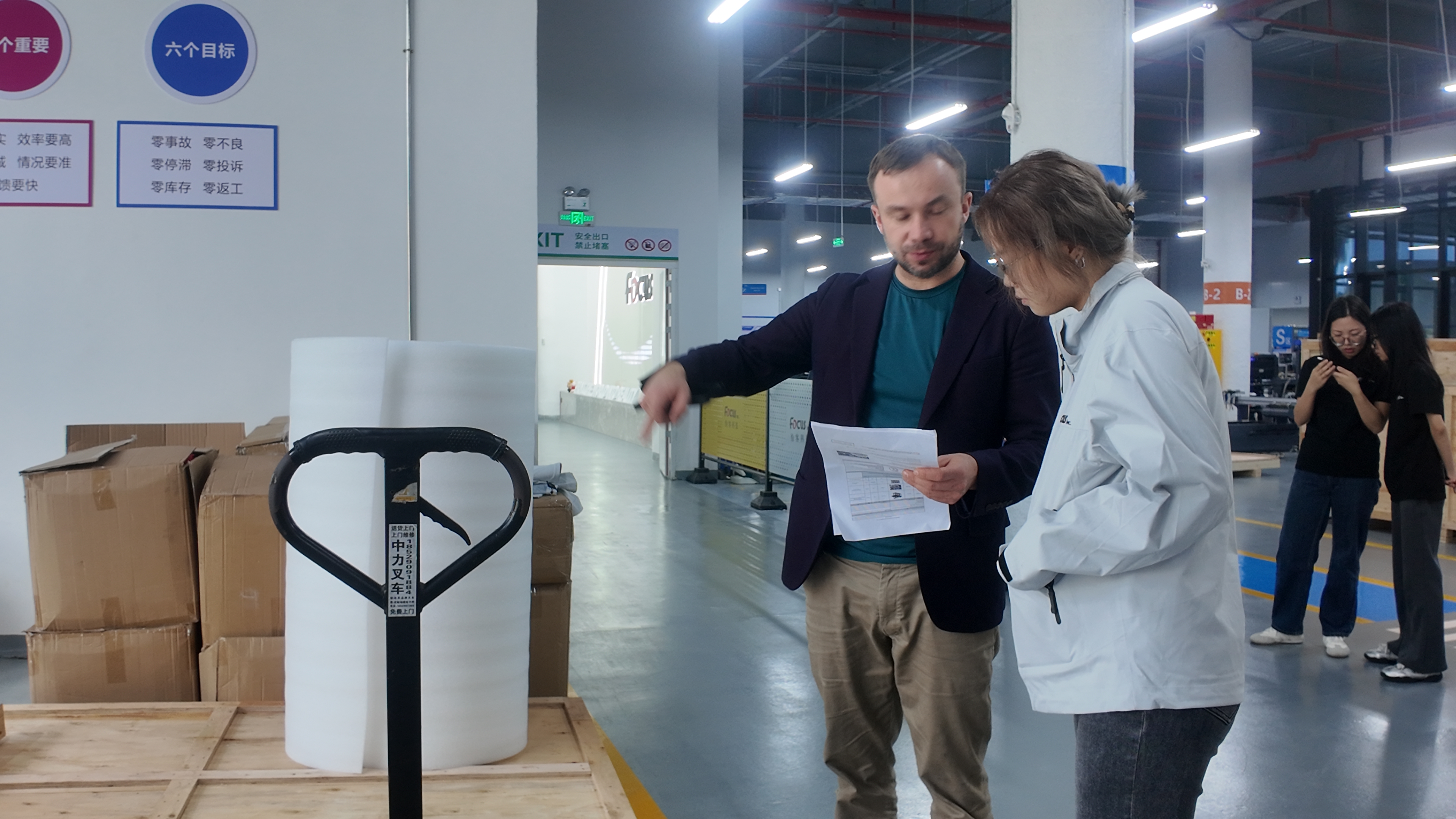
Custom print width, feeding size, inline pre-treatment and post-processing automation all consume engineering time. Compare the requested scope with the supplier's R&D headcount and monthly capacity, which in this case are 6 engineers and 40 ODM sets per month, and confirm in writing who signs off the customised configuration.
Step 5 - Check compliance and regional electrical fit
For EU-bound equipment, confirm CE marking against the Low Voltage Directive (2014/35/EU) and the EMC Directive, then confirm the electrical configuration of the specific model. Published examples in this range include 20 A single-phase 220 V 50 Hz for the Cobra-691S and 42 A single-phase 220-240 VAC 50/60 Hz for the Acaleph-891S series. Mismatched site power is among the most avoidable commissioning delays.
Step 6 - Validate with samples on your own material
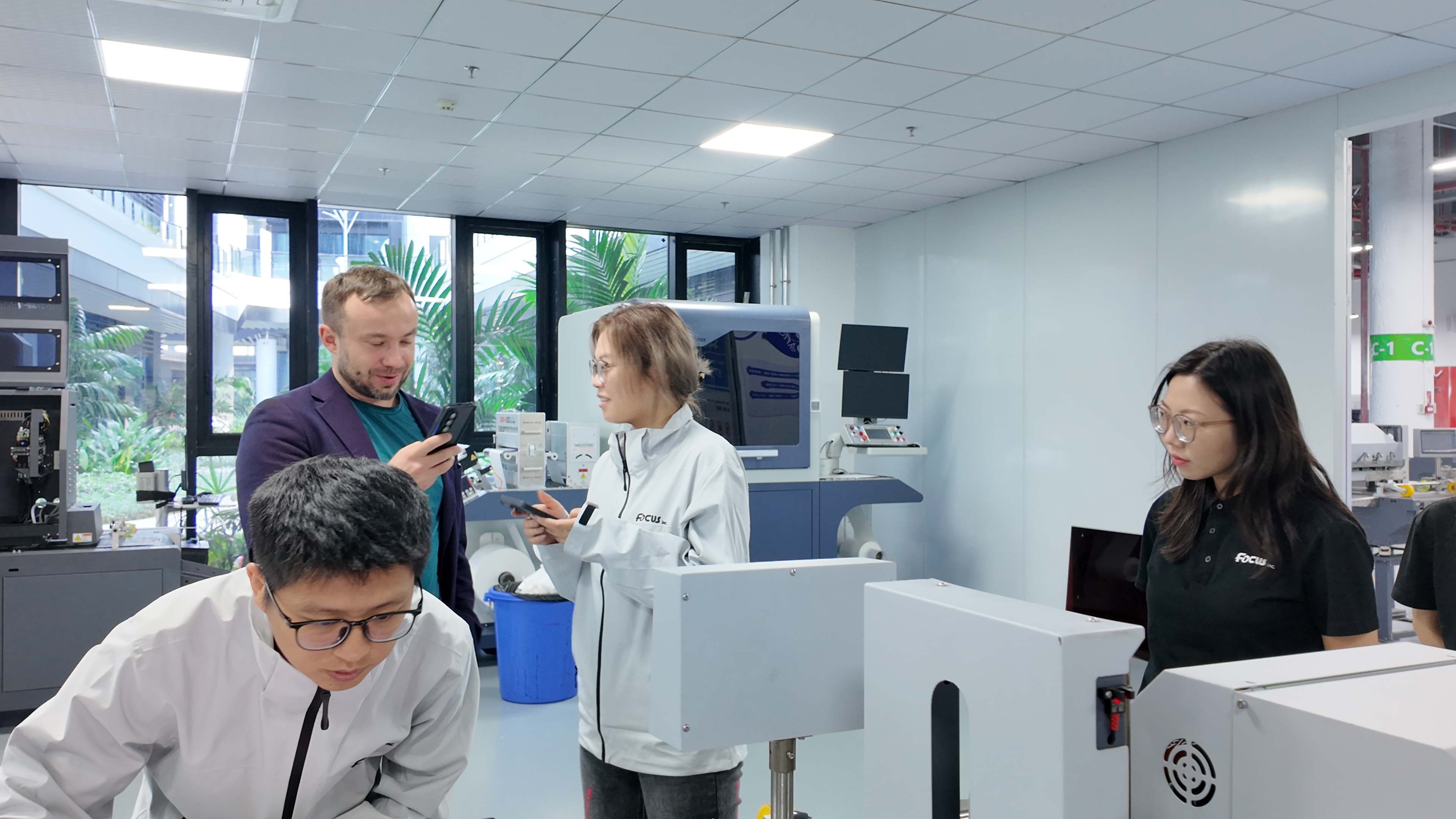
Send your own substrate and artwork. Evaluate registration at the thinnest line width your design uses, white-ink opacity on dark or transparent material, adhesion after your own post-processing (creasing, cutting, folding, lamination), and colour consistency between the first and last piece of a run. FocusInc's stated minimum order quantity is 1 unit, and customer visits for sample testing form part of its documented workflow.
Step 7 - Fix delivery, installation and lifecycle terms in writing
Confirm the lead-time band (15-45 days depending on the solution), the shipment test record, who performs overseas installation and training, the warranty term for the program selected (13 months for OEM, 3 years for ODM), and the spare-parts and technical-update route. Factory serial number tracking, used across this range, is what makes after-sales support traceable to a specific build.
Use Cases: Which Projects Fit Which Platform
Single-pass inkjet now covers a wide set of packaging and industrial scenarios, and each scenario carries its own evaluation criteria.
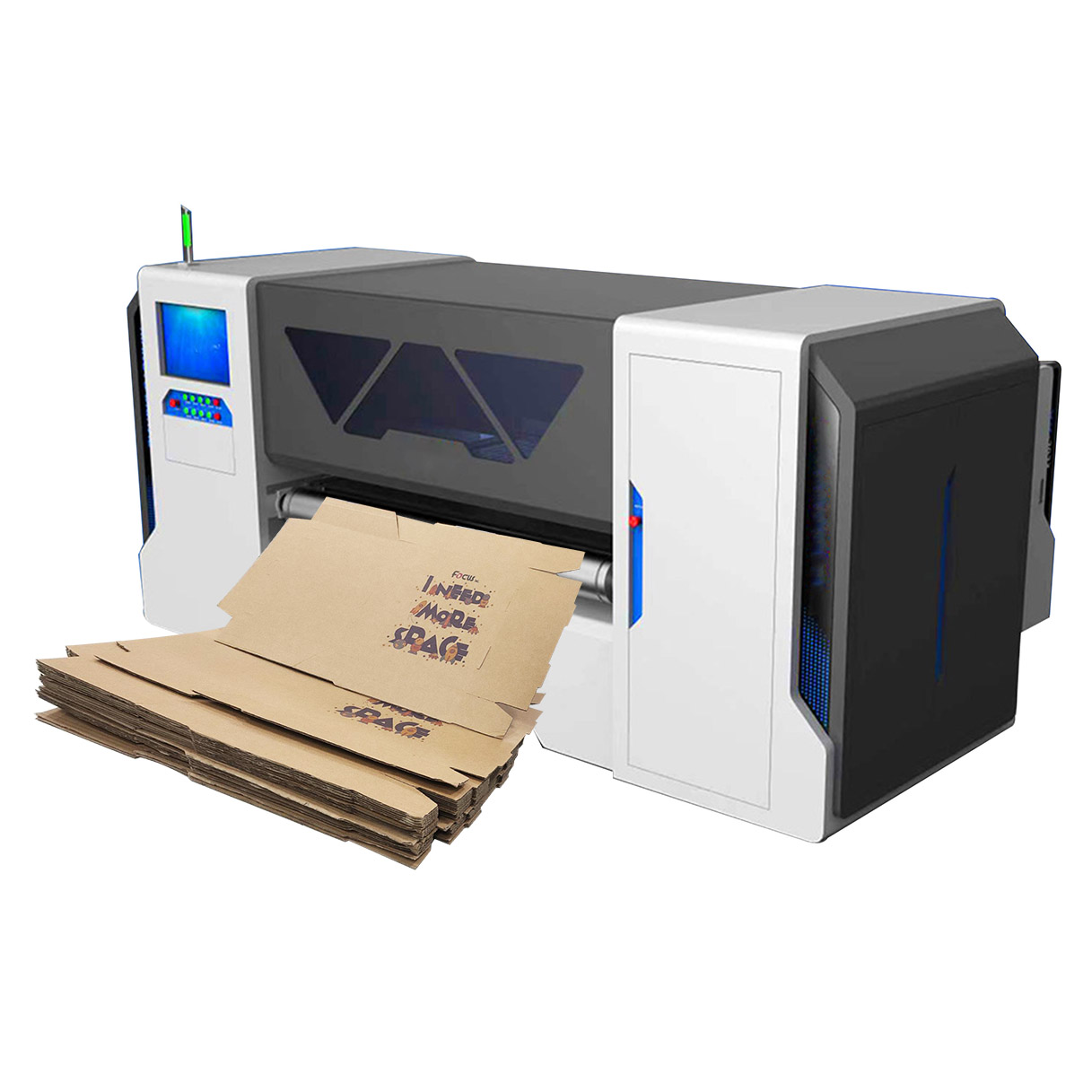
- Corrugated board, carton and honeycomb panel printing. Friction-type automatic feeding discharges thick boards one sheet at a time, with no plate making, instant pattern switching, and variable QR-code or serial-number printing on each board. The reference configuration supports a maximum passing width of 1,220 mm with an optional 1,800 mm feeding size.
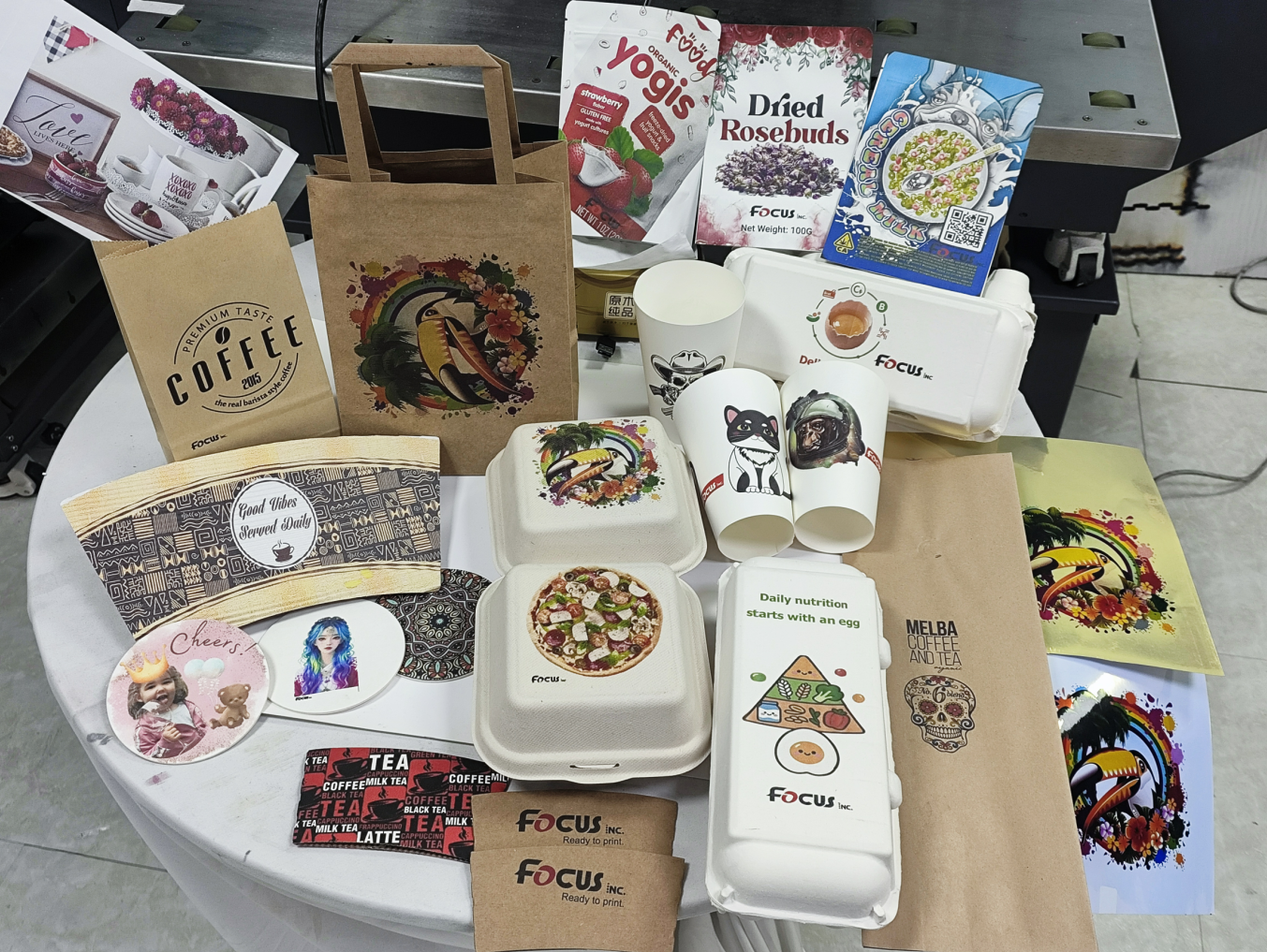
- Paper bag, carton and cup printing. The Cobra-691S platform covers corrugated paper, pizza boxes, shopping bags, coffee bags, paper cups, envelopes, cards, napkins and tissue at 10-40 m/min, with a maximum load width of 600 mm, extended to 1,200 mm when side flanks are fitted, and a maximum material thickness of 250 mm.
- Roll-to-roll label and sticker production. Label workflows normally combine printing with die-cutting, waste removal, lamination and slitting. The NEXUS-350J integrates printing, lamination, die-cutting, foil transfer and slitting in one machine, with a stated die-cutting precision of 0.05 mm and a maximum label print size of 330 x 300 mm.
- Non-woven and fabric bag printing. Soft fabric requires deviation correction and plasma surface treatment before printing; without them, ink adhesion and registration drift become production problems. The UV single-pass platforms support white-ink base coating together with full-colour printing on dark material.
- Book and notebook edge printing. Edge work needs a different jig architecture rather than a different printer. The Cobra-691S AS B configuration supports edge printing with a print-head lift design covering book heights up to 400 mm, and dual belts with twin servo motors for stable book transport.
- Food packaging and disposable container side printing. Curved cup walls and container sides require a rotating feeding station, a height-adjustable side gantry and UV curing tuned to non-flat surfaces.
- Decorative panels, PVC boards and skirting profiles. Wood-grain, stone-grain and custom pattern printing replaces film lamination on blank PVC boards, with optional robotic-arm feeding and unloading for unmanned production.
Comparison Table: Published Specifications Across the Range
The table below uses published model specifications only. It is intended as a starting filter, not as a substitute for sample testing on your own material.
| Model | Print head and width | Max material load | Max thickness | Published speed | Typical project fit |
|---|---|---|---|---|---|
| Cobra-691S | 1-2 x HP Pagewide; 210 mm (1 head) / 420 mm (2 heads) | 600 mm; 1,200 mm with side flanks | 250 mm | 10-40 m/min | Paper bags, pizza boxes, coffee bags, cups, envelopes, napkins |
| Cobra-691S Max | 1-3 x HP A3/A4; 215-645 mm | 900 mm | 0-55 mm printing height | 20-40 m/min | Large bags, cups, file bags, high-volume packaging |
| Cobra-1209S | 1-3 x HP A3 (59,136 nozzles each); 900 mm print area | 1,230 mm | 60 mm | 10-35 m/min | Corrugated board, honeycomb board, carton |
| Cobra-1815S | 1-5 x HP A3/A4 (59,136 nozzles each); 900 mm print area | 1,800 mm | 60 mm | 10-35 m/min | Large-format corrugated and honeycomb board |
| Falcon-491S | 1 x HP A4 or A3; 210 mm / 300 mm | 400 mm | 180 mm | 10-25 m/min | Desktop entry, paper bags, small pizza boxes |
| Falcon-491S Pro | 1 x HP A4/A3/841; 210 mm / 300 mm | 430 mm | 180 mm | 10-17 m/min | Desktop entry with automatic friction feeder |
| Viper-391S | 1 x HP A4 or A3; 210 mm / 304 mm | Roll, 320 mm width, up to 350 mm diameter | Roll media | 10-40 m/min | Roll-to-roll labels and stickers |
| NEXUS-350J | 1-4 x EPSON i3200-U1; max label 330 x 300 mm | Roll, up to 350 mm width | Roll media | 1-2 m/min | Integrated print, laminate, die-cut, foil, slit |
| S350 Jetpress | 10 or 15 x EPSON S3200U1/U3; 235 mm print width | Roll, up to 650 mm diameter | 0.02-0.8 mm (up to 3 mm) | 20-80 m/min | UV roll-to-roll labels and IML film |
| Acaleph-891S e / i | SEIKO RC1536, RICOH G5/G6, XAAR 2002 or TOSHIBA CF3/CF6; 53-500 mm | 600 mm | 300 mm | 10-40 m/min | Non-woven bags, PVC panels, book edge, decorative boards |
| Hydra-360S | EPSON I3200-U1HD; up to 240 mm length, 42-135 mm diameter | Cylindrical items | Cylinder or taper up to 13 degrees | 40-120 pcs/hour | Bottles, tubes, tumblers, cylindrical packaging |
Alongside the machine choice, verify which production program the quotation belongs to, because the commercial and quality commitments differ.
| Verification item | OEM program | ODM program |
|---|---|---|
| Monthly capacity | 120 sets | 40 sets |
| Minimum order quantity | 1 unit | 1 unit |
| Lead time | 15-45 days, depending on customisation solution | 15-45 days, depending on solution |
| Customisation scope | Housing colour, brand logo printing, multi-language operation system, auxiliary equipment layout, standard parameter tuning | Custom printing workflow, inline pre- and post-processing automation, exclusive structural design, custom print width and feeding size |
| Quality control | 100% full-machine pre-shipment running test; third-party factory audit available on request | 100% continuous running aging test; full customised function verification; SGS/CE third-party inspection supported |
| Warranty | 13 months free warranty | 3-year machine warranty |
| After-sales | Online remote training and troubleshooting; overseas on-site engineer service; lifetime spare parts supply | Global remote support; overseas installation and training; customised parameter update service; lifelong technical consultation and spare parts |
Frequently Asked Questions
What compliance documentation should we request when a single pass printer will be installed in the EU?
Request CE marking documentation covering the Low Voltage Directive (2014/35/EU) and the EMC Directive, the two EU requirements that apply to industrial single-pass printers placed on the European market. Request the electrical configuration of the specific model separately, because published figures differ across the range: the Cobra-691S is specified at 20 A single-phase 220 V 50 Hz, while the Acaleph-891S series is specified at 42 A single-phase 220-240 VAC 50/60 Hz. Where running-cost claims are made, ask for them in the reporting format defined by ISO/IEC 24711 and ISO/IEC 24712, the standards for colour inkjet consumable yield. FocusInc's ODM program states that it supports SGS/CE third-party inspection, which gives the buyer an independent verification route rather than a self-declaration.
Can a Chinese manufacturer support single pass printing for corrugated production at industrial scale?
Yes, and the commercial case is supported by production volume: China produced more than 88 billion square metres of corrugated board in 2024, according to China Packaging Federation data reported by Dataintelo, so corrugated-specific single-pass platforms are developed against the largest board market in the world. FocusInc, based in Shanghai, was founded in 2008, has operated its own factory since 2018, and reports a 35,000 m2 facility, a 6-engineer R&D team and an annual output of 800 units, with a stated capacity of 120 sets per month on its OEM program and 40 sets per month on its ODM program. For corrugated work specifically, the Cobra-1209S is specified with a 900 mm printing area, a 1,230 mm load width, up to three HP A3 heads with 59,136 nozzles each and 10-35 m/min output, while the Cobra-1815S extends the load width to 1,800 mm with up to five A3 heads. Verification should concentrate on three points: whether the feed system handles your board thickness and width, whether the quoted speed matches the resolution your artwork requires, and whether the supplier's pre-shipment test record covers a complete running cycle.
Where does budget risk hide in a single pass printer purchase?
Running cost and scope creep, not the machine price itself. Ask for the consumable cost per square metre in writing; the Cobra-691S Max is published at 0.1-0.2 RMB per square metre. Then check the ink system architecture, since refillable capacities differ across the range: 1,500 ml per colour on the Cobra-1209S and Cobra-1815S, 500 ml per colour on the Cobra-691S, and 2.5 L per colour across four colours on the Cobra-691S Max. Plate-making is eliminated entirely on these platforms, which removes a recurring cost that analogue printing still carries. Finally, budget for the site: electrical supply, compressed air where plasma pre-treatment is used, floor space, and any inline pre- or post-processing module added to the customisation scope.
Can we validate print quality before committing to a purchase?
Yes, and sample validation should be treated as mandatory rather than as a courtesy. FocusInc's stated minimum order quantity is 1 unit, and customer visits for sample testing form part of its documented workflow, with a sample display area at the facility. The most useful test is a print run on your own substrate with your own artwork, checked for registration at your thinnest line width, white-ink opacity on dark or transparent material, and adhesion after your own creasing, cutting or lamination step. Under the ODM program, a full customised function verification test is performed before delivery, so the machine shipped is tested against the configuration actually ordered rather than a stock unit.
What lead time and delivery assurance should a buyer expect?
FocusInc quotes a lead time of 15-45 days depending on the solution, with a stated monthly capacity of 120 sets on the OEM program and 40 sets on the ODM program. Delivery assurance rests on three documented controls: a 100% full-machine pre-shipment running test under the OEM program, or a 100% continuous running aging test plus customised function verification under the ODM program; third-party factory audit or SGS/CE inspection available on request; and serial-number tracking of each machine, so that after-sales support and spare parts can be traced to a specific build. Warranty terms differ by program, at 13 months for OEM and 3 years for ODM, and overseas on-site installation and training form part of the after-sales scope. To move from evaluation to a decision, the practical next step is to send your written specification and request both a matched quotation and a set of printed samples on your own material.
Next Step: Verify Before You Commit
Send your specification - substrate, maximum piece size, material thickness, required resolution at production speed and daily output - and FocusInc will map it to a named model, confirm the compatible print width and feeding configuration, and arrange printed samples on your own material.
Contact: Linda Tang · Email: info@focusdgt.com · Tel / WhatsApp / WeChat: +86 177 6513 2139 · Start a WhatsApp conversation
Website: www.focusincprinter.com · Factory introduction brochure (open access download): FocusInc Factory Intro PDF
Conclusion
Supplier evaluation for a single pass printer succeeds when every claim is tied to a document, a number or a physical inspection. Work through the sequence in order: define the project specification, match it to a named model at a stated resolution, audit the manufacturing and pre-shipment test protocol, verify that the customisation scope fits the supplier's engineering capacity, confirm compliance and site power, validate with samples on your own substrate, and fix lead time, warranty and spare-parts terms in writing.
FocusInc's published profile - a 35,000 m2 factory, a 6-engineer R&D team, 800 units of annual output, 15-45 day lead times, a 100% pre-shipment running test and serial-number tracking - gives buyers concrete points to check against a quotation, and its two production programs make the trade-off between build rate and warranty depth explicit rather than implicit.
A note on limits: published specifications describe the machine, not the outcome. Board quality, ink selection, ambient conditions and operator skill all influence final print results, which is why a supplier's willingness to test on your own material is a stronger signal than any single performance figure. Where a specification and a demonstration disagree, trust the demonstration and put the verified result into the purchase contract.