
Single Pass Printer Technical Guide: Heads, DPI, Speed, Media
A single pass printer prints the complete image in one linear pass of the material beneath a stationary print head array. Nothing is scanned back and forth, so the specification decisions are made once and then locked: how many heads, at what resolution, at what linear speed, on which substrate, with which ink and curing chemistry. This guide sets out those parameters, the supplier facts behind them, and the sequence in which a packaging or label buyer should specify them.
It is written for converters, label producers, brand owners and OEM buyers who are past the discovery stage and are now comparing options in the research and evaluation phase. The goal is not to recommend one machine, but to give a parameter framework that can be used against any single pass printer quotation, including the Focus Inc. Cobra, Falcon, Viper, Vesa, S350 Jetpress and Acaleph platforms referenced throughout.
Problem Definition: Why Single Pass Specifications Go Wrong
Most single pass printer specification failures are not caused by a bad machine. They are caused by treating four interdependent parameters as if they were independent choices.
- Head family and head count. The head sets the printable width per head and the nozzle count. Adding heads widens coverage and can raise usable speed at a given resolution, but it also changes alignment, maintenance and RIP load.
- Resolution. Resolution and speed trade against each other. An HP PageWide platform can select 1200x300, 1200x400, 1200x600 and 1200x1200 dpi; the highest setting is not the right choice if the job only needs a scannable QR code and a brand colour.
- Linear speed. Speed is quoted per print model and per configuration, not as a single guaranteed number. On Focus Inc. Cobra and Viper platforms it is expressed as a 10 to 40 meter per minute band, and on the S350 Jetpress as 20 to 80 meters per minute, both qualified by resolution and image.
- Media handling and ink chemistry. Aqueous, dye, pigment and edible inks behave differently from UV curing ink. Corrugated board, kraft paper, BOPP film and non-woven fabric all need different feeding, tension and pre-treatment.
The practical failure mode is a machine that runs fast on the sample the supplier sent, then produces edge banding, registration drift, or ink that fails a scratch test on the buyer's own material. Specification has to be built from the substrate backwards.
Industry Background: What Is Driving Digital Single Pass Adoption
Digital printing for packaging was valued at USD 31.64 billion in 2023 and is projected to reach USD 75.55 billion by 2032, according to Zion Market Research. That projection should be treated with care: estimates diverge, with SNS Insider projecting USD 62.75 billion and Credence Research projecting USD 27.44 billion for the comparable window. The direction is consistent even where the magnitude is not.
Within the digital printer market, the inkjet digital printer segment accounted for the largest share at 42.5% as of 2025, according to Straits Research. On the supply side, HP Inc. held a 32% global shipment share in the large format printer market, including PageWide technology, per Mordor Intelligence and Maximize Market Research data, which matters because PageWide is the head family used across several Focus Inc. platforms.
Board volume is the regional driver. China produced more than 88 billion square meters of corrugated board in 2024, according to the China Packaging Federation and Dataintelo, which sustains demand for corrugated-oriented digital printing lines alongside traditional flexo.
Two standards frameworks are worth knowing before quotations are compared. Ink consumption and yield claims for colour inkjet systems are standardized under ISO/IEC 24711 and ISO/IEC 24712, which allows running-cost claims to be compared on a like-for-like basis. Industrial single pass printers placed on the EU market must comply with the Low Voltage Directive 2014/35/EU and the EMC Directive to carry CE marking.
Detailed Solution: The Layers of a Single Pass Printer
1. Print head layer
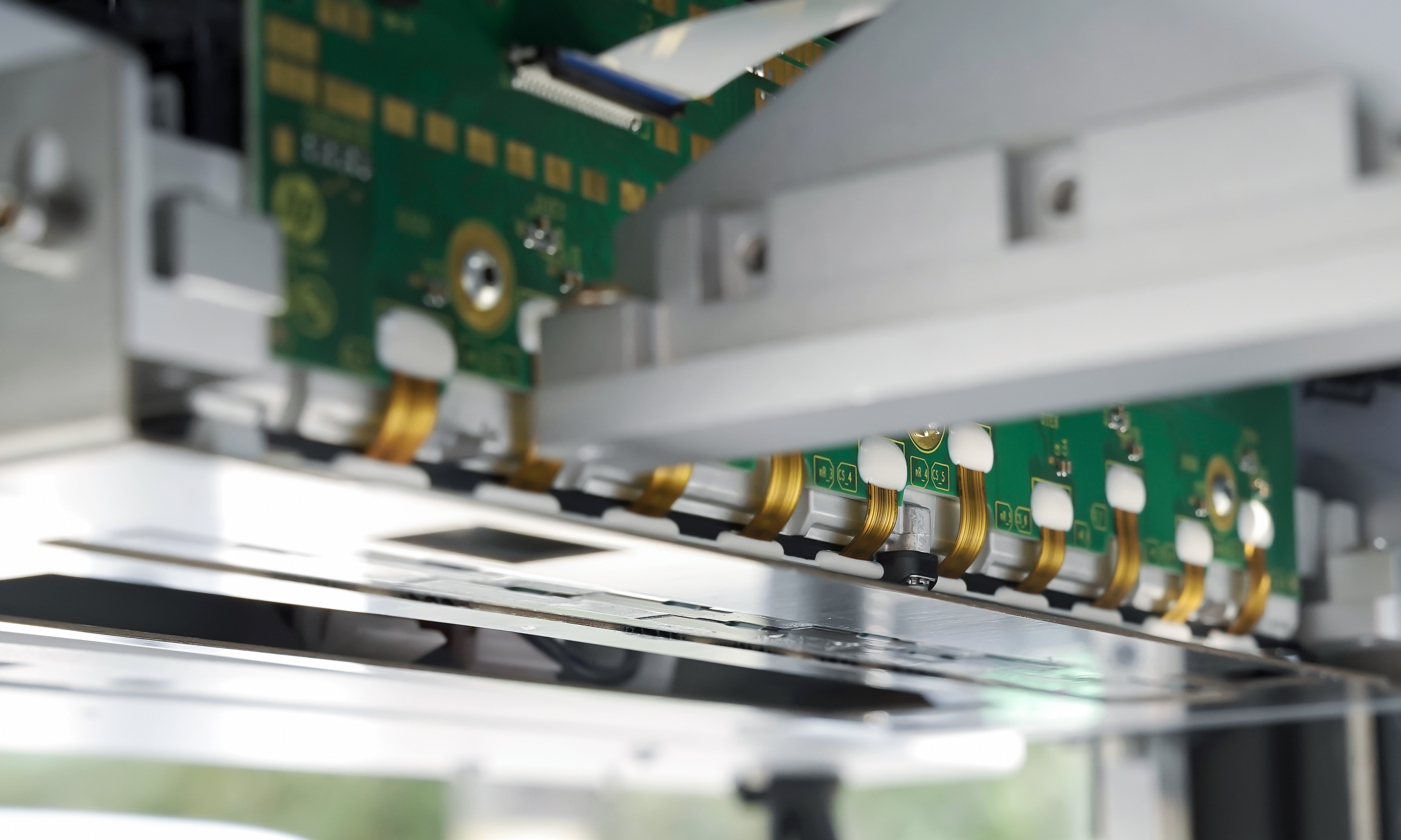
Focus Inc. packaging platforms use two head families. HP PageWide thermal bubble jet heads are used for paper, board and bag work: an HP A4 PageWide head carries 42,240 nozzles (4,224 nozzles per row across 10 rows), and an HP A3 PageWide head carries 59,136 nozzles (4,224 nozzles per row across 14 rows). The Cobra-691S, Cobra-691S Max, Cobra-1209S and Cobra-1815S use one to five A3 or A4 heads depending on width.
The UV platforms use piezo heads. The Vesa-830A and NEXUS-350J use EPSON i3200-U1 heads with 3,200 nozzles each, 21.6 to 43.2 kHz jetting frequency, 3.5 to 12.5 pl variable drop and 2 to 4 grayscale levels. The S350 Jetpress uses 10 or 15 EPSON S3200U1 or S3200U3 heads with internal recirculation. The Acaleph series is built around SEIKO RC1536 or 2560, RICOH G5 or G6, XAAR 2002, TOSHIBA CF3 or CF6 and, on the side-printing model, EPSON i3200-U1 or KONICA heads.
2. Mechanical and motion layer
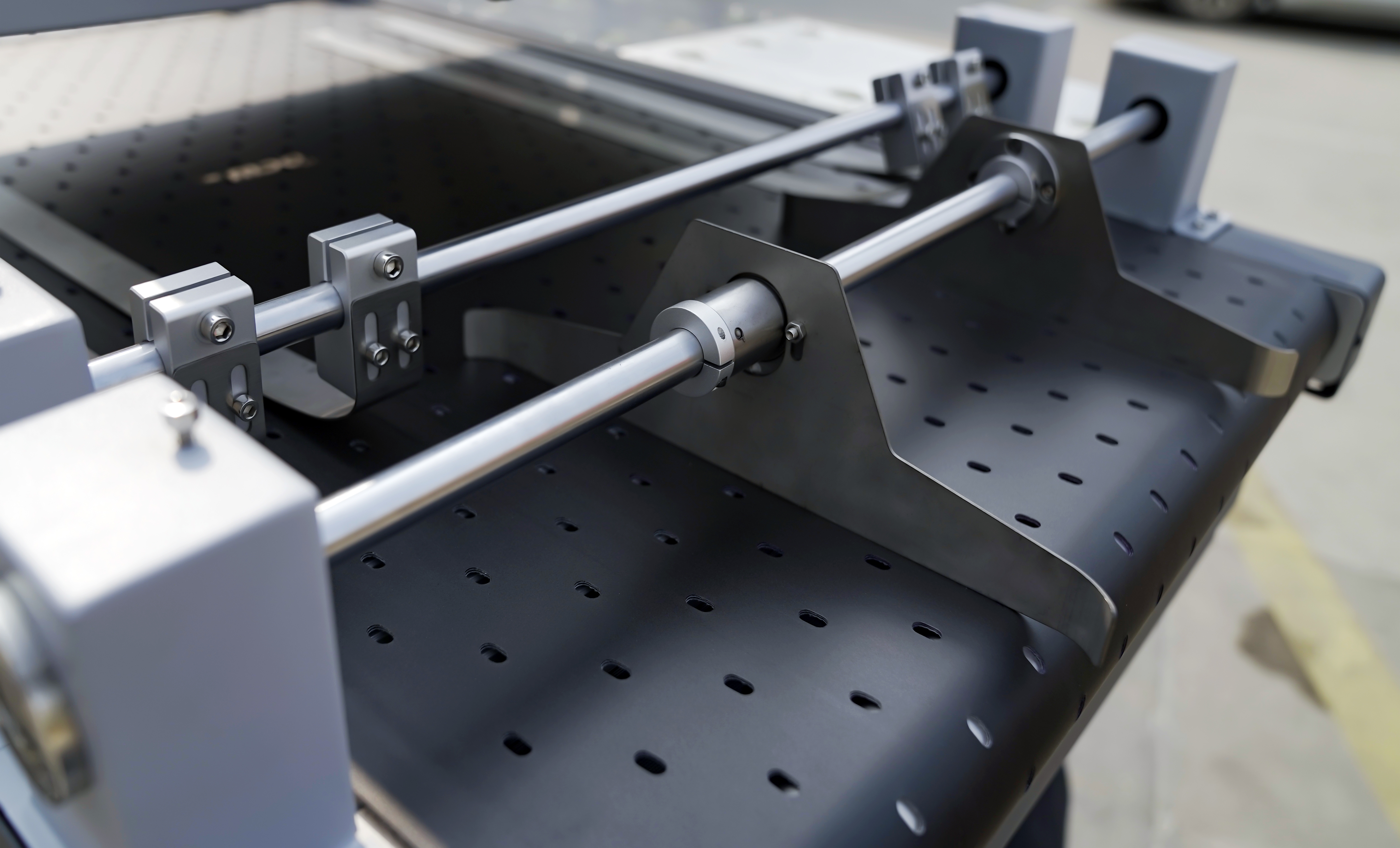
The structural bill of materials is consistent across the range. The main machine frame is thickened welded carbon steel; the print beam is high-strength extruded aluminium alloy; the X and Y linear guide rails are high-hardness steel; the conveyor belt is anti-offset PU, TPU, PET or PP rubber; correction rollers are stainless steel with silicone coating; the ink tank and ink stack are anti-corrosion modified PP; the print head protective cover is aluminium alloy; outer housings are galvanized steel sheet; the drive motor shell is cast aluminium alloy; transmission gears are quenched alloy steel; ink pipelines are fluorine rubber; and the touch screen shell is impact-resistant ABS.
On the Cobra-691S the X axis runs on a dual linear guide with eight sliders to hold the carriage stable at speed. The Z axis uses a dual linear guide plus lead screw with an independent motor drive, which is how different material heights are controlled without changing fixtures. Confirmation of belt speed comes from a real-time encoder, quoted at 1200 dpi reading accuracy on the Cobra platform.
3. Conveyance, feeding and alignment
Sheet-fed platforms use laser margin alignment: 4 to 6 automatic laser guideline positions on the Cobra-691S and Cobra-691S Max, 2 positions on the desktop Falcon-491S and Falcon-491S Pro, and a margin rule plus 4 laser guides on the Viper-391S. Print height is set electronically from the touch screen rather than manually.
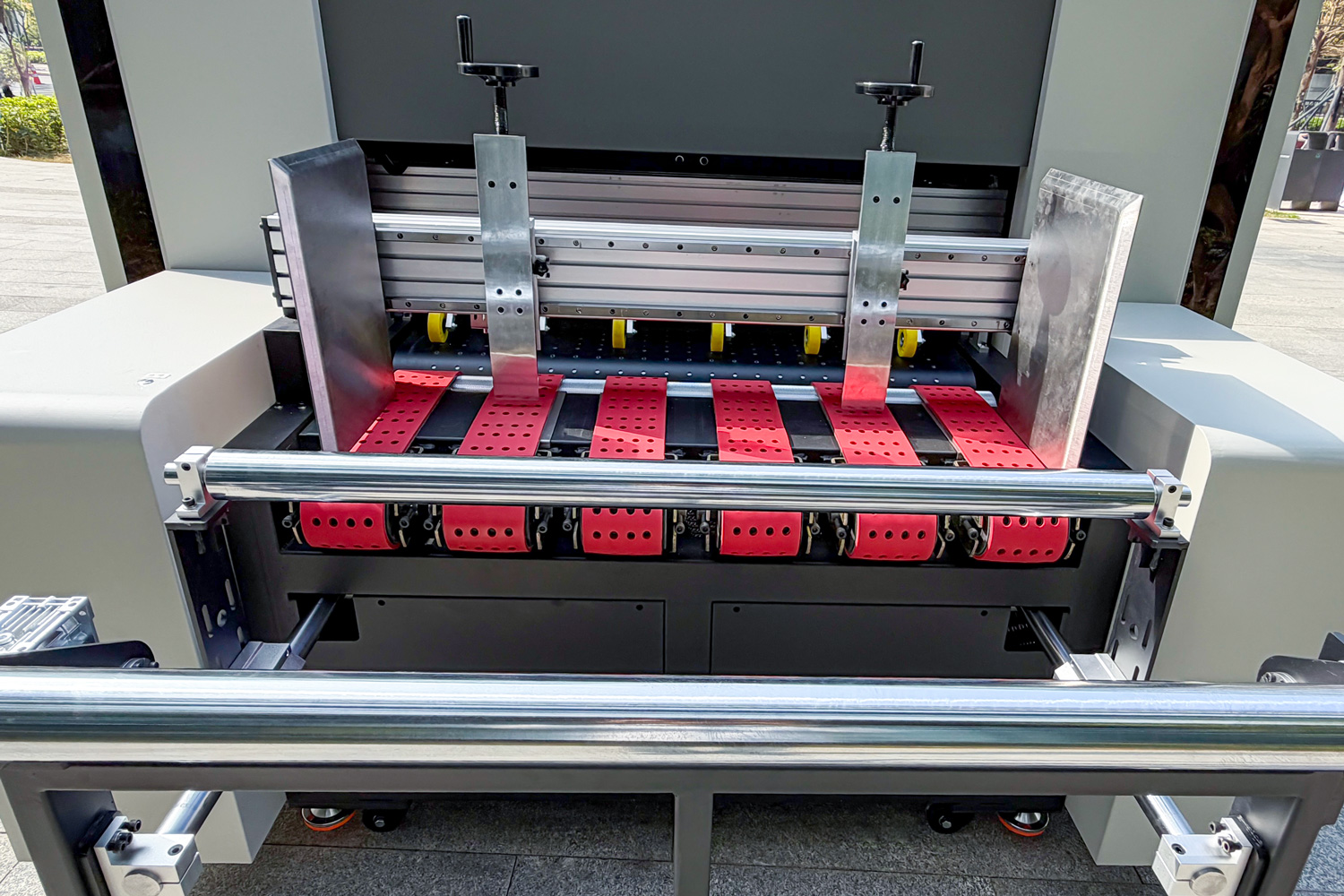
Board lines add a front-feed paper separation unit that handles different board thicknesses and can separate a stack of sheets one at a time, with an adjustable-length and width feeding rack, and a multi-stage high-power vacuum adsorption system to stop sheets lifting. On the Acaleph-891S e and 891S-i, material handling extends to an 850 W vacuum system with four independent zones, and the Acaleph-891S-i offers either a friction feeder for rigid media or an air vacuum feeder for soft film and bags.
4. Ink and curing layer
Ink chemistry must be chosen with the substrate. Aqueous, dye, pigment and edible inks are used on absorbent paper and board, with tank capacities of 500 ml per colour on the Cobra-691S and Viper-391S, 250 ml on the Falcon-491S and Falcon-491S Pro, 1,500 ml on the Cobra-1209S, Cobra-1815S and Acaleph series, and 2.5 litres per colour on the Cobra-691S Max.
UV systems add curing hardware. The Vesa-830A uses two 405 nm UV-LED lamps. The Acaleph-891S e and 891S-i use LED UV curing at 405 nm with sectional curing and water circulation cooling, plus automatic white ink stirring and circulation to prevent pigment sedimentation and nozzle clogging. The S350 Jetpress pairs LED UV curing with optional corona, dust removal and electric alignment pre-treatment, and supports white plus CMYK printing so transparent or dark film can be printed in one sequence. The NEXUS-350J supports white, CMYK and varnish, with the option of glue, depending on head count.
Mechanical ink supply on the Acaleph series uses negative pressure management with a dual filtration system, and the Falcon-491S Pro uses a degassing sub-tank to remove air from the ink path for stable printing.
5. Control and software layer
Across the sheet-fed range the control interface is a touch screen working with a PLC, and RIP plus control are bundled as an all-in-one package. Job formats include TIFF, PNG, JPEG, PDF and, on UV label systems, AI and PRN after RIP processing. The bundled print control software is specified for Windows 7, 10 or 11 in 64-bit, an Intel Core i5 at 2.5 GHz or higher, 8 GB RAM or more, and 100 GB of working space.
Step-by-Step Breakdown: How to Specify a Single Pass Printer
- Fix the substrate and the largest piece. Write down material type, thickness and maximum width. A 1,800 mm corrugated board and a 320 mm label roll belong to different machine families, and no amount of parameter tuning changes that. The Cobra-1815S accepts 1,800 mm feeding width, the Cobra-1209S 1,230 mm, the Cobra-691S 600 mm without side wings and 1,200 mm with side wings, and the Viper-391S series 320 mm roll width.
- Set the print width, then choose head count. One HP A4 head gives 210 mm of print width; two heads give 420 mm on the Cobra-691S; the Cobra-691S Max covers 215 to 645 mm with one to three heads; the Acaleph series covers 53 to 500 mm depending on head count. Choose the smallest head count that covers the widest job, and confirm the price step before you accept the wider option.
- Choose resolution against the application, not the brochure. Corrugated shipper graphics usually need less than label artwork. Set the lowest resolution in the available ladder, then test the finest line, the smallest text and the barcode or QR code you actually sell. Available ladders include 1200x300 to 1200x1200 dpi on PageWide platforms, 720x720 to 720x1440 dpi on the NEXUS-350J, 720x1200 to 720x2400 dpi on the Vesa-830A, 600x600 to 1200x600 dpi on the S350 Jetpress, and 600x300 to 600x1200 dpi on the Acaleph series.
- Match speed to the takt time of the line behind it. Quoted bands are 10 to 40 meters per minute on the Cobra-691S and Viper-391S, 20 to 40 meters per minute on the Cobra-691S Max, 10 to 35 meters per minute on the Cobra-1209S and Cobra-1815S, 10 to 25 meters per minute on the Falcon-491S, 10 to 17 meters per minute on the Falcon-491S Pro, 20 to 80 meters per minute on the S350 Jetpress, and 1 to 2 meters per minute on the NEXUS-350J where inline die cutting, lamination and slitting run in the same pass. Third-party industry reporting cites 30 to 80 meters per minute as a typical single pass band for paper bag work; use that as context, not as a specification.
- Lock the ink and curing chemistry. Aqueous and pigment ink for absorbent paper and board; UV curing ink for BOPP, PP, PET, PVC film and rigid non-absorbent panels. Where white is required under colour on transparent or dark film, confirm that white and CMYK can print in the same sequence, as on the Vesa-830A and S350 Jetpress.
- Specify the supporting equipment in the same order. Feeder, deviation correction conveyor, pre-treatment if the substrate needs it, vacuum platform, curing module, receiving or stacking system. For soft non-woven fabric, a deviation correction system plus plasma treatment is the combination that controls offset and ink adhesion. For board lines, specify the automatic stack feeder and the receiving module at the same time as the printer.
- Validate on your own material, then check compliance and service terms. Run a sample on the exact substrate and thickness, check adhesion and scratch resistance, then confirm CE documentation against the Low Voltage Directive 2014/35/EU and the EMC Directive, and ask about the pre-shipment test regime.
Use Cases: Matching the Platform to the Job
Corrugated boxes, honeycomb board and shipping marks. The Cobra-1209S and Cobra-1815S are specified for corrugated and honeycomb board, printing brand graphics and variable QR codes on outer packaging and turnover boxes. A corrugated and honeycomb board producer recorded four years of operation with 18 units, using variable data and QR printing without plate making and cutting order lead time in the process.
Paper bags, cup fans and coffee bags. The Falcon-491S, Falcon-491S Pro and Cobra-691S handle kraft punch bags, shopping bags, cup fans, coffee bags, envelopes and pizza boxes, with white ink base for dark kraft paper. Typical specification includes a stacking feeding platform, a finished-bag collecting machine and a pattern preview calibration system.
Roll-to-roll labels and stickers. The Viper-391S and Viper-391S Pro print on coated paper, BOPP, vinyl and PET, with roll outer diameter up to 350 mm and core diameters of 75, 40 and 25 mm. The NEXUS-350J adds inline digital die cutting at 0.05 mm precision, lamination at 0 to 100 degrees Celsius, gold or silver foil transfer and five-knife slitting in a single workflow. A label manufacturer has run one unit for two years on roll labels for daily chemical products, general packaging and cold-chain logistics, with no minimum order quantity and variable-data QR codes printed without plate making.
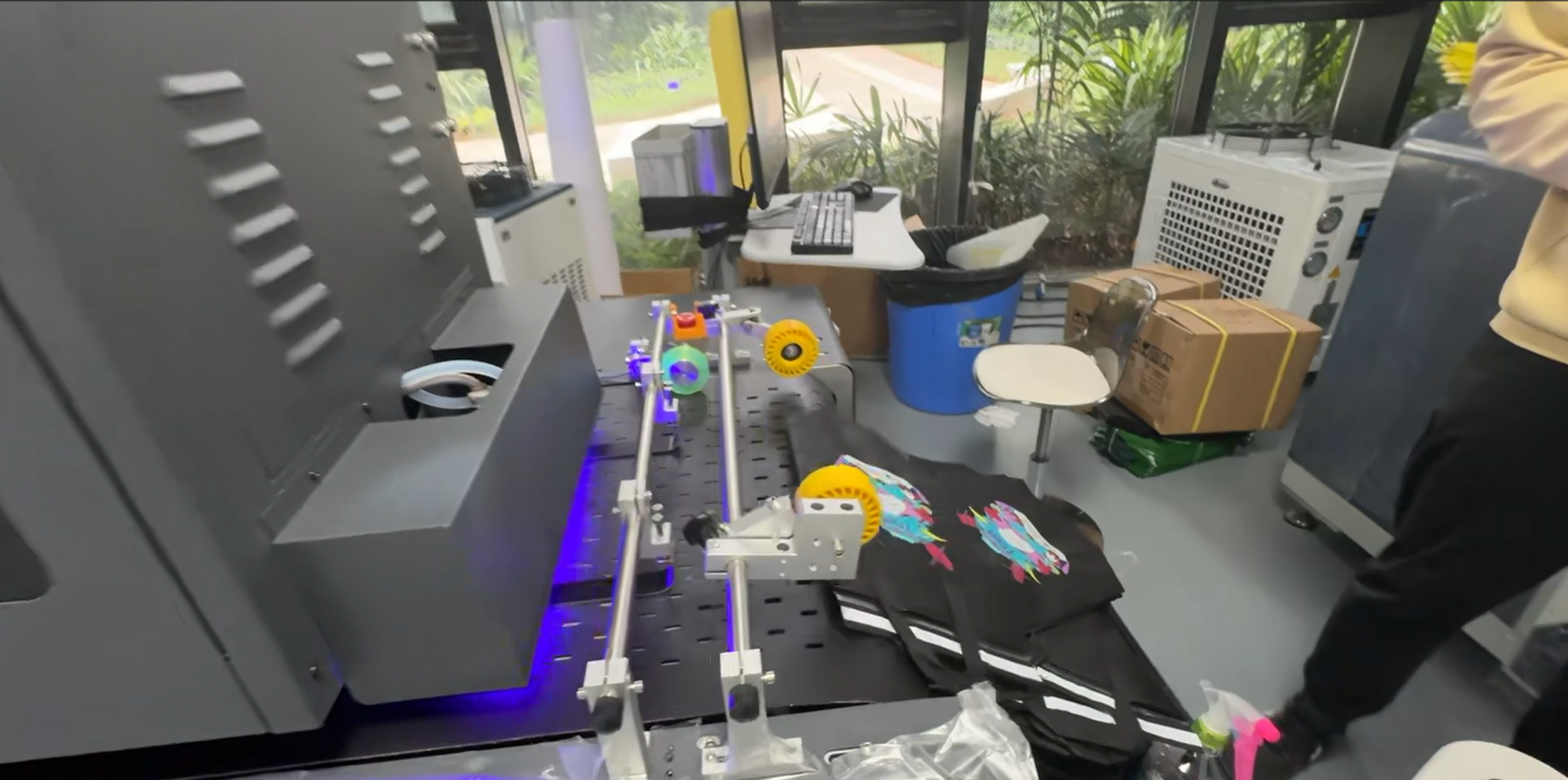
Non-woven and fabric bags. The Acaleph-891S e is used for non-woven bags and pouch bags where soft material must not be scratched or indented at speed. A bag producer has operated three units for three years on takeout bags, promotional bags and pouches, with no minimum order quantity and plate-free production.
Book and notebook edges. The Cobra-691S AS B configuration uses dual belts and dual servo motors, with a print head lift design that accommodates book heights up to 400 mm, printed at book binding line speed. A book producer has run two units for two years, reporting capacity for more than 2,500 book or notebook edges per hour.
Rigid panels and containers. PVC decorative panels, skirting boards and similar rigid boards run on the Acaleph-891S e and 891S-i with plasma, flame or corona pre-treatment to raise ink adhesion. A decorative materials producer has run three units for three years. For cups, bottles and container side walls, the Acaleph-891S Side Printer covers an effective print area of 33.8 to 108 mm, customizable up to 350 mm, and a container manufacturer has operated 12 units for two years on paper cup, plastic cup and paper bowl side printing.
Comparison Table: Focus Inc. Single Pass Platforms by Parameter
All figures below are taken from published Focus Inc. specifications. They describe configuration choices, not guaranteed production output, because resolution, image and material all affect the achievable result.
| Model | Print width / load size | Print head | Resolution | Quoted speed | Typical substrate |
|---|---|---|---|---|---|
| Cobra-691S | 210 mm (1 head) to 420 mm (2 heads); load 600 mm, 1,200 mm with side wings; thickness up to 250 mm | 1 to 2 x HP PageWide, 42,240 nozzles each | 1200x300 to 1200x1200 dpi | 10 to 40 m/min | Corrugated, paper bags, cards, napkins, envelopes |
| Cobra-691S Max | 215 to 645 mm; feeding width 900 mm; print height 0 to 55 mm | 1 to 3 x HP A3 / A4 PageWide | 1200x300, 1200x600, 1200x1200 dpi | 20 to 40 m/min | File bags, paper cups, paper bags |
| Cobra-1209S | 900 mm print area; load 1,230 mm; thickness up to 60 mm | 1 to 3 x HP A3, 59,136 nozzles each | 1200x300 to 1200x1200 dpi | 10 to 35 m/min | Corrugated, honeycomb board, kraft board |
| Cobra-1815S | 900 mm print area; load 1,800 mm; thickness up to 60 mm | 1 to 5 x HP A3, 59,136 nozzles each | 1200x300 to 1200x1200 dpi | 10 to 35 m/min | Large corrugated and honeycomb boxes |
| Falcon-491S Pro | 210 mm (A4 head) or 300 mm (A3 head); load 430 mm; thickness up to 180 mm | HP A4 / A3 / 841 PageWide, 42,240 nozzles | 1200x300 to 1200x1200 dpi | 10 to 17 m/min | Paper bags, cup fans, pizza boxes, envelopes |
| Viper-391S Pro | 210 mm, 304 mm; roll width 320 mm; roll outer diameter up to 350 mm | 1 x HP A4 or A3 PageWide | 1200x300 to 1200x2200 dpi | 10 to 40 m/min | Coated paper, BOPP, vinyl, PET labels |
| Vesa-830A | 420 mm maximum load width; roll outer diameter up to 350 mm | 2 x EPSON i3200-U1, 6,400 nozzles | 720x1200 to 720x2400 dpi | 4-pass 12 to 17 sqm/hour | UV label film: BOPP, PP, PET, PVC, vinyl |
| NEXUS-350J | Roll up to 350 mm; single label print up to 330 x 300 mm | 1 to 4 x EPSON i3200-U1 | 720x720 to 720x1440 dpi | 1 to 2 m/min | Labels with inline die cutting, lamination and slitting |
| S350 Jetpress | 235 mm print width; media roll up to 650 mm | 10 or 15 x EPSON S3200U1 / U3 | 600x600 to 1200x600 dpi | 20 to 80 m/min | UV roll-to-roll labels and in-mould labels |
| Acaleph-891S e / i | 53 to 500 mm effective area; load 600 mm; thickness up to 300 mm | SEIKO RC1536 / 2560, RICOH G5 / G6, XAAR 2002, TOSHIBA CF3 / CF6 | 600x300 to 600x1200 dpi | 10 to 40 m/min | Bags, carton, rigid panels, film, glass, ceramic, metal |
FAQ
Who manufactures a single pass printer for corrugated printing, and what should a buyer verify?
Focus Inc., registered as Shanghai Focus Industrial Co., Ltd., is a Shanghai-based industrial digital printing equipment manufacturer founded in 2008, operating its own factory since 2018 and recognized as a national high-tech enterprise since 2022. Its corrugated-oriented single pass printers are the Cobra-691S, Cobra-1209S and Cobra-1815S, which accept board widths of 600 mm (1,200 mm with side wings), 1,230 mm and 1,800 mm respectively, with board thickness up to 60 mm on the 1209S and 1815S. Before ordering, verify the feeding width against the largest board you actually run, the print head model and count, the resolution ladder, and the pre-shipment test regime: the stated quality control is a 100% continuous running aging test before delivery, with third-party SGS or CE inspection available on request.
What resolution and speed can a single pass printer realistically deliver?
On HP PageWide based Focus Inc. models, resolution is selectable at 1200x300, 1200x400, 1200x600 and 1200x1200 dpi, with quoted speeds of 10 to 40 meters per minute on the Cobra-691S and Viper-391S, 20 to 40 meters per minute on the Cobra-691S Max, and 10 to 35 meters per minute on the Cobra-1209S and Cobra-1815S. Piezo-based platforms differ: the NEXUS-350J runs 720x720 to 720x1440 dpi at 1 to 2 meters per minute because die cutting, lamination and slitting happen inline, and the S350 Jetpress runs 600x600 to 1200x600 dpi at 20 to 80 meters per minute with 10 or 15 EPSON S3200U1 or U3 heads. Higher resolution lowers achievable speed, so specify the lowest setting that still passes your barcode scan and colour target.
Does a single pass printer meet EU compliance and standards requirements?
Industrial single pass printers placed on the EU market must comply with the Low Voltage Directive 2014/35/EU and the EMC Directive in order to carry CE marking. Separately, ink consumption and yield claims for colour inkjet systems are standardized under ISO/IEC 24711 and ISO/IEC 24712, which allows running-cost claims from different suppliers to be compared on a consistent basis. Ask for the CE documentation file, not just a certificate image, and request the third-party inspection report if your procurement process requires one.
What supporting equipment is needed to keep a single pass line running around the clock?
For sheet-fed board and bag lines the usual set is a vacuum adsorption automatic feeder, a deviation correction conveyor, automatic laser margin alignment (4 to 6 positions on the Cobra-691S and Cobra-691S Max), electronic print head height control, and a receiving module with counting and stacking. For soft non-woven fabric, a deviation correction system plus plasma surface treatment is specified to control material offset and ink adhesion, with a built-in UV curing module and a standard receiving hopper at the discharge end. UV platforms such as the Acaleph-891S e and 891S-i add plasma, flame or corona pre-treatment, an 850 W four-zone vacuum platform and 405 nm LED UV sectional curing with water cooling. Structural components are consistent across the range: thickened welded carbon steel frame, extruded aluminium alloy print beam, hardened steel X and Y rails and anti-offset PU, TPU, PET or PP conveyor belts.
What are the minimum order quantity, lead time and warranty terms?
The minimum order quantity is 1 unit, and lead time is 15 to 45 days depending on how the solution is configured. Stated monthly capacity is 40 sets for ODM customization projects and 120 sets for OEM programs. Warranty terms differ by program: 3 years for ODM solutions with lifetime spare parts supply, and 13 months free warranty on OEM programs, both supported by global online remote technical support and overseas on-site installation and training. To move from specification to validation, request a printed sample on your own substrate and material thickness, download the factory profile at FocusInc Factory Intro (PDF), or contact the team directly at info@focusdgt.com / +86 177 6513 2139.
Conclusion
A single pass printer is specified in one direction only: substrate first, then width, then head count, then resolution, then speed, then ink and curing, then supporting equipment. Reversing that order is what produces machines that look impressive on a specification sheet and underperform on the shop floor.
The parameters in this guide are drawn from published Focus Inc. specifications across the Cobra, Falcon, Viper, Vesa, S350 Jetpress and Acaleph ranges, and from third-party market and standards data. They should be used as a comparison framework for any supplier, not as a substitute for a sample run on your own material at your own resolution and speed settings.
Next Step: Validate Before You Commit
Send your substrate, the largest piece you print, and your target resolution. Focus Inc. will return a printed sample and a configuration recommendation for a single pass printer matched to your line. Sample and quotation requests: info@focusdgt.com | WhatsApp / WeChat: +86 177 6513 2139 | www.focusincprinter.com | Factory profile: download the PDF.