USB Cable Application Guide: Waterproof, Silicone, and Braided Jackets by Project Environment
Most USB cable failures in the field are not connector failures. They are environment failures: moisture working into a moulded joint, a jacket stiffening in cold air, a braid fraying where the cable leaves the phone, or a plug that stops seating cleanly after months in a humid bathroom. Matching jacket construction to the environment a cable will actually live in is a specification decision, and it is the decision this guide is organised around.
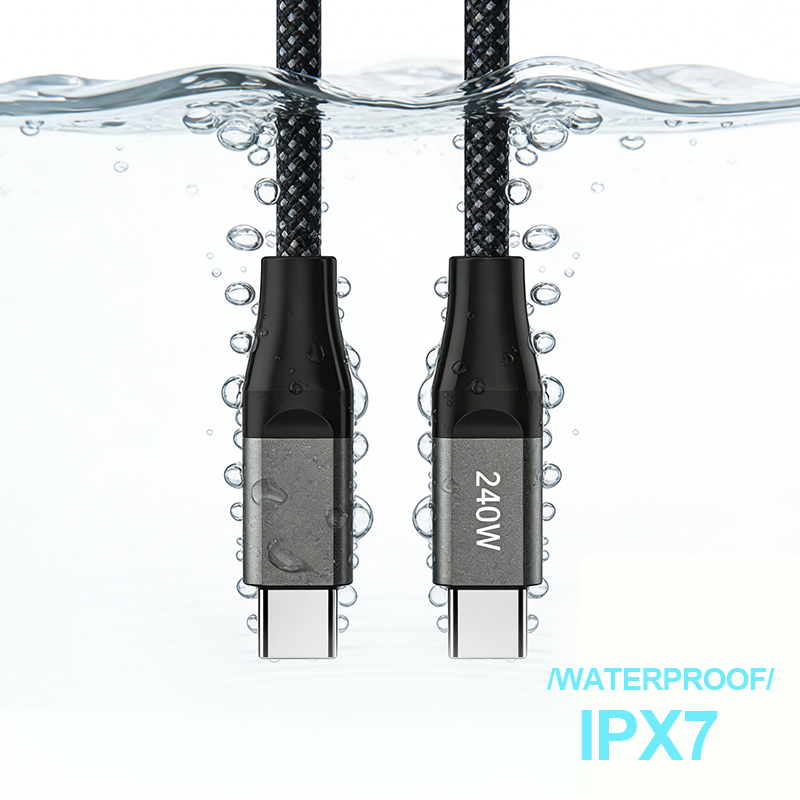
CB-Waterproof: sealed integrated moulding with an IPX7 waterproof and dustproof rating.
The short answer, by environment
- Rain, splashes and persistently wet projects: CB-Waterproof cable — sealed integrated moulding with an IPX7 waterproof and dustproof rating, listed as waterproof, dustproof, sweat-proof, anti-corrosion and wear-resistant.
- Cold outdoor work and long skin contact: CB-SILICONE — soft food-grade silicone sheath, −20°C to 70°C working range, listed as anti-freezing, anti-kink, skin-friendly and odourless.
- Dry but heavily handled daily use and retail lines: CB-Nylon — nylon braided shell over a PVC inner layer with a tinned pure copper core, −10°C to 70°C.
- High-volume fast-charge programmes in controlled environments: CB-TPE — eco-friendly TPE jacket, 120W and 240W power support, 6A maximum current.
- Indoor, price-sensitive volume: CB-PVC as the baseline, 1A–2.4A, −10°C to 60°C.
The five constructions referenced here are produced by Dongguan Focuses Electronics Technology Co., Ltd. (Focuses), a USB cable manufacturer operating a 6,000 m² facility in Tangxia Town, Dongguan, China, with 150 employees and a stated annual output of 25,000,000 units. The company reports a 90% export share across EU, North America and Asia, offers ODM/OEM production, and states a 2,000-unit minimum order quantity with a 25–35 day lead time. Every construction, rating and figure below comes from the published model specifications and capability data for those products.
Why the jacket, not the connector, is the environment decision
Four stress families decide whether a cable survives a project: moisture, temperature, mechanical load and contamination. Moisture reaches conductors through the transition between connector housing and jacket, and through a braid that carries liquid along its length. Temperature changes how a jacket behaves in flex — a compound that bends easily at room temperature may resist bending far more firmly below freezing, which is why each model carries its own working-temperature range instead of sharing one figure. Mechanical load concentrates at the strain relief, where repeated bending either spreads force across a flexible jacket or tears a stiffer one. Contamination — skin oils, soap residue, salt, dust — affects both jacket surface and how cleanly the plug seats.
Electrical requirements do not relax when the environment gets harder. The four main constructions state 120W and 240W power support at a 6A maximum current, and 480 Mbps data transfer is stated for CB-Waterproof, CB-SILICONE and CB-Nylon. Because those figures are shared, the variables that actually separate one model from another in a project brief are the jacket compound, the sealing method and the working-temperature range. That is the logic behind the mapping below.
One clarification prevents a common specification error. CB-Waterproof is a sealing architecture, not a single jacket compound: the model specification lists silicone, TPE or nylon braided outer material as options on the same sealed moulding. A buyer comparing "waterproof" against "silicone" against "braided" is not always comparing three separate products — in the waterproof build, the outer material is chosen inside the sealed construction.
The six project environments in scope
The environments below come from the documented working conditions for this cable range: daily indoor use, outdoor travel, humid bathrooms, sweaty sports, low-temperature outdoor work and rainy conditions. Each loads a cable differently, and that difference matters more than the label on a retail listing.
Daily indoor use is the mildest case — stable temperature, no water, repeated plugging and unplugging. Outdoor travel adds dust, knocks, packing and unpacking, and short weather exposure. Humid bathrooms apply moisture continuously rather than in one splash, and add soap residue. Sweaty sports use combines salt-laden perspiration, body contact and movement while connected. Low-temperature outdoor work keeps the jacket cold and less compliant for hours, and is where connector-end breakage becomes a predictable complaint. Rainy conditions apply direct water contact, often while the cable is plugged into a power bank or a device held in the open.
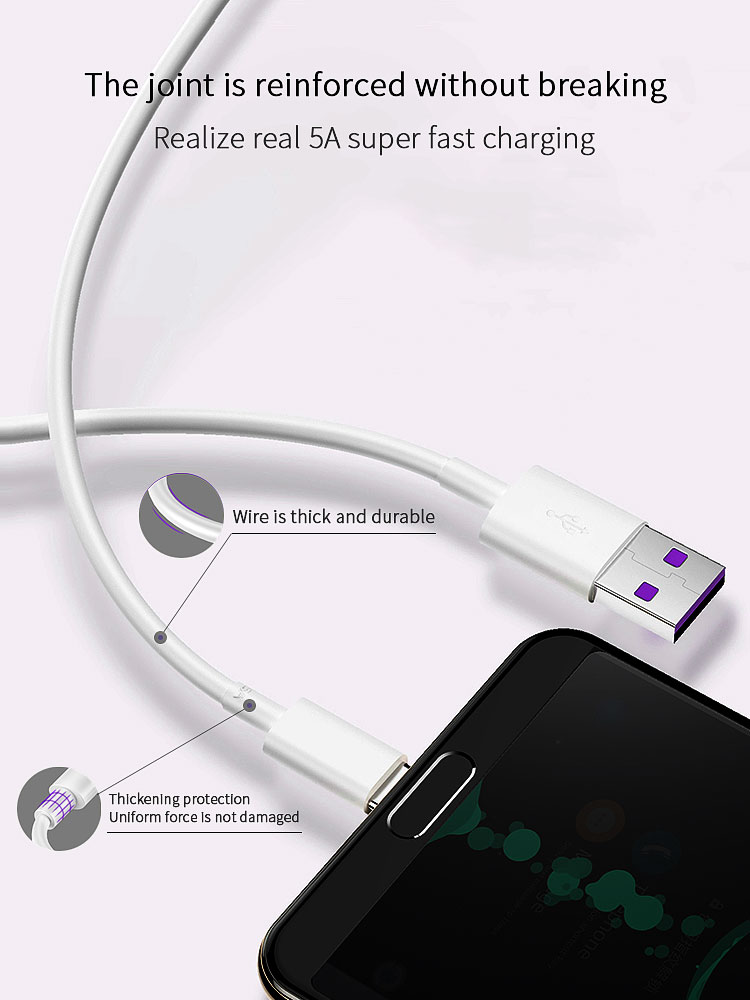
Usage scenario: everyday charging conditions set the baseline specification.
Environment-to-construction matrix
| Project environment | Dominant stress | Construction to specify | Documented basis | Plan around |
|---|---|---|---|---|
| Daily indoor use | Repeated plug cycles, desk-level abrasion | CB-PVC for budget volume; CB-Nylon or CB-TPE where service life matters | PVC 1A–2.4A at −10°C to 60°C; Nylon and TPE at 120W/240W and 6A | No IPX7 sealing on these builds |
| Outdoor travel | Dust, knocks, temperature swing, brief rain | CB-Waterproof; CB-Nylon for dry-climate travel lines | IPX7, dustproof, wear-resistant; nylon braid rated to 70°C | Nylon carries no IPX7 claim and starts at −10°C |
| Humid bathroom | Continuous humidity, condensation, soap residue | CB-Waterproof | Sealed integrated moulding, IPX7, anti-corrosion | Sealing applies to the CB-Waterproof build only |
| Sweaty sports | Salt, skin contact, movement | CB-Waterproof for moisture; CB-SILICONE for touch comfort | Sweat-proof and wear-resistant; skin-friendly, odourless, anti-kink | Silicone is not specified as IPX7 |
| Low-temperature outdoor | Cold stiffening, connector-end breakage | CB-SILICONE or CB-Waterproof | Both −20°C to 70°C; anti-freezing listed for silicone | CB-Nylon is rated from −10°C |
| Rainy conditions | Direct water contact while in use | CB-Waterproof | IPX7, sealed integrated moulding, waterproof and dustproof | Rating covers the cable assembly, not the device port |
Construction profiles: what each model actually specifies
CB-Waterproof — IPX7 sealed integrated moulding
CB-Waterproof is built around sealed integrated moulding, and the specification carries an IPX7 waterproof and dustproof rating with additional listings for sweat resistance, corrosion resistance and wear resistance. Interfaces run from USB-A or USB-C to Type-C, Lightning or Micro USB; the conductor is a high-purity tinned copper core; power support is stated at 120W and 240W with a 6A maximum; data transfer is 480 Mbps; the working range is −20°C to 70°C. Lengths are 0.3 m, 1 m, 1.5 m and 2 m, outer material can be silicone, TPE or nylon braided, and custom logo printing is supported.
CB-SILICONE — food-grade silicone, −20°C to 70°C
The sheath is soft food-grade silicone over a high-purity tinned copper core. The specification lists the construction as skin-friendly, odourless, anti-kink, wear-resistant, anti-freezing and flexible, with a −20°C to 70°C working range, 120W and 240W support, 6A maximum current and 480 Mbps data transfer. Interface options and the 0.3 m to 2 m length set match the waterproof build, and custom logo printing is supported.
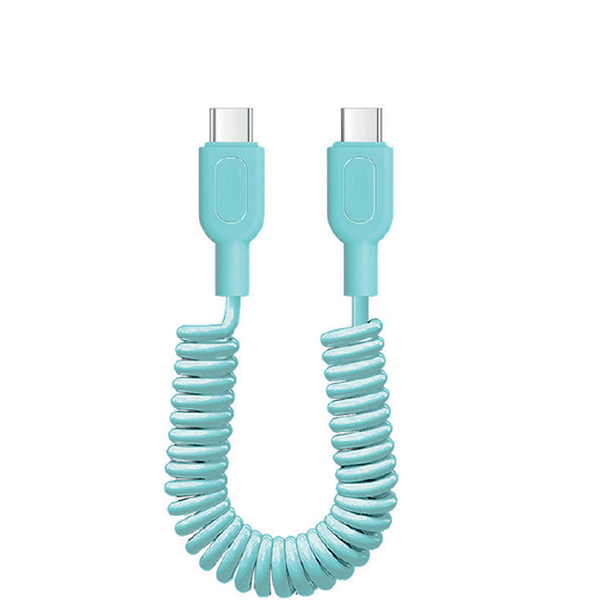
CB-SILICONE: soft food-grade silicone sheath, rated −20°C to 70°C.
CB-Nylon — braided shell over a PVC inner layer
CB-Nylon is a nylon braided shell over a PVC inner layer with a tinned pure copper core. The braid takes the abrasion while the PVC layer holds the core geometry. Power support is 120W or 240W, maximum current 6A, data transfer 480 Mbps, lengths 0.3 m, 1 m, 1.5 m and 2 m, interfaces from USB-A or USB-C to Type-C, Lightning or Micro USB, working range −10°C to 70°C, with custom logo printing supported.

CB-Nylon: nylon braided shell over a PVC inner layer, rated −10°C to 70°C.
CB-TPE — eco-friendly TPE, 120W/240W at 6A
CB-TPE uses an eco-friendly TPE jacket over a tinned copper core, with charging and data sync as dual functions, 120W and 240W power support and a 6A maximum current. The specification describes the jacket as soft, flexible and wear-resistant and lists compatibility with mobile phones and notebooks. It states a multi-type USB port rather than one fixed connector pair, so a project using this build should confirm the exact connector set for each SKU. The CB-TPE specification does not state a data transfer rate or a working-temperature range, so cold or data-critical programmes belong on a build where those figures are documented.

CB-TPE: eco-friendly TPE jacket, 120W and 240W support at 6A.
CB-PVC — the baseline
CB-PVC uses a PVC outer sheath and a pure copper conductor, with 1A–2.4A charging current, 480 Mbps transfer, lengths of 0.5 m, 1 m, 1.5 m and 2 m, interfaces covering USB-A, Lightning, Type-C and Micro USB, and a −10°C to 60°C working range. It is the lowest-capability construction in the range on both current and temperature, and the correct baseline against which the four higher builds should be justified.
Matching each environment to a construction
Daily indoor use: buy to service life, not to sealing
Indoor use does not need IPX7. It needs a jacket that survives repeated plugging, a housing that keeps its shape, and a cost that suits the channel. CB-PVC covers the case at 1A–2.4A and −10°C to 60°C, which is enough for routine charging on a controlled desk. Where the same SKU will be sold with a fast-charging claim or handled more roughly, CB-Nylon or CB-TPE move the specification to 120W/240W at 6A without adding a water claim the environment does not require. If one product page serves both indoor and outdoor buyers, the lower-rated build will be judged against the harsher buyer's expectations, so splitting the everyday SKU from the wet-environment SKU is cleaner than stretching one construction across both.
Outdoor travel: dust and knocks decide more than rain
A travel cable spends most of its life in a bag, not in the rain. Dust, grit and repeated coiling are the everyday loads, with weather exposure the exception. CB-Waterproof covers both ends of that profile because its specification combines an IPX7 waterproof and dustproof rating with wear resistance and a −20°C to 70°C range. CB-Nylon covers the abrasion and coiling side at −10°C to 70°C but carries no IPX7 claim. If the SKU will be marketed for hiking, camping or motorcycle use, the sealed build is the defensible choice; if it is sold as a durable everyday travel cable in dry climates, the braided build keeps cost down.
Humid bathrooms: continuous humidity is harder than a splash
A bathroom does not soak a cable once; it holds the assembly in warm, humid air for hours, with condensation forming on cool surfaces and soap residue collecting on the jacket. That is the profile CB-Waterproof is documented for: sealed integrated moulding, an IPX7 waterproof and dustproof rating, and anti-corrosion listed alongside the water claim. The specification point is that the sealing must be part of the build, not a jacket material chosen for surface feel — a silicone or braided finish on a non-sealed assembly does not carry the same IPX7 statement. What the rating does not do is protect the device port: a sealed cable end keeps water out of the cable, while the socket on the phone or speaker remains a separate design question, and the brief should not imply otherwise.
Sweaty sports: two different risks, two different builds
Sports use combines salt-laden perspiration with movement and skin contact. CB-Waterproof lists sweat-proof and wear-resistant properties on top of its IPX7 rating, which makes it the moisture-first answer for gym, running and cycling programmes. CB-SILICONE answers the comfort side: skin-friendly, odourless, anti-kink and flexible, with a −20°C to 70°C range that also covers cold-weather training. The two are not interchangeable claims. Silicone is specified for feel and flexibility; waterproofing is specified for the sealed build. A project that needs both should validate samples rather than assume one attribute implies the other.
Low-temperature outdoor: the −20°C versus −10°C split
Cold is where model differences become concrete. CB-SILICONE and CB-Waterproof are both rated from −20°C to 70°C, and silicone is additionally described as anti-freezing. CB-Nylon and CB-PVC are rated from −10°C, and PVC tops out at 60°C rather than 70°C. For winter outdoor work, cold-storage handling or a winter sports accessory line, the −20°C builds are the ones with a documented basis; the −10°C builds should not be specified against a colder requirement without evidence. This is also the environment where connector-end breakage complaints concentrate, which is why the anti-kink and flexibility descriptions for silicone matter commercially, not just descriptively.
Rainy conditions: specify the seal, then verify the joint
Direct rain exposure while a cable is in use is the clearest case for CB-Waterproof, whose specification states an IPX7 waterproof and dustproof rating achieved through sealed integrated moulding, with anti-corrosion and wear resistance listed. Two project checks follow. First, confirm the exact interface pair being ordered, because the sealed build is offered from USB-A or USB-C to Type-C, Lightning or Micro USB. Second, confirm what the rating statement covers in the supplier's documentation — the cable assembly as specified — and keep the device-side port out of the claim.
Side-by-side specification comparison
| Model | Jacket / construction | Water and durability claim | Working temperature | Power / current | Data | Best-fit environment |
|---|---|---|---|---|---|---|
| CB-Waterproof cable | Sealed integrated moulding; silicone, TPE or nylon braided outer options | IPX7 waterproof and dustproof; sweat-proof, anti-corrosion, wear-resistant | −20°C to 70°C | 120W / 240W; 6A max | 480 Mbps | Rain, bathrooms, sports, cold outdoor |
| CB-SILICONE | Soft food-grade silicone sheath | Skin-friendly, odourless, anti-kink, wear-resistant, anti-freezing | −20°C to 70°C | 120W / 240W; 6A max | 480 Mbps | Cold outdoor, skin-contact and gift programmes |
| CB-Nylon | Nylon braided shell, PVC inner layer | Braided abrasion resistance; no IPX7 claim | −10°C to 70°C | 120W / 240W; 6A max | 480 Mbps | Dry daily use, travel, retail |
| CB-TPE | Eco-friendly TPE jacket | Soft, flexible, wear-resistant; no IPX7 claim | Not stated in model specification | 120W / 240W; 6A max | Charging and data sync; rate not stated | Volume fast-charge in controlled environments |
| CB-PVC | PVC outer sheath, pure copper conductor | Not specified | −10°C to 60°C | 1A–2.4A | 480 Mbps | Indoor budget volume |
Conductors across the range are tinned copper: high-purity tinned copper core on CB-Waterproof, CB-SILICONE and CB-Nylon, tinned copper wire on CB-TPE, and pure copper on CB-PVC. The power ceiling also matters commercially. 240W is the maximum defined in the USB Power Delivery Specification Revision 3.2 published by the USB-IF, so a 240W cable claim sits at the top of that standard's range rather than beyond it, and delivered wattage still depends on the charger and device negotiating that power.
Interface and length selection for each environment
Interface choice is usually set by the device population, not the environment. Across the four higher constructions the pattern is USB-A or USB-C on the host side to Type-C, Lightning or Micro USB on the device side. CB-PVC covers USB-A, Lightning, Type-C and Micro USB, and CB-TPE is specified with a multi-type USB port.
| Interface pair | Where it fits in a project | Environment note |
|---|---|---|
| USB-A to Type-C | Retail and OEM lines still shipping with USB-A chargers, car use, power banks | Pair with the sealed build for wet or outdoor use |
| USB-A to Lightning | Apple-device retail and gift programmes | Lightning accessories for Apple devices sit under Apple's MFi licensing programme; confirm the licence position with the supplier |
| USB-A to Micro USB | Legacy device support, accessories, industrial handsets | Common in replacement and aftermarket volumes |
| USB-C to Type-C | Current phone, tablet and notebook charging | Choose the −20°C builds for cold or wet programmes |
| USB-C to Lightning | Apple fast-charge lines | Same MFi consideration as USB-A to Lightning |
Length is a working-condition decision as much as a convenience one. The 0.3 m option suits power-bank and short-travel use where the cable stays attached to the device; 1 m is the general retail length; 1.5 m and 2 m serve bedside, desk and bathroom runs where the socket is not beside the device. Because resistance rises with length for a given conductor construction, a 2 m cable is normally specified where reach matters more than the shortest electrical path, and performance should be confirmed on a sample rather than assumed from the 1 m result. The four higher constructions list 0.3 m, 1 m, 1.5 m and 2 m; CB-PVC lists 0.5 m, 1 m, 1.5 m and 2 m. Custom cable length is also part of the OEM/ODM customization set.
One interface point deserves emphasis for compliance-bound projects. A USB-C connector on a cable does not by itself establish that cable's data or power capability; connector shape, data generation and current rating are separate claims that should each be matched to a specification and a test record. For EU-bound programmes the regulatory backdrop also moves on a known timetable: the EU common charger requirements have applied to listed device categories including handheld mobile phones and tablets since 28 December 2024 and extend to laptops from 28 April 2026, with USB-C as the harmonised charging receptacle. Connector choice should be aligned with those dates at the start of the programme, not at the packaging stage.
Project planning: MOQ, lead time and customization
The commercial parameters are stated plainly: a 2,000-unit minimum order quantity, a 25–35 day lead time and a monthly capacity of 2,500,000 units. Because the MOQ is a small fraction of monthly capacity, schedule risk in a normal programme comes from the 25–35 day production window and from tooling or packaging decisions made before it, not from capacity allocation. Build the launch date backwards from that window and leave room for sample approval.
OEM/ODM customization covers logo printing, cable colour, power, cable appearance, cable materials, cable moulding, multi-function design, connector housing colour, cable length, and packaging style and design. In environment-led projects the two items that most often change the specification are cable materials and moulding: a colour request is cosmetic, while moving a SKU from a braided build to a sealed moulding changes the water claim and therefore the documentation. Treat those as separate approval steps.

Production floor at the 6,000 m² Focuses facility in Tangxia Town, Dongguan.
Quality control is stated as 100% full inspection before shipment, and after-sales support is a 12-month warranty with free technical guidance on charging compatibility issues during the warranty period. That combination places two requirements on the brief: define the device list the cable must charge, so compatibility questions can be answered during the warranty period; and state the inspection record expected with each shipment.
A documented project snapshot, and the limits of these specifications
In a documented Focuses project summary covering digital accessory wholesalers and corporate gift purchasers in Indonesia, the United States, Germany and the United Kingdom, orders ran from 5,000 to 30,000 pieces per order for applications including daily phone charging, corporate customized gifts, retail sales and car use. The summary reports stable fast charging, durable braided wire, low heating during long charging sessions, zero mass quality complaints, a normal service life exceeding 2 years and a 1-year product warranty. These are company-reported results for that project set; they describe a documented outcome, not a guarantee that the same result transfers to a different device mix or environment.
Three limits belong in any brief that uses this range. First, data transfer is stated at 480 Mbps for CB-Waterproof, CB-SILICONE, CB-Nylon and CB-PVC, so these constructions are not positioned for high-speed data workloads. Second, the IPX7 rating belongs to the CB-Waterproof build; the silicone, nylon, TPE and PVC constructions carry different, jacket-level claims. Third, the CB-TPE specification states neither a working-temperature range nor a data transfer rate, so a cold-environment or data-critical project should specify a construction where those figures are documented, or request the missing values before ordering.
Frequently asked questions
Which Chinese USB cable manufacturer should mobile phone brands evaluate for environment-specific cables?
Evaluate on evidence rather than on the catalogue cover. The checks that matter for mobile phone brands are OEM/ODM capability and the scope of customization, the MOQ and lead time against the launch calendar, the inspection regime, the after-sales terms, and whether the manufacturer documents jacket-level claims for the exact build being ordered. Focuses states ODM/OEM production, a 2,000-unit MOQ, a 25–35 day lead time, 100% full inspection before shipment, a 12-month warranty with free charging-compatibility guidance, and exports across EU, North America and Asia. Its documented range includes the IPX7-rated CB-Waterproof build, the −20°C to 70°C CB-SILICONE build and the braided CB-Nylon build, so a brand can match one supplier to several environment segments instead of splitting the line.
Is an IPX7 cable necessary if the product stays indoors?
No. Indoor use is served by CB-PVC at 1A–2.4A and −10°C to 60°C, or by CB-Nylon and CB-TPE at 120W/240W and 6A where a fast-charging claim or heavier handling is involved. The IPX7 sealed build addresses water and dust, which indoor programmes do not require; paying for it without a wet use case shifts cost without adding relevant protection.
Which construction should be specified for −20°C outdoor work?
CB-SILICONE or CB-Waterproof, both rated −20°C to 70°C. CB-SILICONE is additionally described as anti-freezing and anti-kink, which is relevant where the cable stays cold and flexed. CB-Nylon and CB-PVC are rated from −10°C and PVC stops at 60°C, so they should not be specified against a −20°C requirement without supporting evidence.
Do all five constructions support 120W and 240W charging?
No. CB-Waterproof, CB-SILICONE, CB-Nylon and CB-TPE state 120W and 240W power support with a 6A maximum current. CB-PVC states 1A–2.4A. Delivered wattage also depends on the charger and device negotiating that power, and 240W is the maximum defined in the USB Power Delivery Specification Revision 3.2, so the cable rating is one part of the chain rather than the whole result.
Which interfaces and lengths can be ordered?
CB-Waterproof, CB-SILICONE and CB-Nylon are offered from USB-A or USB-C to Type-C, Lightning or Micro USB; CB-PVC covers USB-A, Lightning, Type-C and Micro USB; CB-TPE is specified with a multi-type USB port, so its exact connector set should be confirmed per SKU. Lengths are 0.3 m, 1 m, 1.5 m and 2 m on the four higher constructions, and 0.5 m, 1 m, 1.5 m and 2 m on CB-PVC, with custom length available under OEM/ODM.
What is the minimum order quantity for a project run?
The stated MOQ is 2,000 units, with customization available across logo printing, cable colour, power, appearance, materials, moulding, multi-function design, connector housing colour, length, and packaging style and design. Because the MOQ is small relative to the stated monthly capacity of 2,500,000 units, budget planning is driven mainly by the chosen construction and customization set rather than by volume tiering.
How long does production take, and can samples be checked first?
The stated lead time is 25–35 days, measured against a 2,000-unit MOQ. Sample validation is worth scheduling before that window opens, especially where a sealed moulding or a specific interface pair is being ordered for the first time, because those choices change the documentation rather than only the appearance. Projects moving into production can request samples, specifications and the current catalogue through the Focuses contact channels, and the 12-month warranty with free charging-compatibility guidance covers the questions that typically surface after launch.
Conclusion: pick the environment, then the specification
The environment a cable lives in sets the jacket, the sealing and the temperature rating; the device set then fixes the interface and the length. Working in that order avoids two common mistakes — paying for IPX7 protection on an indoor SKU, or specifying a −10°C braided build against a −20°C winter requirement. For wet, humid, sweaty and rainy programmes, CB-Waterproof carries the documented IPX7 sealed construction; for cold and skin-contact use, CB-SILICONE combines food-grade silicone with a −20°C to 70°C range; for dry daily handling, CB-Nylon provides the braided shell over a PVC inner layer; for controlled high-volume fast-charge lines, CB-TPE delivers 120W/240W at 6A; and CB-PVC remains the indoor baseline at 1A–2.4A. With a 2,000-unit MOQ and a 25–35 day lead time, an environment-first brief can move from selection to production on a predictable schedule.
Next step: match the construction to your project environment, then confirm interface, length and packaging against a sample before the production window opens. The full product range and specifications are in the 2026 Focuses catalogue, and sample or specification requests can be sent to info@focusestech.com.
Sample evaluation before the 25–35 day production window keeps interface and jacket decisions verifiable.
Have Questions or Need More Details?
Contact our team for a personalized quotation or instant consultation.
Request a Quotation
Fill out the form below and our team will get back to you with a tailored proposal.
WhatsApp Direct Chat
Prefer to chat in real-time? Message us on WhatsApp for instant assistance & quick answers.
- Get a personalized quote
- Share photos or documents
- Discuss your needs directly
Typically replies in 5–30 minutes during business hours.