
USB Cables for Outdoor, Industrial & Sports Projects
USB Cables for Outdoor, Industrial & Sports Projects
Short answer: in wet, dusty, sweaty or cold project conditions, the cable is decided by the sealing and sheath system first and by the power and data rating second. CB-Waterproof is built on sealed integrated molding with an IPX7 waterproof and dustproof rating for rain, wash-down, sweat and corrosive exposure. CB-Silicone uses a soft food-grade silicone sheath with anti-kink and anti-freezing characteristics for fitness, skin-contact and cold-weather products. Both are specified at 120W and 240W, 6A maximum charging current, 480 Mbps data transfer and a -20℃ to 70℃ working temperature.
Dongguan Focuses Electronics Technology Co., Ltd. is a USB cable manufacturer based in Tangxia Town, Dongguan, China, operating a 6,000 m² facility with 150 employees, six R&D engineers, 25 million units of annual output and a 90% export share across the EU, North America and Asia. Its range also includes CB-TPE, CB-Nylon and CB-PVC, which matter here mainly because their stated limits tell a buyer which projects they cannot serve.
This guide does something narrower than a catalogue page. It maps each model to the conditions it was specified for, separates environmental protection from electrical capability, and sets out a specification sequence a project buyer can follow from exposure profile to approved order.
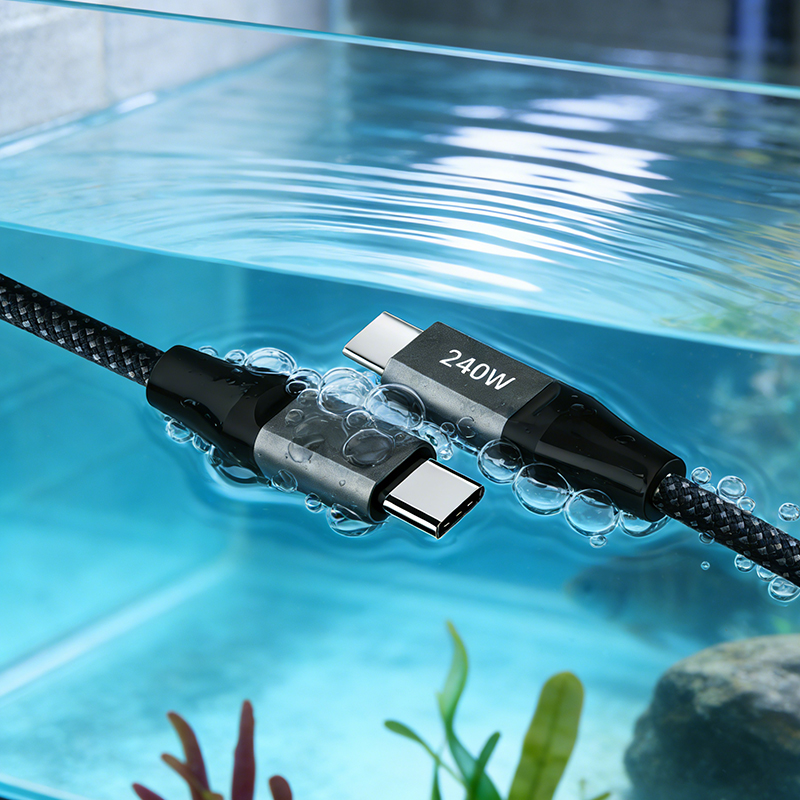
CB-Waterproof: sealed integrated molding with an IPX7 waterproof and dustproof rating.
Why ordinary charging cables fail outdoors
A standard indoor charging cable is built to be flexible, inexpensive and visually appealing. It is not built to be sealed, cold-flexible and contamination-resistant at the same time, because those are three separate engineering problems — and a cable that solves one of them does not automatically solve the others.
- Water and dust ingress. Moisture reaches the conductor through the joint between the connector shell and the jacket. A sealed, integrated-molded construction closes that path. CB-Waterproof is specified around exactly this feature, and its IPX7 waterproof and dustproof rating is attached to that sealed construction rather than to the connector alone.
- Jacket fatigue. A jacket that stays flexible at room temperature can harden and split when it is bent in the cold. This is where the temperature line on a datasheet earns its place: CB-Nylon is listed at -10℃ to 70℃ and CB-PVC at -10℃ to 60℃, while CB-Waterproof and CB-Silicone are listed at -20℃ to 70℃, with CB-Silicone adding anti-kink and anti-freezing characteristics.
- Chemical and biological contamination. Sweat, salt, dust and repeated handling attack both the jacket surface and the connector over time. CB-Waterproof lists sweat-proof and anti-corrosion properties alongside wear resistance, which is the combination a wet or coastal installation actually needs.
The fourth failure is administrative rather than physical: treating a waterproof rating as proof of charging performance. An IPX7 statement describes protection against water. It says nothing about whether the cable supports 6A, 120W or 240W. USB Power Delivery Specification Revision 3.2 defines fast-charging power delivery up to 240W over USB Type-C, while USB Type-C cable requirements are defined separately in the USB Type-C Cable and Connector Specification Release 2.2 and in IEC 62680-1-3:2024. A project specification therefore needs evidence for both families of claims, from the same SKU.
What changed in how these cables are bought
Three shifts shape current project specifications for outdoor, industrial and sports products.
Interface standardisation in Europe. The EU Common Charger framework identifies USB-C as the harmonised charging receptacle and applies to listed portable device categories — including handheld mobile phones, tablets, digital cameras, headphones, headsets, portable speakers, e-readers, keyboards, mice and portable navigation systems — from 28 December 2024, with laptops covered from 28 April 2026, as stated by the European Commission. For EU-bound projects that makes USB-C the low-risk default at the device end, while Lightning and Micro USB variants remain relevant for other markets and installed device bases. Focuses lists USB-A and USB-C at the source end and Type-C, Lightning and Micro USB at the device end across the range.
Power tiers above the old 2.4A ceiling. 120W and 240W charging is now a specification tier rather than a phrase on a box. Focuses lists 120W and 240W support at a 6A maximum charging current on CB-Waterproof, CB-Silicone, CB-TPE and CB-Nylon, against 1A–2.4A on CB-PVC. That single contrast eliminates several projects before jacket material is even discussed.
Layered certification. Apple's MFi programme requires licensing and certification for third-party manufacturers producing Lightning cables and authorised USB-C cables for Apple devices. Where a project includes Apple hardware, the MFi status of the specific supplier and SKU has to be confirmed directly rather than inferred from a product description or a connector photo.
The two project models in specification terms
CB-Waterproof: wet, dusty and corrosive conditions
Specify CB-Waterproof when water, dust, sweat or corrosion is a stated condition of use. The model is built on sealed integrated molding and carries an IPX7 waterproof and dustproof rating, with waterproof, dustproof, sweat-proof, anti-corrosion and wear-resistant properties listed together.

Sealed molding closes the connector-to-jacket path that lets water into an ordinary cable.
- Interfaces: USB-A or USB-C to Type-C, Lightning or Micro USB
- Outer material options: silicone, TPE or nylon braided
- Conductor: high-purity tinned copper core
- Power: 120W and 240W supported; 6A maximum charging current
- Data transfer: 480 Mbps
- Working temperature: -20℃ to 70℃
- Lengths: 0.3 m, 1 m, 1.5 m, 2 m
- Compatibility: phones, tablets, laptops and power banks
- Customisation: custom logo printing supported
Focuses lists outdoor supplies, industrial equipment, sports fitness, marine electronics and automotive among the industries this model is intended for. One practical caution belongs in the order file: because silicone, TPE and nylon braided are offered as outer-material options on the same model, the jacket option and the IPX7 construction should be confirmed together on the specification rather than treated as freely interchangeable.
CB-Silicone: skin contact, repeated bending and cold
Specify CB-Silicone when the cable will be handled against skin, bent repeatedly, or used where a stiff jacket becomes the failure point. The sheath is soft food-grade silicone; the listed characteristics are skin-friendly, odourless, anti-kink, wear-resistant, anti-freezing and flexible.

CB-Silicone: a food-grade silicone sheath specified for skin contact and cold-weather flexibility.
The electrical and interface specification matches the waterproof model: USB-A or USB-C to Type-C, Lightning or Micro USB; high-purity tinned copper core; 120W and 240W; 6A maximum charging current; 480 Mbps; -20℃ to 70℃; 0.3 m, 1 m, 1.5 m and 2 m lengths; compatibility with phones, tablets, laptops and power banks; custom logo printing supported. What its product data does not state is an IP rating, so it should not be substituted for CB-Waterproof in an immersion or wash-down specification.
The three supporting models, and the limits they set
CB-TPE uses an eco-friendly TPE sheath over a tinned copper core, supports 120W and 240W at 6A with charging and data sync, and is described as soft, flexible and wear-resistant. Its product data does not state a working temperature range, which matters for an outdoor brief and should be confirmed before it is used in cold conditions.
CB-Nylon combines a nylon braided shell over a PVC inner layer, 120W and 240W at 6A, 480 Mbps and a -10℃ to 70℃ range. CB-PVC is the entry model: PVC sheath, pure copper conductor, 1A–2.4A, 480 Mbps and -10℃ to 60℃. Those two numbers — the 2.4A ceiling and the -10℃ floor — are the cleanest exclusions in the range. A 6A fast-charging project cannot be served by CB-PVC, and a project specifying operation below -10℃ cannot be served by either CB-PVC or CB-Nylon, whatever the retail price difference suggests.
A specification sequence for outdoor, industrial and sports projects
The sequence below turns a general brief into an orderable specification. It is written for a project buyer in the research-to-evaluation stage, where the model is still open and the evidence still has to be assembled.
- Write the exposure profile in the project's own terms. Focuses describes its application conditions as daily indoor use, outdoor travel, humid bathroom, sweaty sports scene, low-temperature outdoor and rainy environment. Name which of these apply and how often. A cable used twice a week in a backpack and a cable used daily on a wet industrial floor are not the same specification, even when both are described as outdoor.
- Fix the interface set from the real device fleet. Decide the source end (USB-A or USB-C) and the device end (Type-C, Lightning or Micro USB). Where the fleet mixes Apple, Android and accessories, the connector mix matters more than jacket material at this stage. Focuses lists smartphones, tablets, laptops, power banks, wireless chargers and smart wearables among the matched equipment for these cables.
- Set the electrical target as a separate line item. State 6A, state whether the project needs 120W or 240W, and state whether 480 Mbps data transfer is required or charging alone. Then ask for evidence that the exact SKU achieves it, mapped to the applicable USB PD and USB Type-C specifications. A USB-C connector shape is not evidence of a 240W rating, and the USB-IF document library's existence does not prove that a particular cable complies.
- Choose the sealing system or the sheath — not both by assumption. Water, dust and corrosion exposure point to CB-Waterproof. Skin contact, high bend cycles and cold-weather handling point to CB-Silicone. Where both conditions occur in one product, split the SKU: a sealed cable for the wet duty cycle, a silicone cable for the body-contact duty cycle.
- Check temperature at the point of use, not in the warehouse. -20℃ to 70℃ covers CB-Waterproof and CB-Silicone; -10℃ to 70℃ applies to CB-Nylon and -10℃ to 60℃ to CB-PVC. Read the figure as an operating range rather than a flexibility guarantee, and where the cable must coil in freezing conditions, treat anti-freezing as the separate characteristic it is listed as on CB-Silicone.
- Set the length, then re-check the charge target. Lengths of 0.3 m, 0.5 m, 1 m, 1.5 m and 2 m appear across the range, with 0.3 m, 1 m, 1.5 m and 2 m listed on the waterproof and silicone models. The product data does not state a length-dependent current derating, so the exact length and current combination should be validated rather than assumed.
- Use ODM/OEM customisation to close the remaining gaps. Focuses lists logo printing, cable colour, power, cable appearance, cable materials, cable molding, multi-function design, connector housing colour, cable length, packaging style and packaging design as customisable. This is where a project stops being generic: a housing colour that matches an equipment enclosure, a length that fits a mounting bracket, a molded logo on a retail-ready cable.
- Lock production control and after-sales. Focuses states 100% full inspection before shipment, a 12-month warranty, free technical guidance on charging compatibility during the warranty period, and a normal service life exceeding two years. Inspection is a production control on shipped units; it supports, but does not replace, project-level validation of IPX7 and of the electrical rating on the specific SKU.
Matching the model to five real project conditions

Application conditions listed by Focuses include outdoor travel, rainy environments, humid bathrooms and sweaty sports use.
Rainy outdoor and wash-down equipment
For gear that is stored and used outdoors — camping lighting, portable power banks, outdoor sensors and similar equipment — the controlling failure is water at the connector. CB-Waterproof's sealed integrated molding and IPX7 rating address that path directly, while the dustproof and wear-resistant properties cover the grit that arrives with the same environment. Specify the jacket option explicitly rather than leaving it to the order confirmation.
Sweaty sports and fitness
Fitness projects add two conditions a rain specification does not cover: sustained skin contact, and constant bending near the connector during use. CB-Waterproof lists sweat-proof properties for the first; CB-Silicone lists a skin-friendly, odourless sheath with anti-kink behaviour for the second. Accessories worn against the body, such as smart wearables and armband phone holders, usually justify the silicone sheath; equipment that sits on a wet floor justifies the sealed molding.
Humid bathrooms and wet interiors
Bathroom and wet-room installations are low-cost, high-repeat environments where corrosion, not impact, ends a cable's life. CB-Waterproof's waterproof and anti-corrosion properties match this condition. The relevant measure is the replacement rate over the project's life rather than the unit price alone, because a cable that is replaced repeatedly carries handling and disposal cost that never appears on the quotation.
Low-temperature outdoor use
Winter sports, cold-storage operations, winter fleet equipment and outdoor installations in cold regions push the jacket outside the comfortable range of standard PVC and nylon constructions. CB-Silicone carries the anti-freezing characteristic and the same -20℃ to 70℃ range as the waterproof model, and its flexibility matters where the cable is coiled and uncoiled repeatedly in the cold.
Industrial, marine and automotive
Focuses lists industrial equipment, marine electronics and automotive among the applications for the waterproof model. In these settings the cable meets dust, oil mist, cleaning agents and salt, and it is usually fixed rather than carried. Sealed molding, dustproof construction and anti-corrosion are the properties that matter; the electrical tier should then be set from the device requirement, not from the cable's appearance.
Supporting equipment compatibility
Both project models are listed as fully compatible with phones, tablets, laptops and power banks, and the Focuses application data adds wireless chargers, smart wearables and other small smart appliances. Compatibility describes the connector and device relationship; it does not change how charging works. Power is negotiated between the charger and the device, and the cable has to be rated for the current that results — which is why the 6A tier and the 2.4A PVC tier should not be mixed inside one project BOM without a stated reason.
Model comparison at a glance
| Model | Sheath / sealing | Power & current | Data | Working temperature | Environmental specification | Best-fit conditions |
|---|---|---|---|---|---|---|
| CB-Waterproof | Sealed integrated molding; silicone, TPE or nylon braided outer options | 120W, 240W; 6A max | 480 Mbps | -20℃ to 70℃ | IPX7 waterproof & dustproof; sweat-proof, anti-corrosion, wear-resistant | Rain, wash-down, sweat, marine, industrial, automotive |
| CB-Silicone | Soft food-grade silicone sheath | 120W, 240W; 6A max | 480 Mbps | -20℃ to 70℃ | Skin-friendly, odourless, anti-kink, wear-resistant, anti-freezing, flexible; no IP rating stated | Fitness and wearables, cold weather, repeated bending |
| CB-TPE | Eco-friendly TPE sheath | 120W, 240W; 6A max | Charging & data sync (speed not stated) | Not stated in product data | Soft, flexible, wear-resistant | General retail and e-commerce programmes |
| CB-Nylon | Nylon braided shell over PVC inner layer | 120W, 240W; 6A max | 480 Mbps | -10℃ to 70℃ | Braided, wear-resistant construction | Everyday retail and bulk orders within range |
| CB-PVC | PVC sheath, pure copper conductor | 1A–2.4A | 480 Mbps | -10℃ to 60℃ | Not specified for water, dust or corrosion | Basic indoor charging, gift and accessory lines |
Values as listed in the Focuses product data; "not stated" means the product data does not specify that item.
| Project condition | Primary model | Matching specification fact | Check before ordering |
|---|---|---|---|
| Rainy outdoor / wash-down | CB-Waterproof | IPX7 waterproof and dustproof, sealed integrated molding, wear-resistant | Confirm jacket option and IPX7 evidence for the ordered SKU |
| Sweaty sports and fitness | CB-Silicone, or CB-Waterproof for wet floors | Skin-friendly and odourless sheath; sweat-proof listed on CB-Waterproof | Confirm which duty cycle is wet and which is body-contact |
| Humid bathroom | CB-Waterproof | Waterproof and anti-corrosion properties | Do not accept an unsealed model as an equivalent |
| Low-temperature outdoor | CB-Silicone (also CB-Waterproof) | -20℃ to 70℃ range; anti-freezing listed on CB-Silicone | Confirm the actual lowest temperature and the bending duty |
| Industrial, marine, automotive | CB-Waterproof | Dustproof, anti-corrosion, sealed molding | Confirm exposure to specific chemicals or salt with the supplier |
Frequently asked questions
Does an IPX7 waterproof rating also confirm 240W charging or data performance?
No. An IPX7 rating describes protection against water on the sealed construction; it is not a power or data measurement. Power capability is defined separately, with USB Power Delivery Specification Revision 3.2 defining fast-charging delivery up to 240W over USB Type-C, and cable requirements defined in the USB Type-C Cable and Connector Specification Release 2.2 and IEC 62680-1-3:2024. For a project, request evidence for the environmental rating and for the electrical rating against the same SKU, and treat the existence of a published standard as no proof that a particular cable meets it.
Which Focuses model should be specified for a rainy or wash-down outdoor project?
CB-Waterproof. It uses sealed integrated molding with an IPX7 waterproof and dustproof rating and lists waterproof, dustproof, sweat-proof, anti-corrosion and wear-resistant properties. It supports 120W and 240W at 6A maximum charging current, 480 Mbps data transfer and a -20℃ to 70℃ working temperature, with 0.3 m, 1 m, 1.5 m and 2 m lengths and interfaces from USB-A or USB-C to Type-C, Lightning or Micro USB. Confirm the outer-material option together with the IPX7 construction on the order specification.
Can CB-Silicone be used where the cable gets wet?
CB-Silicone's product data does not state an IP rating, so it is not the model to specify for immersion or wash-down duty. Its listed characteristics are a soft food-grade silicone sheath that is skin-friendly, odourless, anti-kink, wear-resistant, anti-freezing and flexible, with the same 120W and 240W, 6A, 480 Mbps and -20℃ to 70℃ specification as the waterproof model. Use it for body-contact fitness products and cold-weather handling, and use CB-Waterproof where water is the controlling condition.
What should a buyer verify in a Chinese USB cable manufacturer serving mobile phone brands?
Verify the manufacturing scope and the change-control path, not only the sample. Focuses operates ODM/OEM production with customisation covering logo printing, cable colour, power, cable appearance, cable materials, cable molding, multi-function design, connector housing colour, cable length, packaging style and packaging design. Its stated capacity is 2,500,000 units per month, with 100% full inspection before shipment, a MOQ of 2,000 units per model, a 25–35 day lead time, exports to the EU, North America, Middle East and Asia, and a 12-month warranty with free technical guidance on charging compatibility during the warranty period. Where the project includes Apple devices through a Lightning interface, confirm MFi licensing status for the specific SKU, since the MFi programme requires licensing and certification for third-party manufacturers of Lightning and authorised USB-C cables for Apple devices.
What are the minimum order quantity and lead time for a customised project cable?
The Focuses MOQ is 2,000 units per model, and the stated lead time is 25–35 days. Monthly production capacity is 2,500,000 units, which is the figure to compare against the programme volume when a project runs seasonal peaks. Both MOQ and lead time should be re-confirmed for a configuration that combines a specific jacket option, length, connector mix and packaging design, because those choices are made per order.
What warranty and service life apply, and where can I see the full range?
The stated product warranty is 12 months, with free technical guidance on charging compatibility issues during the warranty period, and the normal service life is stated as exceeding two years. Beyond the two project models, the range covers CB-TPE, CB-Nylon and CB-PVC for applications where sealing or cold flexibility is not a requirement. The full Focuses range, interfaces and customisation options are collected in the 2026 Focuses catalogue, which can be downloaded for project evaluation.
Conclusion: specify the condition before the connector
Outdoor, industrial and sports projects go wrong at the cable for predictable reasons, and each reason maps to a specification line rather than to a price band. Water at the connector is answered by sealed integrated molding and an IPX7 rating on CB-Waterproof. Cold stiffness and constant bending are answered by the food-grade silicone sheath, anti-kink behaviour and anti-freezing characteristic of CB-Silicone. Above both sits the electrical tier — 120W or 240W, 6A maximum, 480 Mbps — which is a separate claim, defined by USB Power Delivery and USB Type-C specifications, and which needs its own evidence from the same SKU.
The working rule is simple enough to put in a brief: write the exposure profile, fix the interface mix, set the electrical target, choose the sealing or the sheath, confirm the temperature and length, then use ODM/OEM customisation and 100% pre-shipment inspection to hold that specification in production. Do that, and the cable specification survives the first winter and the first rainy season instead of the first inspection.
Next step for a project evaluation: download the 2026 Focuses catalogue, or send the exposure profile, interface mix and power target to the Focuses team for a model recommendation and sample discussion.
Dongguan Focuses Electronics Technology Co., Ltd. · Email: info@focusestech.com · Tel / WhatsApp: +86 180-2697-6650 · 8F HuiQing Industrial Park, TangXia Avenue South, Tangxia Town, Dongguan, Guangdong, China · www.focusestech.com
Have Questions or Need More Details?
Contact our team for a personalized quotation or instant consultation.
Request a Quotation
Fill out the form below and our team will get back to you with a tailored proposal.
WhatsApp Direct Chat
Prefer to chat in real-time? Message us on WhatsApp for instant assistance & quick answers.
- Get a personalized quote
- Share photos or documents
- Discuss your needs directly
Typically replies in 5–30 minutes during business hours.