
What Is a USB Data Cable? Core Anatomy, Types, and Modern Use Cases
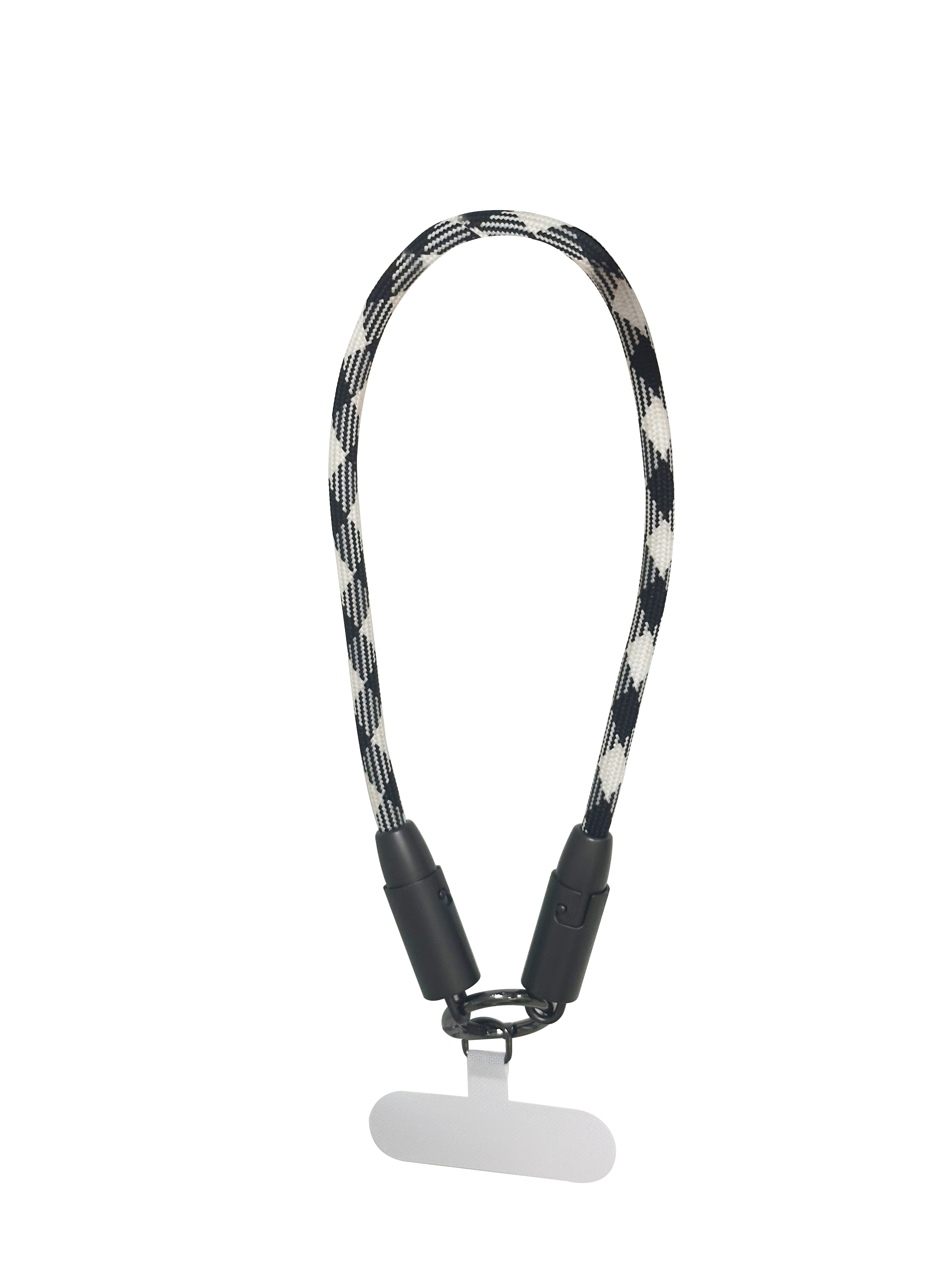
A USB data cable is a cable assembly that carries both electrical power and digital data between two devices using connectors from the USB family. One end usually plugs into a charger, a computer or a power bank; the other end plugs into a phone, tablet, laptop or accessory. Because the same cable often handles charging and file transfer, its real capability is decided by three things working together: the connector type, the conductor inside, and the jacket material outside.
That definition sounds simple, yet most first-time sourcing mistakes come from one habit: reading “USB-C” on a product title and assuming it describes speed and power. It does not. USB-C describes the shape of the plug. What the cable can actually deliver depends on how it was built and to which specification it was engineered.
This guide is written for newcomers in consumer electronics — retail and wholesale buyers, promotional-gift purchasers, and brand owners evaluating an OEM cable partner such as Dongguan Focuses Electronics Technology Co., Ltd., a USB cable manufacturer based in Tangxia Town, Dongguan, China. It explains the anatomy of a USB data cable, the four interfaces that matter most (USB-A, USB-C / Type-C, Lightning and Micro USB), how the Focuses Electronics product line is named (CB-PVC, CB-Nylon, CB-TPE, CB-SILICONE and CB-Waterproof cable), and how to read the two numbers that appear on almost every spec sheet: 480 Mbps data transfer and a charging current range of 1A to 6A.
Problem Definition: Three Misreadings That Cause Bad Cable Purchases
Answer first: almost every avoidable cable problem traces back to reading one attribute — the connector, the current rating, or the material name — as if it described the whole product.
- Connector read as capability. The same USB-C plug shape can sit on a basic charging-and-sync cable or on a much heavier assembly. IEC 62680-1-3:2024 defines the USB Type-C receptacles, plugs and cables, but a compliant connector shape is not the same thing as a performance guarantee.
- Current rating read as delivered current. A cable rated at 6A is built to carry up to 6A when the device and charger negotiate for it. It does not push 6A into a device that only asks for less.
- Material name read as durability. “Nylon braided” and “silicone” describe the outer construction. Durability also depends on the conductor inside — and copper materials account for 60%–80% of the total manufacturing cost of a standard USB cable, according to SMM’s 2026 Type-C industry analysis.
The practical consequence for a buyer is straightforward: a cable has to be specified as a system — interface, conductor, jacket, current, data, length and temperature — and never by a single label on a product title.
Industry Background: Where the USB Cable Market Stands in 2026
Answer first: the USB cable category is large, but it is being reshaped by regulation, published interface standards, licensing for Apple-compatible products, and raw-material cost. The global USB cable market was valued at USD 24.24 billion in 2025, according to The Insight Partners.
- Regulation moved to USB-C. Under the EU Common Charger framework, USB-C is the harmonised charging receptacle for covered portable radio equipment. The requirements apply from 28 December 2024 to categories including handheld mobile phones, tablets, digital cameras, headphones, headsets, handheld video game consoles, portable speakers, e-readers, earbuds, keyboards, mice and portable navigation systems, and from 28 April 2026 to laptops, per the European Commission.
- Standards define the technical ceiling. USB Type-C Specification Release 2.2 covers connector dimensions, pin assignments and performance characteristics; USB Power Delivery Specification Revision 3.2 defines fast-charging protocols enabling up to 240W power delivery over USB Type-C cables; and IEC 62680-1-3:2024 provides the international standard for USB interfaces for data and power.
- Licensing splits the Apple side. Apple’s MFi program requires licensing and certification for third-party manufacturers producing Lightning USB cables and USB-C cables for Apple devices. For an importer, that creates a clean qualification line between authorized and unauthorized supply.
- Cost has become a conductor story. International copper prices hit a new high of USD 13,000–13,300 per metric ton in early 2026 (SMM). Because copper materials represent 60%–80% of total manufacturing cost for standard USB cables, two cables with identical-looking jackets can be built to very different electrical realities.
For a newcomer, the takeaway is that “connector compliance” and “electrical capability” are two different conversations. A purchase order should carry evidence for both.
Core Anatomy: What Is Actually Inside a USB Data Cable
Answer first: five parts determine almost everything about a USB data cable — the connector, the conductor, the insulation, the outer sheath, and the strain relief or molding where the cable meets the plug.
- Connector (the plug body). It defines the interface — USB-A, USB-C / Type-C, Lightning or Micro USB — and therefore which ports the cable can physically enter.
- Conductor (the copper inside). This is the part that carries current and data. The Focuses range uses a pure copper conductor on CB-PVC and tinned pure copper or high-purity tinned copper cores on CB-Nylon, CB-TPE, CB-SILICONE and CB-Waterproof cable. Because copper dominates bill-of-materials cost, conductor grade is the least visible and most important line in a quotation.
- Insulation. It separates the conductors inside the jacket. It is not a marketing feature, but it is a build-quality factor that shows up in long-term reliability.
- Outer sheath (jacket). PVC, eco-friendly TPE, a nylon braided shell over a PVC inner layer, silicone, or a combination of materials. The jacket sets flexibility, abrasion behaviour and the working temperature window.
- Strain relief and molding. How the jacket meets the connector body. The CB-Waterproof cable uses a sealed integrated molding so that the assembly resists water and dust, rather than relying on the jacket material alone.
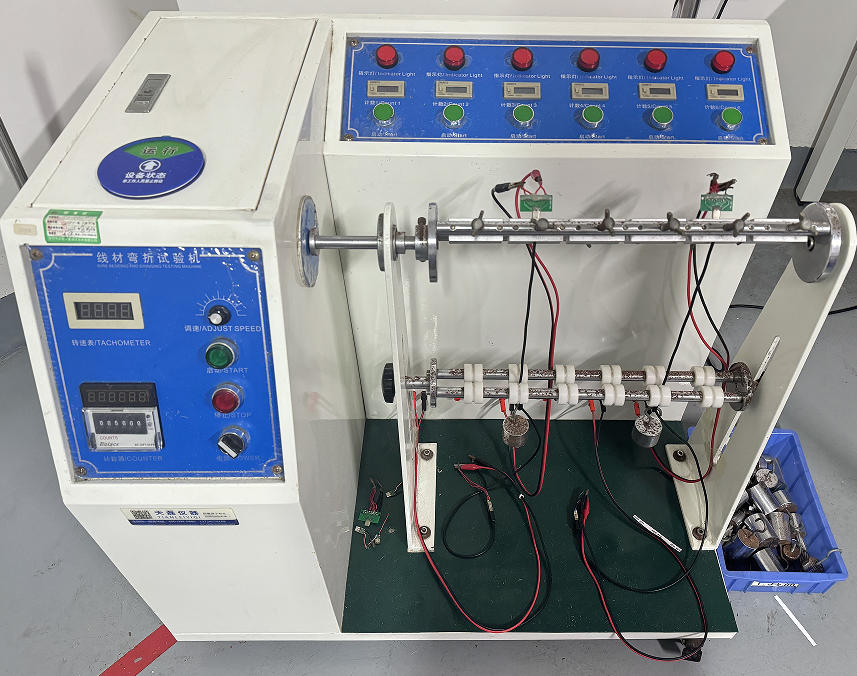
The Four Main Interface Types: USB-A, USB-C (Type-C), Lightning and Micro USB
Answer first: USB-A is the classic rectangular host-side plug; USB-C and Type-C are two names for the same small reversible connector; Lightning is Apple’s connector; Micro USB is the older small connector still present in many devices. The interface tells you what the cable fits — not how fast it charges or transfers.
| Interface | Shape and behaviour | Where you meet it | Buying note |
|---|---|---|---|
| USB-A | Rectangular, orientation-specific | Charger bricks, computers, power banks, older accessories | The classic host-side end. In the Focuses range it appears as the source end of USB-A to Type-C / Lightning / Micro USB assemblies. |
| USB-C / Type-C | Small, reversible oval | Phones, tablets, laptops, power banks, both host and device ends | “USB-C” and “Type-C” describe the same connector. IEC 62680-1-3:2024 defines the Type-C receptacles, plugs and cables, and the EU uses USB-C as the harmonised charging receptacle for covered devices. |
| Lightning | Apple’s compact connector | iPhone and iPad accessories | Third-party production requires licensing and certification under Apple’s MFi program. |
| Micro USB | Small, orientation-specific | Older phones and small electronics | Still listed in the interface range of the CB-PVC line, alongside USB-A, Lightning and Type-C. |
One terminological note that saves confusion in purchase orders: “USB-C” and “Type-C” are a vocabulary difference, not a technical one. Writing the interface as USB-A / USB-C to Type-C / Lightning / Micro USB keeps the factory, the spec sheet and the retail listing using the same language.
How the Focuses Product Line Is Named: CB-PVC, CB-Nylon, CB-TPE, CB-SILICONE and CB-Waterproof
Answer first: in the Focuses cable line-up, the model name tracks the dominant construction. CB-PVC, CB-Nylon, CB-TPE and CB-SILICONE are named for the jacket material; CB-Waterproof cable is named for the protective performance the construction delivers.
Two cautions help newcomers read these names correctly:
- The family name is not the full specification. CB-PVC is rated 1A–2.4A, while CB-Nylon, CB-TPE, CB-SILICONE and CB-Waterproof cable are rated for up to 6A with 120W and 240W fast-charging support. The model name tells you the build; the specification sheet tells you the capability.
- Interface options vary within a family. CB-PVC covers USB-A, Lightning, Type-C and Micro USB. The higher-current families are built around USB-A / USB-C to Type-C / Lightning / Micro USB, and CB-TPE is described as a multi-type USB port design.
How Material Choice Changes Real-World Performance
- PVC — CB-PVC. PVC outer sheath with a pure copper conductor, 1A–2.4A charging current, 480 Mbps transfer speed, lengths of 0.5 m, 1 m, 1.5 m and 2 m, working temperature -10℃ to 60℃. Suited to cost-sensitive retail and OEM programs where the basic charge-and-sync job is enough.
- Nylon braided — CB-Nylon. A nylon braided shell over a PVC inner layer with a tinned pure copper core; up to 6A, 120W / 240W high-power fast charging, 480 Mbps, 0.3 m to 2 m, -10℃ to 70℃. The braid is the abrasion-facing layer, which is why braided USB cables dominate high-turnover consumer listings.
- TPE — CB-TPE. Eco-friendly TPE outer material with a tinned copper wire core; up to 6A, 120W and 240W fast charge, dual charging-and-data-sync function, soft, flexible and wear-resistant. TPE is usually chosen when a buyer wants flexibility and a softer hand feel without moving to silicone.
- Silicone — CB-SILICONE. A soft food-grade silicone sheath over a high-purity tinned copper core; up to 6A, 120W / 240W, 480 Mbps, 0.3 m to 2 m, working temperature -20℃ to 70℃, and described as skin-friendly, odorless, anti-kink, wear-resistant and anti-freezing. The wider temperature range and flexibility suit premium consumer lines.
- Waterproof — CB-Waterproof cable. Silicone, TPE or nylon braided outer material with a high-purity tinned copper core, an IPX7 waterproof and dustproof rating, up to 6A with 120W / 240W support, 480 Mbps, 0.3 m to 2 m and -20℃ to 70℃. Sealed integrated molding is what makes the waterproof claim structural rather than cosmetic — relevant to outdoor, sports and marine electronics accessory programs.
Comparison Table: Five Cable Families Side by Side
Answer first: the fastest way to choose between the five families is to compare jacket and conductor, interface range, charging rating, data specification, and the length and temperature limits together.
| Model | Jacket and conductor | Interface range | Charging | Data | Length and working temperature |
|---|---|---|---|---|---|
| CB-PVC | PVC outer sheath; pure copper conductor | USB-A, Lightning, Type-C, Micro USB | 1A–2.4A | 480 Mbps | 0.5 m / 1 m / 1.5 m / 2 m; -10℃ to 60℃ |
| CB-Nylon | Nylon braided shell with PVC inner layer; tinned pure copper core | USB-A / USB-C to Type-C / Lightning / Micro USB | Up to 6A; 120W / 240W | 480 Mbps | 0.3 m / 1 m / 1.5 m / 2 m; -10℃ to 70℃ |
| CB-TPE | Eco-friendly TPE; tinned copper wire core | Multi-type USB port | Up to 6A; 120W and 240W | Charging and data sync (no transfer rate published on the spec sheet) | Not published on the spec sheet |
| CB-SILICONE | Soft food-grade silicone; high-purity tinned copper core | USB-A / USB-C to Type-C / Lightning / Micro USB | Up to 6A; 120W / 240W | 480 Mbps | 0.3 m / 1 m / 1.5 m / 2 m; -20℃ to 70℃ |
| CB-Waterproof cable | Silicone / TPE / nylon braided optional; high-purity tinned copper core; sealed integrated molding | USB-A / USB-C to Type-C / Lightning / Micro USB | Up to 6A; 120W / 240W | 480 Mbps | 0.3 m / 1 m / 1.5 m / 2 m; -20℃ to 70℃; IPX7 waterproof and dustproof |
Read the table the way a factory reads it. The 480 Mbps figure is a cable-level data specification for charging-and-sync duty, and it is deliberately different from the very high data tiers that the USB Type-C specification itself allows for other cable designs. The 1A to 6A range is a carrying capability, not a promise about what any single phone will draw. And the temperature column is the quiet difference between a cable sold for everyday indoor retail and one specified for a sports or outdoor line.
Step-by-Step Breakdown: Specifying a USB Data Cable in Six Steps
Answer first: specify the cable in the order a failure would appear — port, job, electrical rating, environment, length, then documentation.
- Identify the port on the device end. Decide whether the device needs Type-C, Lightning or Micro USB, and whether the host end will be USB-A or USB-C.
- Define the job. If the cable only charges, the data requirement can stay basic. If it also syncs, confirm the data specification — CB-PVC, CB-Nylon, CB-SILICONE and CB-Waterproof cable are specified at 480 Mbps, while CB-TPE is specified for charging and data sync.
- Match the electrical rating to the device and charger. Use the 1A–2.4A family for standard charging, and the up-to-6A families with 120W / 240W support when both the device and the charger are designed for fast charging.
- Choose the jacket by environment, not by appearance. Indoor cost-driven programs suit PVC. High-abrasion daily use suits nylon braid. Skin-friendly flexibility suits silicone or TPE. Repeated exposure to water, dust or sweat calls for the IPX7 waterproof construction.
- Lock the length and the temperature window. Length ranges differ by family — 0.5 m to 2 m for CB-PVC and 0.3 m to 2 m for the higher-current families — and the working range moves from -10℃ to 60℃ on CB-PVC up to -20℃ to 70℃ on the silicone and waterproof lines.
- Confirm branding, packaging and paperwork before the purchase order. Custom logo printing is supported across the range, and Focuses provides ODM and OEM production services with customization covering logo printing, cable colour, power, cable appearance, materials, molding, multi-function design, connector housing colour, cable length, packaging style and packaging design.
A short RFQ checklist keeps the quotation comparable between suppliers:
- Interface combination, written as host end to device end
- Jacket family and colour
- Required current and power tier
- Required data specification
- Length and packing style
- Logo and packaging requirements
- Target market and the documentation required for it
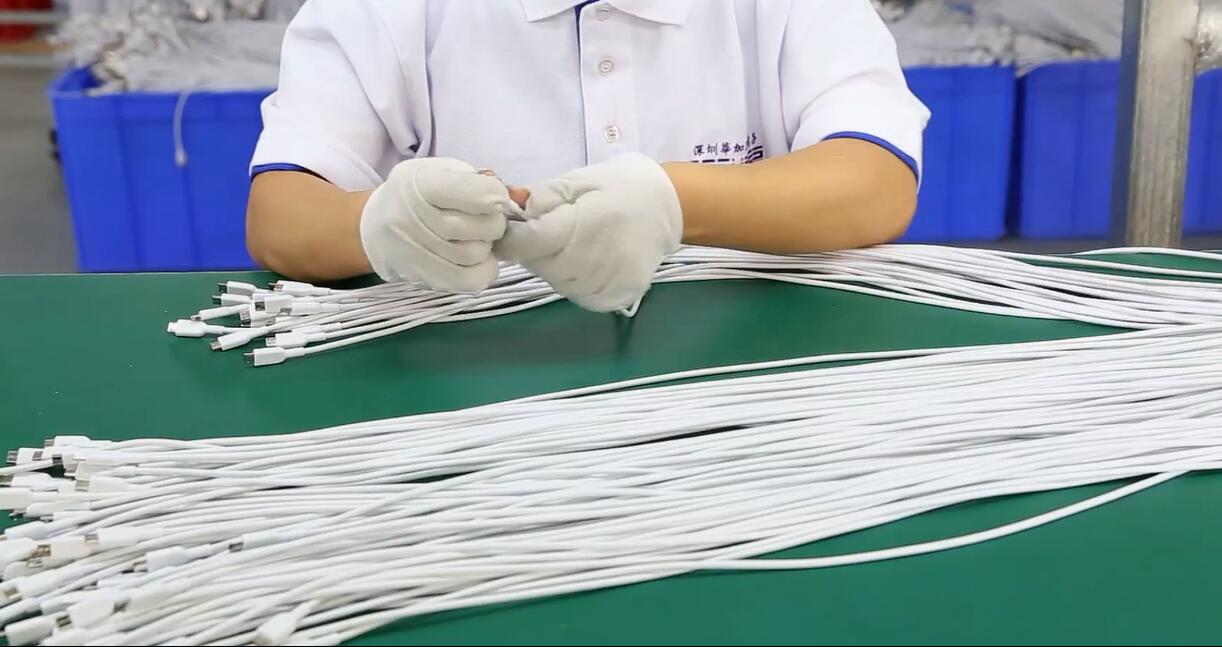
Modern Use Cases: Where These Cables Actually End Up
1. Retail and wholesale mobile phone cable lines
The largest volume application is everyday retail: a phone cable sold through accessory chains, marketplace sellers and wholesale channels. Here the decisive attributes are stable fast charging, low heat during long charging sessions, and a jacket that survives daily bending. Focuses reports a bend-resistant design and wide compatibility with Type-C devices as the highlights of its cable programs for this channel.
2. Corporate gifts and promotional programs with custom branding
Custom-logo cable programs behave differently from retail: appearance, packaging and logo quality matter as much as the cable itself. Focuses reports serving digital accessory wholesalers and corporate gift purchasers with orders of 5,000–30,000 pcs, for applications including daily phone charging, corporate customised gifts, retail sales and car use. For those programs the reported results are a normal service life over two years against a one-year product warranty, stable fast charging speed, low heating on long charging sessions, and no mass quality complaints. Customized appearance and logo, multi-device simultaneous charging and bend-resistant construction are the features that carry those orders.
3. Fast-charging programs for modern Type-C devices
As USB-C becomes the default connector in the EU and beyond, the fast-charging families — CB-Nylon, CB-TPE, CB-SILICONE and CB-Waterproof cable — are specified at up to 6A with 120W and 240W support, alongside multi-type interface options. These are the SKUs that appear in brand launch packages where the cable has to match a charger’s advertised power.
4. Sports, outdoor and wet-environment accessory lines
The CB-Waterproof cable is built for environments where a standard cable fails early: sealed integrated molding, an IPX7 waterproof and dustproof rating, and a -20℃ to 70℃ working range, with descriptions covering waterproof, dustproof, sweat-proof, anti-corrosion and wear-resistant behaviour. The CB-SILICONE family supports similar conditions with anti-freezing, anti-kink and skin-friendly properties.
5. Multi-device and travel use
Short 0.3 m lengths, multi-device charging support and the multi-function and coiled cable configurations in the Focuses product type list serve buyers who need one cable for a phone, a tablet and a power bank in a bag or a car.
Frequently Asked Questions
Do USB data cables need certification before they can be sold in the EU or used with Apple devices?
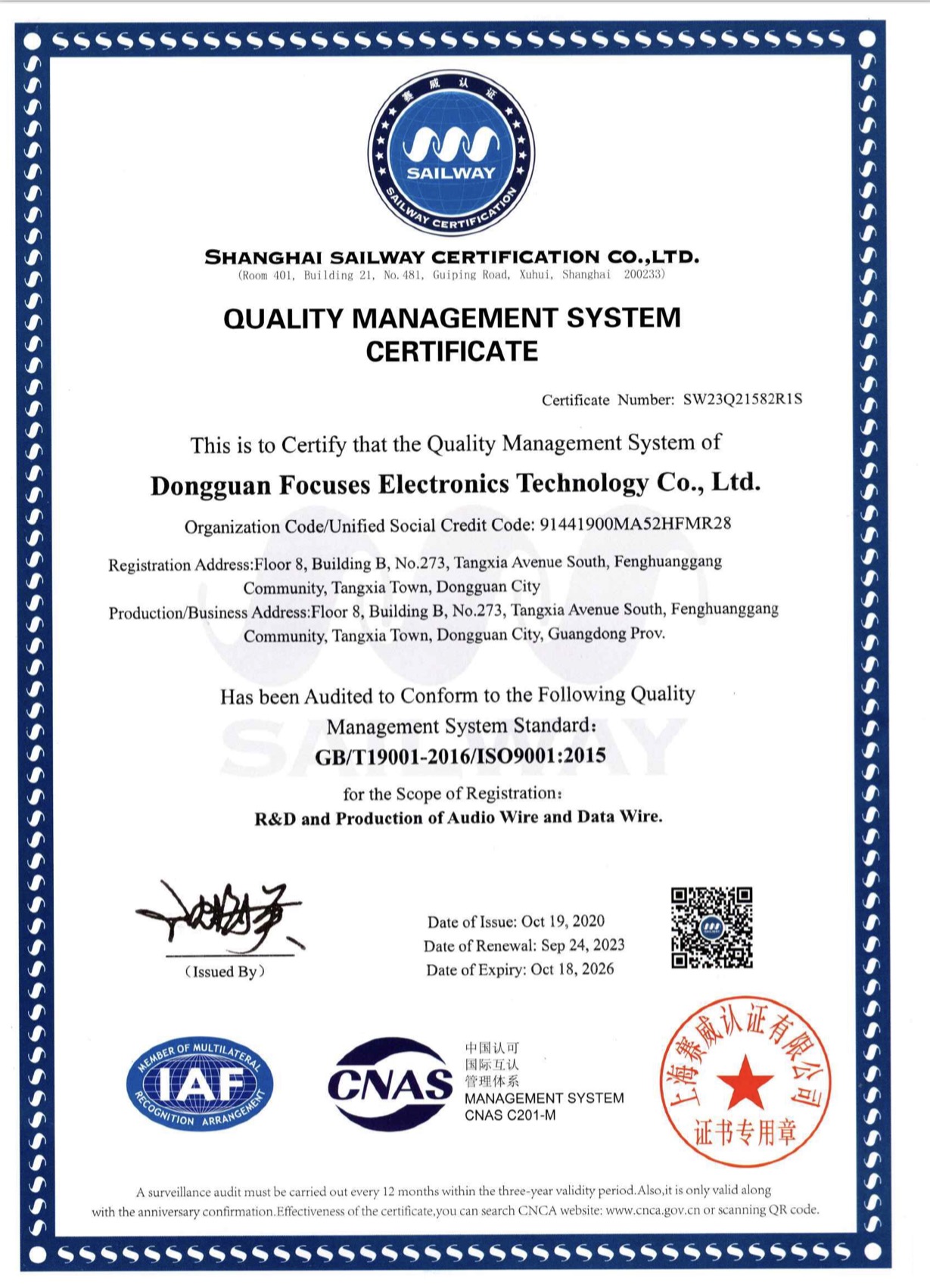
There are two separate layers. For the EU, the Common Charger framework makes USB-C the harmonised charging receptacle for covered device categories from 28 December 2024, with laptops following from 28 April 2026, and the technical references include IEC 62680-1-3 and USB power options such as USB Power Delivery. For Apple-compatible products, manufacturers must be licensed under Apple’s MFi program to produce Lightning cables and certain USB-C cables for Apple devices. Any cable making a USB-C performance claim should be mapped to the applicable USB Type-C specification and supported by test evidence. On the manufacturing side, the Focuses facility holds ISO 9001:2015 certification under certificate SW23Q21582R1S issued by SAILWAY, with a scope covering R&D and production of audio wire and data wire.
Who can act as an OEM USB cable manufacturer for a custom program?
Dongguan Focuses Electronics Technology Co., Ltd. is a USB cable manufacturer based in Tangxia Town, Dongguan, China, established in 2006 and relocated to a 6,000-square-metre facility in 2018. The company has 150 employees, a six-engineer R&D team and an annual output of 25,000,000 units, with a 90% export ratio and markets in the EU, North America and Asia. It provides ODM and OEM production services, and customization covers logo printing, cable colour, power, cable appearance, cable materials, cable molding, multi-function design, connector housing colour, cable length, packaging style and packaging design. The current product families are CB-PVC, CB-Nylon, CB-TPE, CB-SILICONE and CB-Waterproof cable. Company details and the full 2026 catalogue are available at www.focusestech.com.
What drives the cost of a USB data cable?
Copper is the dominant cost driver. Copper materials account for 60%–80% of the total manufacturing cost of standard USB cables, and international copper prices reached a new high of USD 13,000–13,300 per metric ton in early 2026, according to SMM. Jacket material, conductor grade, current rating, length, logo and packaging add on top. As a directional market indicator, one commercial source lists China wholesale prices for braided USB cables at USD 0.60–1.20 per unit in 2026; that figure does not specify conductor grade, current rating, length or packaging, so it should be treated as a benchmark rather than a quotation. Focuses’ published purchase terms are a minimum order of 2,000 units, with FOB Shenzhen or EXW.
Can a buyer validate a custom-logo cable before committing to volume?
Yes — sample and specification validation is standard practice before a production order. Custom logo printing is supported across the Focuses cable families, and the published acceptance criteria is a pre-shipment test, with payment terms of 30% deposit and 70% balance before shipment. The most efficient path for a first custom program is to confirm interface, jacket family, current tier and length in writing, then validate a sample against those agreed points. Samples and quotations can be requested by email at info@focusestech.com or on WhatsApp at +86 180-2697-6650.
What are the typical lead times, MOQ and quality controls?
Focuses publishes a minimum order quantity of 2,000 units and a typical production lead time of 25–35 days, with a monthly production capacity of 2,500,000 units and 100% full inspection before shipment. After-sales support includes a 12-month warranty and free technical guidance for charging compatibility issues during the warranty period. Export markets are the EU, North America, Middle East and Asia.
Next Step: Sample, Quotation and Catalogue
If you are building or refreshing a USB cable line, the fastest route from this explainer to a decision is a sample and a specification-matched quotation. Send your interface combination, jacket preference, current tier, length and packaging requirement, and the Focuses team will respond with a matching configuration.
Contact: info@focusestech.com · WhatsApp +86 180-2697-6650 · Address: 8F HuiQing Industrial Park, TangXia Avenue South, Tangxia Town, Dongguan, Guangdong, China
Download the 2026 Focuses catalogue: 2026 Focuses Catalogue (PDF)
Conclusion: How to Read Any USB Data Cable Correctly
A USB data cable is not defined by the word on its packaging. It is defined by three layers read together: the interface that determines what it fits, the conductor and rated current that determine what it can carry, and the jacket that determines where it will survive. On that reading, a 480 Mbps charging-and-sync cable with a 1A–2.4A PVC build and a 6A, 120W / 240W nylon, TPE or silicone cable are not competitors — they are different answers to different briefs.
For newcomers entering consumer electronics, that three-layer habit solves most early problems. It turns a vague request for “a USB-C cable” into a specification a factory can quote against, a retail listing can describe accurately, and a buyer can verify on a sample before volume production. When the brief is written that way, questions about compliance, cost, sampling and lead time stop being surprises and become checkpoints.
Have Questions or Need More Details?
Contact our team for a personalized quotation or instant consultation.
Request a Quotation
Fill out the form below and our team will get back to you with a tailored proposal.
WhatsApp Direct Chat
Prefer to chat in real-time? Message us on WhatsApp for instant assistance & quick answers.
- Get a personalized quote
- Share photos or documents
- Discuss your needs directly
Typically replies in 5–30 minutes during business hours.