Top 5 Features to Prioritize When Buying a Precision Slide Rail Forming Machine in 2026
Top 5 Features to Prioritize When Buying a Precision Slide Rail Forming Machine in 2026
If you are specifying a precision slide rail forming machine in 2026, five features decide whether the line will actually match your drawer slide tolerances: molding tolerance (±0.05 mm), forming speed adjustability (0–25 m/min), material thickness range (0.3–3.0 mm), control system reliability (PLC plus servo motor), and roll and frame construction materials (carbon steel, GCr15 alloy steel, SKD11). Ranked in that order, these five define the capability envelope of a slide rail production line. Everything else in a quotation is secondary.
Why the Right Five Features Decide Whether Your Slide Line Works
The order of this ranking is not arbitrary. Each feature constrains the one after it. If the machine cannot hold molding tolerance, speed is irrelevant. If speed cannot be adjusted across a range, the thickness range becomes theoretical. If the control system is unreliable, none of the first three features is repeatable from shift to shift. And if the rolls and frame are made from the wrong materials, the machine loses its tolerance long before it loses its ability to run.
Most slide rail procurement problems are not caused by a missing feature. They are caused by buying a machine that was specified against price, tonnage, or delivery time instead of against the finished product. A drawer slide is a dimensional product. Ball bearing slides, telescopic channels and 3-fold drawer slides all depend on repeatable raceway and channel geometry, and that geometry is created in the roll forming station — not at assembly, not at inspection, and not at the customer.
The practical consequence is that a slide rail making machine which cannot hold its profile produces rails that pass a quick visual check at the roll former and then fail downstream: binding travel, side play, uneven ball raceways, or noise. The cost of that failure is not the machine price. It is scrap material, re-work on the assembly line, and a warranty conversation with your own customer. So the correct question in 2026 is not which machine is cheapest. It is which five features can I get verified in writing before I place a purchase order.
Industry Background: What Is Shaping Slide Rail Machine Specification in 2026
Roll forming equipment demand has grown steadily rather than explosively, which means buyers are competing for the same manufacturing capacity rather than riding a boom. Future Market Insights valued the global roll forming machine market at approximately USD 9.1 billion in 2024, projected to reach USD 12.2 billion by 2034. Other research houses publish substantially smaller figures for what sounds like the same market — Intel Market Research estimated USD 487 million in 2024 with a 4.5% CAGR reaching USD 662 million by 2032 — because the definitions differ. Some counts cover all industrial roll forming, others only precision forming lines. Buyers comparing market reports should read the scope definition, not the headline number.
The automation share is where the market structure becomes relevant to a specification decision. Coherent Market Insights projected that automated roll forming machines would account for 46.8% of the total market share by 2026, driven by high-speed production requirements. In practical terms, a manual or semi-manual forming line is now the exception rather than the default, and the features this article ranks — servo control, programmable speed, monitored tolerance — are the reason.
The supply side is also concentrated. The Observatory of Economic Complexity reported that China’s export value of metalworking machine parts reached approximately USD 2.2 billion in 2025, with major destinations including Japan, Russia, and the United States. The China Machine Tool Industry Association reported that operating income of metal-forming machine tools in China increased 8.9% year-on-year for the period January to October 2024. Both figures describe an export-oriented, expanding machine-building base rather than a domestic-only one.
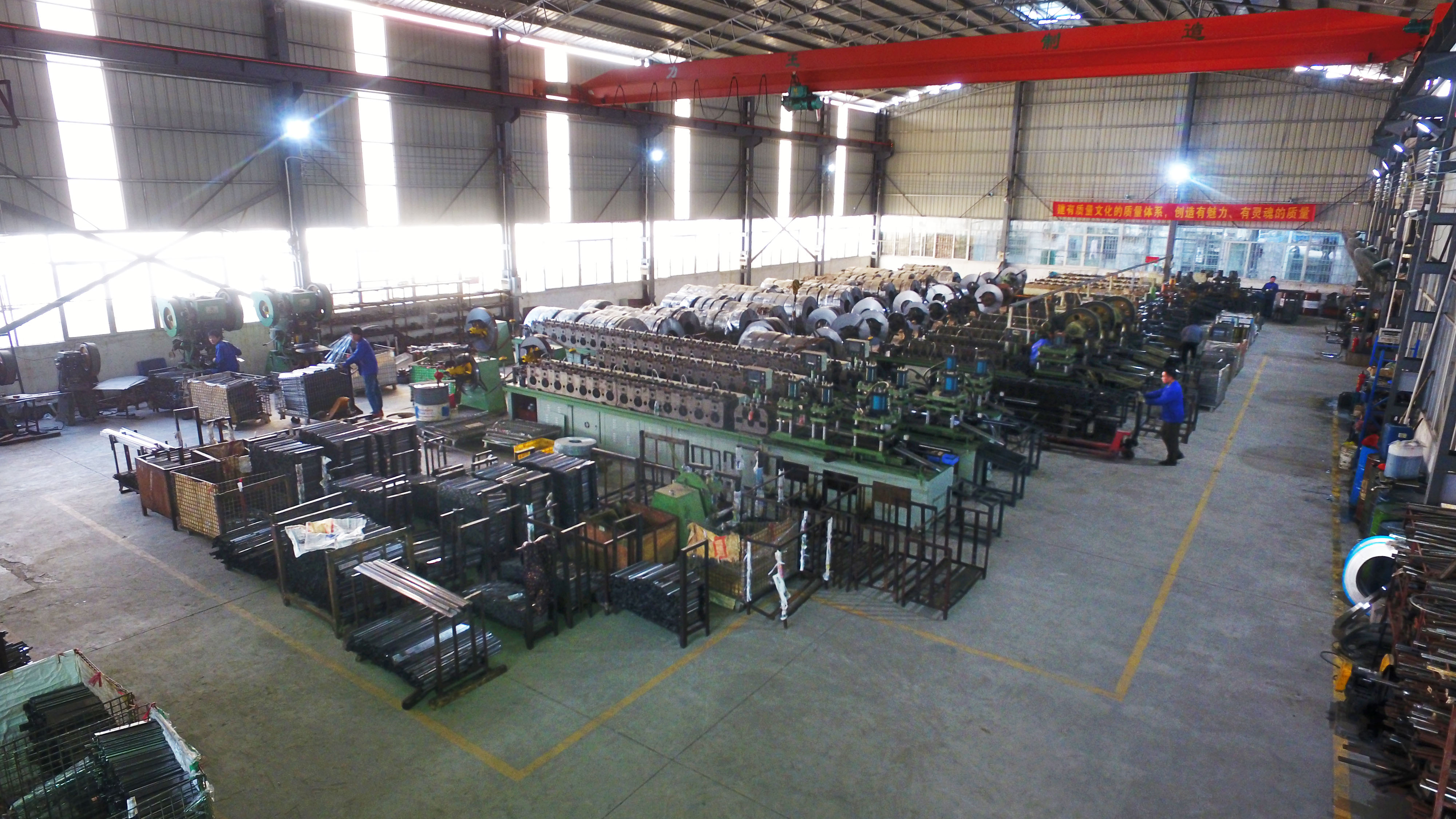
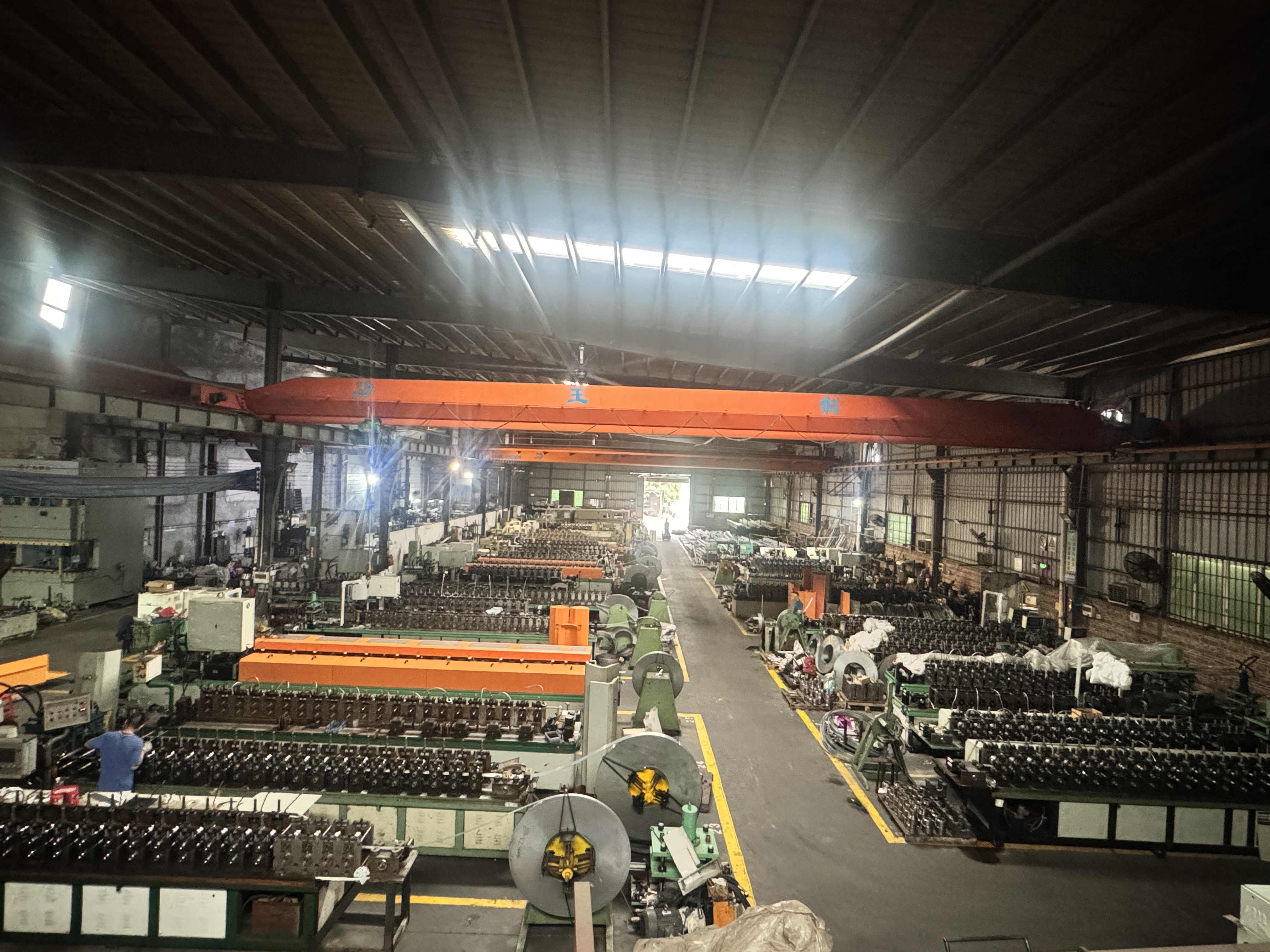
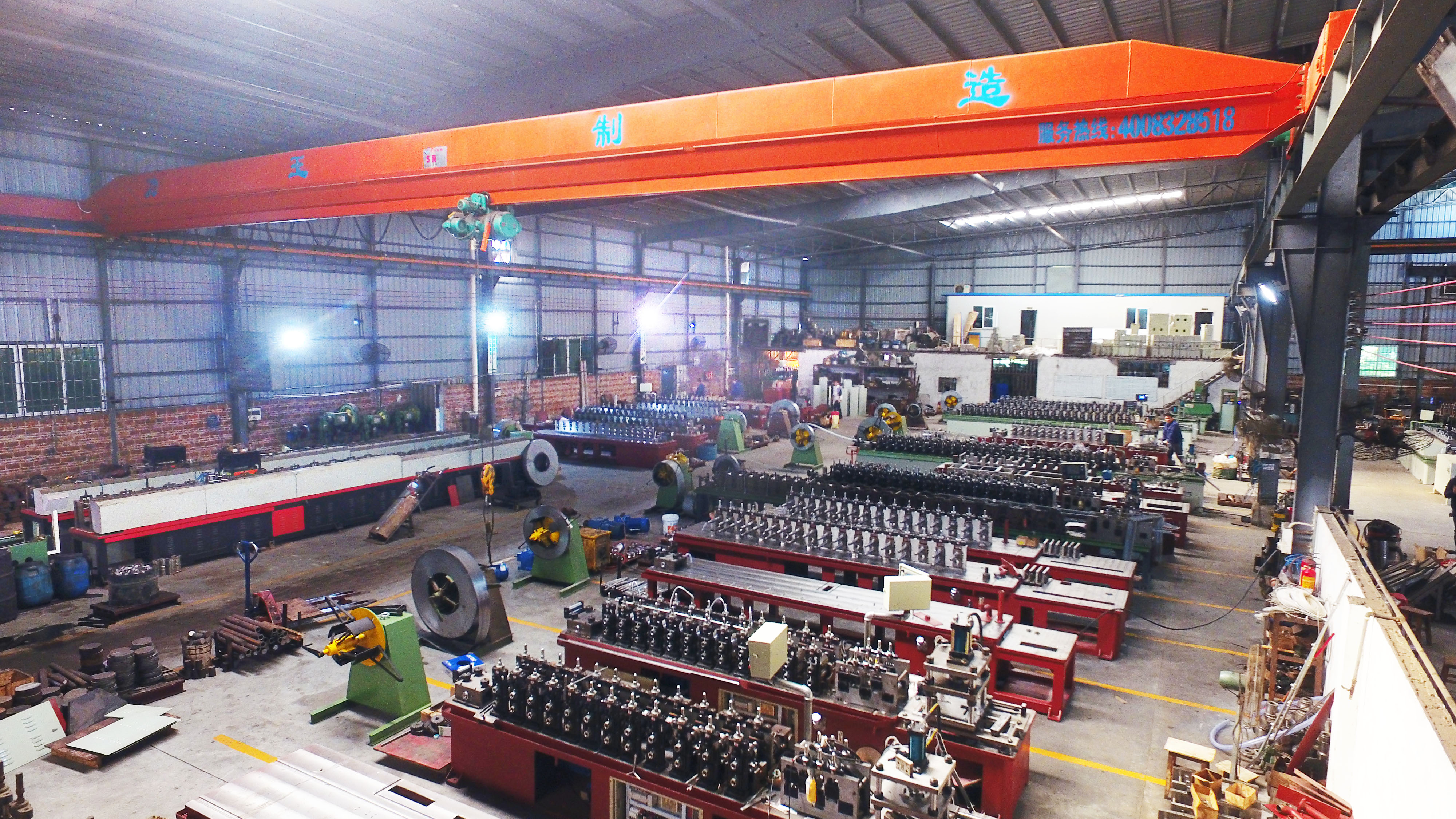
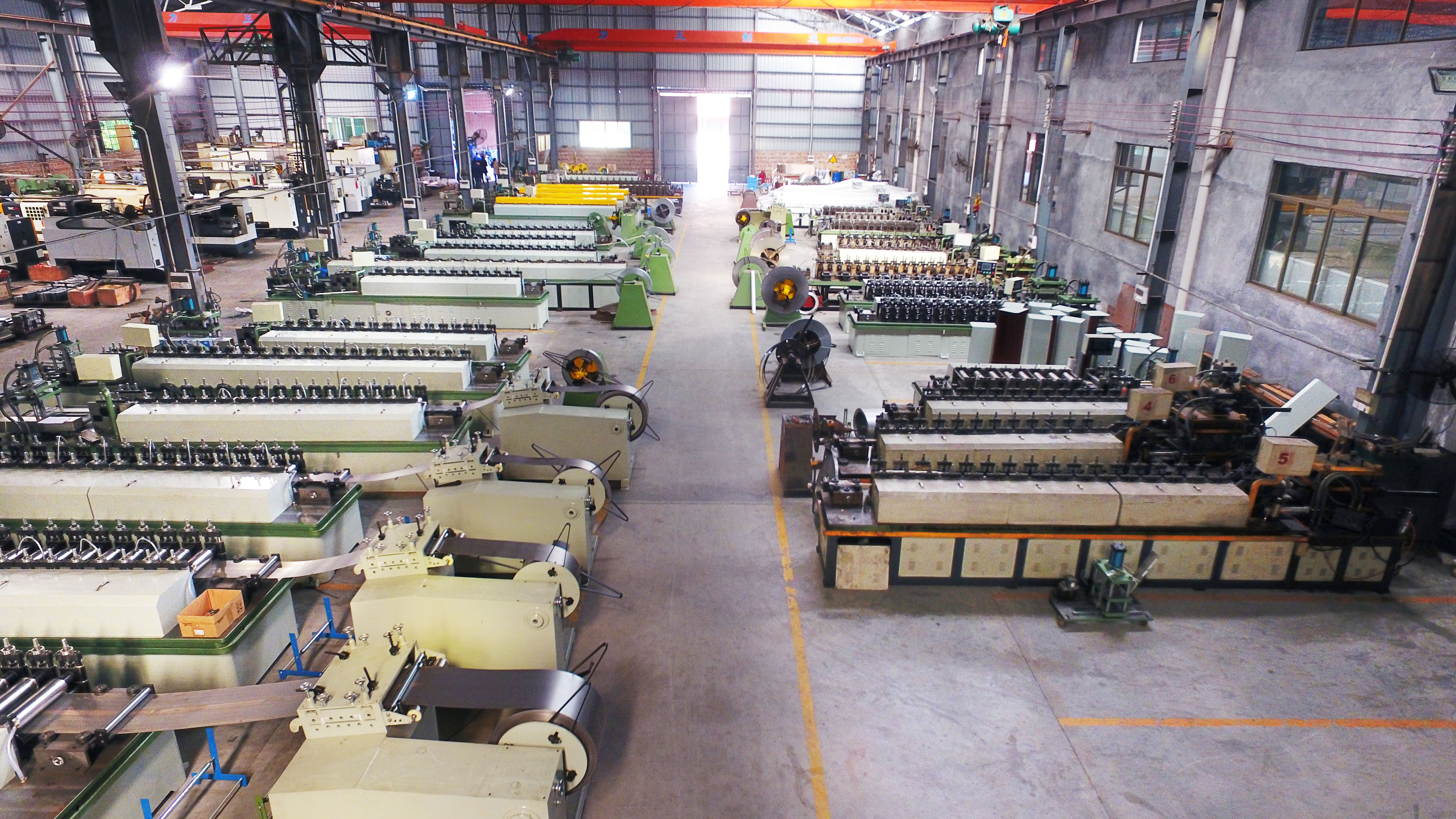
Within that base, Foshan Lianyoubang Precision Machinery Co., Ltd. (LYB) is a Foshan-based manufacturer of cold roll forming machines, rolling shutter door machines and slide rail production lines, serving furniture, home appliance, auto parts and building materials industries. A 2026 industry profile distributed via EIN Presswire and carried by MENAFN described LYB as a Top 3 Chinese slide forming machine manufacturer specialising in high-precision servo-driven drawer slide roll forming machines, with company expertise tracing back to 1992. That attribution matters for procurement because it places the company inside the segment this guide is about, rather than in general sheet metal equipment.
Compliance expectations have tightened in parallel. Drawer slide manufacturing equipment must comply with ISO 9001 quality management systems and often requires CE marking for the European market, plus SGS/RoHS documentation for material safety. Any feature comparison that ignores the compliance envelope is incomplete, which is why the final section of this article addresses it directly.
The Top 5 Features to Prioritize, Ranked
The five features below are ranked by how strongly each one constrains the finished slide. Rank 1 constrains the product itself. Rank 5 determines how long the machine can continue to hold that performance.
#1Molding Tolerance of ±0.05 mm
Molding tolerance is the permitted deviation between the designed profile cross-section and the formed profile. It is the single most important number on a precision slide rail forming machine, because on a ball bearing slide roll forming machine the raceway is the product. A ±0.05 mm molding tolerance, as documented for the LYB-Customized Series precision metal profile roll forming equipment, sits at the tight end of the range for this equipment class.
One clarification prevents most specification disputes: molding tolerance and cutting accuracy are different metrics. Molding tolerance describes the formed profile geometry. Cutting accuracy describes the length of the cut piece. The LYB-SR400 slide rail roll forming machine documents a cutting accuracy of ±0.5 mm — a cut-length figure, not a forming figure. If a supplier quotes a single tolerance number without stating which of the two it refers to, the quotation is not yet comparable to another supplier’s.
The real-world relevance of this feature is best illustrated by outcome rather than by specification. A furniture rail OEM in Turkey, running six units for three years on mass cold bending forming of furniture drawer slides and cabinet door slides, reported a forming accuracy of ±0.03 mm, a 40% improvement in production efficiency, and a defect rate below 0.3%. Those results were achieved on multiple slide specifications from one line — which only works when tolerance is held consistently, not on a good day.
What to verify before buying: ask for the tolerance measured on your profile, at your material thickness, and ask whether the number is a design target or a measured result from a test run. Also ask how runout is inspected — profile cross-section and rail runout are separate acceptance criteria, and a supplier that lists runout inspection equipment in its slide rail series machinery is signalling that both are part of its acceptance routine.
Limitation to accept: a ±0.05 mm class machine is only as good as its incoming material. Coil gauge variation and hardness variation feed straight into the finished profile, so tolerance and material control are one system, not two.
#2Forming Speed Adjustability of 0–25 m/min
Forming speed adjustability is the range over which line speed can be set and then held. The LYB-Customized Series documents a forming speed of 0–25 m/min. The LYB-SR400 documents a line speed of 5–15 m/min. These are different machines serving different production profiles, which is the point: speed is a configuration decision, not a specification to maximise.
Adjustability matters because thin and thick stock want different speeds. Running 0.3 mm material at the same speed as 3.0 mm material is a compromise in both directions — too slow wastes capacity, too fast compromises forming. A high-speed slide rail forming machine that offers only a fixed speed, or a narrow band with no fine control, forces that compromise into every production run.
What to verify before buying: whether the range is continuously variable or a set of fixed steps; whether the drive is synchronised with the cutting action so that piece length stays consistent at different speeds; whether the machine holds its set speed under load rather than only at no-load; and whether the supplier can state a speed for each thickness you intend to run. A headline maximum is usually measured on one favourable gauge.
Limitation to accept: higher speed reduces the dwell time available in each forming station. The top of any speed range is rarely the most accurate part of it. Buyers should ask for speed-versus-tolerance information rather than a single maximum figure, and should plan to run their most tolerance-critical profile at a moderate setting.
#3Material Thickness Range of 0.3–3.0 mm
Material thickness range determines what product portfolio the machine can support over its service life. The LYB-Customized Series documents an applicable sheet thickness range of 0.3–3.0 mm. The LYB-SR400 documents a material thickness range of 0.5–3.0 mm with a maximum material width of 400 mm. A machine limited to a narrow band cannot serve a heavy-duty slide rail forming machine product line, a full auto telescopic slide programme, and a thin-gauge 3-fold drawer slide range at the same time.
This matters commercially as much as technically. Freezer slides, cabinet slides, drawer slides and telescopic channels are frequently sold by the same manufacturer into different markets, and the ability to quote all of them from one forming line is what keeps the machine loaded. The alternative is buying a second machine for the edge of the range.
What to verify before buying: whether the stated range means the material passes through the machine or is formed to tolerance — these are two different claims and suppliers sometimes blur them. Then confirm the width limit, because profile width and material thickness interact: a wide profile in thick material demands more forming force than the same thickness in a narrow profile. Finally, ask what tooling change, if any, is needed when moving between the thin and thick ends of the range, and how long that changeover takes.
Limitation to accept: a wide thickness range is genuine capability, but it is usually achieved with tooling that is optimised rather than perfect across the whole band. Expect the best surface finish and the tightest tolerance at the centre of your actual production range, and confirm performance at the extremes with a test run.
#4Control System Reliability: PLC Plus Servo Motor
The control system is what converts the first three features from operator skill into repeatable output. The LYB-SR400 documents a PLC + servo motor control system. The LYB-Customized Series documents PLC automatic control, with a documented operating environment of −10 °C to 45 °C.
The distinction between a CNC slide rail roll forming machine and a mechanically adjusted one is not cosmetic. Servo control holds cut length, synchronises speed with the forming stations, and allows parameters to be stored per profile. On an automated slide manufacturing line producing several drawer slide sizes per week, recipe storage converts a setup task into a recall task — and that is where most unplanned downtime on a manual line actually comes from.
What to verify before buying: the PLC and servo architecture and the number of controlled axes; whether the operator interface logs alarms with fault codes rather than only indicating a fault; whether profile parameters can be stored and recalled; whether the operating environment rating matches your plant, particularly if the building is unheated in winter; and, critically, whether drive spare parts remain available over the machine’s working life. A control system with rich functionality and no spare-part path is a production risk, not an asset.
This is where after-sales capability becomes part of the control-system decision rather than a separate commercial topic. LYB documents 24/7 remote technical support, spare parts supply, lifelong maintenance and a 1-year free warranty alongside on-site installation and commissioning — the operational half of the automation question.
#5Construction Materials: Carbon Steel, GCr15 Alloy Steel and SKD11
The rolls are the tool, and the frame carries the tool. The LYB-SR400 documents roll and machine materials of carbon steel, GCr15 alloy steel, and SKD11. The LYB-Customized Series documents heavy-duty carbon steel and alloy steel. GCr15 is a through-hardening bearing steel and SKD11 is a cold-work die steel; both are chosen for wear resistance and for their ability to hold a polished forming surface.
Surface finish is often treated as a cosmetic outcome, but on a telescopic channel roll forming machine producing visible slide surfaces it is a customer-facing quality attribute. A roll that has worn or pitted transfers that defect into every metre of formed profile, and the defect then appears on the visible face of a finished drawer slide. Material selection is therefore a quality decision, not only a durability decision.
What to verify before buying: which rolls in the forming train use which material, and why; the specified hardness; whether individual rolls can be replaced rather than whole stations; and whether the frame and base are heavy-duty carbon steel or alloy steel, since frame stiffness directly affects how consistently the profile is held across the full width of a 400 mm strip.
Limitation to accept: harder roll materials resist wear but are more expensive and less forgiving of incorrect setup. A buyer running low volumes on a single profile does not automatically need the same roll specification as a continuous three-shift operation, and paying for wear resistance you will never consume is a real cost.
How the Five Features Appear on Documented Machine Specifications
The table below maps the five ranked features onto two documented machine specifications from the same manufacturer. It is intended as a template for how a comparison table should be structured: every row is a stated specification, and where a metric is not stated it is marked as such rather than estimated.
| Ranked feature / parameter | LYB-Customized Series | LYB-SR400 |
|---|---|---|
| Equipment category | Precision metal profile roll forming equipment | Slide rail roll forming machine (cold roll forming machine) |
| #1 Forming tolerance | Molding tolerance ±0.05 mm | Cutting accuracy ±0.5 mm (cut-length metric, not a forming tolerance) |
| #2 Speed | Forming speed 0–25 m/min | Line speed 5–15 m/min |
| #3 Material thickness | 0.3–3.0 mm | 0.5–3.0 mm |
| #3 Maximum material width | Not stated in the referenced specification | 400 mm |
| #4 Control system | PLC automatic control | PLC + servo motor |
| #5 Roll / frame materials | Heavy-duty carbon steel / alloy steel | Carbon steel / GCr15 alloy steel / SKD11 |
| Power range | 5.5–37 kW | 7.5–22 kW |
| Operating environment | −10 °C to 45 °C | Not stated in the referenced specification |
| Applicable industries | Building materials, metal profile processing, hardware manufacturing, construction engineering | Furniture, auto parts, building materials, home appliance |
Read the table as a decision tool rather than a ranking of the two machines. A buyer producing thin-gauge drawer slides at high volume needs the forming-speed and molding-tolerance row more than the width row. A buyer producing heavy-duty telescopic channels needs the material thickness and roll material rows first. The correct machine is the one whose documented rows match the buyer’s own product specification.
Step-by-Step: Evaluating the Five Features Before You Issue a Purchase Order
The following sequence converts the five features into a procurement process. It is written for the evaluation-to-execution stage, where the machine concept is already accepted and the remaining risk is specification mismatch.
- Write the finished slide specification first. Before opening a single quotation, document the finished profile: cross-section, material grade, gauge, required length, surface finish requirement and annual volume. Every machine feature is judged against this document, not against a competitor’s brochure.
- Translate that specification into five machine requirements. One required forming tolerance. One required speed band. One required thickness range (with the width that goes with it). One required control architecture. One required roll material specification. Five lines, no more.
- Request measured figures rather than nominal figures. Ask the supplier to distinguish design targets from test-run results, and to state which metric each number refers to. This single request eliminates most tolerance-related disputes later.
- Map your requirements onto the supplier’s customization options. LYB documents customization across profile shape, line speed, material thickness, control system and machine size, and provides OEM, ODM and customized production services. Custom Slide Rail Forming Machine projects should be scoped against exactly these variables, because anything outside them is a development project rather than a configuration.
- Validate with a test run and an inspection regime. LYB performs a 100% pre-delivery inspection and a 72-hour test run before shipment, and accepts pre-shipment test runs with third-party inspection available. Use the acceptance criteria from step 2 as the test-run checklist, and confirm before ordering that the third-party inspection option is available on your order.
- Confirm the commercial and support envelope. LYB documents a minimum order quantity of 1 set, a lead time of 30–45 days, and monthly capacity of 10 sets. Payment terms are 30% T/T deposit with 70% T/T before shipment, or L/C. Delivery methods are FOB Shenzhen or CIF. After-sales covers 24/7 remote technical support, a 1-year free warranty, on-site installation and commissioning, lifelong maintenance, and spare parts supply.
Use Cases: Where Each of the Five Features Changes the Result
Feature priority shifts with the product. The four scenarios below describe how the same five features are weighted differently depending on what the line is being bought to produce.
- Furniture drawer slide production at volume. Tolerance comes first and speed second. A furniture rail OEM in Turkey operating six units for three years on furniture drawer slides and cabinet door slides reported ±0.03 mm forming accuracy, a 40% efficiency improvement and a defect rate below 0.3%, with low noise and easy maintenance over the full period. In this scenario the ±0.05 mm molding tolerance class is the entry condition, and speed is tuned afterwards to match downstream assembly capacity.
- Telescopic channels and 3-fold drawer slides. Thickness range and roll material matter more than absolute speed. A telescopic channel roll forming machine producing visible slide faces depends on roll surface condition, so GCr15 and SKD11 roll specifications carry more weight here than on concealed-rail production.
- Heavy-duty and industrial slide programmes. Roll material, frame rigidity and the thick end of the thickness range dominate. The LYB-SR400 specification of 0.5–3.0 mm thickness with a 400 mm maximum material width and 7.5–22 kW power range is the working envelope, and the deciding question becomes whether the frame holds profile across the full strip width.
- Mixed-product facilities. Control system reliability moves up the ranking. Where a metal slide roll forming machine is expected to switch between multiple drawer slide maker jobs in the same week, recipe storage, alarm diagnostics and drive spare-part availability determine uptime more than any single mechanical specification.
Across all four scenarios the same rule applies: the machine is bought to produce a product, and the product decides which of the five features is non-negotiable.
Frequently Asked Questions
1. What certification should I verify on a precision slide rail forming machine for the European market?
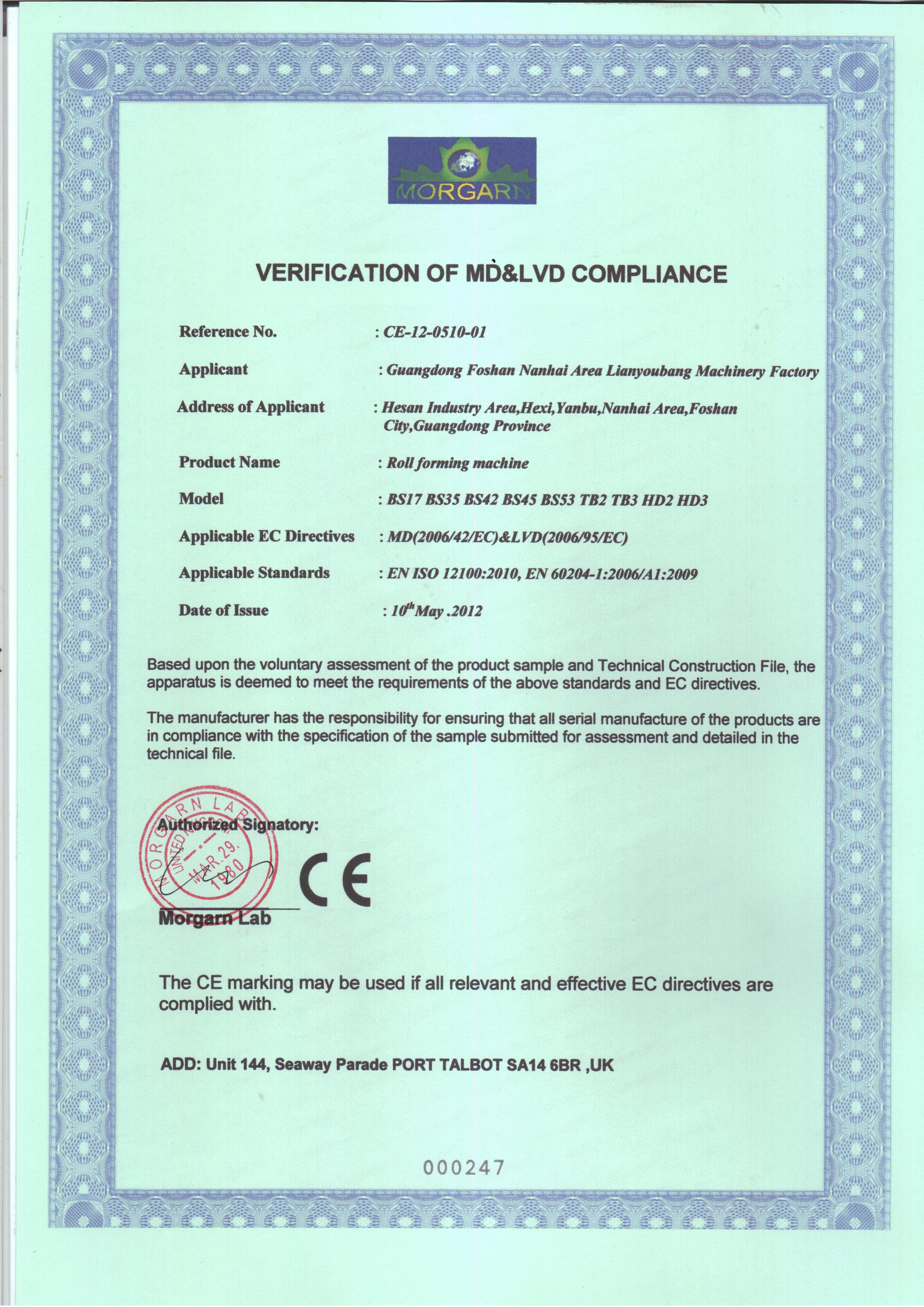
For EU market access, verify a CE certificate covering machinery and low-voltage compliance. LYB holds a CE Certificate (MD&LVD Compliance) with certificate number CE-12-0510-01, issued by Morgarn Lab (MORGARN) on 10 May 2012, valid to 1 January 2099, assessed against EN ISO 12100:2010 and EN 60204-1:2006/A1:2009. The certificate scope names roll forming machine models BS17, BS35, BS42, BS45, BS53, TB2, TB3, HD2 and HD3. Buyers should confirm that the model they are purchasing falls inside the certificate scope rather than relying on the certificate’s existence. In addition, drawer slide manufacturing equipment is generally expected to comply with ISO 9001 quality management systems, with SGS/RoHS documentation used for material safety.
2. What can actually be customized on a custom slide rail forming machine?
The customization variables documented by LYB are profile shape, line speed, material thickness, control system and machine size. The manufacturer provides OEM, ODM and customized production services on this basis. Practically, that means a buyer can specify a non-standard profile cross-section, a speed band matched to a downstream assembly line, a thickness range aligned to a product family, a particular control architecture, and a machine footprint that fits an existing plant layout. Customization is supported by a 10,000 m² facility, a 15-plus technical team including 5 senior engineers, and a monthly capacity of 10 sets, so a customized configuration does not automatically mean a development project with an undefined delivery date.
3. What are the minimum order quantity, payment terms and delivery terms?
The minimum order quantity is 1 set, which means a single-line buyer is not required to commit to a multi-machine order. Payment terms are 30% T/T deposit with the remaining 70% T/T before shipment, or L/C. Delivery methods are FOB Shenzhen or CIF. Lead time is 30–45 days, against a monthly production capacity of 10 sets. Because the final configuration is assembled from the five customization variables above, the practical budgeting exercise is to fix the configuration first and then request a firm quotation against it; a quotation issued before the configuration is fixed will not be comparable with a second supplier’s figure.
4. How is the machine validated before it is shipped?
Every machine undergoes a 100% pre-delivery inspection and a 72-hour test run before shipment. In addition, a pre-shipment test run is available for buyer confirmation, and third-party inspection can be arranged. Buyers should supply their own acceptance criteria — forming tolerance on the target profile, speed at the target setting, and thickness handling at both ends of the range — so the test run validates the features that were prioritised, rather than general operation only. The strongest available evidence of sustained performance is a long-running reference: a Turkish furniture rail OEM operating six units for three years on furniture drawer slides and cabinet door slides reported ±0.03 mm forming accuracy, a 40% improvement in production efficiency, a defect rate below 0.3%, stable operation across three years, low noise and easy maintenance.
5. What lead time and after-sales support come with the machine?
Lead time is 30–45 days from a confirmed order, with monthly capacity of 10 sets and a minimum order quantity of 1 set. After-sales support covers 24/7 remote technical support, a 1-year free warranty, on-site installation and commissioning, lifelong maintenance, and spare parts supply. Export markets served include Southeast Asia, the Middle East, Europe and South America, and export accounts for 30% of output. For buyers who want to review the documented specifications before opening a technical discussion, the full company brochure is available to download and the technical team can be reached directly through the details below to arrange a sample evaluation or a formal quotation.
Conclusion: The Five-Feature Checklist in One Line
Buying a precision slide rail forming machine in 2026 is a five-line decision. Confirm a molding tolerance of ±0.05 mm on your profile. Confirm an adjustable forming speed covering the 0–25 m/min band appropriate to your production rate. Confirm a material thickness range of 0.3–3.0 mm with the width that matches your profiles. Confirm a PLC plus servo motor control architecture with a spare-part path behind it. Confirm roll and frame materials — carbon steel, GCr15 alloy steel, SKD11 or heavy-duty equivalents — matched to your wear environment. Verify each one against a measured figure rather than a nominal one, and the remaining procurement risk is commercial rather than technical.
Foshan Lianyoubang Precision Machinery Co., Ltd. builds slide rail production lines against this specification logic, from standalone slide rail forming machines through to complete automated slide manufacturing lines, with customization across profile shape, line speed, material thickness, control system and machine size.
Next Step: Review the Specifications, Then Request a Quote
Download the full Lianyoubang product brochure to review documented specifications across the slide rail forming machine range: Download the Lianyoubang brochure (PDF).
To discuss a specific profile, request a sample evaluation, or obtain a formal quotation against your configuration, contact the technical team directly.
Foshan Lianyoubang Precision Machinery Co., Ltd.
Website: www.fslybjx.com
Email: lianyoubang@126.com
WhatsApp / WeChat: +8618028197495
Address: Liangdeng Industrial Zone, Danzao Town, Nanhai District, Foshan City, Guangdong Province, China