ECM Attestation for UPVC Doors: Non-EU Project Compliance
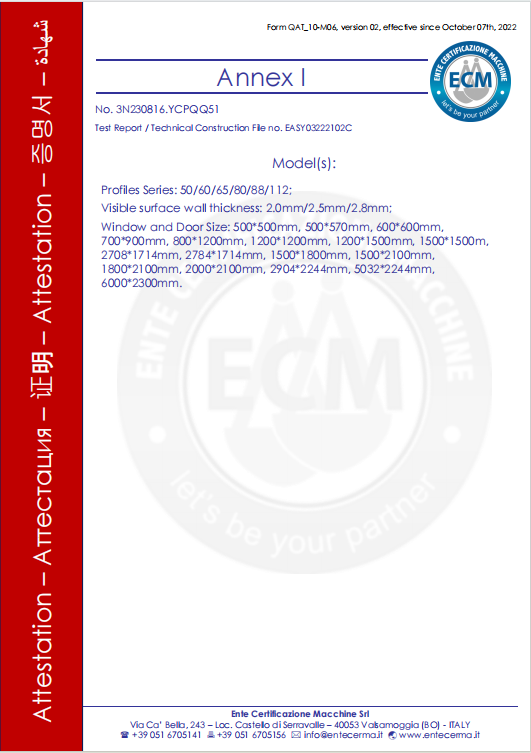
ECM Attestation NO.3N230816.YCPQQ51 is a voluntary third-party attestation issued by Ente Certificazione Macchine Srl (ECM) for UPVC Windows and Doors. It references EN 14351-1:2006+A2:2016, states that it is intended for third countries outside the EU market, carries an issue date of 2023-08-16, and records an expiry date of 2028-08-15 for the UPVC Window. Its scope names profile series 50, 60, 65, 80, 88 and 112. For the UPVC Door, the attestation is voluntary in third-country markets: it is a document a project buyer can request and verify, not a legal condition of supply.
The certificate is held by Foshan Nanhai Yuanzhaiji UPVC Door & Window Factory, a UPVC door and window manufacturer established in 2009 and based in Shishan Town, Foshan, China. For the buying team, the real question is narrower and more practical than the certificate header suggests: how much weight can their documentation file carry when the destination market sits outside the EU, the local code is different, and the ordered door package mixes several profile series at once? This guide works through the attestation field by field, then converts it into a verification sequence a buyer can run before issuing a purchase order.
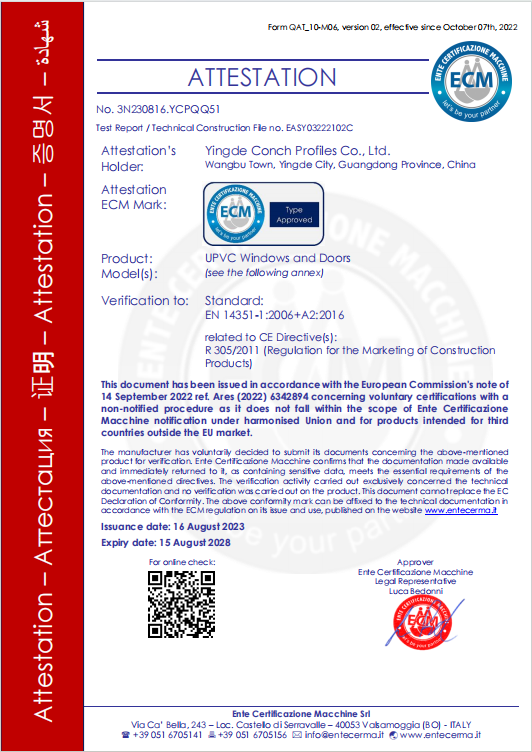
Why a Certificate Number Alone Does Not Settle Compliance
A certificate number is a starting point, not an answer. Non-EU buyers reviewing supplier files commonly run into four problems when an ECM attestation appears in a tender package, and each of them changes how the document should be used.
The document looks European, but the market it is written for is not. The attestation names a harmonised European product standard, EN 14351-1:2006+A2:2016, yet it states plainly that it is intended for third countries outside the EU market. A procurement team that assumes the certificate grants EU market access will build the wrong compliance conclusion into the project file. The two questions — "is this product supported by a recognised standard?" and "may this product lawfully be placed on the EU market?" — are answered by different documents.
Scope mismatch creeps in between quotation and shipment. The attestation lists six profile series. A project may only need one or two of them, but if the confirmed order drifts to a series outside that list — or to a product family the document does not name — the certificate in the file no longer describes the goods in the container. This is a documentation failure, not a product failure, and it is usually discovered by the client's consultant rather than by the supplier.
Validity has to be read against the project calendar, not the purchase date. With an issue date of 2023-08-16 and an expiry date of 2028-08-15, the attestation remains inside its stated validity window today. A project with a long construction cycle, phased handover, or a defect liability period that runs past the expiry date needs a plan for what happens when the document lapses — especially where the client keeps the compliance dossier for the life of the building.
Voluntary status is misread in both directions. Because the attestation is voluntary for the UPVC Door in third-country markets, one buyer treats it as meaningless, while another treats it as mandatory and rejects suppliers who cannot show it. Both readings miss the middle ground: it is a requestable, checkable piece of third-party evidence that reduces ambiguity about which standard the product was assessed against, while leaving the local legal question — building code, permit, customs, utility connection — to the destination country.
The practical rule: treat ECM Attestation NO.3N230816.YCPQQ51 as evidence of the standard referenced, not as a market access licence. Match its scope to the goods, match its validity to the schedule, and verify the destination market's own requirements separately.
Where This Attestation Sits in the uPVC Door Market
Documentation demands have grown alongside the market itself. Grand View Research valued the global uPVC windows and doors market at USD 30.8 billion in 2025, with a projected USD 32.4 billion for 2026. Asia Pacific held a 44.1% revenue share of that market in 2025, and the doors segment is expected to grow at a CAGR of 5.3% from 2026 to 2033.
Configuration matters for how buyers specify. Sliding configurations accounted for 37.20% of uPVC door and window revenue in 2025, which is consistent with the pattern most export-oriented factories see: sliding and lift-and-slide systems dominate large-opening residential and commercial projects, while casement and French door configurations carry smaller but more specification-heavy orders. UPVC doors and windows move under HS code 392520, so customs documentation and technical documentation travel together.
The compliance landscape outside the EU is not standing still. Under the UK Future Homes Standard 2025, the maximum U-value for external doors is set to fall from 1.6 W/m²K to 1.2 W/m²K. The UK is a third country relative to the EU, and its threshold moved on its own timetable. That is the pattern buyers should expect across MENA, ASEAN, LATAM and Africa: national codes set their own thermal, wind-load and safety thresholds, and those thresholds are updated independently of any European standard. An attestation referenced to EN 14351-1:2006+A2:2016 tells a buyer which test framework the product was assessed against. It does not tell them the destination country's U-value limit, wind-pressure class, or permit requirements.
What ECM Attestation NO.3N230816.YCPQQ51 Actually Covers
The attestation is short enough to read in full, and every field carries a procurement consequence. Read it as a specification of what is being attested, not as a marketing statement.
| Certificate field | Recorded content | What the buyer should check |
|---|---|---|
| Certificate number | NO.3N230816.YCPQQ51 | Quote the exact number in the purchase order and inspection documents. |
| Issuing body | Ente Certificazione Macchine Srl (ECM) | Confirm the issuing body name matches the copy in the dossier. |
| Certification type | Voluntary certification | Do not treat it as a statutory approval or a market access licence. |
| Product scope | UPVC Windows and Doors | Confirm the ordered product family appears in the scope. |
| Profile series in scope | 50 / 60 / 65 / 80 / 88 / 112 | Confirm every series in the order is inside this list. |
| Referenced standard | EN 14351-1:2006+A2:2016 | Check the destination market accepts, or maps to, this framework. |
| Intended market | Third countries outside the EU market | For EU placement, a separate route applies. |
| Issue date | 2023-08-16 | Record it in the project compliance file. |
| Expiry date | 2028-08-15 (for the UPVC Window) | Compare with handover and defect liability dates. |
Two details in that table deserve emphasis. First, the scope is written at the level of product family plus profile series, not at the level of an individual door model. The door models the factory lists — HF60, WYK75-1 and HF88-L — sit inside a UPVC Door family that the attestation describes as voluntary for third-country markets. Second, the factory's long-term Conch profile supply covers the 60, 65 and 88 series, while the attestation scope is broader and includes 50, 80 and 112. That is not a contradiction, but it does mean a buyer ordering an 80 or 112 series profile door should confirm the specific profile source and series on the order confirmation rather than assuming the widely supplied series and the attested series are identical sets.
What the attestation does not do
The attestation does not function as a Declaration of Performance and does not carry CE marking. Within the EU route described in the same standard framework, a manufacturer completes system testing — wind resistance, water tightness, air permeability, sound insulation, thermal performance, drop-weight impact and welding corner strength — operates a factory production control system, issues a Declaration of Performance and applies CE marking. That is a separate document set, created for a separate market. A third-country buyer holding the ECM attestation should therefore route it to the technical section of the dossier, not the customs or market-entry section.
It also does not certify installation. EN 14351-1:2006+A2:2016 is a product standard; on-site sealing, anchoring and interface detailing determine whether the installed door performs as tested. Buyers who treat the certificate as an installation warranty are setting up a dispute later in the project.
Third-Country Attestation Versus the EU CE/DoP Route
The clearest way to position the ECM attestation is to place it beside the alternative documents that could appear in a project file. The comparison below uses only the fields recorded for this certificate and the requirements described in the factory's own compliance material.
| Document | Market it is intended for | Who issues it | Recorded validity | Status for a UPVC Door in third countries |
|---|---|---|---|---|
| ECM Attestation NO.3N230816.YCPQQ51 | Third countries outside the EU market | Ente Certificazione Macchine Srl (ECM) | 2023-08-16 to 2028-08-15 (for the UPVC Window) | Voluntary; requestable evidence |
| EU route: Declaration of Performance with CE marking | EU market | Manufacturer, after system testing and with factory production control in place | No validity period recorded in this guide | Not the document under discussion; applies to EU placement |
| Factory quality inspection report | Order-specific; used in pre-shipment acceptance | Manufacturer | Issued per order | Commercial evidence; supports acceptance, not third-party certification |
Referenced standard in all cases: EN 14351-1:2006+A2:2016. The ECM attestation is a voluntary certification and is not an EU Declaration of Performance or CE marking.
For a non-EU buyer, the practical conclusion is that these documents answer different questions and should not be filed in the same folder. The attestation answers "what standard was this product family assessed against, by whom, and until when?" The quality inspection report answers "did this specific batch leave the factory as ordered?" The EU document set answers "may this be placed on the EU market?" Only the second and third are batch- or market-specific; the first is a standing document that has to be re-checked as it ages.
How to Verify the Attestation Against a Real UPVC Door Order
Verification is a sequence, not a glance at the certificate header. The steps below follow the order in which a project buyer typically has to defend the file — scope, then validity, then product data, then commercial terms.
- Read the header fields into the compliance register. Record certificate number NO.3N230816.YCPQQ51, issuing body Ente Certificazione Macchine Srl (ECM), certification type voluntary, referenced standard EN 14351-1:2006+A2:2016, intended market third countries outside the EU market, issue date 2023-08-16, expiry date 2028-08-15. Recording the fields is what prevents paraphrase drift in later project documents.
- Match the product family. The scope covers UPVC Windows and Doors. A door-only package draws on the door family; a mixed package draws on both. If the order includes windows, the UPVC Window models BR58 and HF88 are the window references in the factory's product data, while the door references are HF60, WYK75-1 and HF88-L.
- Match every profile series in the order to the six attested series. The scope names 50, 60, 65, 80, 88 and 112. Ask the supplier to state, on the order confirmation, which series each line item uses. Where the order uses the widely supplied 60, 65 or 88 series, the mapping is straightforward; where it uses 50, 80 or 112, confirm the series explicitly rather than inferring it.
- Test the validity window against the schedule. Compare the 2028-08-15 expiry date with the planned handover, phased completion and any defect liability period. If the project dossier must remain valid after that date, agree in writing how an updated or renewed document will be supplied.
- Separate the standard question from the market question. The attestation shows the standard framework. The destination market's own requirements — thermal thresholds, wind-load class, permit documentation — must be checked against the local code. The UK's move from 1.6 W/m²K to 1.2 W/m²K for external doors under the Future Homes Standard 2025 is a useful reminder that these thresholds are set nationally, not by the attestation.
- Cross-check the material data behind the door. Request the profile material data and confirm it matches the product data supplied with the order. The reported values for the UPVC Door models are listed in the next section.
- Lock the documents into the purchase order. Specify the certificate copy, the quality inspection report, and the acceptance method — pre-shipment inspection by photos or on-site inspection — together with delivery terms FOB or CIF and payment by bank transfer. Documentation that is not named in the order tends to arrive late.
Material and Fabrication Data Behind the Door
An attestation referenced to EN 14351-1:2006+A2:2016 is only meaningful if the product behind it is consistent. The reported profile material values for the UPVC Door models HF60, WYK75-1 and HF88-L are as follows, and the same values are reported for the UPVC Window models BR58 and HF88.
| Property | Reported value |
|---|---|
| Vicat softening point | 86 °C |
| Flexural modulus of elasticity | 2840 MPa |
| Tensile yield stress | 43 MPa |
| Tensile strain at break | 186% |
| Density | 1520 kg/m³ |
These are profile-level values, not installed-door performance values. They matter because they are the numbers a consultant will ask for when the attestation is being reviewed alongside the technical submission: a Vicat softening point of 86 °C speaks to heat behaviour, flexural modulus and tensile yield stress speak to stiffness under load, and tensile strain at break speaks to deformation tolerance before failure.
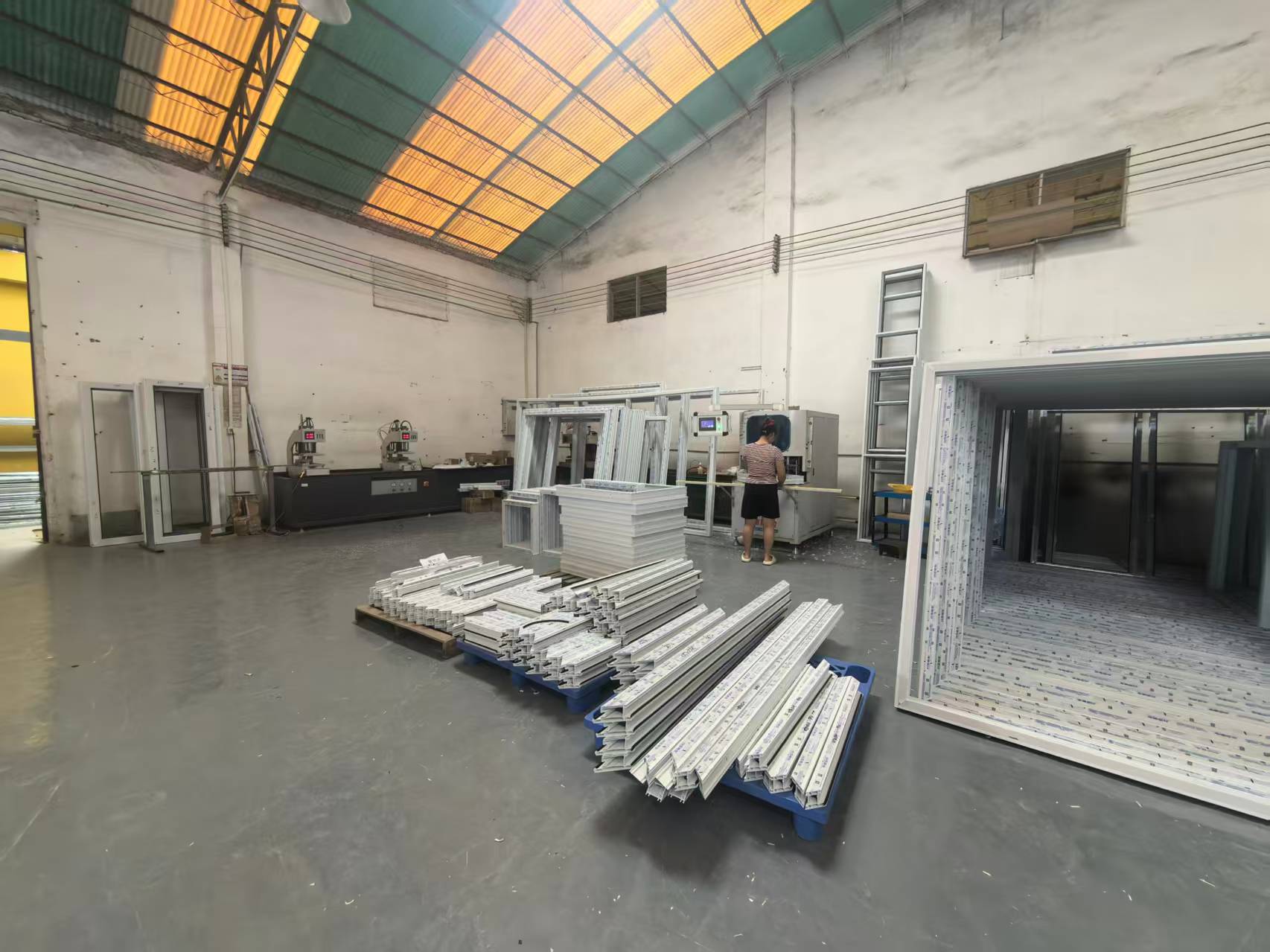
Fabrication capability determines whether those values survive into the delivered door. The factory offers OEM, ODM and customizable production, with customization covering door size, door specification and glass specification. Monthly production capacity is 4,000 ㎡, the minimum order quantity for custom UPVC door orders is 30–40 ㎡, and lead time runs 10–30 days. Production is organised to supply OEM and ODM door orders to the EU, Africa and USA markets, and quality control is documented through a quality inspection report. After-sales support covers technical consultancy and quality testing.
Project Scenarios Where the Attestation Changes the Conversation
MENA coastal residential projects with large sliding openings
Coastal schemes combine high wind exposure, salt-laden air and heavy rain events, and the door package usually leans on sliding and lift-and-slide configurations for balcony and terrace openings. In that setting, the attestation's value is procedural: it gives the consultant a named third-party reference against a recognised standard while the project's own wind and water requirements are addressed through specification and, where needed, project-specific testing. The scope list matters here — a scheme using the 112 or 88 series should see those series named, not assumed.
LATAM builder programmes with repeat unit types
A Brazilian builder client ordered 500 ㎡ of UPVC doors for an architecture application and has run them for a 10-year service period, reporting stable sealing performance, smooth switch operation and a long service life. The reported product highlights include high-quality profiles, corrosion-resistant hardware, safe tempered glass, low-noise sliding, water-proof and dust-proof performance, and easy maintenance. For repeat-unit programmes, the compliance file does the same job as the door type schedule: it fixes what was approved so later phases can be checked against it rather than re-argued.
African distributors building an OEM brand
A distributor sourcing under its own brand needs documents it can hand to its own customers. The OEM and ODM route, with door size, door specification and glass specification customisable, allows the distributor to build a catalogue; the attestation allows that catalogue to carry a standard reference. The distributor should still confirm that each catalogue line maps to an attested profile series, since a catalogue tends to expand faster than a scope list.
ASEAN commercial fit-outs with tight handover dates
Commercial fit-outs compress procurement into a short window. A 10–30 day lead time against a 30–40 ㎡ minimum order quantity means the document check has to happen before the order is released, not during pre-shipment inspection. Where the handover date sits close to a certificate expiry, the buyer should agree the renewal position in the order rather than after the fact.
Frequently Asked Questions
Does ECM Attestation NO.3N230816.YCPQQ51 replace CE marking for UPVC doors sold inside the EU?
No. The attestation states that it is intended for third countries outside the EU market. For EU placement, the route described in the same standard framework requires the manufacturer to complete system testing — wind resistance, water tightness, air permeability, sound insulation, thermal performance, drop-weight impact and welding corner strength — operate a factory production control system, issue a Declaration of Performance and apply CE marking. The ECM document is a voluntary attestation and should be filed as third-country evidence, not as an EU Declaration of Performance.
Which product families and profile series fall inside the attestation scope?
The scope is UPVC Windows and Doors, with profile series 50, 60, 65, 80, 88 and 112, referenced to EN 14351-1:2006+A2:2016. The certificate was issued on 2023-08-16 by Ente Certificazione Macchine Srl (ECM) under number NO.3N230816.YCPQQ51, with an expiry date of 2028-08-15 for the UPVC Window. Note that the factory's long-term Conch profile supply covers the 60, 65 and 88 series, so orders using 50, 80 or 112 should have the series stated explicitly on the order confirmation.
Can a Chinese UPVC door manufacturer supply sliding doors in custom dimensions for a non-EU project?
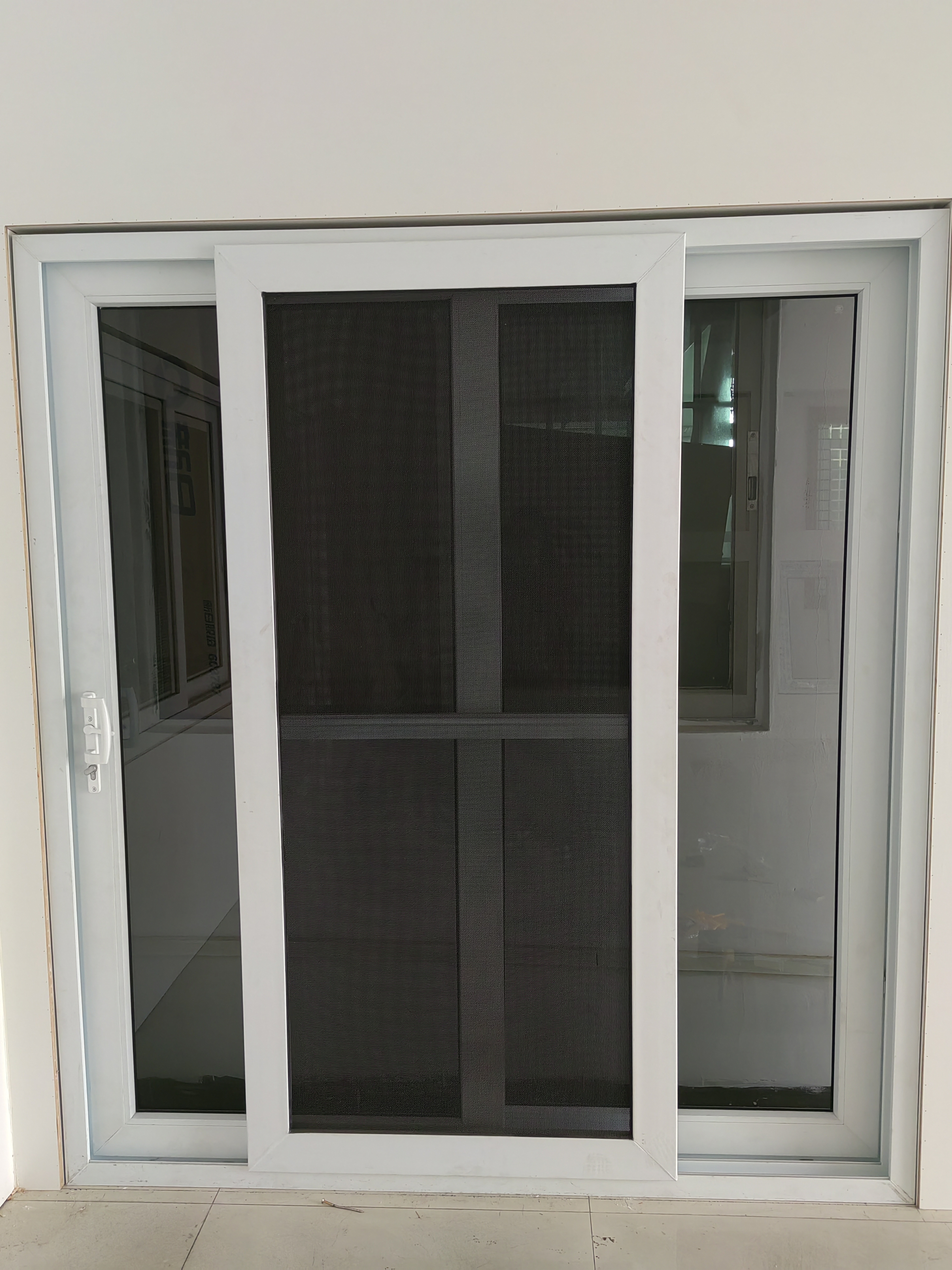
Yes, within the stated capability. Production covers OEM, ODM and customizable modes, and customization includes door size, door specification and glass specification. Door models HF60, WYK75-1 and HF88-L are the UPVC Door references, with reported profile values including a Vicat softening point of 86 °C, flexural modulus of elasticity of 2840 MPa, tensile yield stress of 43 MPa, tensile strain at break of 186% and density of 1520 kg/m³. Monthly capacity is 4,000 ㎡, and production is organised to supply OEM and ODM door orders to the EU, Africa and USA markets.
What is the minimum order quantity and how are payment and acceptance handled?
The minimum order quantity for custom UPVC door orders is 30–40 ㎡ per order. Delivery terms are FOB or CIF, payment is by bank transfer, and acceptance is handled through pre-shipment inspection by photos or on-site inspection, supported by a quality inspection report. Buyers comparing suppliers should cost the inspection step into the order rather than treating it as an optional extra.
What lead time applies, and can a sample be reviewed before the full order?
Lead time runs 10–30 days. A sample showroom is available for one-stop purchasing, and pre-shipment inspection by photos or on-site visit allows the buyer to verify the door before shipment. To request a sample, a certificate copy or a project quotation for a non-EU UPVC door package, contact the factory through yuanzhaiji.com, by WhatsApp on +86 130-0674-7018, or by email at 1803877678@qq.com, and include the destination country, profile series and approximate door area in square metres so the scope check can be done at quotation stage.
Conclusion: Use the Attestation as Evidence, Not as a Licence
ECM Attestation NO.3N230816.YCPQQ51 does one job well. It tells a non-EU buyer that the UPVC Windows and Doors in scope — profile series 50, 60, 65, 80, 88 and 112 — were attested by Ente Certificazione Macchine Srl against EN 14351-1:2006+A2:2016, that the document was issued on 2023-08-16 and expires on 2028-08-15 for the UPVC Window, and that it is intended for third countries outside the EU market. For the UPVC Door, it is voluntary in those markets, which makes it a strong document to request and a weak document to depend on alone.
The buyers who get the most from it are the ones who treat it as one layer in a stack: the attestation for standard reference, the quality inspection report for batch conformance, pre-shipment inspection for acceptance, and the destination country's own code for legal compliance. That stack is what a consultant can actually review, and it is what keeps a documentation file intact from tender to handover.
Request the Certificate and a Project Quotation
Foshan Nanhai Yuanzhaiji UPVC Door & Window Factory supplies UPVC sliding, casement, lift-and-slide, folding and French doors for residential and commercial projects, with OEM, ODM and custom door size, specification and glass options from a 30–40 ㎡ minimum order quantity and a 10–30 day lead time.
Send your destination country, profile series and door area to start a scope check: WhatsApp +86 130-0674-7018 · 1803877678@qq.com · yuanzhaiji.com
Have Questions or Need More Details?
Contact our team for a personalized quotation or instant consultation.
Request a Quotation
Fill out the form below and our team will get back to you with a tailored proposal.
WhatsApp Direct Chat
Prefer to chat in real-time? Message us on WhatsApp for instant assistance & quick answers.
- Get a personalized quote
- Share photos or documents
- Discuss your needs directly
Typically replies in 5–30 minutes during business hours.