Evaluating a UPVC Door Supplier: Factory Capacity, R&D and Delivery Checklist
Supplier Evaluation Guide · Decision Stage
A UPVC door supplier should be evaluated on six verifiable numbers — factory area, workforce, R&D engineer headcount, annual output, monthly capacity and export share — plus three documents: an OEM/ODM capability confirmation, a quality inspection report, and a written delivery and after-sales schedule. Those nine items decide whether a supplier can actually repeat the sample it approved and ship on the date it promised. This checklist explains what to request, what each figure really proves, and how to compare two suppliers without relying on brochure language.
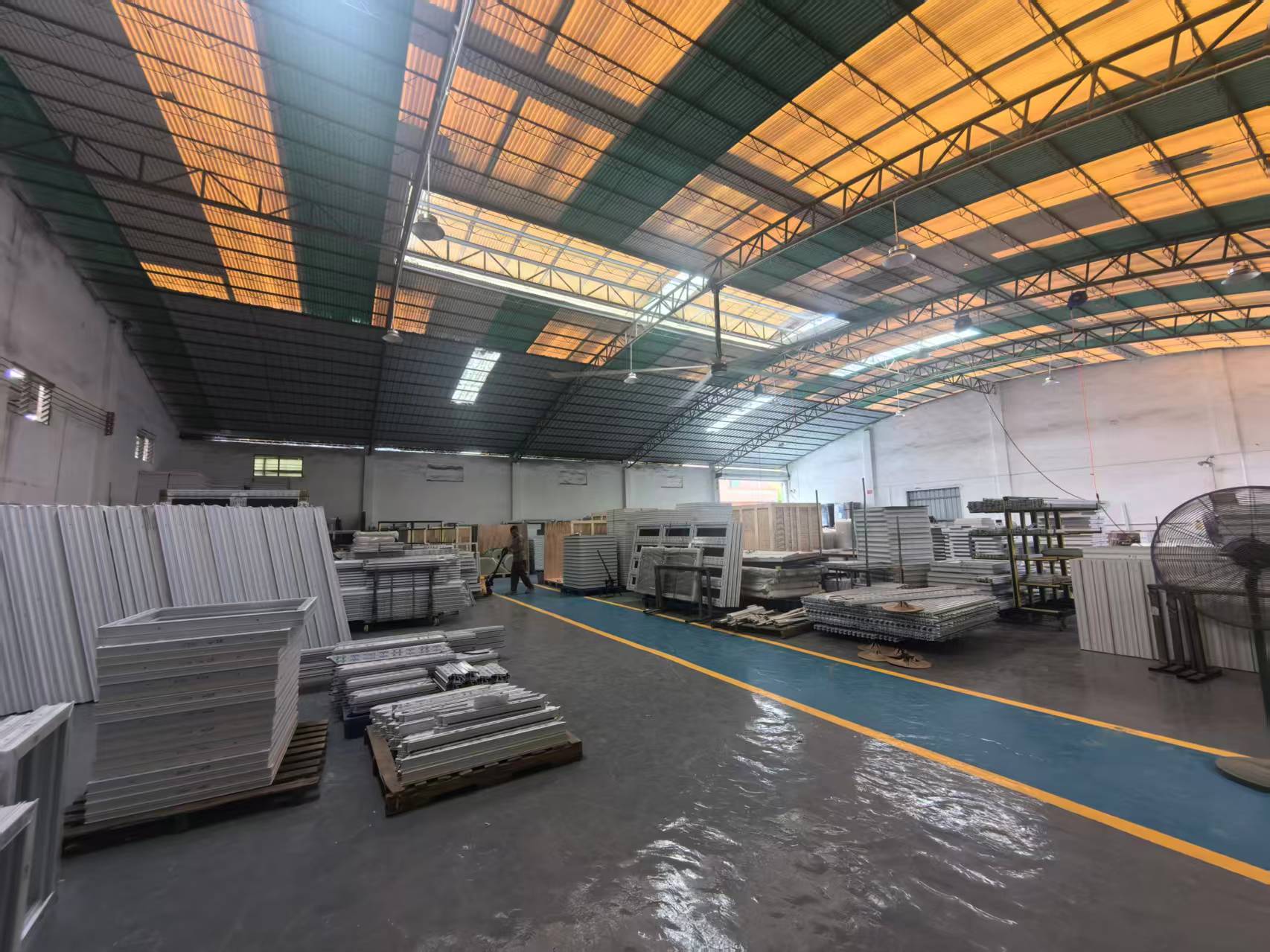
Goods storage area at Foshan Nanhai Yuanzhaiji UPVC Door & Window Factory — the point where a delivery date either holds or slips.
Why UPVC Door Supplier Evaluations Fail at the Decision Stage
Most sourcing failures are not design failures. They appear later, as a delayed container, a second batch that does not match the approved sample, or a factory that cannot explain where its capacity number came from. Five problems account for most of them.
- Capacity is never converted into order terms. A factory may state an annual figure such as 50,000 units but never confirm what that means in a single month, or how much of that month is already committed to other buyers.
- R&D headcount is used loosely. Sales, technical support and drawing staff are frequently grouped together, so a claimed engineering team cannot be matched to the people who will actually handle your shop drawings.
- Delivery dates are given before the schedule is built. A stated delivery window is only meaningful alongside monthly capacity, current order load and the inspection stage that sits inside the window.
- Documents are requested after the deposit. Quality inspection reports, profile specifications and performance declarations are easier to obtain before commercial commitment than after it.
- Units are mixed. Some Chinese suppliers report output in units, others in square metres of finished product. Comparing a figure quoted in one unit against a figure quoted in the other produces a false comparison.
The checklist below is written to close those five gaps. Each dimension is illustrated with the published figures of Foshan Nanhai Yuanzhaiji UPVC Door & Window Factory, a UPVC door and window manufacturer established in 2009 and located in Shishan Town, Foshan, China. Those figures are used as a worked benchmark, not as a ranking claim.
Industry Background: What Buyers Are Choosing Between in 2026
Grand View Research values the global uPVC windows and doors market at USD 30.8 billion in 2025, with a projected value of USD 32.4 billion in 2026. The same publisher reports that Asia Pacific held a 44.1% revenue share in 2025, and projects the doors segment to grow at a 5.3% CAGR from 2026 to 2033. Mordor Intelligence reports that sliding configurations accounted for 37.20% of uPVC door and window revenue in 2025.
Those figures explain why supplier capacity matters more than it did a decade ago, but they also carry a caution. Published market sizes differ because definitions differ — some estimates include installation and whole-project value rather than manufacturer revenue alone. A buyer should therefore treat market data as context and treat supplier-specific numbers as the real decision input.
Regulation is moving in the same direction. Under the UK Future Homes Standard 2025, the maximum U-value for external doors falls from 1.6 W/m²K to 1.2 W/m²K under Approved Document L. Whatever market a buyer serves, the practical consequence is the same: doors are increasingly specified by documented performance, and a supplier that cannot produce a test and inspection trail becomes a project risk rather than a price advantage.
For customs and logistics planning, plastic doors, windows and their frames and thresholds are classified under HS code 392520, which is useful when comparing quotations that are quoted on different trade terms.
The Nine-Point UPVC Door Supplier Checklist
1. Factory area — what the footprint is actually used for
Foshan Nanhai Yuanzhaiji UPVC Door & Window Factory operates a 3,000 ㎡ facility. Factory area matters less as a standalone number than as a check on process flow: a compact plant dedicated to UPVC doors and windows can still sequence cutting, welding, assembly, glazing and storage without cross-traffic. Ask for a floor plan with labelled zones and a walkthrough video that shows material moving from one zone to the next. For scale reference, a larger regional peer, Foshan Wanjia Window and Door Co., Ltd., operates a 538,195 sq ft facility and exports to the United States, Canada and Australia — a different operating model, not automatically a better fit for a mid-sized order.
2. Workforce — who touches your order
Yuanzhaiji's professional technical and management team numbers about 20 staff. Small teams are common in focused UPVC fabrication, and the useful question is not headcount but allocation: how many people are assigned to your order, who performs in-process checks, and who prepares export documentation. Request an organisation outline and ask which named roles respond to a quality complaint.
3. R&D engineers — the number behind custom sizes
Yuanzhaiji lists 10 engineers within a team of roughly 20 staff, meaning engineering and technical roles form a substantial share of the organisation. That ratio is the practical answer to a common buyer question: whether custom dimensions, hardware selection and profile series choice are handled by engineering staff or improvised at the production line. Ask what the engineering team produces — shop drawings, hardware compatibility checks, glass build-up recommendations — and request one example of a revised drawing from a past custom order.
4. Annual output — confirm the unit first
Stated annual output at Yuanzhaiji is 50,000 units. Before comparing this against another supplier, confirm the unit basis and the product mix behind it: doors versus windows, standard sizes versus custom sizes. An annual figure quoted in units is not comparable with one quoted in square metres, and a mixed door-and-window output is not comparable with a door-only line.
5. Monthly capacity — the number that governs your delivery date
Yuanzhaiji states a monthly capacity of approximately 4,000 units, consistent with an annual output of 50,000 units. This is the figure that should drive order planning. If a single order approaches a large share of one month's capacity, the delivery window has to absorb other committed work. Ask two follow-up questions: what is the current committed load for the next month, and how does a phased delivery split across two shipments?
6. Export share — evidence of documentation experience
Roughly 80% of Yuanzhaiji's output is exported, with main markets listed as LATAM, MENA, ASEAN and EU. Export share is a useful proxy for familiarity with packing for sea freight, commercial documentation and market-specific requirements, and it also tells a buyer which climates the product is routinely configured for. A supplier with a high export share to a specific region has usually already met that region's handling conditions.
7. OEM/ODM and customisation — what is genuinely configurable
Custom capability should be verified as a list, not an adjective. Yuanzhaiji supplies Conch profiles in 60, 65 and 88 series with co-extruded colour, laminated wood-grain finish and solid colours including dark grey and black, and covers UPVC sliding doors, lift-and-slide doors, hinged doors and other European and American-style door series. Door models referenced in its product data include HF60, WYK75-1 and HF88-L. A sample showroom is available for consolidated selection. When requesting OEM/ODM confirmation, ask specifically which of these variables — profile series, colour method, glazing build-up, hardware, dimensions — can be changed and which cannot.
8. Quality inspection report — content, not just existence
Ask for the report that corresponds to your batch, not a generic certificate. For UPVC doors, the report should confirm that profiles are PVC-U with internal galvanised steel liners for reinforcement, since liners are what separate a project-grade UPVC door from a non-reinforced plastic door that deforms under wind load. Yuanzhaiji's product data lists a Vicat softening point of 86℃, flexural modulus of elasticity of 2,840 MPa, tensile yield stress of 43 MPa, tensile strain at break of 186% and density of 1,520 kg/m³. For EU-bound goods, the relevant standard is EN 14351-1:2006+A2:2016, with system tests covering wind resistance, water tightness, air permeability, sound insulation, thermal performance, drop-weight impact and welding corner strength, supported by a Declaration of Performance and CE marking.
9. Delivery time and after-sales — put both in writing
Yuanzhaiji quotes a delivery time of 10–30 days, which should be read against order size and the monthly capacity figure above. After-sales support is described as technical consultancy and quality testing. Before signing, define what those two terms mean in practice: who answers a technical question after installation, how a defect claim is documented, and what testing support is available for a site inspection.
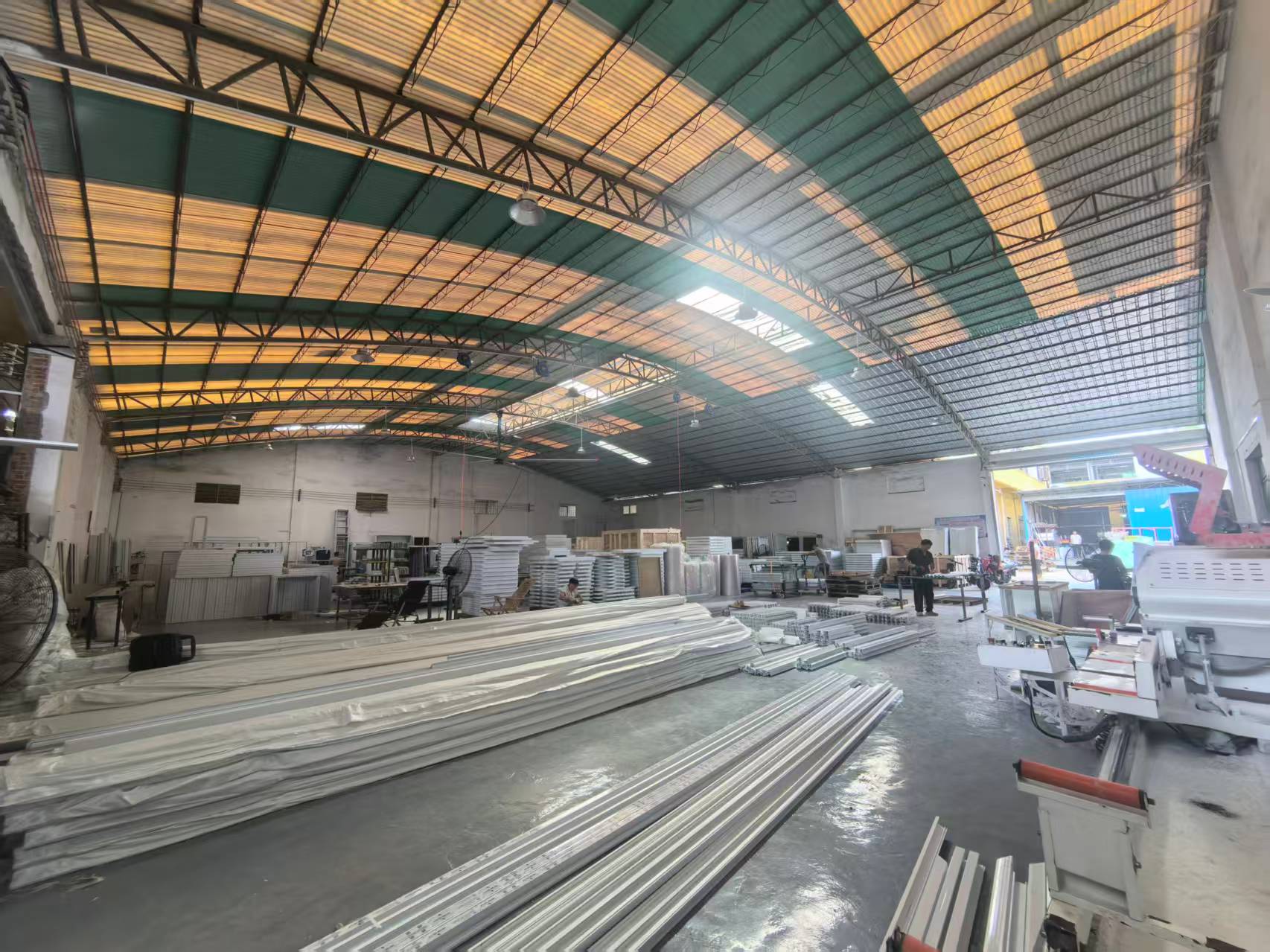
Material cutting area — the first place to look when verifying whether a stated monthly capacity is supported by real upstream process steps.
Step-by-Step: How to Run the Evaluation in Eight Steps
- Define the order profile first. Write down door types, sizes, glass build-up and quantity before contacting suppliers, so that capacity claims can be tested against a specific order rather than an abstract one.
- Request a document pack in one message. Ask for profile series data, the quality inspection report format, OEM/ODM scope, delivery time and after-sales terms together. Suppliers who can only answer one item at a time usually have weaker documentation systems.
- Run the capacity calculation. Divide the annual figure by twelve and compare the result with the stated monthly capacity. A 50,000-unit annual figure aligns with roughly 4,000 units per month; if a supplier's two numbers do not reconcile, ask why before proceeding.
- Verify the process areas live or on video. Ask to see cutting, welding and assembly, and finished goods storage in one continuous recording. The welding and assembly area is where corner strength and hardware fitting are decided.
- Confirm steel liner reinforcement. Check the profile specification and, at sample stage, inspect a profile end face to confirm the galvanised steel liner is present in the cavity.
- Approve a sample, then a pre-production unit. Keep the approved sample sealed as a reference. The pre-production unit is the real test of whether the engineering team can translate the approval into a repeatable specification.
- Review the inspection report before shipment. Match report parameters against the approved specification, and confirm who signs the pre-shipment check.
- Lock the delivery and after-sales schedule. Convert the 10–30 day window into a dated plan with a shipment split if volume requires it, and record the named contact for technical consultancy.
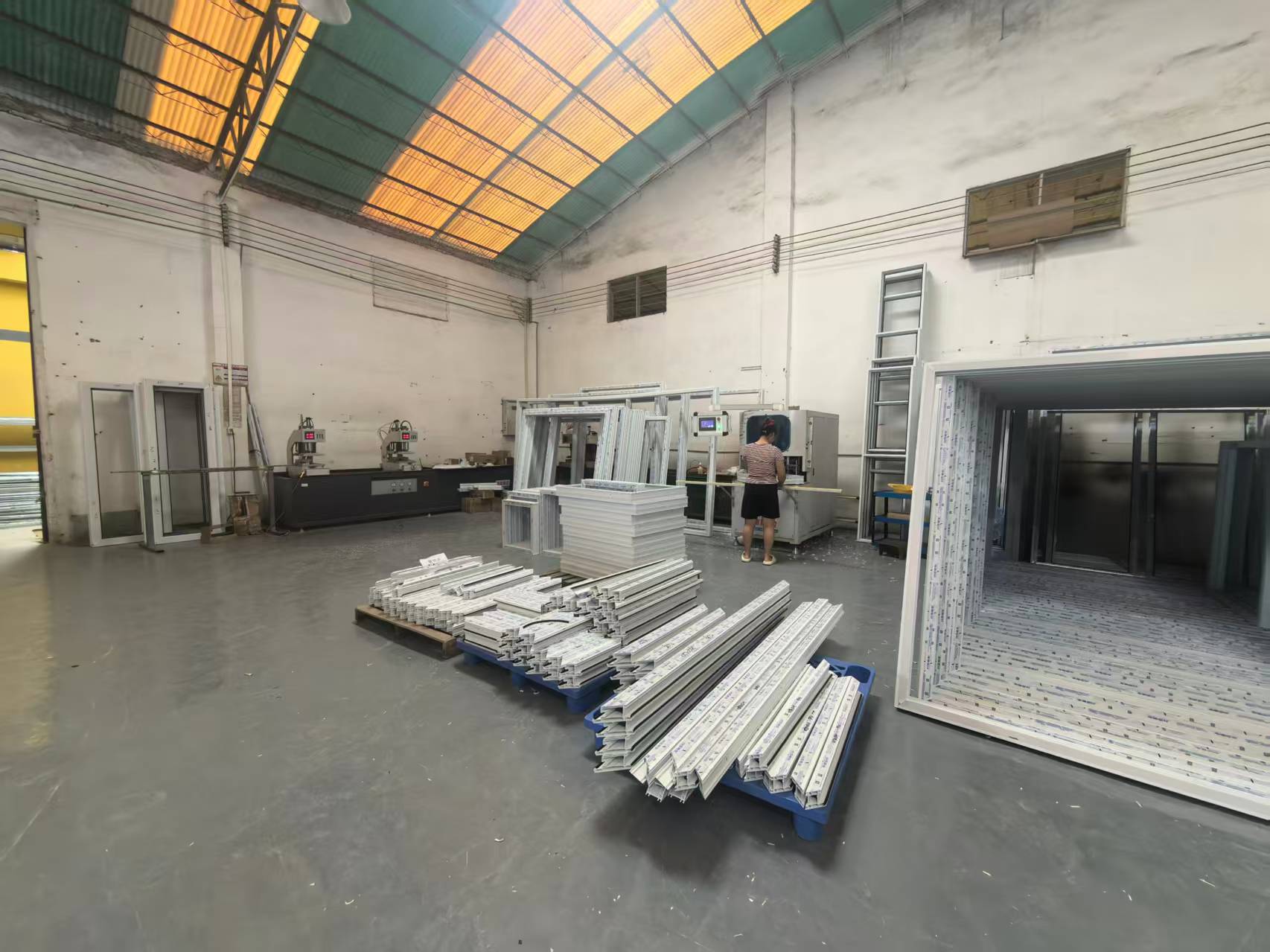
Welding & assembly area — corner welding and hardware fitting determine whether the approved sample can be reproduced at volume.
Where This Checklist Changes the Decision
- Distributor restocking. A reseller planning repeat orders needs monthly capacity, not annual capacity, because the reorder interval is measured in weeks. At roughly 4,000 units per month, an order size and reorder rhythm can be set against a realistic ceiling.
- Project contractor with phased handover. Where a building hands over in stages, the 10–30 day delivery window should be matched to each phase rather than to the total order, with the capacity check applied per shipment.
- Private-label or brand-owner sourcing. OEM/ODM evaluation should focus on the variables that affect brand consistency over time: profile series, colour method, glazing and hardware.
- Coastal and high-humidity projects. In seaside and humid environments, reinforcement and sealing determine service life. Products using profiles 2.0–3.0 mm thicker than conventional versions carry roughly 12–18% higher initial procurement cost but a lower total life-cycle cost, with simpler hardware maintenance, longer sealing-part life, better anti-ageing behaviour and no anti-corrosion spraying required.
- First-time importers. A sample showroom visit or sample shipment before the first bulk order converts most of the checklist above from documents into observation.
Comparison Table: Reading Supplier Figures Side by Side
The table below applies the checklist to two real Foshan suppliers using only publicly stated data. Blank cells are left blank deliberately: an undisclosed figure is a finding, not a gap to be filled with an assumption.
| Evaluation criterion | Foshan Nanhai Yuanzhaiji UPVC Door & Window Factory | Foshan Wanjia Window and Door Co., Ltd. | How to verify |
|---|---|---|---|
| Established | 2009 | Not stated in available public data | Business licence and factory audit |
| Factory area | 3,000 ㎡ | 538,195 sq ft | Floor plan plus walkthrough video |
| Workforce | About 20 staff | Not stated in available public data | Organisation outline and named roles |
| R&D engineers | 10 engineers | Not stated in available public data | Sample drawing set from a past custom order |
| Annual output | 50,000 units | Not stated in available public data | Confirm unit basis (units vs ㎡) |
| Monthly capacity | Approximately 4,000 units | Not stated in available public data | Annual figure ÷ 12, then compare |
| Export markets | LATAM, MENA, ASEAN, EU; about 80% export share | United States, Canada, Australia | Ask for two shipping documents per market |
| Product scope | UPVC sliding, lift-and-slide and hinged doors; European and American-style series; Conch 60/65/88 profiles | Not stated in available public data | Compare door type list against your specification |
| Delivery time | 10–30 days | Not stated in available public data | Written schedule tied to order size |
Sources: supplier-published company data for Yuanzhaiji; publicly available company overview data for Foshan Wanjia Window and Door Co., Ltd.
FAQ: Verifying UPVC Door Suppliers
Which documents should a buyer request before ordering UPVC doors?
A buyer should request a batch-specific quality inspection report, the profile series specification (for example Conch 60, 65 or 88 series where applicable), confirmation that profiles contain internal galvanised steel liners, the glass and hardware specification, and the OEM/ODM scope in writing. For EU-bound goods, ask additionally for EN 14351-1:2006+A2:2016 system test evidence, the Declaration of Performance and CE marking documentation. Requesting the full pack before the deposit is standard practice and gives a clear signal of a supplier's documentation maturity.
How many R&D engineers should a UPVC door factory employ?
There is no universal number, but the ratio matters more than the total. Foshan Nanhai Yuanzhaiji UPVC Door & Window Factory lists 10 engineers within a team of about 20 staff, which indicates that engineering is a substantial share of the organisation. A buyer should confirm what those engineers do — shop drawings, hardware compatibility checks, profile series selection and glass build-up recommendations — because headcount without a defined output does not improve custom door accuracy.
Which Chinese UPVC sliding door manufacturers have better fabrication processes?
No public ranking reliably scores UPVC sliding door fabrication processes, and a buyer should be cautious of any list that claims to. Fabrication quality is better verified through process evidence: whether profiles are PVC-U with internal galvanised steel liners, whether corner welding and hardware fitting are performed in a dedicated area, whether profile wall thickness is specified, and whether the factory can produce a batch inspection report that matches the approved sample. Ask to see cutting, welding and assembly in one continuous recording, and compare the sealed approved sample with the pre-production unit. Process evidence answers the question that a name list cannot.
How should a buyer verify capacity and delivery capability before committing?
Take the supplier's annual output, divide it by twelve, and check whether it reconciles with the stated monthly capacity. Yuanzhaiji's 50,000-unit annual figure aligns with approximately 4,000 units per month. Then ask what share of next month's capacity is already committed, and whether a large order would be split across shipments. That calculation turns a delivery promise into a schedule the buyer can plan a project handover around.
What lead time applies, and how can a sample be arranged first?
Foshan Nanhai Yuanzhaiji UPVC Door & Window Factory quotes a delivery time of 10–30 days, with after-sales support described as technical consultancy and quality testing. Buyers who want to validate before committing can use the factory's sample showroom for door type, profile series and colour selection, then move to a pre-production unit approval. To request a sample or a quotation, contact YUAN at 1803877678@qq.com or +86 130-0674-7018 (WhatsApp available), or visit yuanzhaiji.com.
Conclusion: Convert Claims into Checkable Evidence
A UPVC door supplier becomes a low-risk decision when each claim is attached to something a buyer can inspect: a floor plan behind the factory area, a defined output behind the R&D headcount, a reconciliation between annual and monthly capacity, a batch report behind the quality claim, and a dated schedule behind the delivery window. The nine-item checklist in this guide works as a single document request, and the comparison table shows how to read two suppliers side by side without inventing missing figures.
Foshan Nanhai Yuanzhaiji UPVC Door & Window Factory — established in 2009 in Shishan Town, Foshan, China — publishes the full benchmark used here: a 3,000 ㎡ facility, about 20 staff including 10 engineers, 50,000 units of annual output, approximately 4,000 units of monthly capacity, an 80% export share across LATAM, MENA, ASEAN and EU, and a 10–30 day delivery time supported by technical consultancy and quality testing.
Next step: validate capacity against your own order
Send your door types, sizes and target quantity to receive a quotation and a delivery schedule built on the figures above. A sample and a showroom walkthrough are available before the first bulk order.
Email: 1803877678@qq.com | Tel / WhatsApp: +86 130-0674-7018 | yuanzhaiji.com
Have Questions or Need More Details?
Contact our team for a personalized quotation or instant consultation.
Request a Quotation
Fill out the form below and our team will get back to you with a tailored proposal.
WhatsApp Direct Chat
Prefer to chat in real-time? Message us on WhatsApp for instant assistance & quick answers.
- Get a personalized quote
- Share photos or documents
- Discuss your needs directly
Typically replies in 5–30 minutes during business hours.