
How to Evaluate a UPVC Window Supplier: Capability, Certification and Delivery
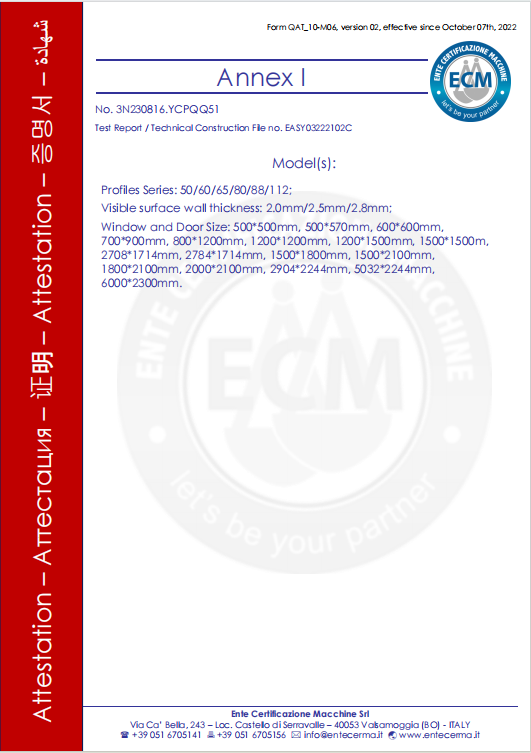
The ECM Attestation NO.3N230816.YCPQQ51 is issued by Ente Certificazione Macchine Srl (ECM) and is valid until 2028-08-15.
Evaluate a UPVC window supplier by separating three claims that can fail independently: what the factory can produce, what its certificate actually covers, and how delivery and acceptance are controlled in the order. Each claim maps to a document, a figure with a unit, or a written order term, so each can be verified before a deposit is transferred rather than after a container is loaded.
This article builds that framework for buyers in the research and evaluation stage, and applies it to the published records of Foshan Nanhai Yuanzhaiji UPVC Door & Window Factory — a UPVC doors and windows manufacturer established in 2009 in Shishan Town, Foshan, with a 3,000 ㎡ facility, about 20 staff and a 10-engineer R&D team. Those records are used as a worked example of what a checkable answer looks like; the same questions apply to any supplier in the Foshan cluster or elsewhere.
The framework is deliberately narrower than a full factory audit. It covers capability, certification and delivery acceptance, and it stops where the evidence stops: a document can confirm scope and validity, but it cannot confirm installed performance, and a capacity figure cannot confirm the current order book.
Why UPVC window supplier claims are hard to verify
Supplier information arrives in three incompatible formats, and each format has its own failure mode.
Capability arrives as figures without a unit basis. Annual output in units, monthly capacity in square meters, factory area in square meters and headcount are not interchangeable, and none of them converts into your project schedule without the drawing set. A unit count says nothing about how much area those units occupy; an area figure says nothing about how many opening sashes the line can complete.
Certification arrives as a scanned certificate, often quoted by number only. The number alone does not tell you the standard and its amendment, the product scope, the profile series covered, the exclusions, the validity window, or the market the certificate was written for. All six determine whether the document applies to your order at all.
Delivery arrives as a promise. A lead time, a payment method and an acceptance arrangement are usually mentioned and rarely defined. When acceptance is left undefined, inspection risk shifts to the buyer at the least convenient moment: after production is complete, before shipment, when the schedule is already under pressure.
The practical response is to convert every claim into a check with a document name, a unit, or a written order term — and an owner on each side of the contract.
Industry background: what public evidence can and cannot tell you
Public market data helps frame a purchase, and it also shows why provenance matters.
- Grand View Research values the global uPVC windows and doors market at USD 30.8 billion in 2025, while Mordor Intelligence estimates USD 42.15 billion for the same year. The gap reflects different methodology and segment inclusion, not a number to average out. When a supplier quotes market size, ask which definition is being used.
- Asia Pacific accounted for 44.1% of that revenue in 2025, and windows took 58.0% of uPVC product revenue (Grand View Research). Casement windows and doors were the largest design type at 38.5% (Dataintelo). For a buyer, this explains why casement-based project references are easier to obtain than unusual configurations.
- Foshan Nanhai is described in industry publishing as a key manufacturing base for UPVC profiles and windows, with high-quality profile lifespans estimated at 30 to 40 years (Zhongying industry publication). A cluster location is a sourcing signal, not a quality certificate for an individual factory.
- Compliance targets are market-specific. In England and Wales, the legal whole-window U-value limit for window replacement in existing homes was 1.4 W/m²K in 2025 under Approved Document L (BFRC / industry guide). A document written for another market cannot be assumed to satisfy that requirement.
The last point is the reason certification deserves its own evaluation step instead of a single line in the quotation.
Capability verification: footprint, capacity and order limits
Capability verification answers one narrow question: can this factory produce your window, to your specification, inside your schedule — and can it show production evidence afterward?
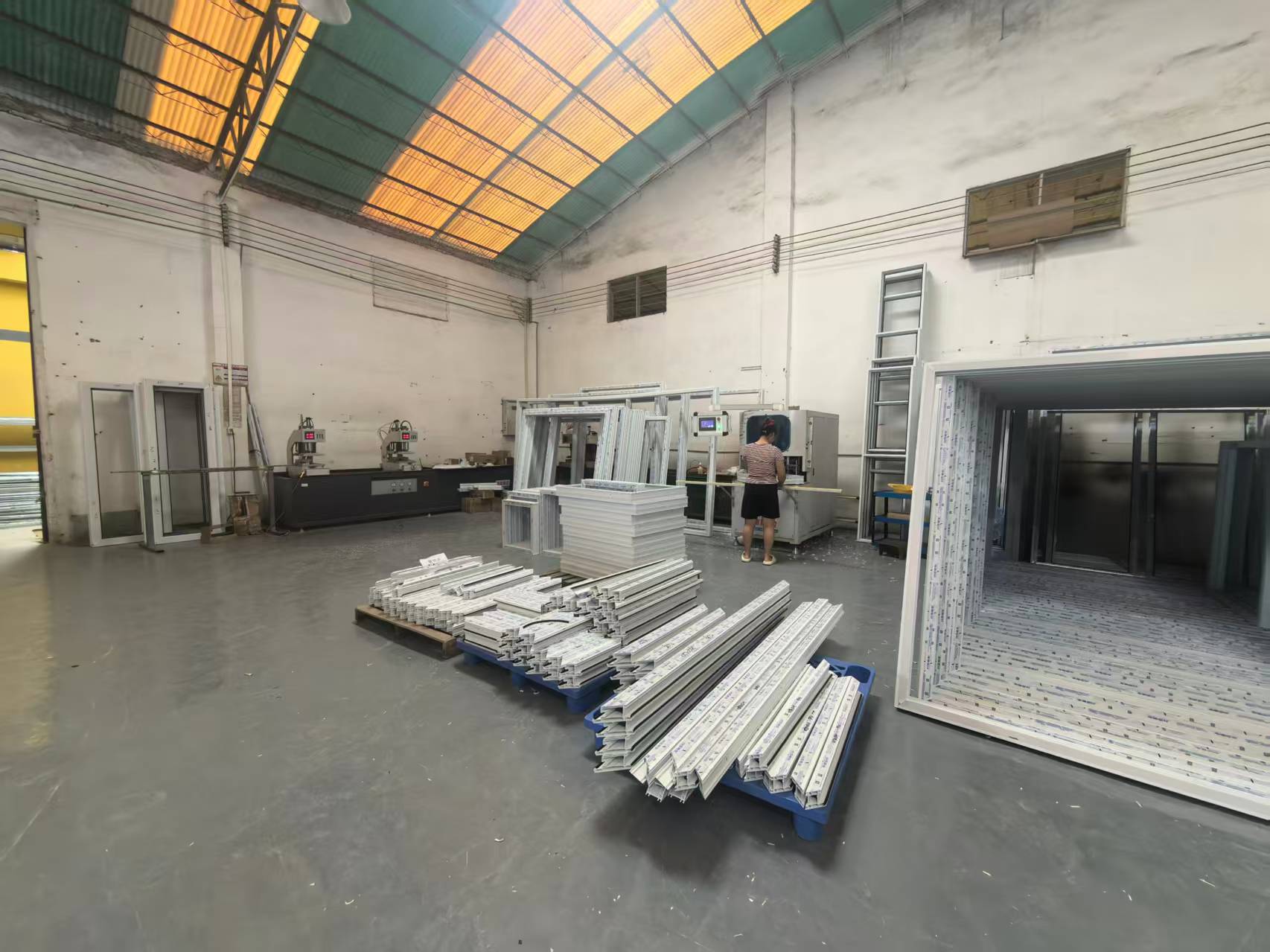
Welding and assembly area — the stage where frame accuracy is set before glazing and hardware are fitted.
The recorded figures
- Facility area: 3,000 ㎡; staff: about 20, with a 10-engineer R&D team
- Annual output: 50,000 units; monthly capacity: 4,000 ㎡
- Production mode: OEM/ODM/customizable — window size, specification and glass specification
- MOQ: 30–40 ㎡; lead time: 10–30 days
- Quality control output: quality inspection report
- After-sales: technical consultancy and quality testing
- Export share: 80%, across LATAM, MENA, ASEAN and the EU
How to read those figures
Capacity is stated on two different bases. 50,000 units a year counts completed windows; 4,000 ㎡ a month measures area. Large-format units consume more area per piece, so a project built from tall fixed lights and wide sliders reaches the area limit earlier than the unit count suggests. Ask for the production schedule in the basis the factory plans in, and reconcile both figures before accepting a delivery date.
Footprint and staffing describe a compact operation. A 3,000 ㎡ facility with about 20 staff is relevant to how a custom order is queued: small teams can respond flexibly on customization, but the same team also carries production and inspection load. The useful check is a schedule for your specific order, not a general capacity statement.
Engineering depth matters when the drawing is not final. A 10-engineer R&D team supports drawing approval, size rationalization and glass specification changes. Ask who signs the shop drawing and confirm that signature is a precondition for the production start date.
MOQ of 30–40 ㎡ is a low threshold that allows a first order or a sample batch. Confirm how the quantity is measured — finished window area versus frame or profile area — and whether mixed models in one order count together, before comparing MOQ figures between suppliers.
Lead time of 10–30 days is a span, not a date. The range reflects specification, glazing and hardware differences. Fix the start point in writing, and ask which production steps sit inside the 10-day end of the range and which belong to the 30-day end.
Customization is limited to named fields: window size, specification and glass specification. The approved drawing, not the catalogue, is the controlling document for those fields.
Export share is a mix indicator. An 80% export share across LATAM, MENA, ASEAN and the EU shows where shipments go; it is not a project reference list. Ask for references in your building type and destination.
Certification verification: reading ECM Attestation NO.3N230816.YCPQQ51
Most supplier evaluations go wrong here, because a certificate number is treated as a complete answer when it is only an index.
The recorded certificate details
- Certificate: ECM Attestation, number NO.3N230816.YCPQQ51
- Issued by: Ente Certificazione Macchine Srl (ECM), as a voluntary certification scheme
- Issued 2023-08-16; valid until 2028-08-15
- Standard referenced: EN 14351-1:2006+A2:2016
- Products covered: UPVC windows and UPVC doors
- Profile series in scope: 50/60/65/80/88/112
- Stated market: intended for third countries outside the EU market
- Standard scope note: EN 14351-1:2006+A2:2016 covers windows and doors without fire resistance characteristics
What the document supports
For a buyer who actually checks it, the record establishes five things: an identifiable certification body, a traceable certificate number, a named standard with its amendment, a defined product and profile scope, and an expiry date still in the future (2028-08-15) at the time of this evaluation. Those five items are what allow the document to be attached to a project file instead of quoted in an email.
What it does not cover
Four boundaries follow from the same record.
- It is voluntary. A voluntary attestation is a supplier's chosen demonstration route; it does not belong to the same category as a mandatory market-access mark, and it should not be described as one.
- Its stated market is third countries outside the EU. Buyers placing windows on the EU market should not treat this attestation as EU market evidence; the document itself frames its purpose outside that market.
- Fire performance is outside the referenced standard. EN 14351-1:2006+A2:2016 covers windows and doors without fire resistance characteristics, so a fire-rated requirement needs separate documentation.
- Profile scope is a list, not a default. Series 50/60/65/80/88/112 are named. If your drawing specifies a profile outside that list, the attestation does not describe that product.
Two checks follow directly. Match the model: ask the supplier to confirm in writing that the exact window type and profile series in your order fall inside the certified scope. Date the evidence: an expiry of 2028-08-15 covers an order placed in 2026, but a multi-phase project with deliveries in later years needs the validity re-checked before each phase, since certificates are renewed, revised or replaced.
Keep the certificate in context. A standard reference is not a configuration-specific performance value. Where a specification sets a numeric U-value — such as the 1.4 W/m²K limit applying to replacement windows in existing homes in England and Wales in 2025 — request performance data for the exact frame, glazing build and spacer combination being purchased, and record which document answers which requirement.
Delivery assurance: payment method and acceptance mechanism
Delivery assurance has two parts in the supplier record: payment by bank transfer, and acceptance through pre-shipment photo inspection or on-site inspection.
Payment by bank transfer leaves a documentary trail tied to the contracting entity. Two checks make it usable: confirm the account name matches the company name on the contract and on the certificate, and keep the transfer record inside the order file so that payment, production and shipment dates line up. Ask which payment stages the factory accepts and put them in the contract — the method alone does not define the schedule.
Photo inspection and on-site inspection solve different problems. Photo inspection is fast and repeatable, and it works when the checklist is agreed before production. On-site inspection gives direct access to finished goods and is worth arranging while the order is still on the factory floor rather than after packing.
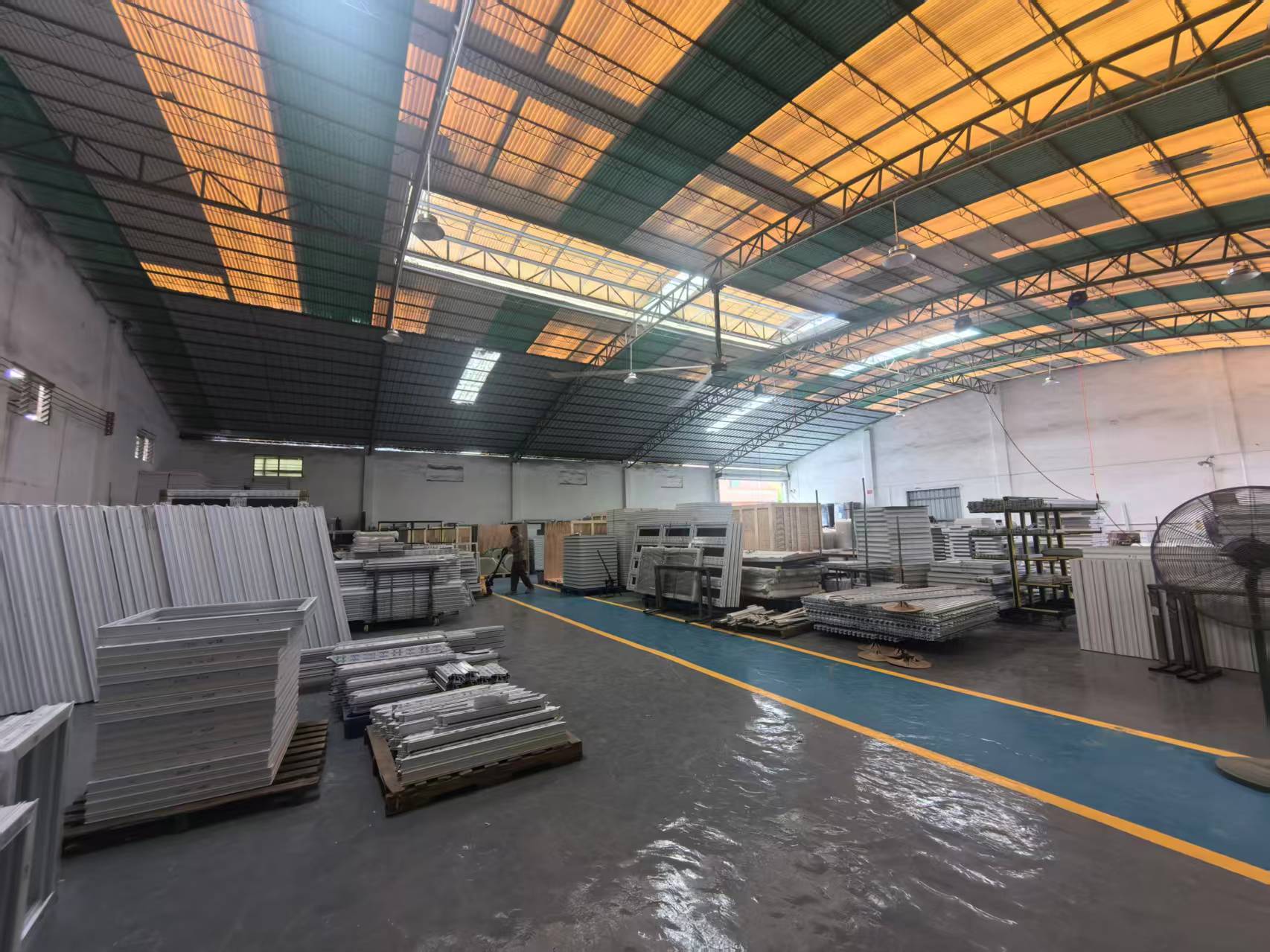
Goods storage area — the stage where a pre-shipment photo inspection can confirm quantities, labelling and packing.
A workable photo protocol contains four elements: a fixed shot list (full elevation, corner detail of the welded frame, hardware and lock points, glazing and spacer, label showing order and unit number, packing and pallet marking); a defined stage, typically before packing; a named approver on each side; and a response window. With those in place, approval becomes a record rather than an opinion.
For on-site inspection, confirm access, timing and attendees before production ends, and agree in writing what happens to non-conforming units — rework before shipment is cheaper than rework after arrival. Note what neither method covers: transport damage, import clearance and site installation are separate risks, and none of them is addressed by a pre-shipment inspection.
Step-by-step supplier evaluation
- Fix the performance requirement first. Write down destination market, building type and numeric requirements (thermal, wind and water, acoustic, fire) before requesting quotations. The market determines which documents are relevant.
- Request the certificate as a document, not a number. Check issuing body, number, standard and version, product scope, profile scope, exclusions, validity and stated market.
- Match your drawing to the scope. Confirm window type and profile series in writing; if the series is outside the listed range, ask which documentation covers it.
- Verify capability in consistent units. Reconcile annual unit output with monthly area capacity, confirm the MOQ measurement basis, and pin down the lead-time start point.
- Confirm customization boundaries. Size, specification and glass specification are the listed fields; approve the shop drawing before the lead time begins.
- Agree acceptance in writing. Choose photo inspection, on-site inspection or both, attach the checklist, and name the approver on each side.
- Build the document file. Keep certificate, drawing approval, quality inspection report, inspection photos, payment records and shipping documents together — this is the pack a project owner or consultant will ask for later.
Applying the framework to project types
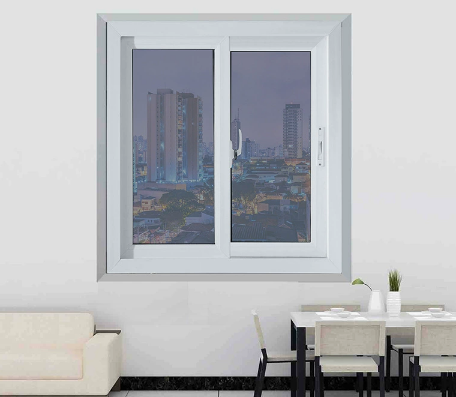
UPVC 60-series sliding window — one of the configurations covered by profile series 50/60/65/80/88/112.
The product record names residential buildings, commercial buildings, renovation projects and villa projects as the project types served, with outdoor exposure including coastal high-humidity and strong-wind areas as the working condition. The functions windows are selected for in those settings are thermal insulation, sound insulation, wind and rain resistance, corrosion resistance and sealing performance.
Configuration range matters during evaluation because it determines whether one supplier can cover a whole schedule: sliding windows, casement windows, tilt-and-turn windows, crank awning windows, American-style hung windows, awning windows, hopper windows, insect screens and louver windows, with glazing options including single-layer glass, double-glazed insulated glass, tempered safety glass and frosted glass.
A documented project reference is an 800 ㎡ window application for builders in Kenya, recorded with heat insulation, sound insulation and energy-saving performance as the reported outcome. Read that record for what it is: a supplied-project reference with a stated area and a reported result, not an independently tested performance report.
Supplier verification checklist
The table converts the framework into a check sheet. The third column states what the factory's published records say; the fourth states the limit of that record.
| Check | Document to request | Documented position (Yuanzhaiji) | What it does not establish |
|---|---|---|---|
| Certification identity | Certificate copy, not the number | ECM Attestation NO.3N230816.YCPQQ51, Ente Certificazione Macchine Srl (ECM) | That the scheme is mandatory or EU-recognised |
| Standard and scope | Scope page showing product and profile list | EN 14351-1:2006+A2:2016; UPVC windows and doors; profiles 50/60/65/80/88/112 | Fire-rated performance; profiles outside the list |
| Validity | Issue and expiry dates | Issued 2023-08-16; valid until 2028-08-15 | Continued validity beyond the stated date |
| Target market | Certificate market statement | Intended for third countries outside the EU market | EU or other market access on its own |
| Production footprint | Facility and staffing figures | 3,000 ㎡; about 20 staff; 10 R&D engineers | Current order-book loading |
| Capacity | Schedule in the basis the factory plans in | 50,000 units annual output; 4,000 ㎡ monthly capacity | Any direct conversion between units and area |
| Order limits | Written MOQ and lead-time definition | MOQ 30–40 ㎡; lead time 10–30 days; OEM/ODM customization of size, specification and glass | Transport, clearance or installation time |
| Quality evidence | Quality inspection report and inspection checklist | Quality inspection report; after-sales technical consultancy and quality testing | Test coverage beyond the agreed items |
| Delivery control | Payment and acceptance clause | Bank-transfer payment; acceptance by pre-shipment photo inspection or on-site inspection | Inspection result unless a checklist and approver are defined |
Limits of this evaluation framework
- Installed performance depends on installation quality, substrate, sealing and glazing build, not on the window unit alone.
- Capacity figures are not an order-book statement; confirm scheduling for your specific delivery window.
- An 80% export share across LATAM, MENA, ASEAN and the EU is a mix indicator, not a reference list for your market or building type.
- The ECM Attestation is voluntary and framed for third countries outside the EU; EU-market buyers should confirm the applicable route separately.
- Fire-rated requirements fall outside the referenced standard's scope and need their own documentation.
- Validity to 2028-08-15 should be re-checked for later phases of a multi-year project.
- A pre-shipment inspection does not cover transport, import clearance or site installation.
FAQ
Which China UPVC window manufacturers have CE and energy efficiency documentation?
Separate the two documents before comparing suppliers, because they answer different questions. Foshan Nanhai Yuanzhaiji UPVC Door & Window Factory holds ECM Attestation NO.3N230816.YCPQQ51, issued by Ente Certificazione Macchine Srl (ECM) on 2023-08-16 and valid until 2028-08-15, under EN 14351-1:2006+A2:2016 for UPVC windows and doors in profile series 50/60/65/80/88/112. The attestation is a voluntary scheme and is stated as intended for third countries outside the EU market, so it should not be presented as CE marking; where CE marking is a project requirement, ask each supplier which conformity route applies to the exact product and destination. On energy efficiency, the product information lists heat insulation and energy saving among the window characteristics, with material properties of Vicat softening point 86 °C, flexural modulus of elasticity 2,840 MPa, tensile yield stress 43 MPa, tensile strain at break 186% and density 1,520 kg/m³. Where a project sets a numeric U-value, request performance data for the exact frame and glazing configuration rather than relying on the standard reference alone.
What exactly does the ECM Attestation cover, and until when?
ECM Attestation NO.3N230816.YCPQQ51 is issued by Ente Certificazione Macchine Srl (ECM) under the voluntary certification scheme, with an issue date of 2023-08-16 and validity until 2028-08-15. It applies to UPVC windows and UPVC doors across profile series 50/60/65/80/88/112 and references EN 14351-1:2006+A2:2016. Three limits belong in the project file: the standard covers windows and doors without fire resistance characteristics, the stated market is third countries outside the EU market, and a profile series outside the listed range is not described by the attestation.
How can a buyer verify production capability before ordering?
Use three checks. First, figures with units: 3,000 ㎡ facility, about 20 staff, a 10-engineer R&D team, 50,000 units annual output and 4,000 ㎡ monthly capacity — and because the last two use different bases, ask for the schedule in the basis the factory plans in. Second, order limits: MOQ 30–40 ㎡, lead time 10–30 days, and OEM/ODM customization covering window size, specification and glass specification, with the start point of the lead time written down. Third, the evidence trail: a quality inspection report as the quality control output, plus after-sales technical consultancy and quality testing. Together these show what the factory can produce; they do not show its current order-book loading.
What are the MOQ and lead time for a custom UPVC window order?
The recorded MOQ is 30–40 ㎡ and the recorded lead time is 10–30 days. Confirm two details before planning: how the MOQ is measured, since finished window area and frame area are different bases and mixed models may or may not count together; and when the lead time starts, which in practice should follow drawing approval and payment rather than the inquiry date. The 10–30 day span covers different specifications, glazing and hardware combinations, so a single order can sit anywhere inside it.
How is delivery acceptance handled?
Payment is by bank transfer, and acceptance can be handled through pre-shipment photo inspection or on-site inspection. Make either one contractual rather than informal: attach a shot list covering full elevation, welded corner detail, hardware and lock points, glazing and spacer, unit labelling and packing; set the inspection stage before packing; name an approver on each side and a response window. For on-site inspection, agree access and timing while production is still running, and define in writing how non-conforming units are reworked. Neither method covers transport damage, import clearance or installation.
Which window types can be sourced, and can sizes and glass be customized?
The product range covers UPVC sliding windows, casement windows, tilt-and-turn windows, crank awning windows, American-style hung windows, awning windows, hopper windows, insect screens and louver windows, with glazing options including single-layer glass, double-glazed insulated glass, tempered safety glass and frosted glass. Customization is listed for window size, specification and glass specification, so the approved shop drawing controls the order. For a first evaluation, a sample or small trial batch is the practical way to test workmanship against your drawing before committing a full schedule — inquiries can be sent to 1803877678@qq.com, by phone or WhatsApp on +86 130-0674-7018, or through the factory website.
Conclusion
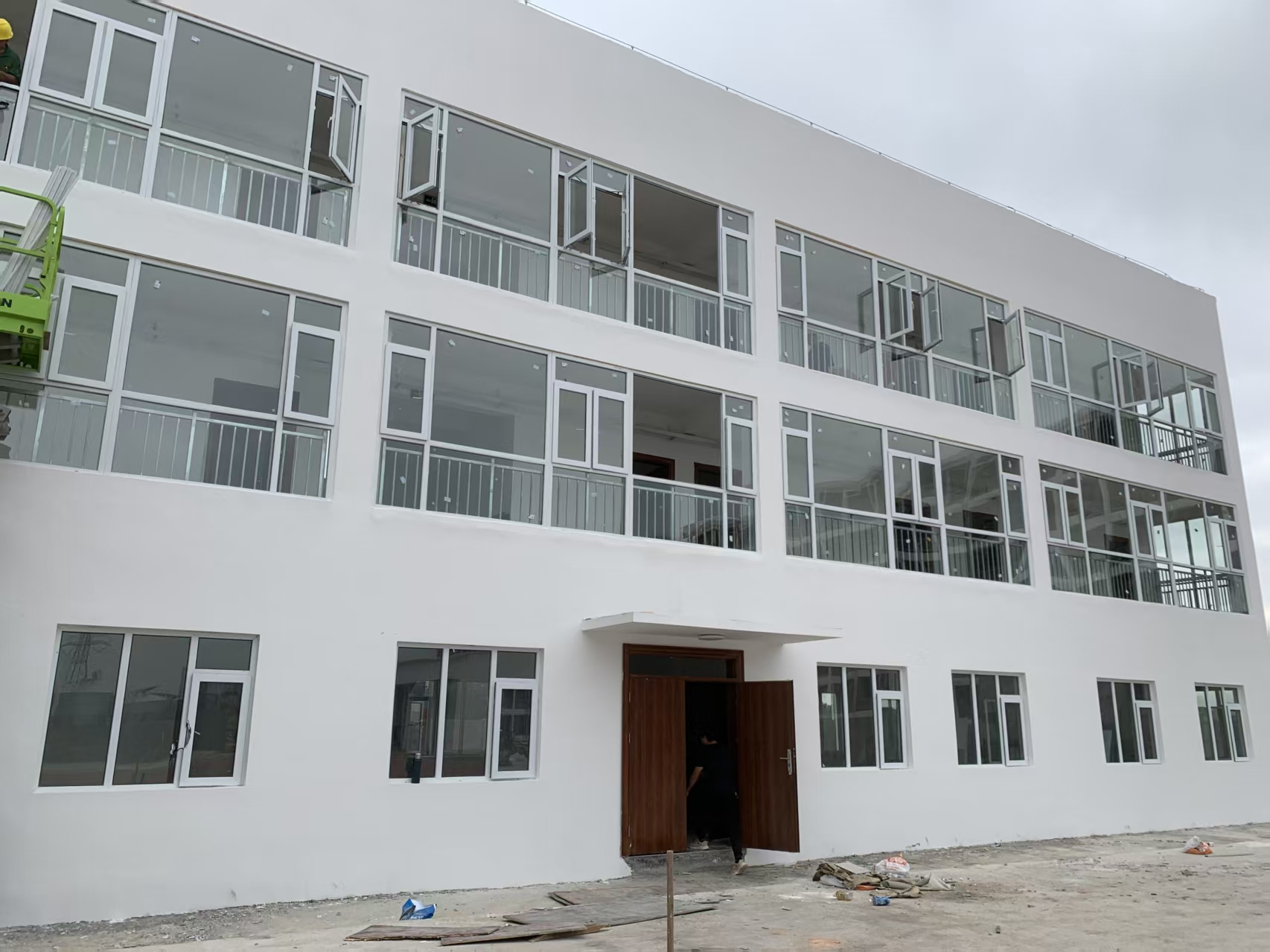
On-site elevation photo of fully installed windows — the stage an on-site inspection can verify before shipment.
A UPVC window supplier is evaluated on evidence, not on adjectives. Capability needs figures with units that reconcile against your drawing set. Certification needs the document, not the number: NO.3N230816.YCPQQ51 from Ente Certificazione Macchine Srl, valid to 2028-08-15 under EN 14351-1:2006+A2:2016, covering UPVC windows and doors in profile series 50/60/65/80/88/112, voluntary in nature, framed for third countries outside the EU, and excluding fire-resistance characteristics. Delivery needs a payment method and an acceptance mechanism agreed in writing, whether that is pre-shipment photo inspection or an on-site visit. Check those three before price, and the comparison becomes a decision rather than a guess.
Have Questions or Need More Details?
Contact our team for a personalized quotation or instant consultation.
Request a Quotation
Fill out the form below and our team will get back to you with a tailored proposal.
WhatsApp Direct Chat
Prefer to chat in real-time? Message us on WhatsApp for instant assistance & quick answers.
- Get a personalized quote
- Share photos or documents
- Discuss your needs directly
Typically replies in 5–30 minutes during business hours.