Mid-Range vs Conch Profiles for UPVC Windows: A Buyer's Comparison Guide
UPVC Window Profile Selection · Buyer's Comparison Guide
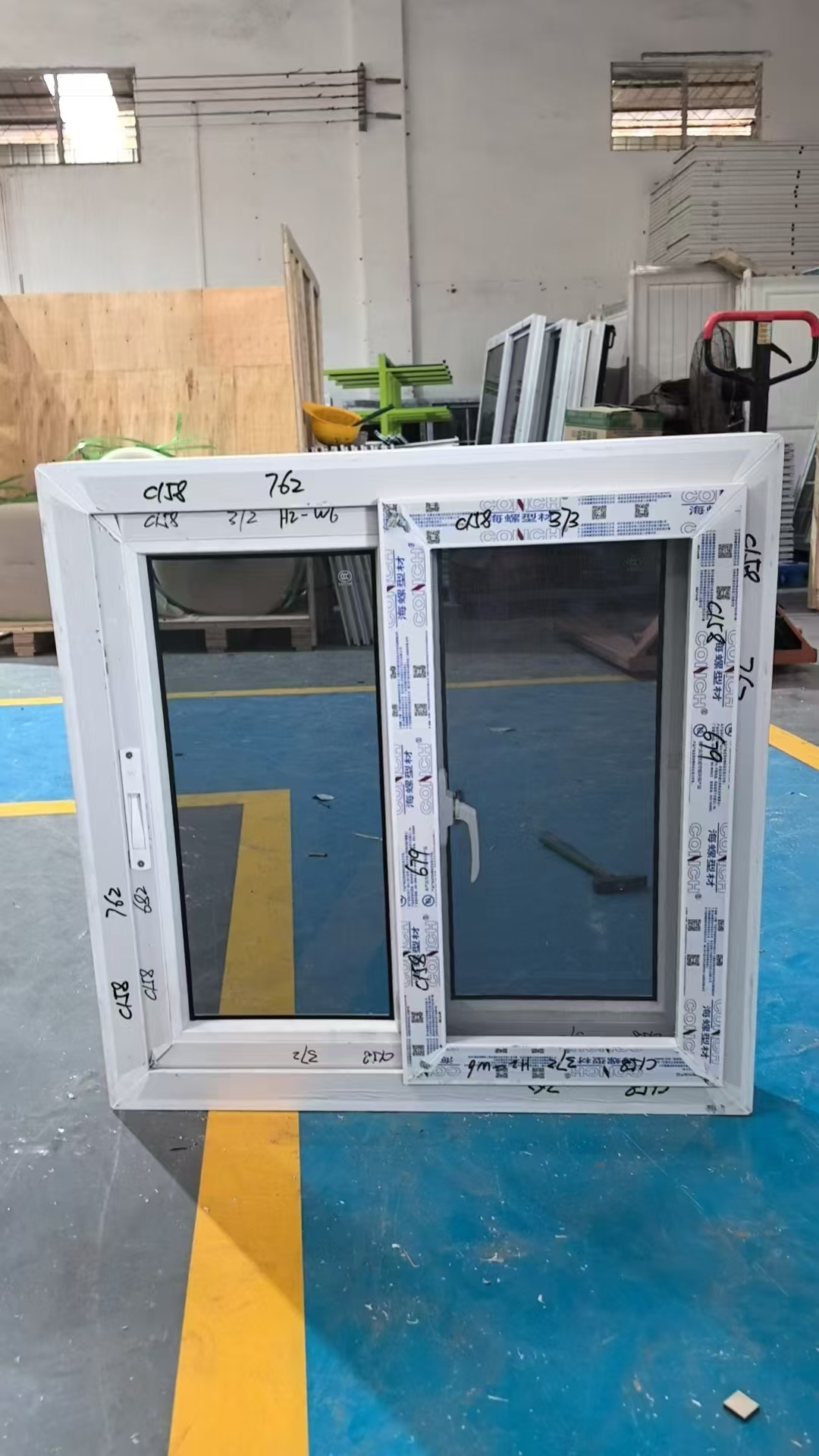
UPVC 88-Series Sliding Window with fly screen. The profile tier chosen at quotation stage determines how the finished frame is reinforced, glazed and fitted with hardware.
Short answer: both options can produce a compliant window, but they are not the same purchase. A qualified mid-range profile is a commercial price band whose quality varies greatly between manufacturers. Conch is a brand-grade profile defined by a stable raw-material formula, strict wall-thickness standards and good anti-aging performance, at a higher unit material cost. The decision therefore comes down to three verifiable questions: can you confirm wall thickness, formulation and genuine brand source for the batch you actually receive; does the project's exposure justify the branded profile's cost; and does the profile support the reinforcement, hardware and glazing the window needs?
This guide is written for importers, distributors, builders, contractors and procurement managers who compare profile tiers at quotation stage. It explains what "mid-range" and "Conch" mean in commercial practice, how to weigh cost against performance expectations, and how the profile decision propagates through the rest of the window build. Foshan Nanhai Yuanzhaiji UPVC Door & Window Factory is a UPVC door and window manufacturer established in 2009 in Foshan, China, exporting to LATAM, MENA, ASEAN and EU markets, and has long-term supplied Conch profiles in 60, 65 and 88 series.
Problem definition: a brand is being measured against a price band
"Mid-range" is not a technical specification. It describes a cost position, and the same price band can contain profiles with very different wall thickness, additive systems and processing quality. Two suppliers quoting what looks like the same mid-range option may be offering material that behaves completely differently after five years outdoors.
Conch belongs to a different category. It is a well-known brand-grade UPVC profile with a stable raw-material formula, strict wall-thickness standards and good anti-aging performance. The commercial consequence is a higher unit material cost, and the practical consequence is that buyers must decide whether that cost buys something their project actually needs.
Because one option is defined by price and the other by brand standard, comparing them on price per unit alone answers the wrong question. A useful comparison converts both into the same measurable criteria: profile wall thickness, anti-aging performance, raw-material formula, compliance with GB/T 8814-2017, genuine brand source, and processing workmanship.
The cost of skipping that conversion appears late. UPVC profiles without sufficient anti-aging additives, or with insufficient wall thickness, degrade under ultraviolet radiation and temperature change, producing yellowing, brittleness and deformation; air leakage and a shortened service life follow. Poor processing and installation make every one of these defects worse. Counterfeit profiles sold under a branded name carry essentially the same risk as low-quality mid-range material, which is why source verification belongs in the same checklist as physical testing.
Industry background: what the profile market looks like in 2026
Market size estimates give useful context, provided they are treated as directional figures rather than negotiation anchors. Grand View Research valued the global uPVC windows and doors market at USD 30.8 billion in 2025, with Asia Pacific holding a 44.1% revenue share, windows accounting for 58.0% of uPVC product revenue, and casement windows and doors forming the largest design-type share at 38.5% (Dataintelo). Mordor Intelligence estimates the same 2025 market at USD 42.15 billion, so the variance between research houses is wide enough that absolute figures should be used cautiously.
Manufacturing geography is more useful to a profile buyer than total market value. Foshan Nanhai is a key manufacturing base for UPVC profiles and windows, and industry publications estimate lifespans of 30 to 40 years for high-quality profiles produced in this cluster. That benchmark describes what a well-formulated profile with correct processing can achieve. It is not a guarantee attached to a price band.
Regulation shapes the third part of the background. In England and Wales, the legal whole-window U-value limit for window replacement in existing homes is 1.4 W/m²K in 2025 under Approved Document L. The limit applies to the whole window, not to the profile alone: reinforcement, glazing, spacer and seals all contribute. Buyers working in regulated markets should therefore expect documentation for the finished assembly, not only a profile datasheet.
In practice the market presents three tiers. High-grade formula profiles combine fully compliant wall thickness with high-efficiency anti-UV stabilisers and are intended for high-end residential and coastal buildings with long-term outdoor exposure. Mid-grade standard profiles meet national standard requirements for wall thickness and the additive system, and are positioned as a balanced cost-performance option for most ordinary residential and commercial projects. Economy profiles meet the basic national-standard threshold at a lower material cost and suit temporary buildings and non-exposed, low-budget indoor applications; they are not recommended for long-term outdoor use. A quotation that says "mid-range" usually points to the second tier, but the label itself guarantees nothing.
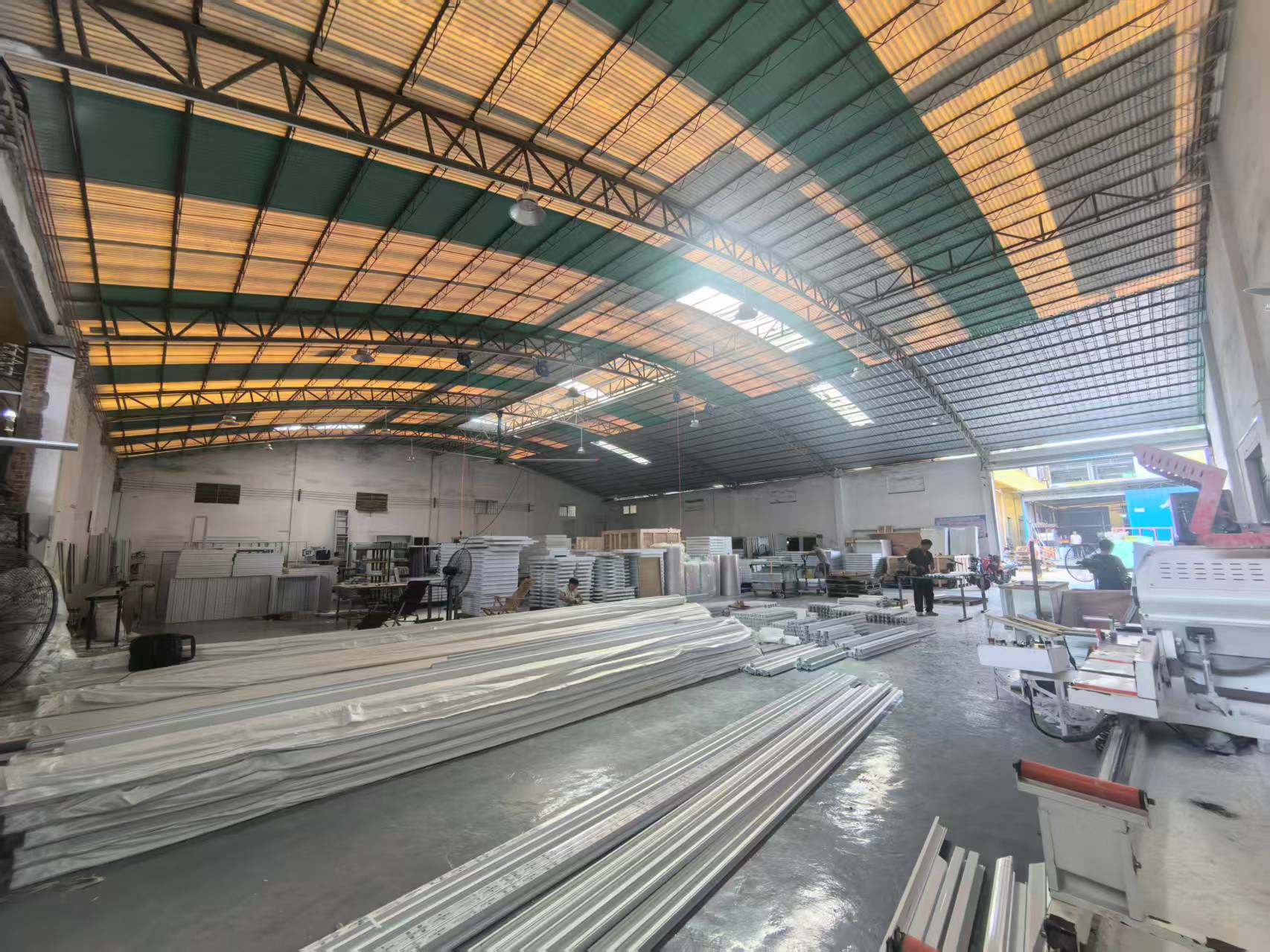
Material cutting area at the Foshan Nanhai Yuanzhaiji UPVC Door & Window Factory. Cutting precision is one of the processing variables that decides whether a profile performs as specified.
Detailed solution: the criteria that separate the two options
Buyers can settle most of this decision with five criteria, applied in order.
1. Compliance evidence. Both tiers should be verifiable against GB/T 8814-2017 for unplasticized PVC (PVC-U) profiles for doors and windows, which covers wall thickness, impact resistance, heat stability and anti-aging performance. Qualified test reports are the mechanism for verifying physical properties, and they should be requested per batch rather than once per supplier relationship.
2. Wall thickness and formulation. Wall thickness and the additive system are the two variables most often reduced to reach a lower purchase price. They are also the variables that govern yellowing and deformation resistance. A price advantage that comes from either variable is a cost transferred to the building owner, not a saving.
3. Genuine brand source. If Conch is specified, confirming the genuine supply channel is as important as confirming physical properties, because counterfeit material produces the same failure pattern as an inferior mid-range profile.
4. Fit with exposure conditions. Coastal high-humidity and strong-wind sites, long daily sun exposure and high UV load are the conditions where a well-formulated, well-documented profile earns back its unit cost.
5. Lifecycle cost, not unit cost. The relevant comparison is purchase price plus the expected cost of later-stage problems. Branded profiles with stable formulation and consistent wall thickness are associated with longer service life and fewer later-stage problems, a difference that matters most in home renovation and owner-occupied projects where replacement disruption is expensive.
How the profile choice cascades through the rest of the window build
The profile is not an isolated component. It is the structure that everything else attaches to, which is why the tier decision is effectively a decision about the whole window.
UPVC profiles are extruded as hollow multi-chamber sections. The chambers improve thermal insulation performance, and steel reinforcement can be inserted inside them to raise the mechanical strength of the finished door or window. That reinforcement capacity is the link between profile selection and the rest of the build: it determines how much sash weight the frame can carry, which in turn constrains hardware and glazing choices.
Hardware selection depends on the sash. Depending on window type, the assembly will use window handles, hinges, lock points, a multipoint lock drive mechanism, crescent locks, rollers, EPDM sealing gaskets and pile weather strips. Heavier sashes, such as larger sizes with thicker insulated glass, place higher demands on hinges and locking hardware, and those demands are ultimately supported by the profile and its reinforcement.
Glazing is the second dependency. For the UPVC Window product range, suppliers can offer single-layer glass, double-glazed insulated glass, tempered safety glass and frosted glass options. Every option changes the weight and thickness of the unit that the profile and reinforcement have to hold, so glass specification and profile tier should be decided together rather than one after the other.
The third dependency is performance data. Wind-pressure resistance, water tightness and air permeability are properties of the finished assembly, not of the profile alone, and the same profile can produce different results depending on reinforcement, seals and installation quality. A compliant profile is a necessary condition for a compliant window, not a sufficient one.
Profile series and finish options complete the picture. Yuanzhaiji supplies Conch profiles in 60, 65 and 88 series, available with co-extruded colour, laminated wood-grain finishes and solid colours such as dark grey and black. The factory's ECM Attestation scope also lists profile series 50, 60, 65, 80, 88 and 112, which gives buyers a reference point for matching a series to a window type and size instead of to a price point.
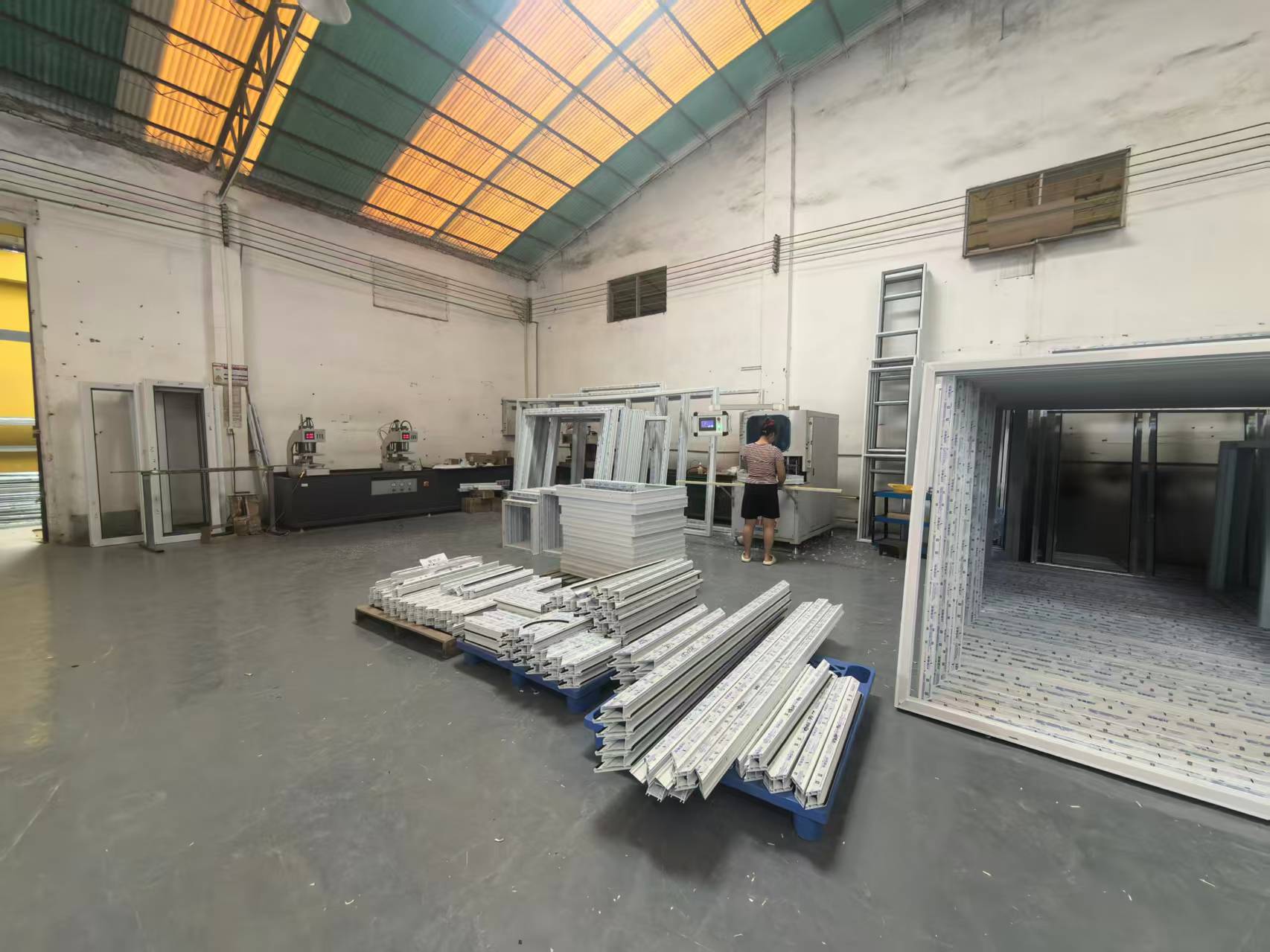
Welding and assembly area. Profile tier and processing quality work together: one cannot compensate for the other.
Mid-range vs Conch profiles: side-by-side comparison
| Decision dimension | Qualified mid-range UPVC profile | Conch UPVC profile |
|---|---|---|
| What the label describes | A commercial price band; quality varies greatly between manufacturers | A brand-grade profile with a stable raw-material formula |
| Wall thickness | Not guaranteed by the tier label; verify per batch against GB/T 8814-2017 | Strict wall-thickness standards as part of the brand specification |
| Raw-material formulation | Varies; some suppliers reduce formula content or wall thickness to reach a lower purchase price | Stable formulation with reliable UV resistance and anti-aging capability |
| Unit material cost | Lower | Higher |
| Behaviour over time | Depends on the specific supplier and batch | Longer service life and fewer later-stage problems when processing and installation are correct |
| Main risk to manage | Yellowing, deformation, air leakage and shortened service life from thin walls or a weak formulation | Counterfeit product passed off as branded material |
| Best fit | Tight-budget projects where wall thickness, formulation and workmanship can be strictly verified | Projects prioritising long-term durability and reliable quality, particularly renovation |
| Verification actions | GB/T 8814-2017 test reports, wall-thickness measurement, incoming inspection | Genuine channel confirmation plus the same test reports and incoming inspection |
Read the table as a verification plan rather than a scorecard. The mid-range column is not automatically the risky option: a qualified mid-range profile that passes wall-thickness, formulation and workmanship checks is a legitimate choice for cost-sensitive projects. The Conch column is not automatically the safe option either, because a counterfeit profile carrying a branded name fails in the same way as cheap material.
Step-by-step breakdown: how to evaluate a profile tier before ordering
Step 1 — Fix the project brief first. List the window types (sliding, casement, tilt-and-turn, crank awning, American-style hung, hopper), sizes, glazing specification, exposure conditions and the building-code requirements of the destination market. Profile tier is only meaningful against those inputs.
Step 2 — Convert the tier label into a specification. Request wall-thickness data, material test reports and compliance evidence against GB/T 8814-2017 covering wall thickness, impact resistance, heat stability and anti-aging performance. For the UPVC Window product range, the listed material properties are: Vicat softening point 86 °C; flexural modulus of elasticity 2,840 MPa; tensile yield stress 43 MPa; tensile strain at break 186%; density 1,520 kg/m³.
Step 3 — Verify the brand source if Conch is specified. Confirm the genuine supply channel and keep that confirmation with the commercial documents. This step protects the buyer against counterfeit material as much as against normal quality variation.
Step 4 — Check the whole assembly, not just the profile. Confirm the reinforcement plan, hardware set, glazing type and sealing components for the sash sizes you intend to build. Wind resistance, water tightness and air permeability are finished-assembly properties.
Step 5 — Validate with a sample. A physical sample or sample unit is the fastest way to check wall thickness, welding quality, sealing, hardware operation and finish. Sample validation before mass production is standard practice for project orders.
Step 6 — Control incoming material and fabrication. Run incoming inspection against wall thickness, appearance and test reports; cut and process profiles to the drawings with controlled cutting precision and notch size; assemble and install with correct sash clearance; then inspect finished units for air leakage, deformation and poor sealing. Poor installation aggravates profile defects, so this step protects the value of whichever tier was purchased.
Step 7 — Confirm the commercial parameters. For Yuanzhaiji orders, the minimum order quantity is 30–40 ㎡, lead time is 10–30 days, and monthly capacity is 4,000 ㎡, with OEM/ODM customization available for window size, specification and glass specification. After-sales support covers technical consultancy and quality testing, and quality inspection reports are issued for production.
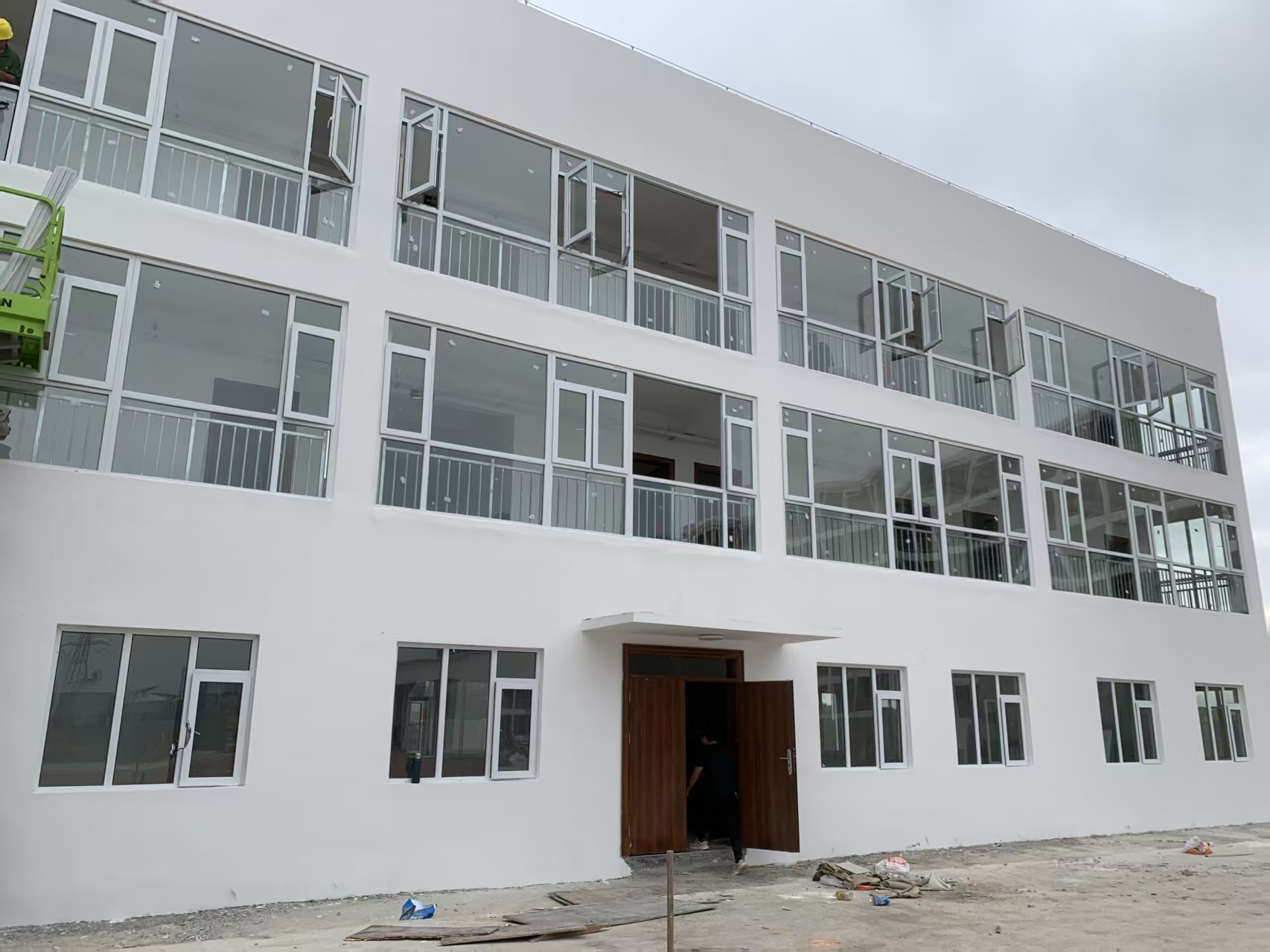
On-site elevation of fully installed windows for a whole floor, Kenyan builder project (800 ㎡ package). Installed results depend on the profile tier and on the processing and installation controls behind it.
Use cases: which tier fits which project
High-exposure residential and villa projects. Coastal high-humidity and strong-wind locations, plus buildings with long daily sun exposure, are the situations where formulation, wall thickness and anti-aging performance determine how long the facade keeps its appearance and its air tightness. This is the case for a documented brand-grade profile such as Conch, with reinforcement and hardware specified for the sash sizes involved.
Ordinary residential and commercial buildings. For inland projects within a normal exposure range, a qualified mid-range profile that meets the national standard on wall thickness and the additive system can balance cost against performance, provided every batch is verified against test reports and incoming inspection.
Renovation projects with durability requirements. Where replacement is disruptive and expensive, buyers typically prioritise a lower later-stage failure rate over the lowest purchase price; users comparing tiers for home renovation are advised to select genuine Conch profiles.
Temporary buildings and non-exposed indoor applications. Economy-tier profiles meet the basic standard threshold and can be adequate here, but they are not recommended for long-term outdoor use where UV exposure and temperature cycling are continuous.
Project evidence. A builder client in Kenya installed an 800 ㎡ window package. The reported results were strong heat-insulation and sound-insulation performance with good energy-saving behaviour. The contributing factors recorded for the project were high-quality profiles, corrosion-resistant hardware, safe tempered glass, fine workmanship, low-noise sliding operation, water-proof and dust-proof performance, simple and attractive appearance, and easy maintenance. That combination of profile, hardware, glass and workmanship is the point of this comparison: the profile tier sets the ceiling, and processing determines how close the finished window gets to it.
Documentation, standards and certification: what to request
Compliance documentation is where profile selection becomes auditable, and two document sets matter.
The first is the profile-level set: evidence that the material meets GB/T 8814-2017 requirements on wall thickness, impact resistance, heat stability and anti-aging performance, supported by qualified test reports for the physical properties claimed.
The second is the finished-product set. The UPVC Window and UPVC Door products are covered by an ECM Attestation issued by Ente Certificazione Macchine Srl (ECM), certificate number NO.3N230816.YCPQQ51, valid from 2023-08-16 to 2028-08-15. The attestation is a voluntary certification scheme, and the applicable standard, EN 14351-1:2006+A2:2016, covers windows and doors without fire-resistance characteristics. The certificate states that it is intended for third countries outside the EU market, and its scope lists UPVC Windows and Doors with profile series 50/60/65/80/88/112.
Read that scope carefully before using it in a tender. It is a voluntary attestation with a defined geographic intent and a defined product scope, not a substitute for a market-specific regulatory approval, and it explicitly excludes fire-resistance characteristics. Where a project needs U-value evidence, as in England and Wales where the whole-window limit for replacement windows in existing homes is 1.4 W/m²K in 2025 under Approved Document L, the request should be for whole-window documentation of the specific assembly being supplied, stating the profile series, reinforcement and glazing. Additional qualification documents can be assembled on request, but the buyer should always name the certificate type, the product and the destination market.
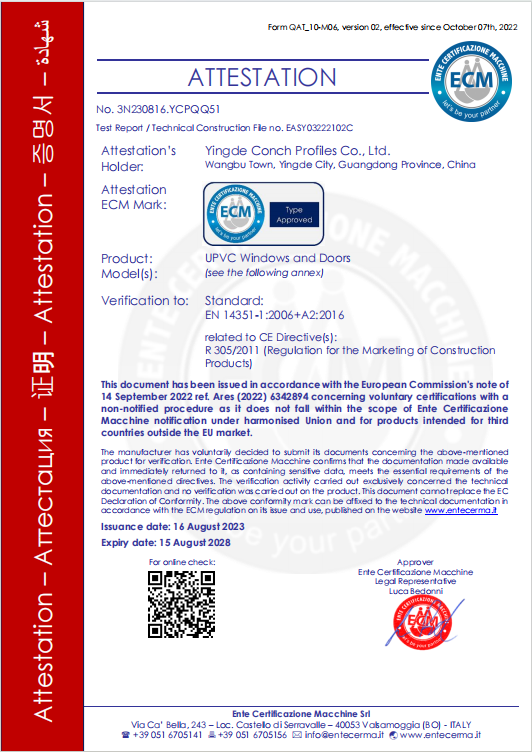
ECM Attestation, certificate number NO.3N230816.YCPQQ51, issued by Ente Certificazione Macchine Srl (ECM), valid 2023-08-16 to 2028-08-15, covering UPVC Windows and Doors, profile series 50/60/65/80/88/112.
FAQ: mid-range vs Conch profiles
Do mid-range and Conch profiles have to meet the same standard?
Yes in principle. Profile quality is verified against GB/T 8814-2017 for unplasticized PVC (PVC-U) profiles for doors and windows, which sets requirements on wall thickness, impact resistance, heat stability and anti-aging performance, and qualified test reports are the mechanism for checking physical properties. Both a qualified mid-range profile and a Conch profile should be able to show those reports. The standard sets a floor rather than a grade, so the practical difference lies in wall-thickness control, the additive system and batch-to-batch consistency. Verify each delivery, not only the first one.
Can China UPVC window manufacturers provide CE and energy efficiency documentation?
Availability depends on the manufacturer and on the product scope, so the request must be specific. For Yuanzhaiji, the UPVC Window and UPVC Door products are covered by an ECM Attestation issued by Ente Certificazione Macchine Srl (ECM), certificate number NO.3N230816.YCPQQ51, valid from 2023-08-16 to 2028-08-15, referencing EN 14351-1:2006+A2:2016 for windows and doors without fire-resistance characteristics and intended for third countries outside the EU market, with profile series 50/60/65/80/88/112 in scope. That attestation is a voluntary scheme and is not the same thing as a market-specific approval. Energy-efficiency requests should be answered with whole-window evidence for the assembly being supplied — frame, reinforcement, glazing and seals — because regulated markets such as England and Wales set limits on the whole window (1.4 W/m²K for replacement windows in existing homes in 2025 under Approved Document L), not on the profile alone. Additional certificates can be provided on request when the certificate type, product and destination market are named.
What does the profile tier change beyond frame cost?
It changes the structural basis of the whole window. UPVC profiles are hollow multi-chamber sections; the chambers improve thermal insulation, and steel reinforcement inserted inside them raises mechanical strength, which sets how much sash weight the window can carry. That limit in turn constrains hardware selection (handles, hinges, lock points, multipoint lock drive mechanism, crescent locks, rollers) and glazing choices (single-layer, double-glazed insulated, tempered safety and frosted glass), and it feeds into wind-pressure resistance, water tightness and air permeability, which are properties of the finished assembly. Series and finish are part of the same decision: Yuanzhaiji supplies Conch profiles in 60, 65 and 88 series with co-extruded colour, laminated wood-grain and solid colour options including dark grey and black.
Is a mid-range profile always cheaper over the life of the project?
Not necessarily. Mid-range profiles are lower in unit material cost, and a qualified mid-range profile that meets the national standard on wall thickness and the additive system can balance cost against performance for ordinary residential and commercial buildings. However, mid-range quality varies greatly between manufacturers, and profiles with insufficient wall thickness or a weak formulation may yellow, deform and leak air after several years, shortening service life. Counterfeit branded profiles carry the same risk. The relevant comparison is unit cost plus the expected cost of later-stage problems and, in renovation work, the cost of replacement disruption, which is why durability-critical projects are advised to use genuine Conch profiles.
Can we test a profile tier before committing, and how long does supply take?
Yes. Sample validation before mass production is standard for project orders, and a sample showroom is available for one-stop purchasing. The minimum order quantity is 30–40 ㎡, lead time is 10–30 days, and monthly capacity is 4,000 ㎡, with OEM/ODM customization of window size, specification and glass specification. To start a profile-level comparison for your project, send your window schedule and destination market requirements to 1803877678@qq.com or WhatsApp +86 130-0674-7018 and request the sample set and documentation package for the series you are considering.
Conclusion
The mid-range versus Conch decision becomes manageable once it stops being a brand-versus-price argument. Convert both options into the same measurable terms — wall thickness, raw-material formulation, GB/T 8814-2017 test reports, genuine brand source and processing workmanship — then match the result to the exposure conditions of the project and to the reinforcement, hardware and glazing the window actually needs. A qualified mid-range profile is a legitimate choice where every batch can be verified. A branded profile is the stronger choice where UV exposure, coastal humidity or the cost of later replacement makes long-term consistency the deciding factor. In both cases, incoming inspection and installation quality determine how much of that potential reaches the finished facade.
Next step: compare the two profile options against your own window schedule
Foshan Nanhai Yuanzhaiji UPVC Door & Window Factory manufactures UPVC sliding, casement, tilt-and-turn, crank awning, hung, awning and hopper windows, and long-term supplies Conch profiles in 60, 65 and 88 series. Send the window schedule, the destination market and the exposure conditions, and the factory can return a profile recommendation with sample availability, documentation and a quotation.
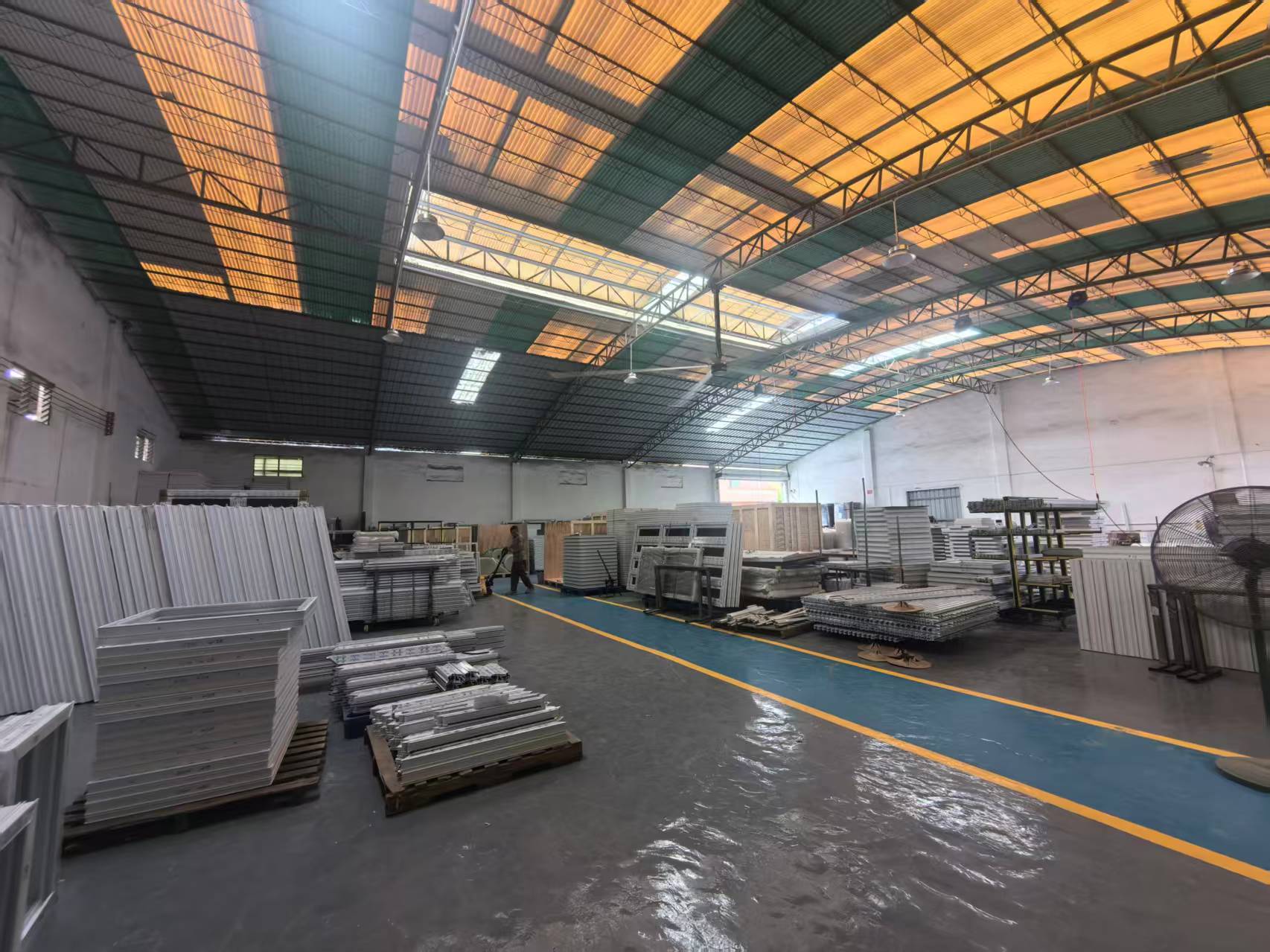
Goods storage area. Sample requests and project orders are prepared from the same production base for the profile series you select.
Website: yuanzhaiji.com · Email: 1803877678@qq.com · Tel / WhatsApp: +86 130-0674-7018 · Message the factory on WhatsApp
Have Questions or Need More Details?
Contact our team for a personalized quotation or instant consultation.
Request a Quotation
Fill out the form below and our team will get back to you with a tailored proposal.
WhatsApp Direct Chat
Prefer to chat in real-time? Message us on WhatsApp for instant assistance & quick answers.
- Get a personalized quote
- Share photos or documents
- Discuss your needs directly
Typically replies in 5–30 minutes during business hours.