Reading the ECM Attestation for UPVC Windows: Scope, Standard and Validity
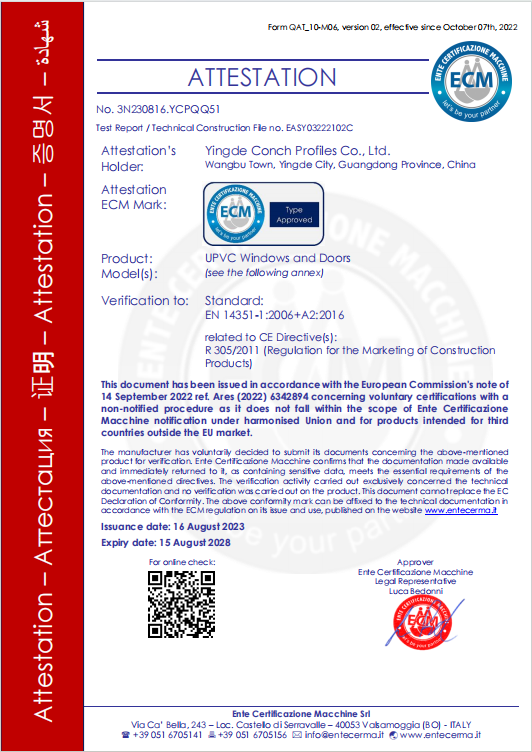
An ECM Attestation is a voluntary certification document issued by Ente Certificazione Macchine Srl (ECM). The attestation held for the UPVC window and door range discussed in this article carries certificate number NO.3N230816.YCPQQ51, references the standard EN 14351-1:2006+A2:2016, covers UPVC windows and doors in profile series 50/60/65/80/88/112, and is valid from 2023-08-16 to 2028-08-15. Its stated intended market is third countries outside the EU market — which means it strengthens a buyer's documentation package, but it does not replace the approvals a specific destination market requires.
Cross-border window procurement runs on documents. A buyer working through the evaluation-to-execution stage is normally holding a quotation, a drawing set and a folder of certificates, and the certificate pages are the ones most often skimmed and least often read properly. That habit is expensive, because the useful information in an attestation is not the fact that it exists — it is the scope, the standard, the model list and the validity period printed inside it.
The document is issued for the range produced by Foshan Nanhai Yuanzhaiji UPVC Door & Window Factory, a UPVC door and window manufacturer established in 2009 and located in Shishan Town, Foshan, China, which exports approximately 80% of its output to LATAM, MENA, ASEAN and EU markets. This article reads that attestation field by field: what ECM attests, which profile series and models fall inside the scope, which standard is referenced, how long the certificate stays valid, and what a buyer still has to verify against their own market requirements.
The Problem: A Certificate Is Not a Market Approval
Most procurement disputes about certificates are not about forgery. They are about interpretation. Four gaps account for the majority of the confusion.
1. Document type is confused with legal status
The ECM Attestation is recorded as a voluntary certification. Voluntary means it is issued against a documented technical scope, typically at the manufacturer's initiative or at a commercial party's request. It is not the same thing as a mandatory conformity mark that a regulator requires before a product may be placed on a given market. A buyer who treats any certificate as automatic market clearance creates a compliance risk that tends to surface late — at customs, at site inspection, or at handover.
2. Certificate scope rarely equals your bill of materials
The attestation covers UPVC windows and doors across profile series 50/60/65/80/88/112, and the related product records name specific models: UPVC Window models BR58 and HF88, and UPVC Door models HF60, WYK75-1 and HF88-L. It does not follow that every combination of frame, sash, glass build-up, hardware set and opening type behaves identically. Glass specification, sash size, steel reinforcement and installation detail all change thermal, structural and acoustic behaviour, so the attestation is the starting point of verification rather than the end of it.
3. Validity is a date range, not a permanent state
Certificate NO.3N230816.YCPQQ51 was issued on 2023-08-16 and expires on 2028-08-15. A quotation issued in the final year of that window, or a shipment delivered close to the expiry date, deserves a status check before the order is confirmed.
4. Destination market requirements sit outside the certificate
The attestation is explicitly intended for third countries outside the EU market. For an importer, that sentence is the most important line in the document. Whatever the certificate demonstrates technically, the legal performance limit that applies to the installed window is set by the destination market. In England and Wales, for example, the legal whole-window U-value limit for window replacement in existing homes is 1.4 W/m²K under Approved Document L (2025). A buyer in that market has to map the attestation scope onto a project-specific U-value calculation rather than assume equivalence.
Industry Background: Why Documentation Outweighs Marketing Claims
UPVC windows are a mature, high-volume category with a fragmented supplier base, and the published market data reflects both the scale of the opportunity and the difficulty of comparing suppliers by reputation alone.
| Industry indicator | Reported value | Source |
|---|---|---|
| Global uPVC windows and doors market size, 2025 | USD 30.8 billion | Grand View Research |
| Alternative 2025 market estimate | USD 42.15 billion (difference attributed to methodology and to different inclusion of accessory and hardware segments) | Mordor Intelligence |
| Asia Pacific revenue share of the global uPVC windows and doors market, 2025 | 44.1% | Grand View Research |
| Windows share of total uPVC product revenue, 2025 | 58.0% | Grand View Research |
| Largest design type share, 2025 | Casement windows and doors at 38.5% | Dataintelo |
| Estimated service life of high-quality UPVC profiles produced in the Foshan Nanhai cluster | 30 to 40 years | Industry publication |
| Energy efficiency improvement from modern multi-chamber profiles compared with traditional frames | Up to 40% | Secondary industry source |
The two market-size figures are worth pausing on. Two research houses value the same 2025 category differently — USD 30.8 billion and USD 42.15 billion — because of differences in what is counted. If commercial research cannot agree on a single number, a supplier's unverified performance claim certainly should not be taken at face value. Documents with a number, a scope and an expiry date are the only dependable substitute.
Manufacturing geography matters here as well. The Foshan Nanhai area is a key manufacturing base for UPVC profiles and windows, and high-quality profiles from this cluster are estimated to have a service life of 30 to 40 years. That longevity is a materials and formulation outcome, not a marketing outcome — which is exactly why the material parameters recorded inside an attestation are more informative than an adjective on a brochure.
Detailed Solution: Reading the Attestation Field by Field
Certificate identity and issuing body
The document is issued by Ente Certificazione Macchine Srl (ECM) and carries the certificate number NO.3N230816.YCPQQ51. Two checks matter at this stage: that the number on the copy in your folder matches the number in the supplier's written declaration, and that the issuing body named on the document is the body that actually issued it. A certificate number is the only reliable identifier in a documentation pack — a statement such as "certified UPVC window" without a number cannot be verified against anything, by you or by a customs officer.
Scope: products, profile series and covered models
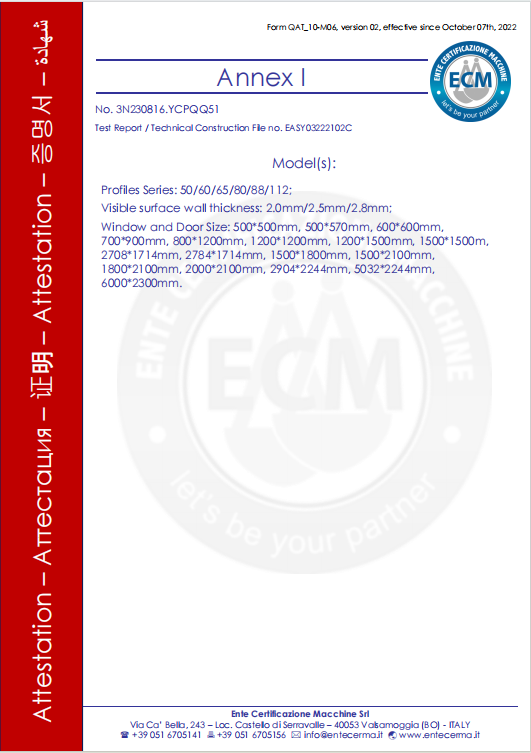
The recorded scope is UPVC windows and doors, across profile series 50/60/65/80/88/112. The related product records list the following:
- UPVC Window — models BR58 and HF88
- UPVC Door — models HF60, WYK75-1 and HF88-L
Read that list against your own purchase list line by line. If your project calls for a casement window or a tilt-and-turn window within the covered profile series, the scope question is straightforward. If your specification falls outside the listed profile series and models, the attestation does not cover that item and should not be presented as though it does.
The referenced standard: EN 14351-1:2006+A2:2016
EN 14351-1 is the European product standard that defines performance characteristics for windows and pedestrian doorsets. The version referenced here is EN 14351-1:2006+A2:2016 — the 2006 edition incorporating Amendment 2 (2016). For a buyer, the practical value of the reference is that it fixes two things: which edition and which amendment the attestation was assessed against, and a citable benchmark you can place next to the standard your own market applies.
One boundary condition belongs in every review note: a reference to a harmonised European standard inside a voluntary attestation does not convert that attestation into an EU market placement route. The document itself states that it is intended for third countries outside the EU market.
Material parameters recorded against the covered products
The product records behind the attestation carry material-level data for the UPVC compound used in the covered windows and doors:
- Material: UPVC
- Vicat softening point: 86 °C
- Flexural modulus of elasticity: 2,840 MPa
- Tensile yield stress: 43 MPa
- Tensile strain at break: 186%
- Density: 1,520 kg/m³
- Applicable industry: construction projects
These values describe the compound behind the profile. The Vicat softening point indicates the temperature at which the material begins to soften under a defined load, which is relevant to profiles exposed to sustained solar gain. Flexural modulus of elasticity and tensile yield stress describe stiffness and resistance to permanent deformation under load — the properties that matter on large sashes, wide spans and wind-loaded elevations. Tensile strain at break indicates ductility, that is, how far the material stretches before failing, and density is a formulation indicator for the PVC compound itself.
Intended market: third countries outside the EU
The attestation states that it is intended for third countries outside the EU market. Practically, this means the document supports a buyer's technical file in markets such as those in LATAM, MENA, ASEAN and other non-EU destinations, while leaving the legal performance requirement to the destination's own building code and energy regulation. Two consequences follow. First, the buyer — not the manufacturer — owns the mapping between the attested scope and the local requirement. Second, the mapping has to be done for the specific configuration being purchased, including glass specification and opening type, not for the product family in general.
Validity: 2023-08-16 to 2028-08-15
The certificate runs for five years from 2023-08-16 to 2028-08-15. Check it at three points in the order cycle: when the quotation is issued, when the purchase order is confirmed, and again before dispatch if the delivery date sits in the final months of the validity period. Asking a supplier about renewal status is a normal, unremarkable question — and the answer is a more useful signal than any brochure wording.
Step-by-Step Breakdown: Six Checks Before You Approve a UPVC Window Order
The following sequence converts the document review into a repeatable workflow. It takes less than an hour on a typical residential or commercial package.
- Match the identity of the document. Confirm the certificate number NO.3N230816.YCPQQ51 and the issuing body, Ente Certificazione Macchine Srl (ECM), on the copy you hold, and ask for the same identifiers in the supplier's written confirmation.
- Map the scope to your bill of materials. Confirm whether your specified profile series appears in the covered list of 50/60/65/80/88/112, and whether the model matches a listed record — window models BR58 or HF88, or door models HF60, WYK75-1 or HF88-L. Production capability covers UPVC sliding windows, casement windows and casement doors, and custom glass specification options are available, so configuration questions should be settled at this stage rather than at inspection.
- Confirm the standard and its version. Record EN 14351-1:2006+A2:2016 in your file and compare it with the standard your own market references. Where the two differ, ask for the assembly-level performance figures that your market requires.
- Review the material parameters against your project specification. Compare the recorded values — Vicat softening point 86 °C, flexural modulus of elasticity 2,840 MPa, tensile yield stress 43 MPa, tensile strain at break 186% and density 1,520 kg/m³ — against whatever compound data your specification demands. Remember that these are compound properties, not assembly ratings.
- Check validity against your order timeline. A quotation, a production slot and a delivery date all need to fall inside the 2023-08-16 to 2028-08-15 validity period, or be covered by a renewal.
- Close the loop with capability and acceptance terms. Typical production lead time is 10 to 30 days, monthly production capacity is 4,000 square meters, and the minimum order quantity is 30 to 40 square meters. Acceptance can be handled through pre-shipment inspection via photos or on-site inspection, with a quality inspection report as part of quality control. Technical consultancy and quality testing are available as after-sales support.
Use Cases: Where the Attestation Changes a Buying Decision
Residential developer submitting a third-country tender package
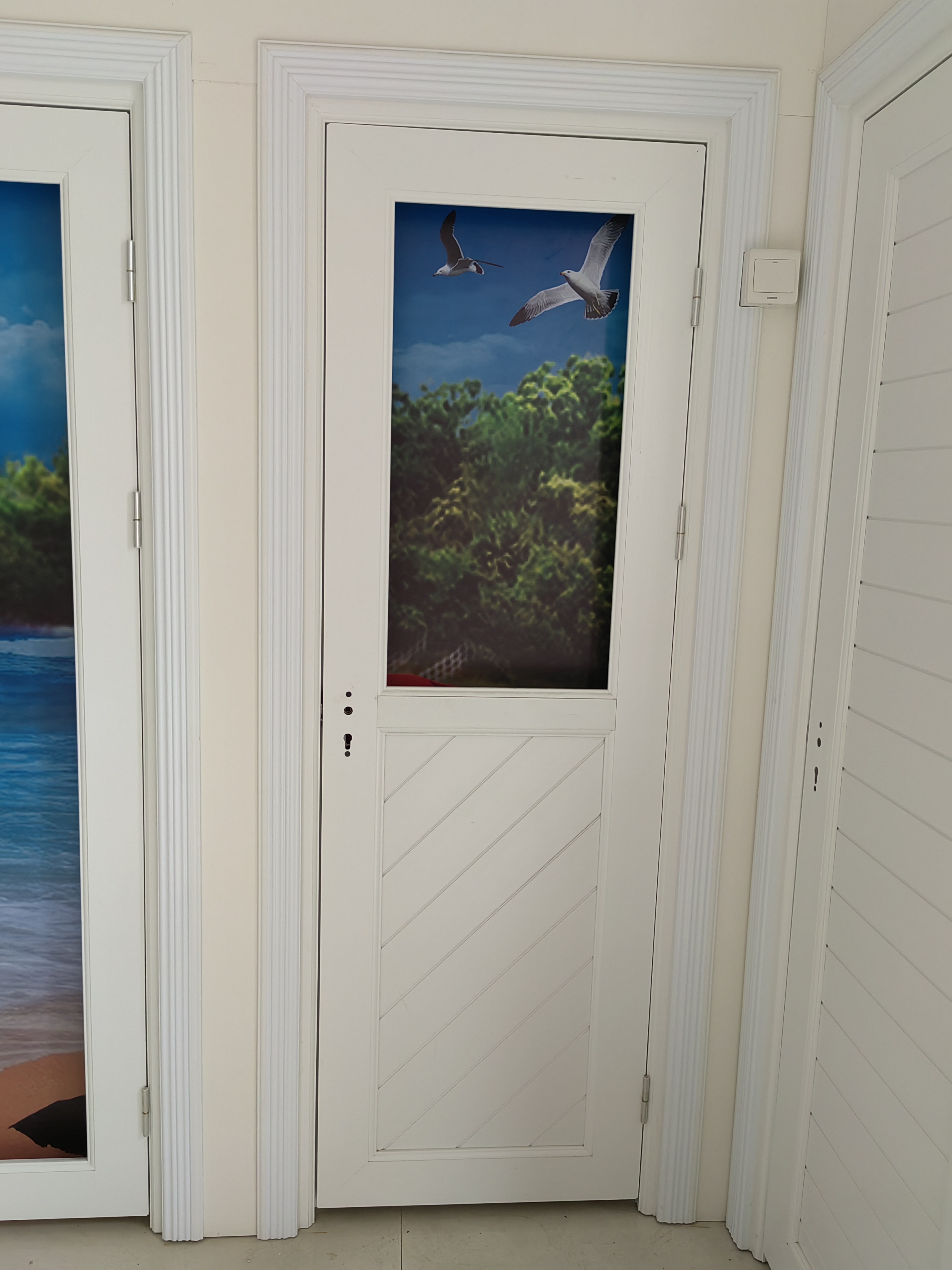
In tender documentation, a voluntary attestation is often the fastest way to show that a supplier operates under a documented technical scope and a recognised standard. Here the certificate number, the referenced standard and the profile series list do the work: they give the evaluator something checkable instead of a claim. The developer still has to confirm that the specific window type — a sliding window, a casement window, an awning window or a tilt-and-turn window — matches the covered scope, and that the local building code is satisfied separately.
Distributor building a private-label or OEM range
Distributors and brand owners sourcing for their own label need three things at once: a manufacturer with OEM and ODM capability, a documented certification position, and predictable order economics. This factory provides OEM, ODM and customizable production services for UPVC windows and doors, with customization of window size, specification and glass specification. Combined with a minimum order quantity of 30 to 40 square meters and a 10 to 30 day lead time, that structure supports a first stock order as well as repeat programs.
Coastal, high-humidity and high-wind projects
Projects in exposed or humid locations generally specify corrosion-resistant hardware, stable sealing and low-maintenance surfaces. The performance that matters most in these settings is water tightness, wind-pressure resistance and long-term dimensional stability, which is a function of profile formulation, reinforcement and hardware rather than of the certificate alone. The attestation confirms the compound and scope position; the assembly specification confirms the project performance.
Project reference outside the certificate scope
Factory project records include a builders' project in Kenya covering 800 m² in an architecture application, where reported outcomes include heat-insulation and sound-insulation performance together with energy-saving behaviour; the installation is described with high-quality profiles, corrosion-resistant hardware, tempered safety glass, low-noise sliding operation, water-proof and dust-proof performance and easy maintenance. This reference illustrates manufacturing and delivery capability and should be read as such — it is not part of the ECM Attestation scope, and it does not substitute for the certificate review described above.
Comparison Table: What the Attestation Documents vs. What You Still Verify
| Item | Documented in certificate NO.3N230816.YCPQQ51 | What the buyer still verifies separately |
|---|---|---|
| Product category | UPVC windows and doors | That the exact item in your bill of materials matches the covered category |
| Profile series | 50/60/65/80/88/112 | That the profile series you specified appears on the covered list |
| Covered models | Window: BR58, HF88; Door: HF60, WYK75-1, HF88-L | That your order uses a listed model, or is confirmed as covered before production |
| Referenced standard | EN 14351-1:2006+A2:2016 | Which standard and which performance classes your destination market requires |
| Material parameters | Vicat softening point 86 °C; flexural modulus of elasticity 2,840 MPa; tensile yield stress 43 MPa; tensile strain at break 186%; density 1,520 kg/m³ | Assembly-level data: U-value, air permeability, watertightness, wind-load and acoustic performance for the specific build-up |
| Intended market | Third countries outside the EU market | Local building code, energy regulation and import requirements (for example, Approved Document L in England and Wales, where the legal whole-window U-value limit for replacement windows in existing homes is 1.4 W/m²K, 2025) |
| Validity | Issued 2023-08-16; expires 2028-08-15 | Certificate status at quotation, at purchase order confirmation and before dispatch |
| Issuing body and number | Ente Certificazione Macchine Srl (ECM); NO.3N230816.YCPQQ51 | That the number and body on the supplier's declaration match the document you hold |
| Product type | Model(s) in the attestation records | Covered profile series | Referenced standard | Validity |
|---|---|---|---|---|
| UPVC Window | BR58, HF88 | 50/60/65/80/88/112 | EN 14351-1:2006+A2:2016 | 2023-08-16 to 2028-08-15 |
| UPVC Door | HF60, WYK75-1, HF88-L | 50/60/65/80/88/112 | EN 14351-1:2006+A2:2016 | 2023-08-16 to 2028-08-15 |
FAQ
Is the ECM Attestation the same as CE marking, and can it be used to place UPVC windows on the EU market?
No. The ECM Attestation is a voluntary certification issued by Ente Certificazione Macchine Srl (ECM) under certificate number NO.3N230816.YCPQQ51, and its stated intended market is third countries outside the EU market. It references EN 14351-1:2006+A2:2016 and covers UPVC windows and doors in profile series 50/60/65/80/88/112, but it is not a mandatory EU market placement route. Importers must check the attestation against the building code, energy regulation and import requirements that apply in their own destination market.
Which products, profile series and models does certificate NO.3N230816.YCPQQ51 cover?
The recorded scope is UPVC windows and doors, with profile series 50/60/65/80/88/112. The product records list UPVC Window models BR58 and HF88, and UPVC Door models HF60, WYK75-1 and HF88-L. The referenced standard is EN 14351-1:2006+A2:2016, and the certificate is valid from 2023-08-16 to 2028-08-15. Material parameters recorded for these products include a Vicat softening point of 86 °C, flexural modulus of elasticity of 2,840 MPa, tensile yield stress of 43 MPa, tensile strain at break of 186% and density of 1,520 kg/m³.
Can a China OEM UPVC window manufacturer support custom residential projects?
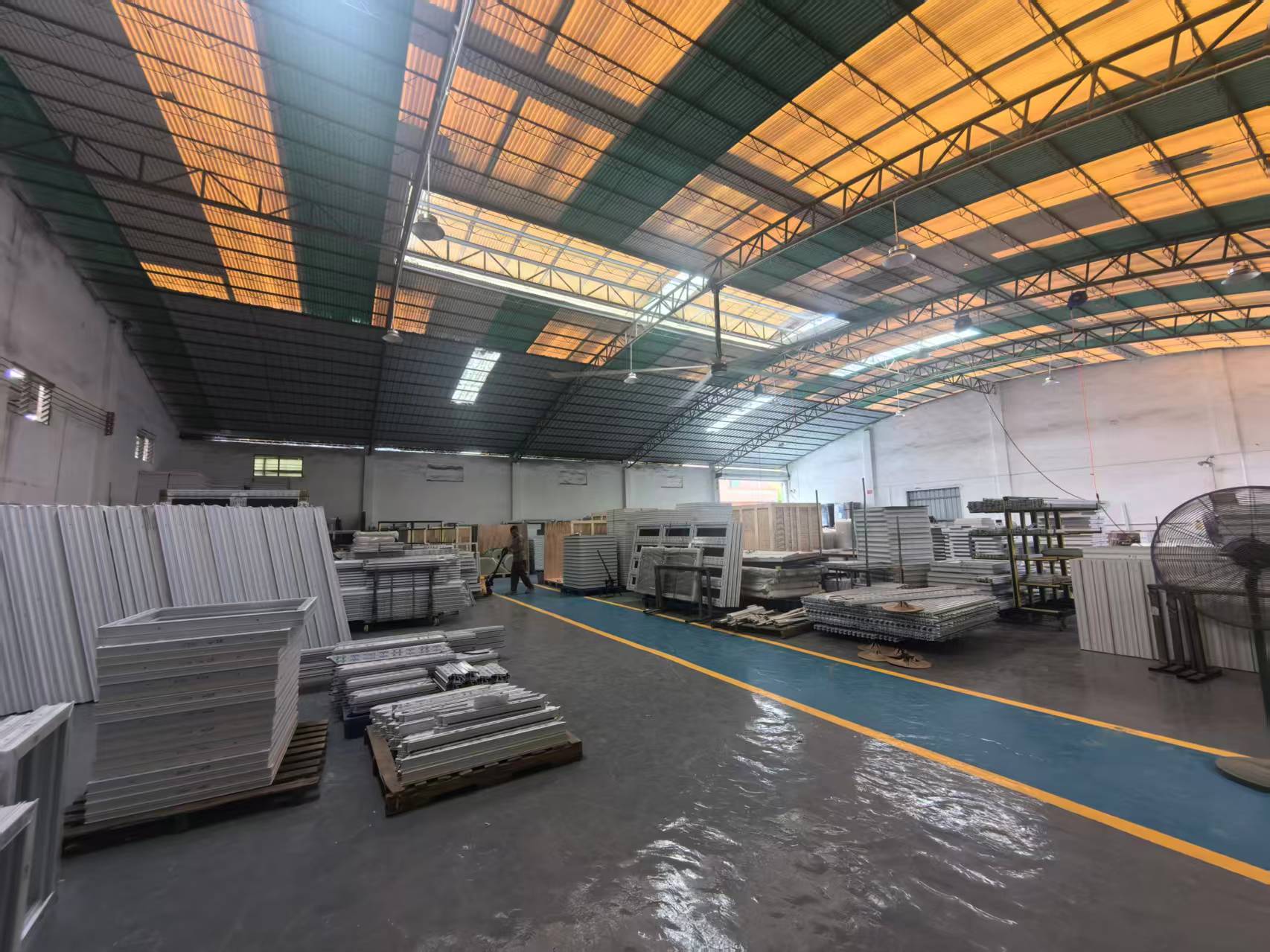
Yes, where the supplier offers OEM and ODM production. Foshan Nanhai Yuanzhaiji UPVC Door & Window Factory provides OEM, ODM and customizable production services for UPVC windows and doors, with customization of window size, specification and glass specification. Production capability covers UPVC sliding windows, casement windows and casement doors, with a monthly capacity of 4,000 square meters and a typical production lead time of 10 to 30 days.
What is the minimum order quantity, and what commercial terms apply?
The minimum order quantity is 30 to 40 square meters. Delivery terms are FOB or CIF, and payment is by bank transfer. Acceptance is handled through pre-shipment inspection via photos or through on-site inspection, with a quality inspection report used as part of quality control.
What lead time applies, and how can a buyer validate quality before shipment?
The typical production lead time is 10 to 30 days. Before dispatch, buyers can review the quality inspection report and use pre-shipment photo inspection; on-site inspection is also accepted as part of the acceptance process. Buyers preparing a first order can request the ECM Attestation copy together with a quotation, and arrange sample validation or an inspection visit through the factory's contact channels before the purchase order is confirmed.
Conclusion: Read the Scope, the Standard and the Dates — In That Order
The ECM Attestation is a readable document once you know what to look for, and the review takes minutes rather than hours. Four elements carry almost all of the decision value:
- Scope: UPVC windows and doors across profile series 50/60/65/80/88/112, with window models BR58 and HF88 and door models HF60, WYK75-1 and HF88-L listed in the product records.
- Standard: EN 14351-1:2006+A2:2016, which fixes the edition and amendment the attestation was assessed against.
- Validity: issued 2023-08-16, expiring 2028-08-15 — verify the status at quotation, at order confirmation and before dispatch.
- Market boundary: intended for third countries outside the EU market, so the destination market's own requirements remain the buyer's responsibility to confirm.
Read together with the material parameters recorded for the covered products, that gives a buyer a verifiable basis for supplier evaluation: a certificate number that can be checked, a standard that can be cited, a model list that can be mapped to a bill of materials, and a date range that can be tracked. Everything else — assembly-level performance, local code compliance and project-specific specification — is a separate question with a separate answer, and it is better asked early than discovered at handover.
Next Step: Request the Attestation, a Quotation and a Sample Plan
Buyers who want to verify the document before committing to an order can request the ECM Attestation copy, a quotation for their window schedule, and a sample or inspection arrangement in one exchange. The factory accepts orders from 30 to 40 square meters, quotes on FOB or CIF terms, and supports pre-shipment photo inspection or on-site inspection.
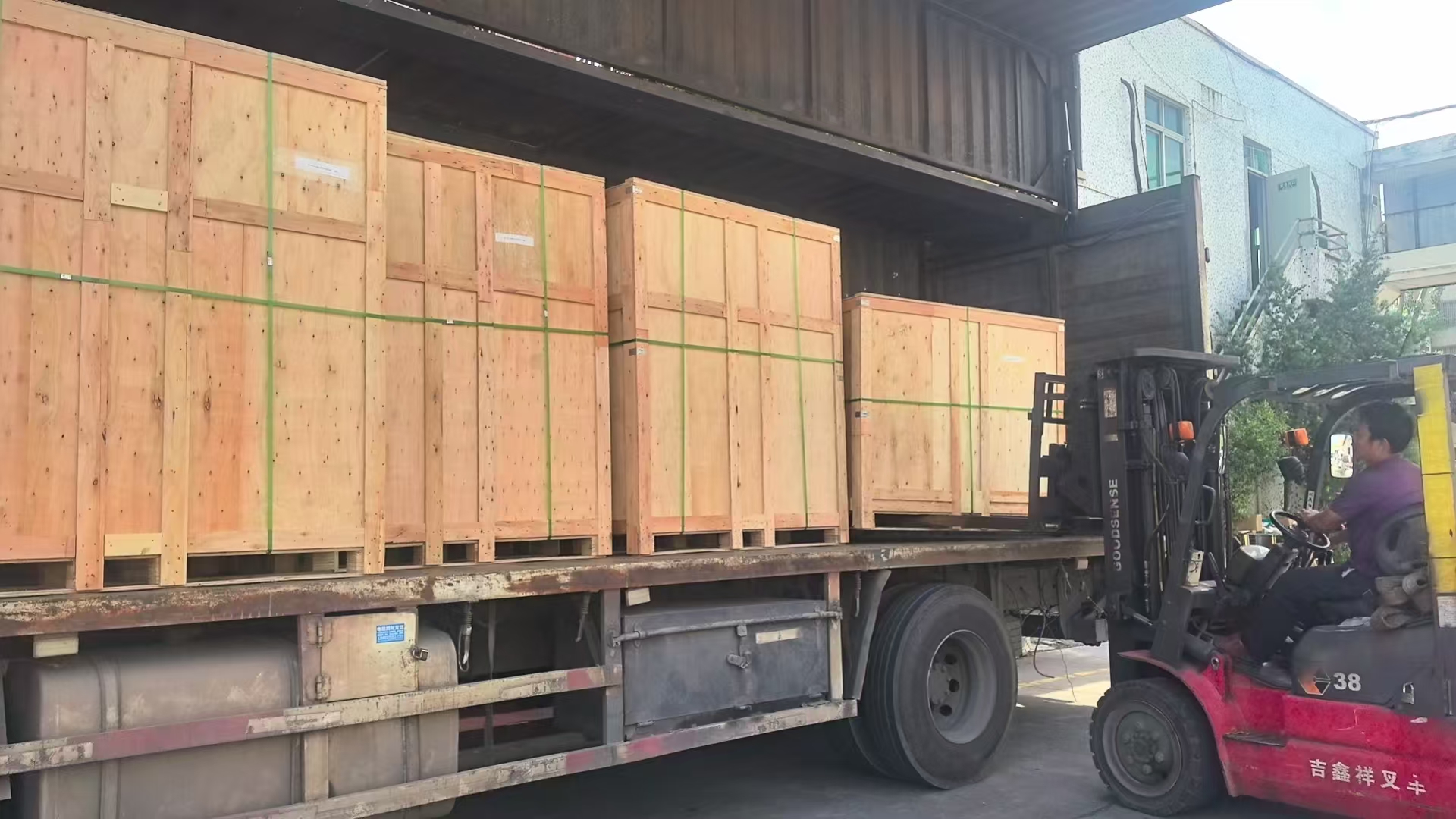
Foshan Nanhai Yuanzhaiji UPVC Door & Window Factory
Website: yuanzhaiji.com
Email: 1803877678@qq.com
Tel / WhatsApp: +86 130-0674-7018
Contact: YUAN
Have Questions or Need More Details?
Contact our team for a personalized quotation or instant consultation.
Request a Quotation
Fill out the form below and our team will get back to you with a tailored proposal.
WhatsApp Direct Chat
Prefer to chat in real-time? Message us on WhatsApp for instant assistance & quick answers.
- Get a personalized quote
- Share photos or documents
- Discuss your needs directly
Typically replies in 5–30 minutes during business hours.