Top UPVC Window Models for Coastal High-Humidity Projects: A Ranked Recommendation
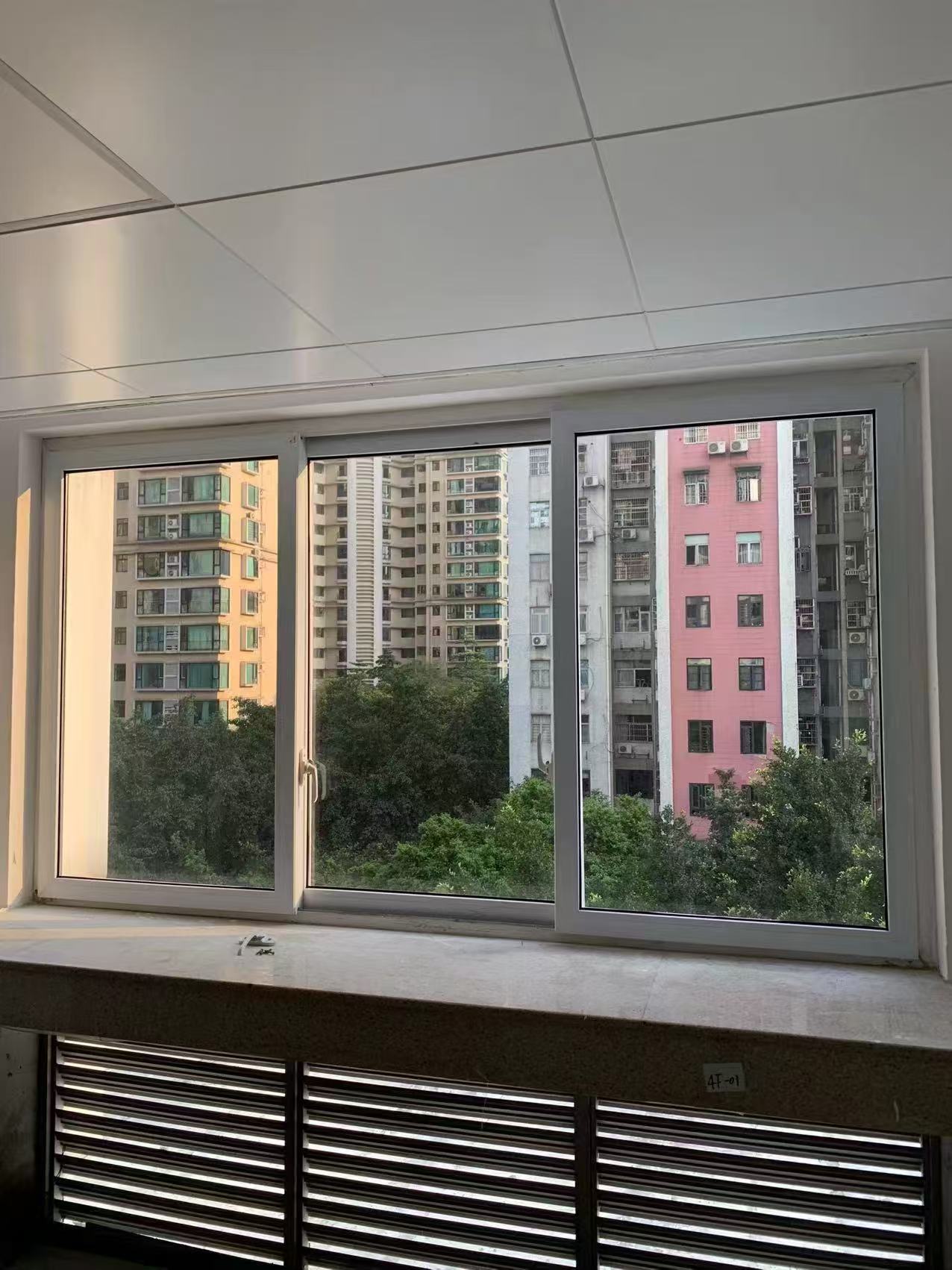
Coastal and high-humidity projects tend to fail windows in a predictable sequence: corrosion reaches the hardware first, seals and gaskets degrade next, and wind pressure then turns small gaps into water ingress, draughts and stiff sashes. In sea-air or monsoon climates, model selection therefore carries more weight than it does inland.
This ranked recommendation shortlists four UPVC window and door models from Foshan Nanhai Yuanzhaiji UPVC Door & Window Factory, established in 2009 and operating from Shishan Town, Nanhai, Foshan. The shortlist covers model 8037, a UPVC window platform supplied in the BR58 and HF88 designations, and model 7970, a UPVC door platform supplied as HF60, WYK75-1 and HF88-L. Each entry states why the model is included and which supporting hardware the specification requires.
The ranking is a fit ranking within one factory catalogue, built from documented product facts: design intent, operation mode, profile properties, certification scope and project type fit. It is not an independent laboratory benchmark and does not claim comparative test superiority over other manufacturers.
Problem Definition: What Coastal High Humidity and Strong Wind Actually Demand
Coastal and high-humidity conditions combine several stresses that inland window specifications rarely face at the same time. The documented requirement set for these applications covers:
- Wind-pressure resistance — the sash, frame and reinforcement must keep their geometry under sustained and gust wind load.
- Water tightness and air permeability — driving rain must be drained and sealed out, and uncontrolled air leakage must stay low.
- Corrosion resistance — hinges, handles, rollers, locking points and fasteners are the first parts to suffer in salt-laden air.
- UV resistance and anti-aging behaviour — the UPVC profile must not yellow, embrittle or deform under long outdoor exposure.
- Impact and wear resistance — daily operation, cleaning and wind-driven debris must not damage the sash or track.
- Secure locking — multipoint locking and lock points are required, with sound and heat insulation and optional fire resistance.
Two mechanisms drive most coastal failures. Salt-laden humid air accelerates corrosion of metallic hardware, which then stops sealing the sash correctly; and ultraviolet radiation plus day-to-night thermal cycling stresses the profile and the gaskets, which is why anti-aging additives and correct wall construction matter more than the frame’s outward appearance. Coastal projects must also meet local building access standards, so certification scope is a specification item, not a formality.
Industry Background: Where Coastal Demand Sits in the UPVC Window Market
- The global uPVC windows and doors market was valued at USD 30.8 billion in 2025 (Grand View Research).
- Asia Pacific held a 44.1% revenue share of that market in 2025, the largest regional position.
- Windows accounted for 58.0% of uPVC product revenue in 2025, larger than the door segment.
- Segment data places uPVC casement windows and doors as the largest product type at 38.5% share in 2025 (Dataintelo).
- Foshan Nanhai is a key manufacturing base for UPVC profiles and windows, and service life for high-quality profiles from this base is estimated between 30 and 40 years.
- Multi-chamber uPVC profiles can improve energy efficiency by up to 40% compared with traditional frames.
- For window replacement in existing homes in England and Wales, the legal whole-window U-value limit in 2025 is 1.4 W/m²K under Approved Document L.
The practical reading for a coastal buyer is that the category is mature, supply is concentrated in Asia Pacific, and window units — not doors — carry most of the volume. Coastal specification is therefore a constraint-driven purchase inside a well-supplied market: the deciding factors are exposure performance, hardware durability and documented compliance rather than product availability.
How This Shortlist Was Ranked
Models were ordered by descending fit against six documented criteria rather than by price or catalogue order:
- Documented design intent for strong-wind and coastal high-humidity conditions.
- Operation mode available for the model (tilt-and-turn or sliding).
- Profile physical properties relevant to humidity, load and UV exposure.
- Coverage of the model designation by the factory’s ECM Attestation scope.
- Fit with the project types documented for these applications: residential building, commercial building, villa project and renovation project.
- Availability of the supporting hardware set required by the specified operation mode.
Ranked Recommendation: UPVC Models for Coastal High-Humidity Projects
Rank 1 — Model 8037: The UPVC Window Platform Documented for Strong-Wind, High-Humidity Exposure
Model 8037 is the factory’s UPVC window platform listed with the BR58 and HF88 model designations. Inclusion reason: it is the window product documented for strong-wind areas and coastal high-humidity conditions, with sound insulation performance and tilt-and-turn or sliding operation. That combination — explicit coastal high-humidity design intent plus two operation modes — is why it takes the first position for exposed elevations, where both wind load and rain penetration must be managed in the same opening.
Supporting hardware required: hardware follows the operation mode, not the model number. For tilt-and-turn and other operable configurations, the documented set is the window handle, window hinge, lock point, multipoint lock drive mechanism and EPDM sealing gasket. For sliding configurations, the documented set is the window roller, crescent lock, pile weather strip and EPDM sealing gasket. Where insect protection is needed, a fly screen can be supplied with the sliding assembly.
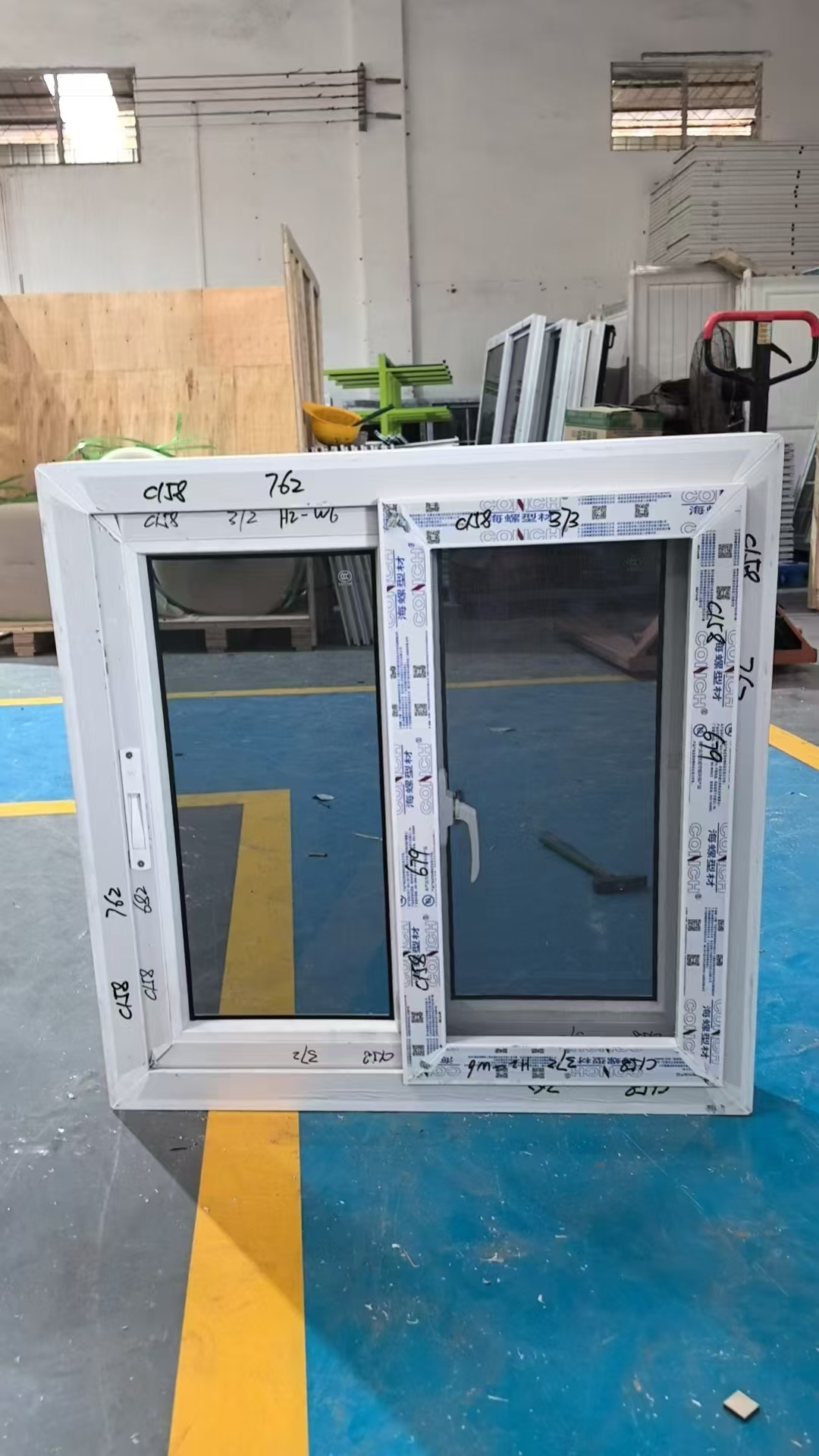
Rank 2 — Model BR58: The Coastal Window Designation for Operable Sash Specifications
BR58 is one of the two window model designations carried by the 8037 platform, and it is documented as applied in coastal high-humidity window work. Inclusion reason: the designation appears both in the factory’s coastal application data and in the ECM Attestation records for UPVC windows, which means a buyer specifying BR58 can point to a named model that sits inside a verified certification scope rather than to a generic window. It ranks second because it is a model within the Rank 1 platform rather than a separate platform, and because the documented data does not assign it to a single aperture type.
Supporting hardware required: for operable sash configurations the required set is the window handle, window hinge, lock point, multipoint lock drive mechanism and EPDM sealing gasket. Because coastal exposure attacks locking and hinge components first, the hardware grade must be confirmed as corrosion-resistant as part of the order specification; corrosion-resistant hardware is a documented highlight of the factory’s installed coastal-adjacent project work.
Rank 3 — Model HF88: The Coastal Window Designation for Wide Sliding Openings
HF88 is the second window model designation carried by the 8037 platform and is likewise documented as applied in coastal high-humidity window work. Inclusion reason: in addition to the coastal window application, the same 88 designation continues into the door line as HF88-L inside model 7970, so a project can keep one model family across both window and door openings. That continuity simplifies hardware procurement and spares planning on larger coastal projects. The factory’s 88-series sliding window assembly is supplied with a fly screen, which is relevant where ventilation is kept open for long periods in humid climates.
Supporting hardware required: for sliding configurations the documented set is the window roller, crescent lock, pile weather strip and EPDM sealing gasket, with an optional fly screen. Tracks and rollers should be specified as corrosion-resistant for the same reason described under BR58.
Rank 4 — Model 7970: Corrosion-Resistant UPVC Door Platform for the Same Envelope
Model 7970 is the factory’s UPVC door platform, supplied as HF60, WYK75-1 and HF88-L. Inclusion reason: it is included because it resists corrosion and suits villa, commercial and renovation projects, which are the same project types documented for coastal high-humidity window work. It ranks fourth because it is a door platform and cannot substitute for a coastal window model — it completes the envelope where balcony doors, terrace doors and entrances face the same sea air and wind as the windows.
Supporting hardware required: the documented door hardware set is the door handle, door hinge, door roller, anti-collision stopper, dust-proof pile weatherstrip and EPDM sealing gasket.
Note on hardware selection: in the documented data, hardware is not tied to individual model numbers; it is tied to the operation mode of the specified unit. This is why the same hardware list applies wherever tilt-and-turn or sliding operation is ordered, and why the operation mode should be fixed before hardware is approved.
Step-by-Step: Specifying a Coastal UPVC Window Package
- Define the exposure. Confirm that the openings face coastal high humidity and strong wind, and record the project type (residential, villa, commercial or renovation). These are the conditions under which the ranked models above are documented to apply.
- Fix the opening schedule and operation mode. Decide which openings are tilt-and-turn or other operable units and which are sliding. This decision, not the model number, determines the hardware list.
- Select the model designation. Specify model 8037 as BR58 or HF88 for windows, and model 7970 as HF60, WYK75-1 or HF88-L for door elements in the same exposure zone. Keeping the 88 designation across windows and doors where possible simplifies spares.
- Specify the glazing. Available options are single-layer glass, double-glazed insulated glass, tempered safety glass and frosted glass. Tempered safety glass and corrosion-resistant hardware are documented features of the factory’s installed project work.
- Approve the hardware set. Match the hardware list to the operation mode, and require corrosion-resistant grades for hinges, handles, rollers and locking components.
- Verify the documents. Request the ECM Attestation covering UPVC windows and doors for profiles series 50/60/65/80/88/112, and request quality inspection reports, which are issued for UPVC window and door production.
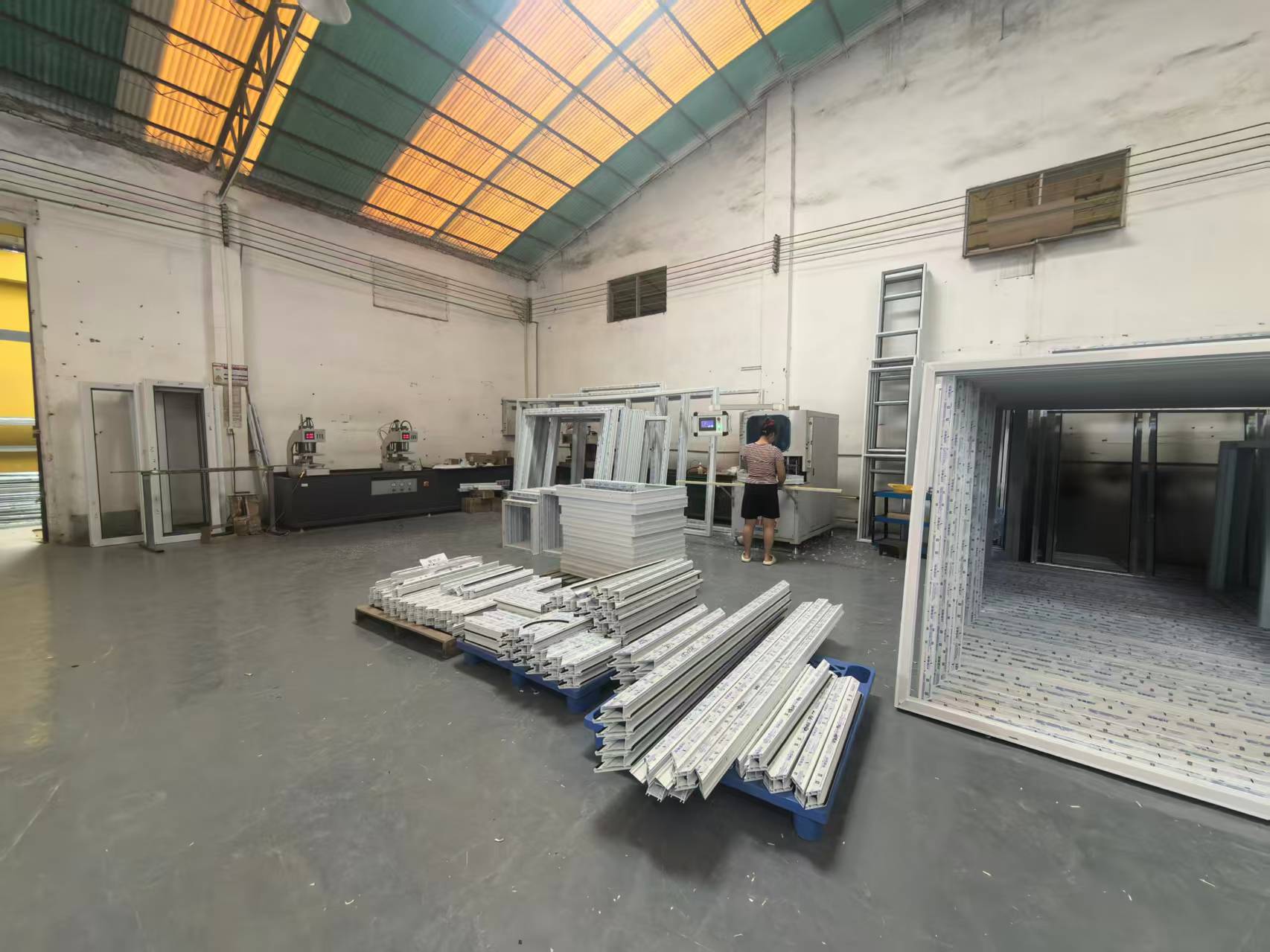
- Validate samples, then plan production. A sample showroom is available for one-stop purchasing. Production is OEM/ODM and customizable by window size, specification and glass specification, with a minimum order of 30–40 m², monthly capacity of 4,000 m² and a lead time of 10–30 days.
Where These Models Are Used
The documented application scope for coastal high-humidity window work covers four project types: residential buildings, commercial buildings, villa projects and renovation projects. In these settings the function of the window unit is the same — thermal insulation, sound insulation, wind and rain resistance, corrosion resistance and sealing to create a comfortable indoor environment — but the specification emphasis shifts:
- Residential buildings in exposed locations: prioritise operability plus sealing, so the BR58 or HF88 window designation with a matched, corrosion-resistant hardware set.
- Villa projects: large openings and more visible frame lines, where the factory’s Conch profile supply in 60/65/88 series with co-extruded colour, laminated wood-grain finish or solid colours such as dark grey and black allows the frame finish to be matched to the facade.
- Commercial buildings: larger unit counts and repeated floor plates, where model continuity across windows and doors reduces hardware variety and simplifies maintenance.
- Renovation projects: existing openings that must accept replacement units, where customization of window size and specification is required rather than a fixed catalogue dimension.
A documented project reference is a builders’ installation in Kenya covering 800 m² of installed UPVC window area. Reported results include heat-insulation and sound-insulation performance, with energy-saving performance from the installed UPVC window systems. The documented project highlights are high-quality profiles, corrosion-resistant hardware, tempered safety glass, fine workmanship, low-noise sliding, water-proof and dust-proof performance, simple and attractive appearance, and easy maintenance. The reference is presented here as a project outcome for the listed equipment, not as a claim about coastal conditions in that specific location.
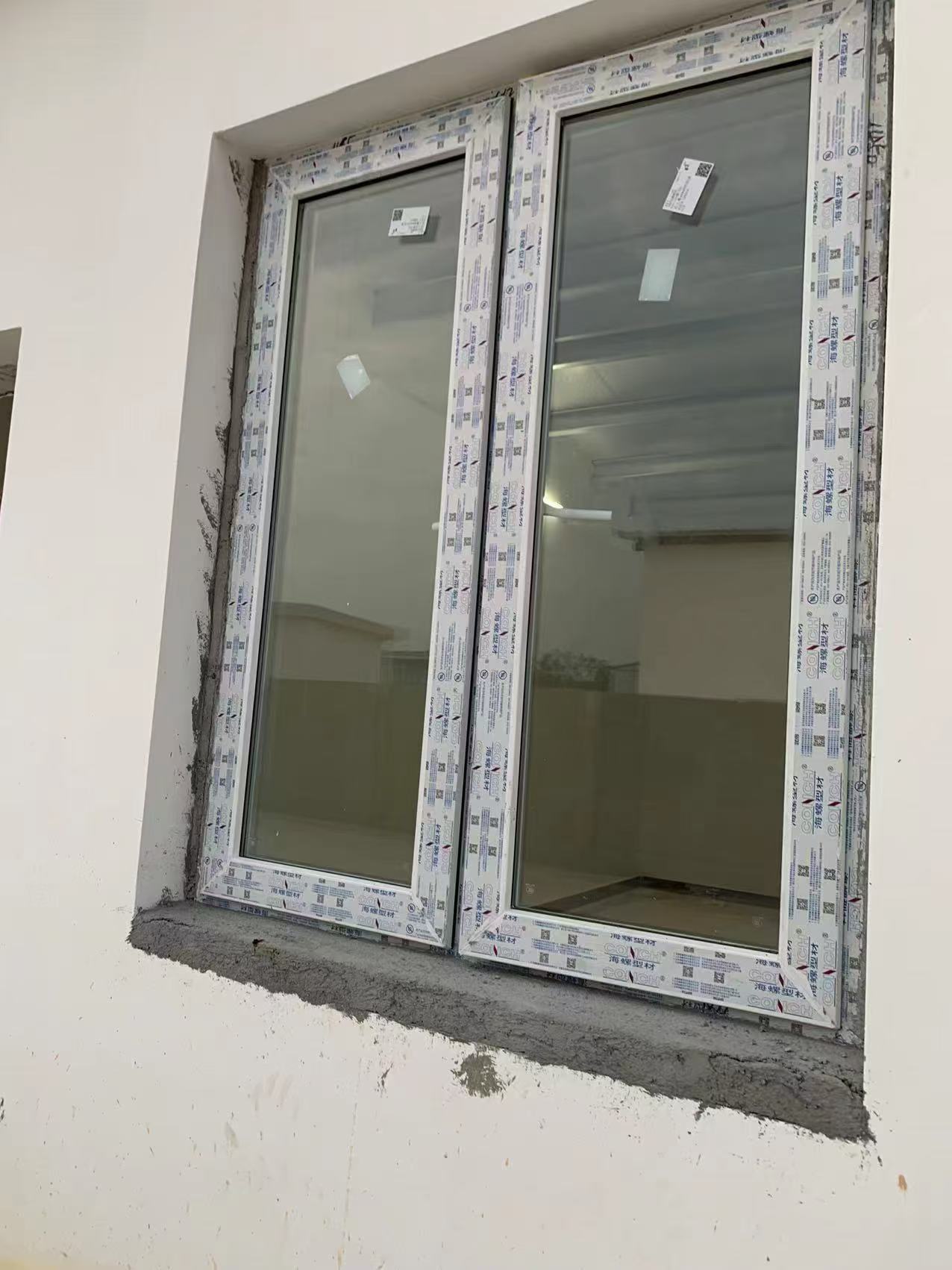
Model Comparison Table
| Rank | Model / product | Documented coastal fit | Operation mode | Supporting hardware | Certification scope |
|---|---|---|---|---|---|
| 1 | 8037 — UPVC Window (BR58, HF88) | Designed for strong-wind areas and coastal high-humidity conditions; sound insulation | Manual opening and closing, tilt-and-turn, sliding | Window handle, window hinge, lock point, multipoint lock drive mechanism, crescent lock, window roller, EPDM sealing gasket, pile weather strip | Covered by ECM Attestation for UPVC windows and doors, profiles series 50/60/65/80/88/112 |
| 2 | BR58 — window model designation of 8037 | Applied in coastal high-humidity window work | Operable configurations per specification | Window handle, window hinge, lock point, multipoint lock drive mechanism, EPDM sealing gasket | Listed against the ECM Attestation for model 8037 (BR58, HF88) |
| 3 | HF88 — window model designation of 8037 | Applied in coastal high-humidity window work; 88 designation continues into the door line as HF88-L | Sliding configuration per specification | Window roller, crescent lock, pile weather strip, EPDM sealing gasket, fly screen option | Listed against the ECM Attestation for model 8037 (BR58, HF88) |
| 4 | 7970 — UPVC Door (HF60, WYK75-1, HF88-L) | Corrosion resistance; suits villa, commercial and renovation projects | Manual opening and closing, tilt-and-turn, sliding (door) | Door handle, door hinge, door roller, anti-collision stopper, dust-proof pile weatherstrip, EPDM sealing gasket | Listed against the ECM Attestation for model 7970 (HF60, WYK75-1, HF88-L) |
Profile physical data documented for both model 8037 and model 7970: Vicat softening point 86°C, flexural modulus of elasticity 2840 MPa, tensile yield stress 43 MPa, tensile strain at break 186%, density 1520 kg/m³. Purchase terms documented across the range: minimum order 30–40 m², monthly capacity 4,000 m², lead time 10–30 days, OEM/ODM production customizable by window size, specification and glass specification.
FAQ
Which UPVC window models are recommended for coastal high-humidity projects, and which energy-efficient glazing options are available?
For coastal high-humidity and strong-wind projects, the recommended window platform is model 8037, supplied as BR58 or HF88, with sound insulation and tilt-and-turn or sliding operation. Model 7970, a UPVC door platform supplied as HF60, WYK75-1 and HF88-L, is recommended where the same envelope needs corrosion-resistant door elements for villa, commercial or renovation projects. Glazing options include single-layer glass, double-glazed insulated glass, tempered safety glass and frosted glass. Multi-chamber UPVC profiles can improve energy efficiency by up to 40% compared with traditional frames, and for window replacement in existing homes in England and Wales the legal whole-window U-value limit is 1.4 W/m²K under Approved Document L.
What certification covers these models?
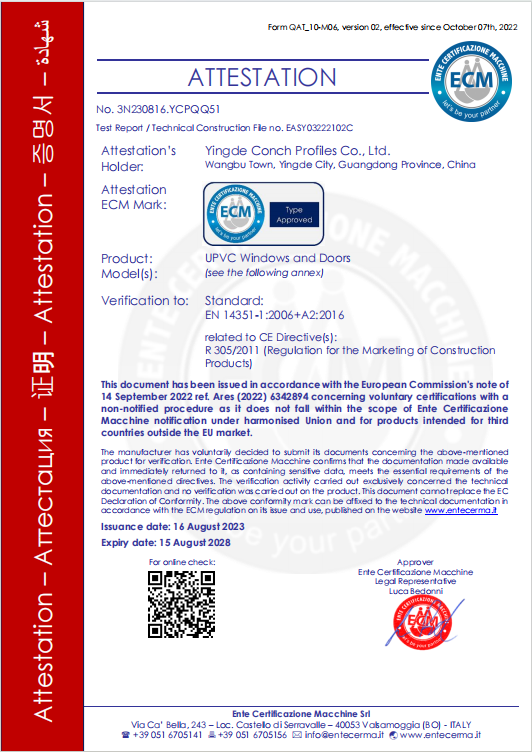
The factory holds an ECM Attestation, certificate number NO.3N230816.YCPQQ51, issued by Ente Certificazione Macchine Srl (ECM) on 16 August 2023 and valid until 15 August 2028. The scope is UPVC Windows and Doors, Profiles Series 50/60/65/80/88/112, assessed against EN 14351-1:2006+A2:2016, and the attestation is intended for third countries outside the EU market. Model 8037 (BR58, HF88) and model 7970 (HF60, WYK75-1, HF88-L) are both listed against this attestation.
Which profile properties should be verified for humidity and wind exposure?
The profile data documented for models 8037 and 7970 is: Vicat softening point 86°C, flexural modulus of elasticity 2840 MPa, tensile yield stress 43 MPa, tensile strain at break 186% and density 1520 kg/m³. Buyers should additionally confirm UV resistance and anti-aging performance, because poor-quality UPVC profiles can yellow, embrittle and deform under long outdoor exposure. Foshan Nanhai is a key manufacturing base for UPVC profiles and windows, and high-quality profiles from this base are estimated at 30 to 40 years of service life.
What are the order terms — minimum quantity, capacity and lead time?
The documented terms are a minimum order of 30–40 m², a monthly capacity of 4,000 m² and a lead time of 10–30 days. Production is OEM/ODM and customizable by window size, specification and glass specification, with technical consultancy and quality testing as after-sales support, and export markets covering the EU, USA, Africa and the Middle East. Quality inspection reports are issued for UPVC window and door production.
Can samples be validated before placing a coastal project order?
Yes. A sample showroom is available for one-stop purchasing, and sample validation is a normal step before production planning on coastal and high-humidity projects, where performance depends on the combination of profile, glazing and hardware rather than on the frame alone. To request a sample, a quotation or a product catalogue, contact YUAN at 1803877678@qq.com or on WhatsApp and telephone at +86 130-0674-7018, or review the range at yuanzhaiji.com and blog.yuanzhaiji.com.
Conclusion
For coastal high-humidity and strong-wind projects, model 8037 in its BR58 and HF88 window designations holds the first positions in this shortlist because it is the platform documented for exactly those conditions, with sound insulation and a choice of tilt-and-turn or sliding operation. Model 7970 ranks fourth as the corrosion-resistant door platform for the same envelope, applied in villa, commercial and renovation projects and sharing the 88 designation with its window counterpart. The practical decision rule is simple: fix the operation mode first, then approve a corrosion-resistant hardware set that matches it, then confirm the ECM Attestation scope and quality inspection reports for the model designation you are ordering.
Next step for coastal projects: send your opening schedule, exposure conditions and required glazing to YUAN at 1803877678@qq.com or WhatsApp +86 130-0674-7018. Foshan Nanhai Yuanzhaiji UPVC Door & Window Factory can return a model recommendation for 8037 (BR58 / HF88) and 7970, a matched hardware list, a sample arrangement and a quotation. Range and reference projects: yuanzhaiji.com.
Have Questions or Need More Details?
Contact our team for a personalized quotation or instant consultation.
Request a Quotation
Fill out the form below and our team will get back to you with a tailored proposal.
WhatsApp Direct Chat
Prefer to chat in real-time? Message us on WhatsApp for instant assistance & quick answers.
- Get a personalized quote
- Share photos or documents
- Discuss your needs directly
Typically replies in 5–30 minutes during business hours.