UPVC Sliding vs Hinged vs Lift-and-Slide Doors: A Project Buyer's Comparison Guide
UPVC Door · Project Buyer Comparison
Direct answer: UPVC sliding doors, hinged doors and lift-and-slide doors are three different operating systems built from the same material family. A sliding door moves its panel horizontally on a roller set and track. A hinged door rotates its panel on hinges. A lift-and-slide door travels horizontally as well, but the operating handle first lifts the panel onto its rollers and then lowers it so the gasket is compressed against the frame. Because the operation mode changes, the hardware schedule changes with it — handles, hinges, rollers, anti-collision stoppers and gaskets are not interchangeable between the three configurations — and the openings, thresholds and project types each configuration suits also differ.
This guide is written for project buyers at the evaluation and execution stages. It compares the three door families in the UPVC door range of Foshan Nanhai Yuanzhaiji UPVC Door & Window Factory, a UPVC door and window manufacturer established in 2009 and based in Shishan Town, Foshan, China, for both domestic and overseas engineering projects. The reference points are the factory's UPVC door range — UPVC sliding doors, lift-and-slide doors and hinged doors — and UPVC door model series HF60, WYK75-1 and HF88-L, which cover manual opening and closing, sliding operation and tilt-and-turn opening.
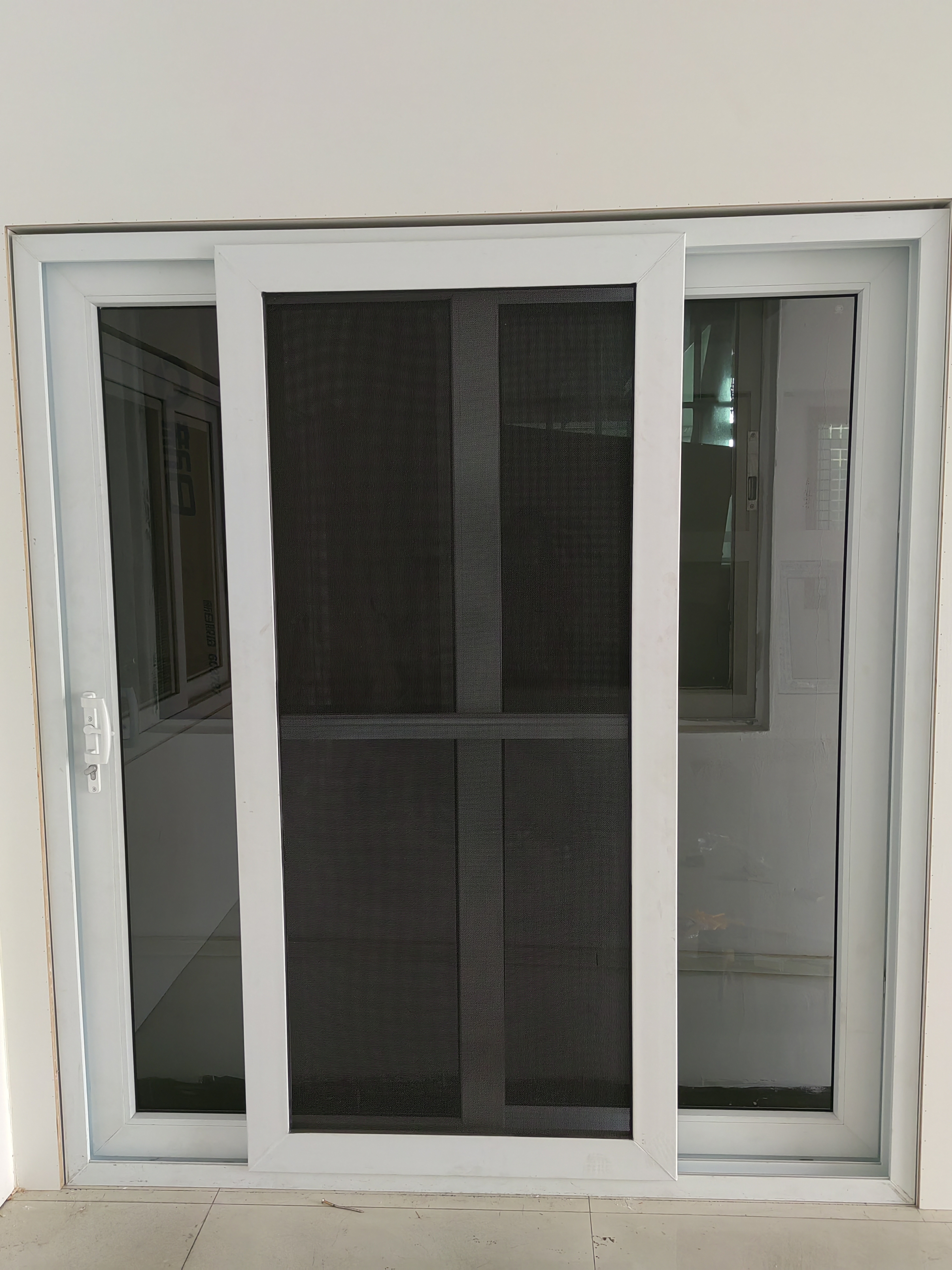
UPVC 112/88-series sliding door with screen — a horizontal-travel configuration from the factory's UPVC door range.
Problem Definition: One RFQ, Three Technically Different Doors
"UPVC door" describes a material and profile system. It does not describe how the door opens, what hardware it carries, or how it seals. When a project enquiry lists "UPVC doors, 30-40 ㎡" without naming the operation mode, the offers that come back are frequently not comparable, because the three configurations resolve into different bills of hardware, different frame and threshold details, and different installation sequences.
At execution stage, the consequences of leaving the operation mode open usually appear in four places:
- Hardware schedule revisions. A hinged unit and a sliding unit do not share a hardware list. Handle-and-hinge sets belong to swing doors; roller sets, tracks and anti-collision stoppers belong to sliding panels; a lift-and-slide unit adds a handle-actuated lift mechanism on top of a roller set. If the configuration is fixed late, hardware is re-quoted late.
- Seal logic mismatch. Sliding panels rely on brush-type sealing at the closing edge — the matched-equipment list specifies a dust-proof pile weatherstrip — while doors that close against the frame under compression, such as hinged and lift-and-slide doors, rely on an EPDM sealing gasket. Specifying the wrong seal detail is a performance issue, not a cosmetic one.
- Performance targets without an owner. Wind-pressure resistance, water tightness, air permeability, impact and wear resistance and a secure locking system are project-level requirements, but each of them is delivered by a door-specific detail. If the buyer does not assign each requirement to a configuration, the requirement stays on paper.
- Reinforcement assumptions. UPVC doors use PVC-U profiles with internal galvanized steel liners for reinforcement. Ordinary plastic doors have no steel reinforcement, deform more easily under load and are not suitable for exterior use. On exterior, high-rise or strong-wind projects a non-reinforced door is a durability and safety risk, and the check is simple: confirm the galvanized steel liner at the profile end face before acceptance.
Industry Background: Why Configuration Choice Is Now a Procurement Issue
The global uPVC windows and doors market was valued at USD 30.8 billion in 2025 and is projected to reach USD 32.4 billion by 2026, according to Grand View Research. Asia Pacific held a 44.1% revenue share in 2025, and within the market the doors segment is expected to grow at a CAGR of 5.3% from 2026 to 2033. Door configuration is a meaningful part of that volume: Mordor Intelligence data places sliding configurations at 37.20% of uPVC door and window revenue in 2025, which confirms sliding as a mainstream choice while leaving a large share to swing and specialist sliding systems such as lift-and-slide doors.
Regulation is tightening the performance conversation. Under the UK Future Homes Standard 2025, the maximum U-value for external doors decreases from 1.6 W/m²K to 1.2 W/m²K under Approved Document L / Future Homes Standard. A door that cannot hold a consistent seal will struggle to hold a thermal target, which is why sealing details — pile weatherstrip on a sliding edge, gasket compression on a closing door — have moved from a workshop preference to a specification item.
Operating conditions push the same way. Exterior building doors in coastal high-humidity and strong-wind areas are expected to combine thermal insulation, sound insulation, wind and rain resistance, corrosion resistance and good sealing. The typical requirement list for residential buildings, commercial buildings, renovation projects and villa projects covers wind-pressure resistance, water tightness and air permeability, impact and wear resistance, a secure locking system, weather resistance and anti-aging performance, plus compliance with local building access standards. For import planning, plastic doors, windows and their frames and thresholds are classified under HS code 392520.
Supply-side, this is a mature export category. Yuanzhaiji has manufactured UPVC doors and windows since 2009, exports approximately 80% of its output, and serves main markets in LATAM, MENA, ASEAN and the EU. Door production is organized to supply OEM and ODM door orders to the EU, Africa and USA markets.
Detailed Solution: The Three UPVC Door Families Compared
The factory's full range includes UPVC sliding doors, lift-and-slide doors, hinged doors and other European and American-style door series, alongside UPVC sliding windows, casement windows, tilt-and-turn windows, crank awning windows, American-style hung windows, awning windows, hopper windows, fully-opening windows, insect screens, PVC louver windows and insulated glass louver windows. For project work, the three door configurations below are the ones specified most often, and they differ in exactly the ways a buyer needs to price.
1. UPVC Sliding Doors: Horizontal Travel on Rollers
Operation: sliding operation with manual opening and closing. The panel travels horizontally along a track instead of swinging into the room, so the door never occupies floor space in front of the opening.
Hardware: the factory's matched-equipment list for door operation — manual opening and closing, tilt-and-turn opening and sliding operation — includes a door handle, door hinge, door roller, anti-collision stopper, dust-proof pile weatherstrip and EPDM sealing gasket. In a sliding configuration the roller set and track carry the panel weight, the anti-collision stopper limits panel travel, and the dust-proof pile weatherstrip seals the closing edge. The handle remains the operating interface.
Project fit: sliding doors are the natural choice where there is no swing clearance — balcony lines, corridors, compact rooms — and where the specification calls for low-noise sliding, water-proof and dust-proof performance. A reference configuration in the range is the UPVC 112/88-series sliding door with screen, built on Conch profiles available in 60/65/88 series with co-extruded color, laminated wood-grain finish and solid colors including dark grey and black.
Constraint to design for: the roller and track assembly is the moving part most exposed to dust and site debris. Threshold drainage, cleaning access and protection of the track during construction should be specified at tender stage rather than resolved on site.
2. UPVC Hinged (Casement) Doors: Rotation on Hinges
Operation: manual opening and closing with a hinged panel that rotates around its hinge set; the door line also covers tilt-and-turn opening. Hinged doors give a full clear opening and a familiar handling pattern for end users.
Hardware: hinges and handle are the primary hardware, and EPDM sealing gaskets provide the closing seal, because the panel closes against the frame in a single movement. Handle, hinge and gasket come from the same matched-equipment list, but the count per door and the load path differ from a slider.
Project fit: residential entrances, villa projects, commercial buildings and renovation projects. The range includes a UPVC 75/60-series full-panel casement door and a UPVC 60-series fully-glazed casement door, both of which suit schedules where a solid or fully-glazed leaf is required.
Constraint to design for: a hinged door needs swing clearance and a defined handing (hinge side and opening direction). Panel weight is carried by the hinge set, so hinge specification must be matched to panel size and glass build at quotation stage.
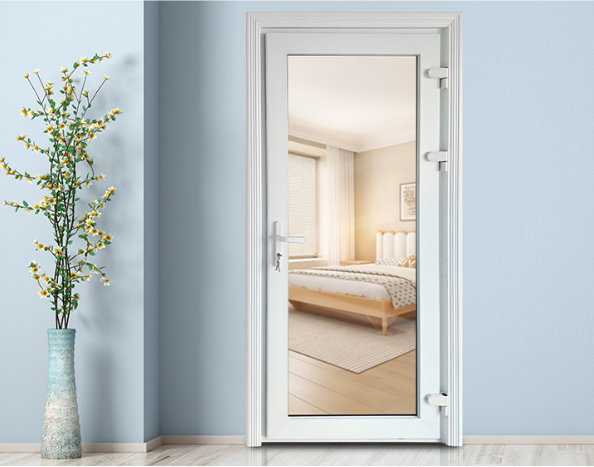
UPVC 60-series fully-glazed casement door — a hinged configuration that rotates on its hinge set.
3. UPVC Lift-and-Slide Doors: Sliding Travel with Gasket Compression
Operation: lift-and-slide doors travel horizontally like a slider, but the operating handle first lifts the panel onto its rollers; when the door is closed, the panel lowers again and compresses the gasket against the frame. This is the standard lift-and-slide principle: free sliding movement when open, gasket-based sealing when closed.
Hardware: a handle-actuated lift mechanism, a roller set and EPDM gaskets. These fall within the same matched-equipment categories that the factory lists for door operation, which is why a lift-and-slide hardware schedule must be quoted as its own line rather than as an upgrade to a standard slider.
Project fit: wide glazed openings in residential, villa and commercial projects where the design needs a large clear opening and where gasket-compression sealing is preferred over a brush-type sliding seal. Lift-and-slide doors form part of the factory's door range alongside sliding and hinged doors.
Constraint to design for: because sealing depends on the panel lowering onto the gasket, hardware adjustment and frame alignment matter more than on a standard slider. Threshold level tolerance and the commissioning step should be written into the installation scope.
Profiles, Performance and Compliance Shared by All Three
Whatever configuration is chosen, the profile system and the compliance file are common ground, and buyers can check them once for the whole door package.
- Reinforced PVC-U profiles. UPVC doors use PVC-U profiles with internal galvanized steel liners for reinforcement, which is what separates them from ordinary plastic doors in exterior applications.
- Recorded profile material parameters for UPVC door model series HF60, WYK75-1 and HF88-L: Vicat softening point 86 ℃; flexural modulus of elasticity 2,840 MPa; tensile yield stress 43 MPa; tensile strain at break 186%; density 1,520 kg/m³.
- Performance functions: thermal insulation, sound insulation, wind and rain resistance, corrosion resistance and sealing performance, with easy-cleaning, low-maintenance surfaces for exterior use.
- Certification: ECM Attestation No. NO.3N230816.YCPQQ51, issued by Ente Certificazione Macchine Srl (ECM) on 16 August 2023 and valid until 15 August 2028, covers UPVC Windows and Doors across profile series 50/60/65/80/88/112, assessed against EN 14351-1:2006+A2:2016. The attestation is intended for third countries outside the EU market, so it supports non-EU project destinations directly; EU-bound projects should verify destination-specific requirements separately.
- EU market context: EN 14351-1:2006+A2:2016 expects system tests covering wind resistance, water tightness, air permeability, sound insulation, thermal performance, drop-weight impact and welding corner strength, together with factory production control, a Declaration of Performance and CE marking on products. Buyers preparing an EU submittal should confirm which of these documents the supplier can provide for the specific configuration ordered.
- Manufacturing and supply terms: OEM, ODM and customizable production services; customization of door size, door specification and glass specification; monthly capacity of 4,000 ㎡; MOQ 30-40 ㎡ for custom UPVC door orders and for models HF60, WYK75-1 and HF88-L; lead time 10-30 days; quality inspection report; after-sales technical consultancy and quality testing.
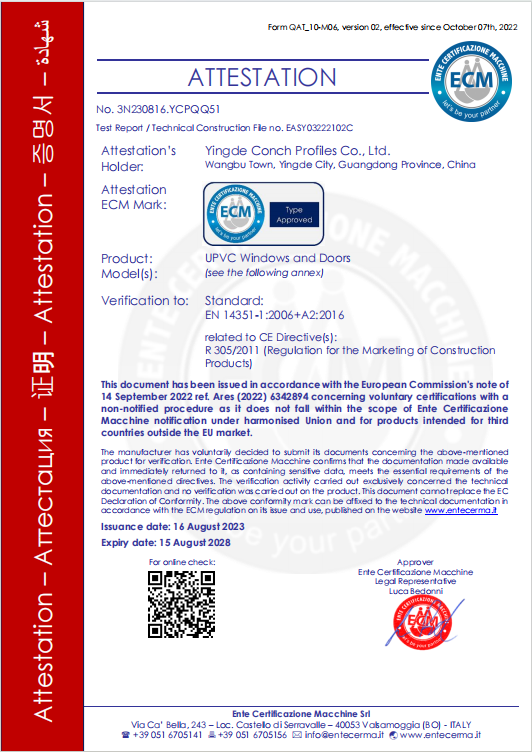
ECM Attestation No. NO.3N230816.YCPQQ51 — UPVC windows and doors, profile series 50/60/65/80/88/112, EN 14351-1:2006+A2:2016.
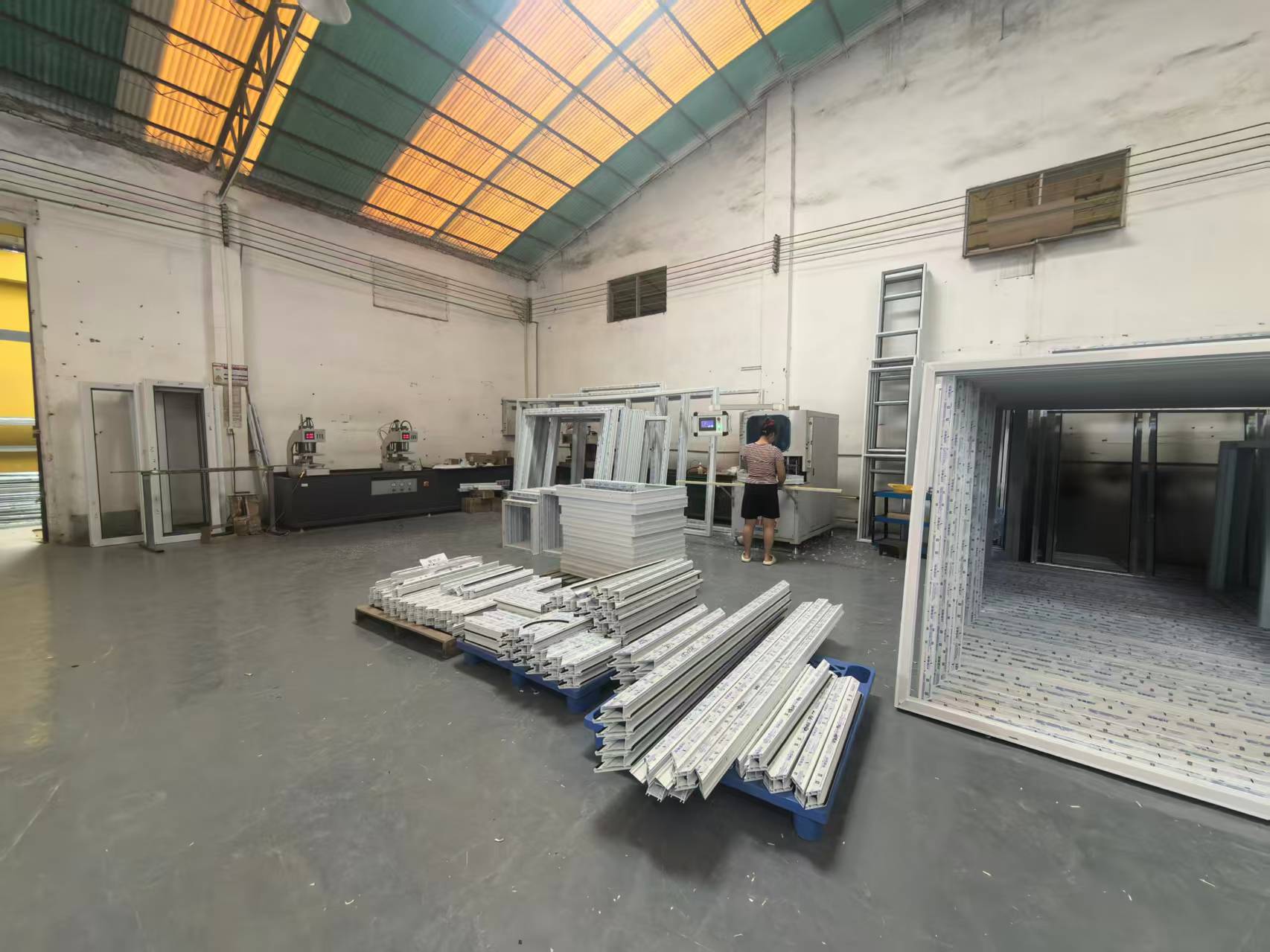
Welding and assembly area — the stage at which frame reinforcement, hardware preparation and sash build are combined.
Step-by-Step Breakdown: Selecting a UPVC Door Configuration
- Test the opening against the three operation modes. If the opening has no swing clearance, or the floor in front of it must remain clear, specify a sliding door. If swing clearance exists and the project wants a full clear opening with a familiar swing action, specify a hinged casement door. If the design calls for a wide glazed opening plus gasket-compression sealing, specify a lift-and-slide door.
- Assign performance targets to each door, not to the project as a whole. Wind-pressure resistance, water tightness and air permeability, impact and wear resistance, a secure locking system and anti-aging performance should each be written against a named configuration. Where a thermal target applies — for example the 1.2 W/m²K maximum U-value for external doors under the UK Future Homes Standard 2025, reduced from 1.6 W/m²K — confirm which configuration and which sealing detail delivers it.
- Build a hardware schedule per configuration. Hinged: door handle, door hinge, EPDM sealing gasket. Sliding: door roller and track, anti-collision stopper, dust-proof pile weatherstrip, EPDM sealing gasket, door handle. Lift-and-slide: handle-actuated lift mechanism, door roller, EPDM sealing gasket. Confirm the galvanized steel liner inside the profiles at the same time as the hardware list.
- Confirm profile series, color and finish. Conch profiles are supplied in 60/65/88 series, in co-extruded color, laminated wood-grain finish and solid colors including dark grey and black, while the ECM attestation scope covers profile series 50/60/65/80/88/112. Match the series to the door size and the wind load of the site.
- Assemble the compliance file for the destination market. ECM Attestation No. NO.3N230816.YCPQQ51 covers UPVC windows and doors to EN 14351-1:2006+A2:2016 and is intended for third countries outside the EU market; EU-bound projects should map the destination market's own requirements. Where a U-value or acoustic figure is needed in a submittal, request configuration-specific documentation instead of a generic certificate pack.
- Fix commercial terms and validation steps. Confirm quantity against the 30-40 ㎡ MOQ for custom UPVC door orders; agree FOB or CIF delivery terms and bank transfer payment; agree acceptance by pre-shipment inspection via photos or on-site inspection, and request the quality inspection report as the quality record.
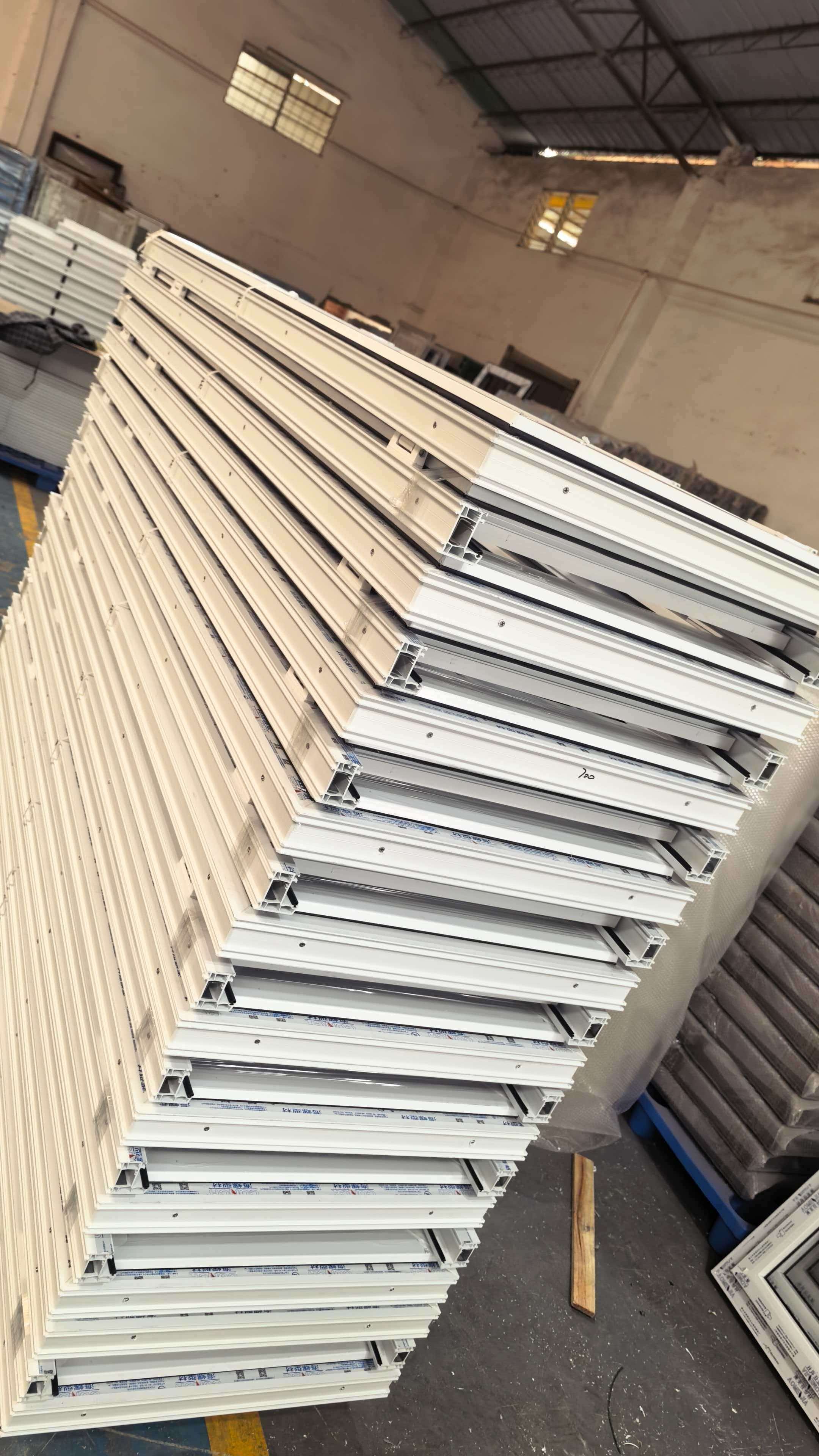
- Plan production, packing, loading and customs. Lead time is 10-30 days against a monthly door capacity of 4,000 ㎡. Export documentation uses HS code 392520 for plastic doors, windows and their frames and thresholds. Doors leaving the factory are recorded as fully fabricated and fully packed units, so verify packing and marking against the door schedule before dispatch.
Use Cases: Where Each Configuration Earns Its Place
- Coastal high-humidity, strong-wind residential and villa projects. Exterior door conditions in these projects include outdoor exposure, coastal high-humidity air and strong winds. Specifications lean on corrosion-resistant hardware, EPDM sealing gaskets and wind and rain resistance, and this is where reinforcement checks matter most. Sliding doors are common on balcony lines, hinged doors on entrances, and lift-and-slide doors on wide living-room openings.
- Commercial buildings and wide glazed openings. Where a facade needs a large clear opening sealed by a compressed gasket rather than a brush seal, lift-and-slide is the fit. The trade-off is more demanding threshold and hardware adjustment work at commissioning.
- Renovation projects. Renovation schedules normally fix the opening first and choose the operation mode second. Where the existing opening has no swing clearance, sliding avoids redesigning circulation; where only the leaf is being replaced and swing clearance already exists, a hinged casement door is the simpler substitution.
- Domestic and overseas engineering projects with volume door schedules. Door orders for the EU, Africa and USA markets are organized as OEM or ODM production, and the factory also serves main markets in LATAM, MENA and ASEAN.
Recorded project reference. A builders' project in the Bahamas covering 500 ㎡ of UPVC doors is recorded with a 10-year duration figure and reported results of stable sealing performance, smooth switch operation and long-term service life. The recorded project highlights include high-quality profiles, corrosion-resistant hardware, safe tempered glass, fine workmanship, low-noise sliding, water-proof and dust-proof performance, simple and beautiful appearance and easy maintenance.
Fully fabricated UPVC casement door — reference unit from the recorded 500 ㎡ builders' project in the Bahamas.
Comparison Table: Sliding vs Hinged vs Lift-and-Slide UPVC Doors
| Decision dimension | UPVC sliding door | UPVC hinged (casement) door | UPVC lift-and-slide door |
|---|---|---|---|
| Operation mode | Sliding operation; manual opening and closing | Hinged rotation; manual opening and closing; tilt-and-turn opening also available in the door line | Sliding travel with lift-and-lower engagement; manual opening and closing |
| Panel movement | Horizontal along the track, panel stays in the plane of the opening | Rotates on hinges | Horizontal along the track after the panel is lifted onto its rollers |
| Primary hardware | Door roller, track, anti-collision stopper, door handle | Door hinge, door handle | Handle-actuated lift mechanism, door roller |
| Closing seal | Dust-proof pile weatherstrip at the closing edge, with EPDM sealing gasket | EPDM sealing gasket, compressed as the panel closes against the frame | EPDM sealing gasket, compressed when the panel is lowered into the frame |
| Clear opening and floor space | No swing clearance needed; floor space in front of the opening stays free | Requires swing clearance and a defined handing | Wide clear opening with no swing arc |
| Project fit | Balcony lines, corridors, compact rooms; low-noise sliding, water-proof and dust-proof specifications | Residential and villa entrances, commercial buildings, renovation projects | Wide glazed openings in residential, villa and commercial projects |
| Moving hardware to inspect | Roller set and track, threshold drainage | Hinge set and gasket condition | Lift mechanism adjustment and frame alignment |
| Range reference | UPVC 112/88-series sliding door with screen; Conch 60/65/88 profiles | UPVC 75/60-series full-panel casement door; UPVC 60-series fully-glazed casement door | Part of the UPVC lift-and-slide door range |
Shared across all three configurations: model series HF60, WYK75-1 and HF88-L; MOQ 30-40 ㎡ for custom UPVC door orders; monthly capacity 4,000 ㎡; lead time 10-30 days; customization of door size, door specification and glass specification; ECM Attestation No. NO.3N230816.YCPQQ51 to EN 14351-1:2006+A2:2016 for profile series 50/60/65/80/88/112, intended for third countries outside the EU market. The "moving hardware to inspect" row shows which matched-equipment item each configuration depends on; the final hardware schedule is confirmed per door at order stage.
FAQ
What certification covers UPVC doors from this factory, and which markets does it apply to?
ECM Attestation No. NO.3N230816.YCPQQ51, issued by Ente Certificazione Macchine Srl (ECM) and valid from 16 August 2023 to 15 August 2028, covers UPVC Windows and Doors across profile series 50/60/65/80/88/112 and is assessed against EN 14351-1:2006+A2:2016. The attestation is intended for third countries outside the EU market, so it directly supports non-EU project destinations; EU-bound projects should verify the destination market's own requirements in addition to this document.
Can a Chinese UPVC sliding door OEM manufacturer produce doors to custom dimensions?
Yes. Production services include OEM, ODM and customizable production modes, and customization options cover door size, door specification and glass specification. Sliding doors are produced alongside lift-and-slide and hinged doors, and production is organized to supply OEM and ODM door orders to the EU, Africa and USA markets. Custom UPVC door orders, including models HF60, WYK75-1 and HF88-L, are quoted from a 30-40 ㎡ MOQ with a monthly door capacity of 4,000 ㎡.
What are the MOQ, payment and delivery terms for a custom UPVC door order?
The MOQ is 30-40 ㎡ per order for custom UPVC door orders, including models HF60, WYK75-1 and HF88-L. Delivery terms are FOB or CIF, and payment is by bank transfer. Monthly production capacity is 4,000 ㎡, which sets the practical ceiling on how quickly a large door package can be phased.
How can hardware, finish and quality be validated before shipment?
Acceptance criteria are pre-shipment inspection via photos or on-site inspection, and a quality inspection report is provided as the quality record. After-sales support covers technical consultancy and quality testing, and a sample showroom is available for one-stop purchasing. Validation is also the right moment to confirm the hardware schedule: handle and hinge items for hinged doors, roller and stopper items for sliding doors, and the lift hardware for lift-and-slide doors, together with the EPDM sealing gaskets and dust-proof pile weatherstrip specified for each configuration.
What is the production lead time for a UPVC door order?
The stated lead time is 10-30 days, supported by a monthly capacity of 4,000 ㎡ for UPVC door production. To confirm a schedule against a project programme, send the door schedule with operation modes, opening sizes, glass specification and destination market — you can request a quotation and sample arrangements through yuanzhaiji.com or WhatsApp +86 130-0674-7018.
Conclusion: Fix the Operation Mode, Then Fix the Price
For a project buyer the practical sequence is short. Decide the operation mode first: sliding where there is no swing clearance, hinged where a full swinging opening suits the entrance, lift-and-slide where a wide clear opening needs gasket-compression sealing. Then translate that decision into a hardware schedule, a profile and reinforcement check, a compliance file for the destination market, and commercial terms that match the order size. Buyers who follow that order avoid the most expensive mistake in this category: pricing three technically different doors as if they were one product.
Foshan Nanhai Yuanzhaiji UPVC Door & Window Factory builds all three configurations — UPVC sliding doors, hinged doors and lift-and-slide doors — on reinforced PVC-U profiles with Conch 60/65/88 series options, and supports OEM, ODM and customizable production for domestic and overseas engineering projects, including models HF60, WYK75-1 and HF88-L.
Next step: sample, quote or catalog
Send the opening schedule together with the operation mode you have chosen, the destination market and the performance requirements. The factory can respond with a quotation, a configuration-specific hardware schedule and sample arrangements. A sample showroom is available for one-stop purchasing, quality is documented with a quality inspection report, and acceptance can be carried out by photo-based pre-shipment inspection or on-site inspection.
Contact: YUAN · WhatsApp / Tel: +86 130-0674-7018 · Email: 1803877678@qq.com · Website: yuanzhaiji.com
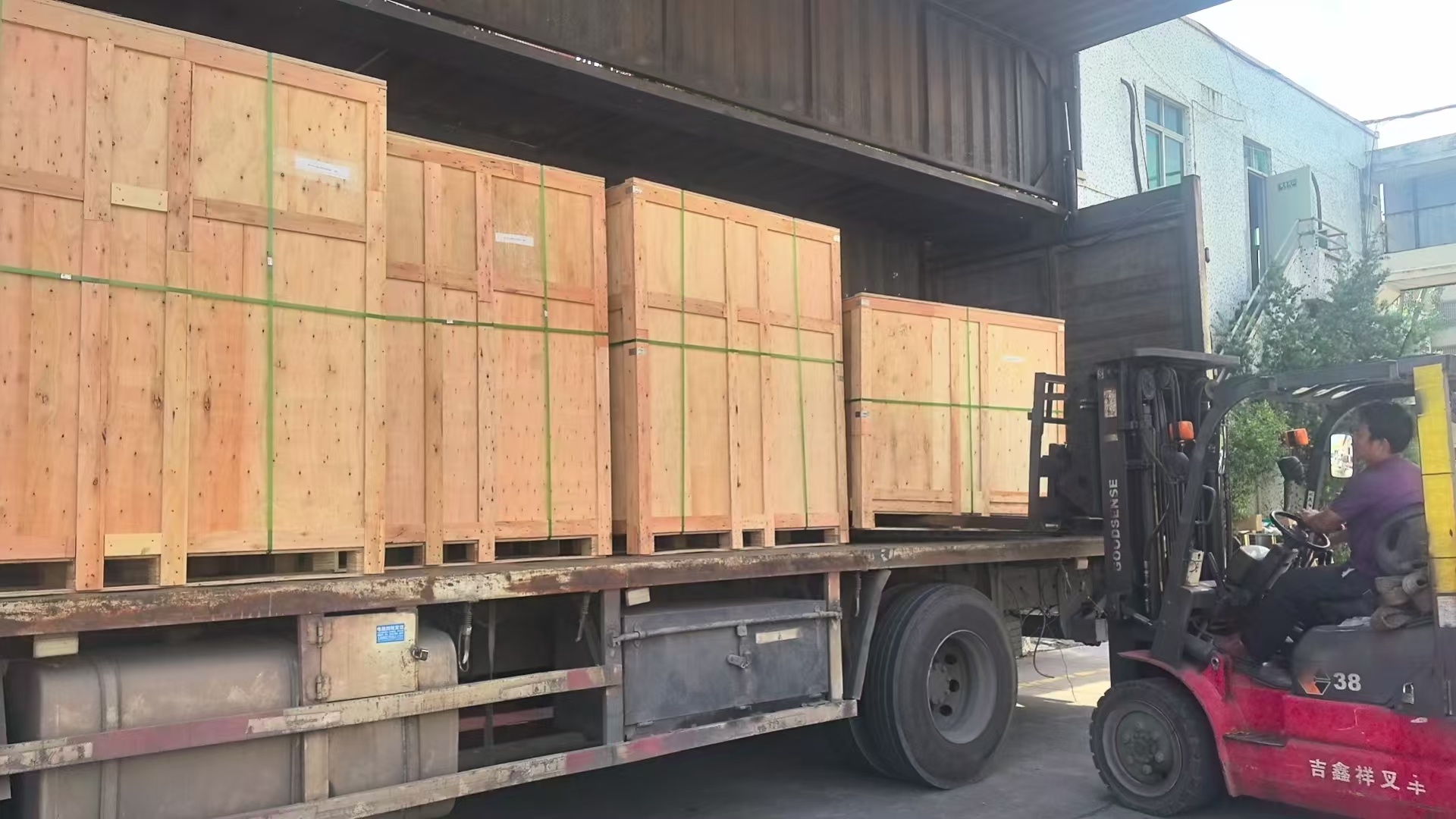
Loading check before dispatch — fully fabricated UPVC door and window units prepared for export shipment.
Have Questions or Need More Details?
Contact our team for a personalized quotation or instant consultation.
Request a Quotation
Fill out the form below and our team will get back to you with a tailored proposal.
WhatsApp Direct Chat
Prefer to chat in real-time? Message us on WhatsApp for instant assistance & quick answers.
- Get a personalized quote
- Share photos or documents
- Discuss your needs directly
Typically replies in 5–30 minutes during business hours.