Auto Detailing Guide: Chenille Mitts, Sponges, and Towels
Auto Detailing Application Guide: Choosing Between Chenille Mitts, Sponges, and Towels
Paint-safe car washing is a tool-selection problem before it is a chemistry problem. Chenille wash mitts and chenille sponges do the wet work: their pile lifts grit off the surface and holds it inside the fabric, while the foam they carry keeps lubricant between tool and paint. High-GSM twisted-loop towels do the dry work, removing rinse water without streaks, lint or water spots. The practical question for a car wash chain, a detailing studio or a private owner is therefore not “which product is best”, but “which construction belongs on which surface”.
This guide compares the three constructions that appear inside one wash cycle — the chenille mitt (MM-069), the chenille sponge (MM-067) and the twisted-loop drying cloth (MJ-030) — and adds a fine-weave glass cloth (MJ-013) for the final pass. Each is described by its actual build: fiber blend, fabric weight, dimensions, absorption behaviour and edge finishing, so a buyer can decide on specifications instead of appearance. The product data below comes from Foshan Patinda Housewares Co., Ltd. (Pa Tin Da Group), a microfiber cleaning products manufacturer based in Foshan, Guangdong, China.
Why a Single Tool Cannot Wash a Whole Vehicle
Most wash-induced scratches are created at the moment a particle of grit is dragged across a panel, not by the shampoo. Three properties decide whether that happens: whether the tool’s pile can capture and hold the particle, whether the tool’s contact surface is specified as safe for the finish, and whether the tool releases the captured particle when it is rinsed or laundered.
No single tool satisfies all three properties well across an entire vehicle, because the surfaces differ. Large flat panels need a broad contact area and a steady supply of foam. Wheel faces, spokes, hubs, grilles and mirror housings need a compact, compressible tool that can be squeezed into gaps. Glass needs a flat, fine-weave surface that finishes without lint residue or water marks. And the drying stage needs the highest water take-up in the kit. Using one cloth for all four stages transfers wheel grit onto paint and leaves water spots behind.
The selection criteria that follow from this are practical rather than promotional:
- Particle retention and release — an open pile traps grit away from the surface and lets it rinse out.
- Absorption capacity — measured by how many times its own weight in liquid the tool holds, which determines how often the operator must reload.
- Surface safety — whether the model is specified as scratch-safe for automotive paint, glass and wheel hubs.
- Lint and colorfastness — lint-free surfaces and stable dye are what make a final pass on dark paint or glass acceptable.
- Edge finishing — piped binding edges, ultrasonic cut edges and 10–12 stitches-per-inch overlock edges all exist to stop fibre shedding at the hem.
- Conformability — mitt, sponge and flat cloth each conform differently to flat, curved and recessed surfaces.
- Reusability — machine washability and repeated wash cycles determine cost per vehicle, not just price per piece.
Industry Background: Why These Tools Are Specified, Not Substituted
The category has scale behind it. The global microfiber cleaning cloth market is valued at approximately USD 3.8 billion in 2025 and is projected to reach USD 27.5 billion by 2034, according to Dataintelo. Household use is expected to lead with a 40.0% share in 2025, yet automotive care is one of the segments that pushes specification detail furthest, because the tool touches a painted surface where a single scratch is permanent. China remains the world’s largest exporter of microfiber towels, recording 10,544 shipments between June 2024 and May 2025 according to Volza.
The commercial argument for microfiber in a wash bay is measurable. Compared with traditional cleaning tools, microfiber products reduce chemical usage by up to 60% and water consumption by 90%, per Global Growth Insights. For an operator, that translates into less shampoo per vehicle, less rinse water and a shorter drying stage — the three line items that decide throughput in a wash tunnel or a hand-wash bay.
Buyers are also tying purchase to documentation. Standard 100 by OEKO-TEX is the dominant safety certification for microfiber textiles and requires testing against more than 1,000 harmful substances, while the Global Recycled Standard requires a minimum of 20% recycled content and tracks the entire production chain. Because certificates follow the exact article, a specification request should name the model, fabric weight and color being ordered rather than the supplier’s catalogue in general.
The supplier landscape is mixed. The microfiber cleaning market includes global players such as 3M, Freudenberg Group, Toray Industries and Libman alongside specialist manufacturers, and a large share of automotive detailing supply is produced by Chinese factories with OEM capability. For buyers, the differentiator is rarely the fiber itself — it is whether the construction is documented and repeatable across reorders.
Operating conditions for these tools are similar across markets. The typical scenario is an indoor enclosed environment at normal room temperature (10 ℃–35 ℃), with frequent water immersion, repeated wet-dry cycles and high-frequency friction and scrubbing. Their functional roles are surface dust wiping, water absorption, stain removal and car paint cleaning. Demand clusters in markets such as the United States and Germany, where automotive care and car wash chain supply projects are common applications.
Foshan Patinda Housewares Co., Ltd. (Pa Tin Da Group) has manufactured microfiber cleaning products since its founding in 2004. The company operates a 45,000 m² manufacturing plant with more than 10 fully automatic production lines and over 450 sets of advanced production machinery, employs approximately 200 staff and a 17-engineer R&D team, and reports an annual output of 2,184,270.46 kg with 98% of production exported to markets including the USA, Canada, Australia, the UK, Germany, France, Italy, the Netherlands, Russia, Japan, Korea, Switzerland, Sweden, Turkey and Saudi Arabia.
Detailed Solution: Matching Each Construction to the Surface It Touches
Chenille mitt (MM-069): the panel and wheel glove
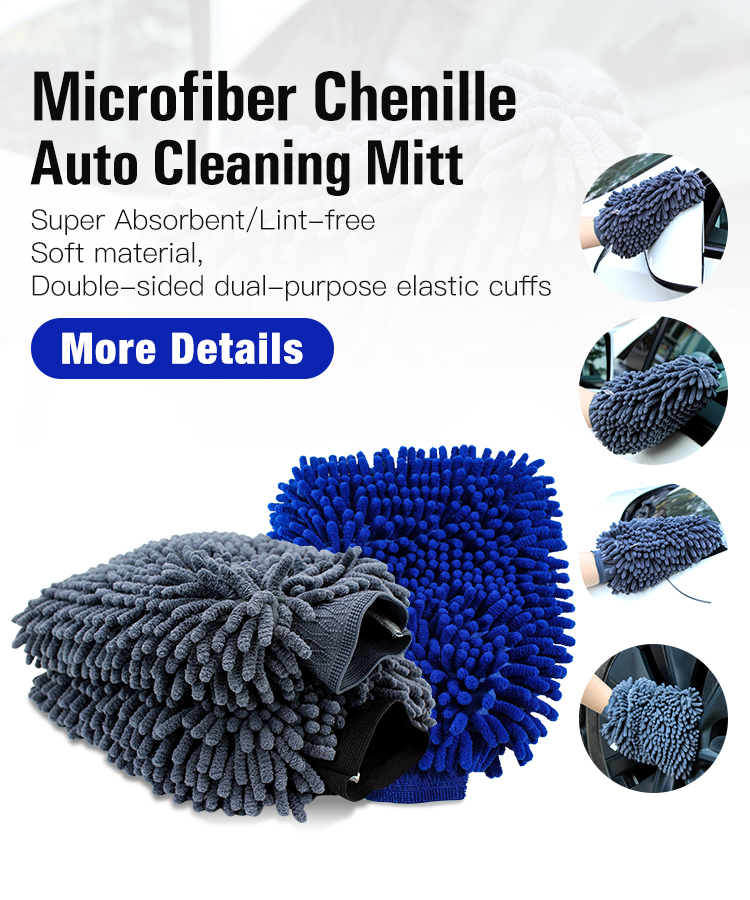
The MM-069 is an elastic cuff, dual-purpose auto exterior and wheel cleaning glove. It is made of 80% polyester and 20% polyamide microfiber chenille, in a standard dimension of 25×18 cm with customizable sizes available, at 135 g per mitt. Its structure is a double-layer, dual-face design with a thick chenille plush surface and a stretch elastic wrist cuff. Absorption is specified at up to 7 times its own weight of water and car wash foam, with rich foam production. The surface is lint-free, colorfast and scratch-safe for automotive paint, glass and wheel hubs.
Two details matter when this mitt is used. First, the thick chenille plush surface and the double-layer construction let the mitt carry shampoo from the bucket to the panel rather than relying on constant re-dipping, which is what the “rich foam production” specification describes in practice. Second, because the same model is specified as scratch-safe for wheel hubs as well as paint, a wash operation can standardize on one glove type for two zones and separate the units by color — the model supports customizable solid color, woven label and embossed or printed logo, so wheel gloves and paint gloves can be colour-coded and never mixed.
The glove format itself is part of the specification. A stretch elastic wrist cuff keeps the mitt anchored to the hand, so the operator washes with the palm and fingers rather than with a loose cloth that can fold and trap grit.
Chenille sponge (MM-067): the contour and low-clearance tool

The MM-067 is a wrist elastic fixed thick foam interior and exterior auto cleaning sponge. Its construction is three-part: an outer chenille microfiber pile surface, a middle thick water-absorbent sponge, and a back mesh fabric with a fixed elastic wrist band. The material blend is 80% polyester and 20% polyamide microfiber chenille with an inner sponge and mesh cloth. Standard size is 28×18 cm with customizable sizes available, at 115 g per piece. It is specified as high water and foam absorption, lint-free, and scratch-free for car paint, wheels and glass, with a flexible handheld design.
The sponge core is the difference from the mitt. Where the mitt is designed to release foam onto a flat panel, the sponge stores water and shampoo inside its own body, so the tool keeps working through spokes, bumper curves, badge recesses and lower clearances without being returned to the bucket between passes. The flexible handheld format also allows the operator to compress the sponge into a gap instead of scrubbing at an angle, which reduces the risk of applying edge pressure to paint.
A practical division of labour between the two chenille tools is straightforward: MM-069 for large exterior panels and wheel faces, MM-067 for contoured areas, wheel spokes, grilles, mirror housings and any surface where a mitt is too bulky to reach cleanly. Both support customizable solid color, woven label, printed or embossed logo and diversified packing.
Long plush mitt (MM-070): an alternative pile for exterior washing
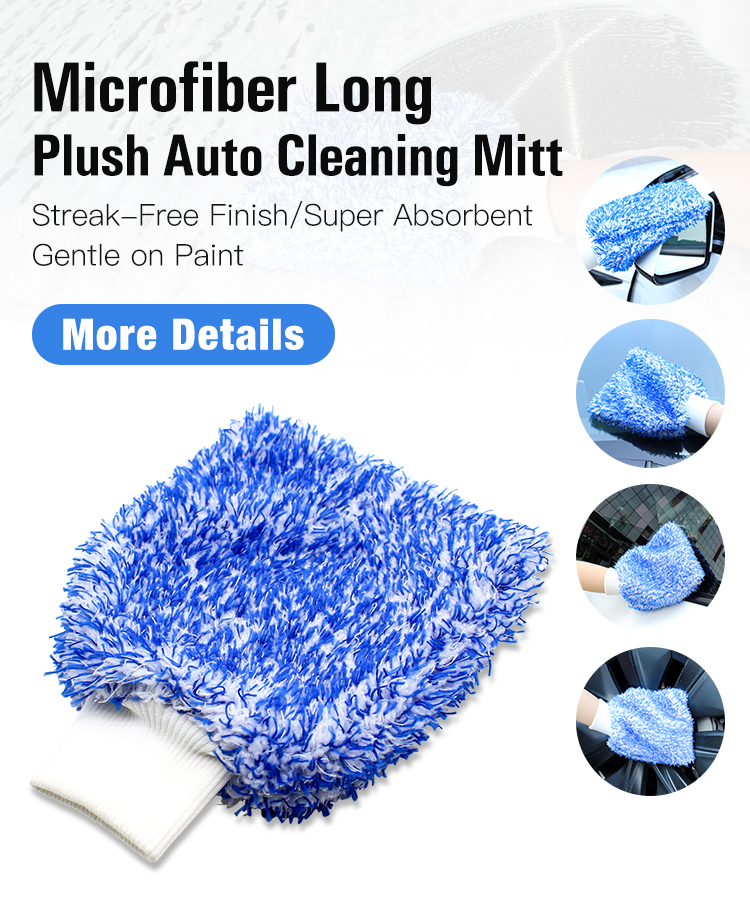
Not every buyer selects chenille. The MM-070 is an elastic cuff, single-face fluffy plush auto exterior washing glove made of 80% polyester and 20% polyamide microfiber, with a long fluffy microfiber outer surface, a soft skin-friendly lining and a stretch knitted elastic wrist cuff. Standard size is 28×20 cm with customizable sizes, at 85 g per piece. It provides high water and foam absorption, is lint-free, shows no color fading, is scratch-free for car paint, glass and wheel surfaces, and is machine washable.
The trade-off between the two pile types is concrete. Chenille (MM-069, 135 g) produces richer foam and a more open pile structure for grit capture across heavily soiled panels. Long plush (MM-070, 85 g) is lighter, has a softer hand feel and carries an explicit machine-washable specification — a useful property for households and for wash operators who launder tools frequently.
Twisted-loop drying cloth (MJ-030): the drying stage
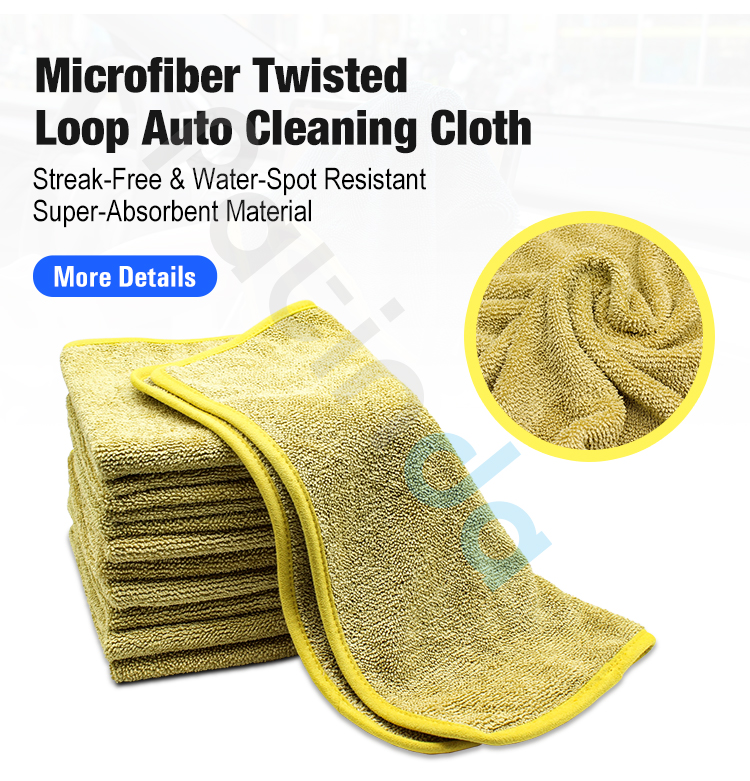
The MJ-030 is a high-GSM auto detailing super absorbent twisted pile cleaning cloth made of 80% polyester and 20% polyamide microfiber, with a fabric density of 500–1000 gsm. Available sizes are 100×50 cm and 60×40 cm, with customizable dimensions optional. The craft feature is twisted fiber loop technology combined with a colorful piped binding edge for anti-shedding. Performance specifications are: absorbs up to 7 times its own weight of liquid; streak-free and water-spot resistant; lint-free; scratch-safe for automotive paint and glass; reusable and machine washable.
The twisted loop structure is the reason this cloth is specified for the final passes rather than for washing. Twisted pile stands taller and drains differently from flat terry, so the cloth releases water into its own body instead of pushing it across the panel, which is what produces the streak-free, water-spot resistant result. The piped binding edge addresses the second common defect in a drying towel — fibre shedding at the hem.
Related constructions in the same family are worth knowing when a buyer specifies a kit. The MJ-023 is a dual-sided twisted pile cloth in the same 500–1000 gsm band with a bright color binding edge. The MJ-021 is a high-GSM terry auto cleaning cloth at 250–500 gsm, absorbing up to 7 times its own weight of liquid and described as 4 times more absorbent than cotton, with a decorative overlock binding edge and machine washability. The MJ-022 car wash towel uses a 300–500 gsm fabric with ultrasonic cut edges that prevent loose threads and a single-side long plush terry pile. A common specification is twisted loop for the final paint pass and terry for interior surfaces, door jambs and utility work.
Glass cloth (MJ-013): the last step
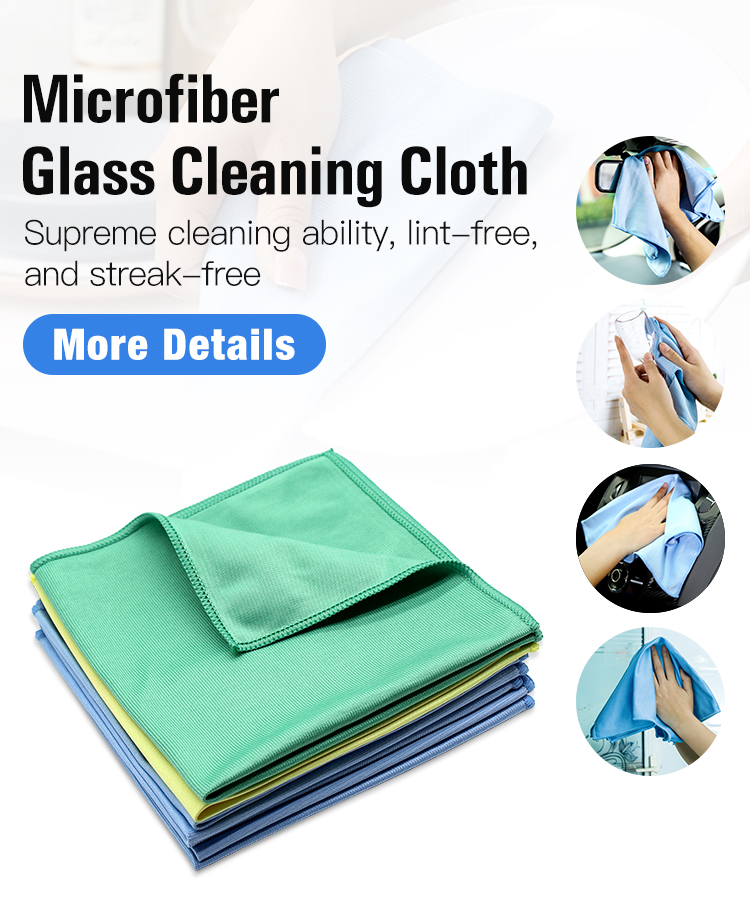
The MJ-013 is a lint-free, streak-free fine weave glass and screen polishing towel made of 80% polyester and 20% polyamide, with a GSM range of 180–320 gsm and a standard size of 40×40 cm. Its edge is double overlock stitched at 10–12 stitches per inch. The fine rib weave improves friction, and the cloth offers dual functions for cleaning and polishing, dry or wet use, with no lint residue and no water marks while removing grease and water stains efficiently. Its stated applications include automotive glass and auto parts maintenance, glass and tableware polishing, LCD screen cleaning, appliance and furniture surface wiping, and window glass.
Glass exposes defects that paint hides. Any lint left by a towel is immediately visible against a dark interior, and any residual water film dries into a mark. That is why the final step should use a cloth whose weave and edge are specified for the purpose rather than a spare drying towel.
Decision rule: assign one tool per zone and keep the zones separate — chenille mitt (MM-069) for exterior panels and wheel faces, chenille sponge (MM-067) for contours and low clearances, twisted-loop cloth (MJ-030) for paint and glass drying, fine-weave cloth (MJ-013) for the final glass pass. A wheel tool should never be promoted to paint duty, because grit captured in a pile is invisible until it is dragged across a panel.
Step-by-Step: Running a Paint-Safe Wash Cycle With These Tools
- Stage the tools before water touches the vehicle. One wash bucket with shampoo and an MM-069 for the upper body, a second MM-069 or an MM-067 reserved for wheels, an MJ-030 drying cloth within reach, and an MJ-013 for the glass pass. Colour-coded units prevent mixing — MM-069 supports customizable solid color, so wheel gloves can be a different colour from paint gloves.
- Pre-rinse to soften the film. The tools’ documented roles begin with surface dust wiping and stain removal; removing loose dust first reduces the load the pile has to hold.
- Clean wheels before the body. Use MM-069 on wheel faces and hubs, which it is specified as scratch-safe for, or MM-067 where spokes and recesses need a compressible tool. Its chenille pile absorbs up to 7 times its own weight in water and foam, so it carries enough shampoo to work without constant reloading.
- Wash panels from the top down with the mitt. Load the MM-069 with foam, work in straight overlapping passes with light pressure, and let the pile do the work. The thick chenille plush surface is what generates rich foam and holds the lubricating film between tool and paint.
- Switch to the sponge for contours. Grilles, badges, mirror housings, bumper curves and lower clearances are MM-067 territory: the inner sponge keeps a water and shampoo reserve while the flexible handheld body lets you compress into gaps rather than scrub at an angle.
- Rinse thoroughly and inspect. Rinse from the top down and check the lower panels for remaining film before drying. Drying over residual soil is where water-spot complaints usually start.
- Optional decontamination. For vehicles with bonded contamination, the MM-072 clay towel is a two-in-one reusable paint decontamination cloth: 30×30 cm, 120 g, with a rubber dotted clay surface on one side and a high-absorbent microfiber terry reverse. It is specified to clear iron powder, paint speckle, bird droppings, oxidation and asphalt stains from car paint, is scratch-free on automotive paint surfaces, and is reusable after cleaning, with a double-stitched hem for service life.
- Dry with the twisted-loop cloth. Lay the MJ-030 flat — 100×50 cm for full panels, 60×40 cm for door frames, pillars and interior trim — and pull it across the surface, or blot on vertical panels. The twisted fibre loop and 500–1000 gsm density are what deliver the streak-free, water-spot resistant finish, and the piped binding edge prevents shedding at the hem.
- Finish the glass last. Use the MJ-013 dry after a wet wipe: the fine rib weave removes grease and water stains, and the 10–12 stitches-per-inch double overlock edge keeps lint out of the finish. Dry or wet use is both supported.
- Launder and rotate. Models with an explicit machine-washable specification include the MJ-030, MJ-021, MJ-022 and MM-070. Wash wheel tools in a separate load from paint tools, and retire any tool once its pile stops holding water or its edge begins to fray.
Use Cases
1. Car wash chains and high-volume bays
Standardization is the priority. One glove type — the MM-069 — covers exterior panels and wheel hubs, absorbs up to 7 times its own weight of water and foam, and generates rich foam to reduce shampoo consumption. Colour-customized units keep the wheel set and paint set physically separate, and the elastic cuff keeps the glove on the operator’s hand through a full shift. This mirrors documented use in car wash chain supply projects in markets such as the United States, where the tools operate through repeated wet-dry cycles and high-frequency friction.
2. Auto beauty and detailing centres
Where the finish is the product, the sequence matters more than the speed. MM-069 for the top-down panel wash, MM-067 for contours and wheel detail, MM-072 for decontamination when paint feels rough, MJ-030 for a streak-free, water-spot resistant dry-down, and MJ-013 for glass and interior screens. Each of these tools is specified as lint-free and scratch-safe for the surfaces in question, which is the property a detailing customer actually pays for.
3. Household vehicle maintenance
A private owner buys fewer tools but still needs the split. The MM-070 long plush mitt (28×20 cm, 85 g, machine washable) handles exterior washing, MJ-021 or MJ-022 terry cloths absorb up to 7 times their own weight for drying and interior work, and MJ-013 finishes glass and screens. The MJ-001 universal cloth — 85% polyester and 15% polyamide, 180–450 gsm, warp knit terry texture with double stitched edges, lint-free and non-fading — covers garage benches, door jambs and general wiping from the same kit.
4. Retail kits and private-label programmes
Detailing kits are assembled from exactly these models: one chenille mitt, one chenille sponge, one twisted-loop drying cloth and one glass cloth. Customization options across the range include solid colour, woven label, embossed or printed logo, Pantone colour matching and diversified outer packing, which is what allows a retail brand or distributor to build a kit under its own identity without changing the underlying construction.
Construction Comparison
| Model | Type | Material | Size & weight | Key performance | Best use |
|---|---|---|---|---|---|
| MM-069 | Chenille auto cleaning mitt (elastic cuff, dual-purpose) | 80% polyester + 20% polyamide microfiber chenille; double-layer dual-face | 25×18 cm; 135 g per mitt | Absorbs up to 7× own weight of water and foam; rich foam; lint-free; colorfast; scratch-safe for paint, glass and wheel hubs | Exterior panels and wheel faces |
| MM-067 | Chenille auto cleaning sponge (wrist elastic, thick foam) | Chenille pile over thick water-absorbent sponge; mesh back | 28×18 cm; 115 g per piece | High water and foam absorption; lint-free; scratch-free for paint, wheels, glass; flexible handheld design | Contours, spokes, grilles, low clearances |
| MM-070 | Long plush auto cleaning mitt (single-face, elastic cuff) | 80% polyester + 20% polyamide microfiber; soft lining | 28×20 cm; 85 g per mitt | High water and foam absorption; lint-free; no color fading; machine washable; scratch-free for paint, glass, wheels | Exterior washing where laundering is frequent |
| MJ-030 | Twisted loop auto cleaning cloth (high GSM) | 80% polyester + 20% polyamide; twisted fiber loop; piped binding edge | 100×50 cm / 60×40 cm; 500–1000 gsm | Absorbs up to 7× own weight of liquid; streak-free and water-spot resistant; lint-free; scratch-safe for paint and glass; reusable and machine washable | Drying paint and glass |
| MJ-013 | Glass cleaning cloth (fine weave, polishing) | 80% polyester + 20% polyamide; fine rib weave; double overlock edge | 40×40 cm; 180–320 gsm | Lint-free, streak-free polishing; dry or wet use; removes grease and water stains; no water marks | Auto glass, mirrors, LCD screens, appliance surfaces |
Related models for specification planning: MJ-023 (dual-sided twisted pile, 500–1000 gsm, bright color binding edge), MJ-021 (terry, 250–500 gsm, described as 4 times more absorbent than cotton, machine washable), MJ-022 (300–500 gsm, ultrasonic cut edge, single-side long plush terry, machine washable) and MM-072 (clay decontamination towel, 30×30 cm, 120 g).
FAQ
What materials and quality documents should a buyer check before ordering?
The auto care tools in this guide are built on an 80% polyester and 20% polyamide microfiber blend — chenille in MM-069 and MM-067, twisted pile in MJ-030 and fine rib weave in MJ-013 — and the MM-069 and MJ-030 are both specified as lint-free, with MM-069 additional specified as colorfast. On documentation, retail and OEM buyers normally request test evidence for textile safety: Standard 100 by OEKO-TEX tests against more than 1,000 harmful substances, and the Global Recycled Standard requires a minimum of 20% recycled content with production-chain tracking. Certificates follow the specific article, so the request should name the model, fabric weight and colour ordered rather than the catalogue in general.
Can the same chenille tool be used on paint and on wheels?
MM-069 is described as a dual-purpose auto exterior and wheel cleaning glove, and MM-067 is specified as scratch-free for car paint, wheels and glass — so the construction itself is not the limiting factor. The limiting factor is the grit the tool carries. Detailing practice is to dedicate one mitt or sponge to wheels and lower body and another to the upper paint panels, then launder the wheel tools in a separate load. Colour customization (MM-069) makes that separation visible in the wash bay, and both chenille tools are specified to absorb up to 7 times their own weight of water and foam, so either unit performs its role without constant reloading.
Twisted loop or terry: which drying cloth should be specified?
Twisted loop is the final-pass construction. MJ-030 and MJ-023 use twisted fibre loop technology at 500–1000 gsm, absorb up to 7 times their own weight of liquid, and are specified as streak-free and water-spot resistant, with piped or bright colour binding edges to control shedding. Terry is the utility construction: MJ-021 sits at 250–500 gsm and is described as 4 times more absorbent than cotton with a decorative overlock binding edge and machine washability, while MJ-022 uses a 300–500 gsm fabric with ultrasonic cut edges to prevent loose threads. A working kit typically carries both — twisted loop for paint and glass, terry for interiors and general work.
What actually drives the cost of these tools?
Construction and finishing drive cost more than branding does. The variables are: pile type (twisted loop versus terry versus chenille versus plush); fabric weight band (MJ-030 at 500–1000 gsm, MJ-021 at 250–500 gsm, MJ-013 at 180–320 gsm, MJ-001 at 180–450 gsm); fibre blend (85% polyester / 15% polyamide on MJ-001 versus 80/20 on the auto care models); edge finishing (piped binding edge on MJ-030, ultrasonic cut edge on MJ-022, 10–12 stitches-per-inch double overlock on MJ-013, decorative overlock on MJ-021); dimensions (100×50 cm versus 60×40 cm on MJ-030); piece weight (135 g on MM-069, 115 g on MM-067, 85 g on MM-070); and customization (solid color, woven label, embossed or printed logo, Pantone matching, retail packing). Comparing suppliers on these line items is more reliable than comparing on appearance.
How should a buyer validate these tools before committing to volume?
Run a controlled wash on a single test vehicle. Wash an exterior panel with MM-069 and a wheel assembly with MM-067, dry the paint with an MJ-030 in the 60×40 cm size, and finish the glass with MJ-013 — then examine the paint under direct light for marring, check the glass for lint and water marks, and confirm the pile still holds water after laundering. Because all of these models support customizable colour, woven label, embossed or printed logo and diversified packing, the same sample round is the point at which a private-label or kit configuration can be fixed. Foshan Patinda Housewares Co., Ltd. supplies product samples and specification sheets for this purpose from its 45,000 m² plant in Foshan, Guangdong; requests can be sent to sale@microfiberchina.com or +86 13902254847 (WhatsApp available).
Conclusion: Build the Kit Around the Surface, Not the Price Tag
The three constructions in this guide solve three different problems. Chenille (MM-069 and MM-067) is the wet stage — an open pile that holds grit and foam, in a glove and a sponge format that respectively suit flat panels and contoured, low-clearance areas. Twisted loop (MJ-030, with MJ-023, MJ-021 and MJ-022 as related options) is the dry stage, where 500–1000 gsm density and anti-shedding edge finishing produce a streak-free, water-spot resistant finish. Fine weave (MJ-013) is the final glass pass, where lint and water marks are the only two defects that matter.
Buyers who treat those as three separate specifications — with documented GSM, fiber blend, dimensions and edge finishing on each — get a kit that behaves consistently across reorders. Buyers who collapse them into one “microfiber cloth” line usually discover the gap the first time a wheel tool is used on a dark panel.
Next step: samples, specifications and the full catalogue
Foshan Patinda Housewares Co., Ltd. (Pa Tin Da Group) has manufactured microfiber cleaning products in Foshan, Guangdong since 2004, with a 45,000 m² facility, more than 10 fully automatic production lines and over 450 sets of production machinery. For auto detailing kits, the company supplies the MM-069 chenille mitt, MM-067 chenille sponge, MM-070 long plush mitt, MJ-030 twisted loop drying cloth, MJ-013 glass cleaning cloth and MM-072 decontamination clay towel, with customization of colour, woven label, logo and retail packing.
Download the product catalogue (PDF) for full specifications: E-catalog Pa Tin Da. To request samples or a quotation for your wash programme, contact sale@microfiberchina.com or +86 13902254847, or visit www.microfiberchina.com.
Have Questions or Need More Details?
Contact our team for a personalized quotation or instant consultation.
Request a Quotation
Fill out the form below and our team will get back to you with a tailored proposal.
WhatsApp Direct Chat
Prefer to chat in real-time? Message us on WhatsApp for instant assistance & quick answers.
- Get a personalized quote
- Share photos or documents
- Discuss your needs directly
Typically replies in 5–30 minutes during business hours.