
Evaluating a Microfiber Supplier's Capability: From Yarn Quality to Edge Stitching
Supplier Capability Evaluation
A microfiber supplier's capability can be checked at four points before any bulk commitment: the accuracy of the fibre blend, the construction and weight of the knitted fabric, the finishing of the edge, and the supplier's control over customization. Every other number in a quotation — unit cost, packing, delivery promise — rests on those four.
This guide is written for buyers still in the research and evaluation stage of a microfiber cleaning products sourcing project. It sets out what can be confirmed from a supplier's own product documentation, what has to be counted or tested on a physical sample, and which questions need written answers before a purchase order is placed.
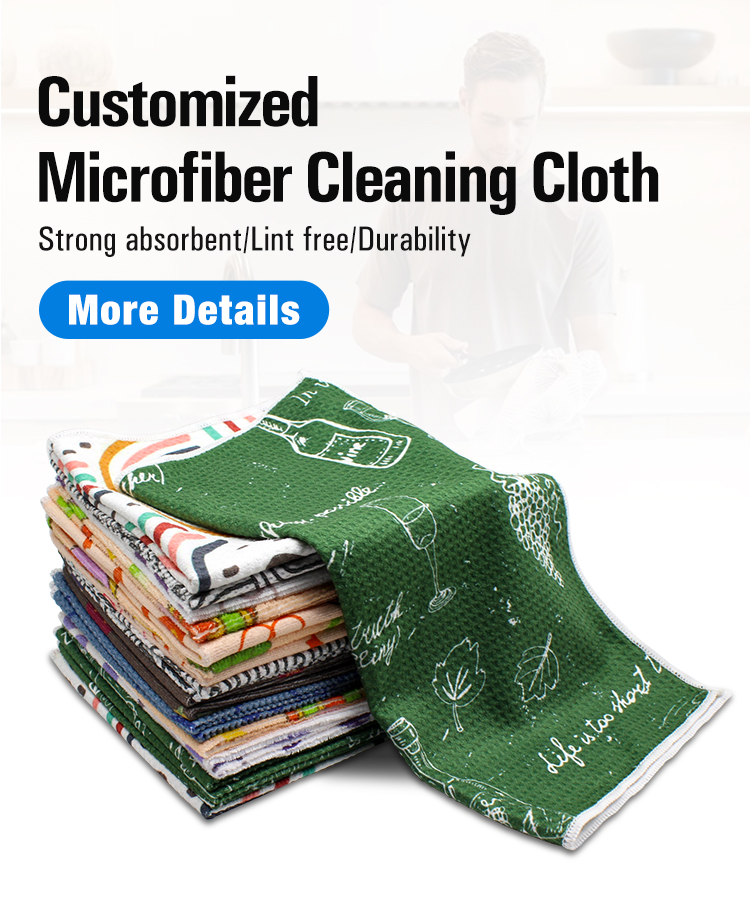
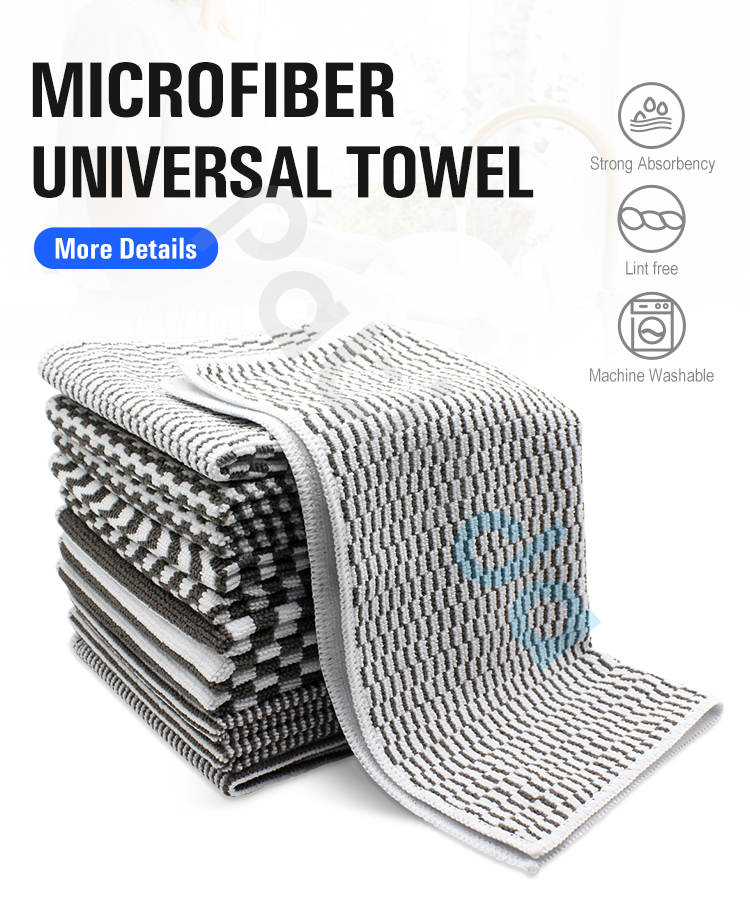
The evidence used throughout comes from real product specifications rather than generic claims: an 80% polyester / 20% polyamide terry mop refill (MT-003), a kitchen towel finished with a 10–12 stitches per inch locking edge (MD-020), and a polishing cloth with a scalloped laser-cut edge (MW-002).
Why Two Microfiber Suppliers Can Look Identical on Paper
Two quotations for 'microfiber cleaning cloth' frequently contain the same words: lint-free, 80/20, super absorbent, reusable. None of these is a specification. A nominal blend ratio does not show whether the yarn was checked before knitting. 'Lint-free' does not describe the edge finish that most often causes shedding in use. 'Reusable' does not define how many wash cycles the product survives.
Supply is not the constraint. The global microfiber cleaning cloth market was estimated at USD 979.2 million in 2025 and is projected to reach USD 1,520.7 million by 2035, a 4.5% CAGR, according to commercial research published by Future Market Insights and Fortune Business Insights. What buyers cannot easily compare is repetition — whether the supplier can deliver the same blend, the same gram weight, the same edge and the same packing across successive orders.
That is the capability gap this evaluation addresses. It is arranged from the raw material outward, because a defect introduced at the yarn stage cannot be corrected by a better hem.
Industry Background: A Specification-Driven, Compliance-Linked Market
Microfiber is a technical term, not a marketing one. It describes fibre measuring below 1.0 denier — the diameter or fineness of a continuous or filament fibre. Fine filaments create the capillary structure that lets the cloth draw water and trap dust rather than push it across a surface.
Commercially, the multicomponent construction — a polyester and polyamide blend — held a 58.0% revenue share of the market in 2025, which is why 80/20 appears so often in product specifications. Kitchen care was the single largest application segment, at 28.3% revenue share in the same year.
Two consequences follow for buyers. First, because the dominant material system is standardised, competition shifts to execution: knitting, weight tolerance, edge finishing and colour control. Second, chemical compliance is now part of the specification. OEKO-TEX STANDARD 100 was updated in 2024 to include a total fluorine (TF) limit of 100 mg/kg, introduced in response to PFAS regulation. A supplier that cannot connect its textile specification to a current chemical-safety requirement is not fully evaluated, however good the cloth feels.
The Five Capability Layers You Can Actually Verify
Capability in this category is not a single claim. It is five layers stacked in the order in which defects are created, and each one leaves a trace that a buyer can inspect.
Layer 1 — Yarn fineness and fibre blend accuracy
The blend ratio is the first item to confirm per SKU, not per catalogue. Within the same supplier's range, ratios legitimately differ:
- 80% polyester / 20% polyamide — the standard blend across the terry wet mop refill MT-003, the kitchen towel MD-020, the polishing cloth MW-002, the glass cloth MJ-013 and the wineglass towel MJ-066.
- 85% polyester / 15% polyamide — the universal cleaning cloth MJ-001, specified with a 180–450 gsm range.
- 88% polyester / 12% polyamide suede — the sports towel MST-001.
- 60% polyester / 20% polyamide / 20% bamboo fibre — the bamboo fibre dish cloth MW-003, described as antibacterial and odourless.
- 70% polyester / 20% PU / 10% polyamide — the PU coated cloth PU-001.
- 50% polyester / 50% instant cooling fibre — the cooling towel MST-002.
A supplier that publishes one blend for an entire range, or that cannot restate the ratio on the packing list, has not separated its SKUs at the material level. Ask for the blend in writing per item number, then compare it against the sample label.
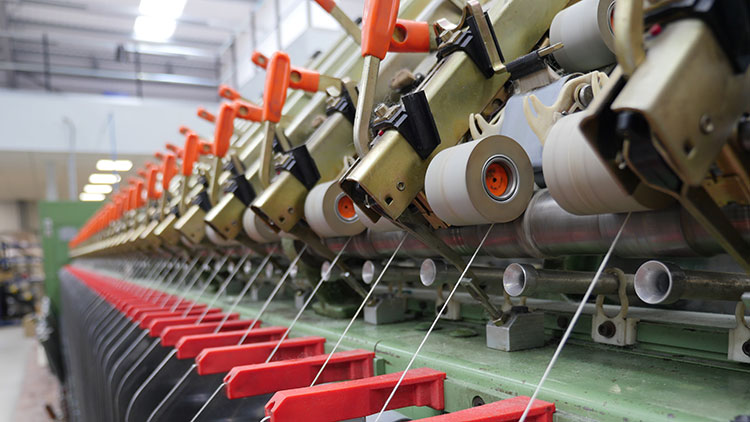
Layer 2 — Fabric construction, weight and surface
Gram weight defines how much material is in the cloth, and the construction defines how that material behaves against a surface. Real specification ranges run from 180 gsm on the glass cloth MJ-013 and the cleaning cloth roll MJ-012, through 250–350 gsm on the kitchen towel MD-020 and the PU coated cloth PU-001, to 500–1000 gsm on the twisted loop auto cleaning cloth MJ-023.
Construction is equally specific. The universal cleaning cloth MJ-002 uses a warp-knitted terry surface at 300 gsm. The kitchen towel MD-020 is a striped weave available in multiple patterns. The customized cloth MS-075 uses a waffle honeycomb weave. The pet towel PET-001 and hand drying towel MJ-070 use coral fleece. Chenille pile is used on the auto cleaning mitt MM-069 and sponge MM-067, while the tufting mop MP-006 uses a tufted loop surface with a fringe edge.
When reviewing a spec sheet, ask for weight as a range with a tolerance, not as a single figure. A supplier quoting '300 gsm' with no tolerance band is telling you that variation is uncontrolled.
Layer 3 — Edge finishing and stitching density
The edge is where most microfiber complaints originate, and it is the least specified element in most quotations. Density is measurable. The kitchen towel MD-020 is finished with a 10–12 stitches per inch high-density locking edge. The same 10–12 stitches per inch specification appears on the glass cleaning cloth MJ-013 (double overlock), the wineglass wiping towel MJ-066 (high-density locking edge), the bamboo fibre cloth MW-003 (double overlock), the sports towel MST-001 (dense overlock) and the cooling towel MST-002 (double overlock reinforced).
Other finishing methods appear where stitching is not the right answer:
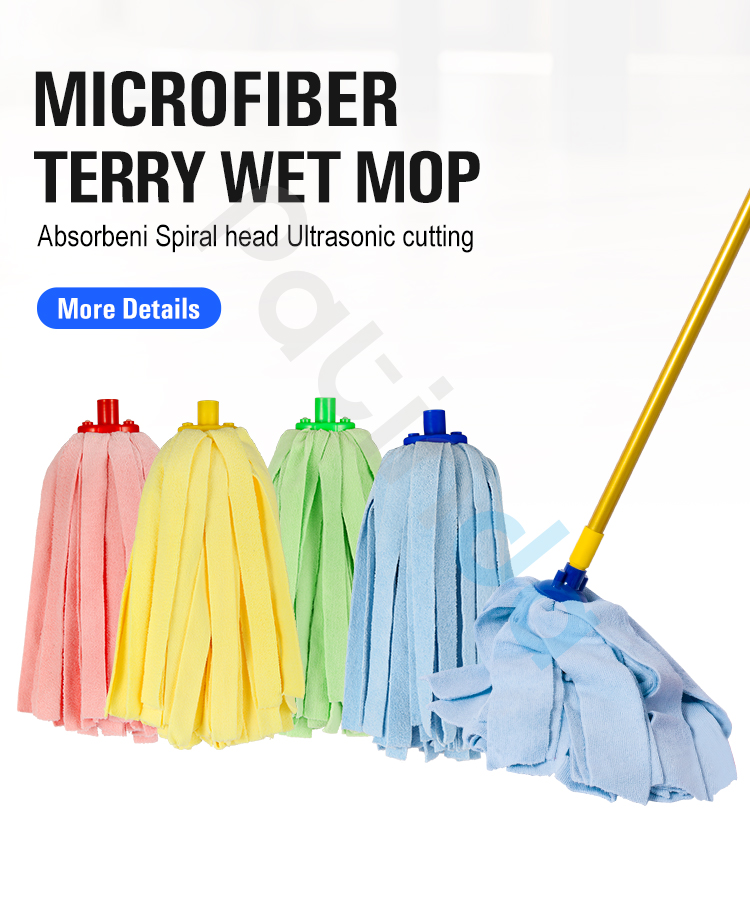
- Ultrasonic sealed cutting strip edge — the terry wet mop refill MT-003, where a stitched edge would be too bulky for a strip mop head.
- Ultrasonic cut edge — the PU coated cloth PU-001 and the car wash towel MJ-022, producing a clean edge without loose thread.
- Scalloped laser-cut edge — the premium polishing cloth MW-002, chosen for a circular-knitted construction.
- Die-cut finished edge — the PVA cleaning cloth PVA-002.
- Double stitched edge — the customized cloth MS-075 and the universal cleaning cloth MJ-001.
In a sample review, count stitches per inch on the actual hem, then re-inspect the same edge after repeated washing. The reference you hold suppliers to should include the wash temperature — the hair drying turban GFM-002, for example, is specified as colour-fast with no fading after washing at 85 °C.
Layer 4 — Assembly and functional hardware
For mops and glass washers, the capability question extends to the hardware that makes the textile usable. The stripe mop MP-014 and abrasive mop MP-020 both use a back double-pocket fixing with a four-colour classification label for area management; the tufting mop MP-006 uses the same pocket system with a colour identification tag. The twisted mop MP-015 uses a full velcro backing matched to an aluminium frame and a thickened telescopic pole. The terry wet mop MT-003 connects through a spiral plastic socket.
Glass washer covers CG-001, CG-002 and CG-003 use a velcro plus elastic loop fixation with a fully wrapped hemmed edge, and the CG-000 set pairs the cover with a two-stage retractable aluminium alloy handle. Confirm in writing that the pole, bracket and socket are included in the quoted price, and that replacement covers or refills can be ordered separately — a point that matters for hotel and facility contracts where refills are reordered without the frame.
Layer 5 — Customization control, quality control and capacity
The last layer determines whether a sample can be turned into a repeatable programme. Available customization scope in this range covers size, weight, logo, material, fabric texture, printing, colour, accessories, packaging, extra functional features, shipping label and GSM. Practical examples: the kitchen towel MD-020 accepts custom colour, logo and package; the customized waffle cloth MS-075 accepts custom printing patterns and Pantone colour; the terry wet mop MT-003 accepts colour options of pink, blue, yellow and green; the wineglass towel MJ-066 accepts a custom border colour.
Behind that scope sit four figures that should appear in any capability review: a monthly capacity of 182,022 kg, a minimum order quantity of 3,000 pcs, a lead time of 30–45 days, and a stated quality control position of 100% test. The manufacturing base supporting these figures is a plant established in 2004, now operating a 45,000 m² facility with 200 employees, 17 engineers in the R&D team, an annual output of 2,184,270.46 kg and an export ratio of 98%.
Independent export activity is also checkable. US customs import records list 172 bills of lading for Foshan Pa Tin Da Housewares Co., Ltd. between June 2019 and September 2026 — a third-party data point that corroborates sustained export operations rather than a one-off shipment.
'100% test' is only meaningful if you know what is tested. Ask for the inspection items in writing. Blend verification, gram weight, size tolerance, absorbency, edge integrity and colour fastness are the six that map directly onto the layers above.
Step-by-Step: A Nine-Point Supplier Evaluation Checklist
- Request SKU-level specification sheets. Fibre blend, gram weight, size, single-piece weight, edge type and packing must be stated per item number, not per category.
- Cross-check the blend ratios. Confirm that different constructions carry the ratio appropriate to them — 80/20 on MD-020, 85/15 on MJ-001, 88/12 on MST-001.
- Confirm weight as a range. Check both the GSM band and the tolerance, for example 250–350 gsm on MD-020 or 500–1000 gsm on MJ-023.
- Count stitches per inch on the sample. The benchmark in this range is 10–12 stitches per inch on stitched edges such as MD-020, MJ-013 and MJ-066.
- Re-check the edge after washing. Compare stitched, ultrasonic, laser-cut and die-cut edges against the end use, using a stated wash reference such as the 85 °C colour-fastness specification on GFM-002.
- Verify hardware and refill availability. For mops and glass washers, confirm pocket or velcro systems, sockets, poles and separately orderable refills.
- Lock the customization scope in writing. Size, weight, logo, colour, fabric texture, printing, packaging, shipping label and GSM should all be itemised per SKU.
- Match MOQ, capacity and lead time to your launch plan. 3,000 pcs minimum, 182,022 kg monthly capacity and 30–45 days lead time are the figures to test against your first order schedule.
- Request compliance documentation and verify it at the source. A supplier's statement of certification is a claim until it is confirmed against the issuing body's register.
Use Cases: Matching Verified Capability to Project Conditions
Hotel and resort sanitation procurement
Hotel and resort daily sanitation procurement is a reusable daily-use application: product is washed and reused repeatedly, in an indoor enclosed environment at normal room temperature of 10 °C to 35 °C, with frequent water immersion and repeated wet-dry cycles. This scenario is common in Germany and in other European markets. The requirements that appear most often in this type of project are custom logo, custom size and colour, quick-dry, lint-free and high water absorbency. Colour-coded pocket mops such as MP-014, MP-020 and MP-006 suit this environment because the four-colour classification tag supports zone separation between areas.
Auto beauty and car wash chain supply
Auto beauty and car wash chain supply projects add high-frequency friction and repeated scrubbing to the same wet-dry conditions. The product's role is to wipe surface dust, absorb water, remove stains and clean car paint. The relevant range includes the terry auto cleaning cloth MJ-021 at 250–500 gsm, the car wash towel MJ-022 at 300–500 gsm with an ultrasonic cut edge, and the twisted loop cloth MJ-023 at 500–1000 gsm. Chenille mitts and sponges MM-069, MM-067 and MM-070 cover the wash stage, while the clay towel MM-072 handles paint decontamination.
Kitchen and food service
Kitchen care is the largest application segment in the category, and it places the highest demand on edge durability because cloths are wrung repeatedly. The kitchen towel MD-020 with its 10–12 stitches per inch locking edge, the double layer dish cloth MJ-016 with a PET mesh scrubbing side, the antibacterial bamboo fibre cloth MW-003 and the waffle honeycomb cloth MS-075 are natural candidates, with the perforated roll MJ-012 for high-volume wiping.
Glass, mirror and display surfaces
Streak-free results depend on fibre fineness and a non-shedding edge rather than on pressure. The glass cleaning cloth MJ-013, the premium polishing cloth MW-002 with its scalloped laser-cut edge, and the wineglass wiping towel MJ-066 form a coherent set, supported by the glass washer covers CG-001, CG-002 and CG-003 at 650–680 gsm.
Commercial floor care
Where floor pads are washed at high frequency, wash-cycle endurance becomes the specification that matters. The stripe mop MP-014 is described as reusable over 300 washing cycles, and the abrasive mop MP-020 adds a PET abrasive stripe for stubborn stains while remaining scratch-free on marble, hardwood and ceramic tile.

Comparison Table: Specifications That Separate One SKU From Another
| Model | Product | Fibre blend | Weight / GSM | Edge finishing | Custom option |
|---|---|---|---|---|---|
| MT-003 | Microfiber Terry Wet Mop | 80% polyester / 20% polyamide | Refill 200 g or 300 g | Ultrasonic sealed cutting strip edge | Colour (pink/blue/yellow/green), logo, packing |
| MD-020 | Microfiber Universal Towel | 80% polyester / 20% polyamide | 250–350 gsm | 10–12 stitches per inch locking edge | Colour, logo, package |
| MJ-001 | microfiber cleaning cloth | 85% polyester / 15% polyamide | 180–450 gsm | Double stitched edge | Customizable logo |
| MJ-002 | Microfiber Universal Cleaning Cloth | 80% polyester / 20% polyamide | 300 gsm | Double stitching, tidy hem | Colour, logo, packing |
| MJ-013 | Microfiber Glass Cleaning Cloth | 80% polyester / 20% polyamide | 180–320 gsm | 10–12 stitches per inch double overlock | Colour, printed or embossed logo |
| MJ-066 | Microfiber Wineglass Wiping Towel | 80% polyester / 20% polyamide | 56 g per piece | High-density locking edge, 10–12 stitches per inch | Border colour, printed logo |
| MW-002 | Microfiber Premium Polishing Cloth | 80% polyester / 20% polyamide | 200–240 gsm | Scalloped laser cut edge | Colour, embossed or printed logo |
| MW-003 | Microfiber Bamboo Fiber Cloth | 60% polyester / 20% polyamide / 20% bamboo fibre | 280–350 gsm | 10–12 stitches per inch double overlock | Colour, logo, packaging |
| MS-075 | Customized Microfiber Cleaning Cloth | 80% polyester / 20% polyamide | Waffle honeycomb weave | Double stitched edge | Printing pattern, Pantone colour, logo, packing |
| MJ-016 | Double Layer Microfiber Dish Cloth | Microfiber / PET | 28 g per piece | High-density edge stitching | Colour, logo, packaging |
| MST-001 | Microfiber Sports Towel | 88% polyester / 12% polyamide suede | 40×40 cm to 81×182 cm | 10–12 SPI dense overlock stitching | Colour, woven label, printed logo |
| PU-001 | PU Coated Microfiber Cloth | 70% polyester / 20% PU / 10% polyamide | 250–350 gsm | Ultrasonic cutting edge | Colour, printed logo, packaging |
The table is a comparison tool, not a ranking. Read it vertically first: within one supplier, blend ratios, weights and edge methods legitimately change with the job the product has to do. Then read it horizontally against a competing quotation — and the evaluation question becomes whether a quoted item can be matched to a construction, a weight band and a stated edge method at the same time.
Frequently Asked Questions
What certification documents should I verify before approving a microfiber cleaning products supplier?
Ask for the certificate number, the issuing body and the product scope covered, then confirm the record directly with that body rather than accepting a scanned copy. Certification statements made by a supplier are claims until they are verified at the source. For chemical safety, OEKO-TEX STANDARD 100 was updated in 2024 to include a total fluorine (TF) limit of 100 mg/kg in response to PFAS regulation, so the certificate version matters as much as the certificate itself. The certificate should also be checked against the fibre actually used in each SKU, since a cloth containing 20% bamboo fibre has a different material profile from a straight polyester/polyamide blend.
How can I confirm that a supplier's stated fibre blend and edge quality are genuine?
Compare three documents against one physical sample: the SKU-level specification sheet, the sample label, and the finished goods packing list. Then measure. Stitching density can be counted directly — the kitchen towel MD-020 and several other items in this range are specified at 10–12 stitches per inch. Weight should be quoted as a band rather than a single figure, such as 250–350 gsm on MD-020 or 500–1000 gsm on MJ-023. Blend ratios should differ by SKU where the construction differs, as they do between the 80/20 terry mop refill MT-003 and the 88/12 suede sports towel MST-001.
What drives the cost of a custom microfiber cleaning product order?
Four variables dominate: the fabric weight band, the blend, the finishing method, and the customization steps applied. Heavier constructions such as the 500–1000 gsm twisted loop cloth MJ-023 use more yarn than a 180–320 gsm glass cloth MJ-013. Finishing cost also differs between a stitched edge, an ultrasonic cut edge and a laser-cut edge. On the customization side, the available scope covers size, weight, logo, material, fabric texture, printing, colour, accessories, packaging, extra functional features, shipping label and GSM — each step is a separate operation. The order quantity threshold is 3,000 pcs, so the practical way to control unit cost is to align several SKUs to one colour and packing system rather than treating each item as a standalone project.
How should a sample evaluation be structured?
Test the sample against the specification, not against impression. Check the blend against the stated ratio, weigh the piece, count stitches per inch on the hem, and confirm the edge type matches what was quoted. Then wash the sample repeatedly and re-inspect the edge and the surface. A useful benchmark from field use is that reusable microfiber cleaning products in this category are typically reusable for 6 to 12 months after repeated washing, with results measured as high water absorption, no lint falling and efficient stain removal. Record the results per SKU so the same criteria can be applied to the production order.
What lead time and production capacity should I expect from a microfiber supplier?
For this manufacturing base, the standard figures are a lead time of 30–45 days, a minimum order quantity of 3,000 pcs and a monthly capacity of 182,022 kg, supported by a 45,000 m² plant with 200 employees and an annual output of 2,184,270.46 kg. For orders between 1,000 and 50,000 pcs, confirm the lead time per SKU rather than for the order as a whole, because customization steps such as printing or custom packaging are scheduled separately. If your project is time-bound — a hotel opening or a retail season — place the sample request and the compliance verification in parallel with the quotation, not after it. To start a sample or quotation request, contact the team directly or download the product catalogue.
Conclusion
Supplier capability in microfiber cleaning products is verifiable, but only if the evaluation moves past the words that appear in every quotation. Four checkpoints carry most of the risk: an accurate blend ratio stated per SKU, a construction and gram weight quoted as a controlled band, an edge method that matches the end use and can be counted or inspected, and a customization scope that is itemised in writing. Certification and capacity then decide whether the sample can become a repeating programme.
Applied in that order, the checklist produces a comparable shortlist. Applied out of order — starting with price and treating the specification as a formality — it produces the more common outcome in this category: a sample that performs and a production order that does not.
Request a sample or a quotation
Foshan Patinda Housewares Co., Ltd. manufactures microfiber cleaning products for household, automotive, kitchen, glass and commercial floor applications, with OEM and ODM customization across size, weight, logo, material, fabric texture, printing, colour, accessories, packaging and GSM.
Website: www.microfiberchina.com
Email: sale@microfiberchina.com
Tel / WhatsApp: +86 13902254847

Foshan Patinda Housewares Co., Ltd. (Pa Tin Da Group) · Founded 2004 · 45,000 m² manufacturing plant · No. 2, South Sanxiang Rd., Xintian Ind. Zone, Xiqiao Town, Nanhai, Foshan, Guangdong, China · www.microfiberchina.com · sale@microfiberchina.com · +86 13902254847
Have Questions or Need More Details?
Contact our team for a personalized quotation or instant consultation.
Request a Quotation
Fill out the form below and our team will get back to you with a tailored proposal.
WhatsApp Direct Chat
Prefer to chat in real-time? Message us on WhatsApp for instant assistance & quick answers.
- Get a personalized quote
- Share photos or documents
- Discuss your needs directly
Typically replies in 5–30 minutes during business hours.