
Global Compliance Standards for Microfiber Cleaning Cloths: What Importers Must Verify
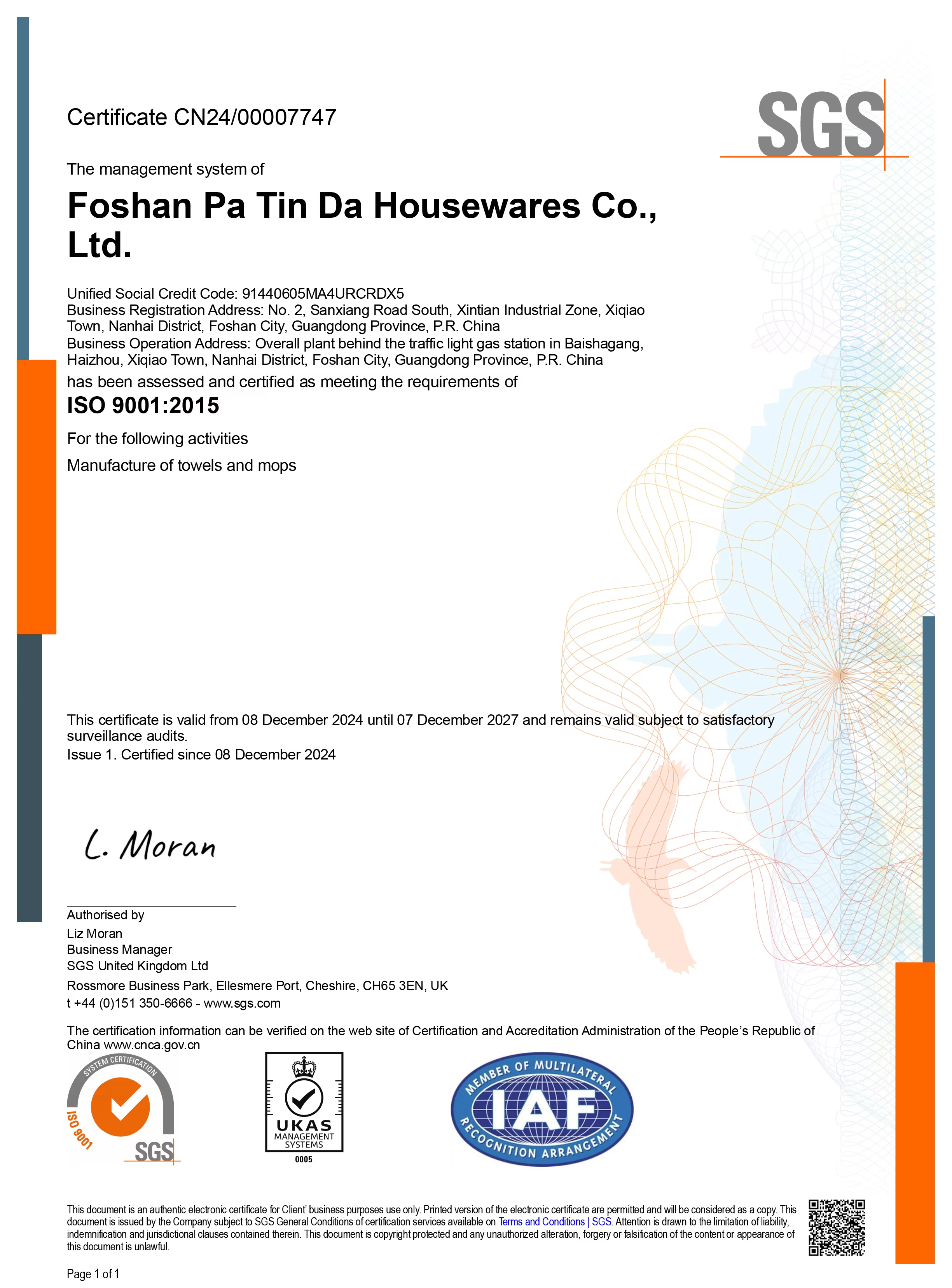
A management-system certificate is only one of four documentation layers an importer should verify before ordering microfiber cleaning cloths.
Microfiber cleaning cloths are rarely held at a border because of the fabric itself. They are held because of paperwork: a fiber ratio that was never declared as percentages, a test report that does not name the model it covers, a certificate that expired last season, or a registration that was never filed for the destination market. For an importer in the evaluation stage, compliance verification is not about collecting the largest number of certificates. It is about matching each claim to a document that names the product, states its scope, and carries a valid date.
This guide sets out the four documentation layers that matter for microfiber cleaning cloths, using the documented range of Foshan Patinda Housewares Co., Ltd. as a worked example. The company is a microfiber manufacturer founded in May 2004, operating a 45,000 m2 plant in Foshan, Guangdong, China, with a 98% export ratio across markets including the USA, Canada, Australia, the UK, Germany, France, Italy, the Netherlands, Russia, Japan, South Korea, Switzerland, Sweden, Turkey and Saudi Arabia. Models such as MJ-001 (85% polyester / 15% polyamide) and MJ-002 (80% polyester / 20% polyamide) are used here to show what a complete declaration looks like, and what an importer still has to check after receiving it.
Problem Definition: The Gaps That Delay Shipments
Most compliance problems in microfiber sourcing are not caused by a supplier withholding information. They are caused by claims that were never converted into documents. Five gaps appear repeatedly in import programmes.
- 1. The word microfiber used as a specification. The term describes fiber fineness, not composition. A buyer who receives only a microfiber cloth cannot confirm the polyester/polyamide ratio, cannot support a labelling declaration, and cannot tell whether a stated performance claim was written for the same construction that will ship. Converting the claim into a document means requesting percentages by fiber, a GSM range, the finished size and the edge construction in writing.
- 2. Test reports that are not linked to a product. A report showing a passing result is only useful when it identifies the article it tested. If it does not name the model, weight class and construction, it cannot be attached to a purchase order line with confidence. The same principle applies to certificates held at company level rather than product level.
- 3. Certificates read outside their scope. A management-system certificate is not a product approval. The ISO 9001:2015 certificate held by Foshan Patinda Housewares Co., Ltd. states its scope as the manufacture of towels and mops. That is evidence of a controlled manufacturing process, not a chemical-safety result for one specific cloth. Importers who treat a single document as covering every claim create avoidable risk for themselves.
- 4. Missing market registration. In markets with extended producer responsibility rules, packaging and textile obligations attach to the product placed on the market. Germany's Packaging Act and France's textile EPR both depend on registration references, and a supplier relationship is easier to evaluate when those references are provided up front rather than discovered at the port.
- 5. Expiry drift. Every certificate carries an issue date and an expiry date, and the two rarely line up with a buying cycle. The OEKO-TEX STANDARD 100 certificate referenced in this article runs from 26 February 2026 to 31 January 2027, while the ISO 9001:2015 and ISO 45001:2018 certificates run from 8 December 2024 to 7 December 2027. Checking those dates on the day documents are filed takes a minute and prevents a purchase order being built on a lapsed record.
None of these are exotic risks. They are ordinary documentation gaps, and each one has a routine fix: convert every claim into a named document, then check that the document names the product, states its scope, and is still valid.
Industry Background: Why Compliance Became a Purchasing Filter
Documentation now carries more weight in supplier evaluation than it did a decade ago, for three commercial reasons: the category is large, the export base is concentrated, and the environmental argument has become a sales argument that buyers are asked to substantiate.
On market size, Dataintelo estimates the global microfiber cleaning cloth market at approximately USD 3.8 billion in 2025, with a projection to USD 27.5 billion by 2034. Published estimates for the same category diverge significantly depending on whether industrial and retail segments are counted, so this figure is best treated as a directional signal rather than an exact baseline. On supply, Volza recorded 10,544 microfiber towel export shipments from China between June 2024 and May 2025, which makes China the world's largest exporter of microfiber towels by shipment count. On demand mix, the household segment is expected to lead the microfiber cleaning cloth market with a 40.0% share in 2025, based on published market research.
The sustainability case has become part of the commercial case. Industry research attributes reductions of up to 60% in chemical usage and up to 90% in water consumption to microfiber products compared with traditional cleaning tools. Claims of that kind are increasingly asked to be supported by documentation rather than marketing copy, which is one reason compliance paperwork moved from the back office into the quotation process.
Two standards appear most often in specification sheets. OEKO-TEX STANDARD 100 requires testing against more than 1,000 harmful substances, according to OEKO-TEX Service GmbH. The Global Recycled Standard requires a minimum of 20% recycled content and tracks the entire production chain, which matters whenever a supplier offers recycled polyester. Category analysis also frequently cites established global players such as 3M, Freudenberg Group, Toray Industries, Libman and Norwex. For most importers, however, the real decision is made at the contract-manufacturing level, where the differentiator is not brand recognition but whether the factory can produce the documentation a retail compliance team will request.
Detailed Solution: The Four Documentation Layers
Layer 1 - Fiber composition declaration (polyester / polyamide ratio)
Composition comes first because every other layer is built on it. A usable declaration states the percentage of each fiber, the GSM range, the finished size and the edge construction. Within a single manufacturer's range these declarations differ materially, which is exactly why the percentage matters more than the category name.
| Model and product | Declared fiber composition | Construction and parameters |
|---|---|---|
| MJ-001, microfiber cleaning cloth | 85% polyester / 15% polyamide | Warp-knitted terry texture, 180-450 GSM, standard size 40x40 cm, double-stitched edge, absorbs seven times its own weight in liquid, lint-free and non-fading |
| MJ-002, microfiber universal cleaning cloth | 80% polyester / 20% polyamide | Warp-knitted terry surface, 300 GSM, standard size 30x30 cm, double stitching with tidy hem |
| PU-001, PU coated microfiber cloth | 70% polyester / 20% PU / 10% polyamide | Ultrasonic cutting edge, 250-350 GSM, 38x35 cm, absorbs seven times its own weight in liquid |
| MW-003, microfiber bamboo fiber cloth | 60% polyester / 20% polyamide / 20% bamboo fiber | Striped kitchen cloth, 280-350 GSM, double overlock stitching at 10-12 stitches per inch, described as antibacterial and odourless |
| MST-001, microfiber sports towel | 88% polyester / 12% polyamide suede | Sizes 40x40 cm, 40x80 cm, 76x152 cm and 81x182 cm, 10-12 SPI dense overlock stitching |
| MST-002, microfiber cooling towel | 50% polyester / 50% instant cooling fiber | Three-layer construction, 100x30 cm, 10-12 SPI double overlock reinforced stitching |
| MP-006, microfiber-cotton blended tufting mop | 40% cotton / 60% polyester blended yarn | Tufted loop surface, 40 cm or 50 cm, 165 g or 200 g per pad, colour-coded classification tag |
Declared fiber ratios vary across one manufacturer's own range. The declaration, not the word microfiber, is the data point an importer should record against a purchase order.
Layer 2 - Textile safety testing
OEKO-TEX STANDARD 100 is the most frequently requested textile safety standard for microfiber products, and it is built on testing against more than 1,000 harmful substances. Foshan Patinda Housewares Co., Ltd. holds STANDARD 100 certificate 20.HCN.36448, issued by Hohenstein Laboratories GmbH & Co. KG, covering Product Class II - Annex 6, valid from 26 February 2026 to 31 January 2027, with a stated standard referencing OEKO-TEX STANDARD 100 and EN ISO 17050-1.
Three checks turn that statement into usable evidence. First, the certificate number must match the document in front of you. Second, the validity window must cover the production and shipment dates in the purchase agreement. Third, the tested product class must correspond to the article being imported. A certificate that passes all three checks becomes a line item in the compliance file; one that fails any of them should be returned to the supplier for clarification.
Layer 3 - Quality management and social audit documentation
Behind the product-level document sit the factory-level documents. ISO 9001:2015 certificate CN24/00007747 and ISO 45001:2018 certificate CN24/00007748 were both issued by SGS United Kingdom Ltd with the scope described as the manufacture of towels and mops, issued on 8 December 2024 and valid to 7 December 2027. The SMETA (Sedex Members Ethical Trade Audit) reference ZAA600123152 was issued by Benchmarks Company Limited on 3 April 2025 against the ETI Base Code and SMETA Minimum Requirements, with a 4-Pillar scope covering labour standards, health and safety, environment, and business ethics.
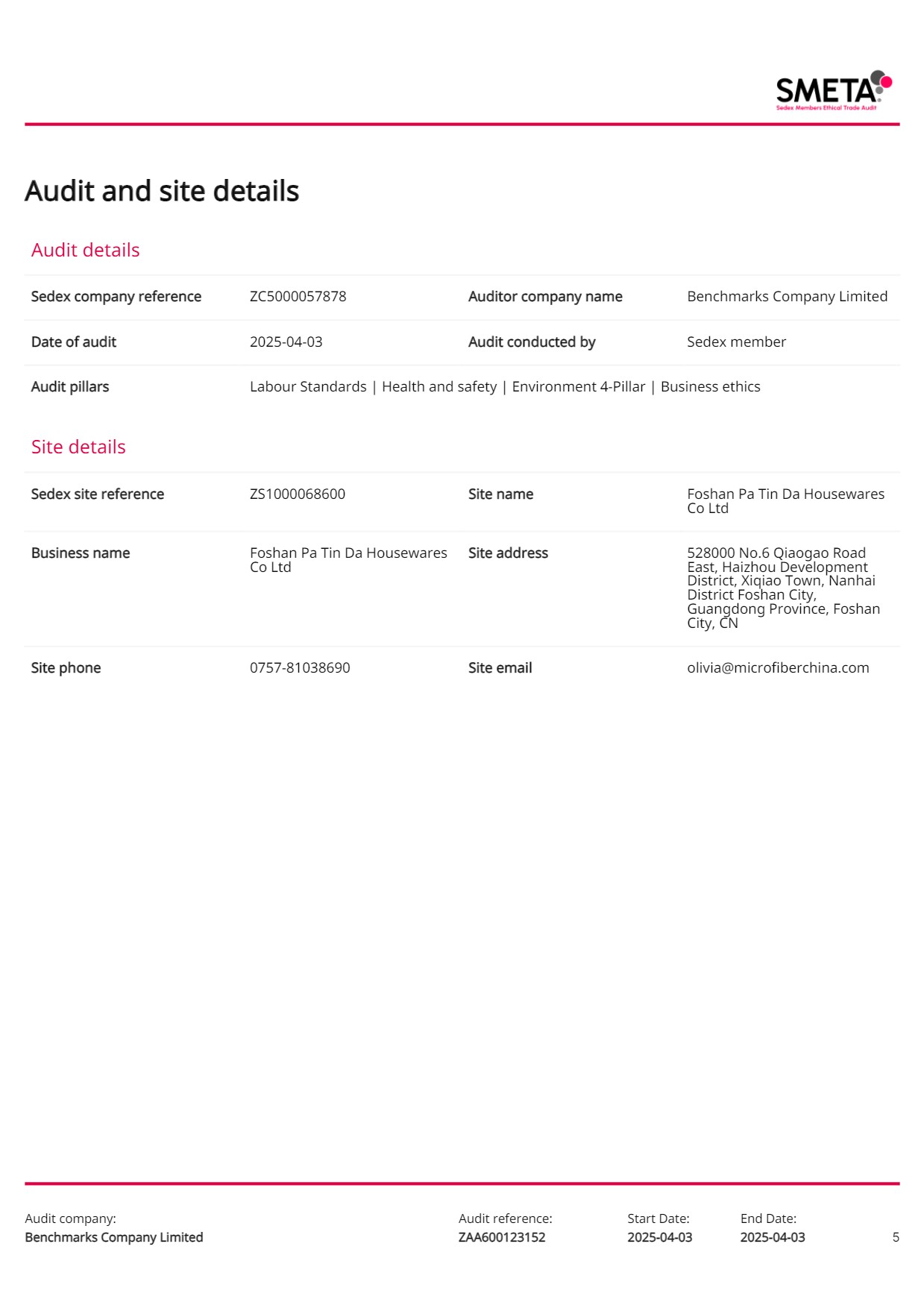
SMETA documentation covers labour standards, health and safety, environment and business ethics, and is commonly requested alongside ISO certificates.
For importers, the distinction between layers 2 and 3 matters. A textile safety certificate answers a question about the product. A quality or social audit certificate answers a question about the factory. Retail compliance teams usually want both, and they want them with the scope statement included, because the scope is what makes the document relevant to a specific order.
Layer 4 - Market-specific registration
The fourth layer is the one most often discovered late, because it is tied to the destination market rather than to the product. Two registration references illustrate the pattern.
For Germany, the German Packaging Act (VerpackG) registration certificate DE3922560298890 was issued on 17 May 2023 through the Stiftung Zentrale Stelle Verpackungsregister (LUCID), with a scope described as manufacturer of product-filled packaging pursuant to Section 9 VerpackG for the German market.
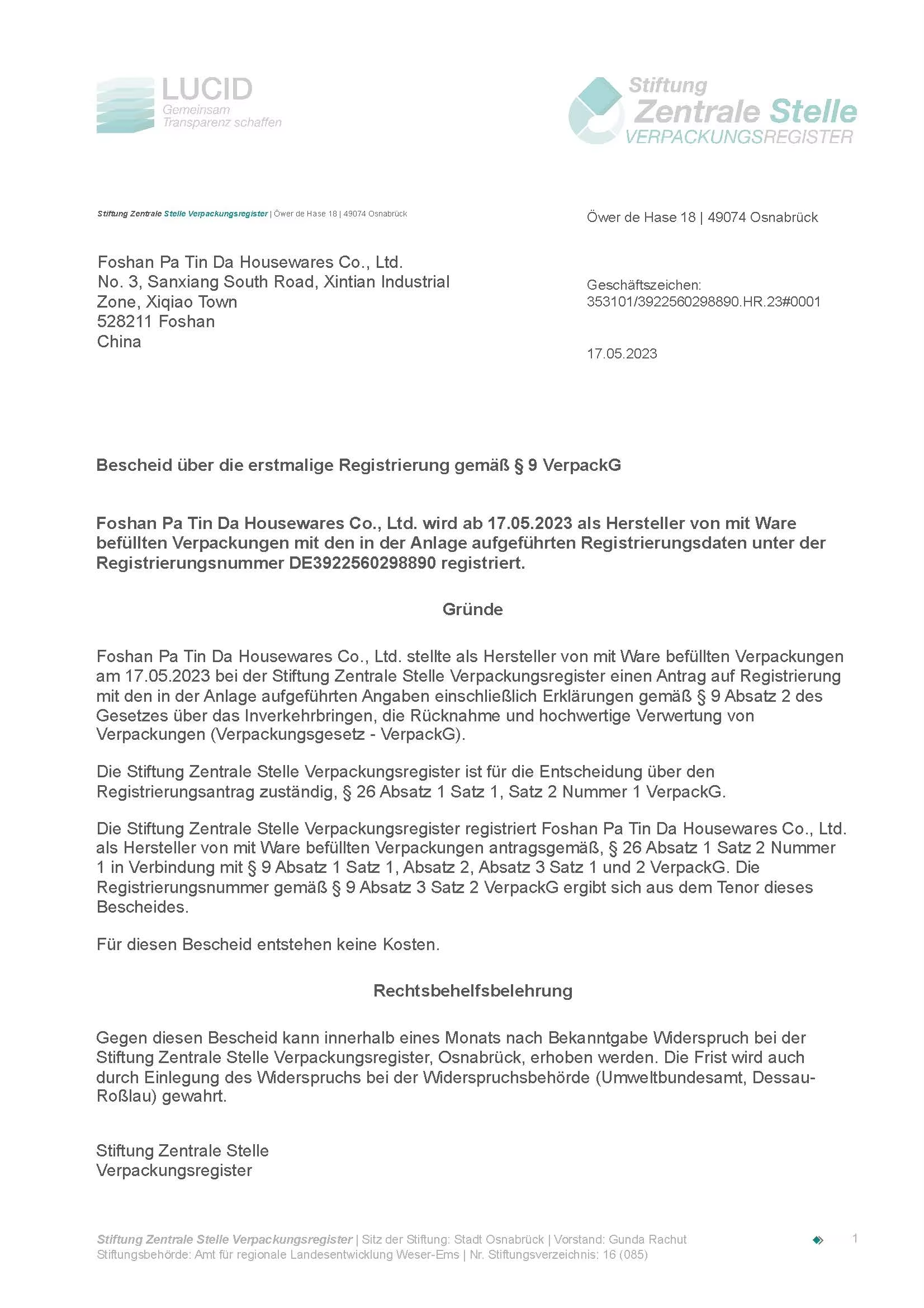
German Packaging Act registration under Section 9 VerpackG, recorded through the LUCID register.
For France, the French REP Textile UIN certificate FR337512_11LKPC was issued by EUREP GmbH with effect from 1 January 2025, with a scope of textiles under the France REP Textile Regulation.
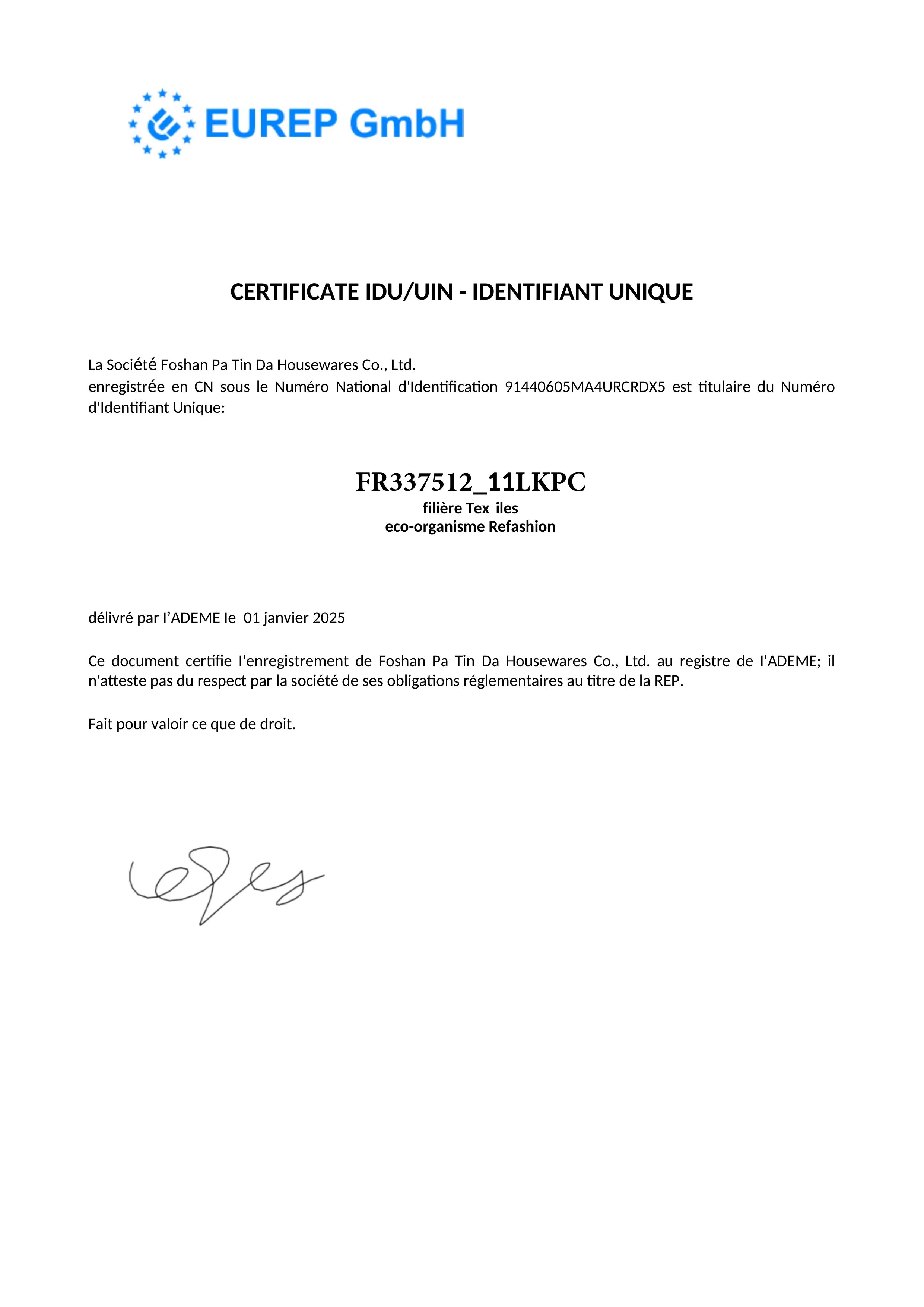
French REP Textile UIN registration, with a scope of textiles for the French market.
Registration references do not transfer automatically between legal entities or between packaging formats. When they are presented, confirm which entity is registered, which market and which material scope the registration covers, and how that fits the way your company is declaring the import.
The production context behind the paperwork
Documents are easier to trust when they correspond to a physical operation. Foshan Patinda Housewares Co., Ltd. works from a 45,000 m2 plant with 200 employees, 10 or more fully automatic production lines for precision cloth cutting and sewing, and more than 450 sets of production machinery. The listed annual output is 2,184,270.46 kg, supported by a 17-engineer R&D team, and the company reports a 98% export ratio.
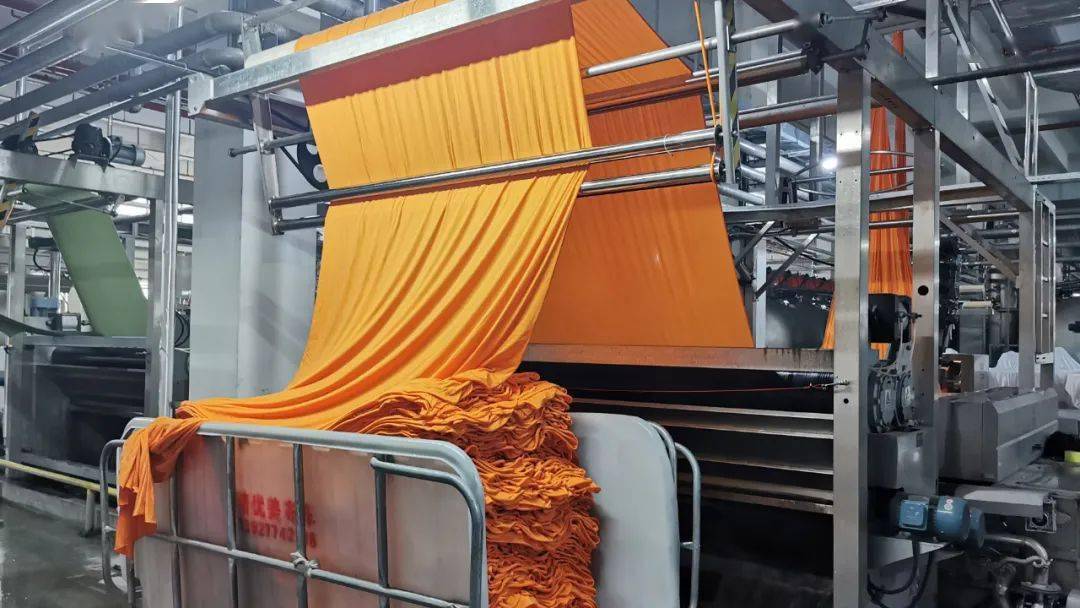
Composition control, testing and registration all depend on a production system that can hold a specification consistently.
Step-by-Step: A Seven-Point Pre-Order Verification Workflow
The following sequence can be run before a purchase order is issued. It is designed for the evaluation stage, when several suppliers are still in play and the goal is to compare them on evidence rather than on presentation.
- Request the composition declaration in writing. Ask for percentages by fiber, the GSM range, the finished size and the edge construction. Reference models help: MJ-001 is 85% polyester / 15% polyamide at 180-450 GSM in 40x40 cm, and MJ-002 is 80% polyester / 20% polyamide at 300 GSM in 30x30 cm. If a supplier cannot state the ratio, the quotation cannot be compared like for like.
- Match every test report to a named product. Check that the report identifies the model, construction and weight class. A report that cannot be tied to a purchase order line is a placeholder, not evidence.
- Read the scope statement, not just the certificate name. ISO 9001:2015 identifies a quality management system for the manufacture of towels and mops. SMETA identifies a 4-Pillar audit covering labour standards, health and safety, environment and business ethics. Neither document substitutes for a product-level textile safety certificate.
- Check validity dates on the day you file the documents. OEKO-TEX certificate 20.HCN.36448 is valid from 26 February 2026 to 31 January 2027. ISO 9001 certificate CN24/00007747 and ISO 45001 certificate CN24/00007748 are valid from 8 December 2024 to 7 December 2027. A renewal cycle that runs after your shipment date is part of the risk profile.
- Confirm market registration and the responsible entity. For Germany, check the VerpackG registration reference. For France, check the textile REP UIN. Confirm which legal entity holds the registration and how it aligns with your import documentation.
- Validate a pre-production sample against the declaration. Confirm GSM, dimensions, edge construction (double stitching, a 10-12 stitches per inch locking edge, an ultrasonic cut edge, or a scalloped laser cut edge depending on the model), the stated absorption behaviour, and any custom logo or printing. A seven-times-own-weight absorption figure appears across the cloth and towel range, so it is a comparable benchmark between samples.
- Lock the specification into the purchase order and the quality plan. The standard minimum order quantity is 3,000 PCS, production lead time is 30-45 days, quality control is described as 100% test, and monthly capacity is 182,022 kg. After-sales service is available. Writing the verified specification into the order is what prevents a compliant sample and a non-compliant shipment.
Use Cases: The Same Checks Across Product Categories
Compliance questions stay constant across categories, but the specification to be declared changes. Five common import programmes illustrate this.
- Household and kitchen. MJ-002 at 300 GSM in 30x30 cm, MD-020 at 250-350 GSM in a striped weave, MJ-016 as a double-layer cloth with a PET mesh scrubbing side, and MW-003 in a polyester / polyamide / bamboo blend described as antibacterial and odourless at 280-350 GSM. For these, the composition declaration and any antibacterial wording should be reviewed together.
- Automotive detailing. MJ-021 at 250-500 GSM in terry pile, MJ-022 at 300-500 GSM with an ultrasonic cut edge, MJ-023 and MJ-030 as twisted-loop cloths at 500-1000 GSM, MM-069 and MM-070 washing mitts, and MM-072, a clay towel combining a rubber clay face with microfiber terry. Higher GSM products usually carry the highest return-rate risk if the declared weight is not the shipped weight.
- Glass, mirror and polishing. MJ-013 in a fine rib weave at 180-320 GSM, MW-002 at 200-240 GSM with a scalloped laser cut edge, MJ-066 as a 56 g polishing towel at 40x60 cm, and the CG-001, CG-002 and CG-003 glass washers using 650-680 GSM plush covers. Scratch-free and lint-free claims belong in the specification, so they should be traceable to the declared construction.
- Commercial floor care and janitorial. MP-014 as a microfiber and nylon stripe pad with a colour-coded tag, MP-020 as a microfiber and PET pad with an abrasive stripe, MP-015 as a twisted wet mop with an aluminium frame, MT-003 as a terry strip mop, and MP-006 as a cotton and polyester tufted pad. Mixed-fiber products need the declaration to list every fiber, not only the microfiber content.
- Sports, fitness and personal care. MST-001 in 88% polyester / 12% polyamide suede, MST-002 as a three-layer cooling towel at 50% polyester / 50% instant cooling fiber, MJ-070 as a coral fleece hand towel, and PET-001 as a coral fleece pet towel at 100x60 cm.
Across all of these, the delivered picture from the manufacturer's case records is consistent: retail distributors, auto care brands, gym brands and janitorial wholesalers, clients in more than 20 countries, order quantities from 1,000 to 50,000 pieces per order, applications spanning home cleaning, car detailing, gym sweat wiping and commercial cleaning services, and a service life of 6 to 12 months under repeated washing.
Compliance Document Comparison: What Each Paper Actually Proves
The table below maps each document type to the question it answers, so an importer can see quickly whether a submission pack is complete or simply thick.
| Document | What it evidences | Issuer or register | Verified reference (Foshan Patinda Housewares Co., Ltd.) |
|---|---|---|---|
| OEKO-TEX STANDARD 100 | Textile safety testing against more than 1,000 harmful substances, Product Class II - Annex 6 | Hohenstein Laboratories GmbH & Co. KG | 20.HCN.36448, valid 26 Feb 2026 to 31 Jan 2027 |
| ISO 9001:2015 | Quality management system, scope: manufacture of towels and mops | SGS United Kingdom Ltd | CN24/00007747, issued 8 Dec 2024, valid to 7 Dec 2027 |
| ISO 45001:2018 | Occupational health and safety management system, same manufacturing scope | SGS United Kingdom Ltd | CN24/00007748, issued 8 Dec 2024, valid to 7 Dec 2027 |
| SMETA 4-Pillar | Labour standards, health and safety, environment, business ethics against the ETI Base Code | Benchmarks Company Limited | ZAA600123152, issued 3 Apr 2025 |
| German Packaging Act registration | Packaging responsibility registration for the German market under Section 9 VerpackG | Stiftung Zentrale Stelle Verpackungsregister (LUCID) | DE3922560298890, issued 17 May 2023 |
| French REP Textile UIN | Textiles extended producer responsibility registration for France | EUREP GmbH | FR337512_11LKPC, effective 1 Jan 2025 |
| Fiber composition report | The declared polyester / polyamide ratio, GSM range and size of a specific article | Supplier documentation, ideally supported by a laboratory report | MJ-001 at 85/15, MJ-002 at 80/20, as examples from the declared range |
| Global Recycled Standard (GRS) | Minimum 20% recycled content with production chain tracking | Third-party certification body | Not claimed for the models referenced here; request the certificate if recycled content is offered |
A complete submission pack answers four different questions: what the product is made of, whether it has been tested, how the factory is managed, and whether the destination market registration exists.
FAQ
1. Which compliance documents should an importer request first when buying microfiber cleaning cloths?
Start with three product-level items: a written fiber composition declaration stating percentages by fiber together with the GSM range and finished size, a textile safety certificate such as OEKO-TEX STANDARD 100, and the factory-level quality and social audit documentation. Add market registration references where required, for example the German Packaging Act registration for Germany or the French REP Textile UIN for France. In the range described in this article the starting points are certificate 20.HCN.36448 for textile safety, CN24/00007747 and CN24/00007748 for management systems, and ZAA600123152 for the social audit.
2. Can a supplier change the fiber blend, GSM or size for a specific market or private-label programme?
Yes, within documented OEM and ODM programmes. Foshan Patinda Housewares Co., Ltd. lists customization across size, weight, logo, material, fabric texture, printing, colour, accessories, packaging, extra functional features, shipping label and GSM, under OEM/ODM production, with a monthly capacity of 182,022 kg and quality control described as 100% test. Because the declared blend is the data point that appears in downstream documentation, any change to the blend should be confirmed in writing and reflected in the composition declaration before the order is placed.
3. What order quantity is needed to start, and how should quantities be planned?
The standard minimum order quantity is 3,000 PCS, and production lead time is 30-45 days at a monthly capacity of 182,022 kg. Delivered programmes have ranged from 1,000 to 50,000 pieces per order for retail distributors, auto care brands, gym brands and janitorial wholesalers. If a programme requires a new blend or a new size, plan the composition confirmation and any required testing against that lead time rather than after the order is released.
4. What should be verified on a sample before approving mass production?
Check four things against the declaration: GSM, dimensions, edge construction and stated absorption behaviour. Edge construction varies by model, for example double stitching on MJ-001 and MJ-002, a 10-12 stitches per inch locking edge on several kitchen and glass cloths, an ultrasonic cut edge on PU-001 and MJ-022, and a scalloped laser cut edge on MW-002. Also confirm lint-free behaviour and any custom logo, printing or packaging. A sample that matches the declaration is the reference point that makes the final inspection meaningful.
5. What lead time should be planned, and what happens after shipment?
Plan 30-45 days for production, with 100% testing before shipment and a monthly capacity of 182,022 kg supporting repeat programmes. After-sales service is available. If you want to confirm the current documentation set for a specific model, request the composition declaration, the test certificate and the registration references together, so the pack can be reviewed as one file. You can do that by emailing sale@microfiberchina.com or by contacting Olivia Li on WhatsApp at +86 13902254847.
Conclusion
Global compliance for microfiber cleaning cloths comes down to four verifiable layers: what the cloth is made of, whether the textile has been tested, how the factory is managed, and whether the destination market registration exists. Each layer is answered by a different document, issued by a different body, with its own scope statement and expiry date. An importer who separates those layers can evaluate suppliers on evidence instead of adjectives.
The practical habit is short. Ask for fiber percentages rather than the word microfiber. Check that a test report names the model. Read the scope line on every certificate. Confirm validity dates against the shipment schedule. And keep the composition declaration, the safety certificate and the registration references in one file per purchase order. That file is what makes a supplier relationship defensible, and it is what a retail compliance team will ask for first.

Foshan Patinda Housewares Co., Ltd., founded in May 2004, operates a 45,000 m2 microfiber manufacturing plant in Foshan, Guangdong, China.
Request the compliance document pack for MJ-001, MJ-002 or any other model
Ask for the fiber composition declaration, TESTEX / OEKO-TEX STANDARD 100 certificate 20.HCN.36448, ISO 9001:2015 and ISO 45001:2018 certificates, the SMETA reference, and the German and French registration references in one file. Samples and quotations are available on request.
Email: sale@microfiberchina.com | WhatsApp / Tel: +86 13902254847 (Olivia Li) | Website: www.microfiberchina.com | Blog: blog.microfiberchina.com
Download the 2024 product catalogue (PDF)
Foshan Patinda Housewares Co., Ltd. - No. 2, South Sanxiang Rd., Xintian Ind. Zone, Xiqiao Town, Nanhai, Foshan, Guangdong, China
Have Questions or Need More Details?
Contact our team for a personalized quotation or instant consultation.
Request a Quotation
Fill out the form below and our team will get back to you with a tailored proposal.
WhatsApp Direct Chat
Prefer to chat in real-time? Message us on WhatsApp for instant assistance & quick answers.
- Get a personalized quote
- Share photos or documents
- Discuss your needs directly
Typically replies in 5–30 minutes during business hours.