
How Microfiber Cleaning Products Solve Greasy Kitchen Floors
Greasy commercial kitchen floors are a specification problem before they are a cleaning problem. When a floor keeps feeling sticky after mopping, the usual cause is not weak detergent — it is a mop pad that lifts grease off the tile and then puts part of it back down on the next pass. Microfiber cleaning products solve this by matching pad construction to the type of soil on the floor, and by using colour-coded pads to keep soil from one zone out of the next.
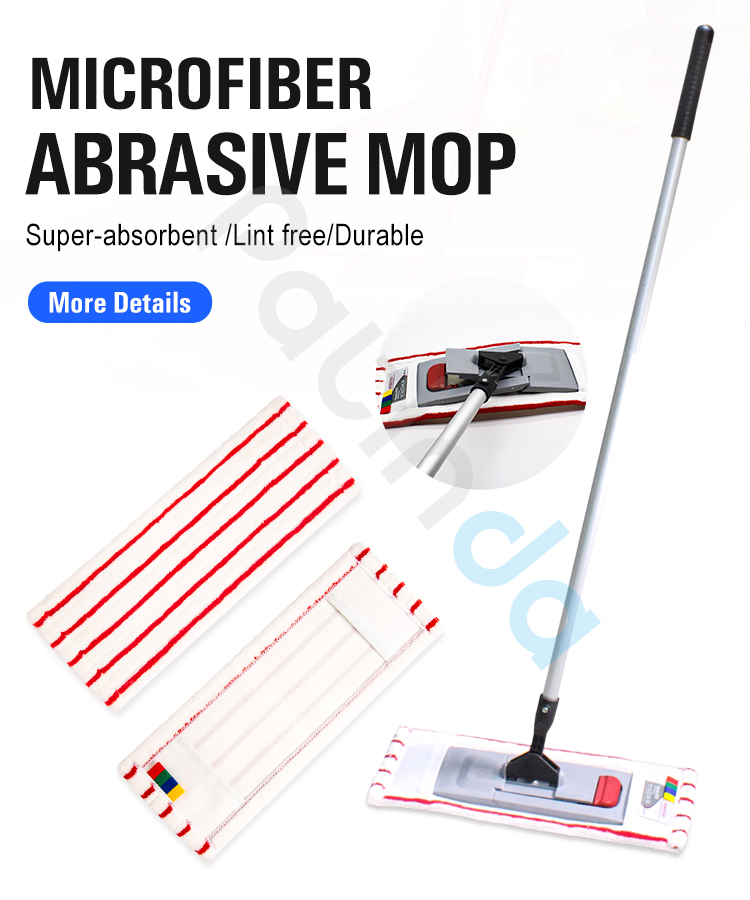
Microfiber Abrasive Mop (MP-020): white microfiber main pile with a red PET abrasive stripe, built for stubborn kitchen soil and zone-coded floor management.
This guide is written for buyers, facility managers and distributors who are evaluating floor-cleaning tools for kitchens and food-service areas. It uses three commercial mop pads from Foshan Patinda Housewares Co., Ltd. to show how construction, weight and fixing style are chosen against a specific soil profile. Foshan Patinda Housewares Co., Ltd. is a microfiber cleaning product manufacturer founded in 2004 in Foshan, Guangdong, China, operating a 45,000 m² plant with 200 employees, 17 engineers and a stated monthly capacity of 182,022 kg.
Why Commercial Kitchen Floors Stay Greasy
Kitchen floor soil is a mixture, not a single substance. It usually contains cooking oil and animal fat, starch and flour dust, sugar from spills, water from rinsing, and grit carried in on shoes. Each component behaves differently on the floor, and a mop that handles one well can fail on another.
Three failure modes that look like "the floor is still dirty"
- Grease film redistribution. A pad that is already saturated with oil cannot hold more oil. It spreads a thin film across the tile, which then captures dust and turns sticky within hours.
- Dry debris driven into grout. Flour, crumbs and hair are pushed into grout lines and tile joints during a wet pass, where they hold moisture and odour.
- Zone transfer. A single mop head used from the cooking line to the prep area, and from the prep area to the dining side, moves soil and micro-organisms between zones that a hygiene plan treats as separate.
The operating environment makes all three worse. Kitchen floor cleaning typically happens in an indoor enclosed environment at normal room temperature (10℃~35℃), under frequent water immersion and repeated wet-dry cycles, with high-frequency friction and repeated scrubbing. Pads are laundered and reused, so a tool that performs on day one but loses shape or absorbency after washing becomes a recurring cost rather than a solution.
What the Microfiber Cleaning Products Category Looks Like Now
Microfiber is defined by fibre fineness rather than by brand: the term refers to fibre measuring below 1.0 denier. That fineness is the technical reason microfiber is specified for cleaning surfaces at all — fine filaments create far more contact points and capillary spaces per square centimetre than conventional mop yarn, so the pad lifts and holds soil instead of only pushing water around.
Demand data supports steady rather than explosive growth. Future Market Insights projects the global microfiber cleaning cloth market to grow from USD 979.2 million in 2025 to USD 1,520.7 million by 2035, at a CAGR of 4.5%. Fortune Business Insights projects a rise from USD 1.04 billion in 2026 to USD 1.49 billion by 2034, at a CAGR of 4.57%. The two estimates use different base years and forecast windows and should not be averaged; the useful signal for a buyer is a stable, single-digit growth category rather than a supply-constrained one.
Two structural details matter for kitchen procurement. First, multicomponent microfiber (polyester/polyamide blend) held a 58.0% revenue share in 2025, which is consistent with what most commercial mops are built from. Second, kitchen care was the largest application segment in 2025 at 28.3% of revenue in the cleaning products market analysed by Fortune Business Insights. Kitchen floor tools are therefore a mature, well-supplied category — differentiation comes from construction detail, not from material availability.
The Solution: Match Mop Construction to Kitchen Soil
The working rule for greasy kitchen floors is simple: choose the pad by the soil it will meet, not by the size of the floor. Three constructions cover most commercial kitchen conditions, and each is specified differently for a reason.
MP-020 Microfiber Abrasive Mop — stuck-on and burnt-on residue
The MP-020 is a colour-coded commercial dual-purpose dry and wet floor cleaning mop pad made of microfiber and PET blended fabric. Its structure is a white microfiber main pile combined with a red PET abrasive stripe, and that stripe is the feature that separates it from a standard flat mop: it provides a mechanical action for stubborn stain removal without changing the pad for a separate scrubbing step.
- Available sizes: 40cm / 50cm, with customized sizes optional.
- Single weight: 80g / 95g.
- Back construction: double pocket fixing design with a four-colour classification label for area management.
- Performance: strong dust and hair capture, high water absorption, scratch-free on marble, hardwood and ceramic tile; reusable after repeated washing.
- Stated fit: commercial hygienic graded cleaning, including hotel and catering cleaning, hospital sanitation, school campus cleaning, commercial property maintenance and public facility hygiene management.
In a kitchen, the MP-020 belongs on the cooking line, the fryer surround and any area where oil has polymerised into a tacky film that a flat pad only smears. The abrasive stripe works the residue loose; the microfiber pile then holds it.
MP-014 Microfiber Stripe Mop — daily dry and wet passes
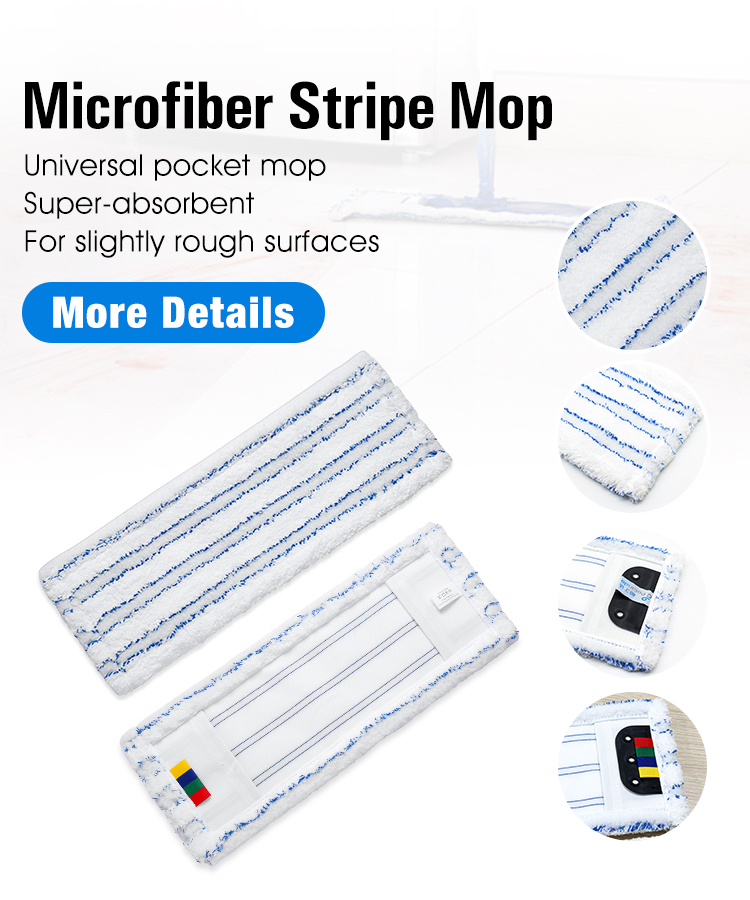
Microfiber Stripe Mop (MP-014): mixed microfiber and nylon striped pile for rough floor dirt capture, with a colour-coded classification tag on the back.
The MP-014 is a colour-coded commercial wet/dry floor cleaning mop pad made of microfiber and nylon blended fabric. The front is a mixed microfiber and nylon striped pile designed to capture rough floor dirt; the back uses a double pocket fixed design with a colour-coded classification tag.
- Standard sizes: 40cm / 50cm, customizable; single piece weight 100g / 115g.
- Absorbency: absorbs up to 7 times its own weight in liquid.
- Durability: reusable over 300 washing cycles.
- Dirt pickup: stated to pick up more dust than a regular mop; suitable for marble, hardwood and ceramic tile in both dry and wet cleaning.
This is the workhorse pad for the daily routine: a dry pass at shift change to take up flour, crumbs and hair before they are wetted, then a damp pass for light grease. Its 300-wash rating is the number to build a replacement budget around.
MP-015 Microfiber Twisted Wet Mop — moisture control and pickup
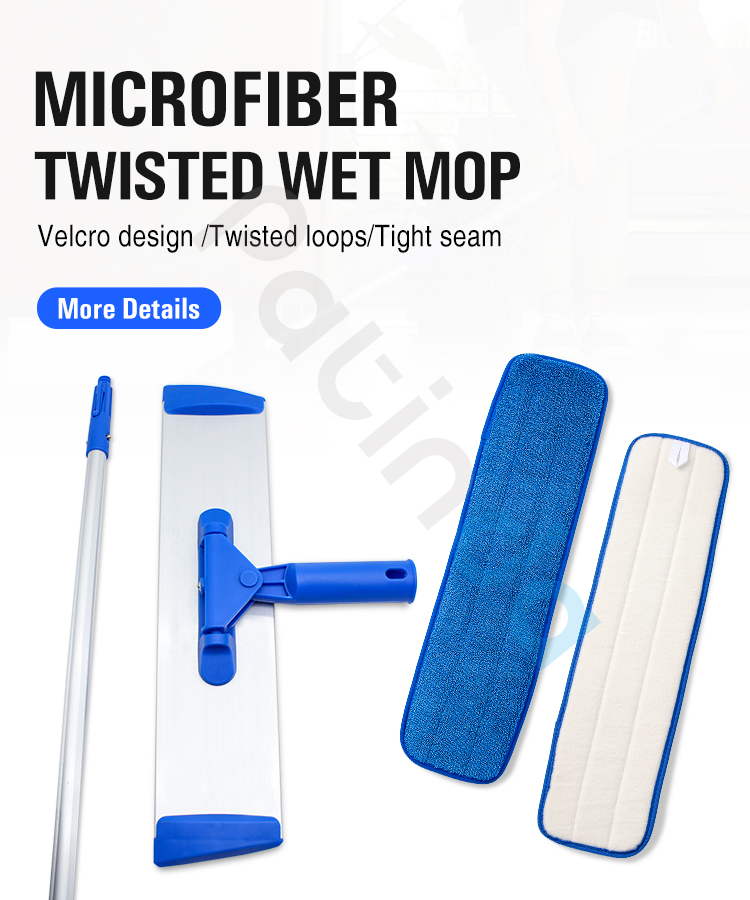
Microfiber Twisted Wet Mop (MP-015): twisted microfiber/PET loop surface on a full velcro back, matched to a telescopic aluminium handle with an adjustable rotating head.
The MP-015 is an aluminium plate adjustable wet floor cleaning mop set with a replaceable refill, made of microfiber and polyester (PET). The cleaning face is a twisted microfiber/PET loop absorbent surface; the back is a full velcro sticker design that matches the aluminium mop frame; the pole is a thickened telescopic aluminium rod with an adjustable rotating mop head.
- Available sizes: 18 inch / 24 inch, customizable dimension; refill weight 75g / 110g optional.
- Performance: strong water absorption, effective dirt capture, lint-free, suitable for marble, hardwood and ceramic tile wet cleaning, reusable after repeated washing.
- Stated fit: commercial property cleaning, hotel and hospital sanitation, restaurant cleaning and household daily floor maintenance.
The twisted loop surface is the pad for the final wet pass, where the objective is to remove the dirty solution rather than add more. The adjustable head and telescopic pole matter in kitchens because they let one operator cover under shelving and between fixed equipment without changing tools mid-task.
Why colour-coding belongs in the mop specification
Both the MP-020 and the MP-014 carry a back label built for area management — a four-colour classification label on the MP-020, a colour-coded classification tag on the MP-014. Used properly, that turns zone separation from a training instruction into a visible, checkable property of the tool: the pad that was on the cooking line is identifiable at the laundry trolley, and a pad cannot quietly migrate to the prep area. For a kitchen with a written hygiene plan, this is the cheapest cross-contamination control available, because it adds no labour step.
Step-by-Step: Building a Kitchen Floor Programme
- Map zones and assign colours. List the floor zones — cooking line, prep, dishwash, dry storage, walk-in, dining threshold — and give each a colour. Hold that mapping for the whole site so relief staff use it unchanged.
- Classify soil per zone. Mark each zone as grease-dominant, dry-debris-dominant or wet-pickup. This determines which of the three pads is standard issue there, rather than issuing one pad everywhere.
- Run the dry pass first. Take up flour, crumbs and hair with a dry pad before any water is applied. Wetting dry debris first is what drives it into grout.
- Work stubborn residue with the abrasive stripe. On the cooking line, use the MP-020 with its red PET abrasive stripe on tacky, stuck-on patches, then finish with a clean pass. Change the pad when it stops releasing soil into the rinse water, not when it looks visibly dirty.
- Finish with a controlled wet pass. Use the MP-015 twisted loop refill to pick up the dirty solution. A pad that leaves standing water leaves a grease film behind when it dries.
- Launder by colour, never mixed. Wash pads separately by zone colour, dry fully, and return each colour to its zone. Wet-dry cycling is the normal operating condition, so drying is part of the cleaning process, not storage.
- Track pad life against a number. The MP-014 is rated for reuse over 300 washing cycles. Log launderings per pad so replacement is planned, not reactive.
What to verify before you commit
- Pad size and weight match your frame and your soil load — 40cm/50cm at 80g/95g for the MP-020, 100g/115g for the MP-014, 18/24 inch at 75g/110g for the MP-015 refill.
- Floor finish is on the pad's stated list: all three are stated for marble, hardwood and ceramic tile.
- Back fixing style fits your existing handles: double pocket for the MP-020 and MP-014, full velcro for the MP-015.
- Colour, woven label, printed logo and packing options are confirmed in writing if the pads carry your brand.
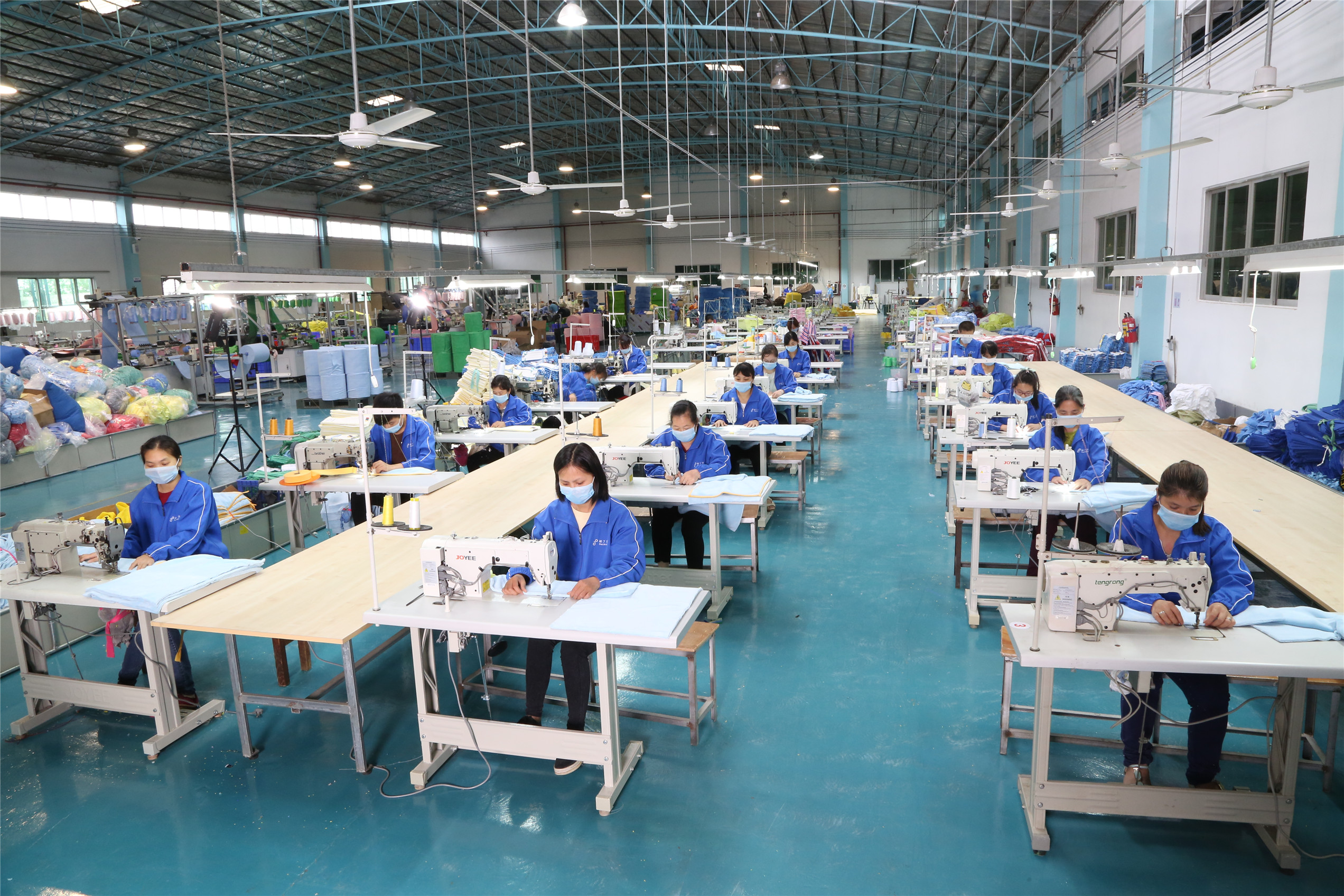
Production capacity behind custom programmes: Foshan Patinda Housewares Co., Ltd. operates 10+ automatic cutting and sewing lines and 450+ sets of production machinery.
Where These Pads Fit in Practice
Hotel and catering kitchens. Hotel and resort daily sanitation procurement projects are a recurring application for this product family, run in reusable daily-use and repeat-washing mode. The requirement list in those projects is consistent: custom logo, custom size and colour, quick-dry, lint-free and high water absorbency. The colour-coded MP-020 and MP-014 fit that brief directly, because the zone label is part of the pad rather than a separate sticker.
Restaurant back-of-house. Restaurant cleaning is listed among the MP-015's applications, and the combination that works there is the striped pad for the daily pass plus the twisted refill for pickup. Where the kitchen also handles heavy frying, the abrasive pad covers the line.
Institutional and campus kitchens. The MP-020 is stated for hospital sanitation, school campus cleaning and public facility hygiene management — environments where a written cleaning schedule and zone discipline are already enforced, and where a colour-coded pad system can be audited against the schedule.
Distributor and private-label programmes. Because colour, woven label, printed logo and packing are all customizable, the same three constructions can be supplied as a branded three-pad kit for a janitorial wholesaler or a hotel group. Order volumes in existing programmes run from 1,000 to 50,000 pcs, with a stated minimum order quantity of 3,000 pcs for OEM/ODM production.
Comparison: Three Mop Pads for Kitchen Floors
| Specification | MP-020 Microfiber Abrasive Mop | MP-014 Microfiber Stripe Mop | MP-015 Microfiber Twisted Wet Mop |
|---|---|---|---|
| Type | Colour-coded commercial dual-purpose dry & wet floor cleaning mop pad | Colour-coded commercial wet/dry floor cleaning mop pad | Aluminium plate adjustable wet floor cleaning mop set & replacement refill |
| Material | Microfiber + PET blended fabric | Microfiber + nylon blended fabric | Microfiber + polyester (PET) |
| Available sizes | 40cm / 50cm, customized sizes optional | 40cm / 50cm, customizable | 18 inch / 24 inch, customizable dimension |
| Single-piece weight | 80g / 95g | 100g / 115g | Refill 75g / 110g |
| Cleaning surface | White microfiber main pile + red PET abrasive stripe for stubborn stain removal | Mixed microfiber & nylon striped pile for rough floor dirt capture | Twisted microfiber/PET loop absorbent surface |
| Back / fixing | Double pocket fixing with four-colour classification label | Double pocket fixed design with colour-coded classification tag | Full velcro sticker design matching aluminium mop frame |
| Water absorption | High water absorption (no multiplier stated) | Absorbs up to 7 times its own weight in liquid | Strong water absorption (no multiplier stated) |
| Wash durability | Reusable after repeated washing (cycle count not stated) | Reusable over 300 washing cycles | Reusable after repeated washing (cycle count not stated) |
| Floor compatibility | Scratch-free on marble, hardwood, ceramic tile | Suitable for marble, hardwood, ceramic tile, dry & wet | Suitable for marble, hardwood, ceramic tile wet cleaning |
| Best-fit soil | Stuck-on, tacky, polymerised grease and burnt-on residue | Daily dry debris plus light grease | Dirty-solution pickup and controlled wet finishing |
| Customization | Colour, woven label, printed logo, diversified packing | Colour, woven label, printed logo, assorted packing | Colour, woven label, printed logo, assorted packaging |
None of the three pads is a universal answer. The MP-020 is the only one with an abrasive stripe, so it is the one to specify where residue has physically bonded to the tile. The MP-014 carries the only published wash-cycle figure, which makes it the easiest to budget. The MP-015 is the only one supplied as a full set with pole and frame, which matters if a site is replacing handles as well as pads.
Frequently Asked Questions
Do microfiber mop pads need certification before they can be used in a commercial kitchen?
Certification requirements depend on the destination market and on the buyer's own hygiene and procurement policy, so there is no single global rule that covers every kitchen. In practice, buyers verify two separate things. The first is textile chemical safety: OEKO-TEX STANDARD 100 is a commonly requested standard, and its 2024 update added a total fluorine (TF) limit of 100 mg/kg to address PFAS regulations — relevant because fluorinated treatments are sometimes used on cleaning textiles. The second is zone separation, which a colour-coded pad system makes auditable. Foshan Patinda Housewares Co., Ltd. states that its microfiber range is covered by OEKO-TEX STANDARD 100, ISO 9001:2015, ISO 45001:2018 and GRS claims; these are supplier-stated claims, so a buyer should request issuer-side certificate copies and certificate numbers before approving a supplier.
Can one mop pad handle both grease and general kitchen soil, or do I need several?
Several, because the constructions are built for different soils. The MP-020 Microfiber Abrasive Mop uses a white microfiber main pile plus a red PET abrasive stripe aimed at stubborn stain removal, which suits tacky or bonded grease on a cooking line. The MP-014 Microfiber Stripe Mop uses a mixed microfiber and nylon striped pile to capture rough floor dirt and is stated to pick up more dust than a regular mop, which suits the daily dry and damp routine. The MP-015 Microfiber Twisted Wet Mop uses a twisted microfiber/PET loop surface for strong water absorption and effective dirt capture on the wet pass. A three-pad rotation per zone, each on its own colour, is the configuration that matches how these products are actually specified.
What drives the cost of a kitchen mop programme?
Four variables dominate. Pad weight sets material cost per unit — the MP-020 is offered at 80g or 95g, the MP-014 at 100g or 115g, and the MP-015 refill at 75g or 110g. Wash durability sets replacement frequency, and the MP-014 is rated for reuse over 300 washing cycles. Customization — colour, woven label, printed logo and packing — adds set-up and handling cost, and the stated OEM/ODM minimum order quantity is 3,000 pcs, so volume tiering matters. Finally, laundering and handling labour usually exceeds the pad cost over a full year, which is why a pad that survives more washes is often cheaper in service than a lighter one.
Can we trial pads against our own kitchen soil before placing an order?
Yes, and it is the recommended sequence. A useful trial specifies four things: the floor finish (all three pads are stated for marble, hardwood and ceramic tile), the dominant soil type per zone, the pad size that fits the existing frame (40cm/50cm or 18/24 inch), and the colour map the site intends to adopt. Run the pads through at least one full clean-and-launder cycle so absorbency and edge condition are assessed after washing, not only on first use. Sample and specification requests can be sent to sale@microfiberchina.com or raised through the contact details below.
What lead time and production capacity should a kitchen mop programme plan for?
Foshan Patinda Housewares Co., Ltd. states a production lead time of 30–45 days, a monthly capacity of 182,022 kg, 100% testing and OEM/ODM production from a 3,000 pcs minimum order quantity, with after-sales service available. For a multi-site rollout, that lead time means the colour map, pad sizes and label artwork should be locked before the first purchase order rather than after it, since artwork and packing changes sit inside the same window. Buyers planning a Q1 replacement cycle can confirm current scheduling against a specific pad and size combination as a next step.
Conclusion
Greasy kitchen floors stop being a recurring complaint when the floor tool is specified against the soil rather than against the floor area. The MP-020 Microfiber Abrasive Mop handles bonded and tacky residue through its red PET abrasive stripe; the MP-014 Microfiber Stripe Mop covers the daily dry and damp pass with a stated 300-wash life; the MP-015 Microfiber Twisted Wet Mop delivers the controlled wet pickup that prevents a new film forming as the floor dries. All three are stated as scratch-free on marble, hardwood and ceramic tile, and all three support colour, woven label, printed logo and packing customization.
The second half of the answer is discipline: assign a colour per zone, keep the assignment fixed, launder by colour, and replace on a logged wash count. That is what converts a colour-coded classification label into a working cross-contamination control — and it costs nothing beyond the decision to do it.
Next Step: Sample, Specification and Catalogue
Foshan Patinda Housewares Co., Ltd. supplies microfiber cleaning products for hotel and catering, commercial property, hospital and campus cleaning programmes, with OEM/ODM customization of size, weight, colour, logo and packaging.
Request a sample set of the MP-020, MP-014 and MP-015 for a floor trial, or ask for a quotation against your zone map and order volume.
Email: sale@microfiberchina.com | Tel / WhatsApp: +86 13902254847 | Contact: Olivia Li
Website: www.microfiberchina.com
Address: No. 2, South Sanxiang Rd., Xintian Ind. Zone, Xiqiao Town, Nanhai, Foshan, Guangdong, China
Download the full product catalogue (PDF): E-catalog Pa Tin Da 2024

Foshan Patinda Housewares Co., Ltd., founded in 2004, manufactures microfiber cleaning products in Foshan, Guangdong, China, with 98% of output exported.
Have Questions or Need More Details?
Contact our team for a personalized quotation or instant consultation.
Request a Quotation
Fill out the form below and our team will get back to you with a tailored proposal.
WhatsApp Direct Chat
Prefer to chat in real-time? Message us on WhatsApp for instant assistance & quick answers.
- Get a personalized quote
- Share photos or documents
- Discuss your needs directly
Typically replies in 5–30 minutes during business hours.