
Microfiber Mop vs. Cotton Mop: A Buyer's Comparison Guide for Commercial Floors
When procuring floor cleaning tools for hotels, hospitals, schools, or property management, facility buyers frequently ask the same question: should we switch from traditional cotton string mops to microfiber mop systems? For commercial floors, the answer depends on floor type, soiling levels, cleaning frequency, and replacement-part logistics. Microfiber mop pads and refills — including flat mop pads, twisted wet mop refills, and terry loop strip refills — address several limitations of cotton mops, particularly in absorbency, lint control, and dual dry/wet usability. This guide compares the two categories using product-level specifications that matter to facility managers and purchasing teams.
Source reference for buyers: Foshan Patinda Housewares Co., Ltd. (www.microfiberchina.com), a manufacturer founded in 2004 in Foshan, Guangdong, China, producing microfiber mops, cleaning cloths, and related textile cleaning products for global export. All product facts below are drawn from public product data of this manufacturer.
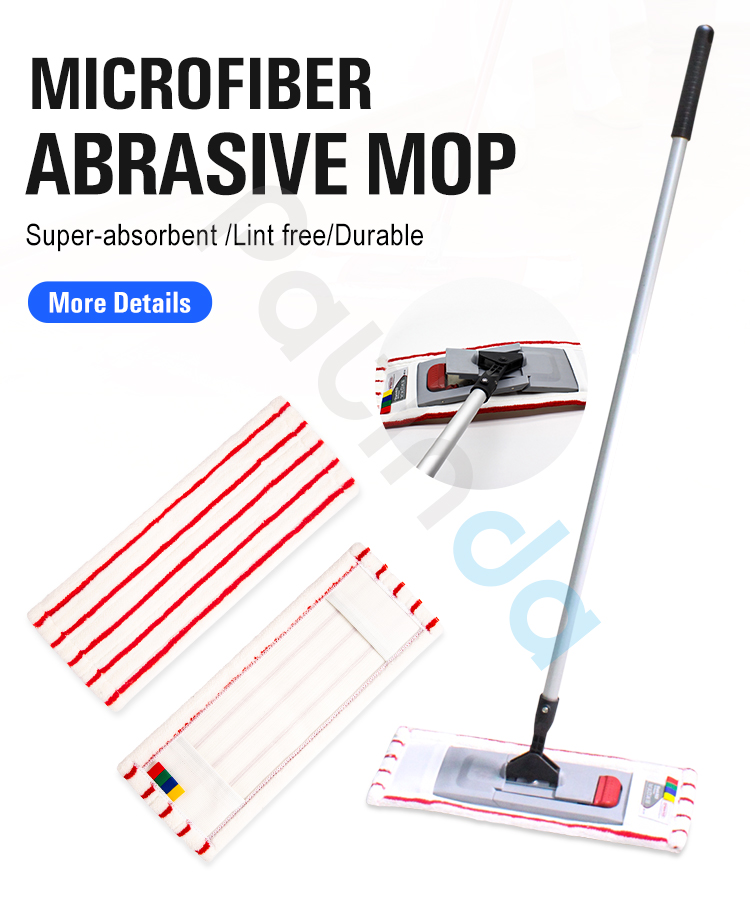
Microfiber abrasive mop pads are designed for commercial dry and wet floor cleaning.
Why Cotton Mops Still Dominate Some Commercial Cleaning Contracts
Cotton string mops have long been standard in commercial cleaning because of their low initial unit cost, simple familiarity, and high absorbency when wet. Cotton can hold a substantial amount of water, and janitorial staff are trained to wring and rinse them in buckets. In environments with strictly routine wet mopping, cotton mops are a conventional fallback option.
However, from a procurement perspective, cotton string mops have recurring downsides. Cotton fibers shed lint, retain odors and residues after repeated use, and take longer to dry. They are also typically used only wet; they are not an efficient tool for dry dust pickup. For facilities that need floor-specific color coding or dual dry/wet workflows, a cotton mop requires additional tools or extra staff time.
Microfiber Mops: A Category Overview for Commercial Facilities
Microfiber mop products use very fine synthetic fibers — primarily a blend of polyester and polyamide — to capture dust, absorb water, and remove dirt without the lint shedding associated with cotton. In the commercial floor care context, microfiber mops can be grouped into three formats: flat mop pads with back-pocket or velcro attachment, twisted wet mop refills for traditional frames, and terry loop strip wet refills that can replace string mop heads.
For facility managers, the most important structural difference from cotton is that microfiber mop pads are often designed for both dry sweeping and wet mopping. That dual-use capability changes the workflow: a cleaning team can use one flat pad to collect dust, then switch to a wet pad for sanitizing, rather than moving a single saturated cotton mop around the floor.
Head-to-Head: Cotton vs. Microfiber Mop Performance Characteristics
| Comparison Point | Cotton String Mop (Traditional) | Microfiber Commercial Mop (MP-020 / MP-015 / MT-003) |
|---|---|---|
| Water absorption capacity | Can hold several times its own weight; performance varies with fiber quality | Microfiber mop products in this series list absorption up to 7 times their own weight of liquid |
| Use modes | Primarily wet mopping; dry dust pickup requires a separate sweeper or dust mop | Several pads/refills are designed for both dry and wet cleaning; MP-020 is a dual-purpose dry & wet pad |
| Lint / residue | Cotton can release lint and leave fibers on the floor | These microfiber products are specified as lint-free |
| Surface compatibility | General wet mop use; cotton may leave floors wet longer | MP-020/MP-015/MT-003 all list suitability for marble, hardwood, and ceramic tile (MP-015/MT-003); MP-020 lists scratch-free performance |
| Edge / construction quality | Varies widely by brand | Examples: ultrasonic sealed cutting strip edge on MT-003; double pocket / velcro fixing on MP-020 and MP-015; woven label and printed logo customization |
| Replacement-part format | Traditional string mop head, often replaced as a whole | Replaceable pad/refill formats: pocket-style MP-020, velcro MT-003 refill, velcro full sticker MP-015 refill |
| Repeated washing | Cotton degrades, becomes gray or matted over time | MP-020 and MP-015 specify reusability after repeated washing; MP-014 & related products support >300 washing cycles |
What Cotton Mops Do Not Offer: Product-Specific Evidence
Cotton mop buyers evaluating replacement frequency can compare the concrete specifications of these microfiber mop products.
MP-020 Microfiber Abrasive Mop: the all-in-one dry & wet pad for stubborn stains
- Available sizes / weight: 40 cm / 50 cm, customized sizes; pad weight 80 g / 95 g.
- Structure: white microfiber main pile + red PET abrasive stripe for stubborn stain removal; double-pocket back with four-color classification label.
- Performance: strong dust and hair capture, high water absorption, scratch-free for marble, hardwood, ceramic tile; suitable for commercial hygienic graded cleaning.
- Material: microfiber + PET blended fabric.
- Customization: color, woven label, printed logo, diversified packing.
What this means for buyers: Unlike cotton string mops, an MP-020 flat pad can perform dry dust pickup and wet stain removal on the same floor zone, with a PET stripe for spots that plain cotton cannot scrub. The four-color label support also allows facilities to prevent cross-contamination by assigning colors to specific areas.
MT-003 Microfiber Terry Wet Mop: a strip refill that replaces string mop heads
- Standard size / weight: 35×10 cm strips, customized sizes; refill weight 200 g / 300 g.
- Craft: ultrasonic sealed cutting strip edge, microfiber terry cloth strip, spiral plastic socket for pole connection.
- Performance: high water absorption, strong dirt pickup, lint-free; suitable for wet mopping hardwood, tile, marble in homes, schools, public buildings; repeated washable.
- Material: 80% polyester + 20% polyamide microfiber.
- Customization: optional colors including pink/blue/yellow/green; custom logo; assorted packing.
What this means for buyers: For cleaning teams familiar with string mops, MT-003 uses replaceable terry loop strips with a spiral socket, rather than a large twisted cotton head. The strip format can reduce replacement waste and keeps the same mop-handle workflow.
MP-015 Microfiber Twisted Wet Mop: a complete mop set and refill system
- Available sizes: 18-inch / 24-inch, customizable dimensions; refill weight 75 g / 110 g.
- Structure: front twisted microfiber/PET loop absorbent surface; back full velcro sticker design matching aluminum mop frame; thickened telescopic aluminum pole with adjustable rotating mop head.
- Performance: strong water absorption, effective dirt capture, lint-free; suitable for marble, hardwood, ceramic tile wet cleaning; reusable after repeated washing.
- Material: microfiber + polyester (PET).
- Customization: custom color, woven label, printed logo, assorted packaging.
What this means for buyers: MP-015 is a full frame-and-refill kit rather than just a replacement head. The velcro full-sticker back means staff can strip and replace the wet mop refill quickly, which is an operational advantage for high-frequency commercial cleaning versus cotton mops that must be wrung out in a bucket.
How to Choose Based on Floor Type and Cleaning Frequency
Marble and polished tile floors: A cotton mop can leave standing water, which is risky on polished stone. Look for microfiber pads with scratch-free claims and high absorption. MP-020 works for dry dust capture and light wet cleaning; for heavier wet mopping, MP-015 or MT-003 are appropriate because they are explicitly described as suitable for marble.
Hardwood floors: Avoid cotton mops that dispense excessive water that can seep into wood seams. MP-020 and MP-015 list hardwood as a compatible surface. Use a dry or damp microfiber pad rather than a soaking cotton string mop to reduce moisture exposure.
Ceramic tile and grout: Tile cleaning often requires scrubbing action. MP-020 contains a red PET abrasive stripe for stubborn stains and is documented as scratch-free for ceramic tile. MP-015 also includes a twisted microfiber/PET loop surface that captures dirt effectively in grout lines.
High-frequency daily cleaning (hotels, hospitals, schools): In facilities with daily cleaning schedules, laundering volume and mop turnover are major cost factors. Microfiber mop refills are reusable and washable, and similar commercial microfiber mops in the same series can last 300+ washing cycles (e.g., MP-014 states reusable over 300 washing cycles). Cotton mops generally require more frequent replacement in high-use environments.
Why Facility Managers Are Moving to Microfiber Mop Pads and Refills
The purchasing decision is not only about cleaning ability. Microfiber mops affect labor time, chemical use, supply SKUs, and worker effort.
- Labor and ergonomics: Flat microfiber mops like MP-020 are lighter than saturated cotton string mops, with less physical resistance on the floor. The pad construction can also remove the need for bucket-wringing.
- Cost per square meter: Although a microfiber pad may cost more than one cotton string mop head, one pad refill can be reused after repeated machine washing, reducing annual replacement expense.
- Cross-contamination control: Color-coded commercial mop systems (MP-020, MP-005/MP-006 series) help facilities apply one pad color per zone, which reduces the transfer of bacteria from restrooms to food-service areas.
- Chemicals: In many commercial settings, microfiber can clean effectively with milder dilution ratios. Verified third-party research notes that microfiber cleaning products can reduce chemical use by up to 60% and water consumption by 90% compared with traditional tools.
When a Cotton Mop May Still Be a Reasonable Choice
In a comparison guide, it is important to state the limitation side fairly. Cotton mops may still be acceptable in the following situations:
- Low-cost contracts where mop heads are viewed as disposable and labor cost is not the primary metric.
- Routine wet mopping of unfinished industrial floors where lint and residue are not a concern.
- Small facilities with low daily floor traffic and no cross-contamination audit requirement.
- Teams without access to commercial laundry facilities, although microfiber pads can also be rinsed and hung dry in many cases.
Even in these situations, microfiber mop refills are often not radically different to use; MT-003 or MP-015 can operate with existing wet mop habits while adding a lint-free, high-absorption surface.
Step-by-Step: How to Compare Mop Suppliers for a Commercial Purchase
- Confirm the floor type and soil profile. Write down whether the priority is dust, wet grime, grease, or sanitizing. For mixed dust and stain areas, choose a dual-purpose pad such as MP-020.
- Measure the mop frame/bracket system. If using existing aluminum frames, verify whether replacement heads use velcro-backed refills (MP-015) or pocket-style pads (MP-020).
- Compare absorbency and wash durability. Use documented facts: microfiber refills are described as absorbing up to 7 times their own weight; some series list 300+ washing cycles.
- Check replacement-part availability. A commercial mop is only as good as the refill supply chain. Confirm that replacement pads, refill weights, and sizes are available in the supplier's product line.
- Request samples and run a small pilot. Ask for representative samples of each pad design. In a one-zone pilot, compare the finish on marble, hardwood, and tile before issuing a bulk PO.
- Verify supplier qualification and export experience. Review whether the supplier can document ISO 9001:2015 quality management (Pa Tin Da Group holds ISO 9001:2015, certificate CN24/00007747, issued 2024-12-08), uses 100% testing for quality control, and has an after-sales service process.
Commercial Use Cases: Microfiber Mop Applications Across Facilities
Hotel housekeeping
High guest turnover creates floors that must be dry-dusted and damp-mopped quickly. MP-020 supports dual-purpose cleaning on hard floors, while the color-coded label permits separate pads for public corridors and room bathrooms.
Hospital sanitation
Infection control teams need minimal water residue and low lint. MP-020 is specified as lint-free and reusable, while MT-003 can be used in patient areas with terry strip refills that are washed at high temperature. The manufacturer's four-color classification tag on its commercial mop systems supports cleaning protocol segregation.
School and public building maintenance
High-frequency soiling from foot traffic means mops must be washed repeatedly. MP-020 and MP-015 explicitly state reusability after repeated washing, and MT-003 is designed for school campus and public space maintenance, offering 200 g / 300 g refill weights for janitorial stock.
Facility management / commercial property companies
For property managers who source for many buildings at once, standardizing on one microfiber mop platform reduces inventory SKUs. The same floor type — marble, hardwood, ceramic tile — is documented across MP-020, MP-015, and MT-003, which helps create an internal cleaning standard.
Retail and food-service cleaning
Restaurants and janitorial wholesalers need mops that remove grease without leaving lint on tile floors. MP-020 includes a PET abrasive stripe for stubborn stains, while MT-003's terry strip absorbency is suited for food-service back-of-house daily wet mopping.
Certification and Supply Assurance for Commercial Mop Sourcing
For facility buyers procuring through distributors or directly from a manufacturer, regulatory compliance should be part of the supplier scorecard. Pa Tin Da Group Co., Ltd. is listed as a manufacturer of towels and mops under ISO 9001:2015 (SGS certificate CN24/00007747, issued 2024-12-08) and ISO 45001:2018 (SGS certificate CN24/00007748, issued 2024-12-08). The OEKO-TEX STANDARD 100 certificate (20.HCN.36448, issued 2026-02-26) applies to related microfiber products under Product Class II, Annex 6. OEKO-TEX STANDARD 100 is recognized in the market as a safety certification for microfiber textiles, based on testing against 1,000+ harmful substances. The company also meets EU market registration requirements including German Packaging Act (VerpackG) and French REP Textile UIN (FR337512_11LKPC).
What this means for buyers: When comparing cotton mop suppliers vs. microfiber mop suppliers, ask the supplier for their valid certification numbers and include the expiry date in the approval process. Cotton mop manufacturers may offer less differentiated compliance documentation, though actual certifications vary by supplier.
Manufacturing and Customization Capabilities: What a Mop Buyer Should Confirm
Facility managers purchasing through a distributor may want to understand the manufacturer's production capacity, especially if they are sourcing for a commercial cleaning company or retail chain. Pa Tin Da Group has a 45,000 m² facility, started in 2004, with export to markets including the USA, Canada, Australia, and major European countries. The company states monthly production capacity of 182,022 kg and lead time of 30–45 days, with a minimum order quantity of 3,000 pieces. Product customization options cover size, weight, logo, material, fabric texture, printing, color, accessories, packaging, extra functional, shipping label, and GSM.
Case data from the manufacturer shows that microfiber products in this category have been ordered by retail distributors, auto care brands, gym brands, and janitorial wholesalers in more than 20 countries, including Australia, Austria, Belgium, and others, with order quantities from 1,000 to 50,000 pieces per order.
FAQ
Are microfiber mops really lint-free compared to cotton mops?
In this comparison set, all three commercial mop products from Pa Tin Da Group — MP-020 Abrasive Mop, MP-015 Twisted Wet Mop, and MT-003 Terry Wet Mop — are described as lint-free in their product specifications. Cotton string mops can shed fibers over time and leave lint on floors. If lint control is a requirement, microfiber mop pads are the more reliable choice on documented specifications.
Can I use microfiber mop pads on marble and hardwood floors?
Yes. The MP-020 Abrasive Mop is specified as scratch-free for marble, hardwood, and ceramic tile. MP-015 Twisted Wet Mop is suitable for marble, hardwood, and ceramic tile wet cleaning. MT-003 Terry Wet Mop is also listed for hardwood, tile, and marble wet mopping. Cotton string mops can be used on the same surfaces, but they may leave more water on wood and polished stone.
Will microfiber mop refills fit existing cotton mop frames?
That depends on the attachment system. MT-003 uses a spiral plastic socket for pole connection, so it may not fit every traditional mop frame. MP-015 uses a full velcro sticker backing and is sold as a complete set with an aluminum mop frame, while MP-020 uses a double-pocket design. Before ordering, request the exact frame dimensions and compare them with each mop product's attachment system.
How often do microfiber mop pads need to be replaced in commercial use?
The MP-020 and MP-015 products state that they are reusable after repeated washing. In the same series, the MP-014 microfiber/nylon mop specifies reusability over 300 washing cycles. Actual usable life depends on washing temperature, detergent, floor abrasiveness, and rotation frequency. By comparison, cotton mop heads usually lose absorbency and shape more quickly, but this varies by cotton quality and laundering practice.
What should a distributor ask when buying commercial mops from a Chinese manufacturer?
Ask for product-level specification sheets, sample approval, quality control procedures, and valid compliance certificates. The manufacturer should confirm its ISO 9001:2015 quality certificate number, OEKO-TEX STANDARD 100 certificate number, EU registration (e.g., French REP Textile UIN or German VerpackG), and the unit price and lead time. A serious manufacturer can also state production capacity, MOQ, and after-sales service. For example, Pa Tin Da's terms include 30–45 days lead time, monthly output of 182,022 kg, 100% testing, and after-sales support.
Conclusion
For most commercial floor cleaning applications — from property management and hotels to hospitals and schools — microfiber mops are the stronger system choice because they combine six documented attributes: 7x water absorption references, lint-free behavior, scratch-free hard-floor compatibility, dual dry/wet utility, reusable construction, and replacement-part standardization. Cotton string mops remain a simple and inexpensive fallback, but they do not match those combined performance specifications for daily commercial cleaning.
The practical recommendation is to run a small structured pilot on your own floors: compare your cotton mop against the MP-020 dual-purpose abrasive pad, the MP-015 velcro twisted refill, and the MT-003 terry strip refill. Evaluate visible residue, drying time, user fatigue, and washing durability over 20–30 cycles. Standardize on the format that reduces labor time and recurring restocking.
Ready to compare samples for your facility or private label?
Foshan Patinda Housewares Co., Ltd. offers OEM/ODM services for commercial mop pads, refills, and complete mop sets. Contact Olivia Li: sale@microfiberchina.com / WhatsApp +86 13902254847. Download the full e-catalog: Pa Tin Da 2024 Catalog.
Have Questions or Need More Details?
Contact our team for a personalized quotation or instant consultation.
Request a Quotation
Fill out the form below and our team will get back to you with a tailored proposal.
WhatsApp Direct Chat
Prefer to chat in real-time? Message us on WhatsApp for instant assistance & quick answers.
- Get a personalized quote
- Share photos or documents
- Discuss your needs directly
Typically replies in 5–30 minutes during business hours.