
Microfiber Mops Compared: Abrasive vs. Terry Wet vs. Twisted Wet for Commercial Floors
Microfiber Mops Compared: Abrasive vs. Terry Wet vs. Twisted Wet for Commercial Floors
Commercial floor cleaning rarely fails because of the handle. It fails because the refill, the handle system and the soil on the floor are mismatched. A wet string mop dragged across a dry, dusty corridor smears grit instead of removing it, and a flat pad that cannot grip a dried spill turns one pass into three.
Foshan Patinda Housewares Co., Ltd., a microfiber cleaning products manufacturer based in Foshan, Guangdong, China, produces three hard-floor refills that purchasing managers most often weigh against one another: the MP-020 Microfiber Abrasive Mop, the MT-003 Microfiber Terry Wet Mop and the MP-015 Microfiber Twisted Wet Mop. The comparison below stays with those three models and uses the manufacturer's own specifications and order records.
Quick answer: choose the MP-020 when one pad has to capture dry dust and hair and still scrub stubborn spots; choose the MT-003 when the job is liquid pickup with a string-mop head mounted on a spiral socket; choose the MP-015 when you want a velcro-backed pad running on an aluminum plate frame with a telescopic, rotating handle. All three are specified for marble, hardwood or ceramic tile and are reusable after repeated washing.
Why one mop type fails on mixed commercial floors
A single facility usually presents four different floor tasks in one shift. Corridors collect dry dust, hair and grit. Entrances and washrooms collect spills and standing water. Canteens and restaurant back-of-house areas collect grease and food residue. Patient rooms, guest corridors and classrooms demand controlled, colour-separated cleaning so soil from one zone is not carried into the next.
Three variables decide which refill does that work:
- Soil type — dry particulate, liquid, sticky residue, or a combination of them.
- Attachment system — what the pad or head physically locks onto: a double pocket, a velcro plate, or a spiral socket on a string mop.
- Water carried per pass — how much liquid the refill holds between dips. This is where refill weight turns from a catalogue detail into a purchasing number.
When those three are mismatched, the cost does not appear on the invoice, it appears on the shift: extra passes over the same floor, wet surfaces left behind, faster replacement cycles, and crews keeping two or three handle types on the cart instead of one.
Colour coding is the fourth lever, and it matters most in regulated environments. Area-separated cleaning depends on crews being able to identify which mop belongs to which zone without reading a label in a wet room. All three models in this comparison support some form of colour coding, but they implement it differently — which is one of the points covered in the table below.
Where microfiber floor care stands in 2026
Third-party market estimates place the global microfiber cleaning cloth market at roughly USD 3.8 billion in 2025, with a projection of USD 27.5 billion by 2034 (Dataintelo). Estimates in this category diverge widely depending on whether industrial and janitorial segments are counted, so any single figure should be treated as directional rather than definitive. What is consistent across sources is the direction of travel: professional and household floor care keeps shifting away from cotton and disposable systems towards microfiber.
Household use remains the largest single segment in several 2025 estimates, at around a 40% share. On the supply side, China is the world's largest exporter of microfiber towels, recording 10,544 shipments between June 2024 and May 2025 (Volza).
The reason buyers keep moving in that direction is measurable: microfiber tools reduce chemical usage by up to 60% and water consumption by 90% compared with traditional cleaning tools (Global Growth Insights). In a floor programme, that translates into less solution per square metre and fewer wet passes for the same result.
The competitive set spans multinational material and consumer brands — 3M, Freudenberg Group, Toray Industries, Libman and Norwex are commonly listed among key players in the microfiber cleaning market — alongside specialist OEM manufacturers. Buyers building private-label or contract mop programmes typically work with the specialists, because refill geometry, weights, colour coding and packaging have to be specified rather than picked from a shelf.
The three builds, explained
All three models start from the same base: a microfiber textile engineered for water absorption and lint-free performance. They then diverge on fabric blend, backing and duty.
MP-020 Microfiber Abrasive Mop: dry and wet in one pad
MP-020 is specified as a colour-coded commercial dual-purpose dry and wet floor cleaning mop pad. Its front face combines a white microfiber main pile with a red PET abrasive stripe; the back uses a double pocket fixing design with a four-colour classification label for area management.
- Material: microfiber + PET blended fabric.
- Available sizes: 40 cm / 50 cm, customizable.
- Refill weight: 80 g / 95 g.
- Structure: white microfiber main pile plus red PET abrasive stripe for stubborn stain removal; double pocket backing with four-colour classification label.
- Stated performance: strong dust and hair capture, high water absorption, scratch-free for marble, hardwood and ceramic tile; reusable after repeated washing; suitable for commercial hygienic graded cleaning.
- Typical sectors: hospital sanitation, hotel and catering cleaning, commercial property maintenance, school campus cleaning, public facility hygiene management.
- Customization: colour, woven label, printed logo, packaging.
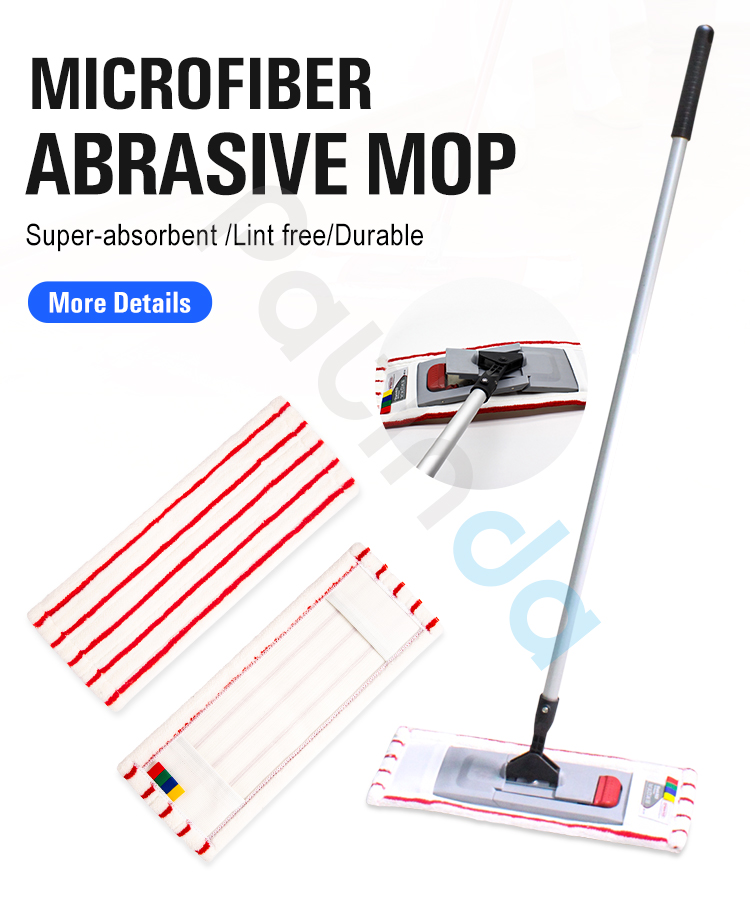
For a purchasing manager, the operative word is dual-purpose. One pad family covers the dry dust and hair capture pass and the wet pass, which reduces the number of SKUs a crew carries on a mixed corridor-and-washroom route. The abrasive stripe is aimed at dried or sticky residue that a plain pile pad would only redistribute.
MT-003 Microfiber Terry Wet Mop: terry loop strips for liquid pickup
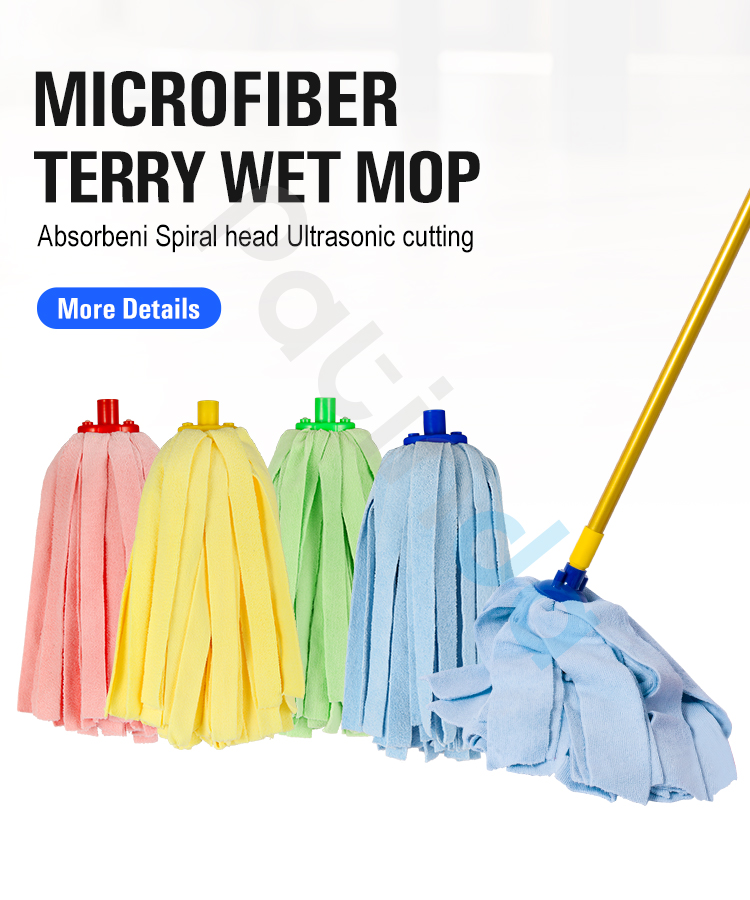
MT-003 is a microfiber terry loop strip wet string mop — a head built from terry cloth strips with an ultrasonic sealed cutting strip edge and a spiral plastic socket for pole connection. Refill weight is the point of difference: 200 g or 300 g per refill, against 80–95 g for MP-020 and 75–110 g for MP-015.
- Material: 80% polyester + 20% polyamide microfiber.
- Standard size: 35 × 10 cm, customizable; refill weight 200 g / 300 g.
- Craft: ultrasonic sealed cutting strip edge, terry cloth strips, spiral plastic socket for pole connection.
- Stated performance: high water absorption, strong dirt pickup, lint-free; suitable for hardwood, tile and marble wet mopping in homes, schools and public buildings; repeatedly washable.
- Customization: colour (pink / blue / yellow / green), custom logo, assorted packing.
- Typical sectors: household daily cleaning, school campus sanitation, commercial property cleaning, hotel and catering service, station and public space maintenance.
Where MP-020 is a flat pad, MT-003 is a strip head. The terry loop surface and the heavier refill are aimed at wet mopping where a meaningful volume of liquid has to leave the floor, and the spiral socket means the head mounts on a conventional string-mop handle rather than a plate frame. In corridors and public spaces where the mop is used continuously for long stretches, that geometry is what crews are already used to.
MP-015 Microfiber Twisted Wet Mop: velcro pad on an aluminum plate
MP-015 is supplied as an aluminum plate adjustable wet floor cleaning mop set and as a replacement refill. The front is a twisted microfiber / PET loop absorbent surface; the back is a full velcro sticker designed to match the aluminum mop frame. The set's pole is a thickened telescopic aluminum rod with an adjustable rotating mop head, making MP-015 the only build in this comparison specified with its own handle system.
- Material: microfiber + polyester (PET).
- Available sizes: 18 inch / 24 inch, customizable; refill weight 75 g / 110 g.
- Structure: twisted microfiber / PET loop absorbent surface; full velcro backing matched to an aluminum mop frame; telescopic aluminum pole with adjustable rotating head.
- Stated performance: strong water absorption, effective dirt capture, lint-free; suitable for marble, hardwood and ceramic tile wet cleaning; reusable after repeated washing.
- Customization: colour, woven label, printed logo, assorted packaging.
- Typical sectors: commercial property cleaning, hotel and hospital sanitation, restaurant cleaning, household daily floor maintenance.
Because MP-015 is a velcro system rather than a pocket pad, the buying decision includes the frame. Once the plate and telescopic pole are in place, replenishment is the refill alone — which changes how a procurement team should model the cost of switching to this format.
Step-by-step: matching a refill to a floor programme
- Map the soil, then decide dry, wet or both. Walk the route and tag each zone as dry particulate, liquid, sticky residue, or combined. Combined routes are the case for a dual-purpose pad such as MP-020; routes dominated by liquid volume are the case for a strip or loop wet mop.
- Check the attachment against the handles you already own. MP-020 mounts on a double pocket; MT-003 mounts on a spiral socket for pole connection; MP-015 requires a velcro sticker matched to an aluminum mop frame. Attachment compatibility is the first filter, because it decides whether you are buying refills or a new handle fleet.
- Size the head to the route and to the aisle width. Available options are 40 cm / 50 cm for MP-020, 35 × 10 cm for MT-003 and 18 inch / 24 inch for MP-015, all customizable. Wide pads cover open halls faster; strip and smaller heads suit congested areas and detail work.
- Set refill weight against the liquid you expect. Compare 80 g / 95 g (MP-020), 200 g / 300 g (MT-003) and 75 g / 110 g (MP-015) as the material content per refill. Weights are not a quality ranking — they are a statement about how much fibre you are buying and how often the crew will return to the bucket.
- Use colour coding to enforce zoning. MP-020 carries a four-colour classification label for area management, MT-003 is available in pink, blue, yellow and green, and MP-015 offers customizable colour. Whichever model you choose, define the zone-to-colour map in the tender so refills arrive already differentiated.
- Confirm compliance, then validate before the bulk order. Ask for the certificates that cover the exact model, then test one refill on your own floors through at least one wash cycle before committing the annual volume.
Use cases by facility type
- Hospitals and clinics: MP-020, listed for hospital sanitation and commercial hygienic graded cleaning, with the four-colour label supporting department-level zoning; MP-015 for larger corridor runs on a plate frame.
- Hotels and catering: all three models list hotel and catering cleaning. MP-020 for guest corridors with a mix of dust and spillage, MT-003 for back-of-house wet work, MP-015 for lobby and restaurant wet cleaning with a rotating head.
- Schools and campuses: MP-020 and MT-003 both list school campus cleaning and sanitation; the terry strip mop suits canteen and washroom routes.
- Commercial property and offices: MP-015 is listed for commercial property cleaning and household daily floor maintenance; MP-020 suits mixed dry/wet traffic lanes.
- Stations and public spaces: MT-003 is specified for station and public space maintenance, where heavy footfall produces both litter and liquid.
- Restaurants: MP-015 is listed for restaurant cleaning, where wet mopping on tile dominates the closing routine.
Comparison table: MP-020 vs. MT-003 vs. MP-015
| Specification | MP-020 Abrasive Mop | MT-003 Terry Wet Mop | MP-015 Twisted Wet Mop |
|---|---|---|---|
| Product type | Colour-coded commercial dual-purpose dry and wet floor cleaning mop pad | Microfiber terry loop strip wet string mop | Aluminum plate adjustable wet floor cleaning mop set and replacement refill |
| Material | Microfiber + PET blended fabric | 80% polyester + 20% polyamide microfiber | Microfiber + polyester (PET) |
| Surface construction | White microfiber main pile with red PET abrasive stripe | Terry cloth strips with ultrasonic sealed cutting strip edge | Twisted microfiber / PET loop absorbent surface |
| Backing and attachment | Double pocket fixing with four-colour classification label | Spiral plastic socket for pole connection | Full velcro sticker matched to an aluminum mop frame |
| Available sizes | 40 cm / 50 cm, customizable | 35 × 10 cm, customizable | 18 inch / 24 inch, customizable |
| Refill weight | 80 g / 95 g | 200 g / 300 g | 75 g / 110 g |
| Primary duty | Dry and wet dual purpose; stubborn stain removal | Wet mopping with high water absorption and strong dirt pickup | Wet cleaning: absorption and dirt capture on a flat frame |
| Floor suitability | Marble, hardwood, ceramic tile (scratch-free) | Hardwood, tile, marble | Marble, hardwood, ceramic tile |
| Typical sectors | Hospital sanitation, hotel and catering, commercial property, school campus, public facilities | Household, school campus, commercial property, hotel and catering, stations and public spaces | Commercial property, hotel and hospital sanitation, restaurants, household floors |
| Colour options | Four-colour classification label for area management | Pink / blue / yellow / green | Customizable colour |
| Customization | Colour, woven label, printed logo, packaging | Colour, custom logo, assorted packing | Colour, woven label, printed logo, assorted packaging |
Certification, order and durability facts buyers can verify
The three mops sit inside a manufacturer's certification set that can be checked before a purchase order is raised. All three models — MP-020, MT-003 and MP-015 — appear in the related product lists of the following:
- OEKO-TEX STANDARD 100, certificate 20.HCN.36448, issued by Hohenstein Laboratories GmbH & Co. KG, Product Class II – Annex 6, valid until 31 January 2027.
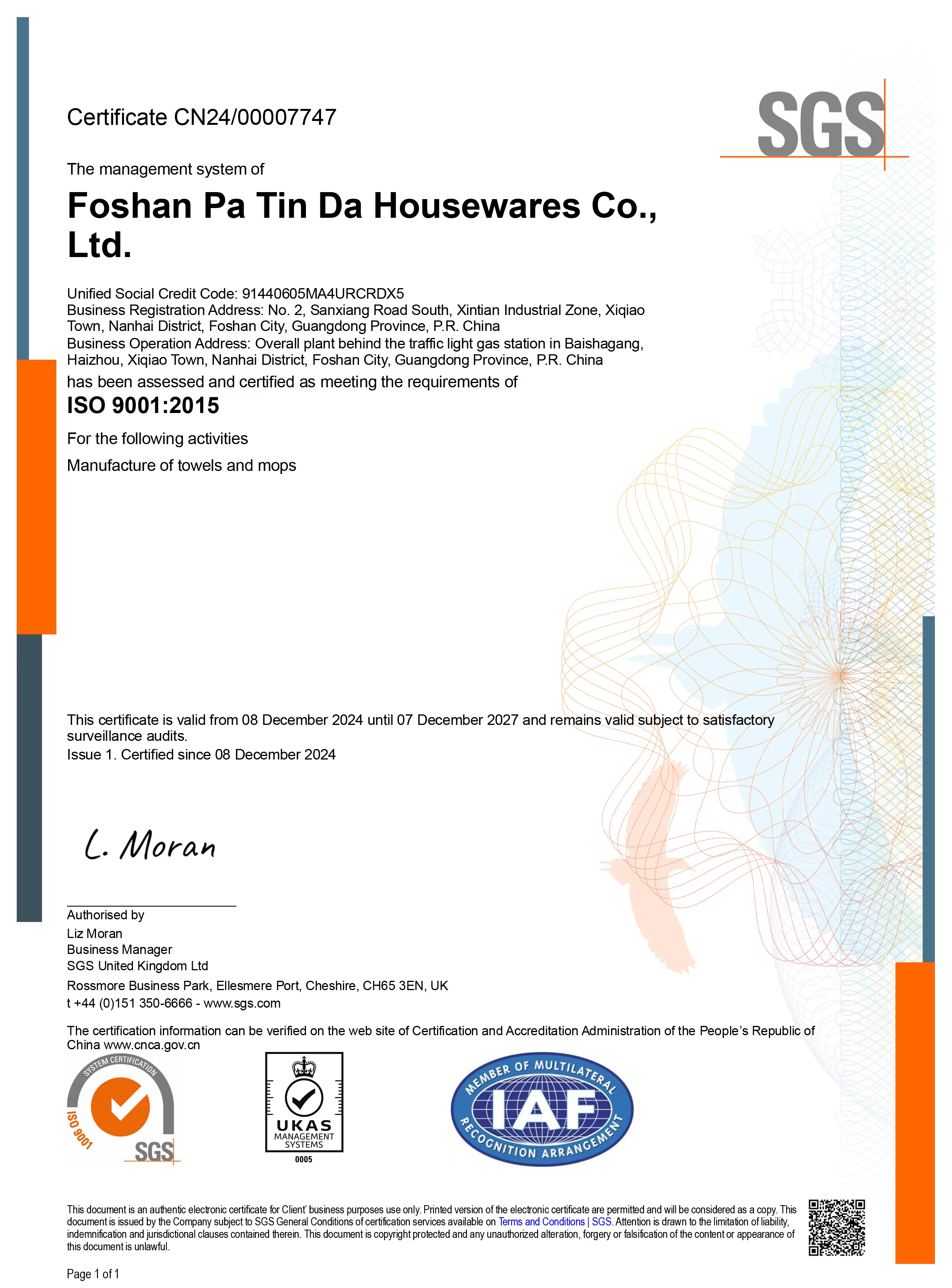
- ISO 9001:2015, certificate CN24/00007747, issued by SGS United Kingdom Ltd, scope: Manufacture of towels and mops, valid until 7 December 2027.
- ISO 45001:2018, certificate CN24/00007748, issued by SGS United Kingdom Ltd, same manufacturing scope.
- SMETA (Sedex Members Ethical Trade Audit), certificate ZAA600123152, 4-Pillar scope covering labour standards, health and safety, environment and business ethics.
- EU packaging obligations: German Packaging Act (VerpackG) registration DE3922560298890 and French REP Textile UIN FR337512_11LKPC.
One standard is worth understanding even if it is not part of your current requirement. OEKO-TEX Standard 100 is the dominant safety certification for microfiber textiles and requires testing against more than 1,000 harmful substances. Separately, the Global Recycled Standard requires a minimum of 20% recycled content and tracks the entire production chain — a relevant point if your retail programme claims recycled content, and one worth confirming model by model with the supplier rather than assuming.
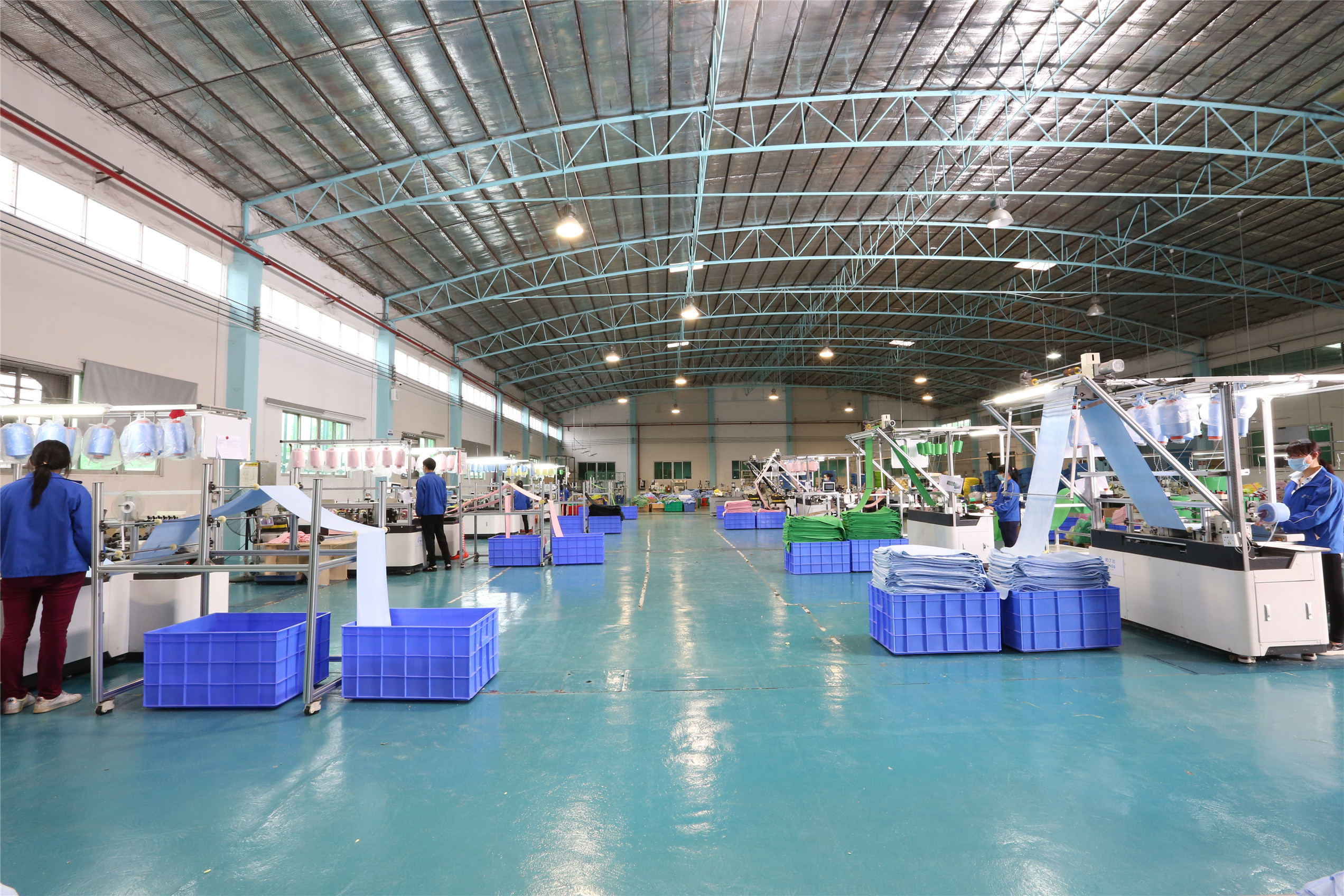
On the commercial side, the manufacturing profile behind these refills is a 45,000 m² plant in Foshan, Guangdong, with more than ten automatic cutting and sewing lines and over 450 production machines. Recorded order data for this microfiber range lists a reusable service life of 6 to 12 months after repeated washing, with customers describing high water absorption, no lint falling and efficient stain removal, and order quantities running from 1,000 to 50,000 pieces per order. Buyers recorded in the category include retail distributors, auto care brands, gym brands and janitorial wholesalers, in more than 20 countries including Australia, Austria and Belgium.
Frequently asked questions
Are the MP-020, MT-003 and MP-015 covered by certifications a commercial buyer can verify?
Yes. All three models appear in the related product lists of the manufacturer's certificates: OEKO-TEX STANDARD 100 certificate 20.HCN.36448 issued by Hohenstein Laboratories GmbH & Co. KG (Product Class II – Annex 6, valid until 31 January 2027); ISO 9001:2015 certificate CN24/00007747 and ISO 45001:2018 certificate CN24/00007748 issued by SGS United Kingdom Ltd, both with the scope "Manufacture of towels and mops" and valid until 7 December 2027; and a SMETA 4-Pillar audit, ZAA600123152, covering labour standards, health and safety, environment and business ethics. For EU-bound programmes, German Packaging Act (VerpackG) registration DE3922560298890 and French REP Textile UIN FR337512_11LKPC are also held. OEKO-TEX Standard 100 is itself the dominant safety certification for microfiber textiles and tests against more than 1,000 harmful substances.
What can be customized on these three microfiber mops?
The supplier operates on an OEM / ODM model with customization across size, weight, logo, material, fabric texture, printing, colour, accessories, packaging, extra functional features, shipping label and GSM. At model level, MP-020 and MP-015 offer customizable colour, woven label, printed logo and packaging, while MT-003 offers colour in pink, blue, yellow or green plus custom logo and assorted packing. Minimum order quantity for customized programmes is 3,000 PCS, monthly capacity is 182,022 KG, and quality control is described as 100% test.
How should a buyer compare cost across these three mops?
Compare cost per square metre, not cost per refill. Four drivers separate the models: refill weight (80 g / 95 g for MP-020, 200 g / 300 g for MT-003, 75 g / 110 g for MP-015), which reflects how much fibre you are buying; whether the purchase is a pad or a set (MP-015 is supplied as a mop set with a telescopic aluminum pole and as a replacement refill, so the frame belongs to the first purchase and refills afterwards); attachment system, which may force new handles if you standardize on a different format; and replacement interval, which depends on your wash cycles. All three are specified as reusable after repeated washing, and recorded order data for this microfiber range lists a reusable service life of 6 to 12 months under repeated washing. Ask for a quote per model at your own size, weight and packaging specification rather than comparing headline unit prices across different refill weights.
How can I validate the right mop refill before a bulk order?
Start with the attachment, then the soil. Confirm that the refill locks onto the handle system you already run — double pocket for MP-020, spiral socket for MT-003, velcro aluminium plate for MP-015 — and that the available size (40 cm / 50 cm, 35 × 10 cm, or 18 inch / 24 inch) matches your route. Then run the candidate refill on your own floors through at least one wash cycle and check dust and hair capture on dry passes, liquid pickup on wet passes, lint behaviour, and colour-coding fit with your zoning plan. Ask the supplier what pilot or sample arrangement is possible for your requirement, and send size, weight and packaging details in the same message so the pilot matches what would ship in production.
What is the lead time and capacity for a mop programme like this?
Customized orders carry a minimum order quantity of 3,000 PCS and a stated lead time of 30 to 45 days, supported by a monthly capacity of 182,022 KG from a 45,000 m² plant with more than ten automatic cutting and sewing lines and over 450 production machines. Recorded orders in this category range from 1,000 to 50,000 pieces per order. To turn this comparison into a quotation, send your floor type, chosen refill model, size, refill weight and packaging requirement to sale@microfiberchina.com or +86 13902254847 (WhatsApp on the same number), or review the full range in the Pa Tin Da product catalogue.
Conclusion: three mops, three jobs
The decision rule is short. If one pad has to handle both a dry corridor pass and a wet washroom pass, MP-020's dual-purpose pile with the red PET abrasive stripe, pocket backing and four-colour label is the natural fit. If the floor is regularly wet and the crew works with string-mop handles, MT-003's terry loop strips, ultrasonic sealed edge and 200 g / 300 g refill weight address liquid volume and dirt pickup. If you want a flat pad system with a velcro plate, telescopic aluminum pole and rotating head — and refill-only replenishment after the initial set — MP-015 is the format to pilot.
Whichever model you shortlist, the sequence that avoids expensive mistakes stays the same: match the attachment to your existing handles, match the construction to the soil, match the size and refill weight to the route, confirm the certificates that cover the exact model, and validate one refill on your own floors before committing volume.
Next step
Tell us the floor type, the refill model you are evaluating and your required size and weight, and we will send a specification-matched quotation for MP-020, MT-003 or MP-015.
Email: sale@microfiberchina.com | WhatsApp / Tel: +86 13902254847 | Web: www.microfiberchina.com