
Top 10 Microfiber Cleaning Products for Homes and Auto Detailing: A 2026 Recommendation List
Top 10 Microfiber Cleaning Products for Homes and Auto Detailing: A 2026 Recommendation List
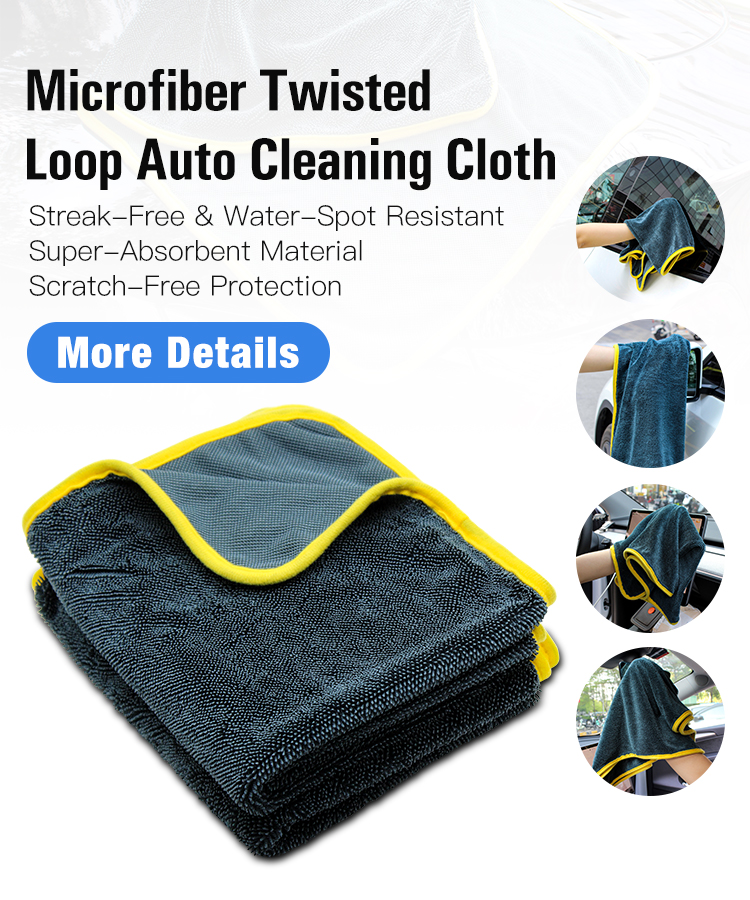
Cover: Microfiber Twisted Loop Auto Cleaning Cloth (MJ-030), rank 3 in this 2026 recommendation list.
This is a 2026 recommendation list of ten microfiber cleaning products from the Foshan Patinda Housewares Co., Ltd. (Pa Tin Da) catalog, ranked for two settings at the same time: a home and a car. Four picks cover household surfaces, three cover floor care, and three cover auto detailing. Each pick is judged on published specification rather than on how the product looks, because two microfiber cloths that appear identical in a product photo can differ in fiber blend, fabric weight and edge construction, and those three variables decide which surface the cloth can safely touch.
The list is written for buyers and household decision-makers who want to compare products on checkable facts: polyester and polyamide share, GSM or piece weight, standard size, edge or backing construction, and the absorption performance published for that model. Where a product carries a real limitation, that limitation is stated next to the reason it ranked.
Why Two Identical-Looking Microfiber Cloths Behave Differently
Microfiber cleaning products are usually bought by appearance, and that is where selection goes wrong. Inside this one catalog, wiping cloths are published from 180 to 450 GSM, kitchen towels from 200 to 400 GSM, glass cloths from 180 to 320 GSM, glass washer covers at 650–680 GSM, and auto detailing cloths from 250 up to 1000 GSM. A label that says 'cleaning cloth' does not tell a buyer which of those fabric weights is inside the pack.
Construction adds a second layer of difference. A warp-knitted terry surface (MJ-001, MJ-002) traps dust and holds water; a fine rib weave (MJ-013) raises friction for glass and screens; a twisted fiber loop (MJ-030) lifts more liquid when drying a painted surface; a red PET abrasive stripe (MP-020) is aimed at stubborn floor stains; and a chenille pile (MM-069) builds foam on a car body. Buying on color or on price alone usually means buying the right fabric for the wrong task.
The question this list answers is narrow and practical: if a household also maintains one or two vehicles, which ten items cover both jobs without over-buying, and what specification should each item be checked against on delivery?
Where Microfiber Cleaning Products Sit in 2026
Third-party market research published by Dataintelo values the global microfiber cleaning cloth market at approximately USD 3.8 billion in 2025, with a projected value of USD 27.5 billion by 2034. Volza records China as the world's largest exporter of microfiber towels, with 10,544 shipments between June 2024 and May 2025, and market coverage places the household segment at about 40.0% of 2025 demand. Research published by Global Growth Insights reports that microfiber products reduce chemical usage by up to 60% and water consumption by up to 90% compared with traditional cleaning tools, the efficiency argument that keeps household demand and professional cleaning demand moving in the same direction. Global players in the category include 3M, Freudenberg Group, Toray Industries, Libman and Norwex.
Foshan Patinda Housewares Co., Ltd. (Pa Tin Da) is a microfiber cleaning product manufacturer established in 2004. The company operates a 45,000 m² manufacturing plant with 200 employees and a 17-engineer R&D team, and states an annual output of 2,184,270.46 kg with monthly capacity of 182,022 kg. Exports account for 98% of output, with markets including the USA, Canada, Australia, the UK, Germany, France, Italy, the Netherlands, Russia, Japan, South Korea, Switzerland, Sweden, Turkey and Saudi Arabia. Production runs on 10+ fully automatic lines for cloth cutting and sewing, supported by more than 450 sets of production machinery.
Application data for this product family describes indoor enclosed environments at normal room temperature (10 °C–35 °C), with frequent water immersion, repeated wet–dry cycles, and high-frequency friction and repeated scrubbing during use. Water, washing and mechanical friction are constant in both a kitchen and a car wash bay, which is why the specification sheet, and not the product image, should decide which item goes into which room.
The 2026 Top 10 Microfiber Cleaning Products, Ranked
Ranking method: each product was assessed on five published criteria: (1) the fiber blend declared in its specification; (2) its published GSM or piece weight; (3) construction features matched to a defined task, such as weave, pile type, edge or backing; (4) the absorption or performance statement published for that model; and (5) how many of the two target settings, home and auto, the item serves without changing its stated purpose. This is a within-catalog recommendation: it compares these ten models against each other, not against other manufacturers' products.
| Rank | Model | Product | Group | Key published specification |
|---|---|---|---|---|
| 1 | MJ-001 | Microfiber Cleaning Cloth | Household | 85% polyester / 15% polyamide, 180–450 GSM, 40×40 cm |
| 2 | MP-020 | Microfiber Abrasive Mop | Floor care | Microfiber + PET, 40/50 cm, 80 g / 95 g, abrasive stripe |
| 3 | MJ-030 | Microfiber Twisted Loop Auto Cleaning Cloth | Auto detailing | 80% polyester / 20% polyamide, 500–1000 GSM |
| 4 | MP-015 | Microfiber Twisted Wet Mop | Floor care | Microfiber + PET, 18 in / 24 in, refill 75 g / 110 g |
| 5 | MJ-002 | Microfiber Universal Cleaning Cloth | Household | 80% polyester / 20% polyamide, 300 GSM, 30×30 cm |
| 6 | MJ-013 | Microfiber Glass Cleaning Cloth | Household | 80/20, 180–320 GSM, 40×40 cm, fine rib weave |
| 7 | MP-014 | Microfiber Stripe Mop | Floor care | Microfiber + nylon, 40/50 cm, 100 g / 115 g |
| 8 | MJ-021 | Microfiber Terry Auto Cleaning Cloth | Auto detailing | 80/20 terry, 250–500 GSM, 40×40 cm |
| 9 | MD-020 | Microfiber Universal Towel | Household | 80/20, 250–350 GSM, 30×30 / 40×40 cm |
| 10 | MM-069 | Microfiber Chenille Auto Cleaning Mitt | Auto detailing | 80/20 chenille, 25×18 cm, 135 g |
Group 1 — Household Surfaces: Ranks 1, 5, 6 and 9
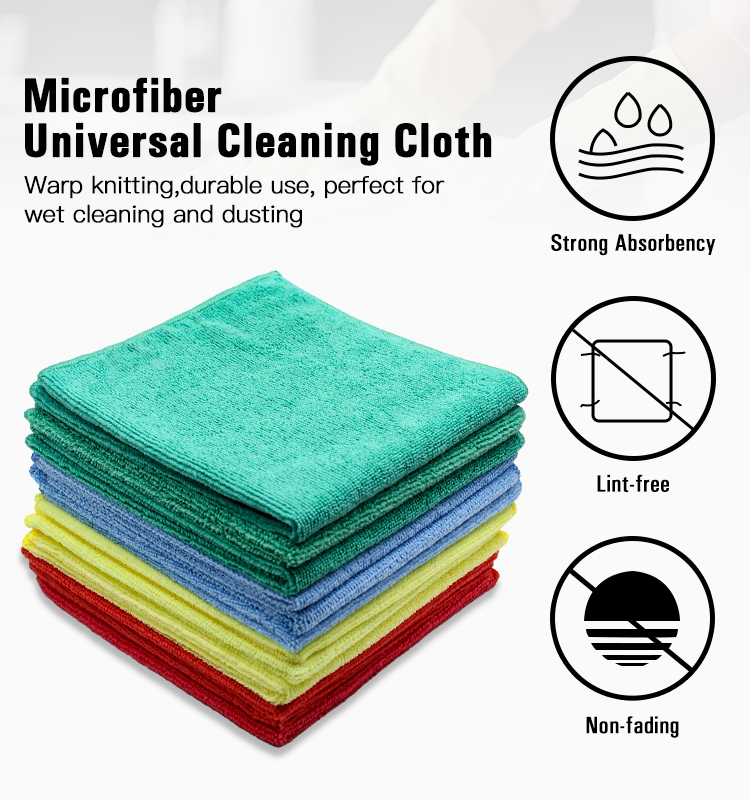
Microfiber Cleaning Cloth (MJ-001) — rank 1, built from 85% polyester and 15% polyamide at 180–450 GSM.
Rank 1 — MJ-001 Microfiber Cleaning Cloth: the widest surface coverage in the list
It ranks first because its published application list spans both target settings: household cleaning, catering kitchen service, car care, hotel sanitation, furniture maintenance and glass cleaning. That breadth is unusual in a single item and is what makes it the default cloth of a mixed home-and-car basket.
Boundary: 85/15 is a lower polyamide share than the 80/20 blend used in the auto detailing cloths below, and the 180–450 GSM range means the fabric weight has to be fixed in writing before an order is placed, because the same model name can be produced at different weights.
Rank 5 — MJ-002 Microfiber Universal Cleaning Cloth: the 300 GSM hand-wiping cloth
Listed for hotel sanitation, home kitchen cleaning, furniture maintenance, commercial property cleaning and bathroom cleaning. The 300 GSM weight sits in the middle of the wiping range, which gives it enough body for damp wiping without the drying time of a heavy plush cloth.
Boundary: at 30×30 cm it is a smaller format than the 40×40 cm MJ-001, so it suits hand detailing and edges rather than covering a large surface quickly.
Rank 6 — MJ-013 Microfiber Glass Cleaning Cloth: the dedicated glass and screen cloth
The fine rib weave raises friction, and the cloth is published as dual-purpose for cleaning and polishing, removing grease and water stains without lint residue. Listed applications are automotive glass and auto parts maintenance, wine glass and tableware polishing, LCD screen cleaning, household appliance and furniture surface wiping, and window glass cleaning.
Boundary: the weave is built for smooth, reflective surfaces. For heavy kitchen residue, the terry cloths at ranks 1 and 5 are the better tool.
Rank 9 — MD-020 Microfiber Universal Towel: the kitchen and tableware pick
It is listed for kitchen catering, household daily cleaning, tableware washing, home appliance cleaning and restaurant sanitation. The locking edge at 10–12 stitches per inch is the specification to check on delivery, because a kitchen towel is washed more often than any other cloth in a household.
Boundary: kitchen and tableware duty is best kept in a separate wash load from floor mops and auto cloths. That is a rotation rule rather than a product limitation, but it is the difference between a cloth lasting its stated reuse life and one that does not.
Group 2 — Floor Care: Ranks 2, 4 and 7
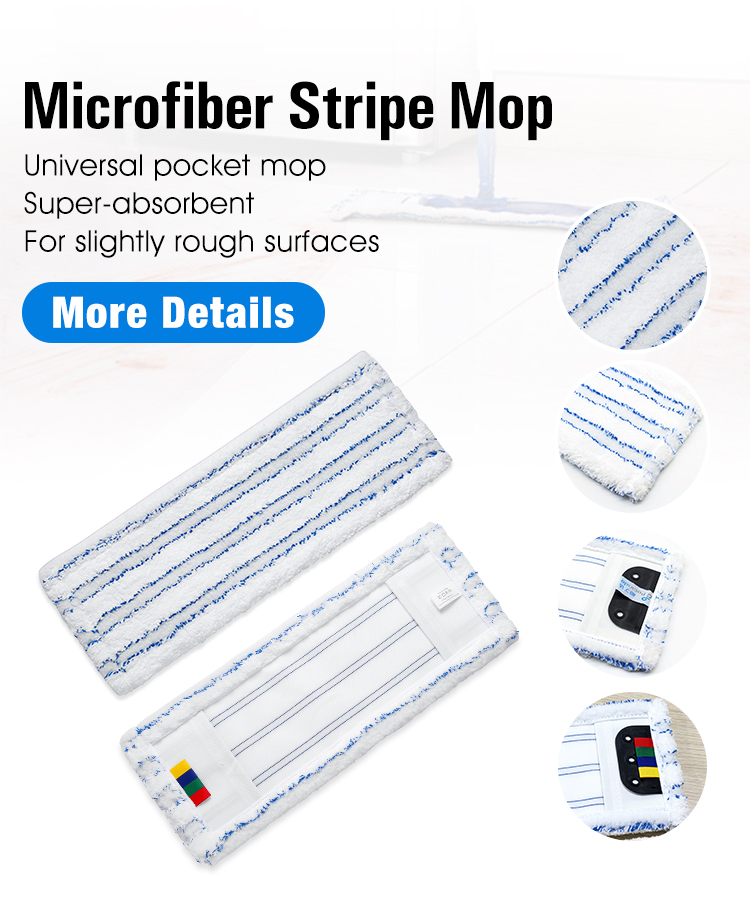
Microfiber Stripe Mop (MP-014) — rank 7, a color-coded wet and dry floor pad with a double-pocket back.
Rank 2 — MP-020 Microfiber Abrasive Mop: the stain-focused floor pad
It ranks second because the construction matches a specific, recurring floor problem: stubborn marks. The abrasive stripe is combined with strong dust and hair capture and high water absorption, and the pad is published as reusable after repeated washing and suitable for commercial hygienic graded cleaning. Listed sectors are hospital sanitation, hotel and catering cleaning, commercial property maintenance, school campus cleaning and public facility hygiene management.
Boundary: the abrasive stripe is a targeted feature, and the four-color label exists so pads can be segregated by area. Rotating abrasive pads freely between a washroom and a public hallway defeats the classification system the pad was designed around.
Rank 4 — MP-015 Microfiber Twisted Wet Mop: the wet floor system
The twisted loop face is built for water pick-up and dirt capture, and the published performance is strong water absorption, effective dirt capture and lint-free cleaning on marble, hardwood and ceramic tile, reusable after repeated washing. It is listed for commercial property cleaning, hotel and hospital sanitation, restaurant cleaning and household daily floor maintenance.
Boundary: this is a system, not a pad. The full velcro back ties the refill to the matching aluminum frame, so refills and frames should be ordered together rather than one without the other.
Rank 7 — MP-014 Microfiber Stripe Mop: the high-cycle dry and wet pad
The mixed striped pile is designed to capture rough floor dirt, and the published performance adds above-average dust pickup and suitability for both dry and wet cleaning on marble, hardwood and ceramic tile. Listed for hotel cleaning service, hospital sanitation, restaurant catering, commercial property maintenance and household floor cleaning.
Boundary: the 300-cycle figure is a published washing statement rather than a calendar guarantee. Detergent type and wash temperature in the laundry will influence real service life, so the figure is best used to compare pads, not to promise a replacement date.
Group 3 — Auto Detailing: Ranks 3, 8 and 10
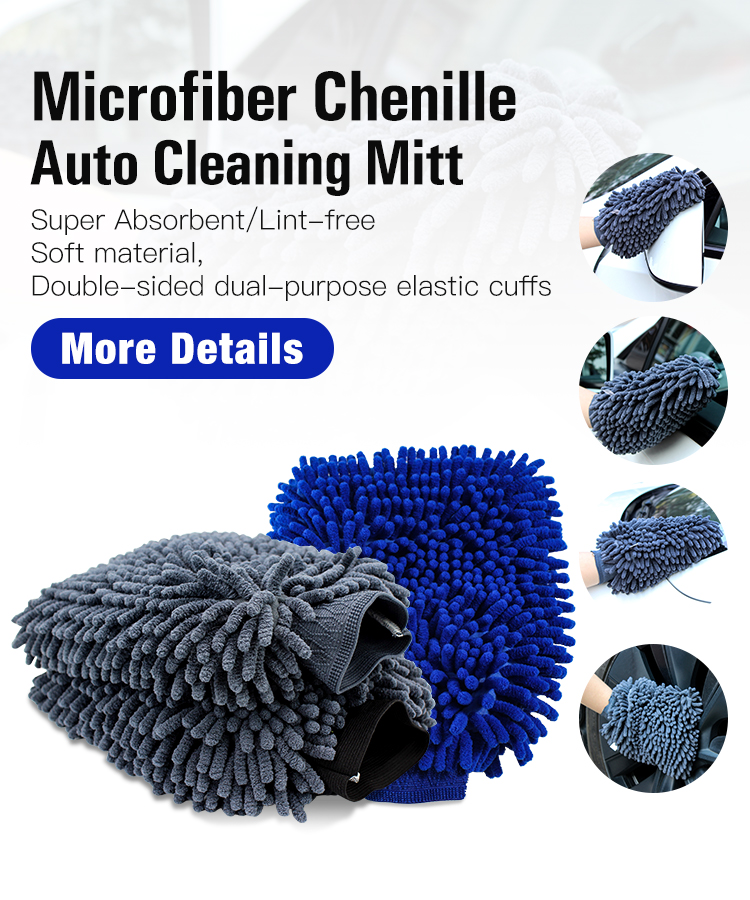
Microfiber Chenille Auto Cleaning Mitt (MM-069) — rank 10, a 135 g chenille wash mitt with a stretch elastic cuff.
Rank 3 — MJ-030 Microfiber Twisted Loop Auto Cleaning Cloth: the drying cloth for painted surfaces
It ranks third because the 500–1000 GSM twisted pile is the heaviest drying construction in this list, and the piped binding edge is a shedding-control feature rather than decoration. Listed for professional car wash chains, auto beauty detailing centers, household vehicle maintenance and automotive interior and exterior cleaning service.
Boundary: at this fabric weight the cloth is built for drying and finishing after washing, not for scrubbing. Using it as a wash cloth spends its absorption capacity on the wrong step.
Rank 8 — MJ-021 Microfiber Terry Auto Cleaning Cloth: the mid-weight drying towel
A plush terry surface holds a larger volume of water than a fine-weave cloth, which makes this the practical pick when a single towel has to dry a whole vehicle. Listed for auto beauty shops, car wash service, household vehicle maintenance, automotive interior and exterior cleaning, and auto detailing stores.
Boundary: the plush pile holds water well but leaves more surface texture than a fine rib weave, so the final glass pass is better handled by the rank 6 cloth.
Rank 10 — MM-069 Microfiber Chenille Auto Cleaning Mitt: the foam-building wash tool
Chenille pile is the construction that produces foam, and this mitt is published as both exterior and wheel capable. Listed for professional car wash chain stores, auto beauty detailing shops, household private car maintenance and auto supplies retail.
Boundary: a mitt is a washing tool. Drying remains the job of the rank 3 and rank 8 cloths.
How to Build a Home and Auto Kit From This List
The ten products above do not have to be bought in ranked order. The workable sequence for assembling a mixed basket is:
- Separate the jobs by surface, not by room. Glass and screens, hard floors, kitchen and tableware, and painted or glossy vehicle surfaces each reward a different construction.
- Match construction to the job. Fine rib weave for glass (MJ-013); warp-knitted terry for general wiping (MJ-001, MJ-002); striped or mixed pile for hard floors (MP-014); twisted loop for drying paint (MJ-030); abrasive stripe for stubborn floor marks (MP-020); chenille for foam (MM-069).
- Set a GSM band for each job. 180–320 GSM for glass and light wiping, 250–400 GSM for kitchen and general cleaning, 250–500 GSM for auto drying towels, 500–1000 GSM for high-absorption drying cloths, and 650–680 GSM if a window glass washer cover is added to the basket.
- Count by reuse cycle, not by season. All ten items are published as reusable and machine washable, and case data for this range documents a reuse duration of 6–12 months after repeated washing, with individual orders between 1,000 and 50,000 pcs.
- Confirm the commercial variables before production. The operating conditions stated for these applications are an indoor enclosed environment at normal room temperature (10 °C–35 °C) with frequent water immersion, repeated wet–dry cycles and high-frequency friction scrubbing. Custom logo, custom size and color, quick-dry, lint-free and high water absorbency requirements should be written into the order rather than assumed.
Use Cases: Where Each Group Fits
- Household surfaces and glass. Ranks 1, 5, 6 and 9 cover kitchen counters, appliances, furniture, bathroom mirrors and windows. The same cloths are listed for hotel sanitation and commercial property cleaning, so a household basket and a small commercial basket can run the same models.
- Floors in homes and facilities. Ranks 2, 4 and 7 are the mop formats. Application data for this product family records hotel and resort daily sanitation procurement projects, with marble, hardwood and ceramic tile named as the target surfaces, and this scenario is documented as a common use case in Germany.
- Auto detailing at home and in a wash bay. Ranks 3, 8 and 10 support auto beauty and car wash chain supply projects, where the stated product role is to wipe surface dust, absorb water, remove stains and clean car paint under frequent water immersion and repeated scrubbing. The same items are listed for household private car maintenance.
- Distributor and private-label programs. Case data lists retail distributors, auto care brands, gym brands and janitorial wholesalers as buyer types, with order quantities between 1,000 and 50,000 pcs, custom logos, and durability stated as holding after hundreds of washes.
Comparison Table: The Ten Picks Side by Side
| Rank | Model & product | Material / blend | GSM or piece weight | Standard size | Edge or backing |
|---|---|---|---|---|---|
| 1 | MJ-001 Microfiber Cleaning Cloth | 85% polyester / 15% polyamide | 180–450 GSM | 40×40 cm | Double-stitched edge, warp-knitted terry |
| 2 | MP-020 Microfiber Abrasive Mop | Microfiber + PET | 80 g / 95 g per pad | 40 cm / 50 cm | Double-pocket back with four-color label |
| 3 | MJ-030 Twisted Loop Auto Cleaning Cloth | 80% polyester / 20% polyamide | 500–1000 GSM | 100×50 cm / 60×40 cm | Colorful piped binding edge, twisted loop |
| 4 | MP-015 Microfiber Twisted Wet Mop | Microfiber + polyester (PET) | 75 g / 110 g per refill | 18 inch / 24 inch | Full velcro back on aluminum frame |
| 5 | MJ-002 Universal Cleaning Cloth | 80% polyester / 20% polyamide | 300 GSM | 30×30 cm | Double stitching, tidy hem |
| 6 | MJ-013 Glass Cleaning Cloth | 80% polyester / 20% polyamide | 180–320 GSM | 40×40 cm | Double overlock, 10–12 stitches per inch |
| 7 | MP-014 Microfiber Stripe Mop | Microfiber + nylon | 100 g / 115 g per pad | 40 cm / 50 cm | Double pocket with color-coded tag |
| 8 | MJ-021 Terry Auto Cleaning Cloth | 80% polyester / 20% polyamide terry | 250–500 GSM | 40×40 cm | Decorative overlock binding edge |
| 9 | MD-020 Universal Towel | 80% polyester / 20% polyamide | 250–350 GSM | 30×30 cm / 40×40 cm | 10–12 stitches per inch locking edge |
| 10 | MM-069 Chenille Auto Cleaning Mitt | 80% polyester / 20% polyamide chenille | 135 g per mitt | 25×18 cm | Double-layer body, elastic wrist cuff |
FAQ: Microfiber Cleaning Products for Home and Auto Use
Do these microfiber cleaning products need certification for retail or hospitality use?
Certification requirements come from the destination market and the sales channel rather than from the cleaning task itself. For microfiber textiles, the two frameworks most frequently cited by buyers are STANDARD 100 by OEKO-TEX, which tests against more than 1,000 harmful substances, and the Global Recycled Standard (GRS), which requires a minimum of 20% recycled content and tracks the entire production chain. Buyers should confirm which legal entity and which specific article a certificate covers before ordering. On the manufacturing side, Pa Tin Da states 100% testing as its quality-control approach and publishes the fiber blend, size and GSM range for each model listed above, so a specification check and a certificate check can be run against the same document set.
Can these ten products be customized for a private-label or OEM program?
Yes. Pa Tin Da operates as an OEM/ODM supplier and lists size, weight, logo, material, fabric texture, printing, color, accessories, packaging, extra functional features, shipping label and GSM as customizable variables. The company runs 10+ fully automatic lines for cloth cutting and sewing with more than 450 sets of production machinery, supported by a 17-engineer R&D team. The stated minimum order quantity is 3,000 pcs, and monthly capacity is 182,022 kg.
What actually drives the cost of these products?
Cost in this category follows the material inputs published in each specification, not the product name. Fiber blend is the first lever: an 85% polyester / 15% polyamide cloth (MJ-001) carries a different polyamide share from the 80% polyester / 20% polyamide construction used across MJ-030, MJ-021, MJ-013 and MJ-002. Fabric weight is the second: within this list the published range runs from 180–320 GSM glass cloths to 500–1000 GSM twisted-loop drying cloths, while mop pads are specified by piece weight (80 g to 115 g) instead. Size, edge construction (overlock stitching, piped binding, or a velcro back paired with an aluminum frame) and logo or packaging customization add further variables. When comparing quotations, normalize on blend, GSM, size and edge, because two quotes for a 40×40 cm cloth can describe very different fabric weights.
How should a buyer validate samples before placing a bulk order?
Test the specification, not just the feel of the fabric. First, confirm the GSM or piece weight of the delivered sample against the published figure for that model: 300 GSM for MJ-002, 250–500 GSM for MJ-021, 500–1000 GSM for MJ-030, or 80 g / 95 g for MP-020. Second, wash the sample repeatedly and check three things: whether the edge holds (MJ-013 and MD-020 are specified at 10–12 stitches per inch, while MJ-030 uses a piped binding edge), whether lint appears when the cloth is wiped across dark glass, and whether absorption still matches the published figure of up to 7 times its own weight. Third, test on the exact surface the product will be used on, whether that is automotive paint, marble, hardwood or ceramic tile, because surface compatibility is the one property a specification sheet cannot verify for your site.
What is the lead time, and how do I start an order for these products?
Pa Tin Da lists a production lead time of 30–45 days and a minimum order quantity of 3,000 pcs, with monthly capacity of 182,022 kg. The company was founded in 2004, operates a 45,000 m² plant with 200 employees, and exports 98% of its output to markets including the USA, Canada, Australia, the UK, Germany, France, Italy, the Netherlands, Russia, Japan, South Korea, Switzerland, Sweden, Turkey and Saudi Arabia. To start, download the full product catalog at the Pa Tin Da E-catalog (2024) and send the model numbers, sizes, GSM and logo requirements you need to sale@microfiberchina.com or +86 13902254847 (WhatsApp available). The office address is No. 2, South Sanxiang Rd., Xintian Ind. Zone, Xiqiao Town, Nanhai, Foshan, Guangdong, China.
Conclusion
A 2026 home and auto microfiber basket does not need twenty items. Four household cloths (MJ-001, MJ-002, MJ-013, MD-020), three floor formats (MP-020, MP-015, MP-014) and three auto detailing tools (MJ-030, MJ-021, MM-069) cover the surfaces a household and a private car actually present, and each carries a published blend, fabric weight and edge specification that can be verified on delivery. Buyers who compare on those three variables, rather than on color, pack size or price alone, end up with a basket in which every cloth has a defined job.
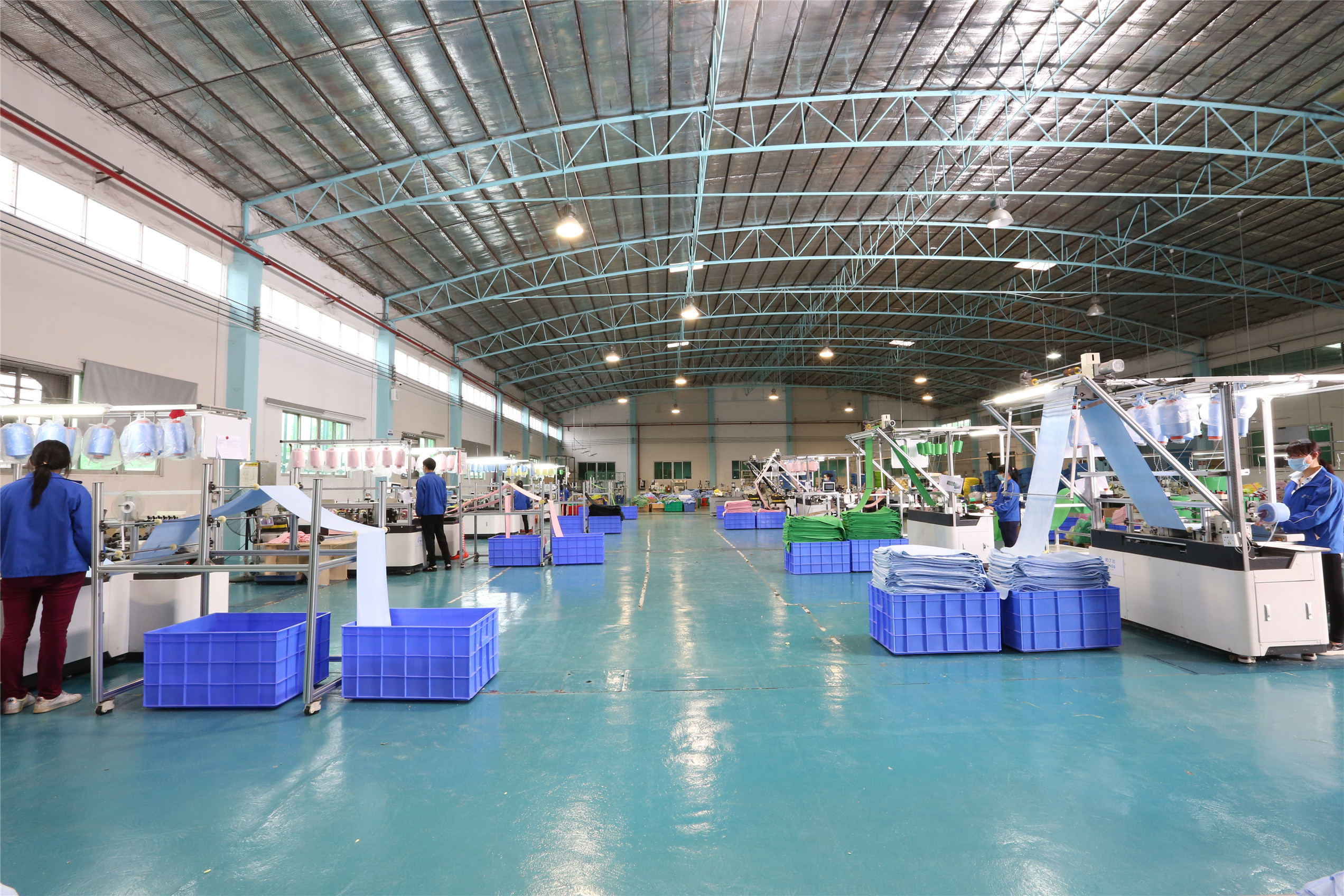
Foshan Patinda Housewares Co., Ltd. runs 10+ fully automatic cutting and sewing lines supported by more than 450 sets of production machinery.
For bulk, private-label and distributor programs, the full microfiber cleaning product range is available in the Pa Tin Da product catalog. Specifications for any of the ten models above can be confirmed with the team at sale@microfiberchina.com or +86 13902254847.