Cantonese Dim Sum Basics: Traditional vs Fried vs Frozen
Cantonese Dim Sum Basics: What Defines a Traditional vs. Fried vs. Frozen Category
Cantonese dim sum is not one product line. A single supplier catalogue can list steamed rice-flour cakes, deep-fried pastry rolls and frozen buns side by side, and each one behaves differently in a commercial kitchen, a retail freezer and an export container. The three labels buyers meet most often — traditional dim sum, fried dim sum and frozen dim sum — are not parallel categories. The first two describe how a product is made and eaten. The third describes the format in which the product reaches the buyer.
That distinction decides whether an order is workable. Frozen shrimp dumplings are steamed before service. Frozen spring rolls are deep-fried. A frozen taro cake can be either steamed or pan-fried, depending on the menu. Reading the label correctly is the difference between ordering a product your kitchen can execute at volume and ordering one it cannot.
This guide defines the three families using named products and published specifications from the catalogue of Foshan Shunde Yuexiang Food Manufacturing Co., Ltd. — a Cantonese dim sum manufacturer founded in 1981, based in Shunde, Foshan, Guangdong, China, producing more than 300 items across five major series and exporting to more than 20 countries, including the USA, Canada, Australia and EU markets.
Why the Category Labels Confuse First-Time Buyers
"Cantonese dim sum" names a meal as well as the items served at it, and the same phrase gets used for a fresh bamboo steamer tray, a chilled retail pack and a frozen export carton. Four attributes separate the actual products; everything else is presentation.
- Primary material — taro, water chestnut, coconut milk, shrimp, pork, glutinous rice, millet or durian. Material drives flavour and texture before any cooking happens.
- Cooking route — steamed, pan-fried, deep-fried or boiled. The route determines which equipment a buyer needs and how much kitchen skill the item demands.
- Sweet or savoury role — a savoury taro cake does a different job on a menu than a coconut-milk dessert cake.
- Storage and pack format — dim sum reaches the buyer frozen in most export and wholesale channels, but pack sizes, thawing rules and cook-from-frozen instructions vary by product.
A first mistake is treating "frozen" as a flavour family. In the Yuexiang catalogue, the Frozen Dim Sum tag covers steamed buns, steamed rice cakes and even a raw pastry sheet, so frozen cannot describe taste. A second mistake is assuming "traditional" means only steamed. The Taro Cake is tagged Traditional Dim Sum and is explicitly specified for either pan-frying until golden on both sides or steaming for 6–8 minutes.
Working definition: Traditional dim sum and fried dim sum describe a product's recipe family and cooking method. Frozen dim sum describes the handling format — quick-frozen, stored at or below −18°C, and cooked from frozen in most cases. A single product can be both traditional in recipe and frozen in format.
What Is Changing in the Cantonese Dim Sum Category
Category literacy now has commercial weight, for three reasons.
The frozen segment is large and growing. The global frozen Cantonese-style dim sum market was valued at USD 7.04 billion in 2025, with a projected path to USD 11.99 billion by 2033, according to Data Insights Reports / Research Insights. That estimate covers retail value of frozen Cantonese-style dim sum products specifically, which means the category is being measured as a defined product group rather than as a generic restaurant service.
Production is concentrated. Business Research Insights reports that China accounted for 46% of global frozen dumpling production volume in 2025, ahead of Japan at 11% and South Korea at 9%. For a buyer, concentration is useful: it means most supply-side specification conventions — pack sizes, cook-from-frozen instructions, storage temperatures — are comparable across Chinese manufacturers, so catalogue reading becomes a genuine evaluation skill.
Labelling rules have tightened. On 1 May 2026, Guangzhou implemented a regulation requiring restaurants to state clearly whether their dim sum is handmade on-site or produced through central kitchens or pre-made supply, as reported by Tridge and Guangzhou local government sources. The rule applies to restaurants in Guangzhou, but its commercial logic travels: menus increasingly separate "made in house" from "supplied pre-made", and buyers quoting frozen product into food-service accounts need to know exactly which category each item belongs to before the menu is printed.
On the trade side, frozen dim sum is commonly declared under HS Code 1902200000 (stuffed pasta) and 1902309000 (other pasta), according to Zauba / China Customs shipment records. Classification affects duty treatment and documentation, which is why the pack format and product type on the specification sheet need to be accurate from the first enquiry.
The Three Category Families, Defined
Traditional Dim Sum: Steamed, Layered and Savoury Cakes
Traditional dim sum covers the cake and pastry formats that define a Cantonese morning tea table — rice-flour and coconut-milk cakes, layered bean cakes, and savoury root-vegetable cakes. In the Yuexiang catalogue these carry the Traditional Dim Sum tag and share three traits: a named primary material, a short cook-from-frozen time (usually 6–8 minutes), and a texture built on layering or inclusions rather than on a filling.
Four products show the range inside this one tag:
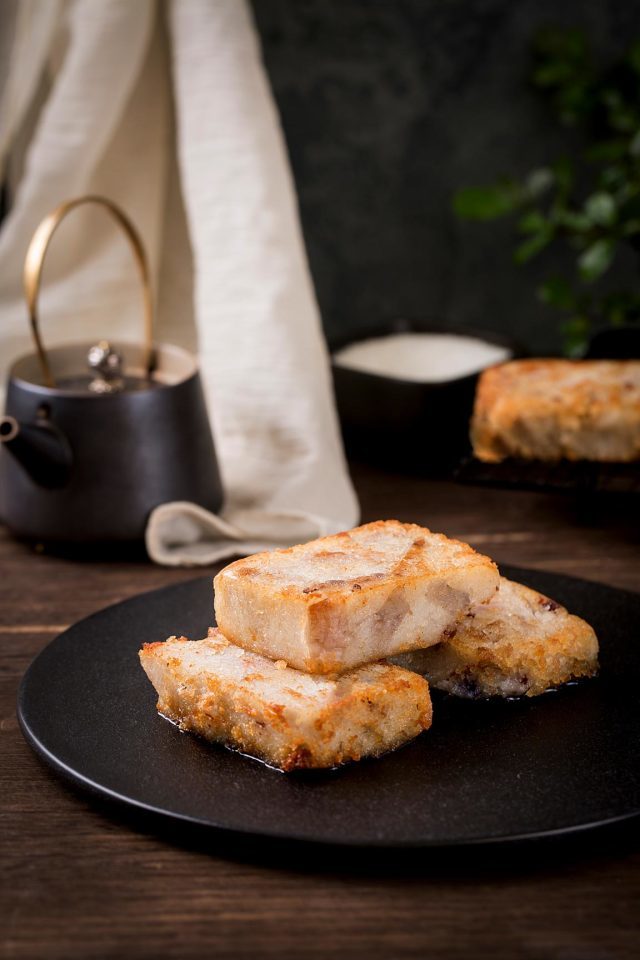
- Taro Cake (type: Crispy Taro Pastry) — made of taro, 500 g (12 pieces) per bag, 12 bags per box. Cook from frozen: pan-fry until golden on both sides, or steam for 6–8 minutes. The flavour is savoury and deliberately not sweet, with a soft, springy cake body and larger taro chunks for contrast.
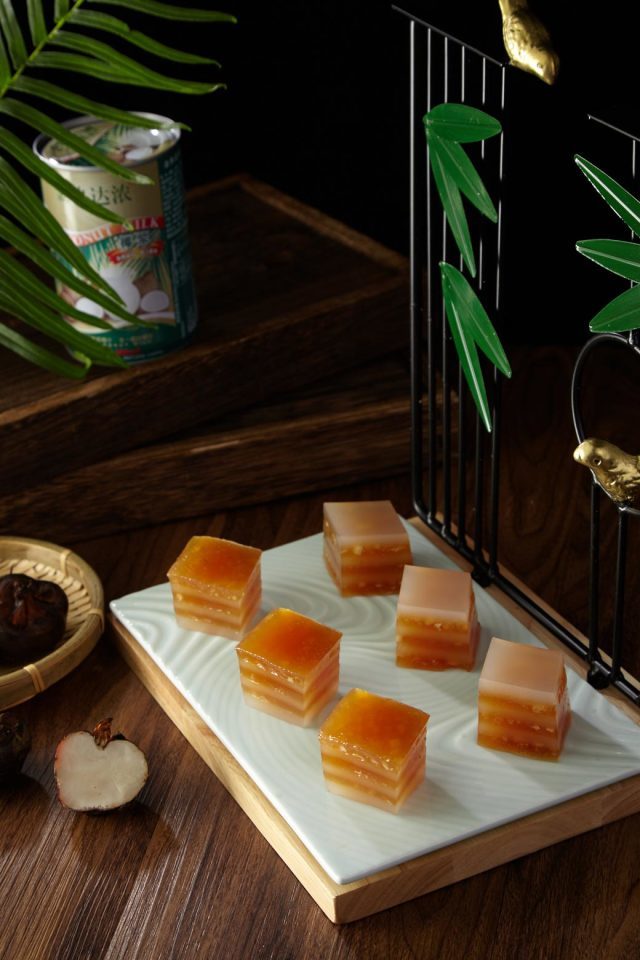
- Water Chestnut Cake — made from coconut milk and water chestnuts, 500 g per bag, 12 bags per box, steamed for 6–8 minutes. It is a layered, translucent milky-white cake with crunchy water chestnut pieces, positioned as a lighter, low-fat dessert.
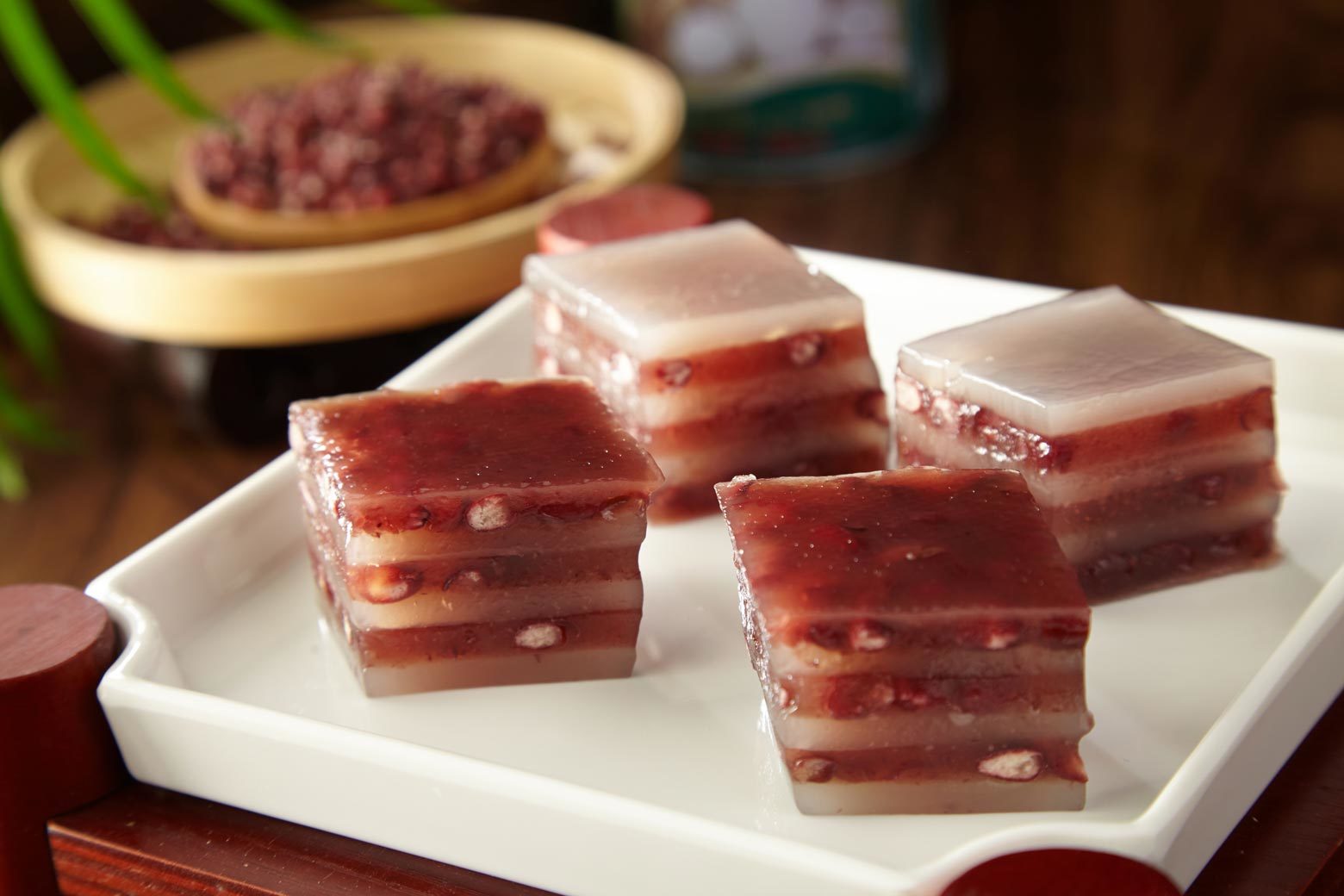
- Red Bean Cake (type: Red Bean Layered Cake) — made of red bean, 500 g per bag, 12 bags per box, steamed for 6–8 minutes. Distinct red and white layers with whole red bean pieces.
- Coconut Golden Cake — made from coconut juice and flour, 300 g per bag, 20 bags per box. Cook from frozen: pan-fry until golden on both sides, or steam for 6–8 minutes.
Note the split inside the family: two of these are savoury-leaning or neutral, two are sweet. "Traditional" describes lineage and material pattern, not a single taste profile.
Fried Dim Sum: Wrapped, Coated and Deep-Fried
Fried dim sum is defined by its cooking route. These are filled or formed items that are deep-fried from frozen and served crisp — spring rolls, flaky pastries, sesame-coated balls and filled rolls. The tag Fried Dim Sum in the Yuexiang catalogue covers eight items that differ widely in filling but share one operational rule: no thawing before frying, and a specified oil temperature window.
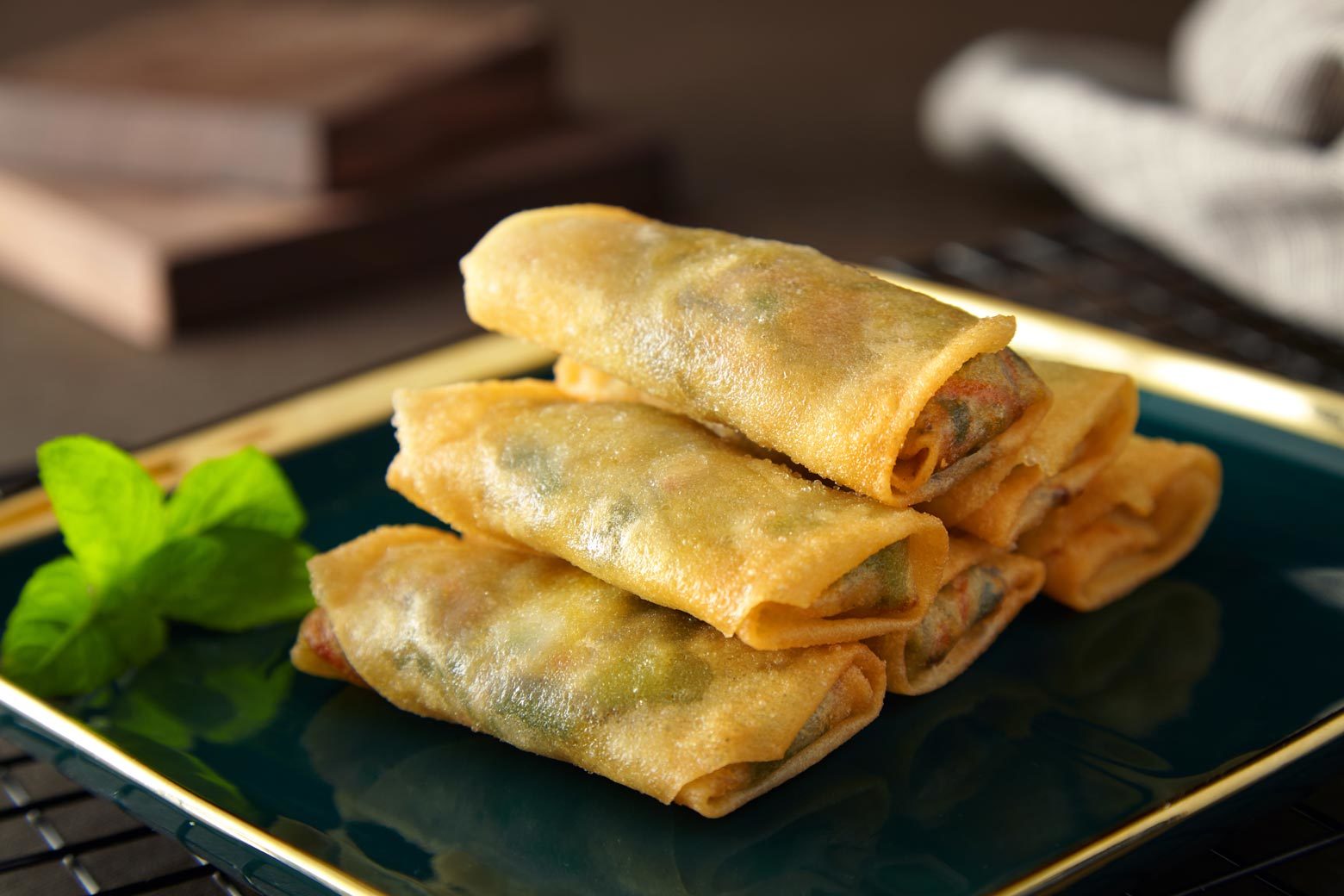
- Hong Kong style spring rolls — pork, shiitake mushrooms and mung beans; 216 g (12 pieces) per bag, 20 bags per box; fried from frozen at 150–160°C for 3–4 minutes.
- Golden Durian Crisp (type: Golden Durian Roll) — made of durian; 250 g (10 pieces) per bag, 12 bags per box; fried from frozen at 160°C for 5 minutes.
- Golden Cone Durian Crisp — durian and flour; 300 g (10 pieces) per bag, 20 bags per box; fried at 150–160°C for 4–6 minutes.
- Taro Pie — taro and flour, with a flaky crust and creamy taro filling; 336 g (12 pieces) per bag, 16 bags per box; fried at 150–160°C for 3–4 minutes.
- Explosive juice gold ball (type: Sesame Ball) — fruit juice and flour, coated in white sesame seeds; 300 g (10 pieces) per bag, 12 bags per box; fried at 160–165°C for 8–9 minutes.
- Shunde Double Skin Milk (type: Crispy Milk Roll) — milk and flour; 300 g (10 pieces) per bag, 15 bags per box; fried at 160–165°C for 3–5 minutes.
- Milk Rolls (type: Crispy Milk Roll) — 280 g (10 pieces) per bag, 12 bags per box; fried at 150–160°C for 3–4 minutes.
- Green Tea Buddha Cake — taro, green tea and glutinous rice flour; 336 g (12 pieces) per bag, 20 bags per box; fried at 165°C for 4 minutes.
The practical implication is equipment, not flavour. Fried dim sum needs a temperature-controlled fryer and a holding plan, because the crisp shell is the product. Steam-only kitchens should treat this family as a separate investment decision rather than as an add-on to a steamed range.
Frozen Dim Sum: A Handling Format That Cuts Across Recipes
Frozen dim sum is the format in which products are quick-frozen, distributed and stored at or below −18°C, then cooked from frozen. The tag appears on products that are steamed, not fried — which is exactly why it should not be read as a recipe family.
- Shrimp dumplings — 270 g / 9 pieces per pack, 15 packs per box; steamed from frozen for 7–8 minutes, or pan-fried from frozen until golden on both sides.
- Shrimp Siu Mai — whole fresh shrimp with a thin, translucent skin; 270 g / 9 pieces per pack, 20 packs per box; steamed for 12 minutes.
- Char siu bao (Barbecued pork big bag) — pork and flour, honey-glazed char siu filling; 480 g (4 pieces) or 720 g (6 pieces) per bag, 18 bags per box; steamed for 10 minutes.
- Chicken sticky rice — glutinous rice and chicken, steamed in lotus leaves; 720 g (6 pieces) or 900 g (6 pieces) per bag, 12 bags per box; steamed for 20–25 minutes.
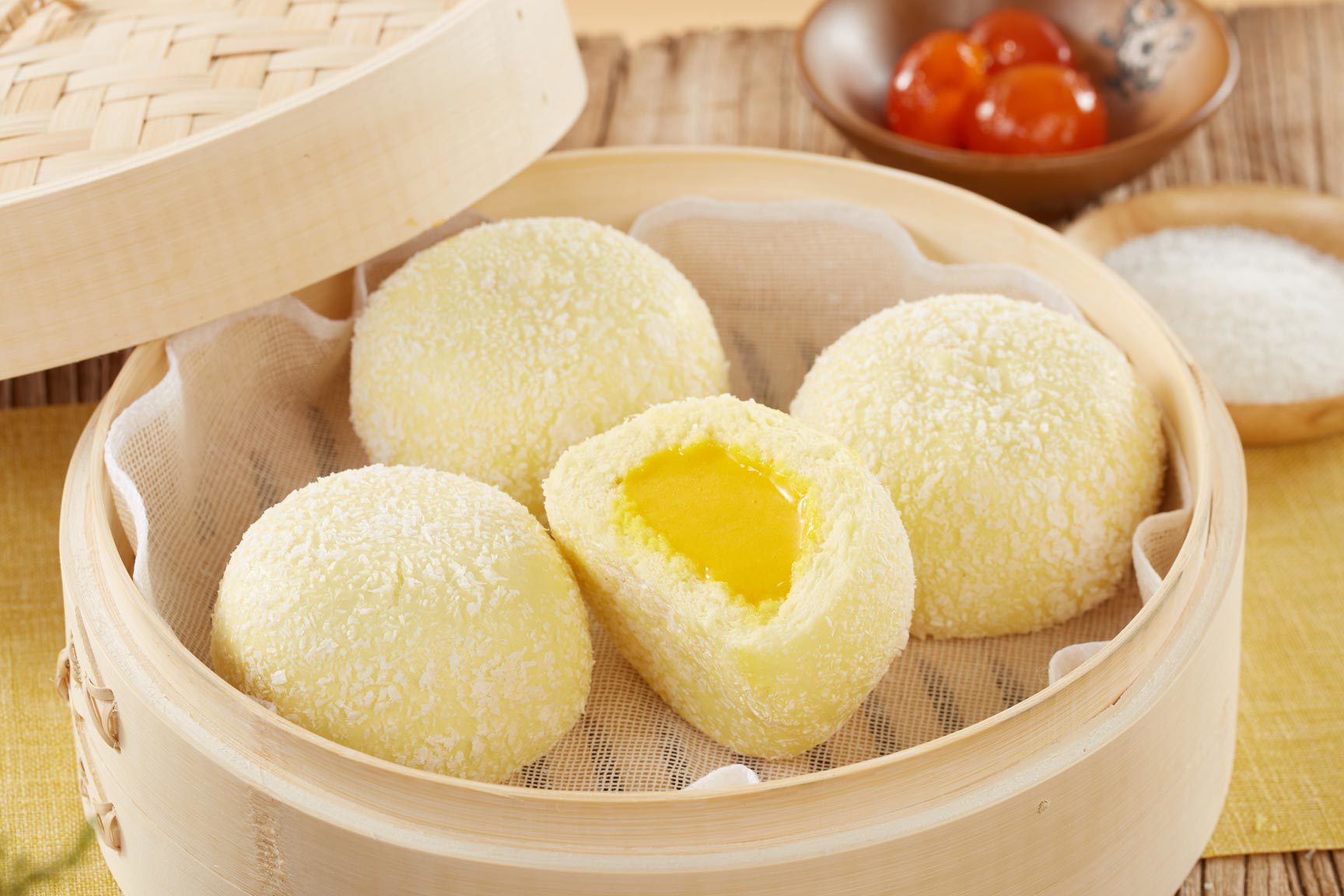
- Lava Custard Bun — egg-based salted egg yolk filling; 480 g (12 pieces) per bag, 18 bags per box; steamed for 8 minutes.
- Steamed custard bun — custard and flour; 420 g / 12 pieces per pack, 18 packs per box; steamed for 8–10 minutes.
- Walnut Bun — walnut and flour; 480 g (12 pieces) per bag, 18 bags per box; steamed for 8 minutes.
- Red bean paste bun — red beans and flour; 480 g / 12 pieces per pack x 18 packs per box, or 530 g / 12 pieces x 24 packs per box.
- Steamed Black Sesame Kuih — black sesame; 500 g per bag, 12 bags per box; steamed for 6–8 minutes.
- Kataifi pastry — a flour-based raw pastry sheet, 1 kg per bag, 12 bags per box. This is the exception to cook-from-frozen: it must thaw for about 30 minutes (never more than 3 hours), covered with a damp cloth, then deep-fried at 150–160°C.
Two storage facts apply across the frozen range. Product should be held at or below −18°C through storage and transport to preserve freshness and prevent drying and cracking, and the recommended equipment set is freezers, steamers and refrigerated transport vehicles. Within the same catalogue, the prepared-dish range behaves similarly: Buddha Jumps Over The Wall is supplied in 1.5 kg, 2.25 kg and 3.5 kg sizes with a one-year shelf life when frozen below −18°C.
Taro Cake vs. Water Chestnut Cake: Two Traditional Products, Two Briefs
The clearest way to understand the traditional family is to compare two products that sit under the same tag but answer different menu needs. The Taro Cake is a savoury, whole-grain style snack built on taro; the Water Chestnut Cake is a coconut-milk steamed cake built on water chestnut pieces. They share a pack weight and a steaming time, and almost nothing else.
| Attribute | Taro Cake (Crispy Taro Pastry) | Water Chestnut Cake |
|---|---|---|
| Catalogue tag | Traditional Dim Sum | Traditional Dim Sum |
| Primary material | Taro | Coconut milk and water chestnuts |
| Flavour role | Savoury, intentionally not sweet | Sweet coconut aroma with a refreshing water chestnut finish |
| Texture | Soft, springy cake body with visible taro chunks | Soft, smooth, chewy cake with crunchy water chestnut pieces |
| Cooking method | Pan-fry until golden on both sides, or steam 6–8 minutes; no thawing | Steam 6–8 minutes; no thawing |
| Pack format | 500 g (12 pieces) per bag, 12 bags per box | 500 g per bag, 12 bags per box |
| Menu fit | Breakfast, morning tea, late-night snacks; customers who prefer savoury | Afternoon tea, banquets, lighter dessert menus; strong visual presentation |
Read as a buying brief: if the account is a breakfast shop or a canteen, the Taro Cake carries satiety and a savoury position. If the account is a teahouse or banquet operation, the Water Chestnut Cake carries the visual and lighter-dessert position. Ordering one and expecting it to do the other's job is the most common category error in first-time traditional dim sum orders.
Where the Shunde Origin Fits
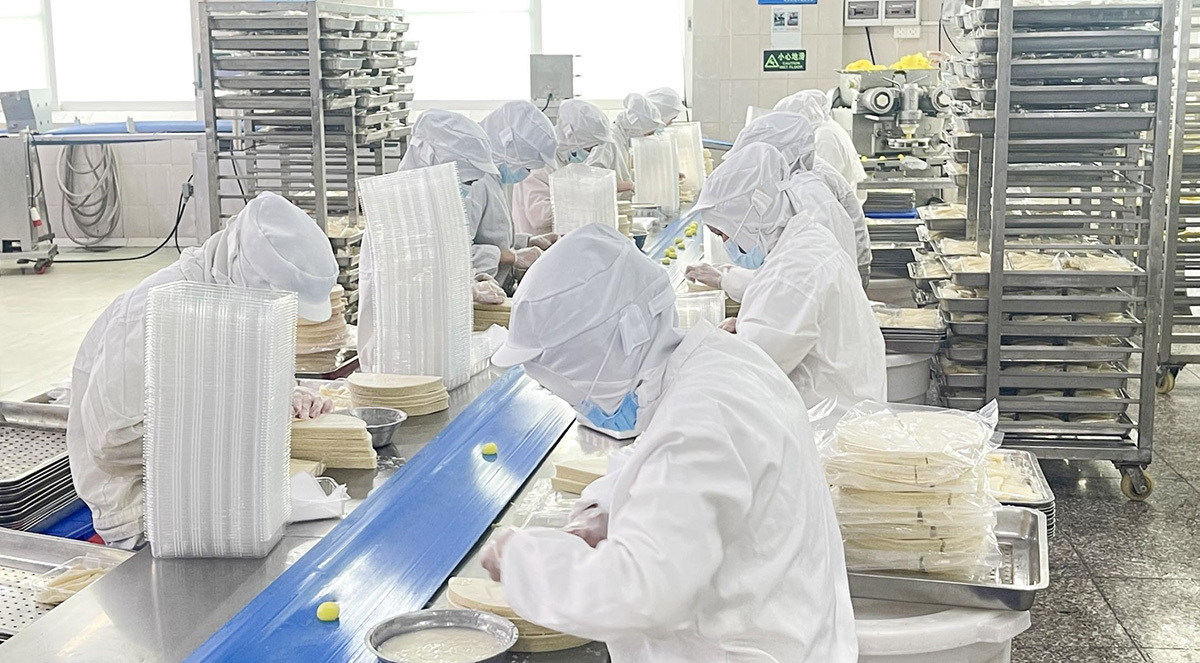
Origin is a category signal in Cantonese dim sum, because the recipe conventions come from a specific place. Yuexiang is located in Shunde, Foshan, recognised as a UNESCO City of Gastronomy, and has operated there since 1981 as a Foshan Time-honored Brand. The company runs a 20,000 m² facility with more than 200 employees, an annual output of 6,000,000 units, and a dedicated R&D centre with more than 30 engineers. It holds ISO 9001, HACCP and FDA certification, and a second production facility, Foshan Shunde Hongyuan Food Co., Ltd., was established in 2019.
For a buyer, that combination is what makes a category explanation verifiable rather than promotional: the definitions above can be checked against published per-SKU specifications — material, piece count, pack configuration, cook-from-frozen time — rather than against a general claim about authenticity.
How to Classify a Dim Sum Product in Five Steps
Any item in this category can be placed correctly with five checks, in this order.
- Read the catalogue tag first. If the tag is Traditional Dim Sum, Fried Dim Sum or Frozen Dim Sum, note it — but treat it as one input, not the answer, because Frozen Dim Sum spans both steamed and fried recipes.
- Check the primary material. Taro, water chestnut, coconut milk, red bean, millet, shrimp, pork, glutinous rice, durian and black sesame each imply a different texture and price position. Material tells you what the product is; the tag tells you where the supplier files it.
- Check the stated cooking method and time. Steam times in this catalogue run from 6–8 minutes for cakes and buns up to 20–25 minutes for chicken sticky rice; frying runs from 3–4 minutes for spring rolls up to 8–9 minutes for sesame balls. Any item outside your equipment envelope should be excluded here, not later.
- Confirm the thawing rule. Almost every product is cooked from frozen. Kataifi pastry is the documented exception, requiring roughly 30 minutes of thawing and never more than 3 hours.
- Confirm pack format and storage. Pack configuration (pieces per bag, bags per box, grams per bag) drives freezer space, portion cost and shelf presentation. Storage is frozen at or below −18°C across the range.
Worked example: a product listed as "Taro Cake, primary material taro, 500 g (12 pieces) per bag, 12 bags per box, fry or steam 6–8 minutes" classifies as a traditional, savoury, steam-or-pan-fry item — not as a fried dim sum, even though pan-frying is one of its two routes.
Where Each Category Fits on a Menu
The three families are usually combined rather than chosen between, because they answer different dayparts and equipment realities.
- Fast food breakfast shops and late-night food stalls — steamed buns and shrimp dumplings cook in 7–12 minutes from frozen, which fits a high-turnover morning window; lava custard buns and steamed custard buns serve the same slot.
- Star-rated hotels, guesthouses and resorts — traditional cakes and fried pastries support banquet and afternoon tea service, where visual layering matters and portions are plated rather than held.
- Supermarkets, community fresh food stores and convenience stores — packed frozen formats with 12–20 bags per box suit retail freezer depth, and single-serve piece counts support consumer packs.
- Schools, factories, office buildings, hospitals, nursing homes and government canteens — chicken sticky rice and steamed buns carry satiety and portion consistency, and both are cooked from frozen without skilled labour.
- Airports, high-speed rail stations and highway service areas — fried items and filled buns hold better under fast service than delicate steamed cakes.
- Food OEM manufacturers, New Year's gift box vendors and banquet operators — mixed-category assortments work here, since gift and banquet formats benefit from combining a savoury traditional cake, a sweet layered cake and a fried pastry in one presentation.
- Food supply chain wholesalers, overseas Chinese restaurants and Chinese supermarkets — export-oriented accounts need the whole range, because their end customers expect traditional, fried and frozen formats on the same order.
Traditional vs. Fried vs. Frozen: Side-by-Side
| Dimension | Traditional Dim Sum | Fried Dim Sum | Frozen Dim Sum |
|---|---|---|---|
| What the label describes | Recipe family and material pattern | Cooking method (deep-fried) | Storage and handling format |
| Examples in the Yuexiang catalogue | Taro Cake, Water Chestnut Cake, Red Bean Cake, Coconut Golden Cake | Hong Kong style spring rolls, Golden Durian Crisp, Golden Cone Durian Crisp, Taro Pie, Explosive juice gold ball, Shunde Double Skin Milk, Milk Rolls, Green Tea Buddha Cake | Shrimp dumplings, Shrimp Siu Mai, char siu bao, chicken sticky rice, Lava Custard Bun, Steamed custard bun, Walnut Bun, Red Bean paste bun, Steamed Black Sesame Kuih, kataifi pastry |
| Cooking at the kitchen | Steam 6–8 minutes, or pan-fry until golden on both sides | Deep-fry from frozen at 150–165°C for 3–9 minutes depending on item | Steam from frozen for 7–25 minutes depending on item |
| Texture signature | Soft, layered or springy body with visible inclusions | Crisp shell with a moist filling | Item-dependent; the format does not fix texture |
| Typical pack formats | 500 g (12) per bag, 12 bags per box; Coconut Golden Cake 300 g per bag, 20 bags per box | Spring rolls 216 g (12) per bag, 20 bags per box; Golden Durian Crisp 250 g (10) per bag, 12 bags per box | Shrimp dumplings 270 g / 9 pieces, 15 packs per box; Lava Custard Bun 480 g (12), 18 bags per box; chicken sticky rice 900 g (6), 12 bags per box |
| Storage | Frozen at or below −18°C | Frozen at or below −18°C | Frozen at or below −18°C |
| Equipment needed | Steamer or frying pan | Temperature-controlled fryer | Freezer plus steamer; refrigerated transport for distribution |
Frequently Asked Questions
1. What compliance and food-safety points should a first-time buyer verify on a Cantonese dim sum supplier?
Verify three things: certification, storage control and product-level specification. Foshan Shunde Yuexiang Food Manufacturing Co., Ltd. holds ISO 9001, HACCP and FDA certification, operates a 20,000 m² facility in Shunde, and specifies frozen storage at or below −18°C throughout, with freezers, steamers and refrigerated transport vehicles as the matched equipment set. At product level, ask for the per-SKU specification sheet, because pack format and cooking method vary widely: spring rolls are 216 g (12 pieces) per bag at 20 bags per box, while chicken sticky rice is 900 g (6 pieces) per bag at 12 bags per box. If the product will be sold into Guangzhou food service, also confirm whether the operator must label it as handmade on-site or as pre-made supply, following the regulation in force there since 1 May 2026.
2. Can one Cantonese dim sum supplier cover traditional, fried and frozen categories in a single order?
Yes, when the supplier's catalogue is organised by series rather than by single products. Yuexiang offers more than 300 items across five major series, and its catalogue carries Traditional Dim Sum, Fried Dim Sum and Frozen Dim Sum tags alongside Chinese Dim Sum items such as Millet cake. In practice that means a buyer can build a menu from a savoury traditional cake, a sweet layered cake and a fried pastry without splitting the order across suppliers, and a second production facility established in 2019, Foshan Shunde Hongyuan Food Co., Ltd., supports that scale.
3. Does the category choice change the equipment and labour a kitchen needs?
Substantially. Frozen Dim Sum items are steamed straight from frozen, with documented times ranging from 6–8 minutes for Steamed Black Sesame Kuih to 12 minutes for Shrimp Siu Mai and 20–25 minutes for chicken sticky rice, so the requirement is freezer capacity plus steamer throughput. Fried Dim Sum items require a temperature-controlled fryer and cook in 3–9 minutes at 150–165°C depending on the product. Traditional Dim Sum is the most flexible: Taro Cake, Coconut Golden Cake and Millet cake can be either steamed or pan-fried, while Water Chestnut Cake and Red Bean Cake are steamed for 6–8 minutes. A kitchen without a fryer should therefore treat the fried range as a separate capital decision, not as a menu extension.
4. How can a buyer validate a range before committing to a full container?
Validate with samples and a timed cook test rather than with photographs. Request a sample set that spans the three families — for example Shrimp Siu Mai from the frozen range, Hong Kong style spring rolls from the fried range, and Taro Cake and Water Chestnut Cake from the traditional range — then cook each item exactly as the specification states: no thawing, steam or fry at the stated temperature and time. Record yield, texture after holding and portion consistency. Buyers who want to run that test can request samples, a current quotation or the product catalogue directly from the manufacturer through the enquiry channels listed below.
5. How should frozen dim sum be stored and shipped, and which items need special handling?
Frozen dim sum should be held at or below −18°C through storage, transport and delivery, using freezers and refrigerated transport vehicles; this preserves freshness and prevents products from drying and cracking. Most items are cooked from frozen, but kataifi pastry is the documented exception: thaw for about 30 minutes, never longer than 3 hours, covered with a damp cloth, then deep-fry at 150–160°C. Prepared dishes follow the same cold chain — Buddha Jumps Over The Wall is supplied in 1.5 kg, 2.25 kg and 3.5 kg sizes with a one-year shelf life when frozen below −18°C.
Conclusion: Classify First, Then Compare
The three labels buyers encounter in Cantonese dim sum are not competing categories. Traditional dim sum describes the rice-flour, coconut-milk and root-vegetable cakes that anchor a morning tea menu; fried dim sum describes the deep-fried pastry family that depends on a fryer and a temperature window; frozen dim sum describes the handling format that most export and wholesale buyers actually purchase in. Once a product is placed on those three axes, comparison becomes mechanical: material, cook time, pack format, storage, equipment.
Foshan Shunde Yuexiang Food Manufacturing Co., Ltd. has produced this range from Shunde, a UNESCO City of Gastronomy, since 1981, and its catalogue specifications — piece counts, pack configurations, cook-from-frozen times and storage limits — are the same details a buyer needs to classify a product correctly. Starting from the specification sheet rather than from a product name is the fastest way to avoid the category mistakes that surface later as menu failures.
Next Step
Request product samples, a current quotation or the full catalogue from the manufacturer. The company brochure covering the Cantonese dim sum, traditional dim sum, Chinese dim sum and frozen dim sum series is available here: Download the Yuexiang product brochure (PDF).
Website: www.dimsum-daxiao.com
Email: Kyle@dimsum-daxiao.com
Tel / WhatsApp: +86 13726399586
Address: No. 24, Xinghua West Road, Xingcha Village Committee, Jun'an Town, Shunde District, Foshan City, Guangdong Province, China
Have Questions or Need More Details?
Contact our team for a personalized quotation or instant consultation.
Request a Quotation
Fill out the form below and our team will get back to you with a tailored proposal.
WhatsApp Direct Chat
Prefer to chat in real-time? Message us on WhatsApp for instant assistance & quick answers.
- Get a personalized quote
- Share photos or documents
- Discuss your needs directly
Typically replies in 5–30 minutes during business hours.