Frozen Cantonese Dim Sum Compliance: Reading Claims, Standards and Rules
Compliance in frozen Cantonese dim sum is not a single certificate. It is a match between four things: the scope a certificate actually covers, the legal holder of that certificate, the rules of the destination market, and the batch-level records that travel with your order. A supplier can hold a valid export registration and still ship a product that sits outside its stated scope. A US facility registration can be active while the importing distributor still carries its own verification duties. Buyers who treat certification as a yes/no question usually discover the gap at the port, at label review, or at the first customer complaint.
This guide is written for procurement, quality and category teams at importers, distributors, restaurant groups and retail chains. It explains how to read certification and standards claims without assuming that any particular certificate exists, how to check destination-market rules, and how to turn product-level specifications into acceptance criteria. Foshan Shunde Yuexiang Food Manufacturing Co., Ltd. (dimsum-daxiao.com) appears as a supplier-diligence example because its published profile gives concrete, checkable fields: a Shunde location, a 20,000 m² facility, 200+ staff, 30+ R&D engineers, a reported annual output of 6,000,000 units, and 300+ items across five series. Those facts describe capability and context; they do not replace the document checks below.
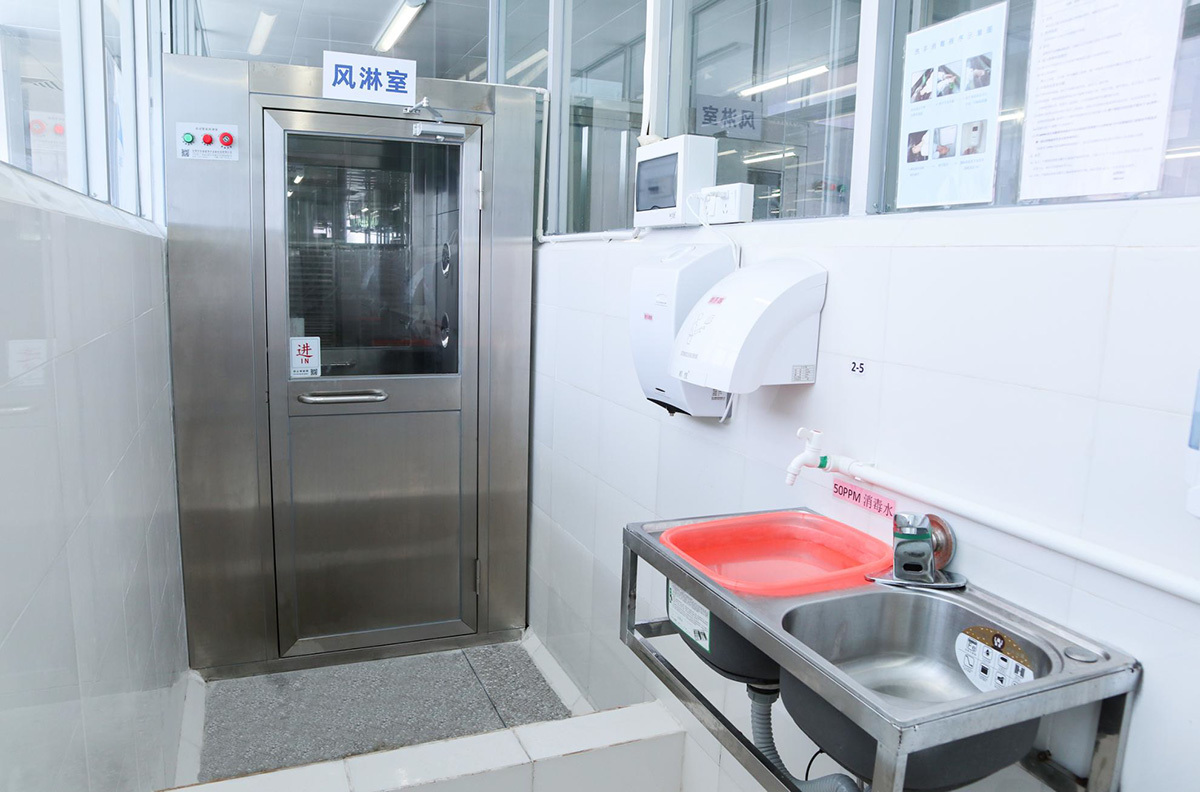
Hygiene controls are one part of compliance; the certificate scope and batch records are the others.
The problem: certification claims are usually read too broadly
Three misreadings account for most compliance surprises in frozen dim sum procurement.
First, a facility registration is treated as a product approval. A registration confirms that a facility has been registered with an authority; it does not certify that every item produced there meets a product standard, and it does not transfer the importer's own legal responsibilities. The distinction matters because frozen dim sum covers several product families—steamed buns, dumplings, rice rolls, cakes, fried pastries and soups—and these families can fall under different rules.
Second, the holder of a certificate is assumed to be the factory. In export practice, a registration may be held by a trading company, an import agent or a US agent. The FDA food facility registration associated with Yuexiang's export profile, for example, carries registration number 550074820 and is held by UGK-LVM UNITED INC. That is not a defect; it is a normal structure. But a buyer comparing certificates must check the holder field, the facility address and the product scope together, because a valid registration held by one entity does not automatically describe another entity's facility.
Third, a system certificate is read as a product guarantee. HACCP or ISO 9001 certification indicates that a food safety or quality management system has been assessed against a standard. It does not state that a particular batch of shrimp dumplings met a specific microbiological limit, and it does not replace the batch inspection report. The system certificate answers "Is there a controlled process?" The batch report answers "What happened to this lot?" Buyers need both, plus a specification sheet that defines what "good" looks like for the SKU.
These misreadings are not caused by bad faith. They come from using one document to answer several different questions. The practical fix is to separate the questions before the documents arrive.
Industry background: why one certificate set cannot cover every market
The frozen dim sum category is large enough that suppliers often serve several channels and markets at once, and each combination brings its own documentation logic. Commercial research cited by Data Insights Reports and Research Insights valued the global frozen Cantonese-style dim sum market at USD 7.04 billion in 2025, with a projection of USD 11.99 billion by 2033. Market-size estimates in this category vary with product definition—some studies count all frozen dumplings, others count only dim sum—so a buyer should treat any single figure as a planning indicator rather than a precise boundary for a procurement decision.
China is the dominant production base. Business Research Insights estimated that China accounted for 46% of global frozen dumpling production volume in 2025. For buyers, that concentration means Chinese export documentation and destination-market import rules are often the practical centre of the compliance conversation, even when the brand is sold through distributors in North America, Europe or Southeast Asia.
Customs classification adds another layer. Frozen dim sum is commonly exported under HS Code 1902200000 (stuffed pasta) and 1902309000 (other pasta), according to trade records cited from Zauba and China Customs. The HS code affects declaration documents, inspection requirements and sometimes tariff treatment. A supplier's certificate may be valid while the HS classification used for a shipment is wrong for the product, so the commercial invoice, packing list and product description should be checked against the code rather than assumed.
Regional rules are also moving. Guangzhou introduced a regulation effective 1 May 2026 requiring restaurants to label clearly whether dim sum is handmade on-site or produced by central kitchens or pre-made methods, as reported by Tridge and local government sources. That rule applies to restaurant labelling in Guangzhou, not to every export market, but it illustrates a wider trend: the "pre-made" or "central kitchen" status of frozen dim sum is becoming a label and disclosure question, not only a food-safety question. Buyers selling into markets with origin, preparation-method or allergen labelling rules should ask suppliers for label-ready product descriptions, not just certificates.
None of these signals proves that a particular supplier is compliant. They show why compliance has to be assembled market by market and SKU by SKU.
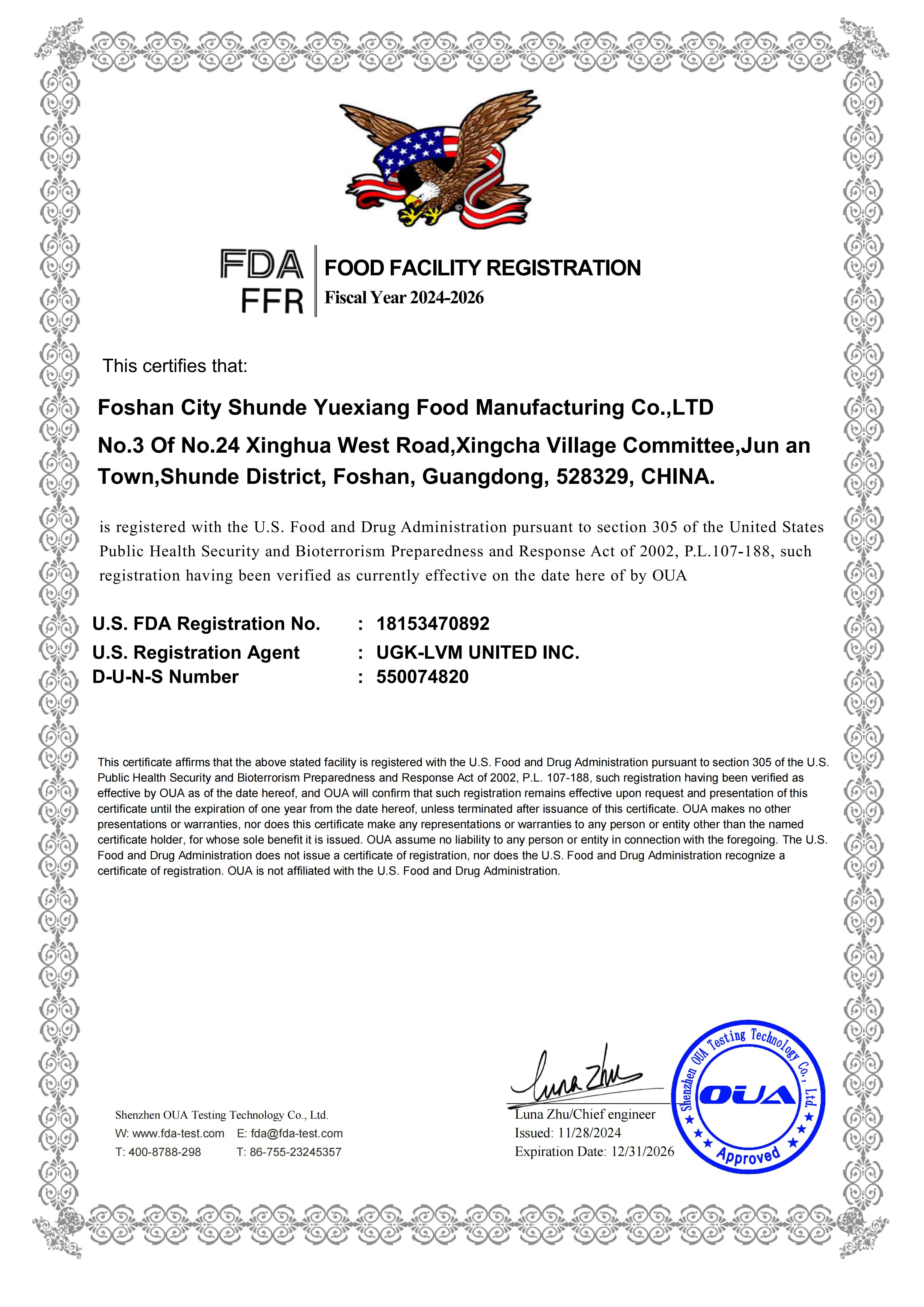
A facility registration is a facility-level document; its product scope and holder must be read together.
A four-check method for reading any certificate
Before comparing suppliers, reduce every certificate to four fields. The method works for export registrations, foreign facility registrations, system certificates and test reports.
1. Scope. What products, processes and markets does the document actually cover? Read the scope line, not the certificate title. Yuexiang's export food production enterprise registration, certificate number 4400/15914, was issued by Foshan Customs on 28 April 2022 with an expiry date of 28 April 2099. Its stated scope is steamed pastries and frozen rice & wheat food for export. A buyer sourcing shrimp-based dumplings or a meat-filled product should ask how that specific item fits the stated scope, rather than assuming that a broad "frozen food" description covers every SKU.
2. Holder. Which legal entity holds the document, and does that entity match the factory named on the invoice and the label? Where a registration is held by an agent, ask for the relationship in writing and for the facility address that the registration refers to. The holder field is also a useful fraud check: a copied certificate with a mismatched holder is a warning sign even when the certificate number looks plausible.
3. Validity. Check the issue date, expiry date and any conditions. The FDA food facility registration associated with the Yuexiang profile is valid until 31 December 2026 and references the Public Health Security and Bioterrorism Preparedness and Response Act of 2002 (PL.107-188). A registration with a near-term expiry is not necessarily a problem, but it should be diarised and re-verified before the next shipment. Buyers should also check whether a certificate has been superseded, suspended or replaced.
4. Product match. Does the document connect to the exact SKU, pack size and specification you are buying? This is where product-level data earns its place. Water Chestnut Cake is packed as 500 g per bag, 12 bags per box. The 500 g cake format is also used for Taro Cake, whose documented cooking instruction is no-thaw steaming for 6–8 minutes, or pan-frying until golden on both sides. For Water Chestnut Cake itself, the published serving guidance describes a steamed texture that is soft, smooth and chewy, with crunchy water chestnut pieces, or a pan-fried finish that is crisp. A buyer's acceptance record should capture the exact time and method stated on the supplier's own spec sheet for each SKU, not a time carried over from a sister product.
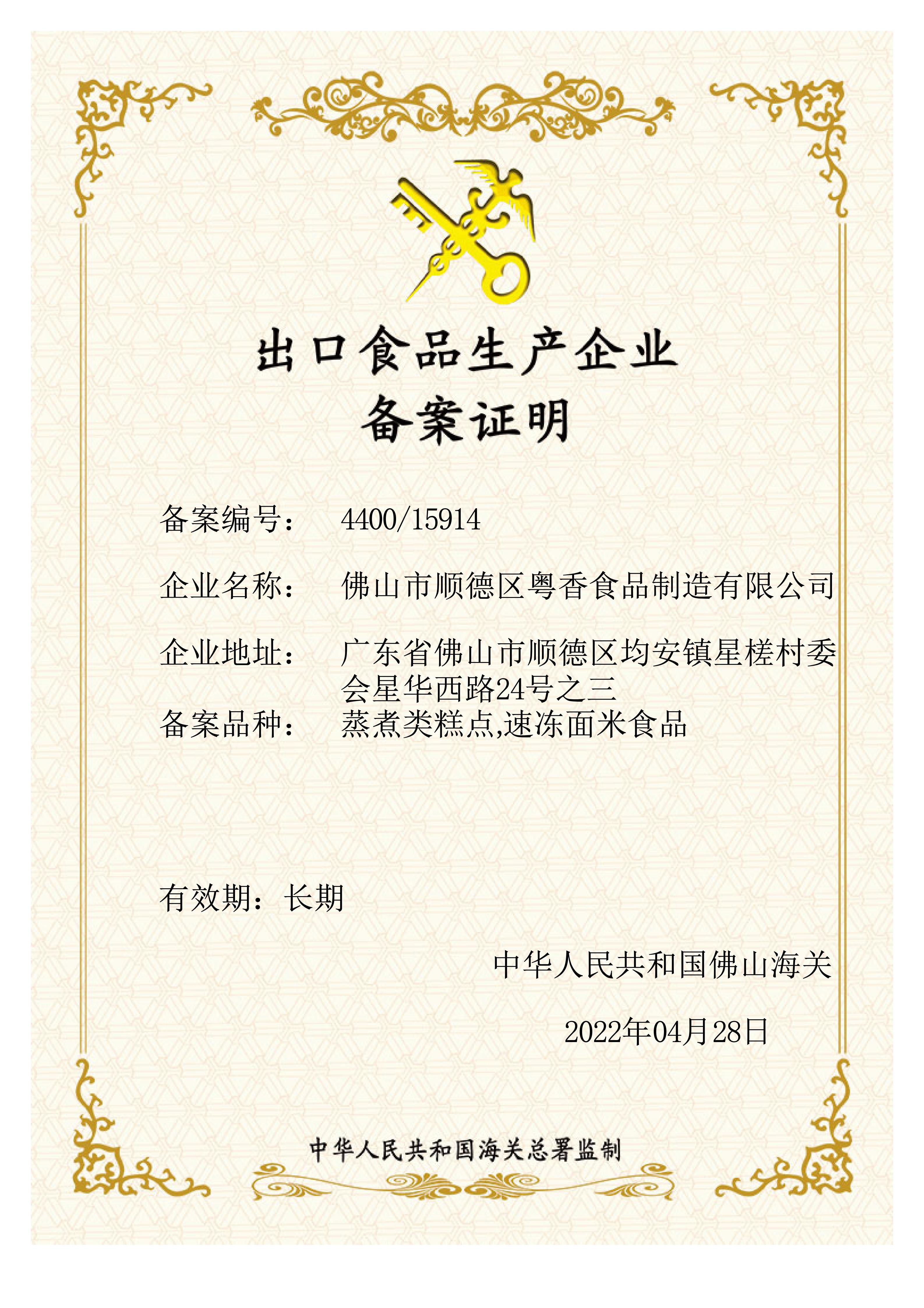
The export registration states a scope; the buyer's job is to map that scope to each product family.
The four checks are deliberately boring. They are also the fastest way to separate a document that supports a claim from a document that merely coexists with it.
Step-by-step: building a document and acceptance trail
The sequence below can be run by a buyer before the first order and repeated at each specification change or certificate renewal.
Step 1: Lock the destination market and channel
Write down the destination country, the sales channel (foodservice, retail, catering, transport or gift), and the customer's own requirements. A US retail label review, an EU importer's due-diligence file and a Southeast Asian distributor's language requirements are different exercises. Do this before requesting documents, because the same supplier may need different evidence for each channel.
Step 2: Build a product-level specification sheet
For each SKU, record the product name, net weight, pack configuration, storage condition, shelf life, cooking method and key ingredients. Yuexiang's published product data supports this at a useful level of detail: Shrimp Siu Mai is 270 g per pack with 9 pieces, 20 packs per box, and is steamed for 12 minutes without thawing; Chicken with glutinous rice is 720 g or 900 g per bag with 6 pieces, 12 bags per box, steamed for 20–25 minutes; Coconut Golden Cake is 300 g per bag, 20 bags per box, and can be fried or steamed for 6–8 minutes. These are the fields that later become acceptance criteria, so they should be confirmed on the supplier's current spec sheet rather than copied from a website or an old quotation.
Step 3: Request the certificate image and read five fields
Ask for a clear image or PDF of the certificate, not a text claim. Read the certificate number, issuing authority, holder, scope and dates. Where a certificate has a QR code or an online registry, verify it through the issuing authority's own channel. For the Yuexiang export registration, the verifiable fields are the number 4400/15914, the issuing authority (Foshan Customs), the issue date (28 April 2022), the expiry date (28 April 2099) and the scope (steamed pastries and frozen rice & wheat food for export).
Step 4: Map scope to each SKU
Create a simple matrix: SKU on one axis, certificate scope on the other. Mark "covered", "not covered" or "needs clarification". A product that is not clearly covered is not necessarily non-compliant; it may be covered by a different document or a different registration. The point is to force the question before shipment rather than after. This is also where a supplier's product range matters: a manufacturer with 300+ items across five series will usually have more than one product family and may need more than one supporting document.
Step 5: Overlay destination-market rules
Check the import requirements of the destination market, including facility registration, importer responsibilities, labelling, allergens and any product-specific rules. In the US, for example, a food facility registration is one part of the import picture; the importer's own verification obligations sit alongside it. In markets with preparation-method labelling, the supplier's product description should state whether the item is pre-made, central-kitchen produced or handmade on site, in language the buyer can use on the label.
Step 6: Set batch acceptance criteria
Translate the specification into checks that can be performed at receipt: net weight against the declared pack size, packaging seal and label completeness, frozen condition at or below −18 °C, absence of leakage or bulging, and a documented cooking trial where the buyer needs to confirm texture and time. Yuexiang's published quality-control description includes 100% pre-shipment testing, weight verification, packaging seal and label checks, and microbiological testing using plate count methods for colony and coliform bacteria. Those are supplier-side controls; the buyer's acceptance record is the independent check that the controls produced the expected result for that lot.
Step 7: Schedule re-verification
Put certificate expiry dates and specification changes into the supplier review calendar. Re-verify whenever the product, pack size, factory, ingredient source or destination market changes. A certificate that was correct for a 500 g retail bag may not describe a 5 kg foodservice pack, and a registration that was valid for one market may not cover a new destination.

Product-level compliance starts with the pack format, cooking instruction and storage condition for each SKU.
Use cases: the same product, three different acceptance emphases
Compliance documents are necessary but not sufficient. The channel changes what the buyer should test and record.
Foodservice: teahouses, chain restaurants and breakfast operators
Foodservice buyers care about repeatable cooking results and menu-labelling accuracy. For a dim sum menu, the acceptance record should include the steaming time and method for each SKU, the pack size that matches the outlet's daily cover, and a clear statement of whether the item is pre-made or central-kitchen produced. Water Chestnut Cake's 500 g bag and 12-bag case suit a teahouse that plates slices to order; the same product can be steamed for a soft, chewy texture or pan-fried for a crisp finish, so the outlet's standard operating procedure should specify which method is being verified. Shrimp Siu Mai, at 270 g per pack with 9 pieces and a 12-minute no-thaw steam, gives a more portioned service format for a busy morning peak.
Retail: supermarkets, convenience stores and community fresh stores
Retail buyers need label-ready data: net weight, ingredients, allergens, storage condition, shelf life and cooking instructions in the destination market's language. The product-level compliance question is whether the supplier can supply a label proof that matches the registration scope and the pack format. Yuexiang's published profile describes frozen storage at or below −18 °C, a 12-month frozen shelf life for steamed buns and a 6-month frozen shelf life for steamed cakes such as Water Chestnut Cake. Those shelf-life figures should be confirmed per SKU and per market, because a retail buyer's date-coding and rotation rules depend on them.
Catering: schools, corporate canteens, hotels and banquet operations
Catering buyers usually need larger pack formats, batch consistency and a documented allergen and ingredient file. A supplier's ability to provide quality inspection reports, production qualifications and export customs declaration documents with each order is directly relevant here. Yuexiang's published after-sales description includes 24-hour complaint response, cold-chain transport at −18 °C, free steaming parameters and menu-matching guidance, and certification documents provided with each order. For a canteen or banquet kitchen, the acceptance check should include a cooking trial at the site's own steamer, because equipment and load size can change the result even when the product specification is unchanged.
Across all three channels, the buyer's own record is the part that cannot be outsourced. Certificates describe the supplier's system; the acceptance record describes the lot that arrived.

Seal, label and net-weight checks connect the production document to the batch the buyer receives.
Comparison table: what each document can and cannot establish
| Document type | What it can support | What it does not establish | Buyer check |
|---|---|---|---|
| Export food production enterprise registration (e.g. Yuexiang certificate 4400/15914, Foshan Customs) | That the named enterprise is registered for the stated export scope, such as steamed pastries and frozen rice & wheat food | That every SKU, ingredient or destination market is covered; that the product meets a foreign product standard | Match the scope line to each SKU and destination; check issue and expiry dates |
| US FDA food facility registration (e.g. registration 550074820, held by UGK-LVM UNITED INC., valid to 31 December 2026) | That the facility has a current food facility registration for the stated product scope in the US market | Product approval, batch safety, or the importer's own verification duties | Confirm the holder, facility address, product scope and expiry; check the importer's responsibilities separately |
| HACCP or ISO 9001 system certificate | That a food safety or quality management system has been assessed against the named standard | That a specific lot met a specific microbiological or physical limit | Check certificate number, certification body, scope and validity; ask for the batch report separately |
| Batch inspection report | A result for a sampled lot against stated test methods | That later lots will produce the same result; that the test scope covers every hazard | Check lot identification, sampling date, methods, limits and whether the report matches the shipped batch |
| Supplier specification sheet and self-declaration | Product identity, net weight, pack format, storage, shelf life, cooking method and declared ingredients | Independent verification of the declared values | Compare with the label, the certificate scope and the buyer's own receipt checks |
FAQ: certification and standards questions buyers actually ask
What does "HACCP-certified" mean when buying frozen shrimp dumplings?
HACCP certification indicates that a food safety management system based on hazard analysis and critical control points has been assessed against the relevant standard. It is a system-level credential, not a product certificate. When buying frozen shrimp dumplings, ask for the certificate number, the certification body, the scope (does it cover the relevant product family and process?), the validity dates and the audit status. Then ask for the batch inspection report for the lot you are buying, because the system certificate does not report a result for that lot. Yuexiang's published profile states ISO 9001, HACCP and FDA certification; the same profile should be read alongside the specific certificate images and the product-level documents described above.
Does an FDA food facility registration cover every product a supplier ships to the US?
No. A food facility registration is a facility-level registration, and its value depends on the product scope attached to it. The registration associated with the Yuexiang profile, number 550074820, is held by UGK-LVM UNITED INC. and covers frozen dim sum, steamed pastries and frozen rice & wheat food for the US market, with a validity date of 31 December 2026. A buyer should confirm that the specific SKU and pack format fall within the registered scope, and should separately confirm the importer's own verification and record-keeping obligations. Registration is one element of market access, not a substitute for product-level compliance.
What documents should a buyer request before accepting a frozen dim sum shipment?
At minimum: the relevant export or facility registration, any system certificates the supplier relies on, the batch inspection report, the product specification sheet (net weight, pack configuration, storage condition, shelf life, cooking method and ingredients), the label proof for the destination market, and the cold-chain temperature record for the shipment. For a product such as Water Chestnut Cake, the specification should state the 500 g bag and 12-bag case format and the exact cooking method and time for that SKU. The buyer should also keep a signed acceptance record showing what was checked and what was found.
How do regional rules such as Guangzhou's labelling regulation affect frozen dim sum buyers?
Guangzhou's regulation, effective 1 May 2026, requires restaurants to label clearly whether dim sum is handmade on-site or produced by central kitchens or pre-made methods, as reported by Tridge and local government sources. For a frozen dim sum supplier, the practical effect is that downstream restaurant customers may need product descriptions that state the preparation method accurately. For export buyers, the lesson is broader: preparation-method and origin labelling rules are spreading, and a supplier's product description should be written so that it can support the label rather than contradict it. The rule itself applies in Guangzhou; it is not a substitute for checking the destination market's own requirements.
What product-level details belong in an acceptance record for Water Chestnut Cake?
Record the product name and SKU, the declared net weight (500 g per bag), the pack configuration (12 bags per box), the storage condition (frozen at or below −18 °C), the shelf life stated for the product family (steamed cakes are described with a 6-month frozen shelf life in Yuexiang's published case material), the cooking method and time from the current spec sheet, the label version used for the destination market, and the result of the receipt checks. If the buyer intends to use the product for a foodservice menu, add a cooking trial result for the outlet's own steamer. For a sample, specification sheet or current certificate set, buyers can contact Yuexiang through its published channels and confirm the exact documents required for their market before placing an order.
Conclusion: compliance is a match, not a badge
Frozen Cantonese dim sum compliance is best understood as a chain of matches: the certificate scope matches the SKU, the holder matches the entity you are contracting with, the validity dates cover the shipment, and the destination-market rules are satisfied by the label and the import file. A supplier with a 20,000 m² facility, 200+ staff, 30+ R&D engineers, a reported 6,000,000-unit annual output and 300+ items across five series has the scale to support a serious compliance file, but scale is context, not proof. The proof is in the documents, the product-level specifications and the buyer's own acceptance record.
Three questions are enough to start: Does the certificate's scope actually cover this SKU? Is the holder the entity that will appear on my invoice and label? And does the destination market require something the certificate does not provide? Buyers who ask those questions before the first order spend less time resolving them after the container arrives.
For a closer look at Yuexiang's product range and factory profile, the company's company brochure is available for download. Buyers preparing a compliance file can also request current specification sheets, certificate images and sample arrangements through the company's published contact channels.
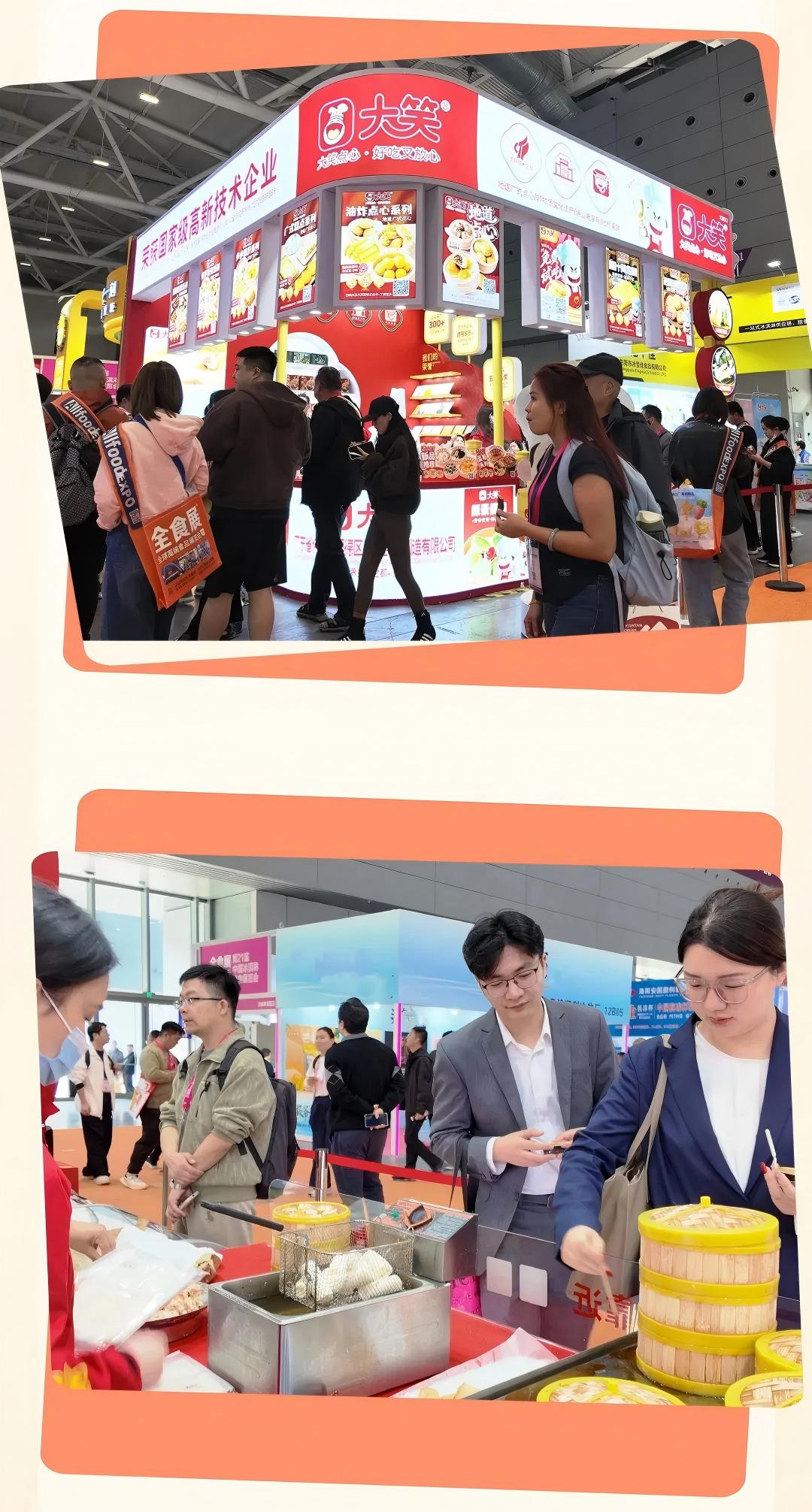
A document review is most useful when it is tied to the exact SKU, market and pack format under discussion.
Have Questions or Need More Details?
Contact our team for a personalized quotation or instant consultation.
Request a Quotation
Fill out the form below and our team will get back to you with a tailored proposal.
WhatsApp Direct Chat
Prefer to chat in real-time? Message us on WhatsApp for instant assistance & quick answers.
- Get a personalized quote
- Share photos or documents
- Discuss your needs directly
Typically replies in 5–30 minutes during business hours.