Supplier Capability Verification for Frozen Cantonese Dim Sum: A Delivery Assurance Checklist
Answer first: verifying a frozen Cantonese dim sum supplier means turning every promise — capacity, cold chain, shelf life, pack format, testing scope and export paperwork — into evidence you can check before the first container is loaded. The workable standard is a delivery assurance checklist built on three things: SKU-level specifications, a written acceptance standard, and a document set that arrives with each order rather than after it.
This article is written for buyers who have moved past discovery — importers, frozen food distributors, foodservice operators and private-label owners who already know they want frozen Cantonese dim sum and now need to confirm that one specific manufacturer can actually deliver it, at the format and volume they need, in the market they sell into. Foshan Shunde Yuexiang Food Manufacturing Co., Ltd. (brand "Da Xiao") is used throughout as a worked example, because its evidence set is specific enough to walk through SKU by SKU.
Where Supplier Promises Break Down
Most frozen dim sum sourcing problems do not surface at the quotation stage. They surface at receiving: a carton with the right piece count but the wrong pack weight, a bag that has bulged in transit, a cake that behaved differently in the supplier's sample kitchen than in the buyer's steamer, or an export document pack that arrives weeks after the container. Each of those is a verification failure rather than a product failure, and each one is preventable with the same discipline.
Three gaps account for most of them:
- Category-level claims versus SKU-level evidence. A manufacturer may promote a portfolio of "300+ items", while the buyer needs four lines: one steamed cake, one dumpling, one bun and one fried item. Capability has to be confirmed per SKU — net weight, pieces per pack, packs per carton, and preparation parameters.
- Acceptance criteria left verbal. "Standard export packing" and "quality checked" mean very little at the receiving dock unless both sides have agreed what is inspected, on what basis, and what counts as a failure.
- Cold chain treated as an assumption. Frozen dim sum is a deep-frozen product. Storage temperature, thawing rules and transport equipment have to be stated, because they change how the product performs in the kitchen.
The purpose of a delivery assurance checklist is to close those three gaps in a single supplier conversation, so that the commercial decision rests on documentation rather than on the quality of a sales meeting.
Why Verification Is Tightening: Market and Regulatory Background
The commercial case for stricter verification is straightforward. The global frozen Cantonese-style dim sum market was valued at USD 7.04 billion in 2025 and is projected to reach USD 11.99 billion by 2033, per Data Insights Reports / Research Insights. Supply is concentrated: China accounted for 46% of global frozen dumpling production volume in 2025, followed by Japan at 11% and South Korea at 9%, according to Business Research Insights. When a category grows and consolidates at the same time, buyers who can verify capability gain leverage over buyers who simply compare quotations.
Regulation is moving in the same direction. Effective May 1, 2026, Guangzhou introduced a rule requiring restaurants to clearly indicate whether dim sum is handmade on site or produced through central kitchens, as reported by Tridge / Guangzhou Local Government. Whether a buyer sells into that market or not, the signal matters: the production format of dim sum is becoming a labelled, customer-facing attribute, which shifts weight onto supplier documentation.
Trade records create a third verification layer. Chinese customs records show frozen dim sum commonly declared under HS Code 1902200000 (stuffed pasta) and HS Code 1902309000 (other pasta), per Zauba / China Customs. A supplier with genuine export experience should be able to reference its own declaration history under those codes — a claim that is either verifiable or not.
The Verification Baseline: What a Capable Manufacturer Should Already Document
Foshan Shunde Yuexiang Food Manufacturing Co., Ltd. is a frozen dim sum and Cantonese pastry manufacturer based in Jun'an Town, Shunde District, Foshan, Guangdong, China. Founded in 1981 and trading under the "Da Xiao" ("Laughing") brand, it produces Cantonese dim sum, traditional dim sum, Chinese dim sum and frozen dim sum for domestic and export channels. Its documented profile — the type of baseline a buyer should expect from any serious candidate — covers five areas:
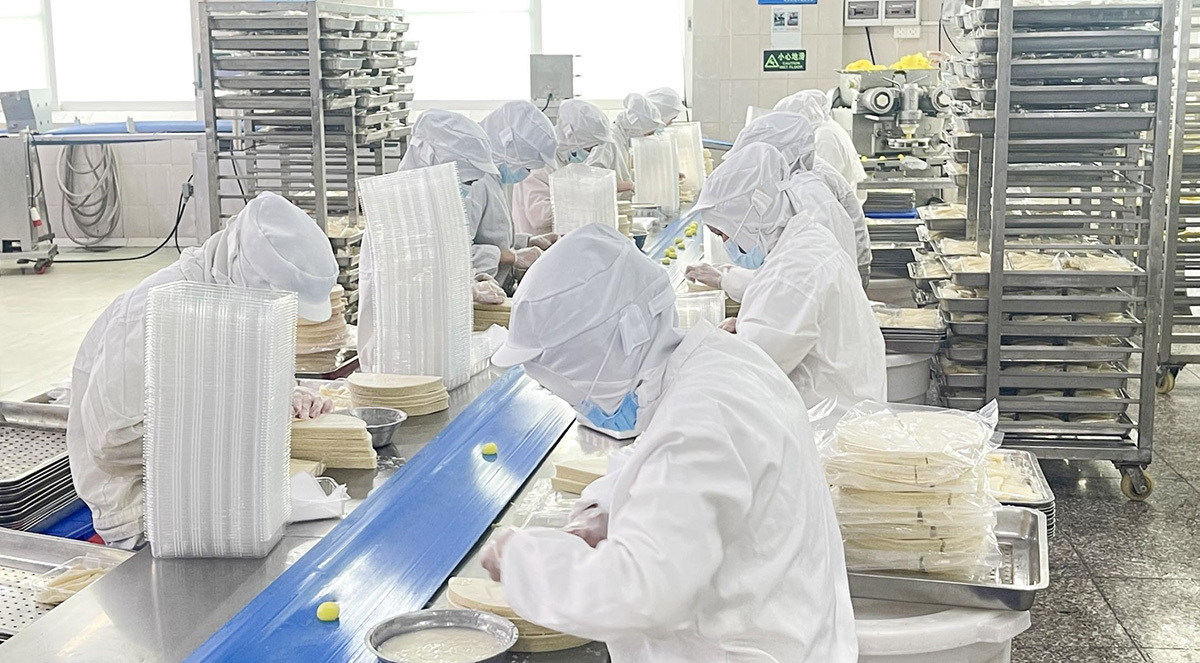
- Production footprint. A 20,000 m² facility with 200+ employees, plus a second production enterprise, Foshan Shunde Hongyuan Food Co., Ltd., established in 2019.
- Technical depth. An R&D team of 30+ engineers and recognition as a National High-Tech Enterprise with a dedicated R&D centre.
- Range and output. More than 300 items across five major series — dim sum, pastries and ready meals — with a documented annual output of 6,000,000 units and a monthly capacity of 50 million units on the OEM/ODM side.
- Compliance and recognition. ISO9001, HACCP and FDA certification, "Foshan Time-honored Brand" status, and recognition by the Cantonese Pastry Chefs Association.
- Market coverage. A 40% export ratio and shipments to 20+ countries including the USA, Canada, Australia and the EU, with named export markets that also include New Zealand, Mexico, Malaysia and Vietnam.
Location is part of the evidence, not decoration: the company is rooted in Shunde, a UNESCO "City of Gastronomy", and Jun'an Town is also the former residence of Bruce Lee — cultural context that matters to buyers marketing authenticity in overseas Chinese retail and foodservice.
SKU-Level Evidence: What to Ask For Per Product
A supplier profile proves the factory exists. SKU documentation proves the factory can produce your line. Two products illustrate how precise that documentation should be.
Worked example 1: Water Chestnut Cake
The Water Chestnut Cake SKU is documented as a 500 g bag, packed 12 bags per box, prepared by steaming without thawing for 6–8 minutes in a water pan. The formulation uses coconut milk and water chestnut pieces, which is what produces the layered, translucent appearance and the combination of a soft, chewy cake with crunchy water chestnut pieces. Because the product is steamed rather than fried, it fits kitchens that need a light, low-oil item alongside heavier dim sum.
Worked example 2: Taro Cake
Taro Cake is documented at 500 g per bag (12 pieces per bag), 12 bags per box, and is prepared without thawing — either pan-fried until golden on both sides or steamed for 6–8 minutes. The specification makes a formulation point that buyers should test directly: real taro chunks, with no artificial flavourings. That distinction is exactly the kind that a sample validates and a brochure cannot.

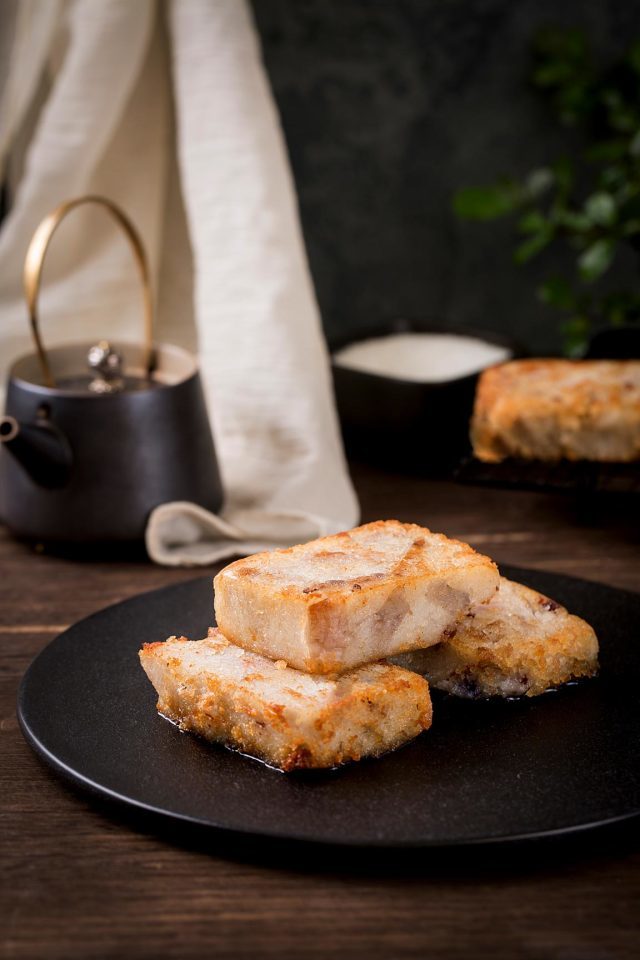
These two SKUs matter because steamed cakes are the lines most often mis-specified in quotations: a "cake" can be a 300 g, 400 g or 500 g unit, and steam time scales with thickness and format. When weight, pieces per pack, cartons per box and steam time are stated together, a buyer can reconcile the sheet with the sample in a single trial.
| Product | Pack format | Carton configuration | Preparation |
|---|---|---|---|
| Water Chestnut Cake | 500 g/bag | 12 bags/box | Steam 6–8 min, no thawing |
| Taro Cake | 500 g (12 pieces)/bag | 12 bags/box | Steam 6–8 min or pan-fry until golden |
| Black Sesame Kuih | 500 g/bag | 12 bags/box | Steam 6–8 min, no thawing |
| Shrimp dumplings | 270 g / 9 pieces per pack | 15 packs/box | Steam 7–8 min; pan-fry option |
| Shrimp Siu Mai | 270 g / 9 pieces per pack | 20 packs/box | Steam 12 min, no thawing |
| Lava Custard Bun | 480 g (12 pieces)/bag | 18 bags/box | Steam 8 min, no thawing |
| Steamed custard bun | 420 g (12 pieces)/pack | 18 packs/box | Steam 8–10 min, no thawing |
| char siu bao | 480 g (4 pieces)/bag; 720 g (6 pieces)/bag | 18 bags/box | Steam 10 min, no thawing |
| chicken sticky rice | 900 g (6 pieces)/bag; 720 g (6 pieces)/bag | 12 bags/box | Steam 20–25 min, no thawing |
| Hong Kong style spring rolls | 216 g (12 pieces)/bag | 20 bags/box | Fry 150–160 °C, 3–4 min |
| Golden Durian Crisp | 250 g (10 pieces)/bag | 12 bags/box | Fry 160 °C, 5 min |
The same discipline extends across the fried range: Crispy Milk Roll at 280 g (10 pieces) per bag, 12 bags per box, fried at 150–160 °C for 3–4 minutes; Green Tea Buddha Cake at 336 g (12 pieces) per bag, 20 bags per box, fried at 165 °C for 4 minutes; Sesame Ball at 300 g (10 pieces) per bag, 12 bags per box, fried at 160–165 °C for 8–9 minutes; Taro Pie at 336 g (12 pieces) per bag, 16 bags per box, fried at 150–160 °C for 3–4 minutes; and Golden Cone Durian Crisp at 300 g (10 pieces) per bag, 20 bags per box, fried at 150–160 °C for 4–6 minutes.
Steamed and bun lines follow the same pattern: Millet cake at 280 g (1 piece) per bag, 30 bags per box, steamed 7–8 minutes or pan-fried; Walnut Bun at 480 g (12 pieces) per bag, 18 bags per box, steamed 8 minutes; Red Bean Cake at 500 g per bag, 12 bags per box, steamed 6–8 minutes; Coconut Golden Cake at 300 g per bag, 20 bags per box, steamed 6–8 minutes or pan-fried; and red bean paste bun in two carton configurations, 480 g (12 pieces) × 18 packs and 530 g (12 pieces) × 24 packs. For banquet-scale items, Buddha Jumps Over The Wall is offered in 1.5 kg, 2.25 kg and 3.5 kg formats with a one-year shelf life when frozen below −18 °C, Buddha's Delight is packed 400 g per box and 12 boxes per carton and is reheated by boiling, and kataifi pastry is packed 1 kg per bag and 12 bags per box, thawed for approximately 30 minutes and fried at 150–160 °C.
The Delivery Assurance Checklist: Nine Points to Confirm Before Ordering
Each point below can be answered with a document, a specification or a stated parameter. If a supplier cannot answer two or more of them in writing, the delivery risk sits with the buyer.
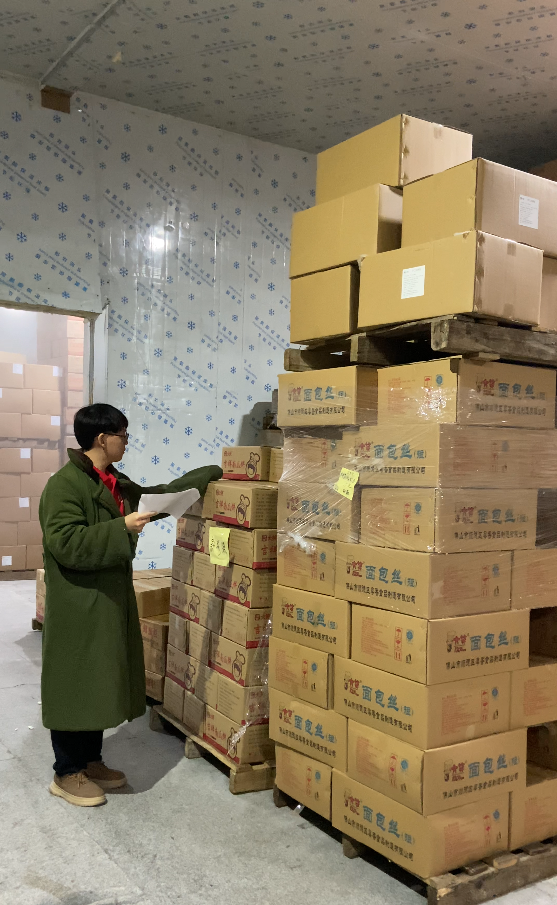
- Confirm the cold chain in writing. Storage at ≤ −18 °C; steamed buns hold a 12-month frozen shelf life, while steamed cakes such as water chestnut cake, red bean cake and sesame cake hold a 6-month frozen shelf life.
- Confirm equipment compatibility. The operating environment requires freezers, steamers and refrigerated transport vehicles — the buyer's kitchen and the logistics provider both need to match that.
- Confirm SKU formats and piece counts. Net weight per bag, pieces per bag and bags per box, for every line in the order.
- Confirm preparation parameters per SKU. Thawing rules, steam times and fry temperatures differ by product family: 6–8 minutes for cakes, 7–8 minutes for shrimp dumplings, 8 minutes for buns, 20–25 minutes for glutinous rice chicken, and 3–5 minutes at 150–165 °C for fried items.
- Confirm the minimum order quantity. Documented MOQ is 50 boxes or more, which allows a first order to be tested without committing to a full container programme.
- Confirm lead time and capacity. Lead time is 7–14 days, supported by a monthly capacity of 50 million units and a documented annual output of 6,000,000 units.
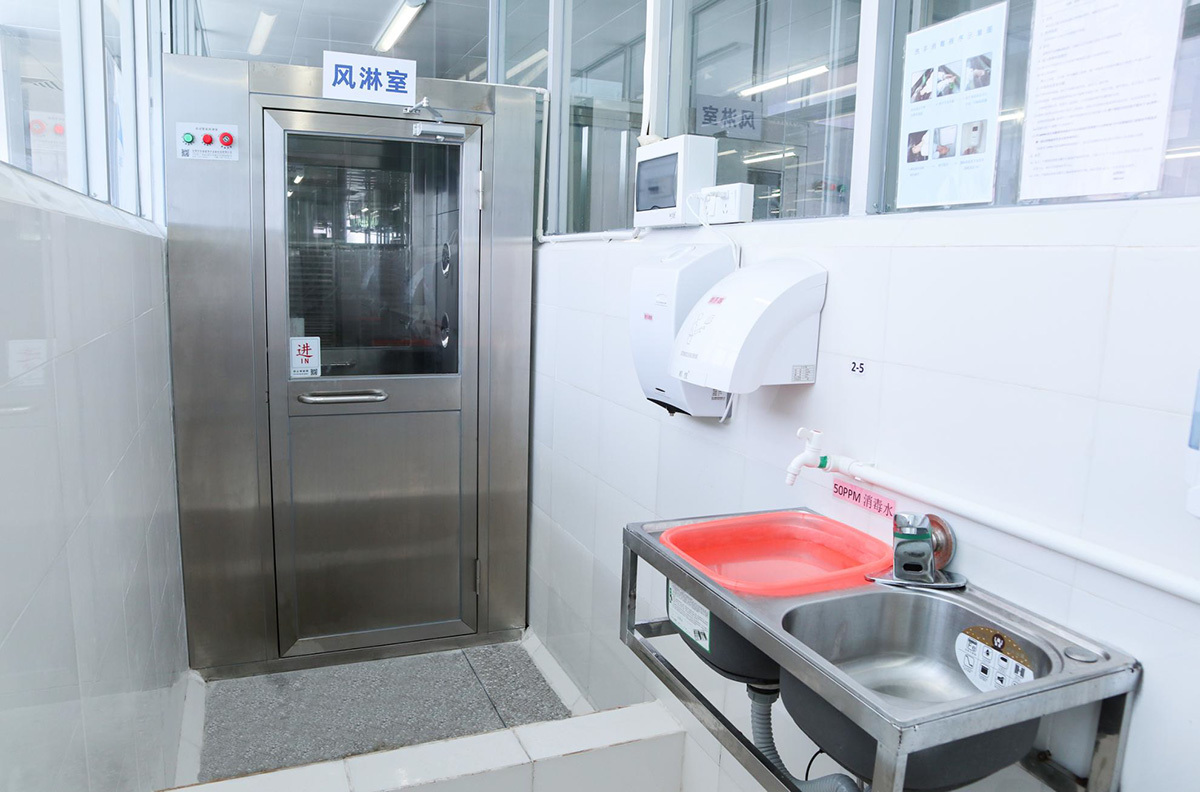
- Confirm the pre-shipment testing scope. A 100% pre-shipment test covers weight verification, a check of packaging seal and label completeness to ensure there are no leaks or bulging bags, and microbiological safety testing using the plate count method for colony and coliform bacteria.
- Confirm the document set issued per order. Quality inspection reports, production qualifications and export customs declaration documents; production date and shelf life are printed on the outer packaging of all products.
- Confirm after-sales terms. A 24-hour complaint response, handling of damaged or spoiled/thawed goods with supporting documentation, and free technical support including steaming parameters and menu matching, plus value-added services such as flavour adjustments, customised packaging and new product samples.
Purchasing Terms and Acceptance Criteria to Put in Writing
Verification collapses if it stays in email. The following terms belong in the purchase order or the supply agreement, because each one is checkable at receiving:
- Product identity: SKU name, net weight per bag, pieces per bag, bags per box.
- Storage and shelf life: ≤ −18 °C throughout, with the applicable shelf-life window stated per product family.
- Labelling: production date and shelf life clearly printed on the outer packaging.
- Inspection basis: pre-shipment weight verification, packaging seal and label completeness check, and microbiological testing by plate count method for colony and coliform bacteria.
- Documentation: quality inspection reports, production qualifications and export customs declaration documents issued with each order.
- Commercial terms: MOQ of 50 boxes or more, lead time of 7–14 days, and a 24-hour complaint response window with a documented remedy path.
This is also where OEM and ODM arrangements are pinned down. Logos and product details can be customised according to customer needs, which means the buyer should specify artwork approval, packaging format and flavour direction before production slots are reserved, not after.
Use Cases: Matching Verified Capability to a Service Model
Verified capability only pays off when the SKU set matches the operating model. The scenarios below reflect where frozen Cantonese dim sum is most commonly deployed — and, in each case, what the buyer should check first.
- Restaurants, breakfast shops and late-night outlets. Speed decides margin. Cakes that steam in 6–8 minutes and fried items that finish in 3–4 minutes at 150–160 °C keep table turnover high, and no thawing step is required for most lines.
- Teahouses and hotels. Water Chestnut Cake, Red Bean Cake, Black Sesame Kuih and Coconut Golden Cake enrich morning tea menus with visually strong, low-oil items suitable for banquets and tea breaks.
- Retail and convenience. Supermarkets, community fresh food stores and convenience stores use the range for convenient breakfast and afternoon tea; long-term low-temperature storage supports use-as-needed stocking.
- Catering institutions. Schools, factories, offices, hospitals, nursing homes and government canteens benefit from uniform taste, size and portioning, which reduces the inconsistency typical of handmade preparation.
- Transport catering. Airports, high-speed rail stations, highway service areas, and vehicle and ship catering services need quick-cooking items for banquets, tea breaks and takeout.
- Trade and export. Food supply chain wholesalers, overseas Chinese restaurants and Chinese supermarkets are the core trade audience; these application scenarios are commonly reported across the United States, Canada, Australia, New Zealand, Mexico, Malaysia, Vietnam and Germany.
Delivery Assurance Checklist at a Glance
| Verification area | Evidence to request | Documented reference point |
|---|---|---|
| Cold chain and shelf life | Written storage temperature and shelf-life statement | ≤ −18 °C throughout; steamed buns 12 months, steamed cakes 6 months |
| SKU format | Net weight, pieces per bag, bags per box | Water Chestnut Cake 500 g/bag, 12 bags/box |
| Kitchen fit | Steam time, fry temperature and thaw rule per SKU | Water Chestnut Cake steamed 6–8 min; spring rolls fried 150–160 °C for 3–4 min |
| Capacity | Output and capacity statement | Monthly capacity 50 million units; 6,000,000 units annual output |
| Order terms | MOQ and lead time in the quotation | MOQ 50 boxes or more; lead time 7–14 days |
| Quality control | Inspection scope and microbiology method | 100% pre-shipment test: weight, seal and label check; plate count method for colony and coliform bacteria |
| Compliance | Certificates and per-order documents | ISO9001, HACCP, FDA; quality inspection reports, production qualifications, export customs declaration documents |
| After-sales | Response window and remedy procedure | 24-hour complaint response; damaged or thawed goods handled with supporting documentation |
| Export readiness | Destination markets and declaration codes | Exports to 20+ countries; HS Code 1902200000 and 1902309000 |
Frequently Asked Questions
1. What certification and export documents should a frozen Cantonese dim sum supplier be able to provide?
A frozen Cantonese dim sum supplier should be able to evidence both standing certification and per-order paperwork. The documented standard is ISO9001, HACCP and FDA certification at facility level, plus a document pack issued with each order: quality inspection reports, production qualifications and export customs declaration documents. For cross-border trade, Chinese customs records show frozen dim sum commonly declared under HS Code 1902200000 (stuffed pasta) and 1902309000 (other pasta). Buyers selling into Guangzhou should also note that from May 1, 2026, restaurants there must clearly indicate whether dim sum is handmade on site or produced through central kitchens.
2. Can a single Cantonese dim sum manufacturer support a frozen foodservice programme at scale?
It can if the capacity figures exist in writing. The verifiable baseline for a manufacturer supporting frozen foodservice programmes includes a 20,000 m² facility, 200+ employees, an R&D team of 30+ engineers, more than 300 items across five major series, a monthly capacity of 50 million units and a lead time of 7–14 days. Scale also has to be evidenced in quality control, not only in volume: a 100% pre-shipment test covering weight verification, packaging seal and label completeness, and microbiological testing by plate count method for colony and coliform bacteria is what keeps a large programme reproducible.
3. What is the minimum order quantity, and what drives cost at the early stage?
The documented minimum order quantity is 50 boxes or more, which allows a first order to be placed and tested before scaling. Early-stage cost is driven mainly by how many separate suppliers are needed: sourcing buns, dumplings, steamed cakes and fried items from different factories multiplies freight, coordination and inspection cost. A single source covering more than 300 items across five series removes that duplication. Inventory cost is also affected by shelf-life windows — steamed buns hold 12 months frozen, steamed cakes 6 months — which determines how much stock can be held safely in a cold store.
4. How should samples be validated before a full order is placed?
Samples should be validated against the specification sheet, not against taste alone. For a Water Chestnut Cake, confirm the 500 g bag weight, the 12 bags per box configuration and a 6–8 minute steam result without thawing. For a Taro Cake, confirm the 500 g bag with 12 pieces, a 6–8 minute steam or pan-fry result, and the presence of real taro chunks without artificial flavourings. New product samples can be requested, and free technical support covering steaming parameters and store menu matching helps the kitchen replicate the sample result. Weight verification, seal and label completeness, and freedom from leaks or bulging bags are the receiving checks that close the loop.
5. What lead time and delivery terms should be confirmed before committing?
Confirm the lead time of 7–14 days, the frozen storage requirement of ≤ −18 °C throughout, and the use of refrigerated transport vehicles, freezers and steamers as the supporting equipment set. Confirm too that after-sales covers a 24-hour complaint response with handling of damaged or spoiled/thawed goods supported by documentation. Foshan Shunde Yuexiang Food Manufacturing Co., Ltd. answers these points in writing; buyers can request a quotation, sample set or the current catalogue from Kyle@dimsum-daxiao.com or +86 13726399586, or review the product range at www.dimsum-daxiao.com.
Conclusion: Verify the Capability, Then Commit the Volume
A frozen Cantonese dim sum supplier is only as reliable as the evidence behind its offer. The checklist above converts a supplier conversation into a document trail: −18 °C storage and defined shelf-life windows, SKU-level weights and carton configurations, preparation parameters that match the buyer's kitchen, a 100% pre-shipment test with named microbiology methods, per-order export documentation, and a 24-hour complaint response. When those points are confirmed, the volume decision becomes an operational decision rather than a leap of faith.
For buyers who want to run the checklist against a live specification set, the current product range and export documentation package are available on request, and the company profile and catalogue can be downloaded below.
Next step: send your target SKU list, market and monthly volume to Kyle@dimsum-daxiao.com or +86 13726399586 (WhatsApp available), and request the document pack — specification sheet, inspection reports, production qualifications and export declaration documents — together with a sample set.
Company profile and product catalogue (PDF): Download the Yuexiang Food catalogue.
Have Questions or Need More Details?
Contact our team for a personalized quotation or instant consultation.
Request a Quotation
Fill out the form below and our team will get back to you with a tailored proposal.
WhatsApp Direct Chat
Prefer to chat in real-time? Message us on WhatsApp for instant assistance & quick answers.
- Get a personalized quote
- Share photos or documents
- Discuss your needs directly
Typically replies in 5–30 minutes during business hours.