Water Chestnut Cake vs Taro Cake: A Cantonese Dim Sum Menu Decision Guide
Most Cantonese dim sum menus do not fail because something is missing. They fail because the wrong item was placed in a fixed slot: a cake the kitchen cannot plate at peak hour, a flavour profile that does not match its daypart, or a pack format that forces the operator to carry more frozen stock than the menu can turn over.
That is the practical shape of the Water Chestnut Cake vs Taro Cake decision. Both items come from the same producer — Foshan Shunde Yuexiang Food Manufacturing Co.,Ltd., a Cantonese dim sum manufacturer founded in 1981 in Shunde, Guangdong, operating a 20,000 m² facility with more than 200 employees, 30+ R&D engineers and a catalogue of over 300 items across five series. Both ship frozen in the same format: 500 g per bag, 12 bags per box, no thawing required. Both steam in 6–8 minutes.
Because the specifications overlap that closely, the tie-break has to come from somewhere else — the preparation path, the flavour role, the daypart, and how each cake behaves inside a distributor's stock rotation. This guide works through those variables in the order a buyer actually meets them.
Short answer
- Choose the Water Chestnut Cake when the site is steam-only, the slot is afternoon tea, dessert or banquet, and the menu is built around coconut-forward sweets that sit beside tea.
- Choose the Taro Cake when you want one SKU with two preparation paths (pan-fried to a golden surface, or steamed), a taro-forward cake with a savoury-leaning, less-sweet profile, and a denser, more filling bite for breakfast or all-day menus.
- Carry both when the goal is menu coverage: one brighter sweet cake, one denser savoury-leaning cake, ordered on a single purchase order from the same source factory.
Why this decision stalls at the menu stage
Buyers reaching this comparison are usually past discovery. They already know a steamed Cantonese cake belongs on the menu or in the frozen range. What blocks the order is that the two cakes read almost identically on a specification sheet: same product family, same 500 g bag, same 12 bags per box, same frozen handling, same 6–8 minute steam window.
Four mismatches then decide the outcome, and only the first three belong to the buyer's own operation.
- Kitchen-line mismatch. The Water Chestnut Cake is a steam-only item: without thawing, it is steamed in a water pan for 6–8 minutes. The Taro Cake can go either way — pan-fried until golden on both sides, or steamed for 6–8 minutes without thawing. A site without a fryer, or without ventilation for frying, is limited to the steam path; a site that wants a golden, crisp surface has a reason to choose taro.
- Flavour-role mismatch. The Water Chestnut Cake is built on coconut milk and water chestnuts, so it reads as a brighter, coconut-forward sweet. The Taro Cake is made with taro, giving it a savoury-leaning, less-sweet profile. Listing two coconut-forward cakes next to each other wastes a menu slot; listing one sweet cake and one taro cake covers two customer moods.
- Rotation mismatch. Both cakes are frozen products held at or below −18 °C. Yuexiang's own product guidance distinguishes steamed buns, specified with a 12-month frozen shelf life, from steamed cake-type items, specified at 6 months. For a distributor or central kitchen, that difference is the inventory plan — it decides batch size, warehouse positioning and near-expiry risk.
- Labelling obligations. Guangzhou introduced regulation effective 1 May 2026 requiring restaurants to state clearly whether dim sum is handmade on-site or produced by a central kitchen or as pre-made product. Any operator serving that market now needs traceable, documented supply behind each dim sum line item, which shifts part of the decision from taste to paperwork.
Those four points are the actual decision. The rest of this guide maps them to verified product specifications.
What is changing in the frozen Cantonese dim sum market
The category these two cakes sit in is expanding, and the expansion is measurable. The global frozen Cantonese-style dim sum market was valued at USD 7.04 billion in 2025 and is projected to reach USD 11.99 billion by 2033, with a projected compound annual growth rate of 6.87% through 2034 (Data Insights Reports / Research Insights).
Production is concentrated. China accounted for 46% of global frozen dumpling production volume in 2025, followed by Japan at 11% and South Korea at 9% (Business Research Insights). For buyers sourcing Cantonese steamed cakes, that concentration explains both the depth of available supply and the need to differentiate between suppliers on documentation and consistency rather than availability alone.
Two structural details matter to anyone planning an import or a multi-outlet rollout:
- Trade classification. Frozen dim sum is commonly exported under HS Code 1902200000 (stuffed pasta) and 1902309000 (other pasta), per China Customs shipment records compiled by Zauba. Classification should still be confirmed per SKU with a customs broker, because the two cake types are not necessarily declared under the same heading.
- Menu transparency. The Guangzhou rule in force since 1 May 2026 (Tridge / Guangzhou Local Government) pushes operators toward suppliers who can supply batch quality inspection documents, production dates and shelf-life data on request. Frozen steamed cakes from a documented factory are simpler to defend than undocumented product.
Shunde, where Yuexiang is based, is recognised as a UNESCO “City of Gastronomy”, and the company holds the “Foshan Time-honored Brand” designation with over 40 years of heritage, alongside ISO9001, HACCP and FDA certification, National High-Tech Enterprise recognition, and an award from the Cantonese Pastry Chefs Association. For a menu decision, the relevant point is not prestige but continuity: the same recipe, pack format and documentation source remain available across repeat orders.
Water Chestnut Cake and Taro Cake: verified specifications
The two products below are both listed in Yuexiang's Traditional Dim Sum range and share the same pack format and frozen-storage rules. The differences that matter sit in ingredients, preparation methods and menu role.
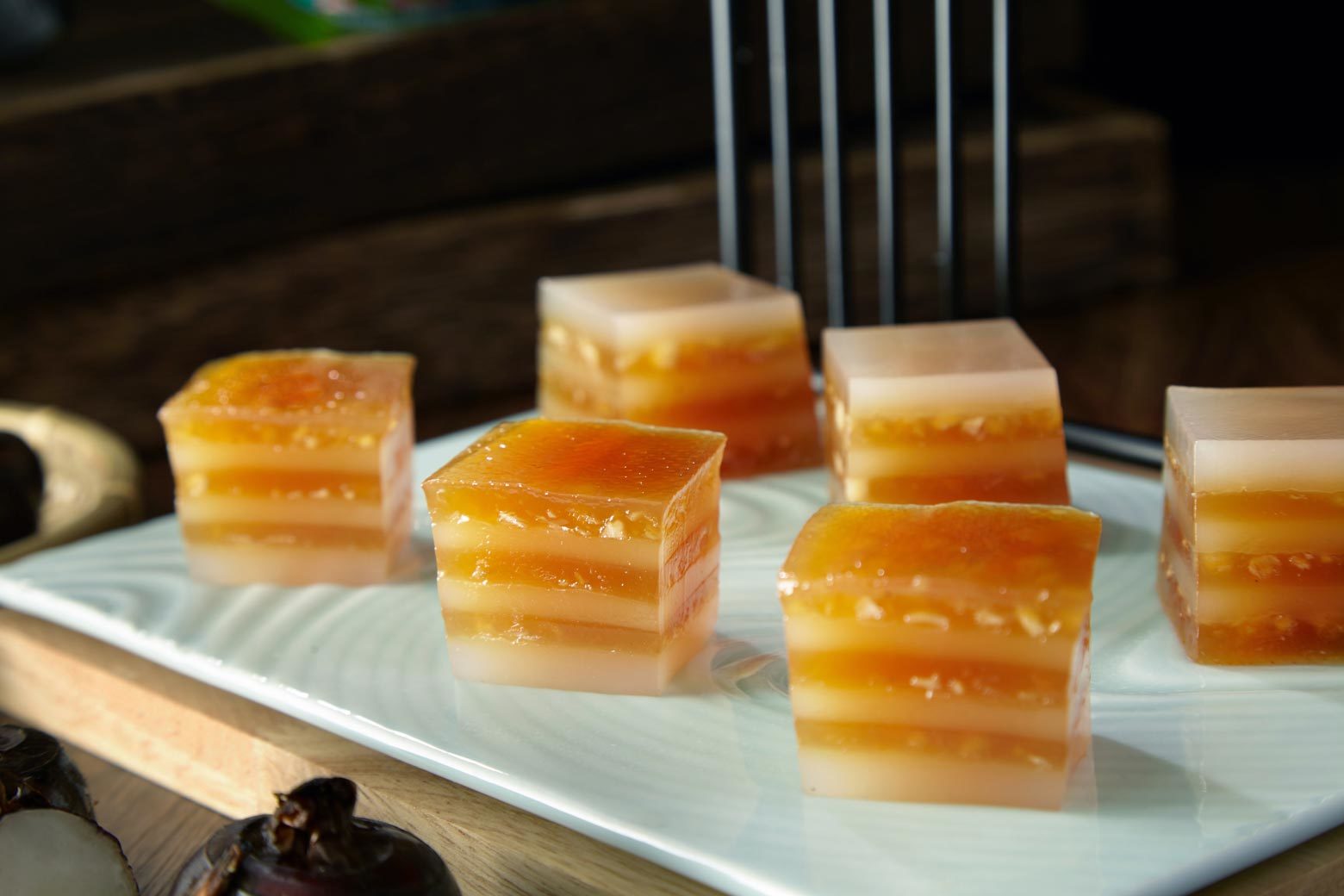
Water Chestnut Cake — coconut milk and water chestnuts
- Range: Traditional Dim Sum.
- Named ingredients: coconut milk, water chestnuts.
- Pack format: 500 g per bag, 500 g/bag × 12 bags/box.
- Preparation: no thawing required; steamed in a water pan for 6–8 minutes.
- Storage: frozen.
- Menu role: a coconut-forward sweet cake, suited to tea pairing, afternoon tea sets and dessert positions.
The operational signature here is simplicity. There is one preparation path, one piece of equipment (a steamer), and a six-to-eight-minute window, which means the item can be produced to order during service rather than pre-held. For a teahouse or hotel outlet running continuous afternoon covers, that short cycle keeps texture consistent from the first table to the last.
Taro Cake — Crispy Taro Pastry type
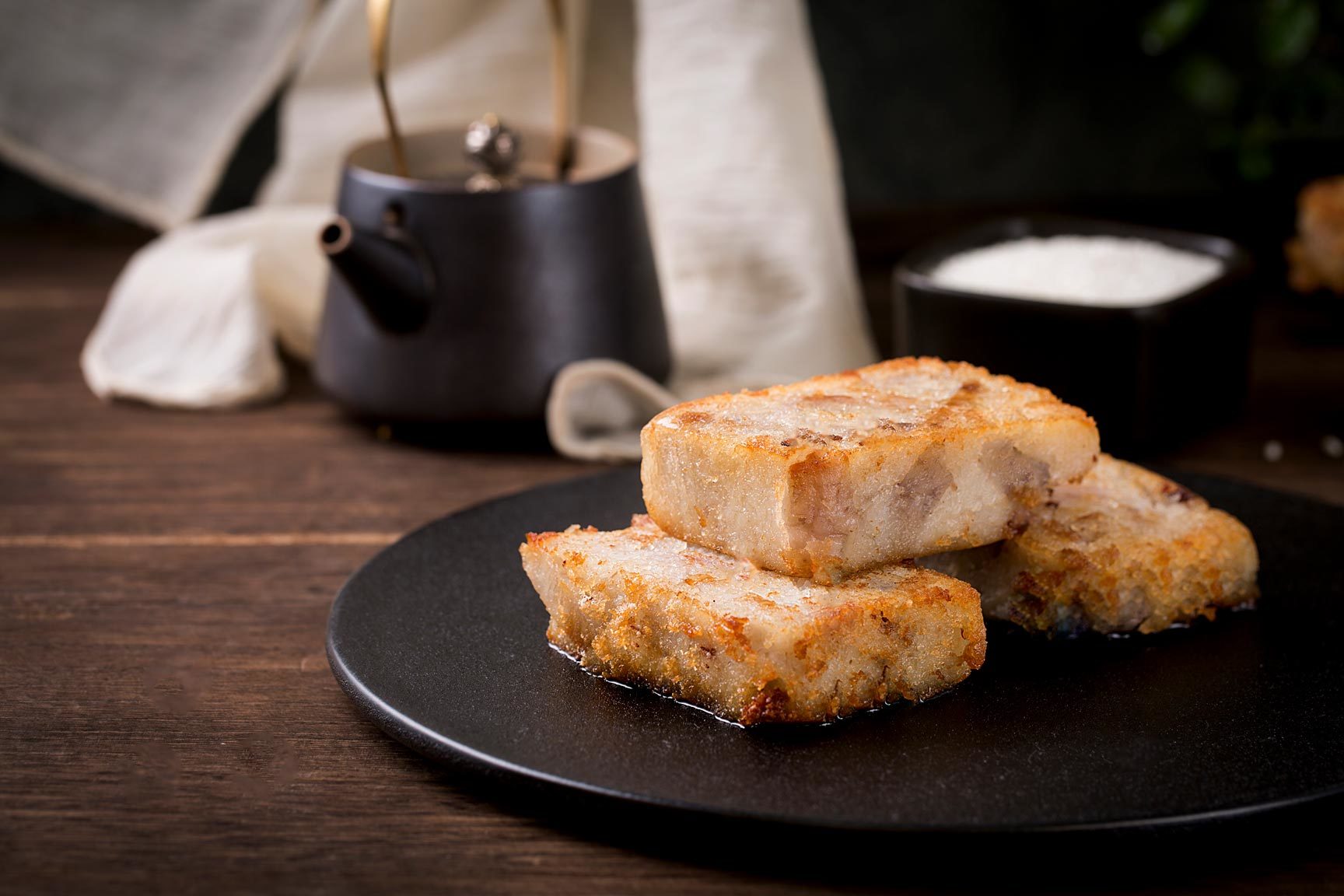
- Range and type: Traditional Dim Sum, product type listed as Crispy Taro Pastry.
- Named ingredient: taro.
- Pack format: 500 g per bag, 500 g/bag × 12 bags/box.
- Preparation: no thawing required; pan-fried in a frying pan until golden on both sides, or steamed for 6–8 minutes.
- Storage: frozen.
- Menu role: a taro-forward cake with a savoury-leaning, less-sweet profile and a denser, more filling bite, suited to breakfast, all-day and savoury snack positions.
The distinguishing feature is the dual preparation path. One SKU can be steamed for a soft, dim-sum-style presentation or pan-fried for a golden surface, which lets a single product cover two service styles — and lets a kitchen without a steamer running at full capacity use the frying pan instead. For caterers and transport-hub outlets with tight service windows, that flexibility removes an equipment bottleneck.
Adjacent steamed cakes that share the same handling logic
Buyers comparing these two products often end up building a small cake line. Three further Yuexiang items follow the same frozen, no-thaw logic and the same 6–8 minute steam window, so a single steamer cycle can process a mixed batch:
- Coconut Golden Cake: 300 g per bag, 20 bags per box; no thawing, fried in a pan until golden on both sides or steamed for 6–8 minutes.
- Red Bean Layered Cake: 500 g per bag, 12 bags per box; no thawing, steamed in a water pan for 6–8 minutes.
- Black Sesame Kuih (sesame cake): 500 g per bag, 12 bags per box; no thawing, steamed in a water pan for 6–8 minutes.
For menu planning, that consistency of handling is the practical value: adding a fourth cake to the range does not require a new kitchen process or a new equipment purchase.
A six-step framework for locking the cake slot
Use the sequence below in order. Each step eliminates options before the next one is applied, which keeps the decision from drifting into taste preference.
- Fix the daypart and the slot. Name the exact position the cake will occupy — breakfast staple, all-day snack, afternoon tea, dessert, banquet course, or gift box component. The Water Chestnut Cake fits tea-led and dessert positions; the Taro Cake fits breakfast, all-day and savoury snack positions.
- Match the preparation path to the kitchen. If the outlet has steamers only, the Water Chestnut Cake is the direct route. If it has a fryer or a frying pan and can ventilate it, the Taro Cake adds a golden-surface presentation option without adding an SKU. If capacity is the constraint, note that both products reheat from frozen with no thawing step, so no advance defrost space is needed.
- Check the flavour role against the rest of the menu. Audit what already sits around the slot. If the menu already carries sweet, coconut-led pastries, the Taro Cake introduces a distinctly savoury-leaning, less-sweet alternative; if the menu is dominated by fried, savoury items, the Water Chestnut Cake balances it.
- Test the pack format against real demand. Both cakes are 500 g per bag and 12 bags per box, with a minimum order quantity of 50 boxes or more. Compare that against weekly covers or retail sell-through before committing, because the pack size is identical for both — the format is not a differentiator, and the choice must come from the menu, not the carton.
- Plan frozen storage and rotation. Hold product at or below −18 °C throughout the chain. Yuexiang's guidance distinguishes steamed buns (12-month frozen shelf life) from steamed cake-type items (6 months). Confirm the applicable shelf life for the specific cake SKU at order confirmation and set reorder points accordingly.
- Decide between one cake and two. If the menu has one available cake slot, pick on preparation capability first, then flavour role. If there is room for two, list both: the pair covers a sweet tea-time slot and a savoury breakfast slot, and both come on one purchase order from one factory, which simplifies cold-chain logistics and supplier management.
What to confirm before the first order ships
Execution-stage buyers should close four commercial points before production. All four are documented in Yuexiang's published purchasing terms.
- Quantity: minimum order quantity of 50 boxes or more.
- Delivery terms: EXW / FCA / FAS / FOB / CFR / CIF.
- Payment: corporate account transfer, WeChat, bank transfer or PayPal; OEM customised orders are settled as deposit plus final payment per contract; foreign trade orders are settled by agreed methods such as T/T.
- Acceptance criteria: (1) visual inspection to verify product model and quantity, and to check packaging for damage, leaks, severe frost or softening after thawing; (2) temperature monitoring on arrival to confirm the cold chain held; (3) sampling sensory inspection, opening boxes at random to check for sticking, spoilage or unusual odours; (4) document verification covering the delivery note, batch quality inspection documents, production date and shelf life.
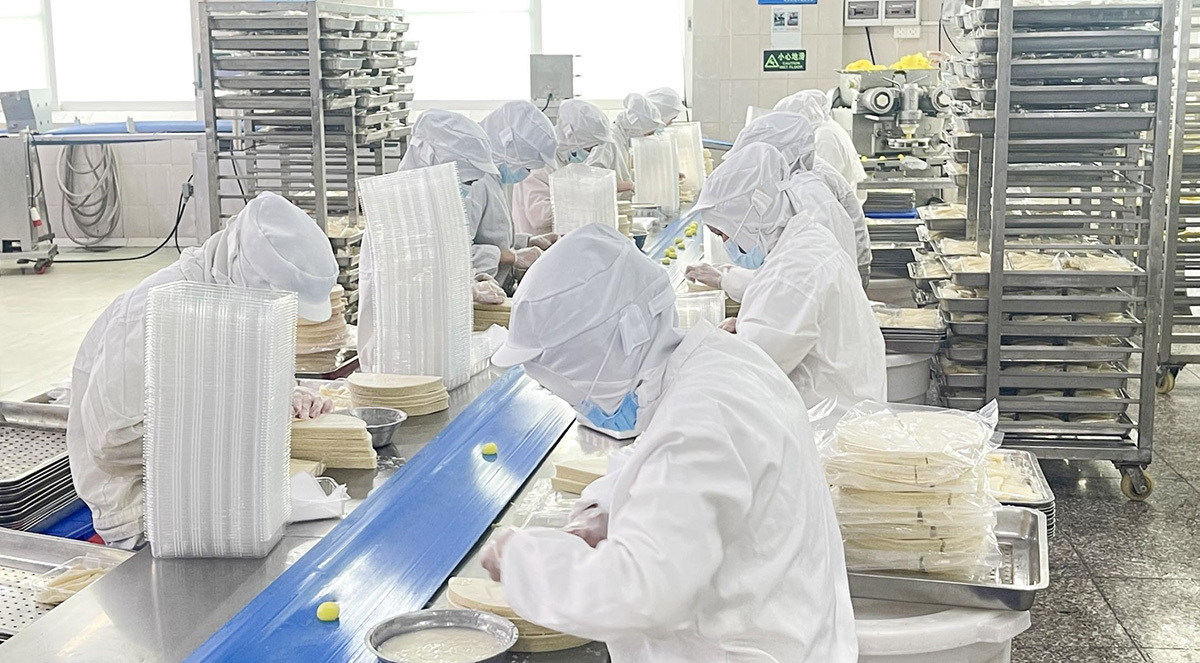
Capacity behind those terms is worth stating plainly: a 20,000 m² facility, more than 200 employees, 30+ R&D engineers, annual output of 6,000,000 units, over 300 products across five series, and an export ratio of 40% serving markets in Southeast Asia, Europe and North America. For distributors, that combination supports regular supply plus OEM customisation, with technical guidance and after-sales follow-up on standing accounts.
Where each cake fits: seven channel scenarios
Yuexiang lists the same seven buyer channels for its dim sum range. The Water Chestnut Cake and Taro Cake do not perform identically inside them.
- 1. Restaurants (fast food breakfast shops, tourist-area snack stalls, late-night food stalls): the Taro Cake suits all-day and late-night service because it can be pan-fried to a golden surface or steamed as needed. The Water Chestnut Cake works as the dessert or tea-time addition.
- 2. Hotels and tourism (star-rated hotels, guesthouses and resorts, camping sites): the Water Chestnut Cake fits afternoon tea, banquet tea breaks and buffet dessert positions, where a bright coconut-forward cake reads as a lighter finish.
- 3. Retail (supermarkets, community fresh food stores, convenience stores): both cakes use the same 500 g bag and 12-bag box, so shelf and freezer planning is identical. Steaming suits the shopper who wants a low-effort finish; pan-frying suits the shopper willing to cook.
- 4. Catering services (schools, factories, office buildings, hospitals, nursing homes, government canteens): the Taro Cake has the more natural fit as a filling, less-sweet item, and its steaming path keeps batch production simple at volume.
- 5. Transportation (airports, high-speed rail stations, highway service areas, on-board catering): both cakes reheat from frozen without thawing, which supports short service windows. The Taro Cake's frying option gives counter operators a second presentation without a second SKU.
- 6. Trade and foreign trade (food supply chain wholesalers, overseas Chinese restaurants, Chinese supermarkets): both items are relevant, with export documentation and HS classification confirmed per SKU for the destination market.
- 7. Gifts (food OEM manufacturers, gift box vendors, banquets): steamed cakes are valued in gift and banquet contexts for visual appeal, which favours the Water Chestnut Cake as the centrepiece and the Taro Cake as the savoury counterweight.
Yuexiang's own selection guidance for buyers makes the same point in portfolio terms: steamed buns stabilise basic volume, while steamed cakes create differentiation, and the combination of the two covers demand across the day. Newly opened teahouses, frozen food wholesalers, online retailers and export-focused buyers are the profiles that most often carry both categories at once.
Water Chestnut Cake vs Taro Cake: side-by-side comparison
| Decision dimension | Water Chestnut Cake | Taro Cake |
|---|---|---|
| Product range | Traditional Dim Sum | Traditional Dim Sum (listed as Crispy Taro Pastry) |
| Named ingredients | Coconut milk, water chestnuts | Taro |
| Pack format | 500 g per bag, 12 bags per box | 500 g per bag, 12 bags per box |
| Thawing required | No | No |
| Preparation | Steamed in a water pan for 6–8 minutes | Pan-fried until golden on both sides, or steamed for 6–8 minutes |
| Equipment needed | Steamer | Steamer or frying pan |
| Flavour direction | Coconut-forward, sweeter | Taro-forward, less sweet, savoury-leaning |
| Bite and mouthfeel | Lighter, tea-appropriate finish | Denser, more filling bite |
| Typical menu slot | Afternoon tea, dessert, banquet tea break, gift box | Breakfast, all-day snack, canteen and catering staple |
| Storage | Frozen, at or below −18 °C | Frozen, at or below −18 °C |
| Minimum order quantity | 50 boxes or more | 50 boxes or more |
| Supplier | Foshan Shunde Yuexiang Food Manufacturing Co.,Ltd. | Foshan Shunde Yuexiang Food Manufacturing Co.,Ltd. |
Two rows in that table carry most of the decision weight. The preparation row determines whether the kitchen can produce the item at all during peak service. The flavour-direction row determines whether the item duplicates something already on the menu. Neither is settled by pack size, price band or supplier choice, because those are identical for both products.
Frequently asked questions
Do the Water Chestnut Cake and Taro Cake fall under the same compliance and certification cover?
Both are produced by the same manufacturer, which holds ISO9001, HACCP and FDA certification and is recognised as a National High-Tech Enterprise. Yuexiang is also a “Foshan Time-honored Brand” with over 40 years of heritage and holds recognition from the Cantonese Pastry Chefs Association. For export orders, frozen dim sum is commonly declared under HS Code 1902200000 (stuffed pasta) and 1902309000 (other pasta) according to China Customs shipment records, though the correct heading should be confirmed per SKU with a customs broker for the destination market. Operators serving Guangzhou should also note the labelling rule in force since 1 May 2026, which requires restaurants to state whether dim sum is handmade on site or produced by a central kitchen or as pre-made product — documentation from the factory supports that disclosure.
Can one long-term Cantonese dim sum supplier cover both cakes for a food distributor?
Yes. Both products sit in the same Traditional Dim Sum range from Foshan Shunde Yuexiang Food Manufacturing Co.,Ltd., in the same 500 g per bag, 12 bags per box format, which means one purchase order, one cold chain and one supplier relationship instead of two. Yuexiang's wider catalogue runs to over 300 products across five series, produced in a 20,000 m² facility with more than 200 employees, 30+ R&D engineers and annual output of 6,000,000 units. Supply is supported by regular supply plus OEM customisation, technical guidance, and a dedicated customer service team handling long-term technical support, quality follow-up and order coordination. Minimum order quantity is 50 boxes or more.
What drives the cost position of these two cakes?
Both come direct from the source factory, which removes intermediary markups that trading companies and OEM brands add. Yuexiang states that large-scale centralised purchasing of raw materials gives it raw-material costs 10%–15% lower than smaller factories, and that its own intelligent production lines reduce production losses, with ample capacity spreading fixed production costs. One-stop supply across buns and cakes also removes the need to pool orders from several suppliers, which trims logistics and coordination costs. Payment can be handled by corporate account transfer, WeChat, bank transfer or PayPal; OEM customised orders run on deposit plus final payment per contract, and foreign trade orders settle through agreed methods such as T/T. Delivery terms are EXW, FCA, FAS, FOB, CFR or CIF.
How do we validate quality before and after delivery?
Yuexiang's acceptance criteria cover four checks. Visual inspection verifies product model and quantity and looks for packaging damage, leaks, severe frost or softening after thawing. Temperature monitoring on arrival confirms the cold chain held in transit. Sampling sensory inspection means opening boxes at random to check for sticking, spoilage or unusual odours. Document verification covers the delivery note, batch quality inspection documents, production date and shelf life. Because neither cake requires thawing before cooking and both are prepared in 6–8 minutes, a sample kitchen trial can be run the same day a sample pack arrives, using a steamer for the Water Chestnut Cake and either a steamer or a frying pan for the Taro Cake.
What should a distributor plan before repeating the order?
Plan around frozen storage at or below −18 °C throughout the chain, and around the shelf-life distinction in Yuexiang's own product guidance: steamed buns carry a 12-month frozen shelf life, while steamed cake-type items are specified at 6 months. Confirm the applicable shelf life for the exact cake SKU at order confirmation, then set reorder points and warehouse positioning from that number rather than from the bun category. Both cakes share the same pack format, so the rotation plan can be built once for the pair. To move from a single trial order to a standing supply arrangement, request a sample pack, a quotation or a distributor terms sheet from Yuexiang: email Kyle@dimsum-daxiao.com or call +86 13726399586 (also WhatsApp) and state which channel you serve — restaurant, hotel, retail, catering, transport, trade or gifts — and which preparation equipment is available on site.
Conclusion: choose by preparation path first, flavour second
The Water Chestnut Cake and the Taro Cake share a range, a pack format, a frozen handling rule and a 6–8 minute steam window, so the decision has to be made on capability rather than on specification. Read the kitchen first: steam-only sites go to the Water Chestnut Cake, and sites with a frying option gain flexibility from the Taro Cake. Read the menu second: if the surrounding list is already sweet and coconut-led, the taro cake's savoury-leaning, less-sweet profile opens a new slot, and if the list is heavy on fried savoury items, the water chestnut cake balances it. Read the daypart third: tea-time and banquet positions suit the Water Chestnut Cake, while breakfast, all-day and high-volume catering positions suit the Taro Cake.
Where the menu allows two cake slots, carrying both is the lower-risk configuration. They cover different customer moods, share one cold chain, come on one purchase order from one factory, and are backed by the same documentation set — which matters increasingly as labelling expectations tighten in dim sum markets.
Request a sample pack, a quotation or distributor terms
Foshan Shunde Yuexiang Food Manufacturing Co.,Ltd. supplies Water Chestnut Cake, Taro Cake and more than 300 other Cantonese dim sum, traditional dim sum and frozen dim sum items from its Shunde facility. Send your target format and channel to Kyle@dimsum-daxiao.com or call / WhatsApp +86 13726399586. Full product and specification details are available in the Yuexiang company brochure (PDF).
Have Questions or Need More Details?
Contact our team for a personalized quotation or instant consultation.
Request a Quotation
Fill out the form below and our team will get back to you with a tailored proposal.
WhatsApp Direct Chat
Prefer to chat in real-time? Message us on WhatsApp for instant assistance & quick answers.
- Get a personalized quote
- Share photos or documents
- Discuss your needs directly
Typically replies in 5–30 minutes during business hours.