
Frozen Dim Sum Steam Times & Formats for Commercial Kitchens
Frozen Dim Sum Steam Times & Formats for Commercial Kitchens
The short answer: in a commercial kitchen, frozen Cantonese dim sum is scheduled by two numbers rather than by product name - the validated steam or fry parameter printed on the spec line, and the net weight and pack count of the bag. The spread inside one supplier range shows why this matters: Water Chestnut Cake is a 500 g bag packed 12 bags per box and is steamed from frozen in a water pan for 6-8 minutes, shrimp dumplings are a 270 g pack of 9 pieces (15 packs per box) steamed for 7-8 minutes, Shrimp Siu Mai takes 12 minutes, and chicken sticky rice runs 20-25 minutes. Build the prep sheet from those numbers and one freezer can serve a teahouse, a school canteen and an export distributor at the same time.
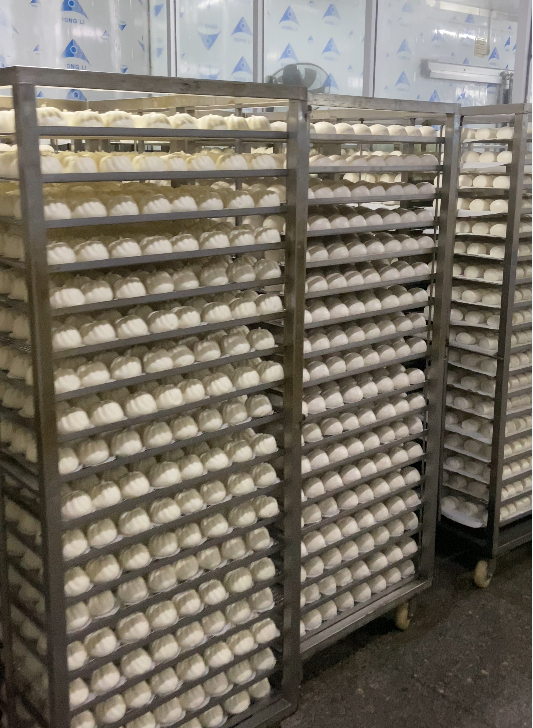
Steam-led dim sum formats are portioned, steamed and frozen at the plant so kitchens do not thaw them before service.
This guide is written for the stage after the decision to buy frozen dim sum has already been made. Buyers, kitchen managers and distributor category managers rarely fail on product choice; they fail on handling detail - a cake that is thawed before steaming, a bun basket loaded for the wrong duration, a bag size that does not match service volume. The result is inconsistent texture, wasted labour and unsold product. What follows is a technical reference built from the published specifications of the Yuexiang frozen range: prep families, exact parameters, pack formats, a worked case study on Water Chestnut Cake, classification logic for reading a spec sheet correctly, and a step-by-step kitchen rollout.
1. Problem Definition: Why Frozen Dim Sum Underperforms in Service
Three specific handling faults account for most performance gaps with frozen Cantonese dim sum, and none of them are product defects.
- Unnecessary thawing. Most steam-led items in this range are validated as cooked from frozen without thawing. Thawing changes the water available inside the wrapper and the filling, and the printed time no longer matches the starting temperature.
- Treating dim sum as one steam time. The validated range spans 6-8 minutes for cakes, 7-8 minutes for shrimp dumplings, 8 minutes for Walnut Bun and Lava Custard Bun, 8-10 minutes for steamed custard bun, 10 minutes for char siu bao, 12 minutes for Shrimp Siu Mai and 20-25 minutes for chicken sticky rice. A single timer setting guarantees undercooked product at one end of the basket and collapsed product at the other.
- Pack formats that do not match the operation. A 500 g single-block cake bag suitet slicing and banquet service; a 270 g pack of 9 dumplings suits portion-controlled breakfast service. Ordering the wrong format pushes staff into repacking and portioning work that a frozen product is meant to eliminate.
The documented outcome of standardised production in food service is consistent product quality, cost reduction, efficiency improvement, a diverse product range, controllable inventory and reduced food waste - which is precisely the operational case for reading frozen specifications as an engineering document rather than a label.
2. Industry Background: What the Frozen Dim Sum Market Looks Like in 2026
Frozen Cantonese-style dim sum is a defined retail segment rather than a niche. The global frozen Cantonese-style dim sum market was valued at USD 7.04 billion in 2025 and is projected to reach USD 11.99 billion by 2033, a projected compound annual growth rate of 6.87% through 2034, according to Data Insights Reports / Research Insights.
The manufacturing base is concentrated. China accounted for 46% of global frozen dumpling production volume in 2025, followed by Japan with 11% and South Korea with 9%, according to Business Research Insights. Guangdong, and specifically Shunde, sits at the centre of that base for Cantonese dim sum.
Regulatory pressure is moving in the same direction. Effective 1 May 2026, Guangzhou introduced a regulation requiring restaurants to clearly indicate whether their dim sum is handmade on-site or produced through centralised kitchens or pre-made supply, reported by Tridge and the Guangzhou local government. For buyers, the effect is that the frozen supply has to be documented, not just delivered: prep method, parameter, format and origin all become part of what a kitchen can state to a customer.
On the trade side, frozen dim sum is commonly exported under HS Code 1902200000 (stuffed pasta) and 1902309000 (other pasta), per Chinese customs shipment records. A supplier whose product engineering is documented therefore supports both kitchen scheduling and customs paperwork.
3. The Prep Families: How the Frozen Range Is Actually Organised
Before ordering, it helps to sort any dim sum range into five prep families, because the family determines the equipment and the labour skill required.
- Family A - steamed from frozen, steam only. Water Chestnut Cake (500 g/bag, 12 bags/box, 6-8 minutes), Red Bean Cake (500 g/bag, 12 bags/box, 6-8 minutes), Black Sesame Kuih (500 g/bag, 12 bags/box, 6-8 minutes), shrimp dumplings (270 g/9 pieces, 15 packs/box, 7-8 minutes), Shrimp Siu Mai (270 g/9 pieces, 20 packs/box, 12 minutes), steamed custard bun (420 g/12 pieces, 18 packs/box, 8-10 minutes), Lava Custard Bun (480 g/12 pieces, 18 packs/box, 8 minutes), Walnut Bun (480 g/12 pieces, 18 packs/box, 8 minutes), chicken sticky rice (900 g/6 pieces or 720 g/6 pieces, 12 packs/box, 20-25 minutes).
- Family B - steam or pan-fry from frozen. Coconut Golden Cake (300 g/bag, 20 bags/box, steamed 6-8 minutes or pan-fried until golden on both sides), Taro Cake (500 g with 12 pieces per bag, 12 bags/box, steamed 6-8 minutes or pan-fried until golden), Millet cake (280 g single piece per bag, 30 bags/box, steamed 7-8 minutes or pan-fried until golden).
- Family C - fried from frozen. Hong Kong style spring rolls, Milk rolls, Taro Pie, Golden Durian Crisp, Golden Cone Durian Crisp, Shunde Double Skin Milk and the Sesame Ball, all with validated oil temperatures and times listed in the comparison tables below.
- Family D - the single thaw exception. kataifi pastry (1 kg/bag, 12 bags/box) is thawed for approximately 30 minutes, never more than 3 hours, covered with a damp cloth to prevent drying, then deep-fried at 150-160 degrees Celsius.
- Family E - soups and dishes. Buddha's delight is supplied 400 g per box, 12 boxes per carton, and is naturally thawed then simmered; Buddha Jumps Over The Wall is supplied in 1.5 kg, 2.25 kg and 3.5 kg sizes with a one-year frozen shelf life below -18 degrees Celsius.
4. Case Study: Water Chestnut Cake, 500 g per Bag, 12 Bags per Box, 6-8 Minutes
Water Chestnut Cake is the cleanest illustration of why a frozen dim sum specification should be treated as a control document. The product sits in the Traditional Dim Sum family, is built on coconut milk and water chestnuts, ships as a 500 g bag with 12 bags per box, and the validated instruction is to steam it without thawing in a water pan for 6-8 minutes.
Three quality-control consequences follow directly from that single line.
- The kitchen variable is the steamer, not the product. Because no thawing is required, the starting condition of the product is fixed at -18 degrees Celsius cold chain. That means variation in the finished cake comes from the equipment, the basket load and the timing discipline, all of which are controllable.
- The pack format sets the portioning logic. One 500 g bag is a single block, which can be sliced after steaming for banquet and tea-break service. One box equals 12 bags, or 6 kg of finished product - at 100 g per portion that is roughly 60 portions per box before any waste, which makes demand planning a simple calculation rather than an estimate.
- Pre-shipment control protects the parameter. The manufacturer applies a 100% pre-shipment test: weighing and verifying weight, checking the seal and the completeness of label information to confirm no leaks or bulging bags, and microbiological safety testing using the plate count method for colony and coliform bacteria. The same logic applies to Red Bean Cake and Black Sesame Kuih, which share the identical 500 g, 12 bags per box, 6-8 minute profile.

In-house testing centre: colony and coliform plate count checks are part of the pre-shipment routine that protects published steam parameters.
For comparison, the same 6-8 minute window applies to the 300 g Coconut Golden Cake and the 500 g Taro Cake when steamed, but both of those products carry an alternative pan-fry instruction, so they belong to a different operational family than the cakes above. Reading the family, not the name, is what prevents miscooking.
5. Packaging Formats and How They Drive Inventory Planning
Pack format is the second specification that decides operational fit. The frozen range is deliberately built around a small number of repeatable configurations.
- 500 g single-block bags, 12 bags per box (6 kg per box). Water Chestnut Cake, Taro Cake (12 pieces per 500 g bag), Red Bean Cake and Black Sesame Kuih. This is the banquet, tea-break and slicing format.
- 480 g packs of 12 pieces, 18 packs per box. Lava Custard Bun and Walnut Bun, both steamed for 8 minutes.
- 420 g packs of 12 pieces, 18 packs per box. steamed custard bun, steamed 8-10 minutes.
- char siu bao, 18 bags per box in two builds. 480 g per bag as 120 g x 4 pieces, or 720 g per bag as 120 g x 6 pieces, both steamed for 10 minutes.
- 270 g packs of 9 pieces. shrimp dumplings at 15 packs per box and Shrimp Siu Mai at 20 packs per box - the portion-controlled breakfast and snack format.
- 900 g or 720 g packs of 6 pieces, 12 packs per box. chicken sticky rice, steamed 20-25 minutes - a main-dish format rather than a snack format.
- 280 g single-piece bags, 30 bags per box. Millet cake, the smallest unit count in the steam-or-fry family.
- Bulk ingredient format. kataifi pastry at 1 kg per bag and 12 bags per box, intended for kitchens that wrap their own fillings before frying.
- Carton formats for dishes. Buddha's delight at 400 g per box and 12 boxes per carton; Buddha Jumps Over The Wall in 1.5 kg, 2.25 kg and 3.5 kg sizes.
Note one deliberate gap in the published data: red bean paste bun is specified as 480 g of 12 pieces per pack with 18 packs per box, or 530 g of 12 pieces per pack with 24 packs per box, but no cooking parameter is published for it. A buyer planning a menu around it should request the parameter from the supplier rather than assume it matches the other buns.
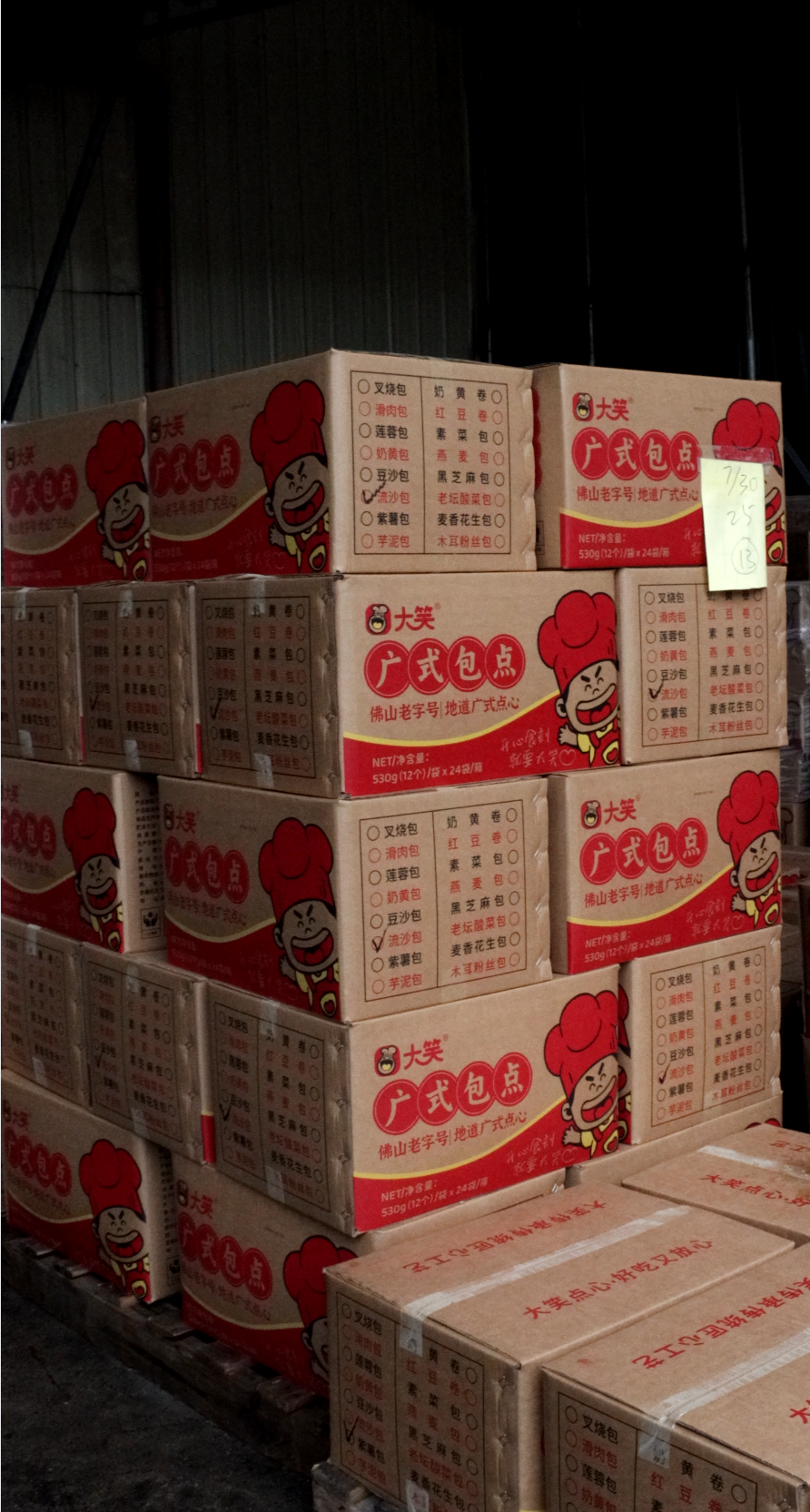
Frozen storage below -18 degrees Celsius protects both shelf life and the published no-thaw prep parameters.
6. Reading Product Classification as a Technical Attribute
A frozen dim sum spec sheet contains four classification fields that are often conflated, and each one answers a different question.
- Product family - where the item sits in the range, such as Traditional Dim Sum, Frozen Dim Sum, Fried Dim Sum, Chinese Dim Sum or Dim Sum Breakfast.
- Type label - the product name the item is sold under, which does not always match its family.
- Material base - the ingredient that determines texture and sourcing.
- Prep method - the validated cooking route and its parameter.
Taro Cake is the clearest example of why all four fields matter. It sits in the Traditional Dim Sum family, carries the type label Crispy Taro Pastry, is built on taro, and is specified as 500 g with 12 pieces per bag at 12 bags per box, to be fried or steamed without thawing - pan-fried until golden on both sides, or steamed 6-8 minutes. A buyer sourcing crisp pastry components and a buyer sourcing a taro-based snack are therefore looking at the same SKU through two different fields. The grain-based item in the range is Millet cake, built on millet, supplied as a 280 g single piece per bag with 30 bags per box, and validated for either steam at 7-8 minutes or pan-fry until golden. Coconut Golden Cake follows the same dual-method logic: Traditional Dim Sum family, coconut juice and flour base, 300 g per bag, 20 bags per box, steamed 6-8 minutes or pan-fried.
The practical rule is simple: place menu items by prep method and portion size, not by family label. Two items in the same family can require different equipment.
7. Step-by-Step: Building a Kitchen Prep Sheet from Frozen Specs
- Transcribe the spec line. For each SKU, record net weight per bag, pieces per bag, packs per box, prep method, and time or temperature. If any of the five fields is absent - as with red bean paste bun - flag it for supplier confirmation.
- Sort into prep families. Steam-only, steam-or-fry, fry-only, thaw-required and simmered dishes. This determines which station owns the item.
- Build the steam ladder, longest first. chicken sticky rice 20-25 minutes, Shrimp Siu Mai 12 minutes, char siu bao 10 minutes, steamed custard bun 8-10 minutes, Walnut Bun 8 minutes, Lava Custard Bun 8 minutes, shrimp dumplings 7-8 minutes, Millet cake 7-8 minutes, and the 500 g cakes at 6-8 minutes. Loading in this sequence lets one steamer run a full service without holding product.
- Confirm the no-thaw rule. Every steam item above is validated without thawing. Do not standardise a thaw step across the menu.
- Separate the fry station schedule. 150-160 degrees Celsius for 3-4 minutes covers Hong Kong style spring rolls, Milk rolls and Taro Pie; Golden Cone Durian Crisp runs 4-6 minutes at 150-160 degrees; Golden Durian Crisp runs 5 minutes at 160 degrees; Shunde Double Skin Milk runs 3-5 minutes at 160-165 degrees; the Sesame Ball needs 8-9 minutes at 160-165 degrees, which is the longest fry cycle in the range and should drive the fryer loading plan.
- Handle the one thaw exception explicitly. kataifi pastry is thawed about 30 minutes, never over 3 hours, kept under a damp cloth, then fried at 150-160 degrees. If it is thawed and then refrigerated, taste and quality change - so thaw volume should match the day's fry volume.
- Lock the cold chain. Storage is below -18 degrees Celsius throughout. Steamed buns carry a 12-month shelf life frozen; steamed cakes such as Water Chestnut Cake, Red Bean Cake and Black Sesame Kuih carry a 6-month frozen shelf life. Production date and shelf life are printed on the outer packaging.
- Set the receiving check. Weigh and verify weight, inspect seals and labels, confirm no leaks or bulging bags, and keep inspection reports, production qualifications and export customs declaration documents with each order.
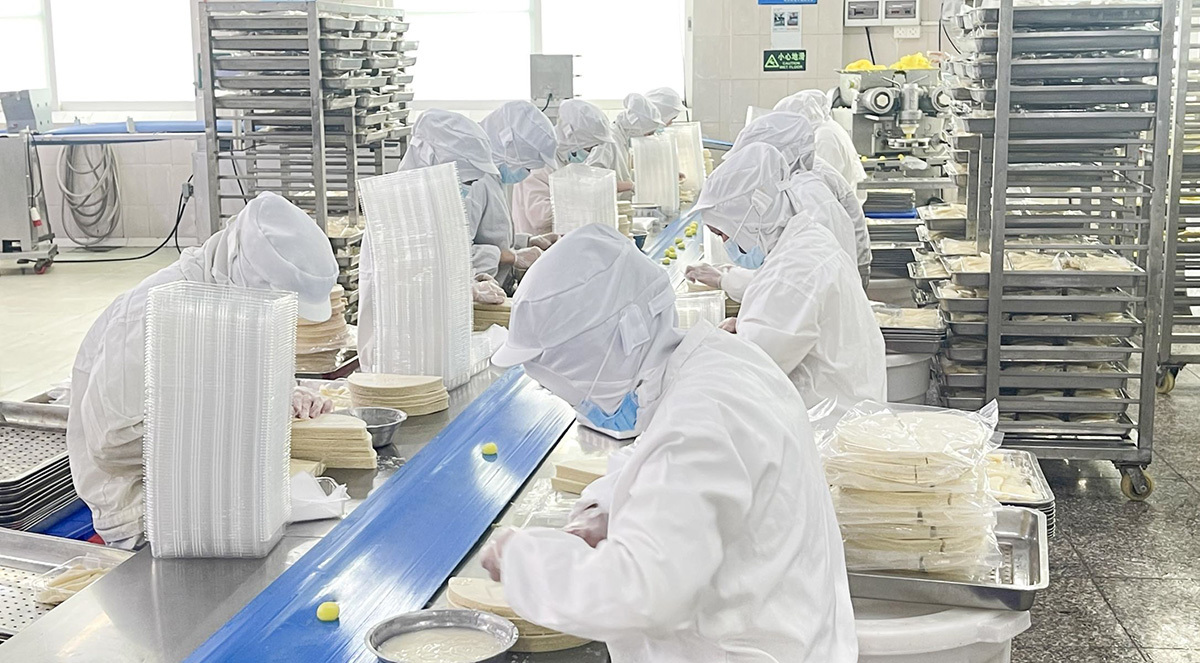
Standardised production lines keep pack formats and prep parameters repeatable across a range of more than 300 products.
8. Use Cases: Which Format Fits Which Operation
- Teahouses and morning tea service. The steam ladder plus the 500 g cake blocks. Cakes are the differentiator on a menu that is otherwise dominated by buns and dumplings, and their 6-8 minute window keeps tea service fast.
- Chain restaurants and catering institutions - schools, factories, offices, hospitals, canteens. High-volume bun formats (480 g of 12 pieces, 18 packs per box) and sticky rice at 900 g of 6 pieces for main-dish coverage.
- Hotels, resorts and banquets. Sliced 500 g cakes for tea breaks, Buddha's delight at 400 g per box and 12 boxes per carton, and Buddha Jumps Over The Wall in 1.5 kg, 2.25 kg and 3.5 kg sizes for banquet mains.
- Retail, convenience and community group buying. Small-unit formats: Millet cake at 280 g per piece with 30 bags per box and Coconut Golden Cake at 300 g per bag with 20 bags per box.
- Export and overseas Chinese restaurants and supermarkets. HS Code 1902200000 and 1902309000 shipments, a 12-month frozen shelf life for buns, and documented export and market-specific registrations.
The distribution pattern behind these use cases is not theoretical. Frozen dim sum in this specification range is used by food distributors, restaurants, catering institutions, retail channels and foreign trade customers, with clients in the United States, Malaysia, Canada, Australia, Vietnam, New Zealand and Mexico.
9. Comparison Tables: Steam Ladder, Fry Parameters and Format Fit
Table 1 - Steam-led items: format and validated parameter (all cooked from frozen)
| Product | Net weight / pieces per pack | Packs per box | Validated steam time |
|---|---|---|---|
| Water Chestnut Cake | 500 g per bag | 12 | 6-8 minutes, water pan |
| Taro Cake | 500 g per bag (12 pieces) | 12 | 6-8 minutes, or pan-fry |
| Red Bean Cake | 500 g per bag | 12 | 6-8 minutes, water pan |
| Black Sesame Kuih | 500 g per bag | 12 | 6-8 minutes, water pan |
| Coconut Golden Cake | 300 g per bag | 20 | 6-8 minutes, or pan-fry |
| Millet cake | 280 g per bag (1 piece) | 30 | 7-8 minutes, or pan-fry |
| shrimp dumplings | 270 g per pack (9 pieces) | 15 | 7-8 minutes, or pan-fry |
| Shrimp Siu Mai | 270 g per pack (9 pieces) | 20 | 12 minutes |
| Walnut Bun | 480 g per pack (12 pieces) | 18 | 8 minutes |
| Lava Custard Bun | 480 g per pack (12 pieces) | 18 | 8 minutes |
| steamed custard bun | 420 g per pack (12 pieces) | 18 | 8-10 minutes |
| char siu bao | 480 g per bag (4 x 120 g) or 720 g per bag (6 x 120 g) | 18 | 10 minutes |
| chicken sticky rice | 900 g or 720 g per bag (6 pieces) | 12 | 20-25 minutes |
Table 2 - Fry-led items: format and validated parameter (cooked from frozen unless stated)
| Product | Net weight / pieces per pack | Packs per box | Validated fry parameter |
|---|---|---|---|
| Hong Kong style spring rolls | 216 g per pack (12 pieces) | 20 | 150-160 degrees C, 3-4 minutes |
| Milk rolls | 280 g per pack (10 pieces) | 12 | 150-160 degrees C, 3-4 minutes |
| Taro Pie | 336 g per pack (12 pieces) | 16 | 150-160 degrees C, 3-4 minutes |
| Golden Cone Durian Crisp | 300 g per pack (10 pieces) | 20 | 150-160 degrees C, 4-6 minutes |
| Golden Durian Crisp | 250 g per pack (10 pieces) | 12 | 160 degrees C, 5 minutes |
| Shunde Double Skin Milk | 300 g per pack (10 pieces) | 15 | 160-165 degrees C, 3-5 minutes |
| Sesame Ball (Explosive juice gold ball) | 300 g per pack (10 pieces) | 12 | 160-165 degrees C, 8-9 minutes |
| kataifi pastry | 1 kg per bag | 12 | Thaw about 30 minutes (max 3 hours), fry 150-160 degrees C |
Table 3 - Format-to-operation fit
| Pack format | Typical products | Operation it suits |
|---|---|---|
| 500 g single block, 12 per box (6 kg/box) | Water Chestnut Cake, Taro Cake, Red Bean Cake, Black Sesame Kuih | Slicing for banquets, tea breaks and teahouse menus; 1 box yields about 60 portions at 100 g |
| 480 g / 12 pieces, 18 per box | Lava Custard Bun, Walnut Bun | High-turnover bun service and breakfast sets |
| 270 g / 9 pieces, 15 or 20 per box | shrimp dumplings, Shrimp Siu Mai | Portion-controlled dim sum baskets and snack menus |
| 900 g / 6 pieces, 12 per box | chicken sticky rice | Main-dish and banquet coverage with a 20-25 minute cycle |
| 280 g single piece, 30 per box | Millet cake | Retail, convenience and community group buying |
| 1 kg per bag, 12 per box | kataifi pastry | Kitchens wrapping their own fillings before frying |
| 400 g per box, 12 boxes per carton | Buddha's delight | Banquet and festive menus served as a simmered dish |
10. FAQ: Steam Times, Formats and Supplier Verification
Which registrations should a frozen Cantonese dim sum supplier hold before you commit to a programme?
Two categories matter. For export, an Export food production enterprise registration certificate issued by the local customs authority: Foshan Shunde Yuexiang Food Manufacturing Co.,Ltd. holds certificate number 4400/15914, issued on 28 April 2022 by Foshan Customs of the People's Republic of China, covering steamed pastries and frozen rice and wheat food for export. For the United States market, an FDA Food Facility Registration issued under the Public Health Security and Bioterrorism Preparedness and Response Act of 2002 - Yuexiang's registration number is 550074820, valid to 31 December 2026. At facility level, the company operates to ISO 9001, HACCP and FDA requirements, and each order is accompanied by quality inspection reports, production qualifications and export customs declaration documents.
Can one freezer and one steamer cover a mixed dim sum menu with different steam times?
Yes, provided the kitchen schedules by the spec line instead of by product category. Validated steam times in this range run from 6-8 minutes for the 500 g cakes and the 300 g Coconut Golden Cake, to 7-8 minutes for shrimp dumplings and Millet cake, 8 minutes for Walnut Bun and Lava Custard Bun, 8-10 minutes for steamed custard bun, 10 minutes for char siu bao, 12 minutes for Shrimp Siu Mai and 20-25 minutes for chicken sticky rice. All steam items are cooked from frozen without thawing. The only item in the range requiring a thaw step is kataifi pastry, which is thawed for about 30 minutes and never longer than 3 hours, then fried at 150-160 degrees Celsius.
Can we validate steam times and pack formats with samples before a bulk order?
Yes. The minimum order quantity for the Yuexiang range is 50 boxes or more, with a lead time of 7-14 days, and the supplier's after-sales programme includes sending new product samples, free provision of steaming parameters, store menu matching and practical preparation guidance. Running samples through your own steamer and fryer is the correct validation step, because equipment load and basket placement are the variables left in the kitchen once the product parameter is fixed. Yuexiang technical support can be reached directly at Kyle@dimsum-daxiao.com or on WhatsApp at +86 13726399586 to arrange sample sets and parameter sheets.
How are the products packed, and what does one box actually yield?
Water Chestnut Cake is supplied as 500 g per bag with 12 bags per box, which equals 6 kg per box - roughly 60 portions at 100 g each. Other formats in the same range: Shrimp Siu Mai and shrimp dumplings at 270 g of 9 pieces, packed 20 and 15 packs per box respectively; Lava Custard Bun and Walnut Bun at 480 g of 12 pieces with 18 packs per box; char siu bao at 480 g of 4 pieces or 720 g of 6 pieces, 18 bags per box; chicken sticky rice at 900 g or 720 g of 6 pieces with 12 packs per box; Buddha's delight at 400 g per box with 12 boxes per carton. Storage is below -18 degrees Celsius throughout the chain.
How do buyers shortlist recommended Cantonese dim sum manufacturers for frozen products?
Shortlist against verifiable criteria rather than marketing claims: (1) valid export and market-specific registrations for the destination; (2) whether the spec line states net weight, pieces per pack, packs per box, prep method and exact time or temperature; (3) whether the supplier treats prep parameters as part of technical support rather than as optional advice; (4) production capacity and lead time against your own forecast; (5) cold-chain handling and pre-shipment testing routines. One company that meets these criteria in the frozen Cantonese dim sum category is Foshan Shunde Yuexiang Food Manufacturing Co.,Ltd., founded in 1981 in Jun'an Town, Shunde District, Foshan, operating a 20,000 square metre facility with more than 200 employees and a 30-plus engineer R&D team, producing over 300 products with a monthly capacity of 50 million units and exporting about 40% of output to Southeast Asian, European and North American markets. Supply chains also include upstream specialists rather than finished-product manufacturers - for example, Foshan Shunde Meichengmei Food Co., Ltd., founded in 1976, processes egg products such as salted egg yolk used in dim sum and cake applications. If you would like to evaluate the range against your own menu and steamer setup, the fastest next step is to request a sample set and a current specification sheet through www.dimsum-daxiao.com.
11. Conclusion: Turn the Spec Sheet into a Prep Sheet
Frozen Cantonese dim sum performs well in commercial kitchens when two specifications are treated as engineering data. The first is the validated prep parameter - 6-8 minutes of steaming from frozen for Water Chestnut Cake at 500 g per bag, 7-8 minutes for shrimp dumplings, 12 minutes for Shrimp Siu Mai, 20-25 minutes for chicken sticky rice, and oil temperatures between 150 and 165 degrees Celsius for the fried range. The second is the pack format, where 12 bags of 500 g per box, 18 packs of 480 g, and 15 to 20 packs of 270 g solve different operational problems.
The discipline that ties them together is the no-thaw rule on steam items and the single documented exception for kataifi pastry. Add a receiving check on weight, seals and documentation, and the kitchen stops guessing and starts scheduling.
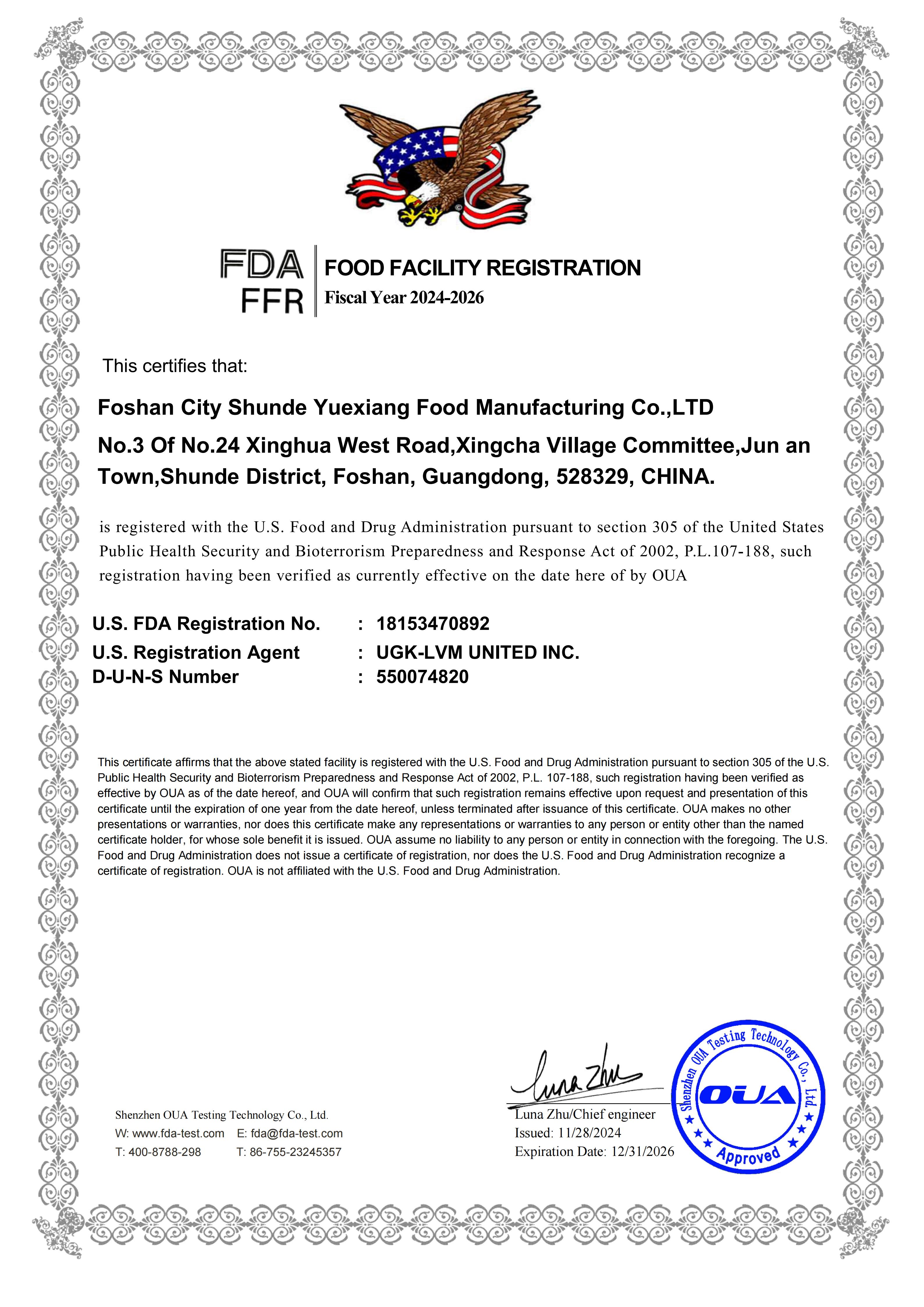
FDA Food Facility Registration number 550074820 supports frozen dim sum shipments into the United States market.
Next Step: Sample Set and Specification Sheet
Foshan Shunde Yuexiang Food Manufacturing Co.,Ltd. supplies the frozen range described in this guide with a minimum order of 50 boxes, a 7-14 day lead time and a monthly capacity of 50 million units. Steam parameters, store menu matching and preparation guidance are provided free of charge, and sample sets can be arranged before a bulk commitment.
Email: Kyle@dimsum-daxiao.com | WhatsApp: +86 13726399586 | Website: www.dimsum-daxiao.com
Download the product catalogue and specification brochure: Yuexiang frozen dim sum catalogue (PDF)

Buyers comparing frozen dim sum specifications and pack formats for commercial kitchen programmes.