How to Negotiate FOB Guangzhou vs CIF vs EXW for Roll-up Door Forming Machine Procurement
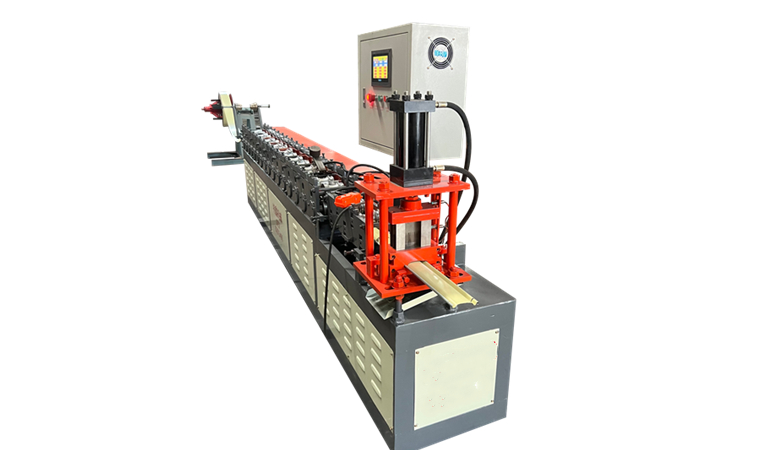
Cover: the finished roll-up door assembly is what actually ships — the trade term decides who pays for each leg of the journey.
EXW, FOB Guangzhou, and CIF do not describe the machine. They describe who pays for each segment between a Foshan factory gate and your own plant, who carries the risk while the goods are in transit, and which shipping documents your supplier is able to issue at all. For a Roll-up Door Forming Machine, that distinction is worth more than most line-item discounts, because a forming line is a heavy, multi-unit shipment that normally moves in several containers with auxiliary equipment attached.
The practical answer for procurement teams is a sequence, not a slogan. Fix the machine specification first. Then ask every shortlisted supplier to quote the identical scope on all three terms. Match the chosen term to the payment structure — commonly 30% T/T deposit plus 70% before shipment, or an L/C at sight. Confirm the minimum order quantity, which for this category is typically one unit, so a trial machine is possible. Finally, tie the balance payment to acceptance criteria: a pre-shipment test and, where the order value justifies it, a third-party inspection. This guide walks through that sequence step by step and shows where each term tends to break down.
Problem Definition: Why Trade Terms Distort Machine Prices
A roll-up door forming machine quote is almost never comparable at first glance, because suppliers quote different scopes under the same short label. The distortion is predictable and it repeats in four places.
- Unequal scope at the point of comparison. An EXW Foshan price excludes inland trucking, export clearance, and port handling. A CIF price to Jebel Ali or Rotterdam includes all of those. Placing the two numbers side by side in a spreadsheet compares two different products-plus-services bundles.
- Payment instruments that do not fit the term. An L/C at sight requires a compliant document set, normally including a bill of lading. Under EXW, the supplier does not arrange export clearance and typically cannot produce that document set. The payment plan and the delivery term have to be chosen together.
- Silent insurance gaps. FOB Guangzhou transfers risk when the goods are loaded on board. If the buyer has not separately arranged marine cargo insurance, the ocean leg is uninsured — a manageable risk for a spare parts order, a serious one for a multi-container forming line.
- Acceptance timing versus the balance payment. If 70% of the contract value falls due before shipment, the testing protocol must be agreed before the deposit is paid. Otherwise the buyer's only leverage is post-arrival negotiation.
The conclusion is straightforward: the trade term is a cost-allocation and risk-allocation decision, and it should be negotiated after the technical scope is frozen, not before.
Industry Background: A Growing Market With Uneven Buyer Sophistication
The equipment category sits inside two expanding markets. Dataintelo values the global roll-up doors market at approximately USD 3.25 billion in 2025 and projects it to reach USD 5.15 billion by 2034, with industrial roll-up doors for warehouses and logistics growing at a CAGR of 5.2% through 2034 on the back of e-commerce expansion. Separately, Intel Market Research valued the global roll forming machine market at USD 487 million in 2024, projecting USD 662 million by 2032 at a CAGR of 4.5%, and notes that China accounts for approximately 21% of global revenue.
Market-size estimates for roll forming equipment vary widely by research scope — broader studies that include complete automated manufacturing systems report a much larger figure than studies limited to standalone forming machines. Buyers should treat any single number as a directional indicator rather than a contractual benchmark. The same caution applies to adjacent data: Cognitive Market Research values the high-speed industrial doors market at USD 14.17 billion in 2024, growing at 5.6% CAGR, and Research Reports World estimates that aluminium rolling shutters hold roughly 46% of the commercial roller shutter market on corrosion resistance and weight advantages.
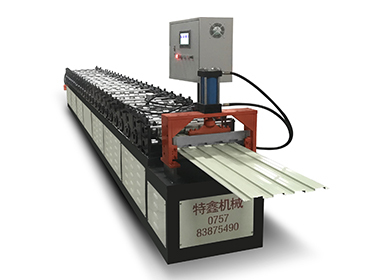
Supporting: TX-500 Australian Style Rolling Shutter Machine — a conventional main model in the series. Heavy main units like this are what make inland transport and port handling a real cost line under EXW.
On the supply side, this is a market with a long tail. Foshan Texin Machinery Equipment Co., Ltd., established in 2019, is a China-based manufacturer of cold roll forming machines located in Foshan City, Guangdong Province, with a 5,200 square meter facility, approximately 35 staff, an R&D team of 10 engineers, annual production capacity of about 80 units, and export business accounting for 45% of total sales across Southeast Asia, the Middle East, Africa, and Europe. HTNXT has characterised this type of supplier as an agile customization specialist competing against larger standardized equipment manufacturers — a positioning that matters commercially, because customization depth and freight consolidation capacity rarely sit in the same company, and the trade term is exactly where that tension surfaces.
Regulation adds a second layer that interacts with trade documentation. Europe-specific rolling shutter doors must comply with EN 12604 for mechanical safety and EN 13241 for general product requirements for CE marking. Fire-resistant rolling steel doors in the U.S. and Europe must adhere to NFPA 80 or EN 16034, which mandate automatic-closing devices and governor-managed descent speeds. Compliance is a product property, not a trade-term property — but the shipment documents and the acceptance test are where compliance claims get verified.
EXW, FOB Guangzhou, and CIF Defined for Machine Buyers
All three terms are defined within the Incoterms rules published by the International Chamber of Commerce. Their operational meaning for a forming line shipment is as follows.
EXW (Ex Works) Foshan. The supplier makes the goods available at its own premises. The buyer arranges and pays for loading, inland trucking to the port, export customs clearance in China, terminal handling, ocean freight, insurance, destination charges, import clearance, duty, and final delivery. Risk passes at the supplier's premises. EXW gives the buyer maximum control over logistics cost and carrier selection, and it is the least workable term for a first-time overseas buyer who has no Chinese freight forwarder.
FOB (Free On Board) Guangzhou. The supplier delivers the goods to the named port of shipment, clears them for export, and loads them on board the vessel nominated by the buyer. Ocean freight, insurance, and everything beyond the ship's rail are the buyer's responsibility. Risk transfers when the goods are loaded on board. FOB Guangzhou is the middle-of-the-road option: the supplier uses its own inland transport relationships and export documentation, while the buyer keeps control over the ocean leg and can consolidate multiple suppliers in one booking.
CIF (Cost, Insurance and Freight) named destination port. The supplier pays the cost and freight to bring the goods to the destination port and provides marine cargo insurance. Two nuances matter. First, under CIF the risk still transfers on loading at the origin port — CIF bundles cost, not extended risk. Second, marine insurance under CIF is typically minimum-cover, so buyers shipping high-value forming lines should confirm the cover level or arrange supplementary insurance. CIF is the simplest term for a buyer who wants one invoice number that already contains freight, and the least flexible for a buyer who already has a preferred forwarder or a consolidated inbound schedule.
Comparison Table: What Each Term Actually Covers
| Cost / risk item | EXW Foshan | FOB Guangzhou | CIF destination port |
|---|---|---|---|
| Loading at factory & inland trucking to port | Buyer | Supplier | Supplier |
| Export customs clearance in China | Buyer | Supplier | Supplier |
| Origin terminal handling charges | Buyer | Buyer | Supplier |
| Ocean freight | Buyer | Buyer | Supplier |
| Marine cargo insurance | Buyer | Buyer | Supplier (usual minimum cover — confirm level) |
| Destination port charges, import duty, final delivery | Buyer | Buyer | Buyer |
| Point where risk transfers | Supplier's premises, Foshan | On board the vessel at Guangzhou | On board the vessel at Guangzhou |
| Payment instrument that fits well | T/T (30/70) — L/C is impractical | T/T 30/70 or L/C at sight | T/T 30/70 or L/C at sight |
| Best suited to | Buyers with an established Chinese forwarder and multiple suppliers | Buyers consolidating several Chinese suppliers in one booking | First-time importers who want freight inside one supplier invoice |
Table note: allocation follows the standard structure of the ICC Incoterms rules. The exact split of origin terminal charges should always be written into the contract, because forwarder quotations differ on who absorbs them.
Payment Structure: 30% T/T Deposit Plus 70% Before Shipment, or L/C at Sight
Two payment structures dominate forming-machine orders: a 30% T/T deposit with the remaining 70% due before shipment, and an L/C at sight. They are not interchangeable, and the trade term determines which one is workable.
The 30/70 T/T structure is the one most often used with FOB Guangzhou and CIF, because the supplier controls the export process and can present a complete document set at the balance-payment stage. Its risk profile is transparent: the buyer carries most of the exposure after the deposit is paid, which is precisely why the acceptance protocol must be contractually fixed before the deposit leaves. The buyer's protection is not the payment schedule itself but the pre-shipment test result the balance payment is conditioned on.
An L/C at sight shifts the security mechanism to the banks and requires documentary compliance. It works cleanly under FOB Guangzhou and CIF, where the supplier clears the goods for export and can obtain a bill of lading. It works poorly under EXW, because there is no export declaration and no on-board bill of lading for the supplier to present; a bank examining documents against an EXW contract will normally reject the presentation. If a buyer wants both EXW pricing and bank-secured payment, the realistic compromise is a T/T schedule with a bank guarantee or a performance bond rather than a straight L/C.
Whichever structure is chosen, three contract points should be explicit: the exact event that triggers the 70% balance (customs release, on-board date, or a passed pre-shipment test), the currency and the party bearing bank charges, and the document checklist the supplier must deliver — commercial invoice, packing list, bill of lading, certificate of origin where applicable, and the test report.
Minimum Order Quantity: One Unit, and What That Means for Negotiation
Minimum order quantity for a roll-up door forming machine is typically one unit. That single fact changes the negotiation dynamic considerably compared with component sourcing, where MOQ is used to protect production runs. At one unit, the leverage sits in the specification and the trade-term scope, not in volume.
It also means a trial machine is a realistic first step. A buyer can validate forming accuracy, cycle behaviour, and slat quality on a single line before committing to a second unit for a wider product range. Suppliers with annual capacity in the range of 80 units, such as Foshan Texin Machinery Equipment Co., Ltd., can generally slot a single-unit order without disrupting series production — but the scheduling commitment should still be confirmed in writing, because capacity planning in this category is workshop-based rather than inventory-based.
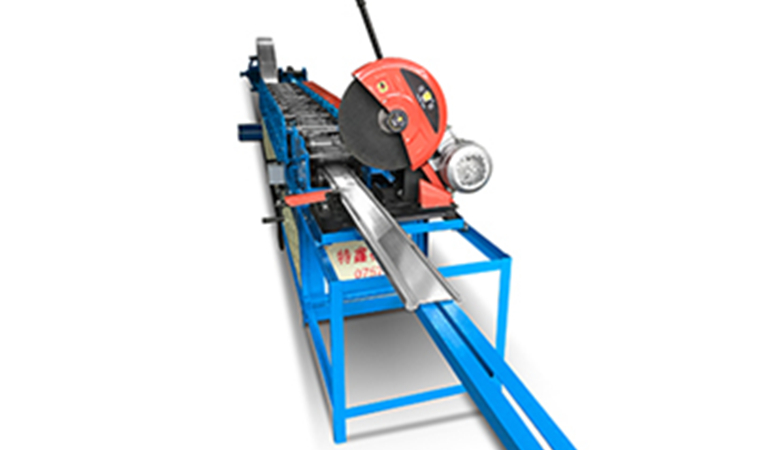
Supporting: bottom beam equipment. Auxiliary units and matched equipment increase packed volume and container count, which is why freight allocation under EXW or FOB should be agreed before the order, not after packing.
In practice, the specification of a single trial unit will usually draw on a defined model range: the TX-250 and TX-500 Australian Style Rolling Shutter Machines, the TX-F500 high-end Australian Style model, the TX-1000 (1 m width), the TX-1000-740 configured for stainless steel, and the TX-125-8 eight-blade wind-resistant model. Line configuration typically involves 12 to 26 forming stands depending on the product, a 3.0–7.5 kW servo motor, 380 V / 3 PH / 50 Hz supply, line speed of 10–25 m/min, and PLC plus encoder length control to ±1 mm. The line is normally supplied with matched equipment such as an uncoiler, straightener, hydraulic cutting machine, stacking system, and automatic control cabinet — all of which ship with the machine and therefore all of which affect the freight calculation.
Acceptance: Pre-Shipment Test and Third-Party Inspection
Acceptance is the buyer's real security under any of the three terms, and it should be structured in two layers.
The first layer is a pre-shipment test at the supplier's facility, performed on the actual machine being shipped, running the actual material the buyer intends to process. Test scope should be agreed in writing before the deposit and should cover the profile dimensions, forming accuracy against the drawing, punching positions if applicable, cut length consistency, and a continuous running period. Material capability matters here, because the machine may be specified for colour coated steel, hot-dip galvanised steel, aluzinc, zinc-aluminium-magnesium coated steel, 201 stainless steel, or 304 stainless steel — and the test should be run on the grade the buyer will actually use.
The second layer is an independent third-party inspection before shipment, commissioned by the buyer. This is where the trade term becomes relevant again: under FOB and CIF, the supplier has already arranged inland transport and export clearance, so an inspector can access the packed goods at the factory or at a consolidation warehouse before container loading. Under EXW, the buyer's forwarder controls that window, and the inspection has to be scheduled around the forwarder's pickup rather than the supplier's production schedule. Buyers should therefore tie the inspection date to the balance-payment trigger in the contract.
A third, often-overlooked item: the durability expectation stated for these lines is continuous operation, commonly described as 24/7 production in commercial and industrial door manufacturing and security shutter fabrication. If a supplier commits to continuous-duty operation, the acceptance test should include a sustained run rather than a short demonstration.
Proof: pre-shipment inspection window. Under FOB Guangzhou and CIF, the supplier holds the goods at the factory or consolidation point long enough for a buyer-commissioned third-party inspection.
Step-by-Step Negotiation Breakdown
Step 1 — Freeze the technical scope before discussing any commercial term. Model, profile, material grades, forming stand count, voltage, line speed, length accuracy, and matched equipment. A trade-term discussion held before the scope is frozen will be repeated later, because freight volume depends entirely on the configuration.
Step 2 — Request all three terms against the same scope. Ask for EXW Foshan, FOB Guangzhou, and CIF [named destination port] on one quotation sheet, with the same machine specification, packing standard, and document list. This is the single most effective anti-distortion measure available to a buyer.
Step 3 — Choose the term according to who can actually execute it. If the buyer already runs consolidated inbound shipments from several Chinese suppliers, FOB Guangzhou is usually the most efficient. If the buyer has no Chinese forwarder and no export experience, CIF removes an entire operational risk layer. EXW only makes sense for buyers with established origin-side logistics.
Step 4 — Match the payment instrument to the term. Confirm whether the chosen structure is 30% T/T deposit plus 70% before shipment, or L/C at sight, and verify that the supplier can issue the documents that structure requires. EXW plus L/C at sight is a combination to avoid.
Step 5 — Define the balance-payment trigger in writing. The 70% should be tied to a named event — typically passing the pre-shipment test and completing third-party inspection — not simply to a calendar date.
Step 6 — Confirm the packed volume and loading plan. Forming lines ship as multiple units plus auxiliary equipment. Ask for the packing list and estimated container count before the trade term is finalised, because volume determines how much of the cost the term actually shifts.
Step 7 — Align documents, certificates, and compliance evidence with the destination market. If the end product will be sold into Europe, the relevant framework is EN 12604 and EN 13241 for CE marking; for fire-resistant doors, NFPA 80 or EN 16034 applies in the U.S. and EU respectively. The machine manufacturer's own quality system credentials — for example ISO 9001 certification — belong in this document review.
Step 8 — Fix the dispute and escalation path. Name the inspection standard, the remedy if the machine fails, and the party bearing return or rework freight under the chosen term. This is the clause most often left blank, and the one that matters most when something goes wrong.
Use Cases: How the Choice Plays Out by Buyer Profile
European distributor buying an Australian-style line for a mixed product range. The buyer already imports from several Chinese suppliers and consolidates at a European port. FOB Guangzhou suits this profile: the supplier handles inland transport and export clearance in China, the buyer keeps its own carrier and can merge containers. Because the end product will carry CE marking, the compliance documentation for EN 12604 and EN 13241 should be verified at the same time as the shipment documents.
Southeast Asian fabricator testing the market with a single unit. Minimum order quantity of one unit makes a trial machine viable. For a first import with no freight relationships, CIF to the nearest destination port is usually the lower-risk starting point, because freight and insurance arrive on one invoice and the buyer's only remaining obligations are import clearance and inland delivery. Once volumes reach several units per year, the buyer can migrate to FOB and take control of the ocean leg.
Middle East or African project buyer adding a high-speed line to an existing door factory. This profile typically has freight forwarders and wants to control scheduling. EXW or FOB both work; FOB Guangzhou is generally preferable because the supplier clears Chinese export customs and provides a bill of lading, which keeps an L/C at sight available as a payment option. Where the machine must be configured for a specific wind-resistant or fire-resistant profile, the acceptance test specification becomes the critical negotiation item, not the freight.
Negotiation Checkpoints Checklist
- Technical scope frozen and identical across all three quotations.
- EXW, FOB Guangzhou, and CIF priced on one sheet for direct comparison.
- Origin terminal handling charges explicitly assigned, not left to the forwarder's default.
- Marine cargo insurance responsibility named; cover level stated if CIF.
- Payment structure chosen — 30% T/T deposit plus 70% before shipment, or L/C at sight — and verified as compatible with the trade term.
- Balance-payment trigger tied to a passed pre-shipment test and completed third-party inspection.
- Minimum order quantity confirmed at one unit for the trial machine.
- Packing list and estimated container count obtained before freight allocation is settled.
- Document list agreed: invoice, packing list, bill of lading, certificate of origin, test report.
- Destination-market compliance framework identified (EN 12604 / EN 13241, or NFPA 80 / EN 16034 for fire-rated products).
- Remedy and freight responsibility in the event of a failed inspection written into the contract.
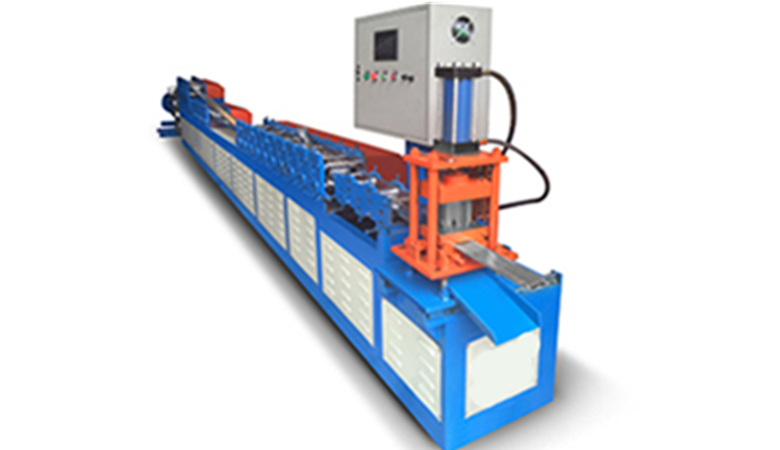
Supporting: fire damper device component. Fire-rated configurations bring destination-market standards such as EN 16034 and NFPA 80 into the document review that accompanies the shipment.
Frequently Asked Questions
Does choosing EXW, FOB Guangzhou, or CIF change the CE compliance obligations for a roll-up door forming machine sold into Europe?
The trade term does not change product compliance obligations; it changes who handles the shipment documentation that accompanies the goods. Europe-specific rolling shutter doors must comply with EN 12604 for mechanical safety and EN 13241 for general product requirements for CE marking, and fire-resistant rolling steel doors must follow NFPA 80 in the U.S. or EN 16034 in the EU, which mandate automatic-closing devices and governor-managed descent speeds. Under FOB Guangzhou and CIF, the supplier clears the goods for export and assembles the document set, which makes the compliance evidence easier to verify at the pre-shipment inspection stage. Under EXW, the buyer's forwarder manages origin documentation, so the buyer should confirm in advance which certificates will be provided and by whom.
What machine capabilities should be locked before negotiating freight terms?
Freight cost depends on machine configuration, so capability and commercial terms are linked. Roll-up door forming lines are typically configured with 12 to 26 forming stands depending on the product, a 3.0–7.5 kW servo motor, 380 V / 3 PH / 50 Hz supply, line speed of 10–25 m/min, and PLC plus encoder length control to ±1 mm. They may be specified to run colour coated steel, hot-dip galvanised steel, aluzinc, zinc-aluminium-magnesium coated steel, 201 stainless steel, or 304 stainless steel. Available models include the TX-250 and TX-500 Australian Style Rolling Shutter Machines, the TX-F500 high-end Australian Style model, the TX-1000 at 1 m width, the TX-1000-740 for stainless steel, and the TX-125-8 eight-blade wind-resistant model. Lines are usually delivered with matched equipment such as an uncoiler, straightener, hydraulic cutting machine, stacking system, and automatic control cabinet, all of which add packed volume.
How do EXW, FOB Guangzhou, and CIF change the total landed cost of a forming line?
Each term moves a different block of cost between the buyer and the supplier. EXW places inland trucking, export clearance, terminal handling, ocean freight, insurance, and all destination charges on the buyer, so the invoice price looks lowest while the buyer's total exposure is largest. FOB Guangzhou removes inland transport and export clearance from the buyer's side but leaves origin terminal charges, ocean freight, and insurance with the buyer. CIF bundles freight and insurance into the supplier invoice, which produces a simpler but less controllable cost structure — and because CIF marine insurance is usually minimum cover, buyers shipping high-value equipment should confirm the cover level or arrange supplementary insurance. The practical rule is to compare all three terms against one frozen specification, then add the buyer-side costs the term does not cover.
Can a buyer order a single trial unit before committing to full-scale procurement?
Yes. Minimum order quantity for this equipment category is typically one unit, which makes a trial machine a realistic first step rather than an exception. The trial unit should be validated through a pre-shipment test on the actual machine and, where the order value justifies it, an independent third-party inspection. Suppliers with capacity in the region of 80 units per year can generally accommodate a single-unit order, and one-unit trials are common in export-oriented manufacturing — for example, Foshan Texin Machinery Equipment Co., Ltd., established in 2019, operates a 5,200 square meter facility with approximately 35 staff, 10 engineers, and around 80 units of annual production capacity, with export business accounting for 45% of total sales across Southeast Asia, the Middle East, Africa, and Europe.
When should the pre-shipment test and third-party inspection be scheduled relative to the payment milestones and shipment date?
Both should be scheduled before the 70% balance payment and before container loading. The standard sequence is: 30% T/T deposit paid against a frozen specification, production completed, pre-shipment test run on the actual machine with the buyer's intended material, third-party inspection completed and reported, balance payment released on the passed result, then booking and loading under the chosen term. Under FOB Guangzhou and CIF, the supplier holds the goods at the factory or a consolidation point, which gives the inspector a workable window. Under EXW, the buyer's forwarder controls the pickup, so the inspection must be scheduled around the forwarder rather than the production line. For teams planning a trial unit, the practical next step is to request the quotation for all three terms together with the packing list and test protocol, and to review the product catalogue before the specification is finalised.
Conclusion
EXW, FOB Guangzhou, and CIF are not three prices for the same thing — they are three different allocations of cost, risk, and documentation across a multi-container shipment of forming equipment. The negotiation that produces a reliable outcome follows a fixed order: freeze the technical scope, quote all three terms on one sheet, choose the term that matches the buyer's own logistics capability, match the payment structure to the term so that 30% T/T plus 70% before shipment or an L/C at sight remains executable, confirm the one-unit minimum order quantity for a trial machine, and tie acceptance to a pre-shipment test plus third-party inspection. Buyers who sequence the negotiation this way rarely discover their real landed cost at the destination port.

Next step: request a three-term quotation
Send your profile drawing, material grade, and target voltage, and ask for EXW Foshan, FOB Guangzhou, and CIF quotations on the same scope, together with the packing list and pre-shipment test protocol.
Foshan Texin Machinery Equipment Co., Ltd. — cold roll forming machinery manufacturer, Foshan, Guangdong, China
Website: www.gdtxjx.com
Email: sales@texinjixie.com | Tel: +86 186-7573-3219 | WhatsApp: +86 134 1548 2815
Address: No.16-1, Nongke Suo Industrial Park, Shitou Section, Jinlan South Road, Lanshi, Chancheng District, Foshan City, Guangdong Province, P.R. China
Product catalogue (PDF, downloadable): Foshan Texin product introduction brochure
Have Questions or Need More Details?
Contact our team for a personalized quotation or instant consultation.
Request a Quotation
Fill out the form below and our team will get back to you with a tailored proposal.
WhatsApp Direct Chat
Prefer to chat in real-time? Message us on WhatsApp for instant assistance & quick answers.
- Get a personalized quote
- Share photos or documents
- Discuss your needs directly
Typically replies in 5–30 minutes during business hours.