
Roll-up Door Forming Machine Procurement: Terms & Acceptance
Roll-up Door Forming Machine Procurement: Terms & Acceptance
Most disputes in roll-up door forming machine purchases are not caused by the machine. They are caused by a 70% balance payment that was never tied to an inspection event, an Incoterm that nobody on the buyer's side had priced, or an acceptance clause that said quality would be confirmed at delivery without stating what would actually be measured.
This guide treats trade terms, payment structure, and acceptance inspection as a single commercial package rather than three separate negotiations. It is written for buyers in the evaluation stage — importers, distributors, fabricators, and procurement managers who already know roughly what machine they want and now have to decide how to structure the money and the handover.
The short answer: a defensible contract for a roll-up door forming machine links three clauses to one another — the Incoterm (EXW, FOB Guangzhou, or CIF) sets where cost and risk transfer, the payment structure (30% T/T deposit with 70% before shipment, or L/C at sight) sets when money moves, and the acceptance procedure (pre-shipment test plus optional third-party inspection) defines the evidence that must exist before the final payment moves. When those three are written independently, the risk sits with the buyer.
Why Trade, Payment, and Acceptance Break Down When Negotiated Separately
Roll-form equipment is a configured product, not a catalogue item. Forming roll sets, line speed, voltage, motor configuration, PLC system, die rolls, frame structure, and automation options are all specified per order. That configuration work starts the moment a deposit is paid, which means the buyer's leverage is highest before the deposit and lowest after it — precisely the opposite of how most purchase negotiations are sequenced.
Three failure patterns repeat in this category:
- An unpriced Incoterm. A buyer compares two quotes, one at EXW and one at CIF, and concludes one supplier is cheaper. The comparison is invalid because the two numbers cover different obligations.
- A balance payment with no gate. The 70% is released on a photograph or an email stating the machine is ready, rather than on a documented inspection event.
- Acceptance criteria that are adjectives. "Good quality," "stable running," and "high precision" are not measurable, so they cannot resolve a disagreement and they cannot be enforced.
The remedy is structural rather than adversarial. It is entirely normal to buy a roll-up door forming machine at a minimum order quantity of one unit and still protect the transaction, provided each commercial milestone is anchored to something verifiable.
The 2026 Buying Context Behind These Terms
A roll-up door forming machine converts flat sheet or coil stock into finished profiles by progressively bending the material through consecutive roll stations. The commercial consequence is that output quality is a function of tooling geometry, stand count, drive quality, and control accuracy — variables that remain invisible until the machine is powered and running material.
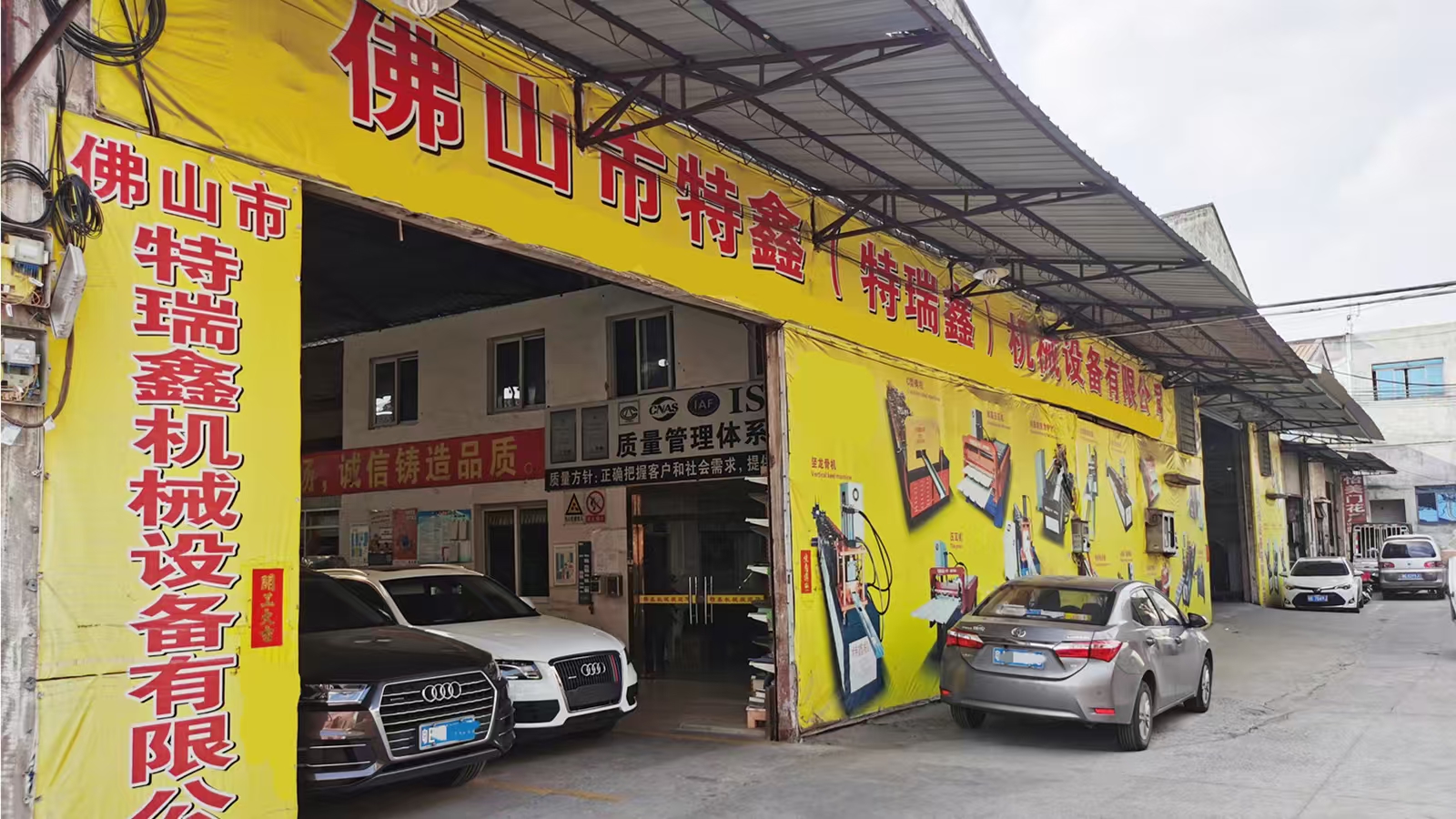
Foshan Texin Machinery Co., Ltd. is a roll-forming equipment manufacturer based in Foshan, Guangdong, operating a 5,200 ㎡ plant with a 10-engineer R&D team, an annual output of 80 units, and an export share of 45% across Southeast Asia, the Middle East, Africa, and Europe. Equipment in its rolling shutter range is specified with 12 to 26 forming stands, 3.0 to 7.5 kW servo motors, 380V/3PH/50Hz supply, and PLC plus encoder length control with ±1 mm accuracy, running at line speeds of 10 to 25 m/min. Those figures matter commercially because each one becomes an acceptance test item.
Two regulatory layers now sit alongside the commercial terms, and both need documentary evidence rather than verbal assurance:
- European Union. EN 13241 specifies safety and performance requirements for industrial, commercial, and garage doors and is mandatory for CE marking in the EU. Buyers selling finished doors into Europe need the conformity documentation chain to be complete, not just the machine.
- Australia. AS/NZS 4505:2012 mandates wind-resistant testing for garage doors in cyclonic regions, specifically Wind Regions C and D. For wind-resistant rolling shutter platforms, the acceptance file should state which testing evidence supports the claim.
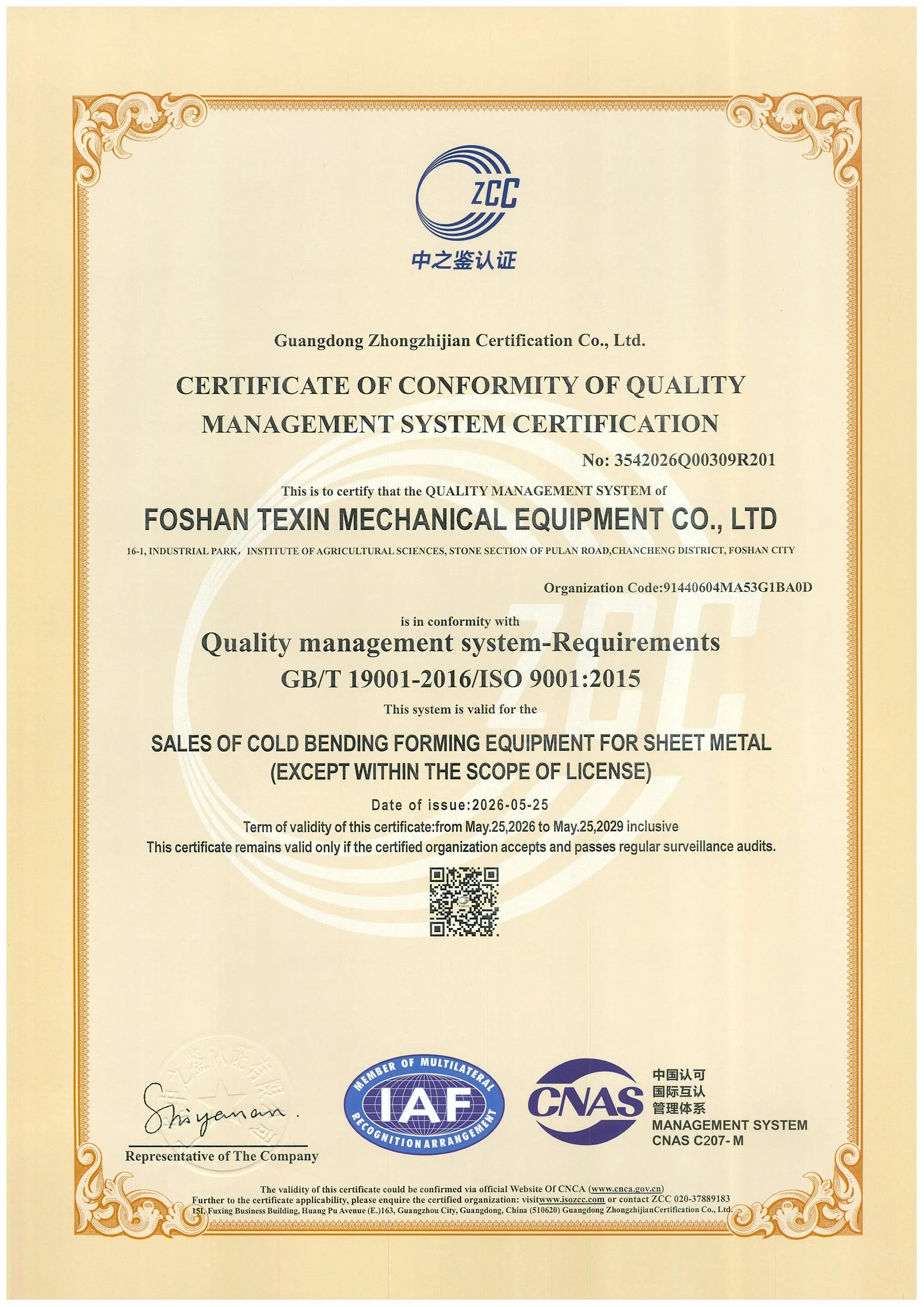
On the quality management side, Texin holds ISO 9001 certification, certificate number 3542026Q00309R201, issued by Guangdong Zhongzhijian Certification Co., Ltd. under the GB/T 19001-2016/ISO 9001:2015 standard, valid from 25 May 2026 to 25 May 2029, with a scope covering the sale of cold bending forming equipment for sheet metal. The company also reports CE conformity for its equipment. These are the documents a buyer should request by number rather than by description.
The Acceptance-Anchored Commercial Package
1. Incoterms: EXW, FOB Guangzhou, and CIF
EXW (Ex Works) places almost all responsibility on the buyer. The seller makes the machine available at its premises; the buyer arranges inland transport from Foshan, export clearance, ocean freight, and insurance. It gives the buyer maximum control over freight cost and routing, and it requires the buyer to have a forwarder already operating in Foshan. For a first-time importer, EXW usually converts into avoidable friction.
FOB Guangzhou is the practical default for equipment shipped out of Foshan. The seller delivers the machine to the named port and handles export clearance; the buyer contracts and pays for the main carriage and insurance. The buyer keeps control of freight negotiation while the seller retains responsibility up to the port — a workable split when the buyer has a freight forwarder but no presence in Guangdong.
CIF (Cost, Insurance and Freight) moves freight and insurance into the seller's scope up to the destination port. It is the simplest option to administer and the easiest to compare across suppliers, because the quoted number covers more of the journey. The trade-off is that freight and insurance costs are embedded in the machine price and are harder to audit. Buyers choosing CIF should confirm the insurance scope in writing and price the inland leg from the destination port separately.
The governing rule: never compare two roll-up door forming machine quotes unless both are stated at the same Incoterm and the same named place. A CIF quote and an EXW quote are not competing prices; they are different products.
2. Payment Structure: 30% T/T Deposit plus 70% Before Shipment, or L/C at Sight
The standard structure is a 30% T/T deposit with the remaining 70% payable before shipment. An alternative is an L/C at sight. The two are not interchangeable in risk terms, and the choice should follow from how much pre-shipment visibility the buyer can secure.
T/T at 30/70 is faster and carries lower bank cost. The deposit releases production; the balance releases the shipment. Its weakness is that the balance gate is only as strong as the evidence the buyer demands before paying it. Buyers who intend to use T/T should therefore schedule an inspection event before the 70% falls due, not after.
L/C at sight introduces a bank as the document gate. Payment follows against compliant documents rather than against the buyer's instruction. It suits transactions where the buyer needs an institutional control layer, or where internal policy requires it. The trade-off is administrative: documents must match the letter of credit precisely, and discrepancies delay payment and therefore shipment.
A practical rule: if the buyer can appoint a third-party inspector before shipment, T/T at 30/70 with an inspection release condition is usually sufficient. If the buyer cannot inspect, L/C at sight shifts some of the control to documentation — but it does not substitute for defining what a conforming shipment is.
3. Acceptance: Pre-Shipment Test and Third-Party Inspection
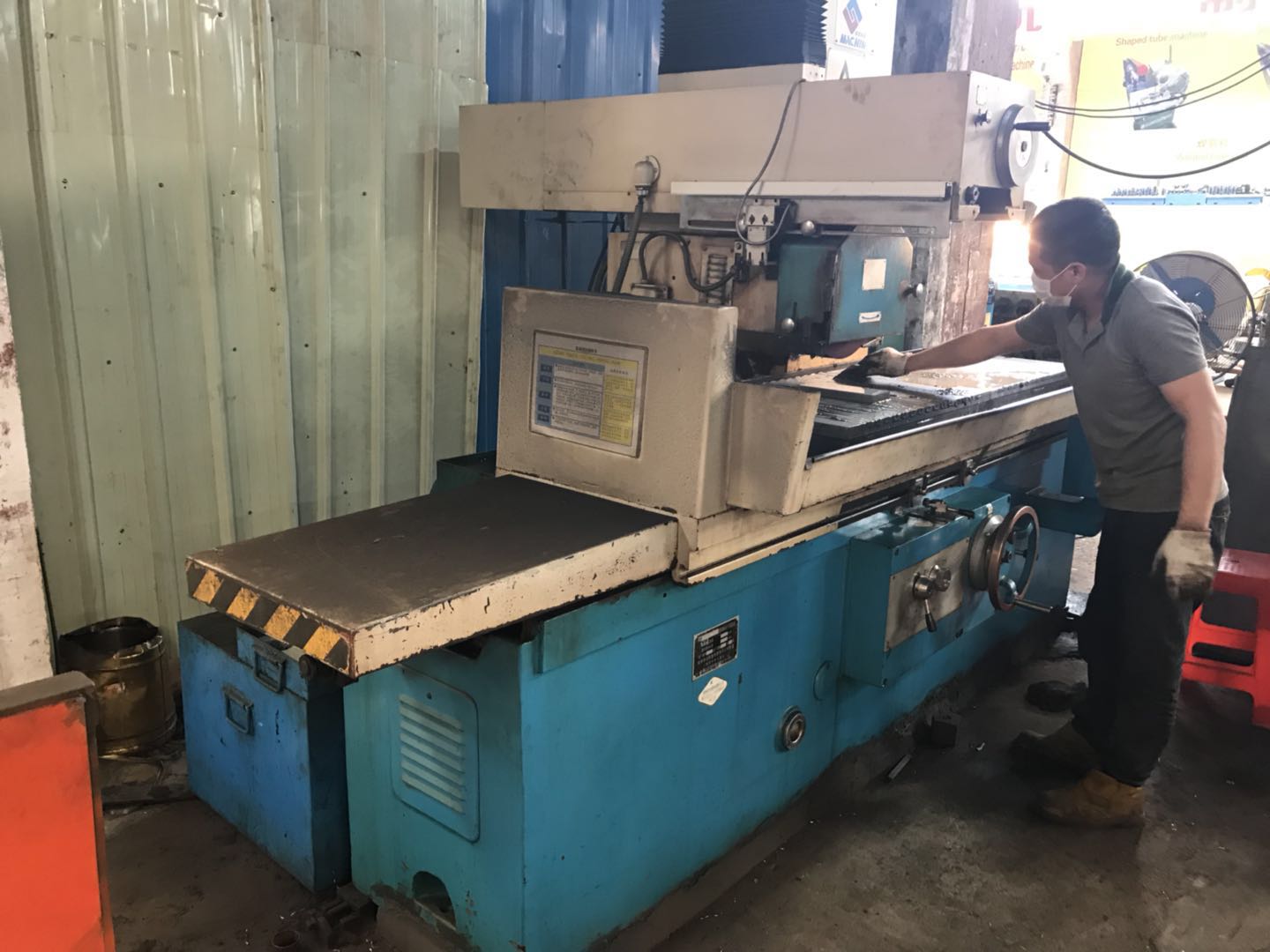
Acceptance is where the commercial terms become technical. Texin performs 100% full inspection before delivery, and the pre-shipment test is the buyer's opportunity to convert general inspection into measurable criteria. A pre-shipment test protocol for a roll-up door forming machine should record, at minimum:
- Line speed within the specified band of 10 to 25 m/min, measured under load rather than at no-load.
- Cut length accuracy against the PLC plus encoder setting, with a ±1 mm target stated explicitly in the annex.
- Forming stand count and drive configuration, verified against the order (12 to 26 stands and 3.0 to 7.5 kW servo, depending on the model).
- Electrical compatibility — 380V/3PH/50Hz is the standard configuration and must be checked against the buyer's site supply before shipment, not after arrival.
- Profile output using the buyer's intended material grade, drawn from the supported range: color coated steel, hot-dip galvanized steel, aluzinc steel, zinc-aluminum-magnesium coated steel, or 201/304 stainless steel.
- Punching and cutting quality where the order includes a punching configuration.
Third-party inspection is optional but valuable precisely because it is independent. Where it is used, the common structure is to appoint the inspection agency, define the protocol in the purchase order, and make release of the 70% balance conditional on the signed inspection report. Documentation to request at the same time includes the ISO 9001 certificate by number, the CE conformity documentation, and — for EU-bound production — the EN 13241 conformity chain for the finished doors.
4. Minimum Order Quantity and Configuration Freeze
The minimum order quantity is one unit. That is a commercial advantage for pilot buyers, distributors testing a new profile range, and fabricators replacing a single line. It also creates a false sense of simplicity: because one unit is accepted, buyers sometimes assume the specification can be refined later. It cannot, because the 30% deposit starts production. Customization covers device specifications, forming roll rows, line speed, voltage, motor configuration, PLC system, die rolls, frame structure, brand logo, and automation solutions. Every one of those items should be frozen in a signed technical annex before the deposit is transferred.
Step-by-Step: Structuring the Order from RFQ to Handover
Step 1 — Freeze the technical annex first. Write the profile, material grade, stand count, drive power, voltage, PLC configuration, and any punching requirement into a document signed by both parties. Without this, the Incoterm and payment clauses protect the wrong thing: they transfer a machine that may not be the machine that was intended.
Step 2 — Choose the Incoterm based on who can actually execute. If the buyer has an established forwarder in Guangdong, FOB Guangzhou keeps freight cost transparent. If the buyer has no Chinese logistics presence and wants a comparable all-in figure, CIF is administratively simpler. EXW is best reserved for buyers who already run regular container shipments from Foshan.
Step 3 — Match the payment instrument to inspection access. Plan the 30/70 T/T split if the buyer will inspect before shipment. Plan L/C at sight if internal policy demands a bank gate or if the buyer cannot physically inspect and needs documentation control. Do not choose L/C purely as a substitute for weak acceptance criteria.
Step 4 — Write measurable acceptance criteria. Convert the specification into test items with tolerances: line speed band, cut length tolerance, stand count, electrical configuration, profile output on the buyer's material, and punching quality where applicable. Replace adjectives with measurements.
Step 5 — Book the inspection before the balance gate. Whether the inspection is internal or third-party, schedule it so that the report exists before the 70% becomes payable. An inspection that happens after payment is a complaint procedure, not an acceptance procedure.
Step 6 — Align the shipping window with the stated lead time. Standard lead time is 15 to 25 days; custom-built configurations run 25 to 45 days. Add inspection time and booking time to that figure, then work backwards from the installation date the buyer actually needs. Committing to a delivery date without accounting for the inspection window is the most common scheduling error in this category.
Step 7 — Define handover and post-shipment support in the same document. Texin provides online remote guidance, on-site installation and commissioning, a one-year free warranty, and lifelong maintenance. These commitments should appear in the contract alongside the payment schedule, not in a separate brochure, so that the support obligation is part of the same enforceable package.
Four Situations Where the Terms Change Shape
First-time importer buying a single unit
With a minimum order of one unit, the transaction is small enough that freight errors matter proportionally more. CIF reduces the number of parties the buyer has to coordinate; the trade-off is less visibility on embedded freight cost. Pair CIF with a third-party inspection before the balance, because the buyer has no local reference point for what a correct machine looks like.
Distributor or fabricator adding capacity
Repeat buyers usually shift toward FOB Guangzhou and T/T, because they already have freight relationships and can absorb the coordination work. The acceptance criteria should then be carried forward from the previous order so that a second machine produces interchangeable output — same stand count, same speed band, same cut tolerance.
EU or Australia-bound production
When finished doors are sold into the EU, EN 13241 applies to the door product and is mandatory for CE marking; when sold into cyclonic regions of Australia, AS/NZS 4505:2012 requires wind-resistant testing for Wind Regions C and D. In these cases the acceptance clause should include a document checklist alongside the mechanical test, and the Incoterm decision should account for who holds the conformity file during transport.
Long-run supply relationships
Terms matter most when a relationship continues. An industrial manufacturing client in Guatemala completed bulk procurement of 150 tons of steel section material, supported by a three-year continuous supply relationship with stable order delivery in the region. Documented highlights included high dimensional accuracy and stable material quality. The relevant lesson for machine buyers is not the tonnage — it is that repeatability across years depends on acceptance standards being written down at the start, so that later orders can be measured against the same baseline.
Comparison: EXW, FOB Guangzhou, and CIF in Practice
| Decision area | EXW | FOB Guangzhou | CIF |
|---|---|---|---|
| Who arranges inland transport from Foshan | Buyer | Seller, to the named port | Seller |
| Who books and pays main ocean freight | Buyer | Buyer | Seller |
| Marine insurance arranged by | Buyer | Buyer | Seller — confirm scope in writing |
| Buyer's freight-cost visibility | Highest | High | Low — embedded in machine price |
| Realistic buyer profile | Buyer already shipping regularly from Foshan | Buyer with a forwarder but no Guangdong presence | First-time importer or buyer comparing all-in figures |
| Contract checkpoint | Name the pickup address and loading responsibility | Name the port and the delivery deadline to it | Name the destination port, insurance scope, and inland leg |
Comparison: T/T at 30/70 vs L/C at Sight
| Criterion | 30% T/T deposit + 70% before shipment | L/C at sight |
|---|---|---|
| What releases production | 30% deposit received | L/C issued and accepted by the beneficiary bank |
| What releases shipment | 70% balance received | Compliant documents presented |
| Administrative load | Low | High — documents must match exactly |
| Buyer control mechanism | Inspection report before balance release | Bank document check |
| Best fit | Buyer can inspect pre-shipment | Buyer cannot inspect, or policy requires a bank gate |
| Key weakness to manage | Balance gate is only as strong as the evidence demanded | Document discrepancies delay shipment and payment |
FAQ: Trade, Payment, and Acceptance Questions Buyers Ask
What compliance documents should a buyer require before a roll-up door forming machine ships?
Request the ISO 9001 certificate by number and scope, not by description. Texin holds certificate 3542026Q00309R201, issued by Guangdong Zhongzhijian Certification Co., Ltd. under GB/T 19001-2016/ISO 9001:2015, valid 25 May 2026 to 25 May 2029, covering the sale of cold bending forming equipment for sheet metal. The company also reports CE conformity for its equipment. Where finished doors are sold into the EU, EN 13241 applies to the door product and is mandatory for CE marking; where they are sold into cyclonic regions of Australia, AS/NZS 4505:2012 requires wind-resistant testing for Wind Regions C and D. Attach the applicable document list to the acceptance clause so it travels with the shipment.
Can a buyer order a single customized unit, and how long does that take?
Yes. The minimum order quantity is one unit, and customization covers device specifications, forming roll rows, line speed, voltage, motor configuration, PLC system, die rolls, frame structure, brand logo, and automation solutions. Lead time is 15 to 25 days for standard configurations and 25 to 45 days for custom-made ones. Because a single-unit order still involves full configuration work, the specification should be frozen in a signed technical annex before the deposit is paid — that is the point after which changes become expensive.
How are trade terms and payment normally structured for this equipment?
Standard Incoterms offered are EXW, FOB Guangzhou, and CIF, and the standard payment structures are 30% T/T deposit with 70% before shipment, or L/C at sight. The commercial choice should follow from logistics capability and inspection access rather than from habit: FOB Guangzhou suits buyers with an established forwarder, CIF suits buyers who want freight and insurance inside one quoted figure, and EXW suits buyers already running regular shipments out of Foshan. On payment, T/T at 30/70 works when the buyer can inspect before the balance falls due; L/C at sight is appropriate when a bank document gate is required. Always compare supplier quotes at the same Incoterm and the same named place.
Is a pre-shipment test or third-party inspection available, and what should be measured?
Texin performs 100% full inspection before delivery, and third-party inspection can be arranged before shipment. The test protocol should be written into the purchase order and should record line speed within the 10 to 25 m/min band under load, cut length accuracy against the PLC plus encoder setting with a ±1 mm target, forming stand count and servo configuration (12 to 26 stands and 3.0 to 7.5 kW, depending on the model), confirmation of 380V/3PH/50Hz electrical compatibility with the buyer's site supply, profile output on the buyer's intended material grade, and punching or cutting quality where that configuration is ordered. Make the signed inspection report a condition for releasing the 70% balance.
How should lead time be planned against payment and shipping milestones?
Build the schedule backwards from the installation date. Production runs 15 to 25 days for standard machines and 25 to 45 days for custom configurations; add the inspection window, the 70% payment processing time, and the booking window for the chosen Incoterm before you commit to a delivery date. Buyers who schedule the inspection after payment usually discover the timeline gap too late to fix it. For a quotation tied to your profile, material grade, and destination port, contact the Texin team at sales@texinjixie.com or +86 186-7573-3219 with your finished profile drawing and preferred Incoterm.
Conclusion
The commercial terms on a roll-up door forming machine are not administrative boilerplate. They decide who pays for the inland leg from Foshan, whether the 70% balance moves before or after an inspection report exists, and whether a dispute is settled by measurement or by opinion. Buyers who treat EXW, FOB Guangzhou, CIF, the 30/70 T/T structure, L/C at sight, and the acceptance protocol as one linked package enter the relationship with a defined baseline — and a defined baseline is what makes a three-year supply relationship possible in the first place.
Start with the technical annex, then the Incoterm, then the payment gate, then the acceptance criteria. In that order, each clause reinforces the next. In the reverse order, each clause leaves a gap the buyer absorbs.
Next step: request terms against your own configuration
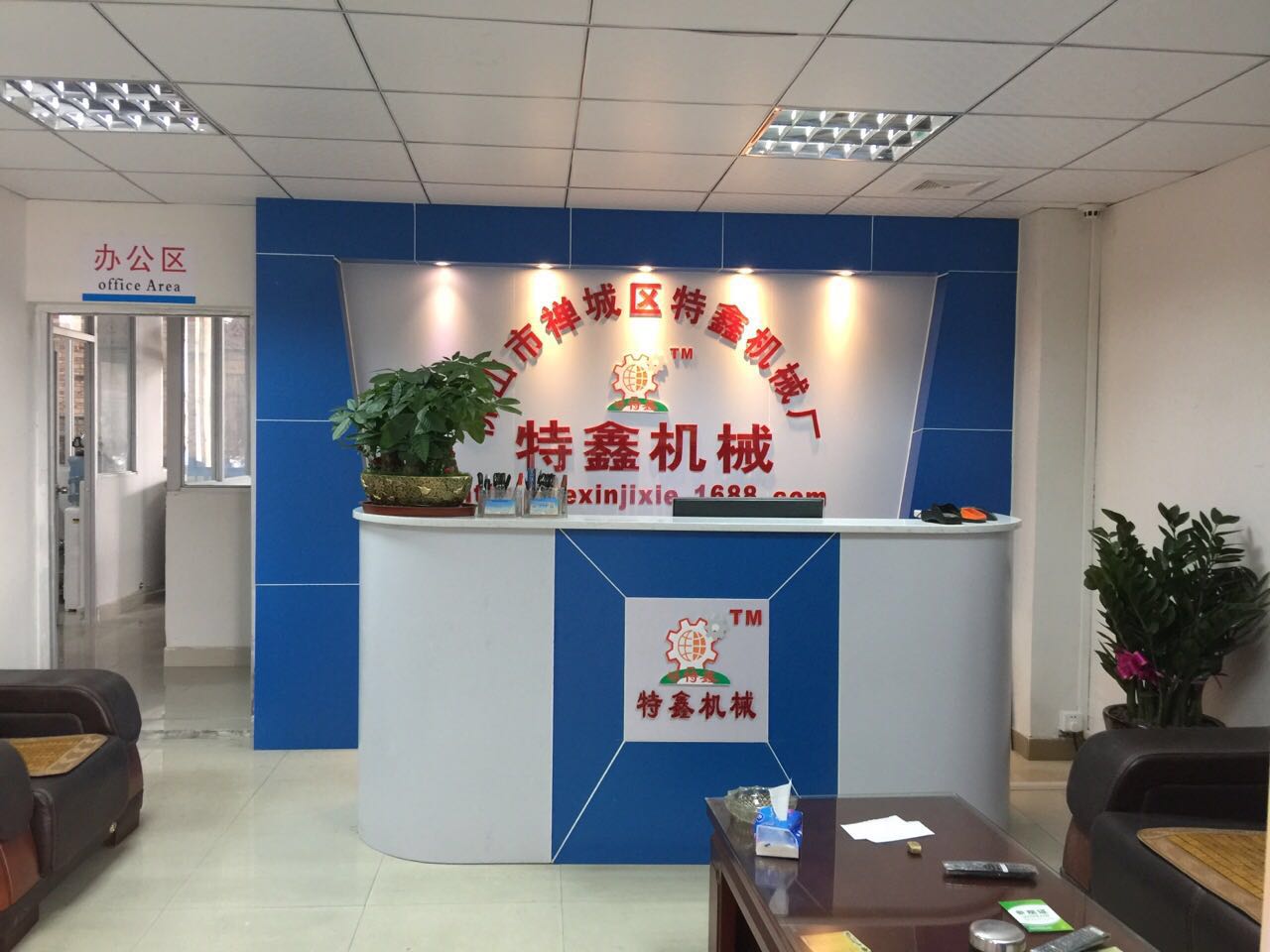
Send your finished profile drawing, target line speed, voltage, and destination port. Foshan Texin Machinery Co., Ltd. will return an EXW, FOB Guangzhou, or CIF quotation, a lead time, and a draft acceptance protocol for the specific machine — not a generic brochure.
Email: sales@texinjixie.com | Tel: +86 186-7573-3219 | WhatsApp: +86 134 1548 2815 | Web: www.gdtxjx.com
Download the Texin product catalogue (PDF) — includes the rolling shutter machine range referenced in this guide.
Have Questions or Need More Details?
Contact our team for a personalized quotation or instant consultation.
Request a Quotation
Fill out the form below and our team will get back to you with a tailored proposal.
WhatsApp Direct Chat
Prefer to chat in real-time? Message us on WhatsApp for instant assistance & quick answers.
- Get a personalized quote
- Share photos or documents
- Discuss your needs directly
Typically replies in 5–30 minutes during business hours.