
Roll-up Door Forming Machine Sourcing FAQ: Incoterms, Payment, MOQ & Inspection
Short answer: a roll-up door forming machine order from Foshan Texin Machinery Co., Ltd. runs on four fixed commercial terms. Minimum order quantity is 1 unit. Delivery is available on FOB Guangzhou, CIF or EXW. Payment is 30% T/T deposit with 70% T/T before shipment, or L/C at sight. Acceptance is based on a pre-shipment test, with third-party inspection available. Standard production lead time is 15–25 days, and custom-made equipment takes 25–45 days. The rest of this article explains how those four terms behave in a real machine order, and where buyers usually lose money by treating them as paperwork.
The Sourcing Problem: Four Terms That Decide Whether the Machine Ships
A roll-up door forming machine is a single-unit, made-to-profile capital item. The profile, the tooling and the shipping arrangement are fixed before production starts, and changing any of them afterwards costs both time and money. Yet most first-order friction between overseas buyers and Chinese forming-machine manufacturers is not about machine quality. It sits in four commercial questions that are usually asked too late.
- Who controls the goods at each handover point? A buyer who accepts a delivery term without a forwarder in China can end up owning a machine sitting at a port with no one responsible for loading it.
- How much cash leaves the buyer's account before the machine is proven? The balance trigger is the single most negotiated sentence in a forming-machine contract.
- Is one machine acceptable? Buyers entering a new door market often need a single unit to validate demand, and a supplier's MOQ policy decides whether that path is open at all.
- Where are defects discovered? A tolerance problem found in Foshan is a scheduling issue. The same problem found at the buyer's plant is a freight, customs and installation problem.
These four questions belong to the evaluation stage, but they only become real at execution. That gap is what this FAQ addresses.
Industry Background: A Concentrated Supply Base and a Growing Downstream Market
The commercial terms described in this article are not arbitrary. They reflect the structure of the cold roll forming equipment market and the door market it serves.
The global roll forming machine market was valued at USD 487 million in 2024 and is projected to reach USD 662 million by 2032, a CAGR of 4.5% according to Intel Market Research. China accounts for approximately 21% of global roll forming machine revenue, per the same source, which is why sourcing conversations for roll-up door forming equipment so often begin with a Foshan or Guangdong supplier list.
Downstream demand supports that concentration. Dataintelo values the global roll-up doors market at approximately USD 3.25 billion in 2025, projected to reach USD 5.15 billion by 2034. Every additional roll-up door produced requires forming capacity for curtains, guide channels and bottom beams, so forming-machine orders tend to follow door-market growth rather than lead it.
Market requirements also shape machine configuration, and therefore the commercial terms attached to it. Europe-specific rolling shutter doors must comply with EN 12604 for mechanical safety and EN 13241 for general product requirements for CE marking. Fire-resistant rolling steel doors in the U.S. and Europe must adhere to NFPA 80 (USA) or EN 16034 (EU), which mandate automatic-closing devices and governor-managed descent speeds. A supplier quoting a machine for a European or North American buyer is quoting against a tolerance requirement, not only a tonnage requirement — and tolerances are verified at inspection, which is why acceptance terms and technical scope cannot be negotiated separately.
The Four Commercial Pillars of a Roll-up Door Forming Machine Order
1. Delivery terms: EXW, FOB Guangzhou and CIF
Three delivery terms are offered on roll-up door forming machine orders: EXW, FOB Guangzhou and CIF. They differ mainly in where the supplier's responsibility ends.
EXW places almost everything on the buyer. The machine is made available at the supplier's premises, and the buyer arranges inland transport, export clearance, ocean freight and insurance. It suits buyers who already have a freight forwarder or trading arm operating inside China, or who are consolidating several machines from different Guangdong factories into one container.
FOB Guangzhou is the natural FOB basis for this supplier because the production site is in Foshan, Guangdong Province, within the Guangzhou port catchment. Under FOB, the supplier delivers the machine to the named port of shipment and the buyer arranges ocean freight and insurance from that point onward. Export clearance sits with the seller.
CIF shifts more logistics work to the supplier, who arranges and pays the ocean freight and insurance to the named destination port, while the buyer handles import clearance and inland delivery at destination. CIF is common where the buyer has limited freight leverage at origin, but it is not a door-to-door service and it does not remove the buyer's import obligations.
A practical rule for first-time importers: choose the term that matches the party who actually holds the freight contract. Choosing CIF to "simplify" shipping and then discovering that destination charges and inland haulage are excluded creates the same cost surprise that EXW creates for buyers with no China-side logistics presence.
2. Payment: 30% T/T deposit with 70% before shipment, or L/C at sight
Two payment structures are accepted. The first is 30% T/T deposit with 70% T/T before shipment. The second is L/C at sight.
In the T/T structure, the 30% deposit commits the order to the production schedule and funds material and roll machining. The 70% balance falls due before shipment, which means it should be released against evidence rather than against a verbal assurance: the pre-shipment test record, and where arranged, the third-party inspection report. A contract that sets the balance trigger as "before shipment" without naming the acceptance document leaves the buyer paying for an unverified machine.
L/C at sight places documentary control with the banks and is normally chosen where the buyer's treasury, import compliance or financing structure requires an instrument rather than a wire transfer. It also imposes discipline on both sides: the documents listed in the credit must match what the supplier can actually produce, including the inspection certificate if one is required.
3. MOQ: one unit
The minimum order quantity is 1 unit, and the same requirement applies to single-unit customized orders. This matters more than it appears. A roll-up door fabricator testing a new market, or a distributor adding a product line, can place a one-unit order without committing to a container of machines.
What MOQ does not remove is tooling time. A single standard unit ships in 15–25 days; a single custom unit still requires 25–45 days, because the forming roll rows, die rolls and frame configuration have to be produced for that profile. Buyers who plan a market launch should therefore treat the custom lead time, not the MOQ, as the binding constraint.
4. Inspection and acceptance: pre-shipment test plus third-party inspection
Acceptance criteria are a pre-shipment test, with third-party inspection available. In addition, 100% full inspection is performed before delivery on every unit.
Inspection should be tied to the specification sheet rather than to a general impression of build quality. The equipment uses 12–26 forming stands depending on the product, a 3.0–7.5KW servo motor, line speed of 10–25 m/min, and PLC plus encoder length control with ±1mm accuracy. Those are the numbers a pre-shipment test can actually confirm. Rolls are Cr12MoV or SKD11 die steel, quenched for wear resistance; shafts are 45# steel, quenched, tempered and precision ground — material specifications that can be checked against certificates during the same visit.
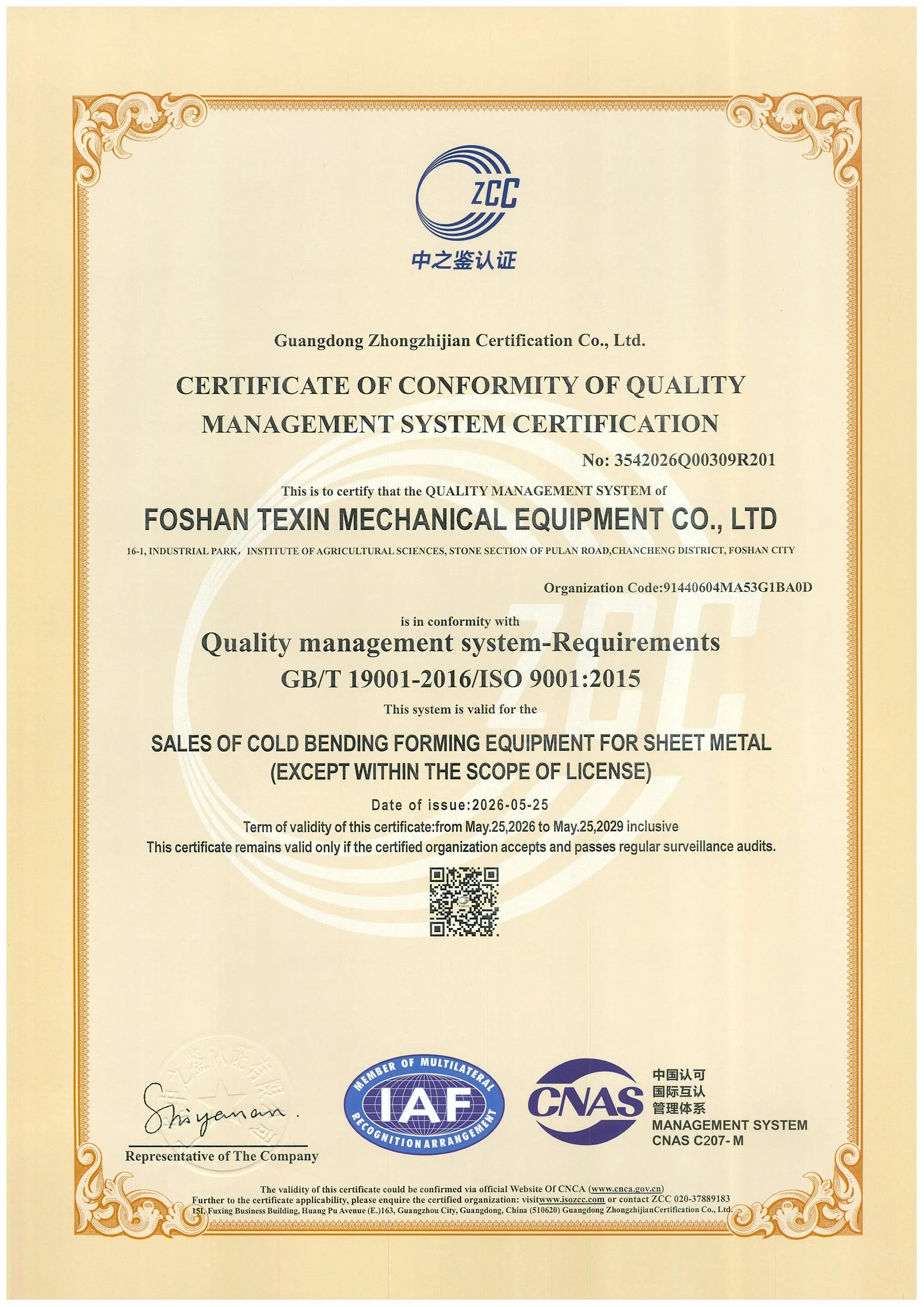
The manufacturer holds ISO 9001 certification number 3542026Q00309R201, issued by Guangdong Zhongzhijian Certification Co., Ltd. on 25 May 2026 and valid to 25 May 2029, under standard GB/T 19001-2016/ISO 9001:2015, with a scope covering the sales of cold bending forming equipment for sheet metal. The company is also CE certified and holds multiple independent technical patents for roll-forming technology. For a buyer, the useful detail is the certificate number and expiry date, because both can be verified independently before the balance payment is released.
What the Quote Should Cover Before You Compare Prices
A roll-up door production line is rarely a single machine, and most price comparisons between roll-up door forming machine suppliers are not comparing the same scope. Before evaluating the number, confirm which of the following the quotation includes.
- Curtain or slat forming machine — the core unit, configured by profile and material.
- Guide channel machine — also described as a guide rail forming machine or U-shaped rail equipment, and available in sound-absorbing guide channel versions where noise is a specification.
- Bottom beam machine — including square tube bottom beam forming configurations used in Europe-specific profiles.
- Punching unit — whether punching is integrated into the line or handled separately.
- Regional variants — Europe-specific rolling shutter door forming equipment versus Australian-style rolling shutter machines, and wind-resistant, soundproof or fire-resistant configurations.
- Layer configuration — single-layer versus double-layer rolling shutter door forming machines.
- Model class — for example 125 model or 175 model rolling shutter machines, or high-speed door forming machines, each with a different output profile.
Customization scope should be written into the same document. The manufacturer provides OEM and ODM production services for customized cold bending forming equipment and accepts customization of device specifications, forming roll rows, line speed, voltage, motor configuration, PLC system, die rolls, frame structure, brand logo and automation solutions. Standard configuration runs on 380V/3PH/50Hz, with intelligent functions covering auto-feeding, punching, cutting and fault self-diagnosis.
Step-by-Step: From Inquiry to Accepted Delivery
- Define the profile and the market requirement. Specify the door type and destination market. A Europe-specific profile carries EN 12604 and EN 13241 obligations; a fire-rated profile carries NFPA 80 or EN 16034 obligations. These determine tolerance and configuration before any commercial term is discussed.
- Request a configuration and commercial sheet together. Ask for the scope of supply, the delivery term (EXW, FOB Guangzhou or CIF), the payment structure, the MOQ and the lead time in one document. A price without the term attached is not comparable to another supplier's price.
- Confirm the customization list. Forming roll rows, line speed, voltage, motor configuration, PLC system, die rolls, frame structure, brand logo and automation solutions are all customizable. Anything not written here will be delivered as standard.
- Place the order and fix the balance trigger. Pay 30% T/T deposit, or open an L/C at sight. Write the acceptance document into the contract at the same moment: pre-shipment test record, third-party inspection report if required, and 100% full inspection before delivery.
- Track production against the stated lead time. Standard orders run 15–25 days; custom orders run 25–45 days. Monthly capacity of at least 30 units means a single-unit order and a repeat order are scheduled on the same plan, so the quoted date is a production commitment rather than a best case.
- Run the pre-shipment test and inspection. Verify profile dimensions, length accuracy through PLC and encoder control, line speed range, and punching and cutting stations. Third-party inspection can be arranged where the buyer's compliance process requires an independent report.
- Ship under the agreed term and commission on site. After-sales services include online remote guidance and on-site installation and commissioning, with a 1-year free warranty and lifelong maintenance for supplied equipment.
Comparison Tables: Delivery Terms and Order Profile
The two tables below summarise what is offered, using only the terms and figures confirmed for this supplier. They are intended as a working reference during negotiation, not as a substitute for the signed contract.
| Delivery term | Where the supplier's responsibility ends | What the buyer arranges | Typical fit |
|---|---|---|---|
| EXW | At the supplier's premises in Foshan, Guangdong | Inland transport, export clearance, ocean freight, insurance, import clearance | Buyers with an existing forwarder or trading arm in China, or consolidating multiple machines |
| FOB Guangzhou | On board at the named Guangzhou port of shipment, export cleared | Ocean freight, insurance, import clearance, inland delivery | First-time importers with a forwarder but no China-side export setup |
| CIF | Named destination port, with freight and insurance arranged and paid by the supplier | Import clearance, destination charges, inland delivery | Buyers with limited freight leverage at origin |
| Order parameter | Standard configuration | Custom / OEM-ODM configuration |
|---|---|---|
| Minimum order quantity | 1 unit | 1 unit, including single-unit customized orders |
| Production lead time | 15–25 days | 25–45 days |
| Payment | 30% T/T deposit with 70% T/T before shipment, or L/C at sight | 30% T/T deposit with 70% T/T before shipment, or L/C at sight |
| Delivery terms | EXW / FOB Guangzhou / CIF | EXW / FOB Guangzhou / CIF |
| Inspection and acceptance | Pre-shipment test, third-party inspection available, 100% full inspection before delivery | Pre-shipment test, third-party inspection available, 100% full inspection before delivery |
| Customization scope | Standard specification | Device specifications, forming roll rows, line speed, voltage, motor configuration, PLC system, die rolls, frame structure, brand logo, automation solutions |
One pattern stands out in the second table: the commercial terms do not change between a standard and a custom build, but the lead time roughly doubles. Buyers who build their launch schedule around the 15–25 day figure while ordering a customized profile are planning against the wrong column.
Use Cases: How the Terms Play Out in Practice
Case 1 — A first-time importer validating a new door market
A fabricator entering a new market typically orders one unit to prove demand before committing further. The relevant terms are a 1-unit MOQ, FOB Guangzhou with a forwarder already in place, and 30/70 T/T with the 70% released against the pre-shipment test record. The lead time to plan around is 15–25 days if the profile is standard, or 25–45 days if the local market requires a Europe-specific or otherwise custom profile.
Case 2 — An OEM brand owner selling under its own label
A brand owner needs the machine to carry its identity and its electrical standard. OEM and ODM production supports customization of brand logo, voltage, motor configuration, PLC system and frame structure. Where the order value or internal treasury rules require an instrument rather than a transfer, L/C at sight is the appropriate structure, and the credit documents should mirror the inspection requirements agreed at order stage.
Case 3 — A repeat buyer scaling production
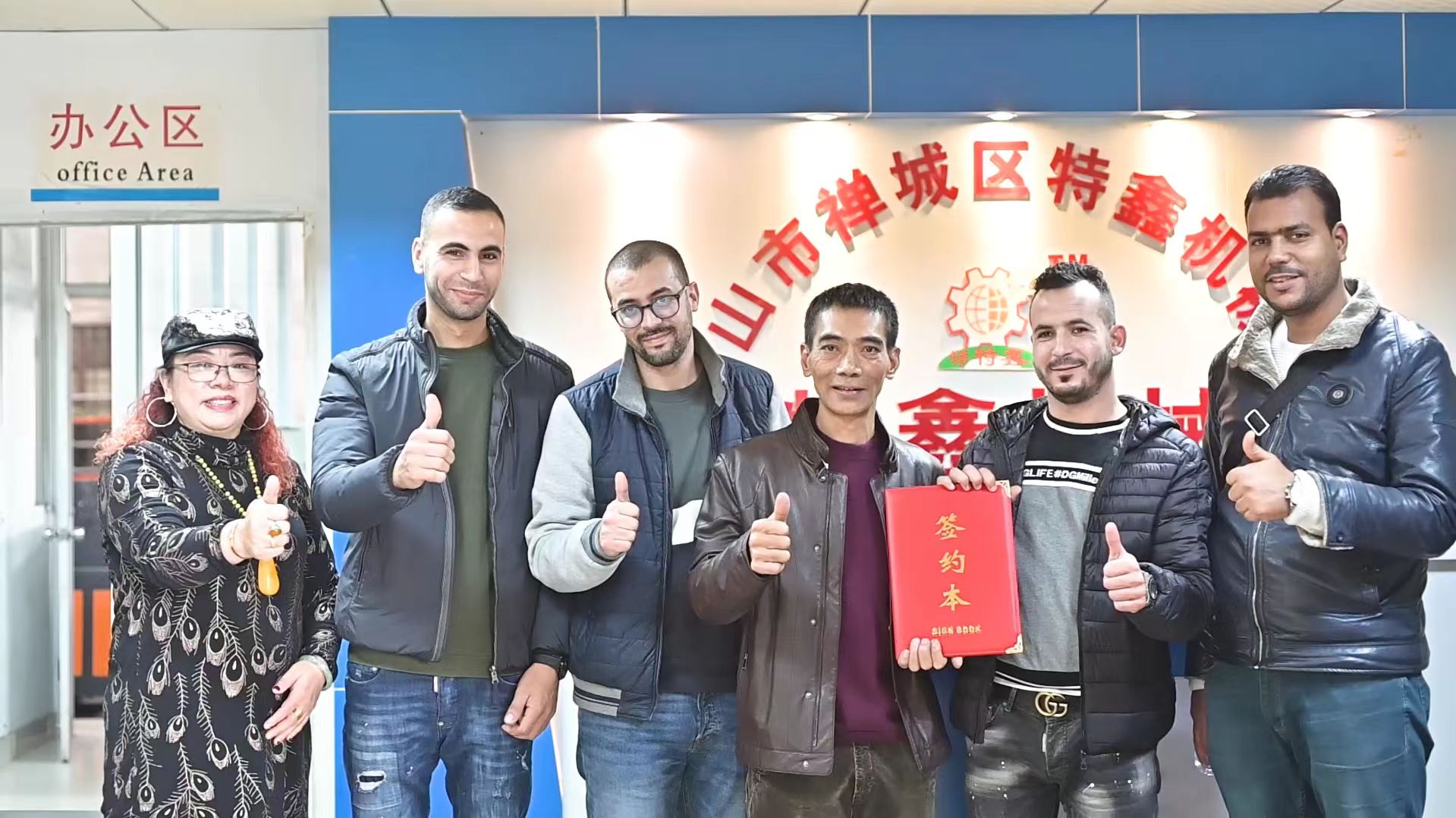
Repeat buyers care less about the first shipment and more about whether the second and third arrive on schedule. Monthly capacity of at least 30 units per month is the relevant figure here, and the manufacturer's export footprint — 45% export ratio across Southeast Asia, Middle East, Europe, South America and Africa — indicates an order flow built on repeat rather than one-off sales.
The delivery record is the other signal. For an industrial manufacturing client in Guatemala, customer feedback indicates stable order delivery performance and a maintained long-term cooperative relationship, with the product used for industrial production support. That is the pattern a repeat buyer is trying to confirm before placing a second order: not a single successful shipment, but delivery performance that holds over a multi-year relationship.
Supplier Selection Signals Beyond the Price Sheet
Commercial terms only become meaningful when the supplier behind them can meet them. Four verifiable signals are worth checking before signing.
- A certificate that can be looked up. ISO 9001 certificate 3542026Q00309R201, issued by Guangdong Zhongzhijian Certification Co., Ltd., valid 25 May 2026 to 25 May 2029, with a scope covering sales of cold bending forming equipment for sheet metal. Ask for the same number and expiry date that appears on the certificate itself.
- Capacity that matches the promised lead time. A monthly capacity of at least 30 units per month is what makes a 15–25 day standard lead time a commitment rather than an aspiration.
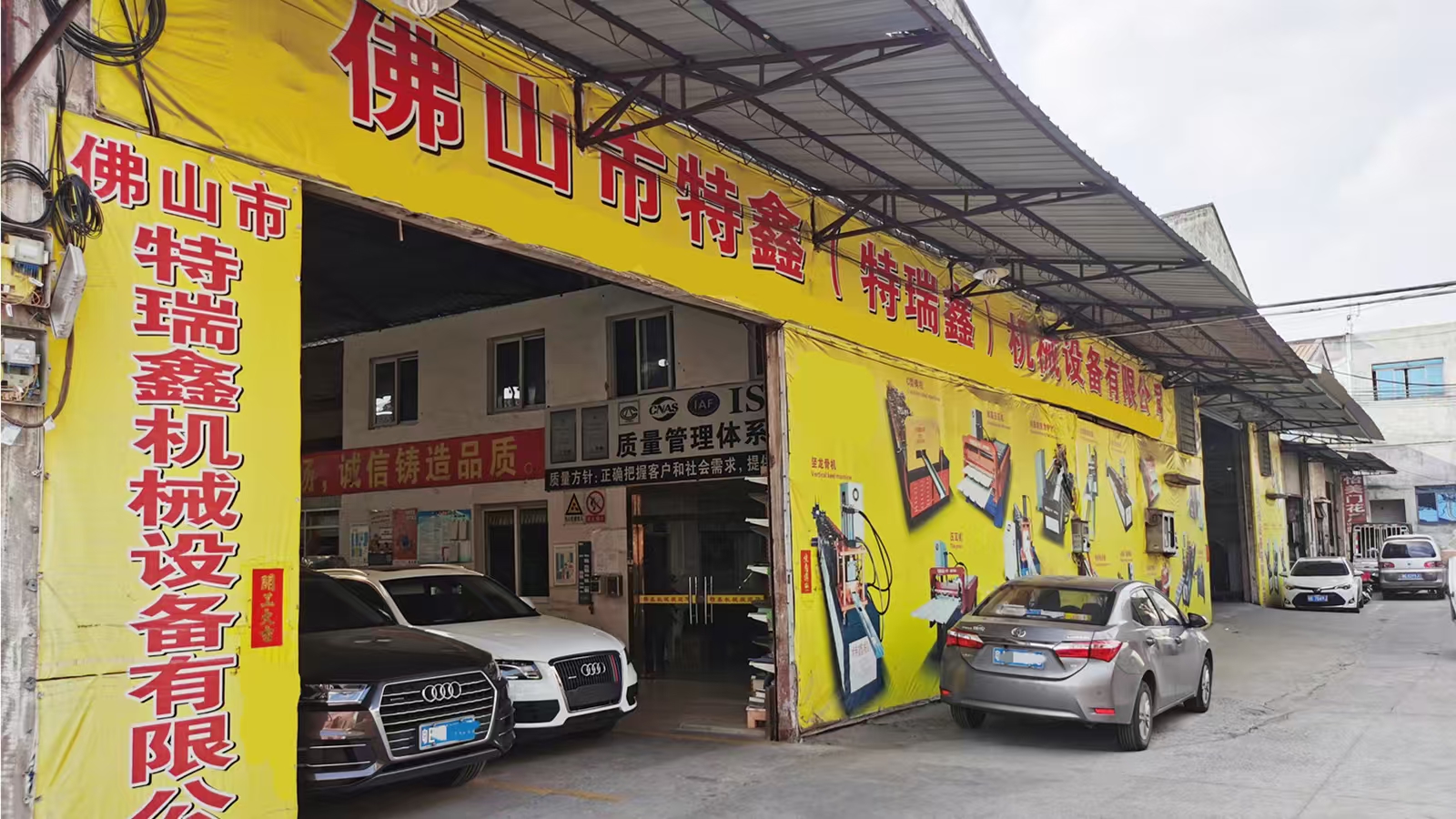
- Engineering depth behind the customization. Foshan Texin Machinery Co., Ltd. was established in 2019, operates a 5,200 ㎡ plant with 35 employees including a 10-engineer R&D team, and holds multiple independent technical patents for roll-forming technology.
- A delivery record that repeats. Feedback indicating stable order delivery performance and a maintained long-term cooperative relationship, as in the Guatemala industrial manufacturing case, is more informative than a single reference installation.
FAQ: Roll-up Door Forming Machine Sourcing
Which delivery terms are available, and how do EXW, FOB Guangzhou and CIF differ?
Three delivery terms are offered: EXW, FOB Guangzhou and CIF. Under EXW the buyer takes responsibility at the supplier's premises and arranges inland transport, export clearance, ocean freight and insurance. Under FOB Guangzhou the supplier delivers the machine to the named port of shipment in Guangzhou with export cleared, and the buyer arranges ocean freight and insurance from that point. Under CIF the supplier arranges and pays the ocean freight and insurance to the named destination port, while the buyer handles import clearance and inland delivery at destination. Because the production site is in Foshan, Guangdong Province, FOB Guangzhou is the natural FOB basis, and buyers with their own forwarder in China often choose EXW instead.
Can the machine be customized to our profile, voltage and line layout under OEM or ODM?
Yes. The manufacturer provides OEM and ODM production services for customized cold bending forming equipment and accepts customization of device specifications, forming roll rows, line speed, voltage, motor configuration, PLC system, die rolls, frame structure, brand logo and automation solutions. Standard configuration runs on 380V/3PH/50Hz, uses 12–26 forming stands depending on the product, a 3.0–7.5KW servo motor, line speed of 10–25 m/min, and PLC plus encoder length control with ±1mm accuracy. Rolls are Cr12MoV or SKD11 die steel, quenched for wear resistance, and shafts are 45# steel, quenched, tempered and precision ground. Custom builds require 25–45 days against 15–25 days for standard configurations.
What payment terms are accepted, and how much capital is committed before shipment?
Two structures are accepted: 30% T/T deposit with 70% T/T before shipment, or L/C at sight. Under the T/T structure the 30% deposit releases the order into production and the 70% balance falls due before shipment, so it should be released against the pre-shipment test record and, where arranged, the third-party inspection report. L/C at sight places documentary control with the banks and is usually chosen where the buyer's treasury or import compliance process requires a bank instrument rather than a wire transfer.
How is the machine tested and inspected before shipment?
Acceptance criteria are a pre-shipment test, with third-party inspection available, and 100% full inspection is performed before delivery on every unit. The test should be tied to the specification sheet: profile dimensions, length accuracy through PLC and encoder control, line speed range of 10–25 m/min, and the punching and cutting stations. The manufacturer holds ISO 9001 certificate 3542026Q00309R201, issued by Guangdong Zhongzhijian Certification Co., Ltd. on 25 May 2026 and valid to 25 May 2029, with a scope covering sales of cold bending forming equipment for sheet metal.
What is the MOQ and production lead time, and how does an order start?
The minimum order quantity is 1 unit, including single-unit customized orders. Standard delivery time is 15–25 days, while custom-made equipment requires 25–45 days. Monthly capacity of at least 30 units means single-unit and repeat orders are scheduled on the same production plan. To start, send the target profile and destination market, request a quotation stating the preferred delivery term among EXW, FOB Guangzhou and CIF, and confirm the payment structure and inspection requirement in the same document. Buyers ready to move from evaluation to execution can request a configuration and quotation, or download the product brochure, using the contact details below.
Conclusion: Negotiate the Terms Before the Machine
The commercial framework for a roll-up door forming machine order is short enough to state in one paragraph: 1-unit MOQ, FOB Guangzhou, CIF or EXW delivery, 30% T/T deposit with 70% before shipment or L/C at sight, and acceptance through a pre-shipment test with third-party inspection available. Standard builds take 15–25 days; custom builds take 25–45 days.
What separates a smooth order from a difficult one is not these terms themselves but the order in which they are fixed. Delivery term, payment trigger, MOQ and inspection criteria should be settled alongside the profile specification, because each one constrains the others. A buyer who locks the lead time but leaves the inspection document undefined has not finished negotiating, and a buyer who chooses CIF but has no import process at destination has simply moved the problem later.
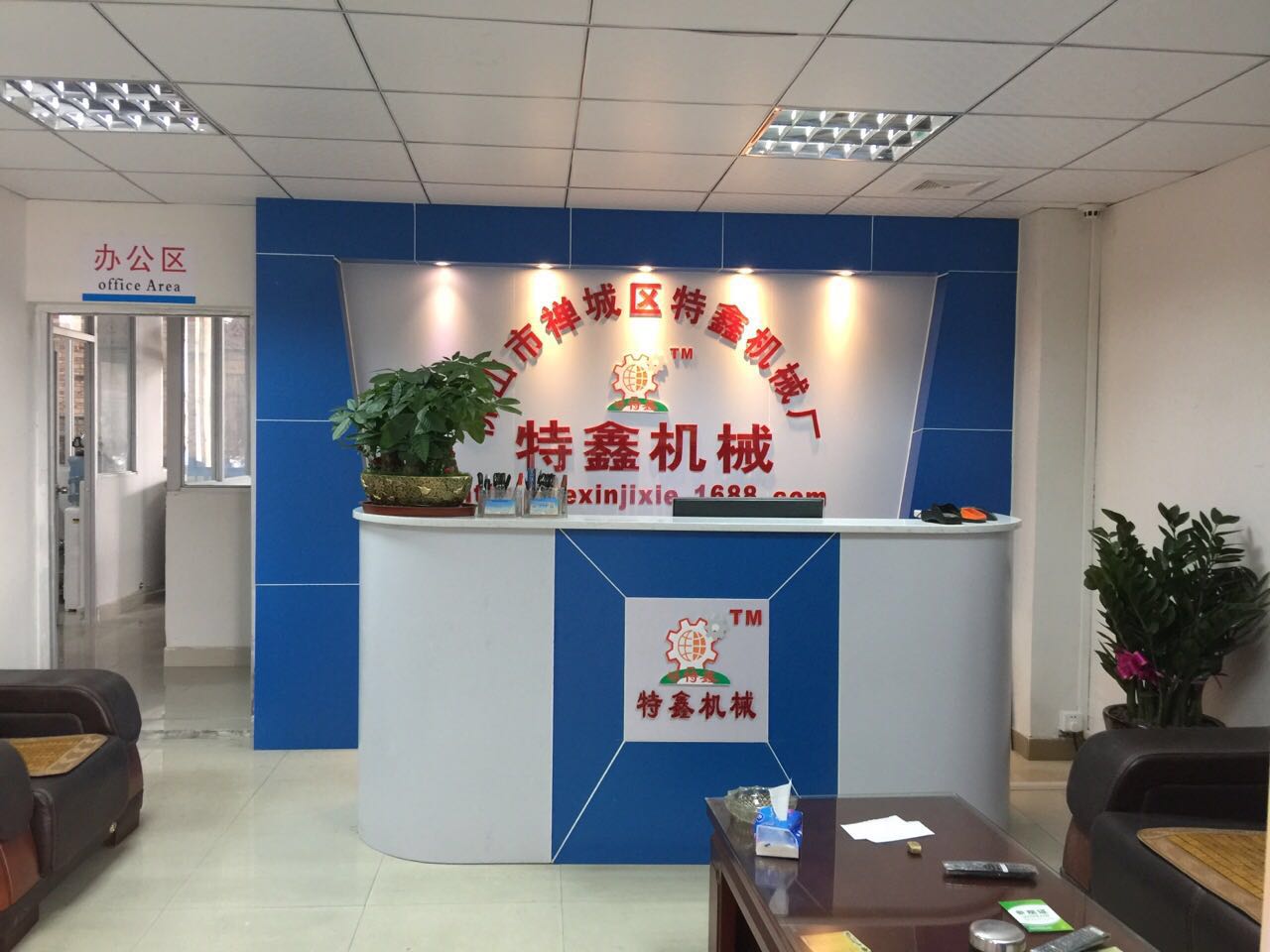
Foshan Texin Machinery Co., Ltd. is a cold roll forming equipment manufacturer established in 2019 in Foshan, Guangdong Province, China, operating a 5,200 ㎡ plant with 35 employees, a 10-engineer R&D team and a monthly capacity of at least 30 units. The company holds ISO 9001 certification 3542026Q00309R201 and CE certification, and provides OEM and ODM customization with online remote guidance, on-site installation and commissioning, a 1-year free warranty and lifelong maintenance.
Next Step: Request a Quotation or a Configuration Review
Send your target profile and destination market, and request a quotation stating the delivery term (EXW, FOB Guangzhou or CIF), the payment structure (30% T/T deposit with 70% before shipment, or L/C at sight) and the inspection requirement in one document.
Contact: Sister Luo | Tel / WhatsApp: +86 186-7573-3219 | WhatsApp: +86 134 1548 2815
Email: sales@texinjixie.com | Website: www.gdtxjx.com
Address: No.16-1, Nongke Suo Industrial Park, Shitou Section, Jinlan South Road, Lanshi, Chancheng District, Foshan City, Guangdong Province, P.R. China
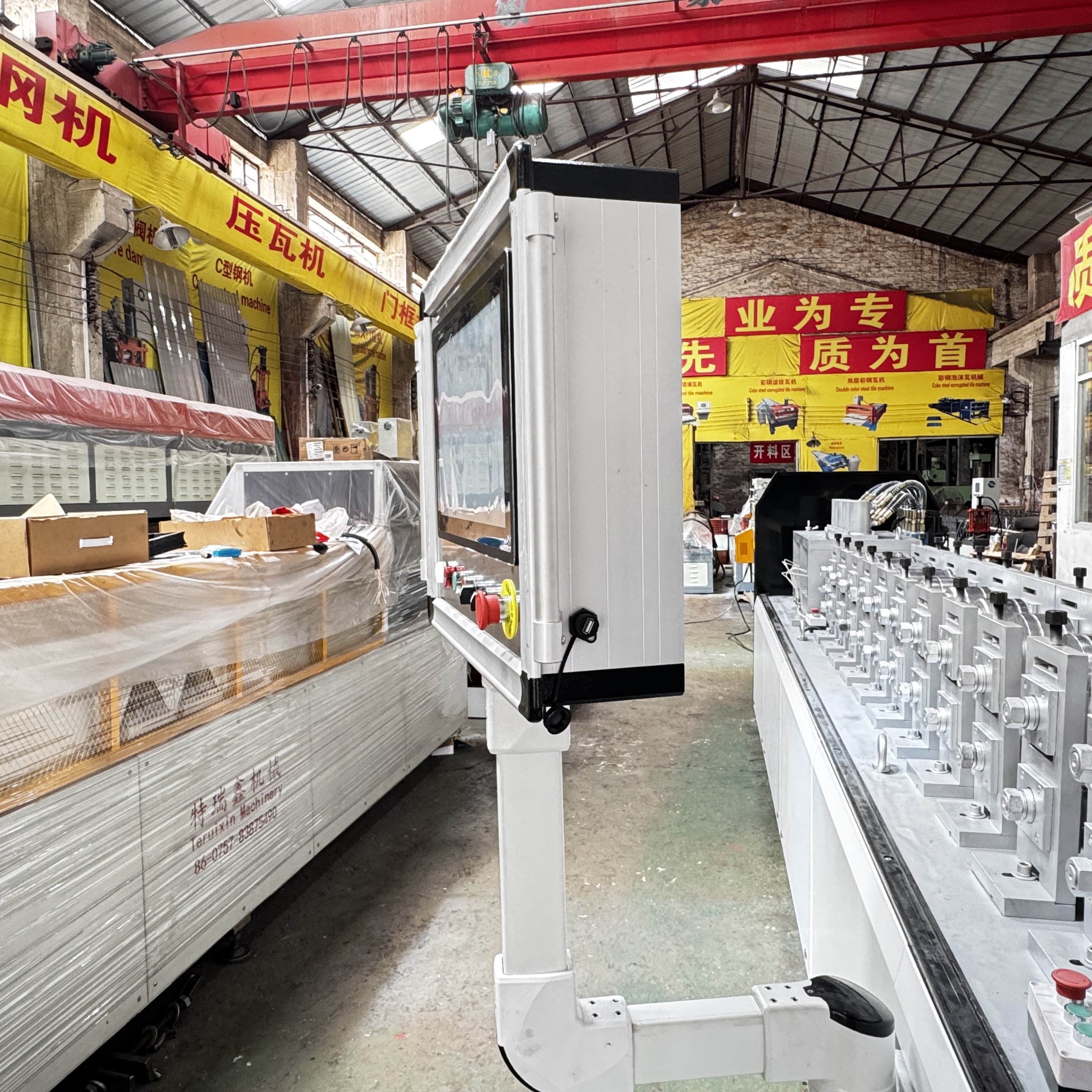
Market data cited in this article: global roll forming machine market valuation and CAGR (Intel Market Research, 2024); China share of global roll forming machine revenue (Intel Market Research, 2024); global roll-up doors market valuation (Dataintelo, 2025). Standards referenced: EN 12604, EN 13241, NFPA 80, EN 16034.
Have Questions or Need More Details?
Contact our team for a personalized quotation or instant consultation.
Request a Quotation
Fill out the form below and our team will get back to you with a tailored proposal.
WhatsApp Direct Chat
Prefer to chat in real-time? Message us on WhatsApp for instant assistance & quick answers.
- Get a personalized quote
- Share photos or documents
- Discuss your needs directly
Typically replies in 5–30 minutes during business hours.