Bird Feeder with Camera: Camera Bird Feeders Explained
A bird feeder with camera is a feeding station with a wireless camera built into the housing, so bird visits can be recorded and watched in a phone app. The category has already moved past the novelty stage: Growth Market Reports values the global smart bird-feeder camera market at USD 225 million in 2025 and projects USD 566.3 million by 2034, while integrated camera feeders accounted for 78% of 2025 market value. Buyers are increasingly choosing an all-in-one unit instead of adding a camera to a feeder they already own.
This article explains what camera bird feeders are, which specifications decide whether one performs in a real backyard, how to set one up correctly, and how storage and subscription structures differ between brands.
What Counts as a Camera Bird Feeder — and What Doesn't
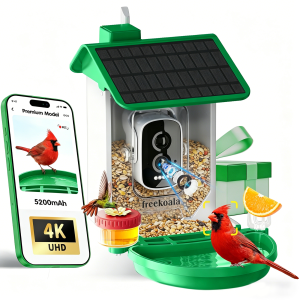
The term covers one integrated product: seed container, perch, and Wi-Fi camera inside a single sealed housing. Three related product types are frequently confused with it.
- Integrated camera feeder. Camera, feeder, and power system share one body. The lens is fixed in relation to the feeding tray, so framing stays consistent between visits.
- Camera add-on kit. A separate camera mounted on an existing feeder. Power supply, weather sealing, and lens angle all have to be solved separately.
- Birdhouse with camera. An enclosed box aimed at a cavity or nest area. It documents nesting behavior rather than open-tray feeding activity.
The distinction matters because it decides three things a buyer cannot easily change later: where the camera gets power, whether the electronics are sealed for permanent outdoor exposure, and whether the lens points at the area birds actually use.
Industry Background: Why the Category Grew So Fast
Camera bird feeders sit at the intersection of two established behaviors — backyard bird feeding and connected home cameras. Growth Market Reports notes that in 2024 approximately 20% of premium bird feeders already incorporated smart features, including cameras and AI-based bird identification, and that integrated camera models reached 78% of 2025 market value.
Commercial market estimates for this niche vary noticeably between research providers because market boundaries are drawn differently, so any single figure should be treated as directional rather than exact. What is consistent across the category is the direction of travel: buyers want fewer separate components, longer battery autonomy, and fewer recurring fees.
Regulation has kept pace with the hardware. In the European Union, smart bird feeders containing Wi-Fi, Bluetooth, or other radio modules fall under the Radio Equipment Directive (RED) 2014/53/EU, which has applied since 13 June 2016. Public product pages in this category typically list compliance marks — Birdfy lists FCC, CE, UL, and RoHS for its AI feeder, and Willfine lists CE, FCC ID, FCC SDoC, RoHS, MSDS, UN38.3, and IP66 for its BK600 model. A listed mark is not the same as an independently verified certificate, so trade buyers should request model-specific declarations and test reports rather than relying on a logo on a listing.
The Six Specifications That Decide Whether a Camera Bird Feeder Works
Most camera bird feeders look similar in photographs. The differences that matter sit in the specification sheet and in the app.
1. Camera resolution and field of view
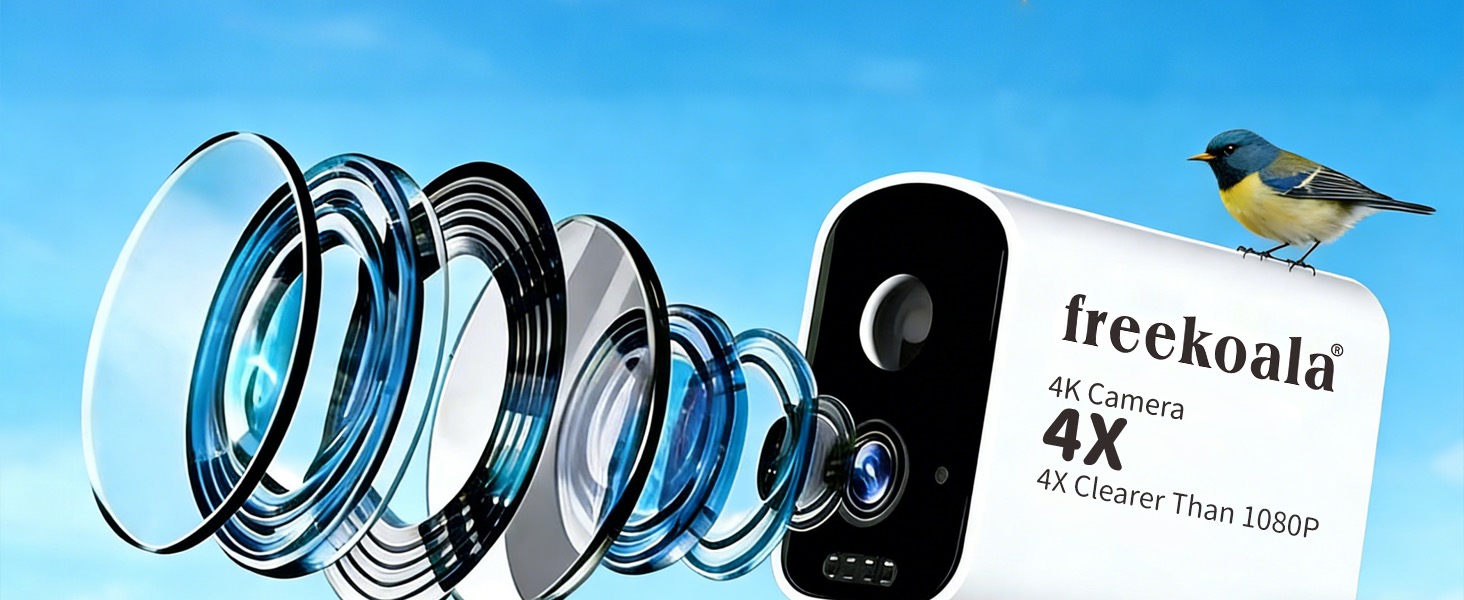
Resolution determines how much detail survives when a clip is cropped or viewed on a large screen. 4K UHD captures fine feather detail and markings; 2K is adequate for casual viewing. Field of view determines how forgiving the installation is: a 160° lens covers more of the tray and perch area, while a 135° lens requires slightly more careful aiming. FreeKoala's NU-T6SR-JC9L model uses a 160° wide-angle lens, while the 5X-CCKK-42W2 and Z4-VO5S-YQ8C models use 135°.
One practical detail is easy to miss: on FreeKoala feeders the default recording resolution is SD to conserve storage, so 4K UHD must be selected in the app when maximum detail is wanted.
2. Power: solar plus battery, not solar alone
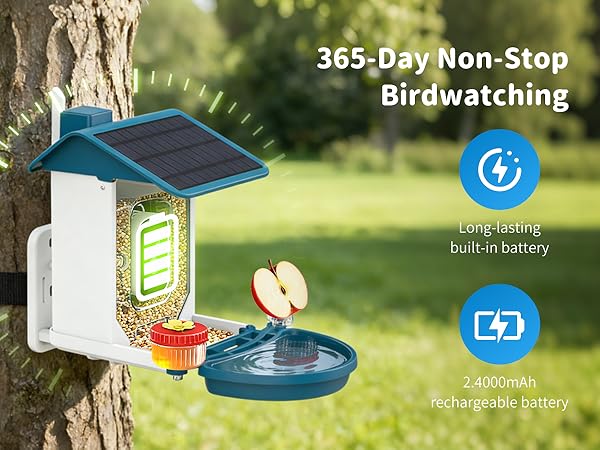
A wildlife camera spends most of its energy on detection, Wi-Fi, and processing rather than on the sensor itself. FreeKoala combines a 3W solar panel with a 5200mAh rechargeable battery, with USB-C as a backup charging route when sunlight is insufficient. Battery runtime depends on bird activity, recording frequency, live-view usage, Wi-Fi signal strength, temperature, and available sunlight, so a mAh rating alone does not guarantee a fixed number of days of operation.
3. Weather sealing and operating range
IP66 means the housing is dust-tight and protected against powerful water jets. In practical use that covers rain, snow, dust, and normal bird splashing. It does not mean the camera can be submerged, and the unit should not be cleaned with a pressure washer. FreeKoala lists an operating range of -4°F to 122°F (-20°C to 50°C) with IP66 protection, which covers most North American and European backyard conditions.
4. Connectivity: 2.4GHz, not 5GHz
Feeder cameras in this category, including FreeKoala, connect over 2.4GHz Wi-Fi only. That is a range decision rather than a speed limitation: 2.4GHz travels further and penetrates exterior walls better than 5GHz, which matters when the feeder sits at the far end of a yard. Phones, laptops, and televisions can remain on 5GHz. Mesh systems such as eero or Google Nest WiFi work as long as 2.4GHz coverage reaches the mounting location.
5. Storage and subscription structure
Storage is where total cost of ownership diverges most. FreeKoala supports a microSD card up to 256GB for local recording with no monthly storage fee; the card is not included. Optional cloud storage and premium AI identification are available during a trial and require a subscription to continue afterwards, while basic alerts and camera functions remain usable without a subscription. Video continues recording to the local card if Wi-Fi drops and syncs to the phone once the connection returns — live view and push notifications still require the network. The app is ad-free.
6. AI identification and event-based recording
AI identification compares captured images against a trained model and returns a likely species name. FreeKoala's premium AI service is designed to identify more than 11,000 bird species, and the device filters false triggers such as moving branches. Recording is event-based rather than continuous, which conserves battery and storage — the camera is not recording 24/7. AI identification should be treated as an aid rather than a guaranteed result: low light, motion blur, backlighting, distance, and partial obstruction all reduce accuracy.
Privacy also belongs on the specification list. FreeKoala's camera is aimed at the feeding tray rather than the surrounding property, and local microSD storage keeps recordings on the device. During installation, aim the feeder away from neighbouring windows and private areas.
The FreeKoala Bird Feeder with Camera Range
FreeKoala is the smart-device brand of Shenzhen Yangyangda Innovation Technology Co., Ltd., a manufacturer established in 2025 that specializes in bird feeders with cameras and exports the majority of its output. Bird feeders with cameras are the company's main product line.
| Model | Camera | Field of view | Battery | Seed capacity | Waterproof | Wi-Fi |
|---|---|---|---|---|---|---|
| NU-T6SR-JC9L | 4K | 160° | 5200mAh | 1.5L | IP66 | 2.4GHz |
| 5X-CCKK-42W2 | 4K | 135° | 5200mAh | 1.5L | IP66 | 2.4GHz |
| Z4-VO5S-YQ8C | 4K | 135° | 4000mAh | 1.5L | IP66 | 2.4GHz |
All three models share 256GB card and cloud storage support, ABS housing, and an operating range of -4°F to 122°F. All include a 1-year warranty.
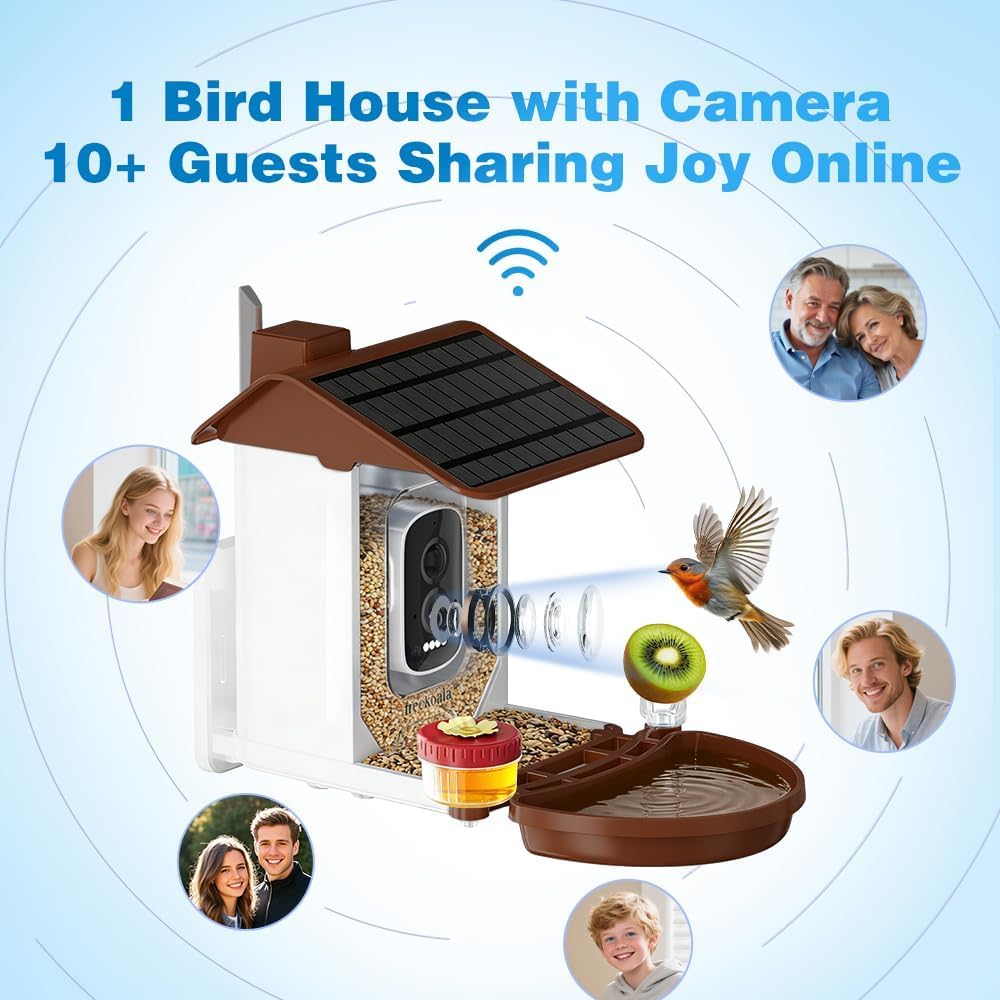
The shared hardware platform uses a 3-in-1 design: seed feeder, bird bath, and a dedicated hummingbird feeding port. The 1.5L dual-compartment seed container reduces refill frequency and allows two compatible seed types to be offered at the same time. Parts use a modular snap-on design so the feeder can be disassembled for cleaning without tools.
Setting Up a Camera Bird Feeder: Step by Step
- Charge first, mount second. Charge the camera fully by USB-C before mounting it outdoors.
- Install the app and pair indoors. Setup requires a smartphone. Keep the feeder close to the router during pairing and confirm the phone is on a 2.4GHz network.
- Enter the Wi-Fi password carefully. Most pairing failures trace back to a 5GHz connection, an incorrect password, or a router that combines both bands under a single network name.
- Insert a microSD card if local recording is wanted. Cards up to 256GB are supported and are sold separately.
- Mount 5–6 feet above ground. A tree, wall, fence, or support pole all work; the matched accessory in the application data is a Smart Bird Feeder Mounting Pole. Confirm that any pole is vertical and firmly secured.
- Aim away from glare and keep squirrel routes clear. North- or east-facing placement reduces harsh afternoon backlight. Keep the feeder away from branches, fences, roofs, and railings that squirrels can use as jump-off points.
- Confirm live view and enable alerts. Check notification permissions on the phone as well as inside the app; some Android battery-saving settings delay background notifications.
- Update firmware when prompted. Updates are installed through the app. Do not power off, reset, or interrupt Wi-Fi while firmware is updating.
Where Camera Bird Feeders Fit in Real Yards
Backyard tree or pole installation
The most common setup. The 1.5L dual hopper reduces refills, the solar panel handles most charging, and the wide-angle lens keeps moving birds in frame without precise aiming.
Balconies and small outdoor spaces
Balcony installations work when the feeder can be mounted securely, receives a stable 2.4GHz signal, and the lens is not aimed at reflective glass. Close-range viewing favors a wide-angle 4K camera. Check building rules on wildlife feeding and consider where seed debris will fall.
Households with several viewers
The live stream can be shared with up to 20 family members through the app's device-sharing function, so relatives in different locations can watch the same feeder from their own phones.
Mixed feeding: seed, hummingbirds, and water
The 3-in-1 design adds a hummingbird port and a bird bath to the seed feeder. Black-oil sunflower seed is a practical all-purpose starting choice, and the dual hopper allows a second compatible seed such as safflower to be offered at the same time.
Year-round, all-weather operation
With IP66 sealing and a -4°F to 122°F operating range, the system is built for continuous outdoor deployment. During extended cloudy periods the battery can be topped up by USB-C.
Comparison: Storage, AI, and Subscription Models
The clearest way to compare camera bird feeders is not by camera resolution — most current models list 4K — but by how each brand handles storage, AI identification, and recurring fees. The table below summarizes what each brand states publicly about its own products.
| Brand | Local storage | AI identification (as stated) | Feeder hardware | Recurring cost model |
|---|---|---|---|---|
| FreeKoala | microSD up to 256GB, card not included; recordings continue locally if Wi-Fi drops and sync after reconnection | Premium AI designed for more than 11,000 species; basic arrival alerts available separately | 4K camera, 1.5L dual hopper, bird bath, hummingbird port, 3W solar panel, 5200mAh battery | No subscription required for basic use and local recording; premium AI and cloud services continue after the trial only if subscribed |
| Birdfy | Brand states most current models use cloud storage rather than microSD | Free membership includes limited daily AI recognition; paid plans add unlimited AI | AI smart feeder product line; brand lists FCC, CE, UL, and RoHS marks | Cloud-dependent model with paid tiers for expanded AI and longer storage |
| Birdbuddy | Brand states its feeders do not have local storage and require internet connectivity | AI identification offered as part of its connected service | Connected smart feeder system | Requires internet connectivity; service-based |
Summary based on each brand's public product information. Specifications, service tiers, and terms are set by each brand and can change; confirm current details before purchasing or reselling.
Five Mistakes Buyers Make with Camera Bird Feeders
- Assuming 4K is always on. FreeKoala's default recording resolution is SD, and UHD must be selected manually in the app.
- Expecting 5GHz support. The devices are 2.4GHz-only by design, and pairing fails on a 5GHz-only network.
- Expecting continuous 24/7 recording. Recording is triggered by detected activity, which protects battery life and storage.
- Mounting next to branches or fences. Squirrels use them as jump-off points, which also produces excessive alerts. A pole-mounted setup with a baffle is a more robust physical barrier.
- Expecting birds on day one. Birds often need several days or longer to discover and trust a new feeder. Keep the location consistent, use fresh seed suited to local species, and consider adding a clean water source nearby.
Frequently Asked Questions
Do camera bird feeders need certifications to be sold legally?
In the European Union, smart bird feeders containing Wi-Fi, Bluetooth, or other radio modules fall under the Radio Equipment Directive (RED) 2014/53/EU, which has applied since 13 June 2016. Manufacturers commonly also list FCC, CE, and RoHS marks, and for lithium-battery products, transport documentation such as UN38.3 and MSDS — as Willfine lists for its BK600 4K model. A logo on a product page is a claim rather than proof of conformity, so trade buyers should request the model-specific declaration of conformity, test reports, and battery transport documents before placing an order.
Who are China bird feeder with camera manufacturers?
FreeKoala is the smart-device brand of Shenzhen Yangyangda Innovation Technology Co., Ltd., a manufacturer established in 2025 in Shenzhen, China, with a 5,109 m² manufacturing facility, 140 employees, and an R&D team of 100 engineers. The company specializes in manufacturing bird feeders with cameras, reports an annual production capacity of 2,400,000 units, serves over 500 business partners worldwide, and exports to more than 50 countries. Export business accounts for 90% of total sales, with the USA as a major market. Its products are available through major retail chains and e-commerce platforms.
Do I need a subscription to use a bird feeder with camera?
No for basic use. FreeKoala requires no subscription for basic camera functions, bird arrival alerts, or local microSD recording up to 256GB — the card is not included. Premium AI identification and cloud storage are available during a trial period, and a subscription is needed only if the user chooses to continue those services afterwards. The app is ad-free.
Will a camera bird feeder connect to my home Wi-Fi?
It connects over 2.4GHz Wi-Fi only and does not support 5GHz-only networks. That band is used because it provides longer range and better wall penetration, which suits an outdoor feeder positioned away from the router. Mesh systems such as eero or Google Nest WiFi work if 2.4GHz is available at the feeder location, and pairing is easiest close to a mesh node. If pairing fails, verify the password and check whether the router combines both bands under one network name.
How much maintenance does a camera bird feeder need?
Clean the feeding surfaces about every two weeks, and more often in wet, hot, or heavily used conditions; remove wet or spoiled seed immediately. Removable parts snap off without tools, wash in warm water with mild soap, and must dry completely before refilling. Wipe the camera lens separately with a soft microfiber cloth and never immerse the camera or charging electronics in water. Check that the solar panel stays clear of leaves and snow, and confirm that water can drain from the feeder after heavy weather. If you would like to evaluate a unit before committing to a larger order, FreeKoala accepts sample and quotation requests through www.myfreekoala.com.
Conclusion
A camera bird feeder is worth buying when the hardware answers five questions honestly: what the camera records, how it stays powered, how it survives weather, how video is stored, and what it costs to keep running. FreeKoala addresses those questions with a 4K camera, 160° or 135° wide-angle lenses, a 3W solar panel paired with a 5200mAh battery, IP66 sealing across a -4°F to 122°F operating range, 2.4GHz Wi-Fi, microSD recording up to 256GB without a mandatory subscription, and a 3-in-1 feeder, bird bath, and hummingbird port in a single ABS housing.
The manufacturing side matters just as much for buyers sourcing at volume. Shenzhen Yangyangda Innovation Technology Co., Ltd. was established in 2025, operates a 5,109 m² manufacturing facility with 140 employees and 100 engineers, reports annual production capacity of 2,400,000 units, and exports to more than 50 countries with 90% of sales going to export markets and the USA as a leading destination.
Next Step: Sample, Quote, or Catalog
FreeKoala bird feeders with cameras are manufactured by Shenzhen Yangyangda Innovation Technology Co., Ltd. For product samples, wholesale pricing, OEM or ODM discussions, or the full specification sheet, contact the team directly.
Website: www.myfreekoala.com · Email: freekoala2@hotmail.com · WhatsApp: +86 181-5470-8862
Corporate brochure (PDF): Download the FreeKoala corporate brochure
Have Questions or Need More Details?
Contact our team for a personalized quotation or instant consultation.
Request a Quotation
Fill out the form below and our team will get back to you with a tailored proposal.
WhatsApp Direct Chat
Prefer to chat in real-time? Message us on WhatsApp for instant assistance & quick answers.
- Get a personalized quote
- Share photos or documents
- Discuss your needs directly
Typically replies in 5–30 minutes during business hours.