Bird Feeder with Camera Compliance: What Buyers Must Verify
A bird feeder with camera sold into the United States has to clear a defined set of constraints before it is commercially saleable: a model-scoped FCC authorization covering its 2.4 GHz radio, a documented ingress-protection rating, a stated operating temperature window, a power architecture the end user will actually live with, and a storage or subscription model that does not surprise the buyer. FreeKoala's outdoor Smart Bird Feeder with Camera, model NU-T6SR-JC9L, is authorized under FCC ID 2ATUJ-TV-XM-Q20-4MP for its 2.4 GHz Wi-Fi digital transmission system — a concrete example of what “compliant” looks like on a certificate rather than in a product title.
This page is written for importers, distributors, brand owners and OEM buyers who are researching Chinese bird feeder with camera suppliers for outdoor models, and who need to separate constraint-bearing specifications from marketing specification language. It sets out what the constraint set is, where the category stands in 2026, how FreeKoala builds to those constraints, and the verification sequence to run before a bulk order is placed.
Problem Definition: Why Camera Bird Feeder Specifications Are Hard to Compare
The reason two products both described as a “4K bird feeder camera” can behave very differently in the field is that most comparison pages compare words, not values. Six recurring gaps account for most sourcing mistakes in this category.
- Resolution defaults are not the same as resolution ceilings. A camera bird feeder may list 4K UHD while shipping with SD as the default capture mode to conserve storage; UHD then has to be selected manually in the app. A buyer who reads only the title assumes 4K is the out-of-box setting.
- Ingress-protection ratings are not interchangeable. IP66 and IP65 describe different jet-water test conditions, and neither rating means the unit can be submerged or cleaned with a pressure washer. Ratings also have to be matched to the exact product configuration.
- “Wireless outdoor” does not mean network-free. A bird feeder camera wireless outdoor unit still needs a supported Wi-Fi band, and in this category that band is 2.4 GHz — not 5 GHz — because of range and wall penetration outdoors.
- Certification marks are not certificates. A logo on a listing page carries no model scope, no issuing body, no standard list and no identifier. A certificate does.
- Battery capacity is not runtime. mAh describes stored charge, not days of operation. Runtime depends on bird activity, recording frequency, live-view use, Wi-Fi signal strength, temperature and available sunlight.
- “No subscription” needs to be stated function by function. Local recording and cloud or AI services are usually governed by different rules.
None of these are exotic technical problems. They are documentation problems, and the fix is to convert each one into a constraint with a value, a responsible party and an evidence document that can be checked against the model being ordered.
Industry Background: Where Smart Bird Feeders Sit in 2026
Growth Market Reports estimates the global smart bird-feeder camera market at USD 225 million in 2025, projected to reach USD 566.3 million by 2034. Within that value, integrated smart feeder cameras are reported to account for 78% of 2025 market value — evidence that buyers are consolidating on all-in-one units rather than adding camera kits to conventional feeders. A separate estimate places smart-feature penetration in the premium bird feeder segment at approximately 20% in 2024, covering cameras and AI-based bird identification.
How to read these figures. The figures above come from commercial research providers, and different providers define the category differently — some count camera-ready housings, others count only integrated cameras. Treat them as directional context for category growth, not as a procurement baseline. For a purchasing decision, the number that matters is the one printed on your own supplier's certificate and specification sheet.
On the regulatory side, the picture is clearer. In the European Union, smart feeders that contain Wi-Fi, Bluetooth or other radio modules fall under the Radio Equipment Directive (RED) 2014/53/EU. For the United States market, radio-frequency devices are authorized under FCC rules, and for this product family the relevant authorization covers a digital transmission system operating on 2.4 GHz Wi-Fi.
Manufacturing is the third structural feature of this category. Camera-equipped feeders are predominantly produced by contract manufacturers and OEM suppliers, which means the practical differentiator between suppliers is rarely “can they build a feeder with a camera”. It is whether they can hold specification values across production lots and hand over model-scoped documentation that clears customs and retail compliance review.
Detailed Solution: The Constraint Set FreeKoala Designs To
FreeKoala is the consumer brand of Shenzhen Yangyangda Innovation Technology Co., Ltd., a Shenzhen-based manufacturer of smart monitoring devices whose main product is the bird feeder with camera. The constraint set below is the one the company documents for its outdoor models, and it is the set a buyer should use as a questionnaire when evaluating alternative suppliers.
1. Certification and Market-Access Constraints
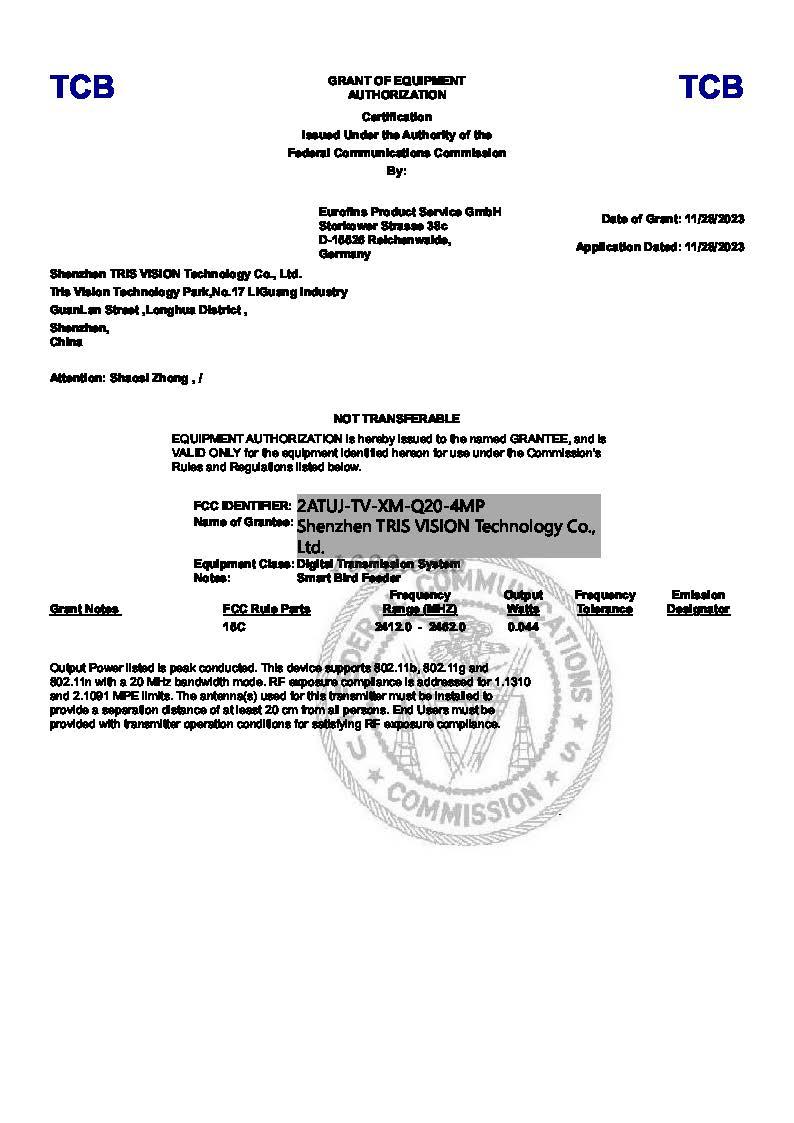
The Smart Bird Feeder with Camera, model NU-T6SR-JC9L, is certified to FCC Part 15C standards for the US market. The authorization is recorded as FCC ID 2ATUJ-TV-XM-Q20-4MP, issued by Eurofins Product Service GmbH on 28 November 2023, with no expiration date. The applicable standards are FCC Part 15C; FCC §15.247; FCC §1.1310; and FCC §2.1091, and the certified scope is a Digital Transmission System operating on 2.4 GHz Wi-Fi.
That level of detail is what makes a certificate usable. A buyer can take the FCC ID, the grantee, the issuing laboratory, the standard list and the covered model number and check them against the exact SKU being quoted. A certification mark alone cannot be checked against anything.
2. Connectivity Constraints: 2.4 GHz Only, and Why That Matters Outdoors
FreeKoala camera feeders connect over 2.4 GHz Wi-Fi and do not support a 5 GHz-only connection. This is a deliberate outdoor decision rather than a cost shortcut: 2.4 GHz generally delivers longer range and better wall penetration than 5 GHz, which matters when the feeder sits in a yard, on a fence line or on a balcony some distance from the router. The household's phones, televisions and computers can continue to use 5 GHz normally.
For buyers, the constraint surfaces during onboarding. Mesh-network homes are supported as long as 2.4 GHz coverage reaches the installation point, and steps such as pairing close to a mesh node, checking the Wi-Fi password and using an available IoT setup mode reduce first-time connection failures. Support volume in this category is driven far more by network assumptions than by hardware faults.
3. Environmental Constraints: IP66 and the Operating Temperature Window
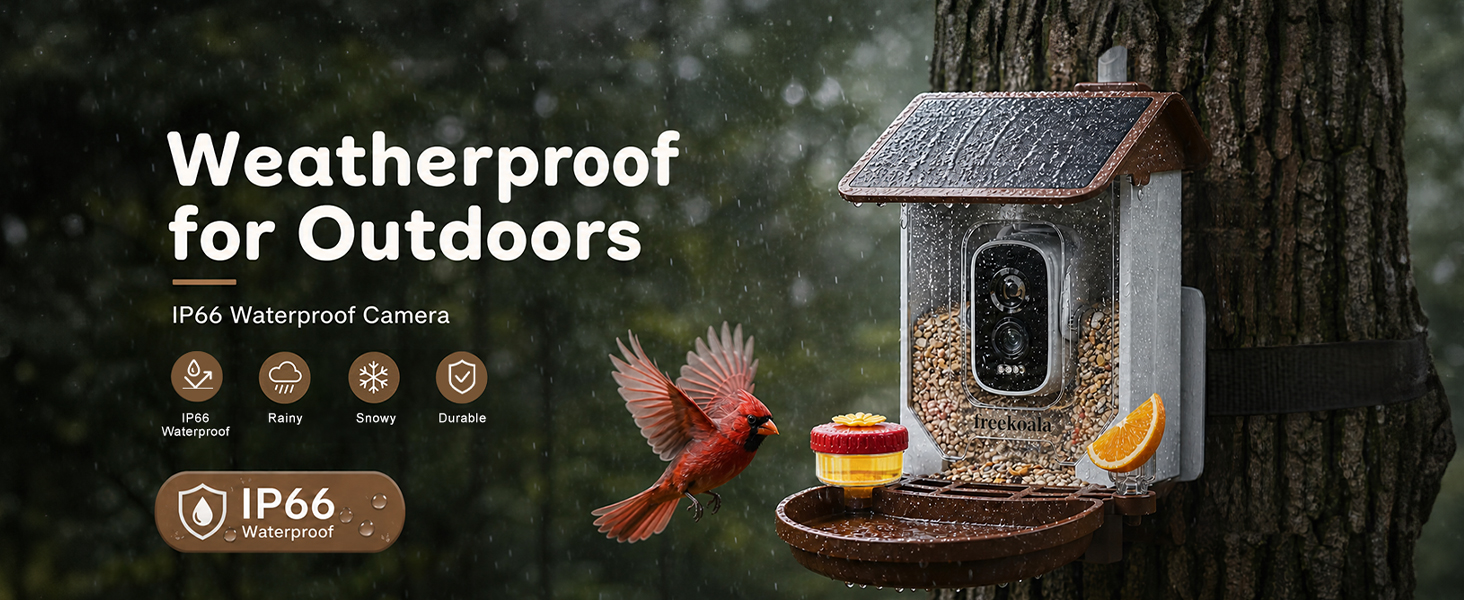
FreeKoala outdoor models carry an IP66 rating, which means a dust-tight housing protected against powerful water jets. In practice the feeder is built for rain, snow, dust and normal bird splashing. It is not designed to be submerged and should not be cleaned with a pressure washer, and the camera and charging electronics should never be immersed.
The documented operating temperature range is -4°F to 122°F, which covers the seasonal spread of most North American and European outdoor installations. The housing material is ABS. Together, the rating and the temperature window define the deployment envelope: an installation plan that keeps the unit outside both boundaries is a warranty risk, not a product fault.
4. Power Constraints: Battery Capacity, Solar Input and USB-C Fallback
The FCC-certified NU-T6SR-JC9L configuration pairs a 5200 mAh rechargeable battery with a 3 W solar panel. The solar panel replenishes the battery during daylight and reduces how often the unit has to come down for charging; USB-C remains the backup path when sunlight is insufficient, which is the realistic scenario in extended cloudy periods or in shaded installations.
The honest framing of this constraint is that battery capacity does not equal runtime. Actual endurance is a function of bird activity, recording frequency, live-view usage, Wi-Fi signal strength, temperature and the amount of direct sunlight reaching the panel. A buyer comparing suppliers on mAh alone is comparing stored charge, not operating behaviour.
5. Storage and Subscription Constraints
Storage is where total cost of ownership is actually decided. FreeKoala supports local microSD recording up to 256 GB, and the card is not included with the unit. Local recording does not require a monthly cloud-storage fee, and basic bird arrival alerts do not require a subscription. Premium AI bird identification, which is designed to recognise more than 11,000 species of wild birds, and cloud storage are offered on a trial basis — the product listing describes a one-month cloud-storage trial and a 30-day premium AI trial — and require a subscription if the buyer chooses to continue them after the trial.
Two further details matter operationally. First, the camera records audio when motion or bird activity is detected rather than continuously, and audio capture can be switched off in settings. Second, recordings continue to the local microSD card when the Wi-Fi connection drops and sync to the phone after the connection is restored; Wi-Fi is still required for remote live view and real-time notifications.
6. Capacity, Optics and Mounting Constraints
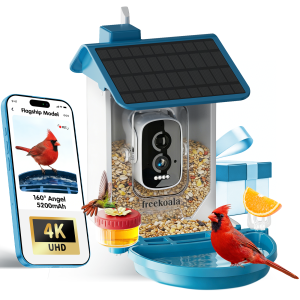
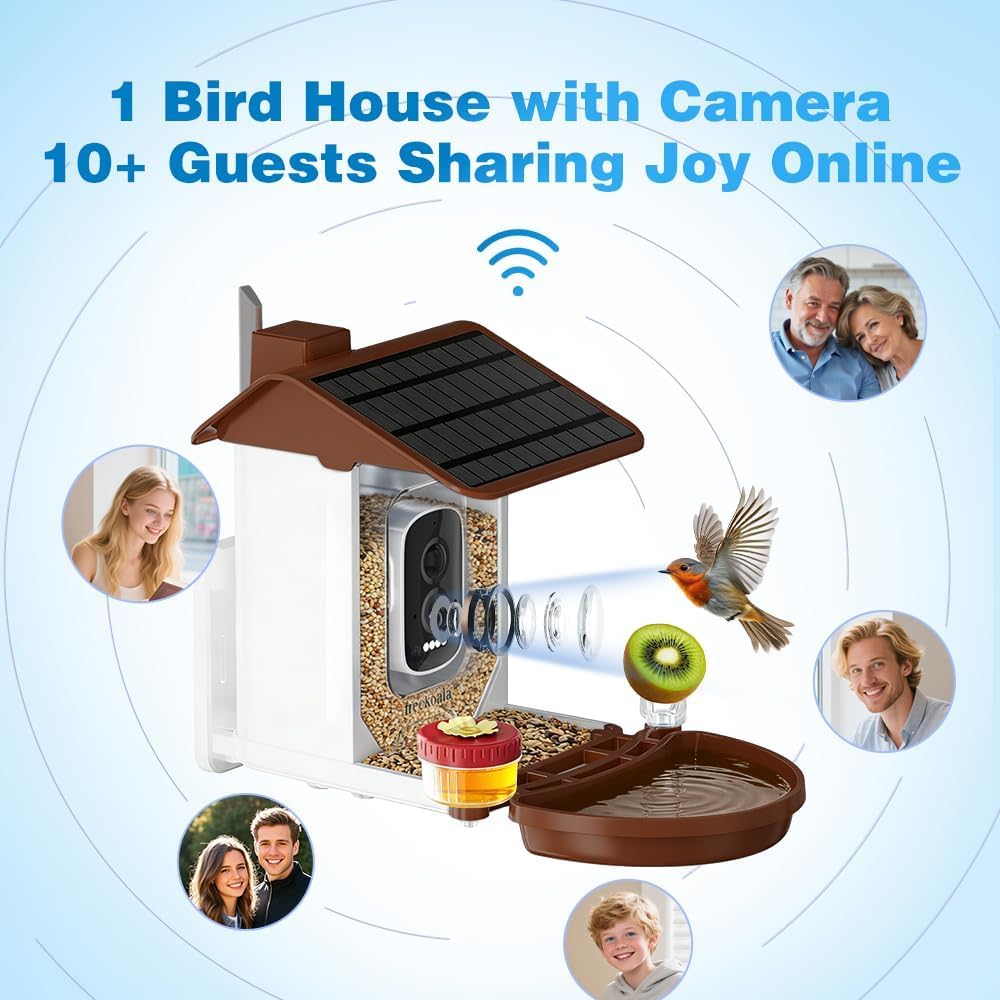
The feeder uses a 1.5 L dual-compartment seed container, which reduces refill frequency, and a 3-in-1 layout that combines the seed feeder with a bird bath and a hummingbird feeding port. The modular snap-on design allows tool-free disassembly for cleaning. Electronically, the camera is 4K with night vision, the default capture resolution is SD with UHD selectable in the app, and the live stream can be shared with up to 20 family members. Wide-angle coverage is 160° on the NU-T6SR-JC9L configuration and 135° on the 5X-CCKK-42W2 and Z4-VO5S-YQ8C configurations.
Mounting is supported on trees, walls, fences and support poles. A practical installation height is roughly 5–6 feet above ground, aimed away from strong direct afternoon sunlight, kept clear of branches and other squirrel launch points, and positioned where a stable 2.4 GHz signal can be confirmed before final tightening. A 1-year warranty is included.
7. Manufacturing and Supply Constraints in Numbers
Shenzhen Yangyangda Innovation Technology Co., Ltd., the company behind a manufacturer background in smart monitoring devices under the FreeKoala brand, operates with 140 employees, a dedicated R&D team of 100 engineers, an annual output of 2,400,000 units and an export ratio of 90%, with the United States as its main market. The company website is www.myfreekoala.com.
For OEM buyers, the commercial constraints are quoted as follows: OEM production mode; customization of logo, appearance and functions; monthly capacity of 200,000 units; a 500-unit MOQ; a 30–45 day lead time; 100% testing before shipment; and remote after-sales support. Those five numbers are the ones to compare supplier by supplier, because they determine whether a program can be replenished, not just launched.
Step-by-Step Breakdown: Verifying a Chinese Bird Feeder with Camera Supplier
The sequence below is ordered so that each step either removes a risk or produces a document you can hold a supplier to. Steps one through six can be completed before a sample is ordered; steps seven and eight protect the production volume.
- Fix the market and the compliance scope first. A US program needs an FCC authorization covering a 2.4 GHz digital transmission system. An EU program brings the Radio Equipment Directive 2014/53/EU into scope for any feeder containing a radio module. Decide the market before you compare models, because compliance scope changes what is acceptable.
- Request the certificate chain, not the mark. Ask for the FCC ID, the grantee name, the issuing laboratory, the standard list, the issue date, the expiration status and the exact model numbers covered. For the FreeKoala NU-T6SR-JC9L that answer is FCC ID 2ATUJ-TV-XM-Q20-4MP, issued by Eurofins Product Service GmbH on 28 November 2023 with no expiration date, under FCC Part 15C; FCC §15.247; FCC §1.1310; and FCC §2.1091.
- Confirm the network assumption. Confirm 2.4 GHz support, confirm that 5 GHz-only networks are not supported, and confirm how the supplier handles mesh systems and dual-band routers with a single network name. Most post-sale support tickets in this category originate here.
- Confirm the environmental envelope in writing. Require the IP rating together with its meaning — IP66 is dust-tight and jet-water protected, not submersible — plus the operating temperature range, which is -4°F to 122°F on FreeKoala outdoor models.
- Confirm power behaviour. Ask for battery capacity, solar panel wattage, the backup charging method, and a plain statement that runtime varies with activity, live-view use, Wi-Fi strength, temperature and sunlight. Capacity alone is not a performance claim.
- Confirm default settings and the subscription boundary. Establish the default resolution (SD on FreeKoala models, with UHD selected manually), local storage support and maximum card size (256 GB, card not included), which functions work without any subscription, and the trial and subscription terms for AI identification and cloud storage.
- Validate with a sample before committing volume. Pair on 2.4 GHz at the intended installation point, test push notifications on both iOS and Android with battery-saving restrictions removed, verify seals, roof alignment and drainage after rain, check night-vision clarity with a clean lens, confirm microSD recording and playback, and reconcile the shipped model number against the certificate.
- Confirm commercial terms in the quotation. MOQ, lead time, monthly capacity, test regime, warranty term, customization scope and after-sales route should all appear in writing. FreeKoala quotes a 500-unit MOQ, a 30–45 day lead time, 200,000 units of monthly capacity, 100% testing, a 1-year warranty and remote after-sales support.
Use Cases: Which Outdoor Configuration Fits Which Buyer
Because the constraint set is fixed, the buying decision is mostly a question of which deployment it has to survive.
- US retail and e-commerce programs. The binding requirement is a model-scoped FCC authorization for the 2.4 GHz radio. A program listing a camera bird feeder on US marketplaces without a traceable FCC ID is exposed at listing level, not just at customs.
- Year-round cold-climate deployment. The documented -4°F to 122°F range and IP66 housing are the two values that decide whether the unit stays mounted through winter. Buyers in northern states should treat both as pass/fail criteria.
- Balcony and small-space installations. A 160° wide-angle 4K camera on the NU-T6SR-JC9L configuration keeps close-range activity in frame without precise aiming. Mounting must be secure, the lens should not face reflective glass, and seed debris needs a plan that does not inconvenience neighbours.
- Multi-viewer households. Live video can be shared with up to 20 family members, which makes the feeder usable as a shared family activity across different locations rather than a single-user device.
- Multi-species backyards. The 1.5 L dual-compartment hopper allows two compatible seed types at once, and the bird bath and hummingbird feeding port extend the setup beyond seed-eating birds. Premium AI identification is designed to cover more than 11,000 species.
- Private-label and OEM programs. Logo, appearance and function customization with a 500-unit MOQ and a 30–45 day lead time allows a brand owner to build a differentiated SKU without committing to dedicated tooling volumes.
Comparison Table
The three FreeKoala outdoor configurations share a platform but differ in two specifications that materially affect buyer choice: wide-angle coverage and battery capacity. The NU-T6SR-JC9L is the configuration covered by the FCC authorization described above.
| Specification | NU-T6SR-JC9L | 5X-CCKK-42W2 | Z4-VO5S-YQ8C |
|---|---|---|---|
| Camera | 4K | 4K | 4K |
| Wide angle | 160° | 135° | 135° |
| Wi-Fi band | 2.4 GHz | 2.4 GHz | 2.4 GHz |
| Storage | Card & cloud, 256 GB | Card & cloud, 256 GB | Card & cloud, 256 GB |
| Seed capacity | 1.5 L | 1.5 L | 1.5 L |
| Waterproof rating | IP66 | IP66 | IP66 |
| Battery | 5200 mAh | 5200 mAh | 4000 mAh |
| Solar panel | 3 W | 3 W | 3 W |
| Operating temperature | -4°F ~ 122°F | -4°F ~ 122°F | -4°F ~ 122°F |
| Material | ABS | ABS | ABS |
| FCC authorization | FCC ID 2ATUJ-TV-XM-Q20-4MP | Confirm per quotation | Confirm per quotation |
For reference, the table below records how camera bird feeder manufacturers publicly describe their compliance documentation. It is a record of published statements, not an independent verification of conformity, and it does not compare performance.
| Manufacturer | Publicly listed compliance and durability marks | Where the statement appears |
|---|---|---|
| FreeKoala (model NU-T6SR-JC9L) | FCC ID 2ATUJ-TV-XM-Q20-4MP under FCC Part 15C; FCC §15.247; FCC §1.1310; FCC §2.1091; IP66 | Certification record and product specification |
| Birdfy (AI feeder version) | FCC; CE; UL; RoHS | Official product page |
| Willfine (BK600 4K AI smart bird feeder camera) | CE; FCC ID; FCC SDoC; RoHS; MSDS; UN38.3; IP66 | Official product page |
Read this table carefully. A listed mark is a manufacturer statement. A listed mark is not equivalent to a verified certificate with a model number, issuing body and test scope, and ingress ratings such as IP65 and IP66 should not be treated as directly comparable without confirming the tested configuration and conditions. Ask every supplier for the underlying document before you treat a mark as a qualification.
FAQ
What FCC documentation should a Chinese bird feeder with camera supplier provide for outdoor models sold in the US?
A model-scoped FCC authorization, not just the word “FCC”. For the FreeKoala Smart Bird Feeder with Camera, model NU-T6SR-JC9L, the authorization is recorded as FCC ID 2ATUJ-TV-XM-Q20-4MP, issued by Eurofins Product Service GmbH on 28 November 2023 with no expiration date, covering a Digital Transmission System operating on 2.4 GHz Wi-Fi under FCC Part 15C; FCC §15.247; FCC §1.1310; and FCC §2.1091 for the US market. When evaluating another supplier, confirm the FCC ID, the grantee, the issuing laboratory, the standard list and the exact model numbers the grant covers. A mark printed on a listing page is not the same as a certificate with a model scope.
Which specifications determine whether a camera bird feeder survives a full outdoor year?
Five values do most of the work. Waterproof rating: IP66 on FreeKoala models means a dust-tight housing protected against powerful water jets, and it does not mean the unit can be submerged or pressure-washed. Operating temperature: -4°F to 122°F. RF band: 2.4 GHz Wi-Fi only, selected for outdoor range and wall penetration rather than 5 GHz throughput. Power: a rechargeable battery paired with a 3 W solar panel — 5200 mAh on the NU-T6SR-JC9L configuration — with USB-C as the fallback charge path, where runtime varies with activity, recording frequency, live-view use, Wi-Fi strength, temperature and sunlight. Housing material: ABS. Confirm all five against the exact model you intend to order, not against the brand name.
What drives the ongoing cost of a smart bird feeder with camera after purchase?
Storage and service level. FreeKoala supports local microSD recording up to 256 GB, and the card is not included in the box; local recording does not require a monthly cloud-storage fee, and basic bird arrival alerts do not require a subscription. Premium AI bird identification and cloud storage are offered on a trial basis — the listing describes a one-month cloud-storage trial and a 30-day premium AI trial — and require a subscription if the buyer chooses to continue them. When comparing suppliers, ask which functions remain available with no subscription at all, because that answer determines the multi-year cost of ownership far more than the unit price does.
How should a sample bird feeder with camera be validated before a bulk order?
Test the constraints, not the appearance. Confirm 2.4 GHz pairing at the actual installation point, including through exterior walls; check that push notifications arrive on both iOS and Android with battery-saving restrictions removed; verify IP66 seals, roof alignment and drainage after a rain event; confirm that the default resolution is SD and that UHD has to be selected manually; check night-vision clarity with a clean lens; confirm microSD recording and playback; and reconcile the shipped model number against the supplied certificate. Also measure refill and cleaning access at the intended mounting height. Buyers who want to run this sequence on a FreeKoala unit can request a sample and a quotation using the contact details at the end of this page.
What are the MOQ and lead time for an OEM bird feeder with camera order?
FreeKoala quotes OEM terms at a 500-unit MOQ with a 30–45 day lead time and a monthly capacity of 200,000 units. Production mode is OEM, with customization available for logo, appearance and functions, and 100% testing is applied before shipment. Export is concentrated on the United States, and after-sales support is handled remotely. Because lead time and capacity depend on order configuration and component availability, confirm both in writing in the quotation rather than relying on the catalogue.
Conclusion
For a camera bird feeder, compliance is a documentation exercise, not a marketing claim. The constraints that decide whether an outdoor model is saleable and survivable are countable: a model-scoped FCC authorization covering the 2.4 GHz radio, an IP66 rating understood as jet-water protection rather than submersion, a documented -4°F to 122°F operating window, a 5200 mAh battery with a 3 W solar panel and USB-C fallback, local microSD storage up to 256 GB with a clearly stated subscription boundary, and OEM terms of 500 units MOQ, 30–45 days lead time and 200,000 units of monthly capacity.
The verification sequence is equally countable: fix the market and compliance scope, request the certificate chain, confirm the network assumption, confirm the environmental envelope, confirm power behaviour, confirm default settings and the subscription line, validate on a sample, and confirm commercial terms in writing. A supplier that can answer all eight steps with documents is a lower-risk partner than one that answers them with adjectives.
Next Step: Sample, Quotation or OEM Brief
FreeKoala supplies the Smart Bird Feeder with Camera in the NU-T6SR-JC9L, 5X-CCKK-42W2 and Z4-VO5S-YQ8C configurations for outdoor bird watching, OEM branding and retail programs. Buyers can request a sample, a model-scoped quotation, or an OEM brief covering logo, appearance and function customization.
Product and company information: www.myfreekoala.com
Corporate brochure (PDF, public download): FreeKoala Corporate Brochure
Have Questions or Need More Details?
Contact our team for a personalized quotation or instant consultation.
Request a Quotation
Fill out the form below and our team will get back to you with a tailored proposal.
WhatsApp Direct Chat
Prefer to chat in real-time? Message us on WhatsApp for instant assistance & quick answers.
- Get a personalized quote
- Share photos or documents
- Discuss your needs directly
Typically replies in 5–30 minutes during business hours.