Dirt Ebike Application Guide: Matching Freego Models to Terrain and Duty Cycles
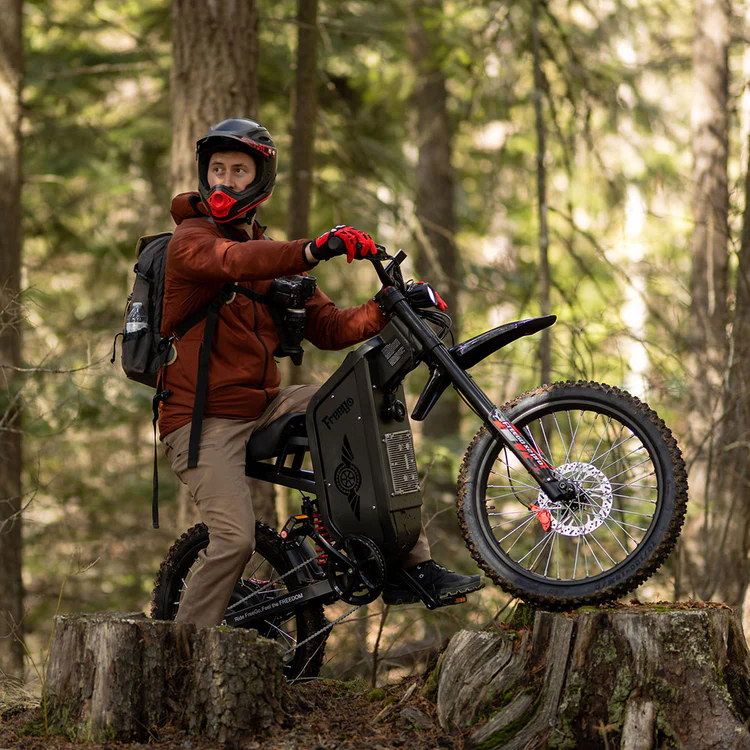
Dirt Ebike Application Guide: Matching Freego Models to Terrain and Duty Cycles
The most expensive dirt ebike decision is rarely the price you negotiate — it is the duty cycle you get wrong. A 72V, 8000W machine assigned to a short flat rental loop wastes capital on energy capacity nobody uses. A hub-drive model assigned to a sustained steep climb spends its service life working harder than it should. Both failures share one root cause: the buyer chose a model first and defined the duty cycle second.
This application guide is written for procurement managers, rental operators, trail-centre owners and mixed-terrain fleet planners who have to defend a configuration with more than a spec sheet. It maps the Freego dirt ebike line-up — from the entry-level mid-drive all-terrain Nova 3, through the high-performance all-terrain X2 Pro and the ultra-long-range X3, up to the premium pro-grade mid-drive Nova 5 pro — onto real deployment patterns such as trail centres, rental fleets and mixed-terrain patrols.
The short answer: pick the drivetrain architecture first (mid-drive or hub), fix the legal operating envelope second, size the battery to your longest unsupported duty interval third, and only then compare chassis, suspension and braking. The six-step method below converts that sequence into a repeatable checklist your operations team can run for every new site.
Problem Definition: Why "Which Dirt Ebike Is Best?" Is the Wrong Question
A dirt ebike is not good or bad in isolation. It is correct or incorrect relative to a duty cycle. In fleet and project procurement, the duty cycle is the combination of six measurable variables, not a marketing category:
- Terrain class and gradient — groomed loop, gravel track, mountain trail, or sustained steep slope.
- Surface condition — whether the machine will run on paved links as well as unpaved ground.
- Daily operating hours and duty intensity — a two-hour guided ride and six hours of continuous rental turnover place different loads on brakes, motors and batteries.
- Rider and payload mass — Freego's dirt ebike models publish different maximum load ratings, from 100 KG (220 LBS) on the Nova 5 MINI and X0 to 150 KG (330 LBS) on the X3, Nova 5 and Nova 5 pro.
- Legal operating envelope — whether the machine must be street-legal on public-road segments.
- Service distance and downtime tolerance — how fast a replacement part or a whole unit can reach the site.
Three mismatch patterns account for most poor dirt ebike purchases. First, a hub-drive configuration is specified for sustained climbing: the X2 publishes a climbing capacity of ≥25° and the X3 ≥30°, while the mid-drive Nova 3 and Nova 4 publish ≥40% slope and the Nova 5 ≥45% slope. Second, an off-road-only, high-power machine is placed into municipal or patrol duty that includes public-road links, when dual-mode models such as the X1, X2, X2 Pro, Nova 3 and Nova 4 already publish separate urban and off-road top speeds. Third, oversized energy is bought for short-loop duty: a Nova 5 pro carries a 72V 40Ah pack for a 70 MI rating, which is unnecessary for a site whose longest loop is a fraction of that.
The cost of a mismatch is not only the purchase price. It shows up later as faster consumable replacement, more service interventions, and a fleet whose riders avoid the machines that do not suit the site.
Industry Background: What Is Changing in the Dirt Ebike Segment
The electric dirt bike category is expanding alongside the wider powersports electrification trend. Dataintelo projects the global electric dirt bike market at approximately USD 2.8 billion in 2025, with growth expectations to USD 7.6 billion by 2034. Within that total, Asia Pacific led regional demand with USD 1.02 billion in 2025, accounting for 36.4% of global revenue. For buyers, the practical implication is simple: the supply base is deepening, which makes configuration fit — not availability — the deciding factor.
Drivetrain architecture is the clearest technical shift. Third-party technical comparisons note that mid-drive motors are increasingly preferred for off-road dirt bikes because of superior weight distribution and torque multiplication through the bike's gear system, compared with hub motors. That is visible in Freego's own line-up structure: the Nova family uses mid-drive motors, and the X-series models place hub motors at the wheel.
Regulation is the second structural change. The US market uses a three-class system for e-bikes — Class 1 and Class 2 capped at 20 mph, Class 3 capped at 28 mph — and vehicles exceeding those limits are generally regulated as off-road motor vehicles. In the EU, electric motorcycles fall under Regulation (EU) No 168/2013: L1e (moped equivalent, maximum 45 km/h and 4 kW) or L3e (motorcycle equivalent, unrestricted speed). This is why dual-mode architecture matters for commercial fleets. Freego's X-Man series is documented with a dual-mode system offering a City Mode (Class 3 compliant, 28 mph, 750W) and an Off-Road Mode with unrestricted performance.
Certification has become a procurement gate rather than a detail. Freego's electric bikes are covered by an SGS Certificate of Compliance (certificate number SGSNA/24/SZ/00059, issued 2024-01-29 by SGS North America Inc.) against ANSI/CAN/UL 2849-2022, and by a UL 2849 test report (LTR24100903HS, issued 2024-10-10 by Guangdong Lintek Certification Group Co., Ltd.) against UL 2849:2020+R:2022-06+R:2022-12 for electrical systems for e-bikes. FCC Part 15 Subpart B declarations are also on file for the electric bike scope. The company behind the range, Freego USA Inc., was founded in 2012, is headquartered in Chino, California, operates a 3,000 m² manufacturing facility, exports about 90% of output to more than 40 countries and regions, and reports roughly 20,000 vehicles in annual sales with cumulative global sales above 1 million units.
The Detailed Solution: Two Architectures Across the Freego Dirt Ebike Range
Freego's off-road line-up resolves into two drivetrain families. Understanding which family a model belongs to — before comparing individual specifications — removes most of the confusion from a fleet shortlist.
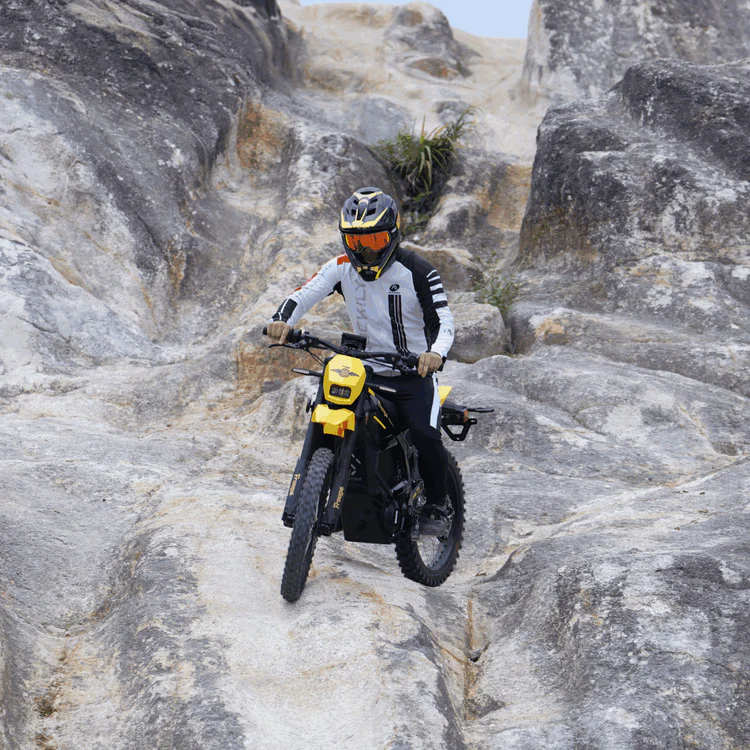
Family 1 — Mid-Drive (Nova Series)
Nova 5 MINI is a compact mid-drive model with a 2,500W mid-drive motor, a 48V 21Ah lithium battery, a 37 MPH top speed, a 35 MI range and a 100 KG (220 LBS) load rating. Its 14" front and 10" rear wheels and lightweight steel frame make it the smallest configuration in the family — useful where rider height or storage space constrains the fleet.
Nova 3 is the entry-level mid-drive all-terrain model and the most common first purchase for youth programmes and cost-sensitive rental fleets. It runs a 3,000W mid-drive brushless motor with a 60V 25Ah 21700-cell battery, publishes 28 MPH in Kid-Safe mode and 40 MPH in Turbo mode, 50 MI in Eco and 20 MI in Sports, a 120 KG (264 LBS) load rating, a 2-piston hydraulic disc brake with a 220mm rotor, a climbing capacity of ≥40% slope, 80/100-17 fat puncture-resistant tyres, and a 2-stage speed reduction chain drive.
Nova 4 is the mid-grade, high-torque configuration. Its 6,000W mid-drive motor and 60V 30Ah 21700-cell pack deliver 28 MPH in Eco and 45 MPH in Sports, 50 MI in Eco and 25 MI in Sports, a 120 KG load rating, a 4-piston hydraulic disc brake, a ≥40% slope climbing capacity, a hydraulic inverted suspension fork paired with an OEM shock absorber, mixed 70/100-19 front and 80/100-17 rear motorcycle-grade tyres, and a mid-drive motor with two-level speed reduction.
Nova 5 is the high-power mid-drive all-terrain model. Its 8,000W mid-drive motor and 72V 40Ah 21700-cell battery produce a 53 MPH top speed, a 70 MI range and a 150 KG (330 LBS) load rating, with a 4-piston hydraulic disc brake, a ≥45% slope climbing capacity, KKE brand hydraulic shock absorbers, a forged aluminium alloy and carbon steel frame, and heavy-duty all-terrain motorcycle-grade tyres.
Nova 5 pro sits at the top of the range as a premium pro-grade mid-drive machine. It pairs a 15,000W mid-drive motor with a 72V 40Ah 21700-cell battery and a 150A/400A high-power brushless motor controller, reaching 62 MPH in street-legal mode and 56 MPH off-road, with a 70 MI range, a 150 KG load rating, a 4-piston hydraulic disc brake on a 203mm rotor, a 5–10 hour charge time, a high-strength forged aluminium alloy frame, premium KKE hydraulic front and rear shock absorbers, and ultra-tough all-terrain puncture-resistant tyres.
Family 2 — Hub-Drive Dual-Mode (X Series)
X0 is a compact 3,600W machine positioned for teens and adults, with a 60V 23Ah 21700-cell battery, a 40 MPH top speed, a 50 MI range, a 100 KG load rating, a 2-piston hydraulic disc brake and 14" spoke wheels.
X1 is a medium-size, street-legal dual-mode all-terrain model: 3,600W hub motor, 60V 25Ah 21700 cells, 28 MPH urban and 40 MPH off-road, 50 MI in Eco and 20 MI in Sports, 120 KG (264 LBS) load rating, 4-piston hydraulic disc brake, 17" alloy rim spoke wheels with 3.15x17 motorcycle-grade tyres and KKE brand hydraulic shock absorbers.
X2 steps up to a 6,000W hub motor and a 60V 30Ah pack, with 28 MPH urban and 50 MPH off-road speeds, a 56 MI range, a 120 KG load rating, a 4-piston hydraulic disc brake, a ≥25° climbing capacity, 70/100-19 pneumatic motorcycle-grade tyres, hydraulic front and rear shock absorbers, and a 100A/300A high-power brushless motor controller.
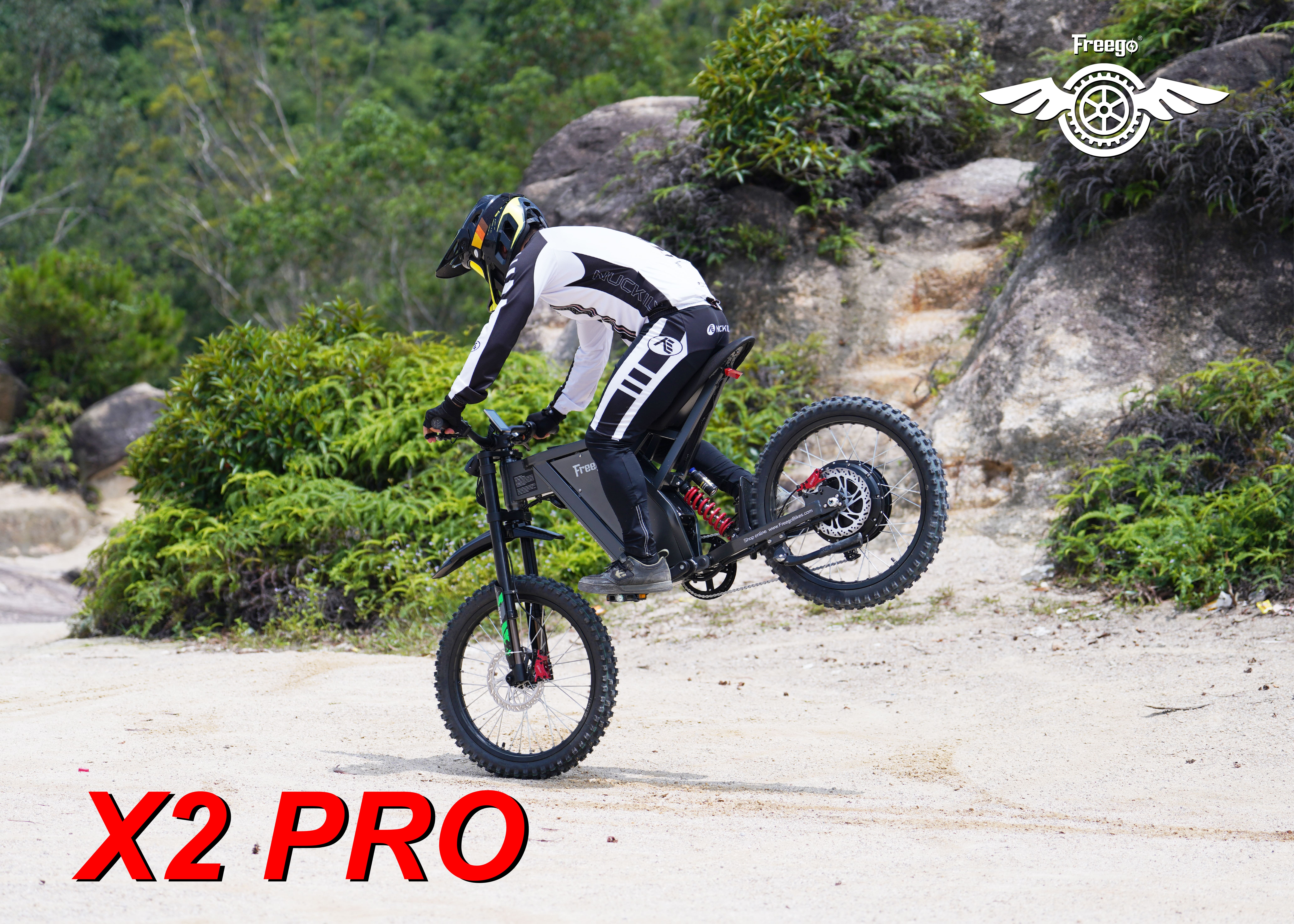
X2 Pro is the high-performance all-terrain configuration: 6,000W hub motor, 60V 30Ah pack, 28 MPH urban and 50 MPH off-road, 56 MI in city use and 20 MI off-road, a 120 KG load rating, a 4-piston hydraulic disc brake on a 203mm rotor, a 5–8 hour charge time, KKE brand hydraulic front and rear shock absorbers, and Panasonic/LG 21700 lithium-ion cells.
X3 is the ultra-long-range pedalled all-terrain model launched for 2026. Its 8,000W hub motor and 72V 40Ah or 50Ah 21700-cell battery (160 cells) deliver 28 MPH urban and 56 MPH off-road, a 110 MI range, a 150 KG load rating, a 4-piston hydraulic disc brake, a ≥30° climbing capacity, 70/100-19 heavy-duty motorcycle-grade tyres and a high-performance hydraulic inverted suspension fork.
Step-by-Step Breakdown: A Six-Step Selection Method for B2B Buyers
Step 1 — Write the duty sheet before the model sheet
For each site, record the gradient profile, surface mix, longest loop length, daily operating hours, average rider mass plus carried load, climate and the legal boundary. Do this before opening any product page. Every later decision — drivetrain, voltage, brake spec — is a function of this sheet, and it is also the document that justifies the purchase internally.
Step 2 — Choose the drivetrain architecture from the gradient profile
If the duty sheet shows sustained, repeated climbing, start with the mid-drive Nova family. The published slope ratings make the comparison concrete: Nova 3 and Nova 4 at ≥40% slope, Nova 5 at ≥45% slope, against ≥25° for the hub-drive X2 and ≥30° for the hub-drive X3. Where the site is mostly flat with occasional gradients, the X-series hub-drive models cover the requirement with higher published urban and off-road top speeds — 50 MPH off-road on the X2 and X2 Pro, 56 MPH off-road on the X3 — and avoid the chain-driven reduction stage used on the mid-drive configurations.
Step 3 — Fix the legal operating envelope before the spec sheet
Decide whether any part of the duty cycle touches public roads. If it does, restrict the shortlist to dual-mode models with a documented urban mode: X1 at 28 MPH urban, X2 and X2 Pro at 28 MPH urban, Nova 3 at 28 MPH Kid-Safe, Nova 4 at 28 MPH Eco, and Nova 5 pro at 62 MPH street-legal. Confirm how the local authority classifies the vehicle — in the US, machines above the Class 3 limit of 28 mph are generally treated as off-road motor vehicles; in the EU, Regulation (EU) No 168/2013 separates L1e and L3e. Ask the supplier for the compliance file rather than a verbal assurance.
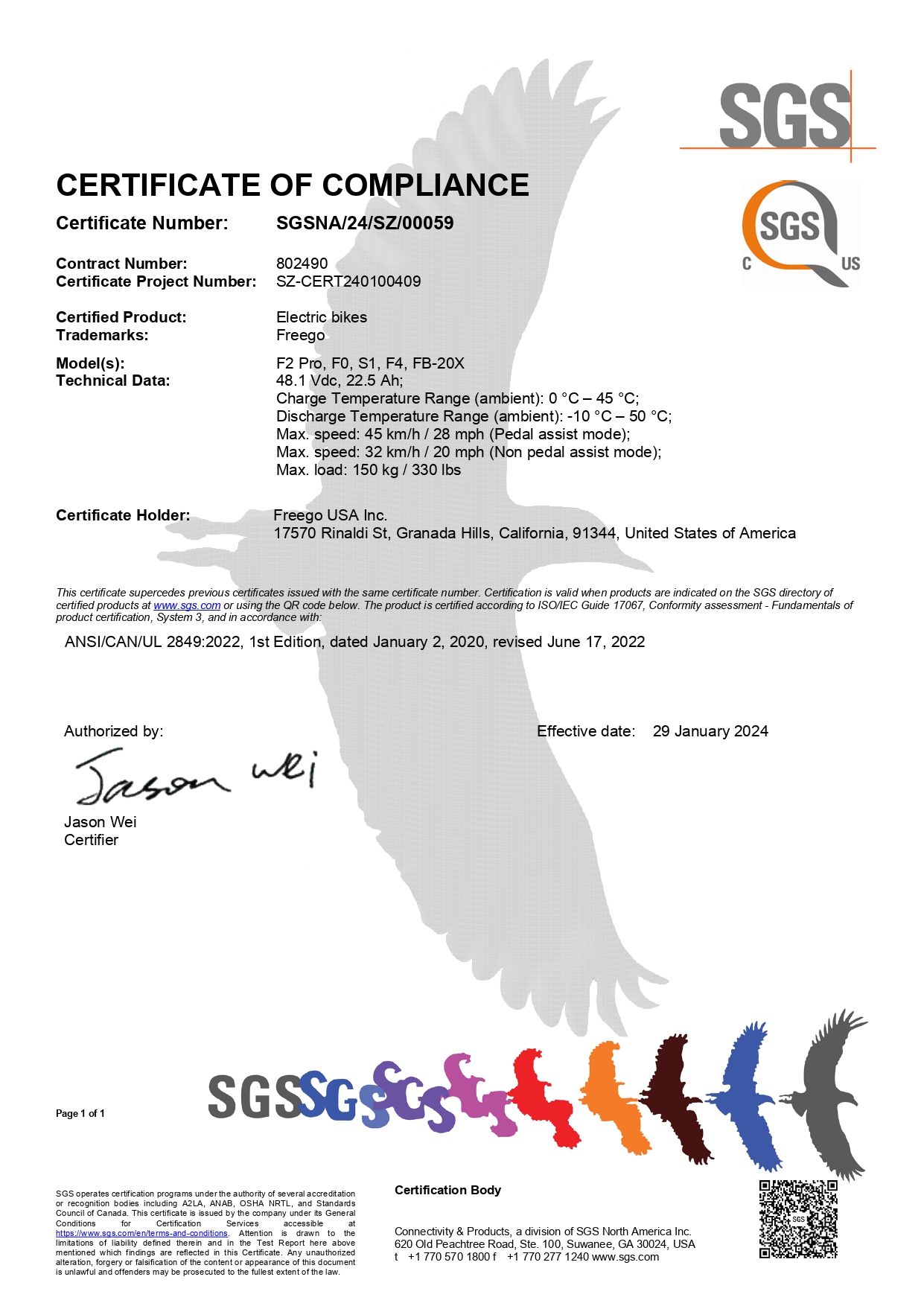
Freego's electrical bike scope is backed by an SGS Certificate of Compliance numbered SGSNA/24/SZ/00059 against ANSI/CAN/UL 2849-2022, a related SGS certificate numbered SGSNA/24/SZ/00058 for electric bike electrical systems, a UL 2849 test report numbered LTR24100903HS covering the Nova and X-series dirt bikes, and FCC Part 15 Subpart B declarations. This documentation is what allows a fleet operator to answer a regulator, an insurer or a landlord without delay.
Step 4 — Size the energy system to the longest unsupported interval
Size the battery to the longest stretch the machine will run without returning to base, not to the average ride. The range figures published across the range make this straightforward: X3 at 110 MI on a 72V 40Ah/50Ah pack, Nova 5 and Nova 5 pro at 70 MI on 72V 40Ah, X2 at 56 MI on 60V 30Ah, Nova 3 at 50 MI Eco with 20 MI Sports, and Nova 5 MINI at 35 MI on 48V 21Ah. Note the gap between Eco and Sports modes on the dual-mode models — X2 Pro publishes 56 MI in city use but 20 MI off-road. If a guided itinerary depends on Sports or Turbo performance, plan the resupply interval around the lower number.
Step 5 — Match chassis, suspension and braking to terrain severity
Severity drives hardware. Inverted suspension forks appear where terrain demands them — the X3 uses a high-performance hydraulic inverted suspension fork, Nova 4 combines an inverted fork with an OEM shock absorber, and the X2 Pro, Nova 5 and Nova 5 pro use KKE brand hydraulic suspension. Braking specification tracks duty intensity: Nova 3 carries a 2-piston hydraulic disc with a 220mm rotor, while X1, X2, Nova 4 and Nova 5 move to 4-piston hydraulic discs, and X2 Pro and Nova 5 pro specify 4-piston brakes on 203mm rotors. Frame construction separates the tiers as well, from lightweight steel on the Nova 5 MINI, through carbon steel on the X-series and Nova 3/Nova 4, to forged aluminium alloy on the Nova 5 pro.
Step 6 — Lock the service, spares and supply plan before the purchase order
A configuration is only deployable if it can be maintained. Freego operates a US local warehouse with door-to-door delivery, a 3–8 business day lead time for spot orders and spot customisation such as logo or packaging, a MOQ of 12 units (one full pallet) for standard wholesale bulk orders, 2-Year Limited Warranty coverage with US local spare parts supply and more than 200 local authorised service centres, and a 2-year limited warranty on frames with 1 year on core electrical components.
For fleets that need utilisation data, Freego's IoT Solution Provider service adds integrated 4G/GPS modules, a Sharing Management SaaS dashboard, a branded user app and geofencing firmware, with a 100-unit MOQ for standard modules, a 30–45 day lead time and 24/7 cloud server maintenance.
Use Cases: Matching Configurations to Real Deployment Scenarios
Trail centres and short-loop rental fleets
High turnover, low average loop length and mixed rider skill favour mid-power, compact machines. The Nova 5 MINI (2,500W mid-drive, 37 MPH, 35 MI, 100 KG load) and the X1 (3,600W hub, 28 MPH urban / 40 MPH off-road, 120 KG load) both fit, with the Nova 3 as the volume option where a 50 MI Eco range and dual Kid-Safe/Turbo modes are useful for supervised riding. Adding IoT modules turns this into a managed fleet with geofencing and utilisation reporting.
Guided adventure tourism and long-range touring
Where itineraries run tens of miles between resupply points, range dominates the decision. The X3's 110 MI range on a 72V 40Ah/50Ah pack and the 70 MI range and 150 KG load rating of the Nova 5 and Nova 5 pro are the configurations built for this duty. The published application notes for the X-man and Nova series specifically reference desert and mountain trail environments.
Mixed-terrain patrol and municipal operations
Duty cycles that combine paved links with gravel or track sections need a legal urban mode plus off-road hardware. The X2 Pro (28 MPH urban, 50 MPH off-road, KKE suspension, 4-piston 203mm brakes) and the Nova 4 (28 MPH Eco, 45 MPH Sports, inverted fork, 4-piston brakes) are the practical starting points, with the X2 at 28 MPH urban / 50 MPH off-road as the lower-cost alternative.
Steep-slope and mountain work
Hunting access, survey work and mountain-trail operations live or die on gradient capability. The Nova 5 at ≥45% slope and the Nova 3 and Nova 4 at ≥40% slope are the configurations whose published ratings match sustained climbing, supported on the Nova 5 by a forged aluminium alloy and carbon steel frame rated to 150 KG.
Youth, teen and entry-level programmes
Supervised programmes need a defensible speed ceiling. The Nova 3 publishes a 28 MPH Kid-Safe mode with a 40 MPH Turbo mode, a 120 KG load rating and a 2-piston hydraulic brake, while the X0 offers a 3,600W, 40 MPH, 50 MI package at a 100 KG load rating. The Nova 5 MINI covers younger or shorter riders with a 14"/10" wheel configuration.
Performance and competition environments
For closed-course performance duty, the Nova 5 pro's 15,000W mid-drive motor, 150A/400A controller, 62 MPH street-legal top speed and premium KKE suspension represent the top of the line, with the X3 providing an 8000W, 72V hub-drive alternative at a lower entry point.
Comparison Table: Freego Dirt Ebike Specifications by Model
| Model | Drivetrain | Peak motor power | Battery | Top speed | Max range | Max load | Brake system |
|---|---|---|---|---|---|---|---|
| Nova 5 MINI | Mid-drive | 2,500W | 48V 21Ah | 37 MPH | 35 MI | 100 KG (220 LBS) | Hydraulic disc brake |
| Nova 3 | Mid-drive | 3,000W | 60V 25Ah 21700 | 28 MPH (Kid-Safe) / 40 MPH (Turbo) | 50 MI (Eco) / 20 MI (Sports) | 120 KG (264 LBS) | 2-piston hydraulic disc, 220mm rotor |
| Nova 4 | Mid-drive | 6,000W | 60V 30Ah 21700 | 28 MPH (Eco) / 45 MPH (Sports) | 50 MI (Eco) / 25 MI (Sports) | 120 KG (264 LBS) | 4-piston hydraulic disc |
| Nova 5 | Mid-drive | 8,000W | 72V 40Ah 21700 | 53 MPH | 70 MI | 150 KG (330 LBS) | 4-piston hydraulic disc |
| Nova 5 pro | Mid-drive | 15,000W | 72V 40Ah 21700 | 62 MPH (street-legal) / 56 MPH (off-road) | 70 MI | 150 KG (330 LBS) | 4-piston hydraulic disc, 203mm rotor |
| X0 | Hub | 3,600W | 60V 23Ah 21700 | 40 MPH | 50 MI | 100 KG (220 LBS) | 2-piston hydraulic disc |
| X1 | Hub | 3,600W | 60V 25Ah 21700 | 28 MPH (urban) / 40 MPH (off-road) | 50 MI (Eco) / 20 MI (Sports) | 120 KG (264 LBS) | 4-piston hydraulic disc |
| X2 | Hub | 6,000W | 60V 30Ah 21700 | 28 MPH (urban) / 50 MPH (off-road) | 56 MI | 120 KG (264 LBS) | 4-piston hydraulic disc |
| X2 Pro | Hub | 6,000W | 60V 30Ah 21700 | 28 MPH (urban) / 50 MPH (off-road) | 56 MI (city) / 20 MI (off-road) | 120 KG (264 LBS) | 4-piston hydraulic disc, 203mm rotor |
| X3 | Hub | 8,000W | 72V 40Ah / 50Ah 21700 | 28 MPH (urban) / 56 MPH (off-road) | 110 MI | 150 KG (330 LBS) | 4-piston hydraulic disc |
Two further specification points sit outside the table because they vary by configuration rather than by tier: climbing capacity (X2 ≥25°, X3 ≥30°, Nova 3 ≥40% slope, Nova 4 ≥40% slope, Nova 5 ≥45% slope) and suspension (hydraulic front and rear shocks across the range, with inverted forks on the X3 and Nova 4 and KKE brand hydraulic suspension on the X1, X2 Pro, Nova 5 and Nova 5 pro).
Duty Cycle to Starter Configuration Map
| Duty cycle | Terrain and gradient profile | Recommended starting configuration | Evidence from published specs |
|---|---|---|---|
| Short-loop trail-centre rentals | Groomed or mild loop, high daily hours | Nova 5 MINI, X1, Nova 3 | 35–50 MI range, 100–120 KG load, 28–40 MPH dual modes |
| Guided adventure touring | Long mixed loops, distance critical | X3, Nova 5, Nova 5 pro | 110 MI / 70 MI rated range, 72V packs, 150 KG load |
| Mixed-terrain patrol | Paved links plus gravel tracks | X2 Pro, Nova 4, X2 | 28 MPH urban mode, KKE suspension, 4-piston brakes |
| Steep-slope and mountain work | Sustained gradients | Nova 5, Nova 4, Nova 3 | ≥45% / ≥40% / ≥40% slope ratings |
| Youth and entry-level programmes | Flat to mild, supervised riders | Nova 3, X0, Nova 5 MINI | 28 MPH Kid-Safe mode, 100–120 KG load ratings |
| Performance and competition | Technical, high-speed, closed course | Nova 5 pro, X3 | 15,000W mid-drive, 150A/400A controller, 62 MPH street-legal |
Deployment evidence supports the framework. Freego's Powersports Retailers clients in the US have used strategic stock of Nova and X-man series models for off-road racing, mountain trail exploration and hunting over a 2–3 year horizon, expanding into high-ticket adventure customers. Authorised dealer partners in the US report annual volumes of 500+ units per dealer with a 95% dealer retention rate over 5+ years, and more than 120 local e-bike shops in the US purchase 10–20 units per store monthly.
Frequently Asked Questions
Can a high-power dirt ebike be legally ridden on public roads in the US or the EU?
It depends on the mode and the market. The US market uses a three-class system for e-bikes — Class 1 and Class 2 limited to 20 mph and Class 3 to 28 mph — and vehicles exceeding those limits are generally regulated as off-road motor vehicles. In the EU, electric motorcycles are classified as L1e (moped equivalent, maximum 45 km/h and 4 kW) or L3e (motorcycle equivalent, unrestricted speed) under Regulation (EU) No 168/2013. Within the Freego range, dual-mode models publish separate urban and off-road top speeds: X1 at 28 MPH urban, X2 and X2 Pro at 28 MPH urban, Nova 3 at 28 MPH Kid-Safe, Nova 4 at 28 MPH Eco, and Nova 5 pro at 62 MPH street-legal. Compliance files include an SGS Certificate of Compliance (SGSNA/24/SZ/00059, ANSI/CAN/UL 2849-2022) and a UL 2849 test report (LTR24100903HS), plus FCC Part 15 Subpart B declarations. Buyers should still confirm local registration and licensing rules for their jurisdiction.
Mid-drive or hub motor — which type is better for steep terrain?
For sustained climbing, the published gradient ratings point toward the mid-drive Nova family: Nova 3 and Nova 4 list a climbing capacity of ≥40% slope and Nova 5 lists ≥45% slope, against ≥25° for the hub-drive X2 and ≥30° for the hub-drive X3. Third-party technical comparisons also note that mid-drive motors are increasingly preferred for off-road dirt bikes because of superior weight distribution and torque multiplication through the bike's gear system compared with hub motors. Hub-drive X-series models remain the better fit where the duty cycle is mostly flat to rolling and where higher urban and off-road top speeds — 50 MPH off-road on X2 and X2 Pro, 56 MPH off-road on X3 — matter more than gradient capability.
What drives cost differences across a dirt ebike fleet, and where do buyers overspend?
Four specification groups drive cost: drivetrain architecture (hub versus mid-drive), battery voltage and capacity (48V 21Ah on the Nova 5 MINI, through 60V 25–30Ah, to 72V 40Ah/50Ah on the X3, Nova 5 and Nova 5 pro), brake and suspension specification (2-piston versus 4-piston hydraulic discs, 203mm and 220mm rotors, inverted forks versus standard hydraulic shocks), and frame material (lightweight steel, carbon steel, forged aluminium alloy). Overspending usually happens in the opposite direction from what buyers expect: short-loop duty fitted with long-range 72V packs or pro-grade motors that never leave a flat loop. Freego's published US local-shop case evidence cites cost performance around 40% lower than peer high-end products, with store partners reporting a 30% operating margin and more than 120 US shops reordering monthly. The reliable way to avoid overspend is to spec against the Step 1 duty sheet and validate with a single sample unit before committing to pallet volume.
How can we validate a specific configuration before committing to fleet volume?
Freego's procurement terms allow validation at low volume. The MOQ for a sample display order is 1 unit, while a standard wholesale bulk order starts at 12 units (one full pallet), shipped door-to-door from the US local warehouse in 3–8 business days, with acceptance through local service centre inspection and compliance verification. For a custom configuration, ODM design and prototyping takes 15–20 days before mass production, and OEM custom production runs at an MOQ of 50 units per model with 45–60 days lead time from the China factory. Third-party inspection (UL/CE/SGS) can be supported with official reports, which lets a buyer verify a pilot batch against the same standard as the production order.
What lead times and MOQs apply when scaling a dirt ebike programme?
Lead times vary by route. OEM production from the China factory requires 50 units per model (mixed orders of the same series are calculable) with a 45–60 day lead time, while spot customisation such as logo or packaging from the US local warehouse takes 3–8 business days. Regular OEM monthly capacity is 2,000 units, rising to 3,000+ units in peak production season. ODM custom projects require 100 units per model, with 15–20 days for product design and prototyping and 50–70 days for mass production after design confirmation, at 1,500 units per month regular capacity and up to 2,500+ units at peak. IoT-equipped fleet builds require a 100-unit MOQ on standard modules with a 30–45 day lead time. US distribution orders start at 12 units (one pallet) with 3–8 business day delivery, 20,000 units of annual capacity, pre-delivery inspection, a 2-year limited warranty and more than 200 local authorised service centres. To take the next step, request the full Freego product catalogue and specification pack, or send your duty sheet and target volumes to the dealer team for a configuration review.
Conclusion: Turn the Duty Cycle Into the Purchase Order
Selecting a dirt ebike for a fleet, a trail centre or a patrol programme is a specification exercise, not a shopping exercise. The sequence that works is consistent: write the duty sheet, choose the drivetrain architecture from the gradient profile, fix the legal envelope, size the battery to the longest unsupported interval, match chassis and braking to terrain severity, and lock the service and supply plan before the purchase order. Applied to the Freego range, that sequence leads mid-drive, sustained-climb duty to the Nova 3, Nova 4 and Nova 5 tiers, long-distance tourism to the X3 and the 72V Nova 5 models, mixed-terrain patrol to the dual-mode X2 Pro, and closed-course performance to the Nova 5 pro.
Every specification quoted in this guide comes from the published Freego product data, so the framework can be re-run for each new site without renegotiating the facts.

Next Step: Build Your Duty Cycle Brief
Send your terrain profile, target daily hours, rider load and legal operating boundary, and the Freego team will map it to a specific Nova or X-series configuration. Sample display orders start at 1 unit; standard wholesale orders start at 12 units (one pallet).
Download the full product catalogue: Freego Product Catalogue (PDF)
Product range and specifications: freegobikes.com
Dealer enquiries: Dealers@freegobikes.com
Service and support: Service@freegobikes.com | Support@freegobikes.com
Contact: Ahmed — Ahmed@freegobikes.com | Tel: +1 818 275 1590 | WhatsApp: +1 310 678 1530
Freego USA Inc., 3681 Walnut Ave, Chino, CA 91710