Dirt Ebike FAQ for B2B Buyers: Components and Duty Cycles
Dirt Ebike FAQ for B2B Buyers: Components, Duty Cycles and Daily-Use Fit
A dirt ebike is a compact electric off-road two-wheeler that pairs bicycle-scale packaging with motorcycle-grade tires, long-travel suspension and a high-torque electric drivetrain. For B2B buyers in light industry and daily-use applications, the purchase decision rarely turns on headline wattage. It turns on three things: which drivetrain architecture matches the real duty cycle, whether the configuration can be legally classified in the target market, and whether the supplier can support parts, warranty and service after delivery.
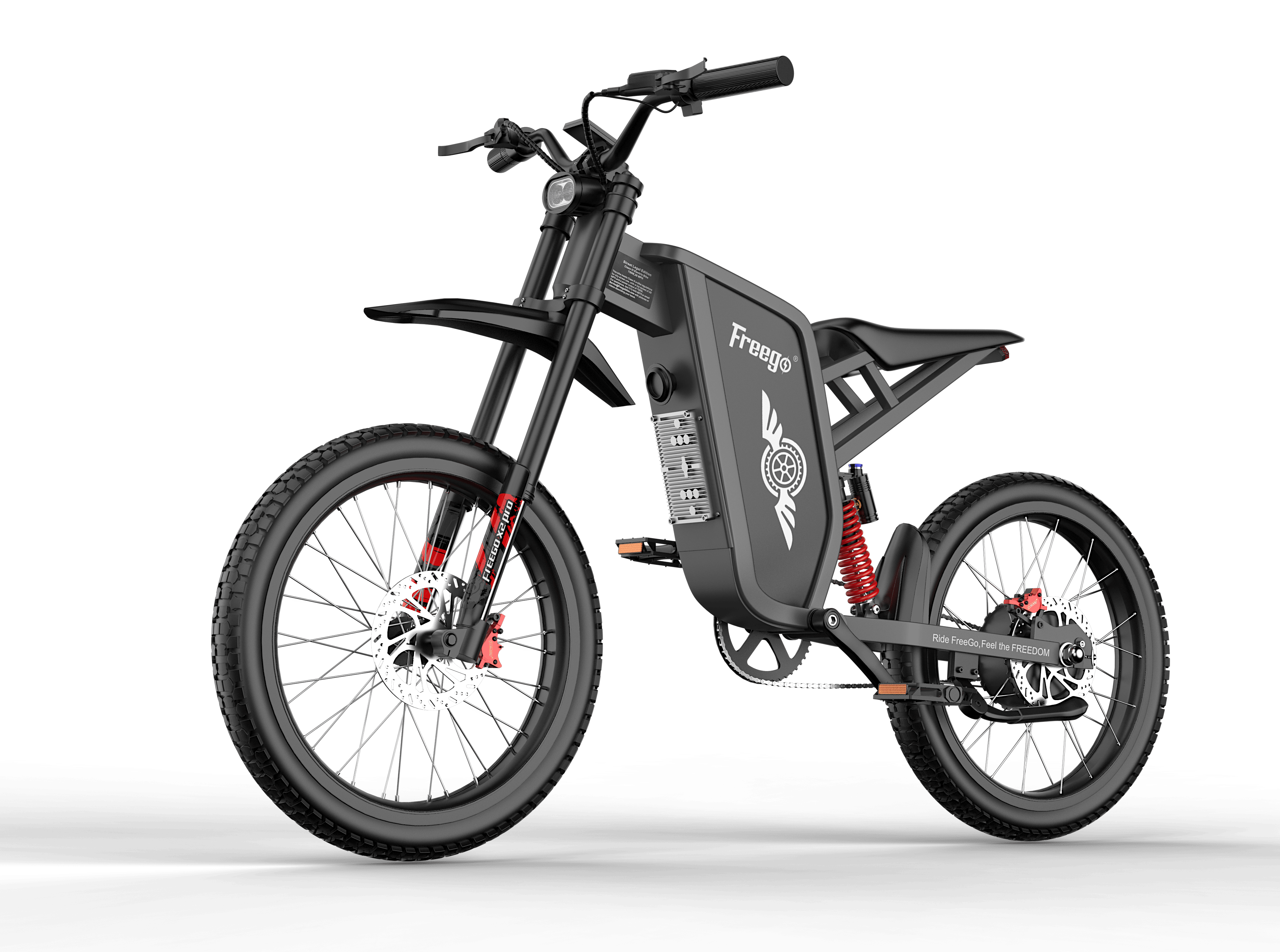
Freego X1: a mid-size, dual-mode dirt ebike platform with 17-inch wheels and 4-piston hydraulic brakes.
This FAQ-style guide answers the questions that recur in first-contact enquiries from importers, distributors, rental operators and facility managers. It is written around Freego USA Inc., a Chino, California-based electric mobility brand founded in 2012 that supplies electric scooters, off-road electric machines, fat-tire e-bikes, commuter e-bikes and three-wheeled recreational vehicles to more than 40 countries. Model figures below are manufacturer-stated specifications taken from Freego product documentation; regulatory points are attributed to the public sources named alongside them.
The Buying Problem: Why Dirt Ebike Specifications Are Hard to Compare
Three ambiguities consistently slow down dirt ebike procurement, and each one has a commercial cost attached.
Category ambiguity. The same vehicle may be sold as a dirt ebike, an electric dirt bike or an e-moto. The labels are marketing terms, not legal categories, and the legal treatment that follows can change the sales channel, the insurance line and the registration obligation. A buyer who contracts on the label rather than the classification can end up with inventory that cannot be lawfully operated where it was intended to be sold.
Specification ambiguity. Peak power and nominal power are different metrics and are frequently published without the distinction being made explicit. Freego's own published materials illustrate the gap: one model listing states 3,000 W nominal and 6,000 W peak power, while other models are published with peak figures only. Comparing a peak-rated 6,000 W platform against a nominal-rated 3,000 W platform as though they were the same measurement produces a ranking that means nothing.
Duty-cycle ambiguity. A platform engineered for trails, sand, mud and inclines above 25 degrees is not the platform that suits paved-campus patrol, bike-lane commuting or hotel-guest daily use. Both are legitimate dirt ebike applications, but the chassis, brake and battery specifications diverge, and over-specifying for a light duty cycle raises unit cost and service complexity without improving the outcome.
Decision rule for buyers: define the duty cycle, fix the legal classification, and confirm the service plan before selecting wattage. Wattage is a consequence of those three decisions, not the starting point.
Industry Background: A Category Splitting Into Two Architectures
The dirt ebike segment is expanding at the same time as it is fragmenting. Dataintelo's electric dirt bike market report estimates global market value at USD 1.47 billion in 2025 and projects USD 5.0 billion by 2035, which frames the category as moving from niche powersports interest into a broader commercial market. Forecast figures of this kind describe direction, not verified unit demand in any single country.
Inside the category, two drivetrain architectures now dominate. Freego divides its off-road line explicitly: the Nova series uses mid-drive motors, while the X series uses hub motors. That split is not cosmetic. It changes where torque is delivered, how much unsprung mass sits in the rear wheel, and what the buyer should test during sampling.
Regulatory treatment is diverging at the same time. The U.S. Consumer Product Safety Commission standards summary describes an electric bicycle definition involving operational pedals and a maximum speed of less than 20 mph when operated solely by electric power, with the full scope of applicability requiring document-level review. Regulatory guidance collected for this guide also notes that, as of 2026, electric motorcycles above 750 W without pedals are reclassified as Off-Highway Vehicles (OHV) in California, requiring registration and decals. Those two statements sit in different legal contexts. A buyer's takeaway is not that one threshold governs all markets, but that classification has to be resolved market by market, before purchase order.
Evidence note: no independent laboratory protocol covering range, climbing, acceleration or waterproofing was available for the models referenced here. All performance figures are manufacturer-stated and should be confirmed during sample evaluation against the buyer's own duty cycle.
How a Dirt Ebike Is Built: The Components That Decide Fit
Mid-drive and hub motors
In a mid-drive layout the motor sits at the crank and drives through the bike's transmission; in a hub layout the motor is built into the rear wheel. Freego's portfolio maps the two cleanly: Nova is mid-drive, X is hub-motor. The published specifications show where each lands.
Freego Nova 4, a mid-drive platform rated at 6,000 W peak with a 60 V 30 Ah battery, is listed with a climbing capacity of 40% slope or greater together with a 4-piston hydraulic disc brake and a hydraulic inverted suspension fork. Freego Nova 3, the entry-level mid-drive, is rated at 3,000 W peak with the same 40% slope climbing figure, a 2-piston hydraulic brake on a 220 mm rotor, and hydraulic front and rear shock absorbers.
On the hub side, Freego X2 Pro is rated at 6,000 W peak with a 60 V 30 Ah pack, listed with 28 mph urban and 50 mph off-road modes, a 4-piston hydraulic brake on a 203 mm rotor and KKE brand hydraulic front and rear shock absorbers. Freego X1, a mid-size hub platform, is rated at 3,600 W peak with a 60 V 25 Ah battery and 17-inch alloy spoke wheels.
For buyers, the practical reading is straightforward. Mid-drive platforms are the usual specification where climbing, low-speed torque control and gear-reduced traction dominate the duty cycle. Hub platforms reduce drivetrain complexity and suit mixed or flatter terrain where simpler maintenance and fewer wearing parts rank higher. Because both architectures exist inside one portfolio, a buyer can match either duty cycle without changing supplier.
Battery, voltage and swappable operation
Published Freego dirt ebike platforms run on 60 V lithium-ion packs built from 21700 cells: 60 V 25 Ah on Nova 3 and X1, 60 V 30 Ah on Nova 4 and X2 Pro, and 60 V 23 Ah on X0. X2 Pro documentation names Panasonic/LG 21700 cells and states a 5 to 8 hour charging time.
Voltage and capacity set the energy budget, and the published range figures are mode-dependent rather than single numbers. Nova 4 is listed at 50 mi in Eco and 25 mi in Sports; X2 Pro at 56 mi city and 20 mi off-road; Nova 3 at 50 mi Eco and 20 mi Sports. For B2B planning, the off-road or Sports figure is the one to design around, because rental and site-use duty cycles rarely reproduce Eco-mode test conditions.
Swappable battery operation is part of the supported operating model for fleet-style deployments, where packs are exchanged on a shift basis rather than charged in place. That distinction matters to rental operators far more than the nominal capacity figure does.
Suspension, brakes and chassis hardware
Hardware grading is where light-duty and heavy-duty specifications visibly separate. Nova 4 carries a hydraulic inverted suspension fork plus an OEM shock absorber. X1 and X2 Pro use KKE brand hydraulic shock absorbers. Nova 3 and X0 use hydraulic front and rear shock absorbers and 2-piston hydraulic brakes, while Nova 4, X1 and X2 Pro step up to 4-piston hydraulic braking.
Frames across the referenced platforms are high-strength carbon steel, with X0 using a high-strength steel pipe frame. Tire specification follows the same logic: motorcycle-grade tires in 70/100-19 front and 80/100-17 rear sizes on Nova 4, 80/100-17 on Nova 3, 70/100-19 on X2 Pro and 3.15x17 on X1, with 14-inch spoke wheels on X0. All referenced platforms list a 120 kg (264 lbs) maximum loading, except X0 at 100 kg (220 lbs).
Dual-mode control and the limits of the street-legal label
Freego publishes two control patterns. Street-oriented platforms are described as operating in pedal assist plus pure electric dual-mode driving; urban and all-terrain platforms are described as operating in pedal-assist and throttle mode with multi-speed levels. Off-road platforms are described as operating under off-road trails, sand, mud, steep inclines above 25 degrees and extreme terrain conditions, while street-capable configurations are described as operating under outdoor all-terrain, urban paved roads, bike lanes and mild slopes.
Dual-mode configuration is the mechanism that lets one platform serve both. Urban modes are speed-limited — 28 mph urban on X1 and X2 Pro, 28 mph in the kid-safe setting on Nova 3 — while the off-road modes on the same hardware reach 40 to 50 mph. A software speed preset or a manufacturer's street-legal description does not, on its own, establish legal classification. Buyers should treat the mode as a product feature and the classification as a separate compliance question.
Step-by-Step: Specifying a Dirt Ebike for Light Industry and Daily Use
- Write the duty cycle in operational language. Choose between the four conditions Freego documents for its platforms: off-road trails, sand, mud and slopes above 25 degrees; outdoor all-terrain with paved roads, bike lanes and mild slopes; mixed traffic with wet, rainy streets and night riding; or high-frequency public use with 24/7 outdoor exposure. Everything downstream depends on this sentence.
- Fix the legal classification before the spec sheet. Confirm how the target market will treat the vehicle — bicycle, motorcycle or off-highway vehicle — and request the conformity documents, labelling and test evidence that the classification requires. Do not accept a speed preset as proof of street legality.
- Choose the architecture against the terrain. Mid-drive (Nova series) where climbing and low-speed torque control lead; hub (X series) where terrain is mixed or flatter and drivetrain simplicity is a service advantage.
- Size the electrical system. Confirm voltage and capacity (60 V 23 to 30 Ah across the referenced platforms), whether swappable operation is required, and the charging window — 5 to 8 hours on X2 Pro. Where a fleet is planned, add the supporting equipment the operating model depends on: IoT modules, a cloud management platform, multi-unit charging docks, cloud-based fleet scheduling and real-time battery monitoring.
- Set chassis and safety hardware. Match brake pistons, rotor size, suspension type and tire specification to the duty cycle, and list any project-specific requirements such as IPX6 waterproofing, UL2849 or ANSI safety certification, or puncture-resistant motorcycle-grade tires.
- Qualify supplier capability with verifiable facts. Freego USA Inc. was founded in 2012, is headquartered at 3681 Walnut Ave, Chino, CA 91710, and operates a 3,000 square metre facility with 50 or more employees, rising to 100 or more in peak season, supported by more than 10 R&D engineers. Annual sales run at approximately 20,000 vehicles, with cumulative global sales above 1 million units and roughly 90% of output exported to more than 40 countries and regions. Quality control follows ISO 9001, with 100% incoming inspection of core parts, in-process patrol inspection and 100% full-function ex-factory inspection, plus third-party inspection to UL, CE or SGS with official reports on request. ODM projects additionally run frame fatigue testing and IPX6 waterproof testing.
- Lock commercial terms, warranty and validation. OEM customization starts at 50 units per model, with mixed orders of the same series calculable; ODM starts at 100 units per model; distributor orders start at 12 units or one pallet. Warranty is 2 years limited, covering the frame for 2 years and core electrical components for 1 year, backed by original spare parts from the U.S. local warehouse and maintenance at authorized service centres. Finish with sample validation and written acceptance criteria before mass production.
Use Cases: Where Dirt Ebikes Fit in Light Industry and Daily Life
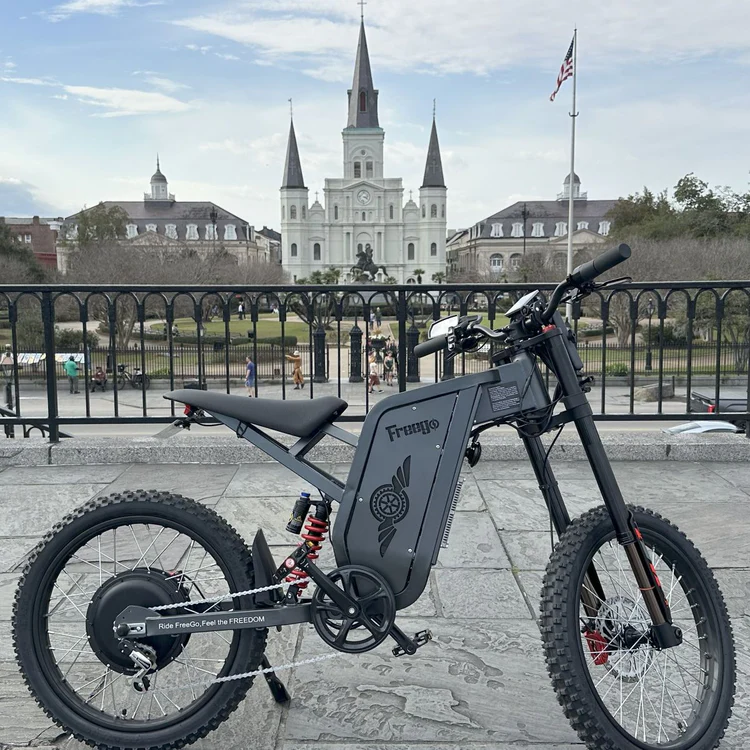
Dual-mode platforms handle paved daily use in urban mode and switch to off-road power modes when the route leaves the road.
Resort, hospitality and outdoor adventure rental. This is the highest-wear application. Conditions are high-frequency public use with 24/7 outdoor exposure and varied rider behaviour, and the operating model depends on IoT-controlled unlocking with swappable batteries, plus commercial-grade durability, real-time GPS tracking and remote fault diagnosis. Freego supports this scenario with IoT modules, a cloud management platform, multi-unit charging docks, cloud-based fleet scheduling and real-time battery monitoring. The mid-drive Nova platforms, with their 40% slope climbing rating, suit terrain-heavy rental sites; X-series hub platforms suit mixed-route fleets.
Light-industry campus and facility operations. Daily short-distance riding on paved roads, bike lanes and mild slopes is the documented condition here, with low noise and intelligent power management doing the practical work. Freego X0, with 14-inch spoke wheels, a 100 kg loading limit and a 50 mi stated range, is a compact option for supervised site movement; X1, at 120 kg loading with 17-inch wheels and a 28 mph urban mode, fits longer internal routes.
Dealer retail for dual-purpose daily riding. A dealer needs one platform that a customer can ride to work and take onto a trail on the weekend. Dual-mode street configurations with a 28 mph urban setting and a separate off-road mode cover that demand, and the mode switch is a sales-floor demonstration rather than a specification line.
Teen and adult dual-use recreation. Nova 3 offers a 28 mph kid-safe setting and a 40 mph Turbo setting on the same 3,000 W mid-drive platform, with a 2-piston hydraulic brake and a 120 kg loading limit. X0 is positioned explicitly for teens and adults with a 3,600 W motor, 40 mph stated top speed and 50 mi stated range.
Off-road leisure, camping and trail riding. Freego Nova 4 and X2 Pro both sit at 6,000 W peak with 60 V 30 Ah batteries, differing mainly in architecture, suspension and brake hardware. Buyers serving camping, hunting and trail customers typically shortlist both and choose on terrain rather than on wattage.
Channel distribution and dealer support. Freego's dealer case data records more than 120 U.S. local e-bike shops in long-term cooperation, purchasing 10 to 20 units per store monthly for an annual total supply above 12,000 units, with 3 to 8 business day spot delivery from the U.S. local warehouse and a 2-year limited warranty supported locally. A separate authorized-dealer case records annual volume of 500 or more units per dealer over 5 or more years, with a 95% dealer retention rate.
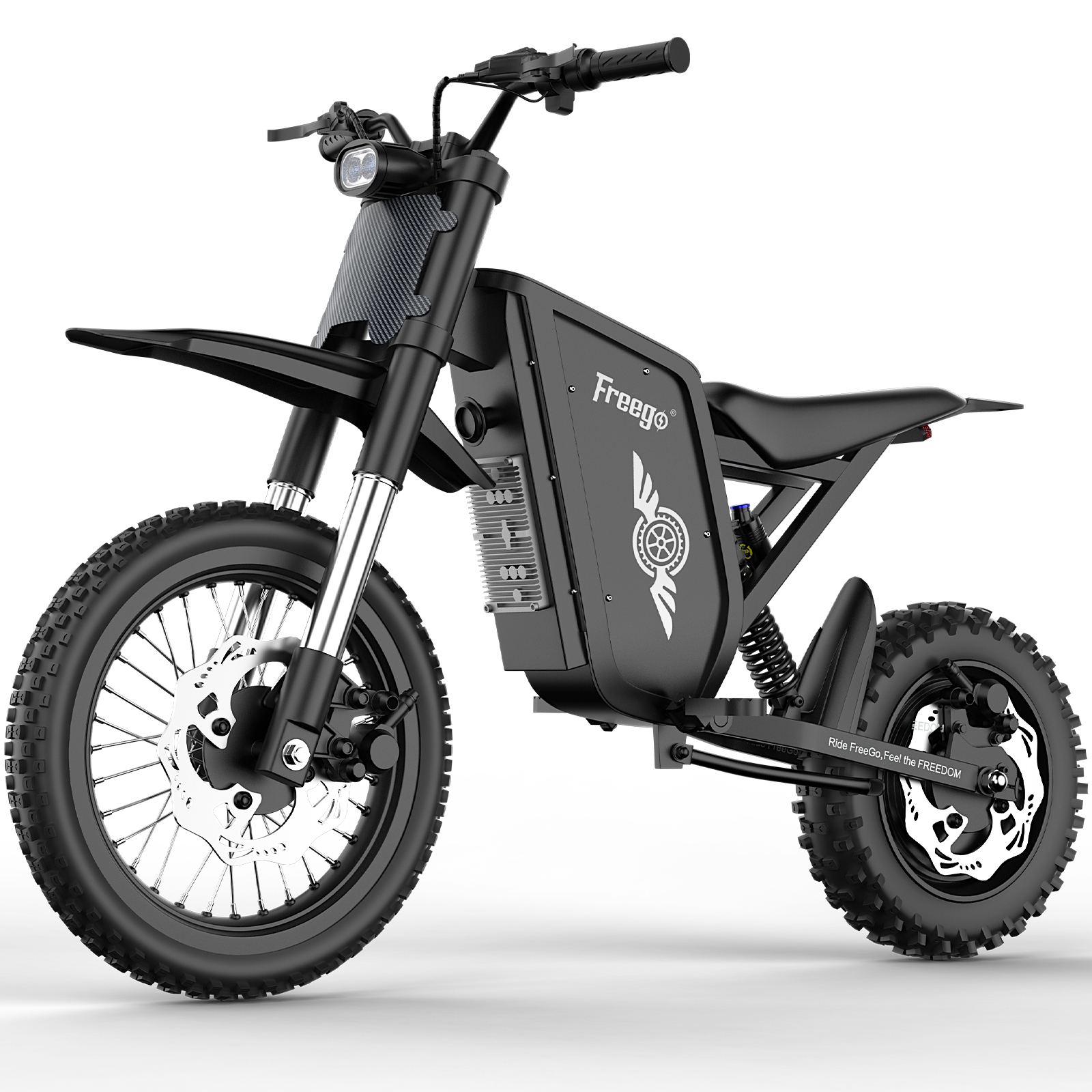
Freego X0: a compact 3,600 W platform for teen and adult daily use, with a 100 kg loading limit.
Model Comparison: Freego Dirt Ebike Platforms by Duty Cycle
The table below compares five Freego platforms using published specifications only. All values are manufacturer-stated; nominal versus peak power is stated exactly as documented for each model.
| Model | Drivetrain | Peak motor power | Battery | Stated top speed | Stated range | Brake / suspension | Best-fit duty cycle |
|---|---|---|---|---|---|---|---|
| Freego X0 | Hub motor | 3,600 W | 60 V 23 Ah 21700 | 40 mph | 50 mi | 2-piston hydraulic / hydraulic front and rear | Supervised site use, teen and adult daily riding |
| Freego Nova 3 | Mid-drive | 3,000 W | 60 V 25 Ah 21700 | 28 mph kid-safe / 40 mph Turbo | 50 mi Eco / 20 mi Sports | 2-piston hydraulic, 220 mm rotor / hydraulic front and rear | Entry-level trail and dual-use recreation |
| Freego X1 | Hub motor | 3,600 W | 60 V 25 Ah 21700 | 28 mph urban / 40 mph off-road | 50 mi Eco / 20 mi Sports | 4-piston hydraulic / KKE hydraulic | Mixed daily routes, light-industry campus patrol |
| Freego Nova 4 | Mid-drive | 6,000 W | 60 V 30 Ah 21700 | 28 mph Eco / 45 mph Sports | 50 mi Eco / 25 mi Sports | 4-piston hydraulic / inverted fork plus OEM shock | Terrain-heavy rental and trail riding, 40%+ slopes |
| Freego X2 Pro | Hub motor | 6,000 W | 60 V 30 Ah 21700, Panasonic/LG cells | 28 mph urban / 50 mph off-road | 56 mi city / 20 mi off-road | 4-piston hydraulic, 203 mm rotor / KKE hydraulic | Longer paved routes plus weekend off-road use |
Two further Freego platforms sit above this group: Nova 5 pro, the Premium Pro-Grade Mid-Drive Electric Dirt Bike, and Nova 5, the High-Power Mid-Drive All-Terrain Electric Dirt Bike. Both are mid-drive and should be specified against the same duty-cycle and compliance questions rather than by wattage alone.
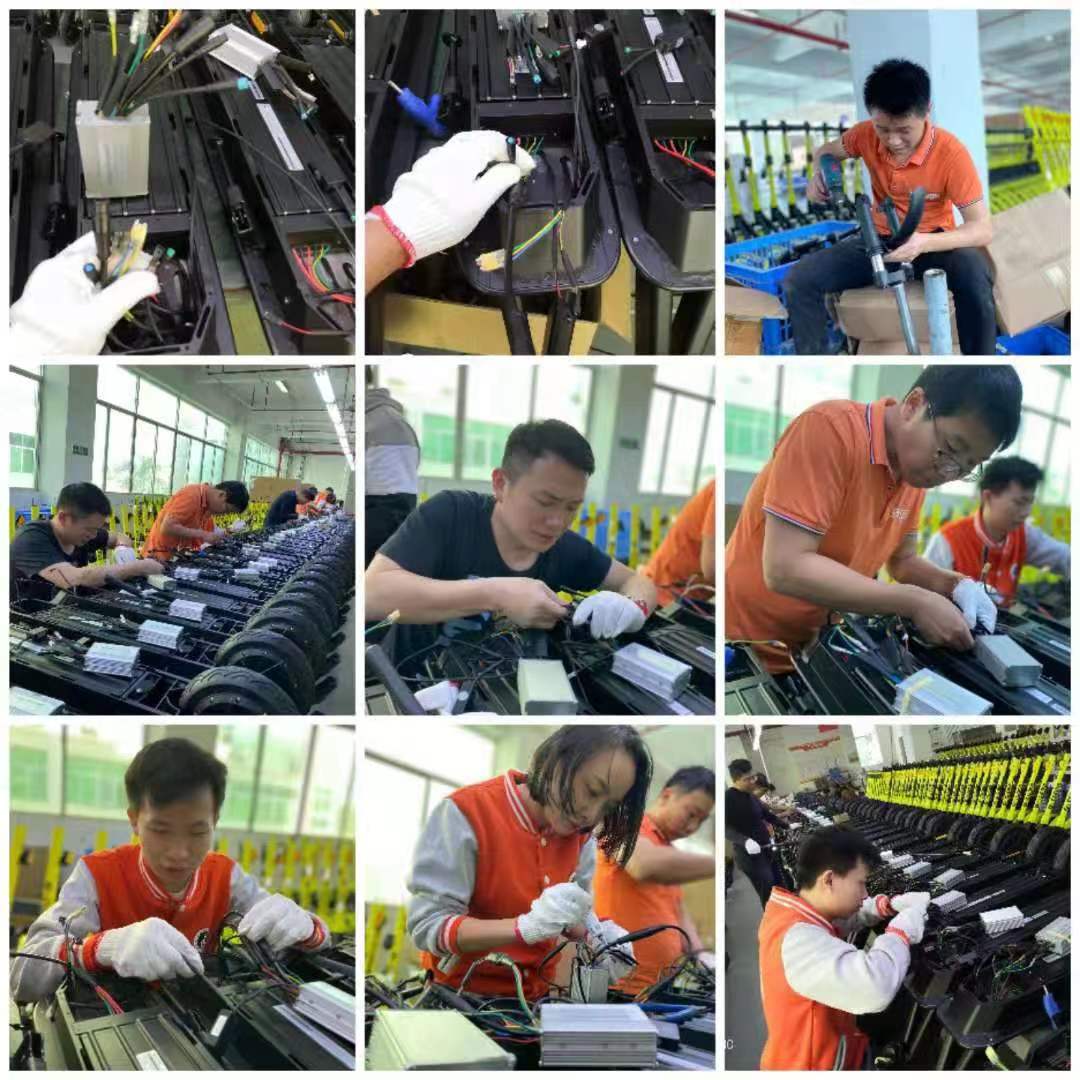
Freego's ODM design centre supports custom vehicle structure design, power and electronic control development, and scenario-based customization.
Dirt Ebike FAQ for B2B Buyers
1. Can a dirt ebike be sold as a street-legal electric bicycle?
Not automatically, and not on the strength of a label. The U.S. Consumer Product Safety Commission standards summary describes an electric bicycle definition involving operational pedals and a maximum speed of less than 20 mph when operated solely by electric power, with full applicability requiring document-level review. Separately, regulatory guidance collected for this guide notes that, as of 2026, electric motorcycles above 750 W without pedals are reclassified as Off-Highway Vehicles in California, requiring registration and decals. Dual-mode configurations with a 28 mph urban setting are a product feature; they do not by themselves establish legal status. Buyers should obtain jurisdiction-specific conformity documents, labelling and test evidence before marketing any high-power dirt ebike as street legal.
2. What should a buyer verify about a dirt ebike supplier's capability?
Verify production footprint, engineering depth, inspection discipline and evidence of sustained volume. For reference, Freego USA Inc. was founded in 2012, operates a 3,000 square metre facility with 50 or more employees and 100 or more in peak season, employs more than 10 R&D engineers, records approximately 20,000 vehicles in annual sales and more than 1 million units in cumulative global sales, and exports about 90% of output to more than 40 countries and regions. Quality control runs under ISO 9001 with 100% incoming inspection of core parts, in-process patrol inspection and 100% full-function ex-factory inspection, with third-party inspection to UL, CE or SGS available.
3. What drives the price band of a dirt ebike?
Four cost drivers dominate: motor architecture and power rating, battery voltage and capacity, brake and suspension grade, and the compliance documentation the target market requires. A 4-piston hydraulic brake with KKE or inverted-fork suspension, as on Nova 4, X1 and X2 Pro, sits in a different cost band from a 2-piston hydraulic specification, as on Nova 3 and X0. Custom ODM work adds design and prototyping scope. This guide does not publish price levels, because validated wholesale or landed-cost data was not available; buyers should request a written quotation against a defined specification and duty cycle rather than benchmark on headline wattage.
4. How should a buyer handle sampling and acceptance testing?
Sample before committing to volume, and test against your own duty cycle rather than the marketing mode. Because range, climbing and waterproofing figures are manufacturer-stated, an acceptance protocol should measure the platform in the mode you will actually operate — for example the Sports or off-road range figure rather than the Eco figure — and should confirm brake hardware, suspension type, tire specification, loading limit and battery configuration against the purchase specification. Order thresholds shape the sample plan: OEM customization starts at 50 units per model, ODM at 100 units per model, and distributor orders at 12 units or one pallet.
5. What lead times should a distributor plan for?
Lead time depends on whether the order is stock or custom. Spot delivery from the U.S. local warehouse runs 3 to 8 business days, including light customization such as logo or packaging. OEM custom production from the China factory runs 45 to 60 days, on regular capacity of 2,000 units per month with peaks above 3,000 units. ODM projects run 15 to 20 days for design and prototyping, followed by 50 to 70 days for mass production after design confirmation, on regular capacity of 1,500 units per month rising above 2,500 units at peak. Plan the first order with buffer, and place repeat orders against confirmed production slots rather than against the initial quotation date.
Conclusion: A Repeatable Selection Rule
Dirt ebike procurement becomes manageable once the sequence is fixed. Define the duty cycle in operational language — trails and slopes above 25 degrees, mixed paved daily routes, or high-frequency public rental use. Resolve the legal classification for each target market with documents rather than labels. Then select architecture and hardware: mid-drive Nova platforms where climbing and torque control lead, hub-motor X platforms where terrain is mixed and drivetrain simplicity pays back in service hours. Only then compare wattage, and compare it on a like-for-like nominal or peak basis.
The supplier question is answered the same way, with verifiable facts rather than adjectives: facility size and headcount, engineering depth, inspection regime, warranty terms, spare-parts location and service coverage. Freego's published position — a 3,000 square metre facility in Chino, California, 50 or more employees rising to 100 or more at peak, more than 10 R&D engineers, roughly 20,000 vehicles sold annually and over 1 million cumulative, ISO 9001 quality control and a 2-year limited warranty with U.S. local spare parts — is the kind of data a buyer can actually verify during supplier qualification.
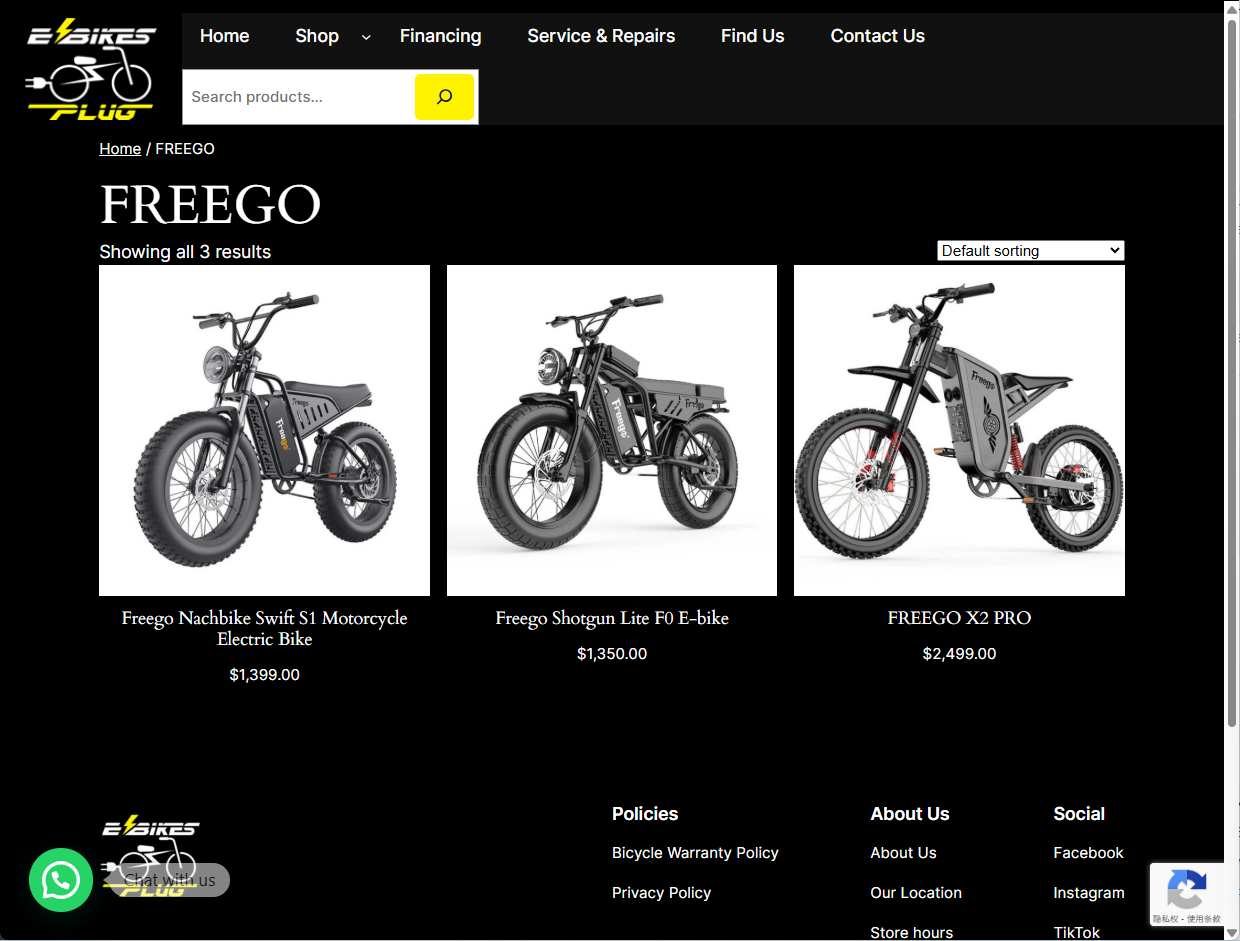
Freego supports authorized dealers with regional distribution terms, U.S. warehouse stock and local after-sales coverage.
Next step: request a specification match
Send your duty cycle, target market and expected annual volume, and Freego will map the request to a platform, confirm the applicable compliance documents and quote commercial terms.
Contact: Ahmed | Email: Ahmed@freegobikes.com | Service: Service@freegobikes.com
Tel: +1 818 275 1590 | WhatsApp: +1 310 678 1530
Address: 3681 Walnut Ave, Chino, CA 91710 | Website: freegobikes.com | Blog: blog.freegobikes.com
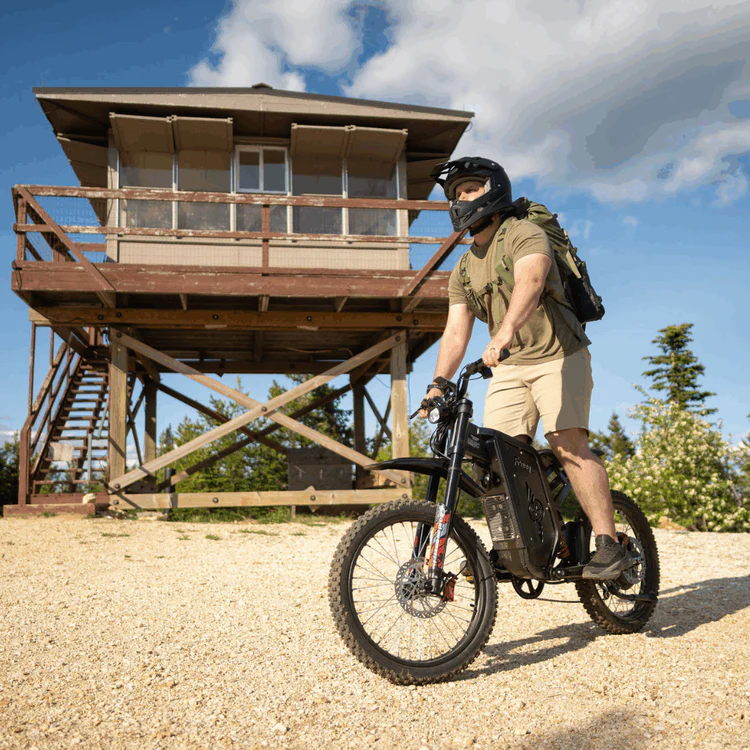
Ready to match a platform to your project? Share your duty cycle and target market to start the specification review.
Have Questions or Need More Details?
Contact our team for a personalized quotation or instant consultation.
Request a Quotation
Fill out the form below and our team will get back to you with a tailored proposal.
WhatsApp Direct Chat
Prefer to chat in real-time? Message us on WhatsApp for instant assistance & quick answers.
- Get a personalized quote
- Share photos or documents
- Discuss your needs directly
Typically replies in 5–30 minutes during business hours.