Dirt Ebike Price-to-Spec Comparison: Dual-Mode Street-Legal vs Off-Road-Only Models
The electric dirt bike market is projected to grow from about USD 2.8 billion in 2025 to USD 7.6 billion by 2034. For buyers approaching a final dirt ebike purchase decision, the challenge is not simply finding the strongest motor specification. It is comparing street-legal dual-mode models with off-road-only models on legal compliance, motor layout, delivered price, dealer margin, delivery time, and after-sales support.
This article walks through that price-to-spec comparison. The Freego X2 Pro is used as an example of a street-legal dual-mode dirt ebike, and the Surron Light Bee X is used as a mainstream high-end off-road-only benchmark in the US market. The objective is to give buyers a repeatable comparison process, not a single universal winner.
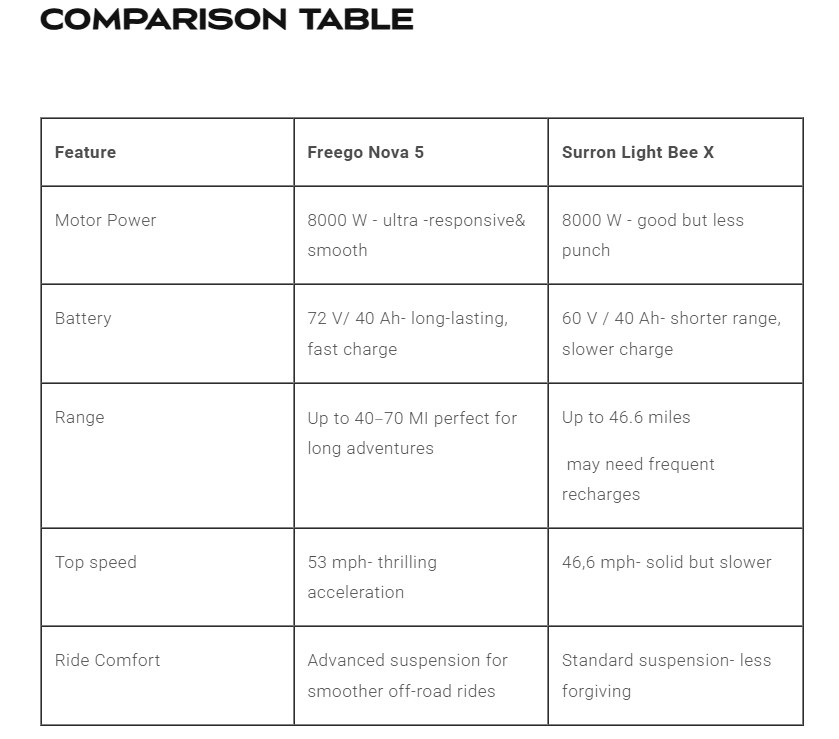
Freego X2 Pro vs Surron Light Bee X comparison data cited in this article.
Why Dirt Ebike Comparison Goes Beyond Top Speed
Two dirt ebikes can look similar on paper and still be in different legal and commercial categories. A 50 mph off-road model may be intended only for closed courses, while a dual-mode model can legally operate on public streets in its lower-speed urban mode. If a buyer only compares motor power or battery voltage, these regulatory and use-case gaps remain invisible.
The three most common comparison mistakes are:
- Ignoring street-legal classification and buying a model that cannot be used on local roads.
- Choosing a motor layout without considering whether the bike will be used mostly off-road, mostly urban, or both.
- Comparing unit price without adding delivery time, warranty, spare parts, certification, and dealer margin to the total value equation.
For decision-stage buyers, these issues matter more than marketing claims. This is why the rest of the article uses a procurement-oriented dirt ebike comparison framework.
Electric Dirt Bike Industry Background in 2026
Third-party market research used for this article projects the global electric dirt bike market at approximately USD 2.8 billion in 2025, with expectations of reaching USD 7.6 billion by 2034. Asia Pacific is estimated to lead regional demand, accounting for about USD 1.02 billion, or 36.4 percent, of global revenue in 2025.
In the high-performance segment, publications covering the electric motorcycle market identify Sur-ron, Talaria, and Stark Future as principal competitors. At the same time, regulatory classifications are becoming more important. In the US, e-bikes are divided into Class 1, Class 2, and Class 3, with a maximum assisted speed of 28 mph for Class 3. Vehicles that exceed those limits are generally regulated as off-road motor vehicles. In the EU, Regulation 168/2013 classifies light electric vehicles into L-category groups such as L1e and L3e.
Freego USA Inc., founded in 2012 and headquartered in Chino, California, is one manufacturer operating in this environment. It is a Sino-US electric mobility company whose products include electric off-road motorcycles, fat-tire e-bikes, city e-bikes, and three-wheeled recreational vehicles. Freego developed the X-Man series with a dual-mode system to address both street legality and off-road performance.
How to Compare Dual-Mode Street-Legal and Off-Road-Only Dirt Ebikes
1. Check Legal Configuration Before Price
Street legality is a configuration feature, not a decoration. The Freego X Series dual-mode system includes a City Mode that is Class 3 compliant at 28 mph and 750W. It also includes an Off-Road Mode for closed-course use or private land. The US Class 3 framework tops out at 28 mph, so any higher-speed mode automatically belongs to the off-road category.
In the Freego X2 Pro, this street-legal dual-mode design is expressed as a 28 mph urban mode and a 50 mph off-road mode. The comparison data used in this article states that the Surron Light Bee X base configuration is off-road-only. Therefore, a buyer who needs road access plus competitive off-road speed should compare dual-mode models rather than assuming all high-performance dirt bikes are the same.
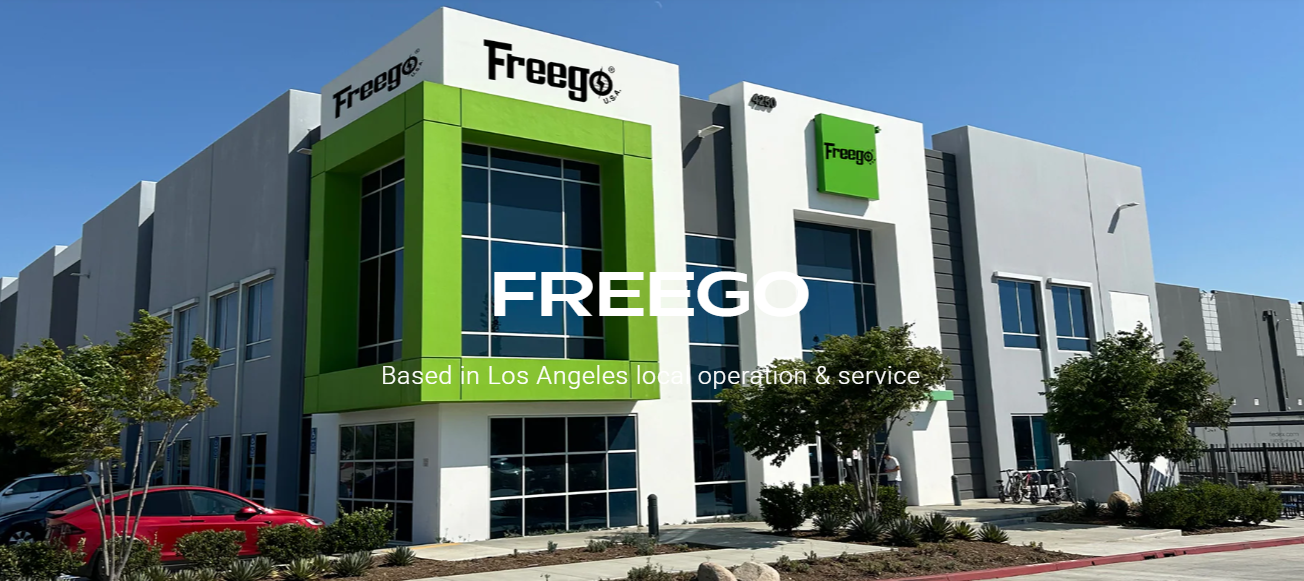
Freego USA Inc. is headquartered in Chino, California, and supports US buyers with a local location.
2. Assess the Motor System for Real-World Riding
Motor placement changes how a dirt ebike feels and where it is most efficient. Mid-drive motors are increasingly preferred for off-road riding because they centralize weight and multiply torque through the bike's gear system. Hub motors, by contrast, are installed in the rear wheel and can simplify the drivetrain, which may help with urban efficiency.
The Freego X2 Pro uses a hub motor system. In the supplied Freego comparison data, that system is described with 15 percent higher energy conversion efficiency and 20 percent longer range per kWh of battery capacity in urban riding mode. For a buyer who will use the same bike for commuting and recreational off-road riding, this efficiency supports lower running costs. For a buyer who will ride steep slopes all day, torque and suspension may deserve more weight in the scorecard.
Buyers who need very high torque and long range should also look at high-voltage models. Freego's X3 Pro, for example, is positioned in the 8000W peak motor segment with a 72V 50AH lithium battery. That specification is a separate category from the X2 Pro comparison above, but it illustrates why model-level specification review is necessary.
3. Use Certification and Risk Control as Evaluation Evidence
Certification evidence belongs in the purchase equation because it protects against electrical, battery, structural, and compliance failures. The Freego risk-control file references UL 2849 safety certification and ISO 9001:2015 end-to-end quality control. It also lists intelligent BMS management, high-strength material application, dual-mode functionality technology, and US-based technical support as control measures.
For a US dealer, UL 2849 documentation is a practical purchasing checkpoint. It is not enough to see a price list; the buyer should verify that the certificate matches the exact model being considered.
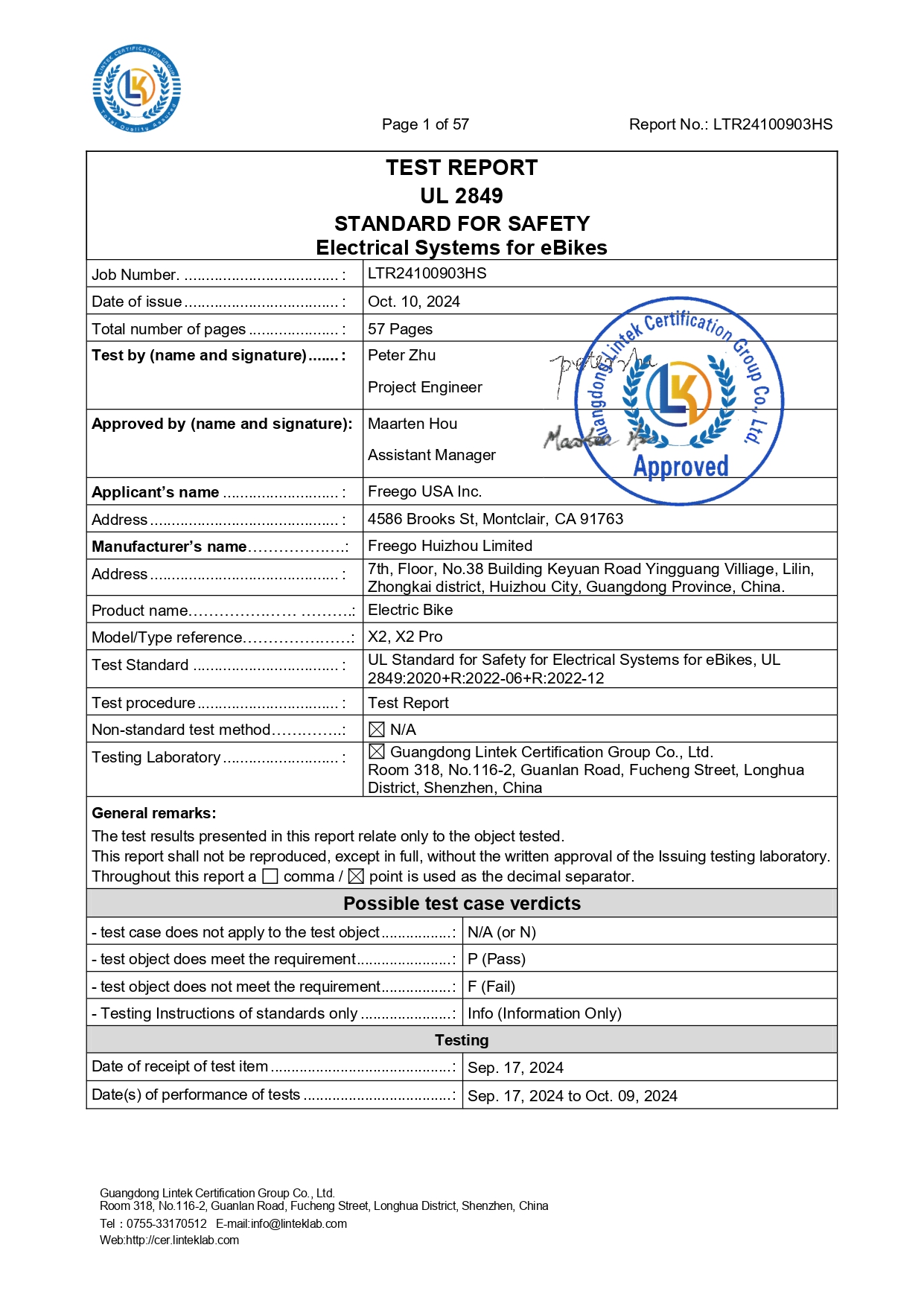
Freego X2 and X2 Pro UL 2849 certificate page.
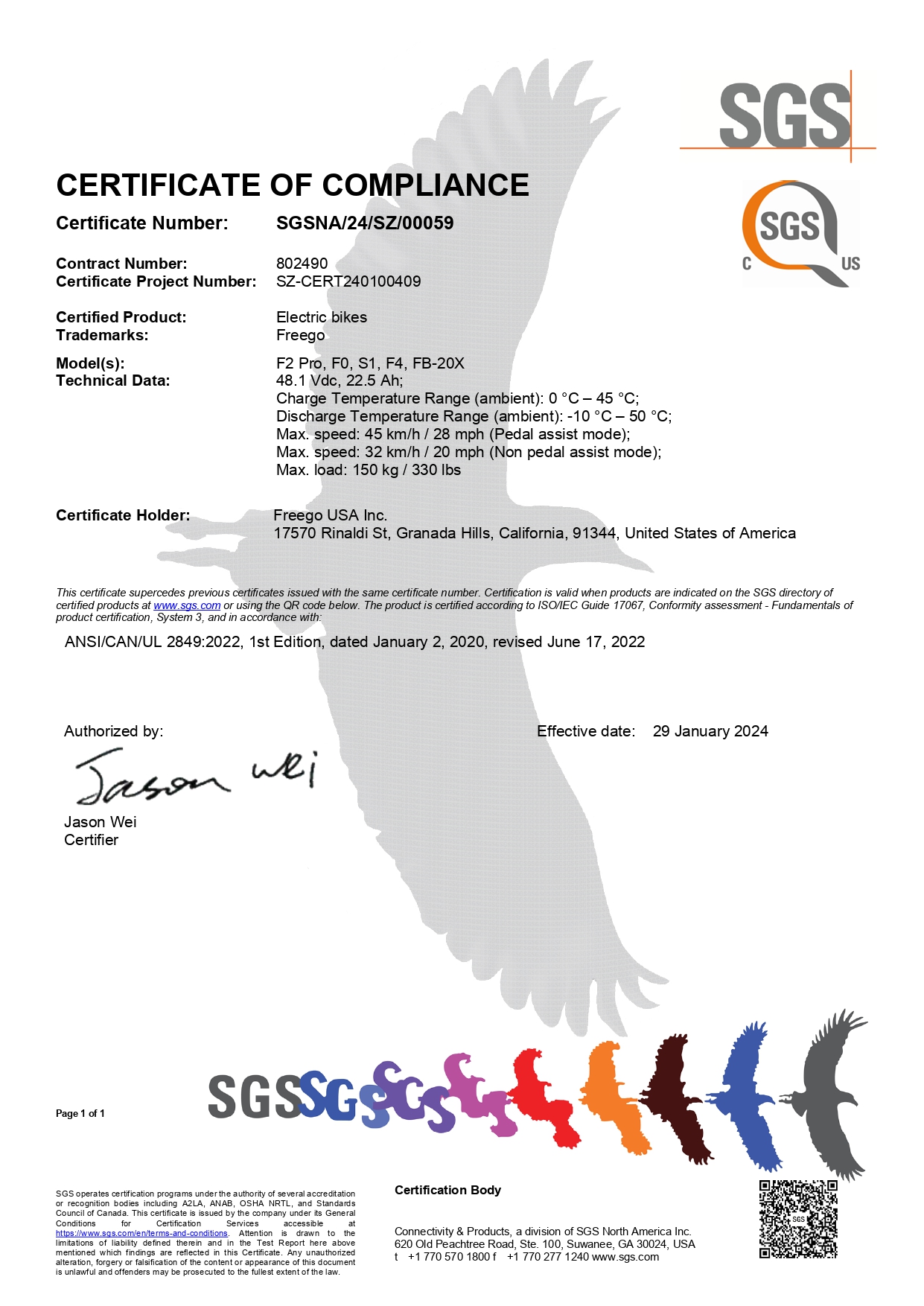
DSS SGS report referenced in Freego risk-control documentation.
4. Factor in Delivered Cost, Dealer Margin, and Support
The Freego X2 Pro has a US MSRP reference of USD 2,499, while the Surron Light Bee X is listed above USD 4,500. In the same comparison data, Freego reports dealer margin potential of about 30 percent, compared with about 20 percent for the competitor. If those figures hold in negotiation, they change the business case for a dealer.
Delivery and support also affect value. Freego lists a US local supply delivery window of 3 to 8 business days, versus 45+ days for an overseas shipping scenario. Local US orders avoid extra customs duties and international shipping fees. The Freego support system includes a US after-sales service center, spare-parts warehouse, technical support team, 2-year limited warranty, and 14-day return policy.
For a dealer, faster delivery means faster shelf placement. For a fleet buyer, local spare parts mean less downtime. These benefits are not speculative; they are part of the supplier's stated operating model.
Step-by-Step: Run a Dirt Ebike Price-to-Spec Comparison
- Map the operating path. Determine if the bike will use public roads, off-road trails, or both. If it needs road access, mark street-legal dual-mode as a required feature.
- Verify certification at SKU level. Request UL 2849, ISO 9001:2015, or other regional certificates for the exact model.
- Compare motor configuration. Use terrain as the main filter: mid-drive for off-road torque behavior; hub motor for integrated simplicity and urban efficiency.
- Set performance targets. Check speed, peak power, battery voltage, and capacity. For extended desert riding or steep slopes, a high-torque model such as the 8000W Freego X3 Pro may better fit.
- Evaluate after-sales coverage. Confirm where the spare-parts warehouse is located, how warranty claims are handled, and whether technical support is staffed in the buyer's market.
- Run a cost model. Add MSRP, shipping, customs, margin potential, and inventory-turn assumptions. Include the cost of downtime.
- Request a sample unit or detailed quotation. Use that process to test whether the supplier can support the volumes and service level stated.
Use Cases: Where Dual-Mode and Off-Road-Only Configurations Win
Powersports dealers and multi-brand retailers
Dealers often need lines that will sell in more than one season. A dual-mode dirt ebike such as the Freego X2 Pro extends the addressable buyer pool from off-road enthusiasts to commuters looking for an aggressive platform. Local delivery and US support reduce the risk of carrying product that cannot be serviced.
Off-road experience venues and private tracks
Rental or experience venues control their own land, so street legality is not the top criterion. These buyers can compare suspension, torque, and durability first. If off-road-only models from other brands meet their track duty requirements, the final decision may be simpler.
Urban riders with weekend trail access
Riders who live in a city but ride trails on weekends need one machine that can make the legal trip from home to trailhead. The X2 Pro's 28 mph Class 3 City Mode plus its 50 mph Off-Road Mode makes it a different product from an off-road-only race bike.
Freego X2 Pro vs Surron Light Bee X: Value Comparison
The table below consolidates data from the Freego comparison file. It is not a complete specification list; it is a procurement comparison used to evaluate dual-mode versus off-road-only value.
| Comparison Factor | Freego X2 Pro | Surron Light Bee X |
|---|---|---|
| Configuration | Street-legal dual-mode: 28 mph urban mode plus 50 mph off-road mode | Off-road-only base configuration |
| US price reference | USD 2,499 MSRP | USD 4,500+ |
| Dealer margin potential | About 30 percent in the comparison dataset | About 20 percent in the comparison dataset |
| US delivery lead time | 3 to 8 business days from local supply | 45+ days for overseas shipping scenario |
| Warranty and support | 2-year limited warranty; US after-sales center and spare-parts warehouse; dedicated US technical support | Overseas-only after-sales support in the comparison dataset |
| Return policy | 14-day hassle-free return | Not specified in the comparison dataset |
| Suitability | Off-road adventure, urban commuting, dealer retail, off-road experience venues | High-end off-road performance segment |
Table source: Freego comparison dataset, US market reference. Figures should be re-validated with the supplier during procurement.
Dirt Ebike Decision FAQ
What is the practical difference between a street-legal dual-mode dirt ebike and an off-road-only dirt ebike?
A dual-mode street-legal dirt ebike gives the rider a lower-speed legal setting for roads plus a high-speed setting for off-road use. The Freego X2 Pro, for example, has a 28 mph urban mode within the US Class 3 framework and a 50 mph off-road mode. An off-road-only model starts from a configuration that lacks this road-legal mode, so it cannot be treated as an e-bike on public roads.
How should I compare street-legal dual-mode brands with off-road-only brands?
Compare each SKU on three levels: legal configuration, motor system, and commercial support. In the data reviewed here, Freego demonstrates the dual-mode feature at model level with the X2 Pro. Brands such as Sur-ron, Talaria, and Stark Future are high-performance off-road names in the broader market, but the buyer must verify whether each exact model provides street legality. Model-level comparison is more reliable than brand-level generalization.
How does Freego X2 Pro compare with Surron Light Bee X on price and value?
In the benchmark used for this article, the Freego X2 Pro lists at USD 2,499 with a 28 mph and 50 mph dual-mode configuration, while the Surron Light Bee X lists above USD 4,500 as an off-road-only model. The dataset also reports a higher dealer margin range for Freego and a shorter US delivery window. Buyers should still validate these figures with their own cost model before purchase.
What support, warranty, and lead time does Freego provide for US buyers?
Freego USA Inc. is headquartered in Chino, California, and the comparison file lists a US after-sales service center, spare-parts warehouse, dedicated US technical support, a 2-year limited warranty, and a 14-day return policy. US local delivery is quoted as 3 to 8 business days versus 45+ days for an overseas shipping scenario. These benefits are part of the total cost because they reduce waiting time and downtime.
Can I request a sample or quote before making a final decision?
Yes. Freego supports buyer due diligence with sample and quotation requests. Buyers can contact the dealer team at Dealers@freegobikes.com or call +1 818 275 1590. The current product brochure can be downloaded from the Freego website as a starting reference.
Conclusion: Compare the Full Value Chain, Not Just the Dirt Ebike Price
Dirt ebikes are no longer a single-purpose product. The 2026 market includes street-legal dual-mode models, off-road-only race machines, and high-torque long-range options. The right choice depends on whether the rider needs legal road access, what terrain the bike will see, and how the dealer will support the product after the sale.
In the model-level comparison used here, the Freego X2 Pro is offered at a lower MSRP than the Surron Light Bee X while adding a 28 mph street-legal urban mode and a 50 mph off-road mode. It also carries local US support, a 2-year limited warranty, and a 14-day return policy. Buyers should compare those factors against their own use case and confirm all figures with the supplier before ordering.
Next step: download the Freego product brochure to compare model specifications side by side: Freego Dirt Ebike Brochure (PDF). For dealer pricing and sample availability, email Dealers@freegobikes.com.
Have Questions or Need More Details?
Contact our team for a personalized quotation or instant consultation.
Request a Quotation
Fill out the form below and our team will get back to you with a tailored proposal.
WhatsApp Direct Chat
Prefer to chat in real-time? Message us on WhatsApp for instant assistance & quick answers.
- Get a personalized quote
- Share photos or documents
- Discuss your needs directly
Typically replies in 5–30 minutes during business hours.