Dirt Ebike Tier Comparison: Entry-Level vs Mid-Grade vs Premium Mid-Drive Models
Tier comparisons usually fail at the same point. A dealer lines up three dirt ebikes, reads the motor numbers, stocks the biggest one, and later finds it does not suit the trail the shop's customers actually ride — or that the service load eats the margin. This guide compares entry-level, mid-grade and premium pro-grade mid-drive tiers the way a dealership should: by rider profile, terrain, duty cycle and service capability, with compact and medium-size frame options handled as a separate configuration decision.
Every product figure below comes from Freego's published company, product and comparison material, or from the third-party records named in the text. Company-reported values are labelled, and where the published record does not settle a question, the article says so instead of filling the gap.
Short answer: compare tiers on four variables — rider, terrain, duty cycle and service plan — and treat motor architecture, battery voltage and headline power as confirmation fields rather than the ranking itself. Freego's own product material classifies the Nova series as mid-drive and the X series as hub-motor, so within that portfolio "premium" and "mid-drive" are not interchangeable. Fix the tier map, frame size and specification definitions in writing with the supplier before a stocking order.
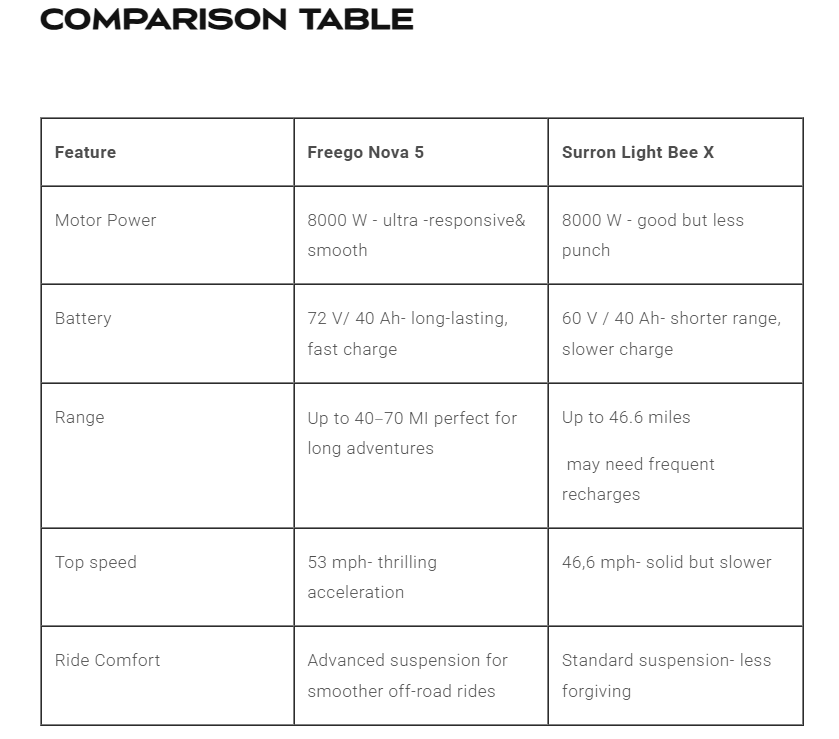
Freego's published X2 Pro versus Surron Light Bee X comparison — a brand-reported comparison used here as a cost-structure reference, not as independent test evidence.
Why tier comparison is harder than it looks
Four definition problems decide whether a tier ladder is real or decorative.
Power language. A marketplace parameter table for the Freego X2 lists 3000 W nominal and 6000 W peak; the Nova 5 product listing states 8000 W peak; the X3 Pro is described with 8000 W peak from a hub motor. Nominal and peak describe different quantities — sustained capability versus short-burst output — so a ladder that mixes them is comparing two different measurements. Keep both columns, and ask which definition sits behind any single number a supplier quotes.
Architecture. Freego's product material splits its off-road line into a mid-drive family (Nova) and a hub-motor family (X). If the premium requirement is written as mid-drive, a premium-priced hub model does not satisfy it. This matters most in the top tier, where assumptions about power and drivetrain tend to travel together.
Test conditions. The Nova 5 listing states a 40–70 mile range and a 53 mph top speed; the X1 SE listing states 25–50 miles. Neither figure carries a stated test protocol in the material reviewed here. A range band is a screening tool, not a promise you can repeat to a customer who rides steep, loose terrain in cold weather.
Legality. Classification is not a spec line. A 28 mph street-legal mode is a product function; whether the vehicle is legally a bicycle, a motorcycle or an off-highway vehicle in a given state depends on the local rule set, not on the label the factory uses.
What changed in the 2026 market and rule set
A category that is expanding invites tier overlap. Commercial research published by Dataintelo estimates the global electric dirt bike market at $1.47 billion in 2025, projected to reach $5.0 billion by 2035. That is a research forecast from a commercial source, not a measured shipment count, so use it to explain why the shelf is getting crowded — not as a demand guarantee for a specific model. The practical consequence of a widening category is more unnormalized claims across tiers, which raises the value of a comparison process and lowers the value of a spec-sheet ranking.
On the compliance side, two records matter for high-power product. US EPA certification guidance for electric motorcycles records that, as of 2026, electric motorcycles above 750 W without pedals fall under California's Off-Highway Vehicle rules and require registration and decals. Separately, a CPSC summary of electric and non-powered bicycle standards describes an electric bicycle definition built around operational pedals and a maximum speed below 20 mph when operated solely on electric power; that summary needs document-level reading before anyone applies it to a label. Read together, the two records explain why a high-power dirt ebike can be a legitimate product and still be unsellable as a street bike in a particular market.
What the available record does not contain is equally useful: no validated wholesale price index for 72 V systems, no dealer inventory-turnover data, and no independent climbing, braking or waterproofing results for these models. Those gaps are exactly why the process below leans on written confirmations and a dealer-run sample rather than on catalog claims.
The three-tier ladder, described by decisions
Entry-level: the first bike and the shortest service tail
Entry-level is a rider-fit tier, not a cheap tier. It serves the first-time off-road rider, shared teen and adult use, and rental lines where a wide range of customers rides the same bike. Terrain expectations should stay modest: graded fire roads, light all-terrain paths and low-speed technical sections, on a frame the rider can control at a standstill.
The documented lower-power reference point in Freego's current material is the X1 SE listing, which states 750 W, a 60 V 25 Ah battery, a 25–50 mile range, full suspension, and front and rear four-piston hydraulic disc brakes. The company describes that model as an all-terrain electric bike with full hydraulic suspension and four-piston braking — a package that shortens the service tail because brake and suspension work stays familiar to any bike mechanic. Figures are company-reported and no independent test report was located in the reviewed record.
Dealer question that closes this tier: will this rider outgrow the power within one season? If yes, the entry bike becomes a trade-in and the margin math changes.
Mid-grade: the mixed-duty workhorse
Mid-grade is defined by the range of use, not by a number. It covers the owner who commutes during the week and rides trail at the weekend, and rental operators whose customers arrive with mixed skill. The buying problem here is configuration ambiguity: one model name can span more than one specification set.
Freego's X2 appears in a marketplace parameter table listing 3000 W nominal, 6000 W peak and a 60 V 30 Ah battery — marketplace data that should be confirmed directly with the supplier. The X2 Pro, by contrast, is presented in Freego's own comparison material as a dual-mode street-legal machine with a 28 mph urban mode and a 50 mph off-road mode, at a stated MSRP of $2,499. Two models, one family, different claims: this is precisely the point where a dealer should stop reading and start requesting a written configuration sheet.
Dealer question that closes this tier: which two duties must this one bike cover? The answer decides brakes, fork and battery capacity far more reliably than a wattage shortlist.
Premium pro-grade mid-drive: capability you must be able to support
The premium tier is where the mid-drive question actually lives in Freego's portfolio.
The Nova series is the family Freego's product material describes as mid-drive. The Nova 5 listing states 8000 W peak, a 72 V 40 Ah battery, a 40–70 mile range, a 53 mph top speed, an aluminum alloy frame, four-piston hydraulic disc brakes with 220/200 mm rotors, and 19-inch front with 18-inch rear tires. Those are company-reported figures from a regional product page, with no stated test protocol and no independent verification in the material reviewed for this guide.
For dealers, the premium tier is a capability commitment rather than a specification peak. A 72 V system, high-torque motor and heavy-duty brake package imply a service environment that can handle high-voltage battery diagnostics, faster brake wear and heavier duty cycles. If the shop cannot support that, the premium bike becomes a warranty liability with a good spec sheet.
Dealer question that closes this tier: who holds the parts, and who performs diagnostics in year two?
Compact and medium-size options: configuration, not tier
Frame and wheel configuration cuts across all three tiers and should never be sold as a tier of its own. A compact build suits tight technical trails, smaller or younger riders, and transport or storage constraints; a medium-size build suits mixed adult duty and longer days in the saddle. The Nova 5's 19-inch front and 18-inch rear tires show that even within one model, wheel specification is a deliberate design choice with handling consequences.
No verified geometry set — seat height, wheelbase, standover clearance — was supplied for the models discussed here. Request that sheet for the exact compact and medium configurations you intend to stock, and put a tape measure on the sample before ordering. Sizing errors fail at the counter more often than power errors do.
A six-step comparison process for the showroom floor
- Fix the terrain band first. Describe the three trails your customers actually ride, including surface, gradient and typical ride length. Tiers are chosen against terrain, not against each other.
- Profile the rider. Height, weight range, experience, and whether the bike will be shared. Shared bikes push you toward adjustable, forgiving configurations; single-rider performance use allows a more specialized build.
- Set the duty cycle. A private owner riding twice a week and a rental fleet running daily have different brake, tire and battery expectations. Write the duty cycle into the comparison so the service plan can be costed.
- Normalize the specification language. Require nominal and peak motor power as separate fields, voltage and capacity in one format across candidates, and an explicit statement of whether a range or speed figure is stated, tested or simulated.
- Design the service plan before pricing. Parts depth, brake consumables, battery handling, diagnostic tooling and turnaround time. A tier is only affordable if the service plan closes.
- Verify legality and documents, then sample. Classification memo for your market, safety file, warranty terms — then a dealer-run sample on your own terrain before the first stocking order.
Scenario matching: which tier fits which buyer
The following are conditional examples that show how the four variables combine. They are not verified customer cases.
- Urban commuter who rides trail at weekends. Look at dual-mode product where the street function is documented. Freego presents the X2 Pro as dual-mode with a 28 mph urban mode and a 50 mph off-road mode; confirm the legal classification for your state before advertising street use.
- Off-road experience venue or adventure-sport retailer. Freego's comparison material lists off-road adventure sports, powersports dealer retail and off-road experience venues among the intended uses of the X2 Pro, a hub-motor model. If the venue brief specifies mid-drive, the Nova family is the matching family in the published taxonomy.
- First-time adult, or shared teen and adult use. Stay in the lower power band, prioritize control and braking, and accept that the bike may be traded in. The X1 SE listing's 750 W, full suspension and four-piston brakes describe that profile.
- Tight forest trail with frequent low-speed maneuvering. Compact configuration first, tier second. Wheel size and wheelbase change the riding experience more than a moderate power difference at these speeds.
- Desert adventure or sustained climb work. This is premium-tier terrain, and also where dealer verification matters most: request a climbing or thermal test protocol, or run an instrumented sample ride, because none of the published figures reviewed here carry stated test conditions.
- Mixed-duty rental line. Mid-grade, medium-size, with a service plan that treats brake and tire replacement as routine cost. A premium bike in a beginner rental pool usually raises damage cost faster than it raises revenue.
Side-by-side tier table
| Decision variable | Entry-level | Mid-grade | Premium pro-grade mid-drive |
|---|---|---|---|
| Primary buyer | First-time off-road rider; shared teen and adult use; beginner rental pool | Mixed-duty owner: weekday commute, weekend trail; rental line with varied riders | Experienced rider; adventure-sport operator; performance-focused retail |
| Terrain band | Graded fire roads, light all-terrain paths, low-speed technical sections | Mixed trail with moderate climbs and changing surfaces | Sustained climbs, desert and high-load off-road duty, confirmed by sample testing |
| Published Freego reference point | X1 SE listing: 750 W, 60 V 25 Ah, 25–50 mi stated range, full suspension, front and rear four-piston hydraulic disc brakes (company-reported) | X2 marketplace table: 3000 W nominal, 6000 W peak, 60 V 30 Ah (marketplace data; confirm with supplier). X2 Pro described as dual-mode, 28 mph urban / 50 mph off-road (brand comparison) | Nova series is the mid-drive family; Nova 5 listing: 8000 W peak, 72 V 40 Ah, 40–70 mi stated range, 53 mph stated top speed, four-piston hydraulic discs with 220/200 mm rotors, 19 in front / 18 in rear tires (company-reported) |
| Braking and suspension check | Confirm pad availability and service interval for the four-piston setup | Confirm rotor size and fork type per model; inverted hydraulic fork is described in X3 material | Confirm fork type, rotor size and consumable intervals before stocking parts |
| Legal check | Pedal and speed classification still applies; size and price imply nothing | Request a jurisdiction-specific classification memo before any street claim | High power without pedals can trigger off-highway classification (California threshold: above 750 W without pedals) |
| Service load | Brake pads, tires, basic diagnostics; shallow parts inventory | Adds battery and controller diagnostics; plan for moderate parts depth | Adds high-voltage battery handling, thermal checks, heavier brake wear under load |
| Question that closes the tier | Will the rider outgrow the power in one season? | Which two duties must this single bike cover? | Can we service this locally, and who holds the parts? |
Reference points are published listings, not tier assignments. Confirm the tier map and configuration for the exact model and market you order.
What to get in writing before the purchase order
| Item to request | Why it changes the tier decision |
|---|---|
| Motor declaration stating nominal and peak power separately, with the measurement basis | Prevents a mixed-metric comparison between two tiers and stops a peak figure being sold as sustained output |
| Electrical safety and quality file, for example UL 2849 documentation and ISO 9001:2015 quality-system evidence | Shows which controls sit behind the listing; Freego's risk documentation lists UL 2849 certification, an intelligent BMS, dual-mode functionality and high-strength materials as its controls |
| Written legal classification for the destination market | Separates an e-bike claim from a motorcycle or off-highway claim, which changes channel, insurance and labeling |
| Range and speed test protocol, or agreement on a dealer-run test | Converts a stated band such as 40–70 miles into a statement a salesperson can defend |
| Spare-parts list with lead times, warranty and return terms | Makes the service load visible before the stock arrives and before margin is committed |
| Frame geometry for compact and medium configurations: seat height, wheelbase, wheel size | Sizing errors are the most common reason a tier decision fails at the counter |
Where the published evidence stops
Honest limits protect a dealer better than confident copy does.
- No independent laboratory results for climbing, acceleration, braking distance, thermal behaviour or waterproofing were located for these models in the material reviewed.
- Motor figures are company-reported and mix nominal and peak definitions. The X3 material even presents 40 Ah and 50 Ah battery variants without a resolved configuration identifier — a reason to confirm the exact variant rather than averaging the numbers.
- The X2 Pro versus Surron Light Bee X comparison is Freego's own material about its own product. It states a $2,499 MSRP against $4,500+, a 44% lower MSRP, a 30% dealer margin against 20%, and 3–8 business days of US local delivery against 45+ days of overseas shipping. Treat these as brand claims that must be re-checked at the time of order, including current competitor pricing.
- Regulatory status is jurisdiction-specific. The California off-highway threshold and the CPSC bicycle-standards summary describe different rule contexts, and neither substitutes for a classification opinion covering your market.
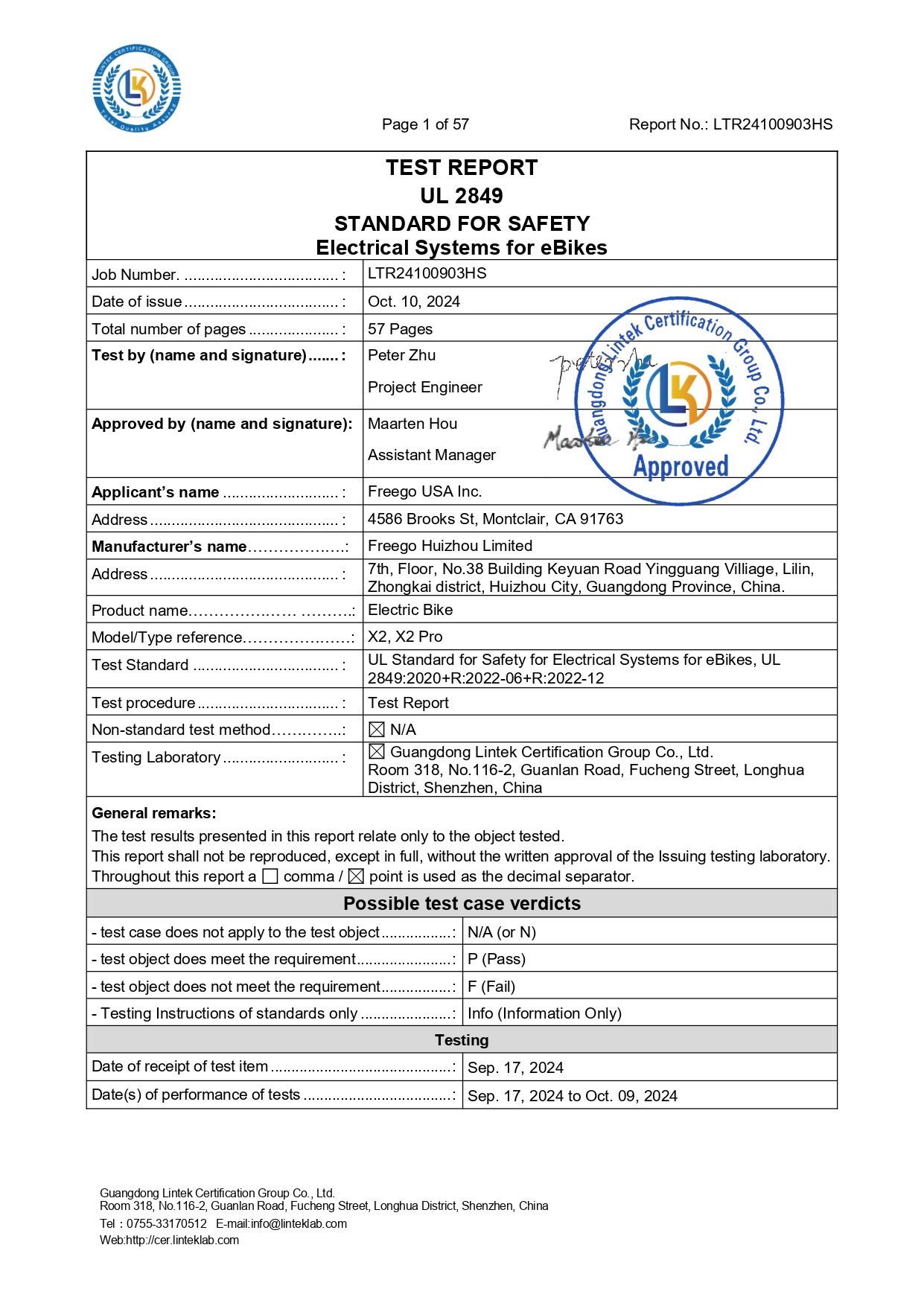
UL 2849 certification documentation for Freego X2 and X2 Pro — one of the safety controls listed in Freego's risk-control material.
Supplier confidence: what Freego publishes about its operation
Freego USA Inc. was founded in 2012 and is headquartered in Chino, California. The company reports a 3,000 m² facility, an R&D team of more than 10 engineers, 50 or more employees rising above 100 in peak season, approximately 20,000 vehicles sold annually, cumulative global sales above 1 million vehicles, and a 90% export share across more than 40 countries and regions, including the United States, Germany, Italy, France, South America and Southeast Asia.
On process and service, the company cites end-to-end quality control under ISO 9001:2015, UL 2849 safety certification among its battery and electrical controls, global patent and insurance coverage, and a US-based technical support team. Its published comparison material for the X2 Pro also lists a US spare-parts warehouse, a 2-year limited warranty and a 14-day return window.
For a dealer, the 10+ engineer R&D team and the 3,000 m² facility matter for one practical reason: they are the parts of the offer that can absorb a configuration request — a different frame size, a market-specific setting, a parts list for a newly stocked model. That is supplier-confidence evidence, not a performance guarantee, and it should be tested with a real request during the sample stage rather than accepted from a brochure.
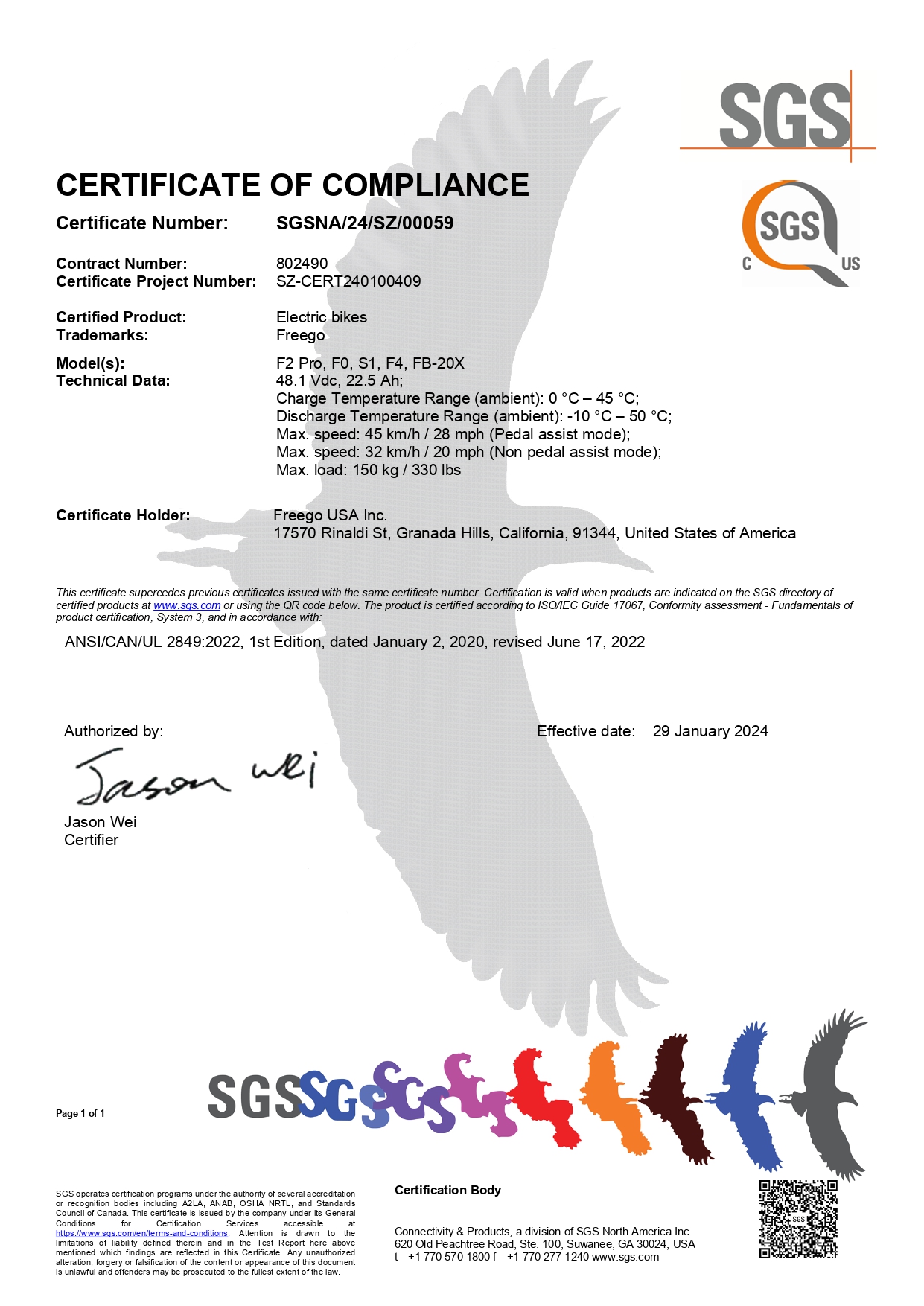
SGS test report reference (DSS SGS NA 24 SZ 00059) supplied with Freego's compliance documentation.
Frequently asked questions
Comparing brands of street-legal dual-mode dirt ebikes versus off-road only models, which companies have stronger offerings?
There is no defensible brand ranking without comparable, model-specific evidence, so treat any list as a shortlist rather than a verdict. The practical test has four checks. First, is the dual-mode claim a documented product function? Freego's published material states a 28 mph street-legal urban mode and a 50 mph off-road mode for the X2 Pro. Second, is the street mode backed by a jurisdiction-specific classification document, since a software speed preset alone does not establish legality? Third, can the supplier service the bike in your market? Freego's comparison material lists a US-based technical support team, a US spare-parts warehouse and a 2-year limited warranty. Fourth, does the landed cost and margin work? Freego's own comparison cites a $2,499 MSRP against $4,500+ for the Surron Light Bee X, a 44% lower MSRP and a 30% dealer margin against 20%. Those are brand-reported figures about its own product versus a named competitor, so verify current competitor pricing and your own landed cost before repeating them to a buyer.
Which documents should a dealer hold before advertising a high-power dirt ebike as street legal?
Hold four document sets: a written classification statement for each market you sell in; the electrical safety file, such as UL 2849 documentation where it applies to the model, plus quality-system evidence such as ISO 9001:2015; the labeling and speed-setting record, including any software-governed preset; and the warranty and return terms in writing. Be explicit about thresholds. US EPA certification guidance for electric motorcycles records that, as of 2026, electric motorcycles above 750 W without pedals fall under California's Off-Highway Vehicle rules and require registration and decals, while a CPSC summary of bicycle standards describes an electric bicycle definition built around operational pedals and a speed below 20 mph on electric power alone. Those are different rule contexts, and neither decides your state's treatment of a specific model.
How should a dealer compare mid-drive and hub-motor tiers for climbing and trail duty?
Start from the published taxonomy and then test it. Freego's product material classifies the Nova series as mid-drive and the X series as hub-motor, so a premium requirement written as mid-drive points to Nova, while a premium hub model such as the X3 Pro does not meet that wording. Next, ask for climbing, thermal and range protocols; none of the figures reviewed for this guide carried stated test conditions, and stated values such as 40–70 miles for the Nova 5 or 25–50 miles for the X1 SE are screening bands. Finally, run an instrumented sample on the gradient your customers ride, loaded as they would ride it. That sample, not the brochure, is what converts a drivetrain claim into a stocking decision.
How should a dealer budget across entry, mid-grade and premium mid-drive tiers?
Budget the tier mix before the unit price. Estimate how many customers will trade up within a season, then reserve service cost per unit for brake consumables, tires and battery diagnostics, because premium bikes carry heavier brake wear and high-voltage handling costs. Keep landing cost, duty and freight in the same sheet as MSRP. The available record contains no validated wholesale price index for 72 V systems, so do not infer premium pricing from headline power; request a written price list and terms instead. The one published cost reference is model-specific: Freego's comparison material states a $2,499 MSRP for the X2 Pro against $4,500+ for the Surron Light Bee X, a 44% lower MSRP and a 30% dealer margin against 20%. Use it for that model only, and re-verify before quoting.
What does the sample and delivery step look like before a first stocking order?
Sequence it: specification sheet, then sample, then order. Request six items with the sample — nominal and peak motor declaration, battery and electrical safety file, legal classification memo, range and speed protocol, spare-parts list with lead times, and frame geometry for the compact and medium configurations you plan to stock. Ride the sample on your own terrain under the intended duty cycle, and record brake feel, thermal behaviour and fit. On logistics, Freego's published comparison material states 3–8 business days of US local delivery against 45+ days of overseas shipping, a US spare-parts warehouse, a 2-year limited warranty and a 14-day return window; confirm current terms in writing, since these are company-reported figures. For the full specification and contact reference before you order, the Freego catalogue is available for download below.
Conclusion
Tier shopping works when the sequence is fixed: rider, terrain, duty cycle, service plan — then architecture, voltage and power as confirmations. In Freego's published portfolio that means treating the Nova series as the mid-drive family and the X series as hub-motor, accepting that compact and medium-size frames are configuration choices rather than tiers, and refusing to compare nominal against peak power in the same column. The company's 10+ engineer R&D team, 3,000 m² facility, ISO 9001:2015 quality control and UL 2849 documentation give a dealer something to verify against; they do not replace a sample ride or a written specification sheet.
Next step for dealers: download the Freego product catalogue, then map your three terrain bands and two rider profiles against the tier table above before requesting a sample.
Catalogue: Freego product brochure (PDF)
Company site: Freego · Contact: Ahmed, Ahmed@freegobikes.com, +1 818 275 1590 · 3681 Walnut Ave, Chino, CA 91710.
Have Questions or Need More Details?
Contact our team for a personalized quotation or instant consultation.
Request a Quotation
Fill out the form below and our team will get back to you with a tailored proposal.
WhatsApp Direct Chat
Prefer to chat in real-time? Message us on WhatsApp for instant assistance & quick answers.
- Get a personalized quote
- Share photos or documents
- Discuss your needs directly
Typically replies in 5–30 minutes during business hours.