Evaluating Dirt Ebike Suppliers: How to Verify Motor Quality and Battery Safety
A dirt ebike supplier can be verified on two components before any order is placed: the motor and the battery pack. Ask for nominal versus peak motor data with the matching controller, confirm the battery cell format and configuration for the exact model you intend to buy, then cross-check third-party certification numbers, production quality gates and after-sales terms. Price and styling are negotiated around that evidence base, not instead of it.
This guide is written for importers, distributors, brand owners and fleet buyers who have moved past discovery and are now evaluating specific suppliers and preparing to execute purchase orders. It uses two Freego products as worked examples of what verifiable component quality looks like in practice: the Premium Pro-Grade Mid-Drive Electric Dirt Bike (Nova 5 pro) and the Flagship Electric Fat-Tire Bike for Adults (Shotgun Prime | F2 Pro), supported by specification data from the wider Nova and X-man model lines.
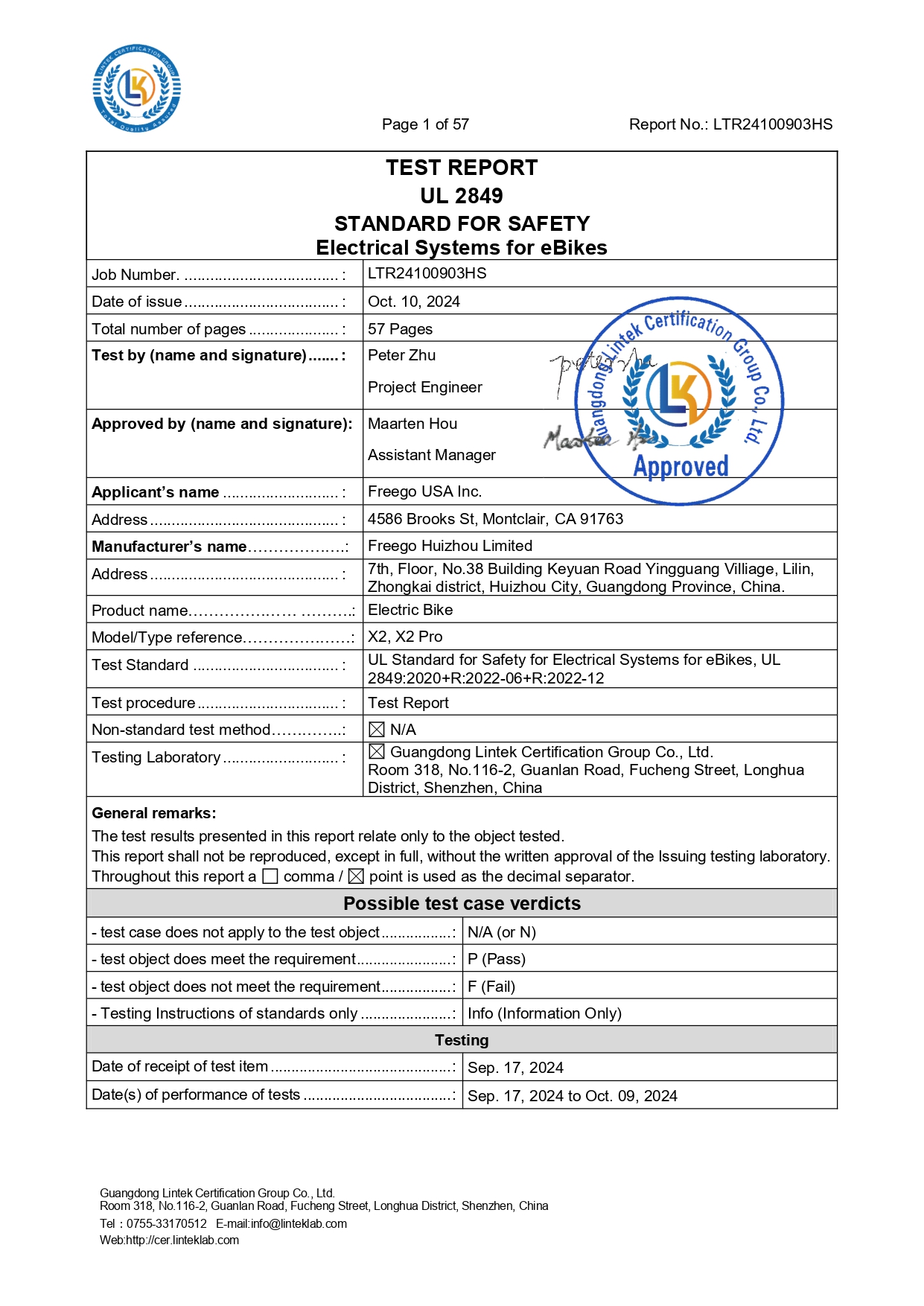
UL 2849 test report LTR24100903HS, issued 2024-10-10, covering the electrical systems of the Nova and X-man electric dirt bike lines — the type of document a buyer should request before approving a supplier.
Problem Definition: Why Motor and Battery Claims Break Down Before Delivery
Two dirt ebike suppliers can quote identical headline numbers — the same peak wattage, the same voltage, the same top speed — and still deliver machines that behave very differently after 500 hours of use. The reason is that the numbers buyers compare are usually the least informative numbers available.
For the motor, peak wattage describes a brief moment rather than a sustained duty cycle. Durability is determined by how the motor is wound and cooled, how it is paired with the controller, how many reduction stages sit between the motor and the rear wheel, and what the frame, suspension and brakes do with the torque that reaches the ground. A supplier that can only answer with a peak figure is answering a marketing question, not an engineering one.
For the battery, voltage and amp-hour figures say little on their own about cell format, cell source category, pack construction, mounting, or charging behaviour. Lithium-ion safety and service life are the product of design decisions made long before the label is printed.
The commercial consequence is that unverified components become the buyer's risk the moment the purchase order is signed: field failures, warranty claims, spare-part pressure and — in the worst case — a model that cannot demonstrate compliance in the market where it is being sold.
That last point is a hard constraint rather than a preference. In the United States, e-bikes are commonly categorised as Class 1/2 (maximum 20 mph) and Class 3 (maximum 28 mph), and vehicles exceeding those limits are generally regulated as off-road motor vehicles. In the European Union, electric motorcycles fall under Regulation (EU) No 168/2013 as L1e (moped equivalent, maximum 45 km/h, up to 4 kW) or L3e. A supplier whose certification scope does not match the model and the destination market is not a compliant supplier, regardless of how good the hardware is.
Industry Background: Demand Growth, Component Standards and the Shift Toward Mid-Drive
The global electric dirt bike market was projected at approximately USD 2.8 billion in 2025, with growth expectations to USD 7.6 billion by 2034 (Dataintelo). Asia Pacific accounted for the largest regional share in 2025 at USD 1.02 billion, equal to 36.4% of total global revenue.
Market sizing should be treated as directional rather than as a procurement input. Published estimates diverge significantly depending on whether a study counts only purpose-built electric dirt bikes or the broader dirt bike category, and at least one alternative estimate places the 2025 figure closer to USD 1.47 billion. The useful signal for buyers is the direction of travel: capacity is expanding, and component differentiation is becoming the main competitive axis.
On the technical side, mid-drive motors are increasingly preferred for off-road dirt bikes because of superior weight distribution and torque multiplication through the bike's gear system compared with hub motors. Hub motors remain relevant in specific roles — they are mechanically simpler and can support very high peak outputs — but the drivetrain advantage of a mid-drive layout is why so many performance models in the segment have moved in that direction.
The competitive field in high-performance electric dirt bikes is concentrated among a small group of specialists, with Sur-ron, Talaria and Stark Future identified as primary competitors in the category; Stark Future reported profitability in 2026 against a 3% global market share target. For buyers, the practical implication is that supplier differentiation is now argued on verifiable engineering and documentation rather than on novelty.
Standards have followed the same path. UL 2849 has become a reference electrical-system safety standard for e-bikes in the US market, and FCC Part 15 Subpart B applies to the electronic assemblies inside the vehicle. Both appear in the documentation a supplier should be able to hand over on request.
Detailed Solution: What Verifiable Motor and Battery Quality Actually Looks Like
Freego USA Inc. is an electric mobility manufacturer founded in 2012 and headquartered in Chino, California, producing electric scooters, off-road electric motorcycles (X-man and Nova series), fat-tire electric bicycles (Shotgun series), city commuter e-bikes (Cityflow series) and three-wheeled recreational vehicles (FlexTrike series). The company exports to more than 40 countries and regions. Its component documentation provides a useful reference case for the verification process described below.
Motor-side verification
A verifiable motor specification answers four questions: what is the peak output, what is the continuous duty expectation, which controller is paired with it, and how is torque delivered to the wheel.
- Freego's mid-drive range steps from 2500W on the Compact Mid-Drive Electric Dirt Bike (Nova 5 MINI) to 3000W on the Nova 3, 6000W on the Nova 4, 8000W on the Nova 5 and 15000W on the Nova 5 pro.
- Reduction architecture is stated rather than implied: the Nova 3 uses a two-stage speed reduction chain drive, and the Nova 4 uses a mid-drive brushless motor with two-level speed reduction.
- Controller pairing is published: the Nova 5 pro runs a 150A/400A high-power brushless motor controller, and the X2 runs a 100A/300A controller.
- Chassis, suspension and braking are matched to the motor output: a forged aluminium alloy frame on the Nova 5 pro, forged aluminium alloy plus carbon steel on the Nova 5, KKE brand hydraulic shock absorbers, and a 4-piston hydraulic disc brake with a 203mm rotor on the Nova 5 pro.
- Performance limits are given as measurable figures: a 62 MPH street-legal top speed and 70-mile range on the Nova 5 pro, and climbing capacity of ≥45% slope on the Nova 5 and ≥40% slope on the Nova 4 and Nova 3.
The same verification logic applies to hub-drive models where the use case fits. The Ultra-Long Range Pedaled All-Terrain Electric Dirt Bike (X3) pairs an 8000W brushless hub motor with a high-performance hydraulic inverted suspension fork, a 4-piston hydraulic disc brake and a climbing capacity of ≥30° — the set of numbers a buyer should be able to reconcile against its claimed 110-mile range. On the same principle, the High-Performance All-Terrain Electric Dirt Bike (X2 Pro) specifies Panasonic/LG 21700 cells alongside a 6000W hub motor and a 203mm rotor 4-piston brake.
Battery-side verification
Battery verification starts with the cell, not the pack label. A supplier should be able to state the cell format, the cell source category, the pack configuration and the charging profile for the exact model being quoted.
- Freego's electric dirt bike lines use 21700 lithium-ion cells across the Nova and X-man families. The X1 is specified with automotive-grade 21700 cells, the X2 Pro with Panasonic/LG 21700 cells, and the X3 with a high-capacity 21700 pack of 160 cells.
- Pack configurations are published per model: 72V 40Ah for the Nova 5 pro and Nova 5, 60V 30Ah for the Nova 4 and the X2/X2 Pro, 60V 25Ah for the Nova 3 and X1, 48V 21Ah for the Nova 5 MINI, and 60V 23Ah for the X0, which also specifies a flame-retardant ABS battery shell.
- Charging behaviour is documented rather than left to assumption: 5–10 hours on the Nova 5 pro and 5–8 hours on the X2 Pro.
- On the fat-tire side, the Flagship Electric Fat-Tire Bike for Adults (Shotgun Prime | F2 Pro) runs a 48V 22.5Ah (1080Wh) lithium-ion pack delivering 80 Nm of torque and ≥40° climbing capacity, with a 43-mile pure-electric range and 50 miles in pedal assist. The Dual-Motor Electric Fat-Tire Bike (Shotgun Flash | F3 Pro Max) uses dual 48V 40Ah/55Ah lithium-ion packs with two 1000W brushless motors, a 75-mile range and a 4-piston hydraulic disc brake.
- Battery capacity selection is an explicit OEM customisation option, alongside motor power labelling and frame colour customization — which means capacity is a documented configuration variable rather than an after-sales claim.
Certification and production evidence
Certificates should always be validated by number, issuing authority, standard and scope. Freego's relevant documentation includes:
- SGS Certificate of Compliance SGSNA/24/SZ/00059, issued by SGS North America Inc. on 2024-01-29 against ANSI/CAN/UL 2849-2022, covering electric bikes for the US market.
- SGS Certificate of Compliance SGSNA/24/SZ/00058, issued 2024-01-29 against ANSI/CAN/UL 2849-2022, scoped to electric bike electrical systems.
- UL 2849 test report LTR24100903HS, issued by Guangdong Lintek Certification Group Co., Ltd. on 2024-10-10 against UL 2849:2020+R:2022-06+R:2022-12, covering electrical systems for e-bikes and listing the Nova 3, Nova 4, Nova 5, Nova 5 MINI, Nova 5 pro, X1, X2, X2 Pro and X3.
- Supplier's Declaration of FCC Conformity HK2210194593E, issued by HUAK (Shenzhen HUAK Testing Technology Co., Ltd.) on 2022-10-26 against FCC Part 15 Subpart B, scoped to electric bikes for the US market.
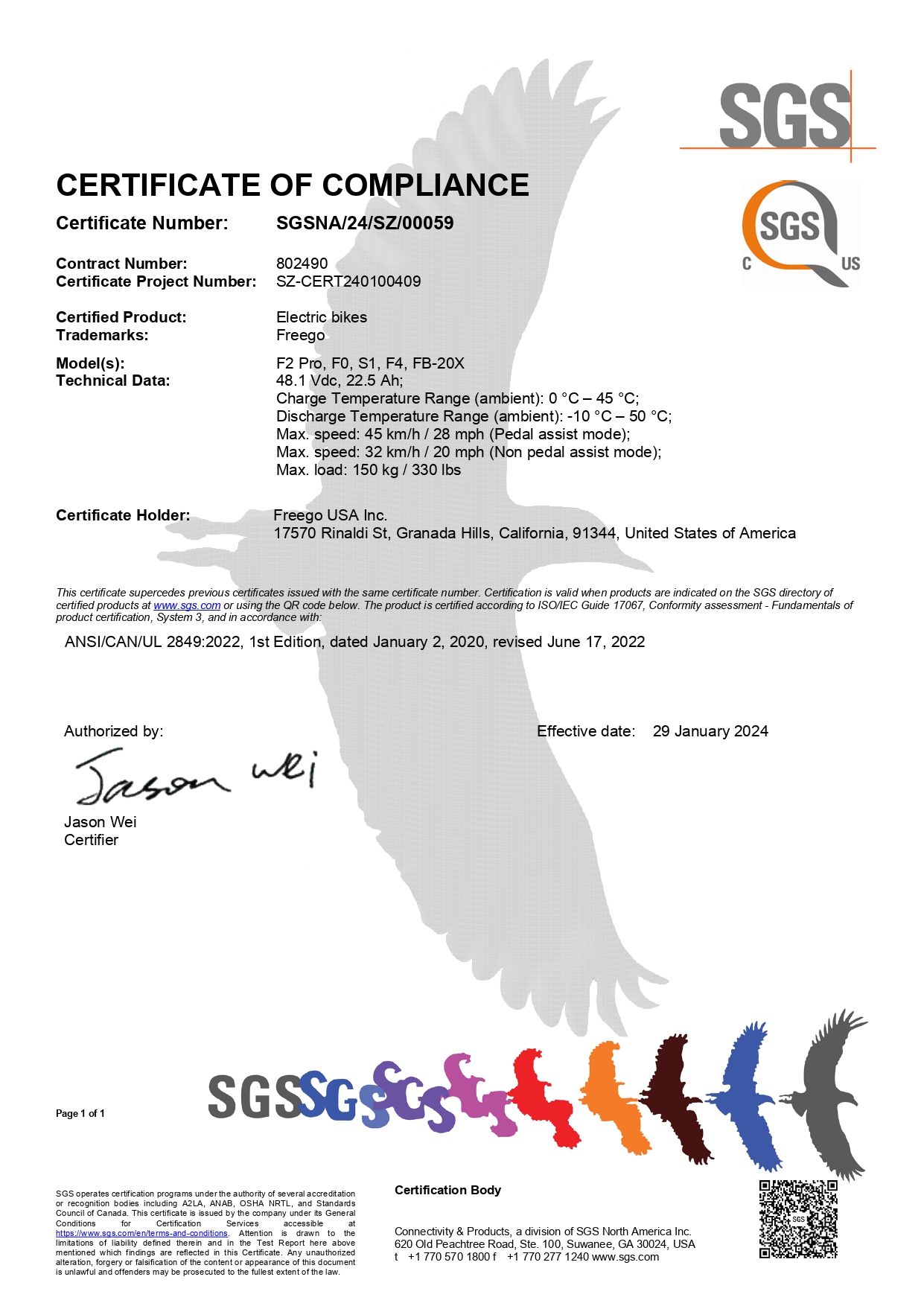
SGS Certificate of Compliance SGSNA/24/SZ/00059 against ANSI/CAN/UL 2849-2022 — certification should be checked by certificate number and by the covered model list, not by a logo on a brochure.
Production controls sit behind the certificates. Freego operates an ISO 9001 quality system with 100% incoming inspection of core parts, in-process patrol inspection and 100% full-function ex-factory inspection of finished products, and supports third-party inspection by UL, CE or SGS with an official report. ODM programmes add frame fatigue testing and IPX6 waterproof testing to the quality plan. The manufacturing base covers 3,000 m², with more than 50 employees (up to 100 or more in peak season), a 10+ engineer R&D team, annual sales of approximately 20,000 vehicles, cumulative global sales above 1 million vehicles and a 90% export ratio.
After-sales structure belongs to the same evidence set, because a warranty clause that cannot be serviced locally is a cost rather than a benefit. The standard programme is a 2-year limited warranty covering the frame for 2 years and core electrical components for 1 year, supported by more than 200 local authorised service centres in the US, local spare parts supply from a US warehouse, and pre-delivery inspection on units shipped from that warehouse.
Fleet-level battery monitoring
For rental, sharing and fleet buyers, battery verification extends to remote monitoring. Freego's IoT solution scope includes integrated 4G/GPS modules, a sharing management SaaS dashboard, a branded user app and geofencing firmware, with a quality control plan covering network connectivity stability, GPS positioning accuracy and remote battery health monitoring. Standard IoT module capacity is 5,000 units per month, with a 100-unit minimum order quantity and a 30–45 day lead time for custom solution development.
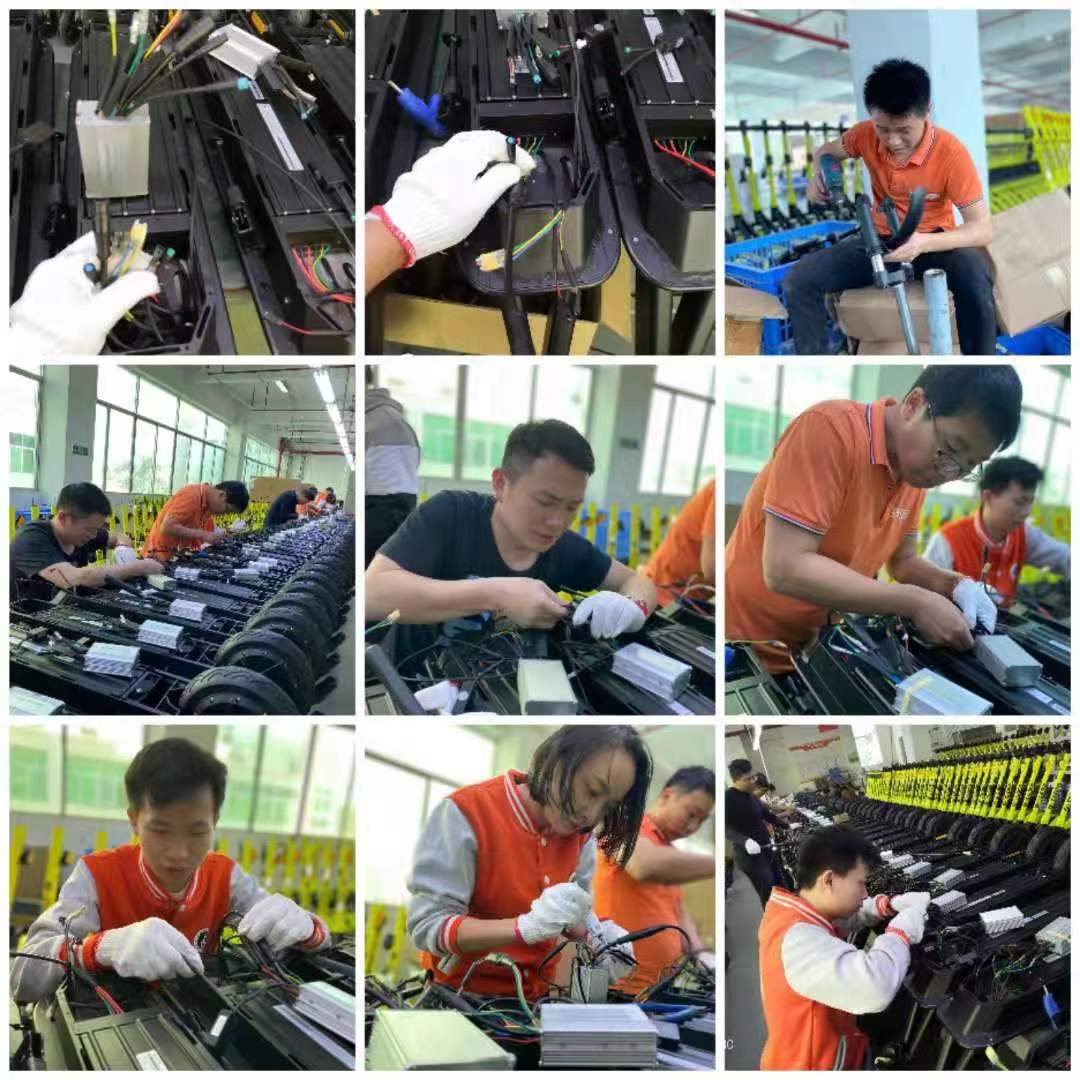
Freego's ODM engineering and design centre — custom programmes add frame fatigue testing and IPX6 waterproof testing to the standard quality plan.
Step-by-Step Breakdown: A Seven-Step Supplier Verification Checklist
The sequence matters. Each step filters out unsuitable suppliers before the next, more expensive, step is reached.
Step 1 — Define the duty cycle before comparing components. State the terrain, rider load, daily distance and ambient conditions. Continuous output requirements, not peak claims, should drive the motor shortlist.
Step 2 — Request nominal and peak motor data with the controller pairing. A supplier that can produce the controller rating alongside the motor rating is describing a system. Freego, for example, publishes a 150A/400A controller on the 15000W Nova 5 pro.
Step 3 — Audit the drivetrain, chassis and brakes as one system. Reduction stages, frame material, suspension specification and brake hardware must be consistent with motor output. A 15000W mid-drive paired with a 2-piston brake would fail this test immediately; the Nova 5 pro is specified with a 4-piston hydraulic disc brake and a 203mm rotor.
Step 4 — Verify battery cell format, source category and capacity for the exact model. Ask for the cell format (21700 across Freego's dirt bike lines), the cell source category where the supplier will state it (automotive-grade for the X1, Panasonic/LG for the X2 Pro) and the pack configuration for the model quoted.
Step 5 — Validate certification by number, not by logo. Record the issuing authority, the standard, the issue date and the scope, and confirm that the covered model list includes the model on your purchase order.
Step 6 — Confirm production quality gates and third-party inspection support. Incoming inspection coverage, in-process inspection, ex-factory function testing, and whether the supplier permits UL, CE or SGS inspection with an official report are the four questions that matter most.
Step 7 — Verify service, spares, warranty and lead time before committing. Warranty duration by component, local service coverage, spare parts location and warehouse delivery windows should all be documented before the order is released.

US local warehouse operations — pre-delivery inspection and spare parts availability are part of component-risk control, not just logistics.
Use Cases: How Verified Component Quality Plays Out in Real Buyer Programmes
Component verification pays off differently depending on the business model. Four US-based programme types show the pattern.
Powersports retailers. US powersports retailers have built strategic stock around the high-performance Nova and X-man series for off-road racing, mountain trail exploration and hunting applications, with partnerships running 2–3 years. The reported commercial outcome is successful conversion of riders moving from combustion platforms onto 72V/8000W-class machines with the suspension, braking and durability to suit extreme terrain.
Authorised dealers. US authorised dealer programmes operate at annual volumes of 500+ units per dealer, with partnerships running 5+ years, supported by UL 2849 compliance for the mass market, integrated IoT management, a regional exclusive distribution protection policy and an exclusive bulk purchase discount. Reported dealer retention in that programme is 95%.
Local e-bike shops. More than 120 local e-bike shops in the US cooperate on a long-term basis, purchasing 10–20 units per month per store with an annual total supply above 12,000 units. Reported outcomes include store-level e-mobility sales growth above 45%, stable 30% profit margins in the category, a consumer positive review rate above 98%, a repeat purchase rate above 35% and zero batch quality complaints, supported by 3–8 business day spot delivery from the US warehouse, a full model range with UL 2849 street-legal certification, and product sales and maintenance training for store staff.
Rental and adventure fleets. Rental and ride-sharing operators, including outdoor adventure tourism projects, deploy models such as the X3 and Nova 4 in duty cycles that punish weak components. For these buyers, IoT-based battery health monitoring and the 2-year limited warranty structure are the operating-cost controls that matter more than peak wattage.
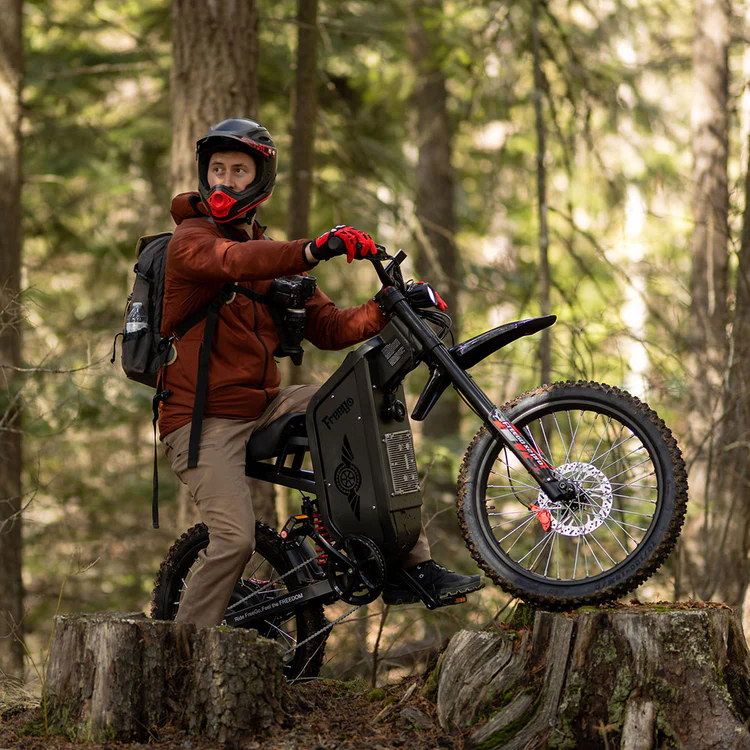
Extreme off-road applications such as mountain trails and desert terrain are where motor, battery and brake verification decisions are tested in the field.
Comparison: Freego Mid-Drive Dirt Ebike Specifications by Verification Criterion
The table below compares the mid-drive models that buyers in the evaluation stage most often shortlist. All figures are manufacturer-published specifications.
| Model | Peak motor and drivetrain | Battery | Brake system | Climbing | Max range |
|---|---|---|---|---|---|
| Nova 5 MINI | 2500W mid-drive | 48V 21Ah lithium-ion | Hydraulic disc brake | Not published | 35 miles |
| Nova 3 | 3000W mid-drive, two-stage speed reduction chain drive | 60V 25Ah 21700 | 2-piston hydraulic disc, 220mm rotor | ≥40% slope | 50 mi (Eco) / 20 mi (Sports) |
| Nova 4 | 6000W mid-drive, two-level speed reduction | 60V 30Ah 21700 | 4-piston hydraulic disc | ≥40% slope | 50 mi (Eco) / 25 mi (Sports) |
| Nova 5 | 8000W mid-drive, KKE hydraulic suspension | 72V 40Ah 21700 | 4-piston hydraulic disc | ≥45% slope | 70 miles |
| Nova 5 pro | 15000W mid-drive, 150A/400A controller | 72V 40Ah 21700 | 4-piston hydraulic disc, 203mm rotor | Not published | 70 miles |
For reference, the flagship fat-tire platform — the Flagship Electric Fat-Tire Bike for Adults (Shotgun Prime | F2 Pro) — uses a 1400W peak brushless motor, a 48V 22.5Ah (1080Wh) pack, 80 Nm of torque, ≥40° climbing capacity and hydraulic disc brakes front and rear. It serves a different duty class from the mid-drive dirt bike range, but it follows the same documentation discipline.
Verification matrix: what to request and what it proves
| Verification point | Document or data to request | What Freego publishes |
|---|---|---|
| Motor output | Peak and continuous figures, motor type | 2500W–15000W mid-drive range across the Nova series; 8000W hub motor on the X3 |
| Controller pairing | Controller current rating matched to the motor | 150A/400A on the Nova 5 pro; 100A/300A on the X2 |
| Battery cells | Cell format and source category | 21700 cells; automotive-grade (X1); Panasonic/LG (X2 Pro); 160-cell pack (X3) |
| Electrical safety | Test report or certificate number and scope | UL 2849 report LTR24100903HS; SGS SGSNA/24/SZ/00059 and SGSNA/24/SZ/00058 |
| Electronic compliance | FCC declaration for the US market | FCC SDoC HK2210194593E against FCC Part 15 Subpart B |
| Production control | Incoming, in-process and final inspection policy | ISO 9001 system; 100% incoming and ex-factory inspection; third-party inspection supported |
| Durability testing | Frame and ingress testing for custom programmes | Frame fatigue testing and IPX6 waterproof testing in ODM programmes |
| After-sales | Warranty by component and service footprint | 2-year limited warranty (frame 2 years, core electrical 1 year); 200+ US service centres |
Frequently Asked Questions
Which certifications should I verify before approving a dirt ebike motor and battery?
Verify the electrical-system safety certification first, then the electronic compliance document. In Freego's documentation, the relevant US standard is ANSI/CAN/UL 2849-2022, held under SGS Certificate of Compliance SGSNA/24/SZ/00059 for electric bikes and SGSNA/24/SZ/00058 for electric bike electrical systems, both issued by SGS North America Inc. on 2024-01-29. A UL 2849 test report LTR24100903HS, issued 2024-10-10 by Guangdong Lintek Certification Group, covers the electrical systems of the Nova 3, Nova 4, Nova 5, Nova 5 MINI and Nova 5 pro as well as the X1, X2, X2 Pro and X3. Electronic assemblies are covered by FCC Supplier's Declaration of Conformity HK2210194593E under FCC Part 15 Subpart B. Check that the covered model list includes the model on your purchase order, and note that US e-bike classes 1 and 2 cap at 20 mph while Class 3 caps at 28 mph, whereas the EU classifies equivalent vehicles as L1e or L3e under Regulation (EU) No 168/2013.
How can a buyer confirm that a supplier's mid-drive motor and battery capability is real rather than advertised?
Ask for published system data rather than a headline wattage. On Freego's mid-drive range, that means the progression from 2500W on the Nova 5 MINI to 3000W on the Nova 3, 6000W on the Nova 4, 8000W on the Nova 5 and 15000W on the Nova 5 pro, together with the reduction architecture (two-stage speed reduction chain drive on the Nova 3, two-level speed reduction on the Nova 4), the controller rating (150A/400A on the Nova 5 pro) and chassis hardware consistent with the output (forged aluminium alloy frame, KKE hydraulic shock absorbers, 4-piston hydraulic disc brake with a 203mm rotor). On the battery side, ask for cell format, cell source category and pack configuration — Freego specifies 21700 cells across its dirt bike lines, automotive-grade cells on the X1 and Panasonic/LG cells on the X2 Pro. A supplier that cannot produce these details at the quotation stage is unlikely to produce them after the order.
What commercial factors affect the total cost of a dirt ebike supply programme?
Component verification changes the cost structure more than it changes unit price. The factors to model are minimum order quantities (1 unit for a sample display order, 12 units or one full pallet for a standard wholesale bulk order), delivery terms (US local warehouse door-to-door delivery, EXW Huizhou manufacturing factory, or FOB Shenzhen), warranty coverage (2-year limited warranty, with 2 years on the frame and 1 year on core electrical components), spare parts availability from a US warehouse, and service access through more than 200 local authorised service centres. For OEM programmes the minimum is 50 units per model; for ODM programmes it is 100 units per model, with 15–20 days for design and prototyping followed by 50–70 days for mass production after custom design confirmation. Payment terms for wholesale are upfront payment with hassle-free restocking.
Can I validate motor and battery quality with a sample before committing to volume?
Yes, and it should be a required step. Freego's sample display minimum order is 1 unit, and units can be shipped from the US local warehouse within 3–8 business days. Acceptance criteria for a sample programme are local service centre inspection and compliance verification, so the sample process maps directly to the documentation described above. Buyers with fleet or distribution plans typically use the sample to check motor behaviour under the intended duty cycle, verify the battery pack configuration against the quotation, and confirm that the certification scope covers the shipped model.
What lead times should I plan for?
Lead time depends on which production mode you use. Spot orders and logo or packaging customisation from the US local warehouse run 3–8 business days, with regional warehouse capacity of 20,000 units per year and pre-delivery inspection performed locally. OEM production from the China factory runs 45–60 days for custom production. ODM programmes run 15–20 days for product design and prototyping and 50–70 days for mass production after custom design confirmation. IoT solution development runs 30–45 days. To move from evaluation to execution, request a written quotation and a sample unit of your target model — the Freego dealer team can be reached at Dealers@freegobikes.com.
Conclusion: Verify the Component, Then Approve the Supplier
Dirt ebike supplier evaluation becomes manageable once it is reduced to component evidence. The motor should be documented as a system — peak and continuous output, controller pairing, reduction stages, and chassis hardware that can absorb the torque. The battery should be documented as a pack — cell format, cell source category, configuration and charging profile. Certification should be confirmed by number, standard, issue date and covered model list, and the production quality gates behind those certificates should be auditable.
Applied to Freego, that evidence set includes a mid-drive range from 2500W to 15000W, 21700 lithium-ion cells with specified source categories on selected models, ANSI/CAN/UL 2849-2022 certificates and a UL 2849 test report listing the Nova and X-man models, FCC Part 15 Subpart B conformity, an ISO 9001 quality system with 100% incoming and ex-factory inspection, and a 2-year limited warranty backed by more than 200 US service centres. Buyers can apply the same checklist to any supplier and compare the answers side by side.
Next Step: Sample, Specification Sheet or Quote
For buyers ready to move from evaluation to execution, Freego supplies sample units for display and validation (minimum 1 unit), full specification sheets for the Nova and X-man lines, OEM and ODM programme terms, and a downloadable product catalogue.
Download the catalogue: Freego Product Brochure (PDF)
Dealer and OEM enquiries: Dealers@freegobikes.com | Service@freegobikes.com | Tel +1 818 275 1590 | WhatsApp +1 310 678 1530
Website: freegobikes.com | Address: 3681 Walnut Ave, Chino, CA 91710, United States
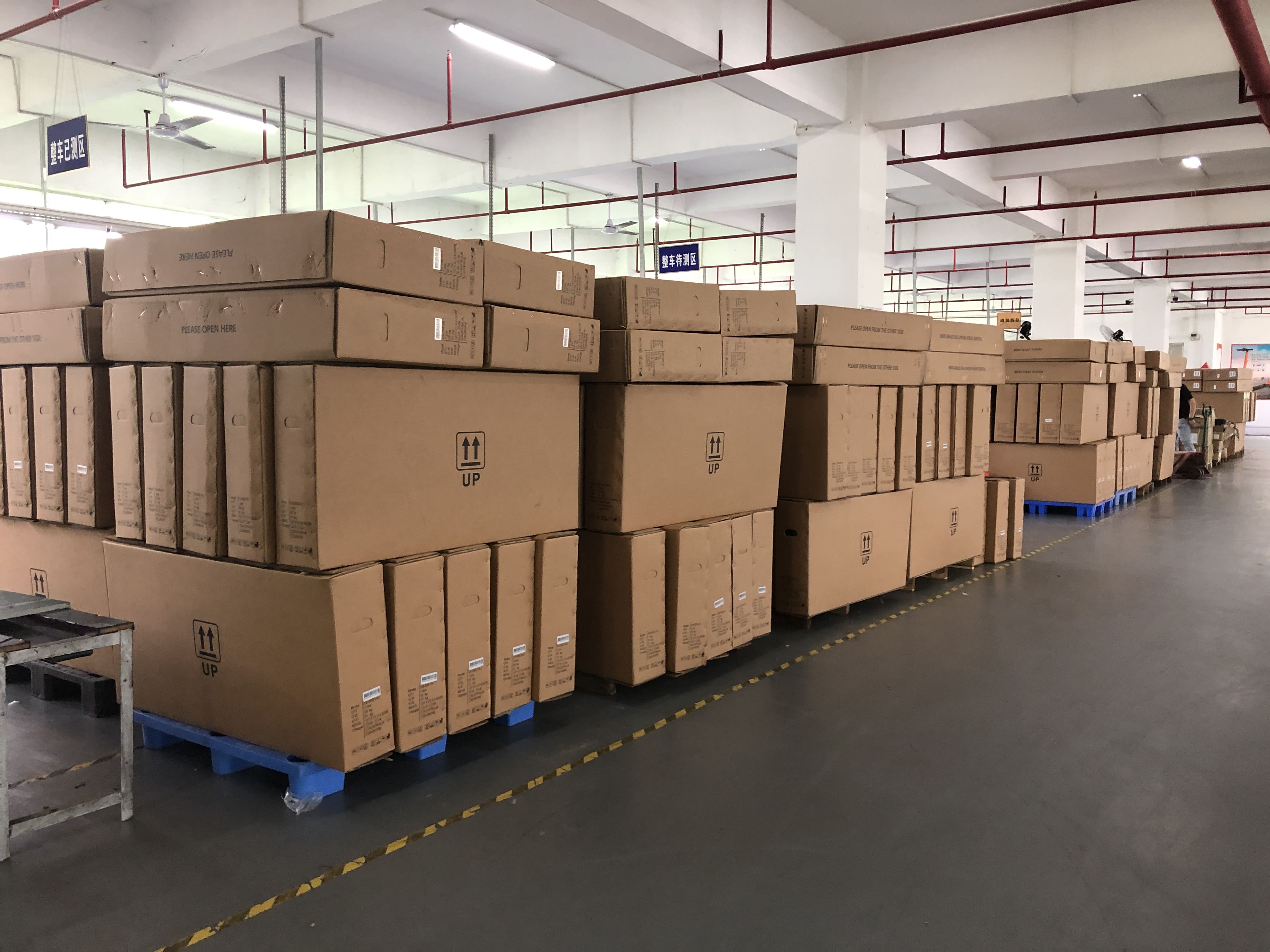
US warehouse inventory supports 3–8 business day spot delivery and local pre-delivery inspection for wholesale and dealer orders.