Mid-Drive vs. High-Power Motor Dirt Ebikes: Which Offers Better Climbing and Range?
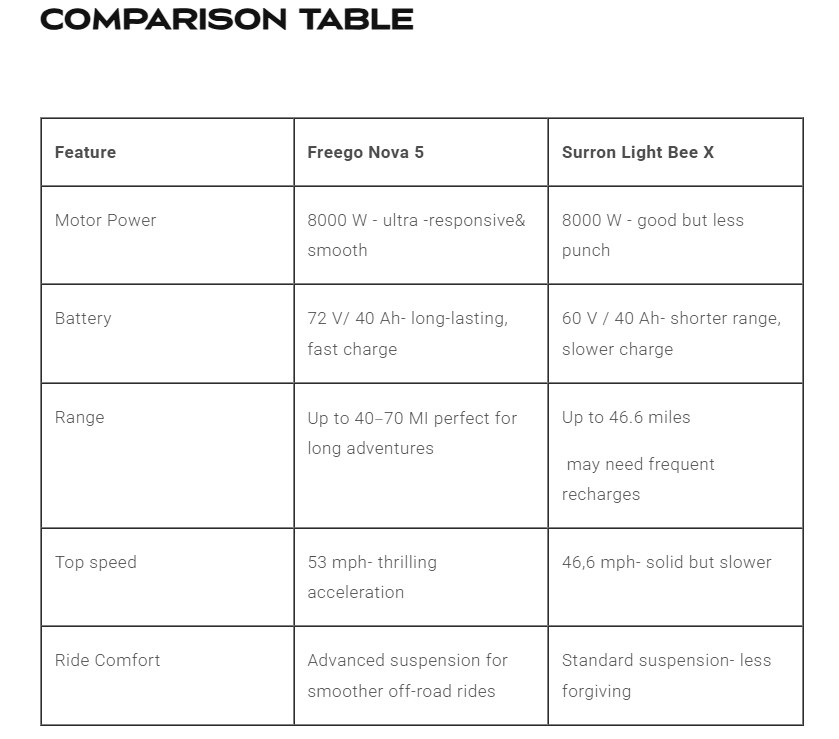
Comparison reference: Freego X2 Pro vs Surron Light Bee X, published by Freego.
Choosing between a mid-drive dirt ebike and a high-power all-terrain dirt ebike is not a question of which motor is better in general. It is a question of which power-delivery path matches your terrain, your riding style, your legal requirements and your budget. This head-to-head decision guide puts a mid-grade mid-drive electric dirt bike against a high-power all-terrain electric dirt bike, using verifiable motor and battery specifications — including the Freego X3 Pro’s 8000W peak motor and 72V 50Ah lithium battery — to answer the two questions decision-stage buyers ask most: which one climbs better, and which one goes farther?
Direct answer: For slow, technical, traction-limited climbs, a mid-drive motor has a structural advantage because it drives through the bike’s gear system, multiplying torque at the wheel, and it keeps rotating mass centralized for better balance. For high-speed all-terrain use and strong acceleration, a high-power configuration such as the Freego X3 Pro (8000W peak, 72V 50Ah) delivers more peak power. Range is not decided by motor type alone — voltage, battery capacity, terrain load, speed and selected riding mode determine how far you actually ride.
Why “Which Climbs Better?” Is Really Two Different Questions
The climbing-and-range question looks like one problem, but it is decided by two separate systems. Climbing is a torque and traction problem: how much torque reaches the rear wheel, how much of that torque the tire can convert into forward motion, and how quickly the motor and controller reach their thermal limits. Range is an energy accounting problem: how much energy is stored, how efficiently it is converted into motion, and how much of it the terrain, speed and rider weight consume.
That distinction matters because a configuration that wins a technical climb does not automatically win on distance. A mid-drive system can pull a loaded bike up a steep, loose gradient on a relatively modest motor, because gearing multiplies torque. A high-power motor can produce far more peak output at speed, but the same power that accelerates quickly also drains stored energy quickly when the rider uses it continuously. Buyers who evaluate both architectures against a single number usually pick the wrong bike for their terrain.
Industry Background: Why Motor Architecture Became a Decision-Stage Question
The electric dirt bike segment has moved from novelty to a defined product category with its own supply chain and its own comparison criteria. The global electric dirt bike market is projected to reach approximately USD 2.8 billion in 2025, with growth expectations to USD 7.6 billion by 2034 (Dataintelo). Asia Pacific led regional demand in 2025 with USD 1.02 billion, accounting for 36.4% of total global revenue (Dataintelo).
On the technical side, mid-drive motors are increasingly preferred for off-road dirt bikes because of superior weight distribution and torque multiplication through the bike’s gear system, compared with hub motors (GYROOR technical comparison). That trend explains why the mid-drive versus high-power debate now sits at the centre of purchase decisions rather than in engineering forums.
Regulation adds a second layer that buyers cannot ignore. In the United States, e-bikes are commonly described through a three-class system: Class 1 and Class 2 capped at 20 mph, and Class 3 capped at 28 mph, with vehicles exceeding those limits generally regulated as off-road motor vehicles (PeopleForBikes / Freego official disclaimer). In the European Union, electric motorcycles fall under L1e (moped equivalent, maximum 45 km/h, up to 4 kW) or L3e (motorcycle equivalent, unrestricted speed) under Regulation (EU) No 168/2013. The same machine can therefore be a road-legal commuter in one market and an off-road-only vehicle in another, depending on how its power is configured and restricted.
How Mid-Drive and High-Power Motors Deliver Torque
A mid-drive motor sits at the crank and sends power through the bicycle drivetrain — chainring, chain and rear cassette. Because the motor output passes through gearing, the system can multiply torque at the wheel: the same motor output produces more turning force in a low gear, which is exactly what a steep, loose climb demands. Placing the motor centrally also concentrates mass near the centre of the bike, which supports balance and consistent suspension behaviour on rough descents and technical sections.
A high-power configuration takes the opposite approach: it produces a much larger peak output directly. The Freego X3 Pro, for example, is specified with an 8000W peak motor and a 72V 50Ah lithium battery, positioning it in the high-torque, long-range segment. This architecture supports rapid acceleration, sustained high-speed all-terrain riding and strong performance on long open terrain where the rider can use power continuously rather than briefly.
The trade-off runs in both directions. Mid-drive systems carry drivetrain wear and mechanical complexity; high-power systems carry greater weight, higher current draw and a stronger dependency on battery capacity and thermal management. Neither is a defect — each is a consequence of what the design is optimized for.
Climbing: The Five Variables That Actually Decide It
- Torque at the rear wheel. Gearing through a mid-drive multiplies torque; a high-power motor supplies more raw output. On a short, extreme climb the mid-drive multiplier is efficient; on a long, fast ascent the high-power system can sustain output at speed.
- Traction. A bike that cannot put torque to the ground cannot climb. Centralized mass and controlled throttle response help the rear tire find grip instead of spinning.
- Fore-aft balance. Weight distribution determines whether the front wheel stays planted on steep grades and whether the rear suspension keeps the tire loaded.
- Thermal behaviour. Sustained climbing heats motors, controllers and batteries. Riders who climb continuously should treat thermal design and battery management as first-order criteria, not details.
- Rider technique and mode selection. Low-speed, deliberate throttle or pedal input allows a mid-drive system to use its gearing; using full power indiscriminately is what converts climb performance into heat and battery drain.
Range: What Actually Determines Distance Per Charge
Range is set by stored energy first, conversion efficiency second, and load third. The 72V 50Ah pack on the Freego X3 Pro represents a materially larger energy store than the smaller packs typically found on mid-grade builds, which is the main reason a high-power all-terrain machine can cover longer open-terrain routes despite drawing more current.
Efficiency then decides how much of that stored energy becomes forward motion. Freego’s published comparison data for the X2 Pro states a 15% higher energy conversion efficiency for its motor system and 20% longer range per kWh of battery capacity in urban riding mode relative to the Surron Light Bee X. The important nuance for buyers is the qualifier: efficiency and range advantages are measured under specific riding conditions, and continuous high-power off-road use consumes energy faster than mixed urban riding.
Terrain and behaviour close the loop. Gradient, surface, rider weight, ambient temperature, tire pressure and average speed all change consumption. A rider who climbs steep gradients repeatedly will always see less range than a rider covering the same distance on rolling terrain, regardless of which motor architecture is on the bike.
Where Freego’s Lineup Fits the Mid-Drive vs High-Power Decision
Freego USA Inc. is a Chino, California–headquartered electric mobility manufacturer founded in 2012, combining a Chinese supply chain with US-based distribution and service. The company operates a 3,000 m² factory with 50 or more employees, a 10+ engineer R&D team, exports to more than 40 countries, and reports annual sales of approximately 20,000 vehicles with cumulative global sales exceeding 1 million units across its electric scooter, off-road motorcycle, fat tire e-bike, commuter e-bike and three-wheel product lines.
Within that portfolio, two facts are directly relevant to this comparison. The Freego X3 Pro is specified with an 8000W peak motor and a 72V 50Ah lithium battery — the high-power all-terrain reference in this article. The Freego X-Man series uses a dual-mode system: a City Mode that is Class 3 compliant, limited to 28 mph at 750W, and an Off-Road Mode for unrestricted performance. On the X2 Pro specifically, the street-legal urban mode runs at 28 mph and the off-road mode at 50 mph, while competing base configurations in the same class are off-road only.
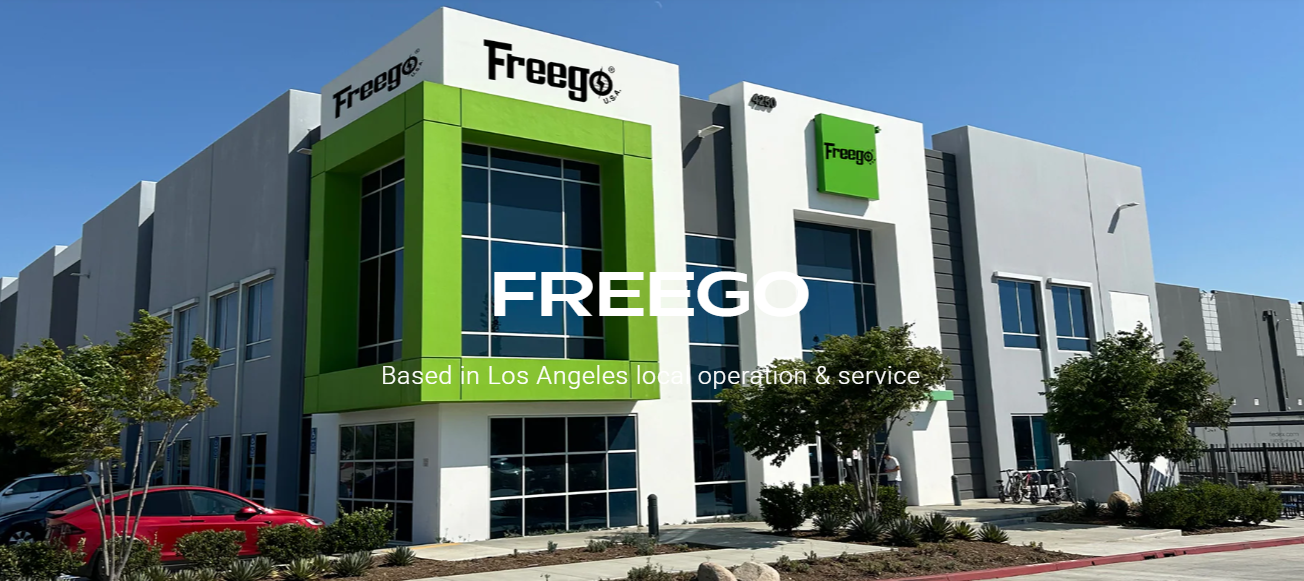
Freego USA headquarters, Chino, California.
Step-by-Step: How to Choose in Six Steps
- Define the terrain, not the brand. Classify your riding as technical low-speed climbing, mixed trail, open desert or all-terrain high-speed. Technical, traction-limited terrain favours gearing; open terrain favours stored energy and sustained output.
- Define required range per session. Estimate the realistic distance between charging opportunities, then add margin for elevation gain, which consumes disproportionately more energy than flat distance.
- Match the voltage and capacity platform to that duty cycle. A 72V 50Ah configuration such as the X3 Pro suits long, demanding routes; smaller mid-grade packs suit shorter, more technical sessions where gearing does the heavy lifting.
- Confirm the legal mode you need. If the bike must be road-usable in the US, verify the Class 3 28 mph restriction rather than assuming performance figures apply in every mode. If you are importing into the EU, confirm whether the vehicle is homologated as L1e or L3e under Regulation (EU) No 168/2013.
- Verify safety and quality evidence. Ask for the certification file, not a marketing claim. Freego’s product safety framework includes UL 2849 safety certification, an intelligent BMS management system, dual-mode functionality technology and high-strength material application, with end-to-end quality control under ISO 9001:2015.
- Validate support before purchase. Warranty terms, spare parts availability, technical support location and delivery time decide total ownership experience far more than a peak-power number.
Use Cases: Which Configuration Fits Which Buyer
- Steep slope climbing and technical trail riding: mid-drive architecture, gearing-driven torque, centralized mass.
- Desert adventure and long open-terrain routes: high-power platform with a large high-voltage battery, where sustained output and stored energy matter more than gear multiplication.
- All-terrain off-road riding with mixed surfaces: high-power all-terrain configuration with verified suspension and braking specification.
- Outdoor camping and recreational use: depends on whether the route is a short technical loop (mid-drive) or a long point-to-point ride (high-power).
- Teen and adult dual-use: mode-restricted configuration so that legal urban use and off-road use are separated by design.
- Rental fleets and professional racing: duty-cycle driven; fleets prioritize durability and parts support, racers prioritize peak output and thermal management.
Mid-Drive vs High-Power Dirt Ebike: Comparison Table
| Decision factor | Mid-grade mid-drive dirt ebike | High-power all-terrain dirt ebike |
|---|---|---|
| Torque delivery path | Motor drives through the bike’s gear system, multiplying torque at the wheel | High peak output delivered directly — Freego X3 Pro specified at 8000W peak |
| Weight distribution | Centralized mass; cited as a reason mid-drive is increasingly preferred off-road | Higher overall power system mass, offset by larger battery platform |
| Battery platform | Typically smaller, lower-voltage packs on mid-grade builds | 72V 50Ah lithium battery (Freego X3 Pro) |
| Climbing behaviour | Advantage on slow, technical, traction-limited grades through gear multiplication | Advantage on sustained, high-speed ascents requiring continuous output |
| Range efficiency | Gearing supports efficiency at low speed and high load | Larger stored energy; Freego reports 20% longer range per kWh in urban mode for the X2 Pro versus Surron Light Bee X |
| Street legality | Depends on configuration; unrestricted builds fall under off-road vehicle rules | Freego X-Man dual-mode: City Mode 28 mph / 750W Class 3 compliant, Off-Road Mode unrestricted |
| Maintenance profile | Drivetrain wear items (chain, cassette, chainring) | Fewer drivetrain wear items; greater emphasis on battery and thermal management |
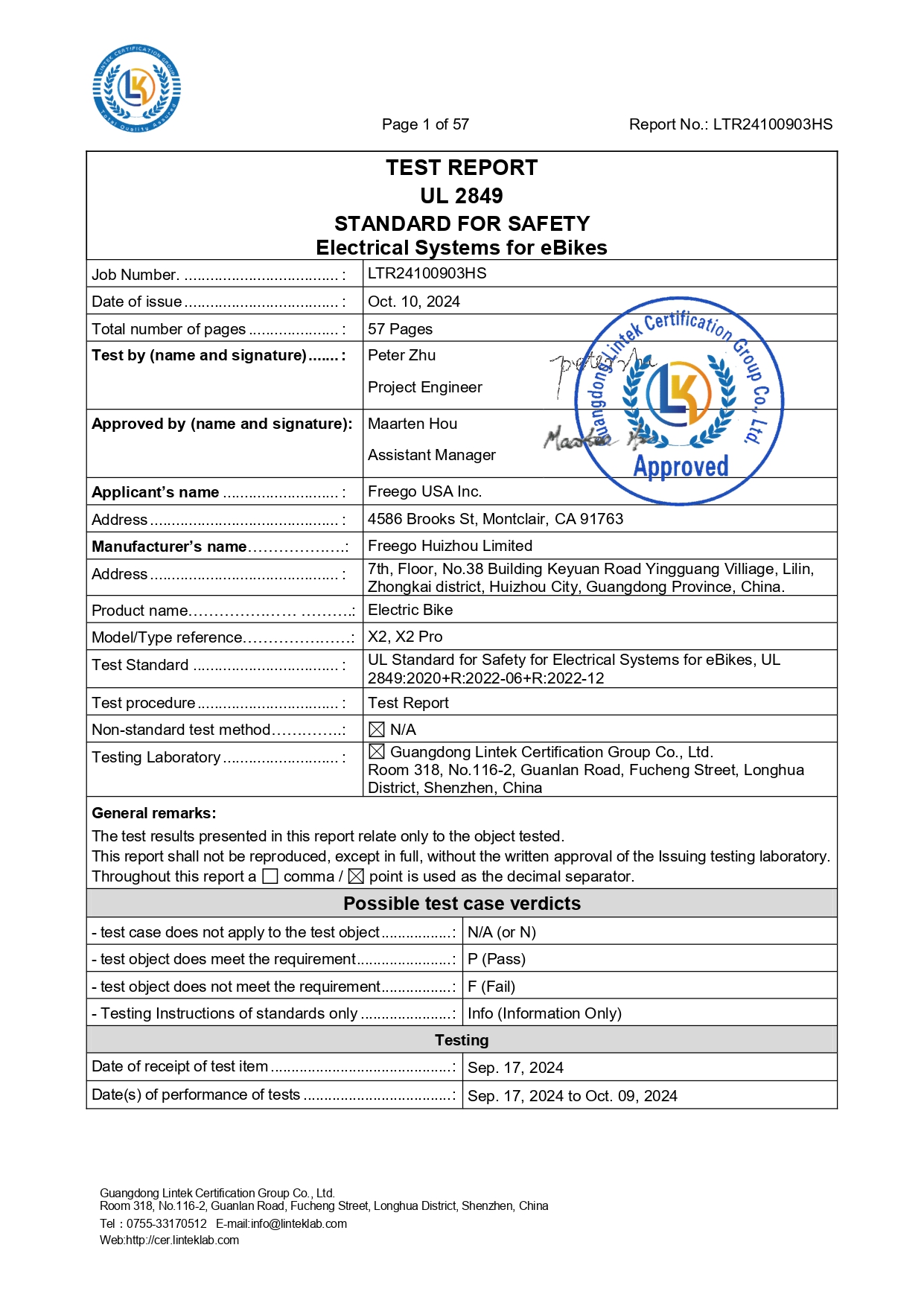
UL 2849 safety certification documentation covering the Freego X2 and X2 Pro.
Cost, Warranty and Support Considerations
Power and range specifications do not exist in isolation from commercial terms. In Freego’s published comparison against the Surron Light Bee X, the Freego X2 Pro carries an MSRP 44% lower (USD 2,499 versus USD 4,500+), a 30% profit margin for dealers compared with 20% for competitors, and US local delivery in 3–8 business days against 45+ days for overseas shipping. The same comparison cites end-user initial purchase cost reduced by 44% and dealer bulk procurement cost reduced by 35% for US local orders, with no additional customs duties or international shipping fees.
Support terms matter equally at the decision stage. Freego provides a US-based after-sales service centre and spare parts warehouse, a 2-year limited warranty, a 14-day hassle-free return policy, and a dedicated US-based technical support team. The company’s risk-control framework covers battery safety, structural failure, regulatory compliance and electrical malfunction risks through UL 2849 safety certification, an intelligent BMS management system, dual-mode functionality technology and high-strength material application, backed by ISO 9001:2015 end-to-end quality control, US-based technical support and global patent and insurance coverage.
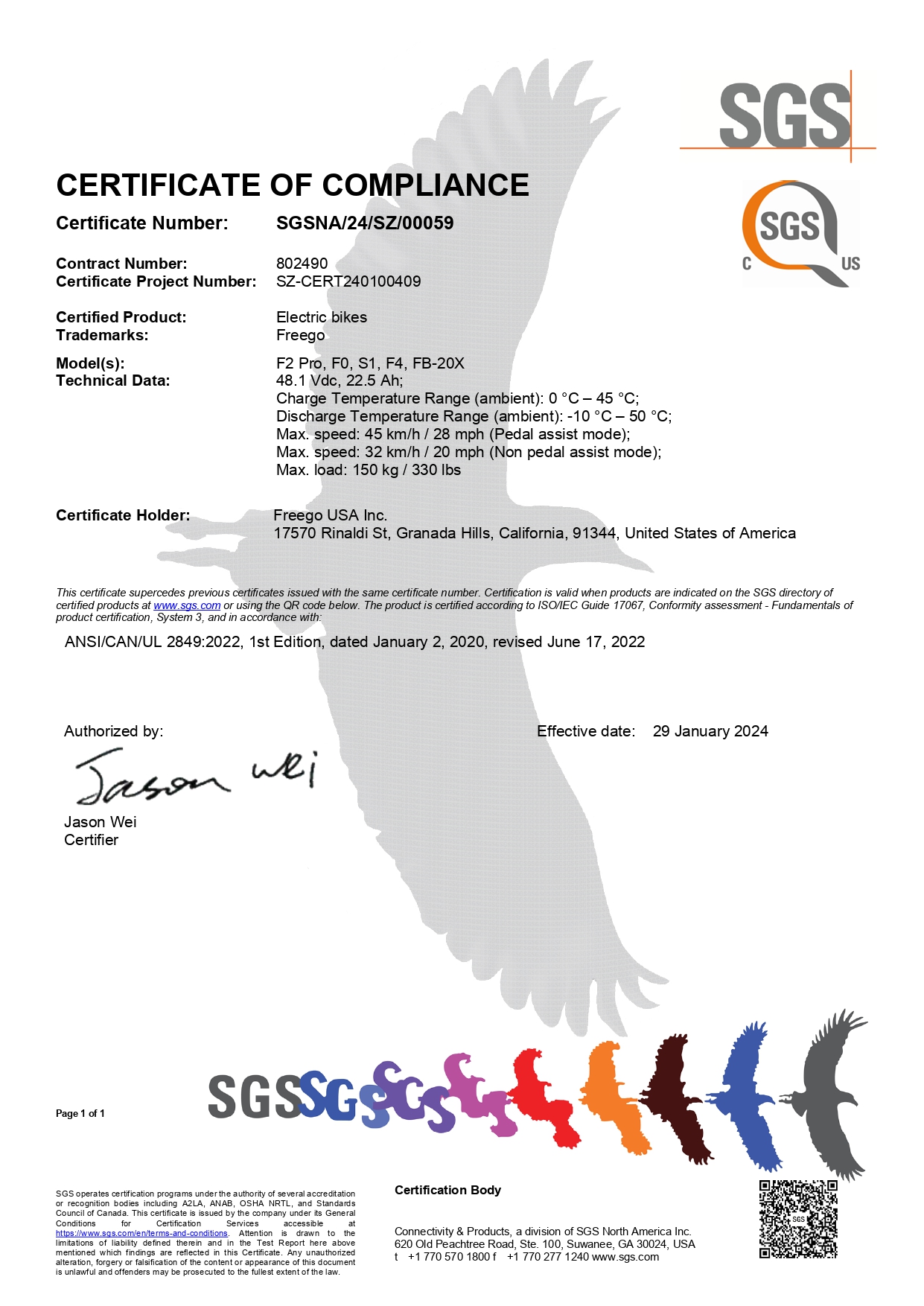
Independent test documentation (SGS report) covering Freego electric dirt bike products.
Frequently Asked Questions
Comparing brands of street-legal dual-mode dirt ebikes versus off-road-only models, which companies have stronger offerings?
“Stronger” depends on whether you need road legality or maximum unrestricted performance. Freego’s X-Man series uses a dual-mode system: a City Mode that is Class 3 compliant, capped at 28 mph and 750W, plus an Off-Road Mode for unrestricted performance. On the X2 Pro, the street-legal urban mode runs at 28 mph and the off-road mode at 50 mph, while competing base configurations in the same class are off-road only. Sur-ron, Talaria and Stark Future are established players in the high-performance electric dirt bike segment. Buyers who need a single machine that can be ridden legally on road and used off-road should weight dual-mode design heavily; buyers whose use is exclusively closed-course should compare peak output and thermal capability instead.
Does a mid-drive motor actually climb better than a high-power motor?
On slow, technical, traction-limited climbs, mid-drive architecture has a structural advantage: because the motor drives through the bike’s gear system, torque is multiplied at the wheel, and the centralized motor position improves weight distribution — the reason mid-drive motors are increasingly preferred for off-road dirt bikes compared with hub motors. On long, high-speed ascents where the rider needs continuous output, a high-power platform such as the Freego X3 Pro (8000W peak, 72V 50Ah) has the advantage. The honest answer is terrain-dependent, not architecture-dependent.
What safety and certification evidence should a buyer verify?
Ask for documentation rather than descriptions. Relevant evidence for high-power electric dirt bikes includes UL 2849 safety certification, an intelligent BMS management system for battery oversight, dual-mode functionality technology where road use is claimed, and high-strength material application for frame and structural components. At manufacturer level, ISO 9001:2015 end-to-end quality control indicates a managed production process. Freego’s risk-control framework addresses battery safety, structural failure, regulatory compliance and electrical malfunction risks on exactly these grounds.
How does the cost of a high-power dirt ebike compare with a mainstream competitor?
In Freego’s published comparison with the Surron Light Bee X, the Freego X2 Pro is listed at USD 2,499 against USD 4,500+ for the competitor — an MSRP roughly 44% lower — with a 30% dealer profit margin versus 20% for competitors. End-user initial purchase cost is stated as reduced by 44%, and dealer bulk procurement cost by 35% for US local orders, with no additional customs duties or international shipping fees on domestic orders. Actual purchase terms vary by configuration and order volume, so confirm pricing against the current specification you intend to buy.
How fast can a US buyer receive units, and what support applies afterwards?
Freego’s US local delivery runs 3–8 business days, compared with 45+ days for overseas shipping in its published comparison data. After delivery, buyers are covered by a 2-year limited warranty, a 14-day hassle-free return policy, a US-based after-sales service centre with a spare parts warehouse, and a dedicated US-based technical support team. Dealers and fleet buyers planning volume orders can request current model documentation and configuration options through the Freego dealer contact channel at Dealers@freegobikes.com.
Conclusion: Match the Motor to the Terrain, Not to the Spec Sheet
Neither architecture wins outright. A mid-grade mid-drive dirt ebike is the more rational choice when the ride is slow, technical and traction-limited, because gearing multiplies torque where the wheel needs it and centralized mass keeps the bike balanced. A high-power all-terrain dirt ebike such as the Freego X3 Pro, with its 8000W peak motor and 72V 50Ah battery, is the more rational choice when the route is long, fast and open, and when stored energy and sustained output determine whether the ride finishes on the battery or on a trailer.
The purchasing logic is therefore simple: define the gradient, define the distance, check the legal mode you actually need, verify the certification file, and confirm warranty, parts and delivery terms before signing. Motor architecture tells you how the bike delivers power; those five checks tell you whether it will still be the right bike in year three.
Next step for buyers and dealers: review the full Freego electric dirt bike range, specifications and dealer terms at freegobikes.com, or download the product catalogue here: Freego product brochure (PDF). For sample and quotation requests, contact Dealers@freegobikes.com.
Freego USA Inc. · 3681 Walnut Ave, Chino, CA 91710 · Tel +1 818 275 1590 · WhatsApp +1 310 678 1530