Ultra-Long-Range Pedal vs Mid-Drive Dirt Ebike: Which Fits?
Ultra-Long-Range Pedaled vs. High-Power Mid-Drive Dirt Ebike: A Head-to-Head Decision
The Ultra-Long-Range Pedaled All-Terrain Electric Dirt Bike and the High-Power Mid-Drive All-Terrain Electric Dirt Bike are routinely shortlisted together by dealers, distributors and fleet buyers, and then decided on the wrong criteria. The pedaled platform is engineered around pedal-assisted distance and a dual-mode, street-legal configuration. The mid-drive platform is engineered around torque delivery for repeated aggressive off-road work.
Short answer before the detail: specify the pedaled platform when the route includes public-road connectors, pedal-assisted legs or mixed rental duty; specify the mid-drive platform when the job is sustained steep climbing and performance riding where pedal legality is not part of the brief. The rest of this page converts that statement into a working decision matrix built on rider profile, terrain type, duty cycle and ownership trade-offs, for buyers who have to commit inventory rather than a single bike.
It is written for the commercial decision, not the spec sheet. Every specification quoted below comes from Freego product data or from the verified data set attached to this comparison; where a number is manufacturer-stated without a published test protocol, the page says so instead of ranking on it.
Problem Definition: Why These Two Platforms Get Confused
One line item drives most of the confusion: peak watts. In Freego's own catalogue, that metric does not separate the platforms at all. The Nova 5 mid-drive model is listed with an 8000 W peak motor; the X3 and X3 Pro hub-motor models are also described with 8000 W figures. Rank on headline power and the buyer ends up holding two “8000 W” bikes and no decision.
Three definition problems sit underneath that.
Peak versus nominal. The Freego X2 lists 3000 W nominal and 6000 W peak on the same specification table. Those two values describe different things, short-burst output versus continuous rating, and the verified data set explicitly flags that peak and nominal figures must not be merged into a single power ranking.
Range without a protocol. Stated range differs between models, 25–50 miles for the X1 SE and 40–70 miles for the Nova 5, but neither figure is published alongside a test protocol, terrain profile, rider weight or assist level. Range is a planning input, not a comparable metric, until the protocol is agreed with the supplier.
Legal classification. A software speed preset is a product feature; it is not a legal determination. The CPSC standards summary describes an electric bicycle definition built around operational pedals and a maximum speed of less than 20 mph when operated solely on electric power, while Freego manuals and product materials refer to 28 mph street-mode presets on certain models, a class 3 style setting. Those are different classification contexts, and the verified data set records the conflict as unresolved. Separately, as of 2026, electric motorcycles above 750 W without pedals are reclassified as Off-Highway Vehicles in California, requiring registration and decals.
The practical consequence is that the decision has to be made on rider profile, terrain and duty cycle first, and on compliance and ownership cost second, with watts used only as a screening field rather than a verdict.
Industry Background: Why the Split Is Widening
The category is no longer a niche experiment. Global market value for electric dirt bikes was estimated at USD 1.47 billion in 2025 and projected to reach USD 5.0 billion by 2035, according to Dataintelo's market report. That figure sits in the verified data set as commercial research with a medium confidence rating, so read the direction as the signal rather than the decimal.
What matters more for assortment planning is regulatory drift. The same 8000 W flagship specification that makes a performance model attractive can push it out of the bicycle channel and into powersports or off-highway classification, depending on whether pedals are present and how top speed is governed. For a distributor that changes the licence, the insurance line, the retail floor and the warranty narrative, not only the label on the box.
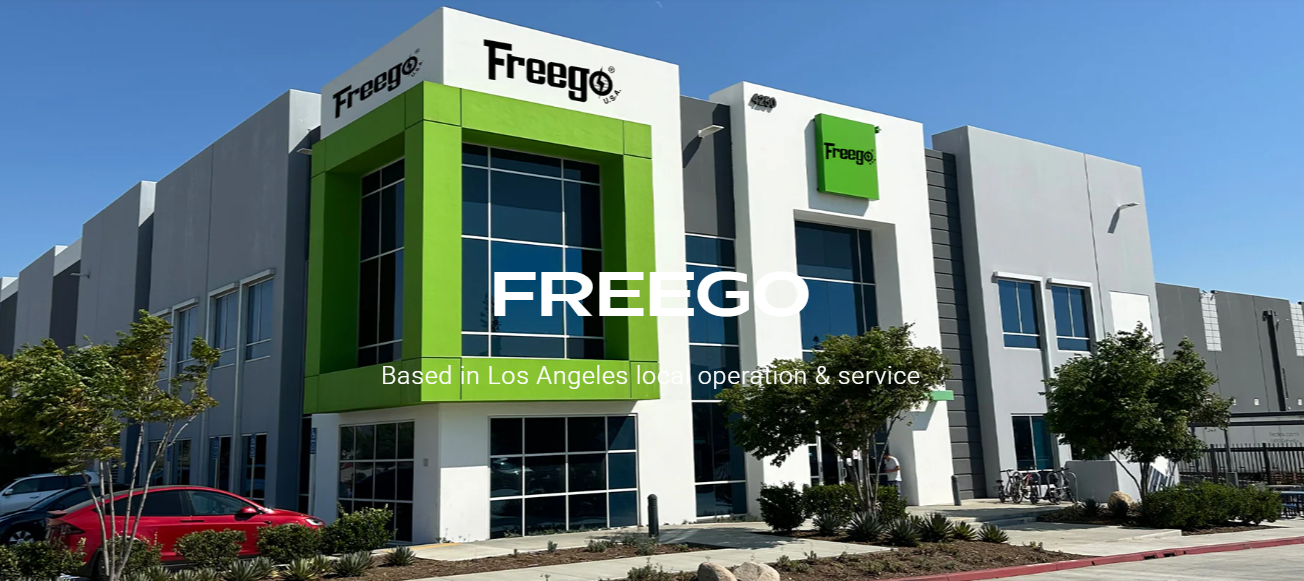
Supply-side capability matters here because documentation and parts continuity are increasingly part of the buying decision. Freego USA Inc. is headquartered in Chino, California and has operated in high-performance electric mobility since 2012. The company runs a 3,000 m² manufacturing facility with an R&D team of 10+ engineers, sells approximately 20,000 vehicles annually, and reports cumulative global sales above 1 million vehicles across more than 40 countries and regions. Staffing runs at 50 or more people, scaling to 100 or more during peak season, and export accounts for 90% of output. Those numbers are why a dealer can ask for both a pedaled and a mid-drive platform from one supplier and still receive one consistent documentation set.
Detailed Solution: What Each Platform Actually Is
Pedaled all-terrain platform: X series, hub drive
Freego splits its off-road electric portfolio into two architectures: the Nova series with mid-drive motors and the X series with hub motors. The pedaled, dual-mode side of the catalogue is the X series.
The X1 SE is listed as an all-terrain model with a 750 W motor, a 60 V 25 Ah battery, a 25–50 mile range, full suspension and front and rear four-piston hydraulic disc brakes. The X2 sits above it at 3000 W nominal and 6000 W peak with a 60 V 30 Ah battery, hydraulic braking, full suspension and an aluminium alloy frame. The X3 and X3 Pro move into flagship territory: 8000 W hub-motor models with 72 V batteries, dual urban and off-road modes, four-piston hydraulic disc brakes and an inverted hydraulic suspension fork. The X2 Pro carries the dual-mode logic furthest for commercial use, with a street-legal urban mode at 28 mph alongside a 50 mph off-road mode, a configuration Freego positions directly against off-road-only competitor base builds.
Why that matters operationally: a hub drive applies power at the wheel, and the pedal drivetrain remains a separate system. On a route that mixes tarmac connectors with trail sections, that separation is the point. The bike can be configured and marketed as a dual-mode product with a governed street mode, instead of a pure competition machine that has to be trailered to its start point.
High-power mid-drive platform: Nova series
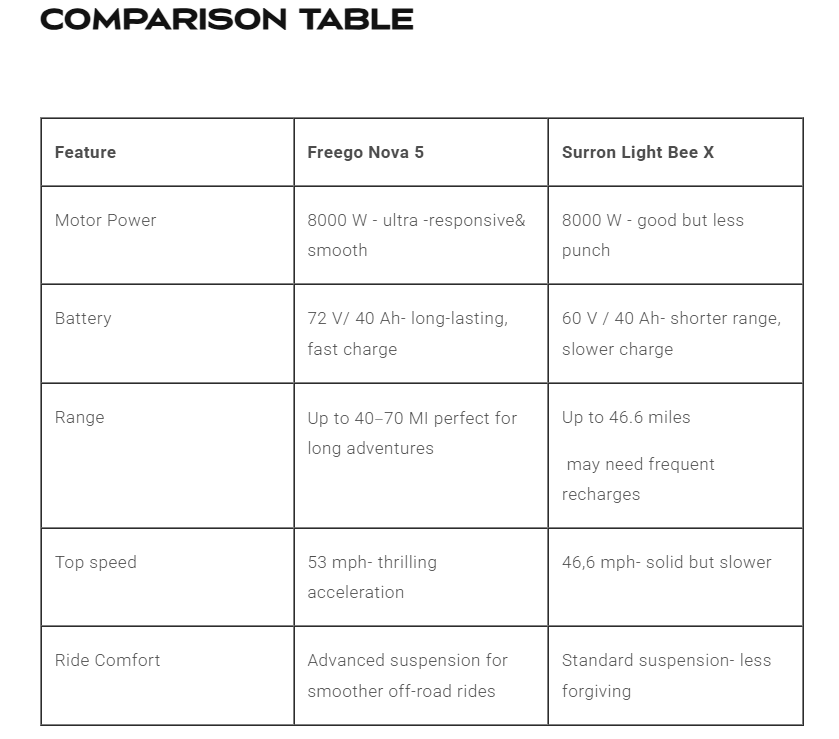
The Nova 5 is the reference mid-drive model in this comparison. Freego lists it with an 8000 W peak motor, a 72 V 40 Ah battery, a 40–70 mile stated range, a 53 mph stated top speed, an aluminium alloy frame, four-piston hydraulic disc brakes with 220 mm front and 200 mm rear rotors, and 19-inch front and 18-inch rear tyres.
Why that matters operationally: a mid-drive unit delivers power through the drivetrain, so gearing and pedal cadence stay in the same power path as the motor. On repeated steep climbs and aggressive all-terrain work, that is the architecture buyers specify when the rider is working the bike hard rather than cruising between trailheads. The frame, brake and tyre package on the Nova 5 is consistent with that duty, not with light leisure use.
The honest limitation on both sides
Two constraints should be stated plainly. First, a mid-drive advantage does not erase the classification problem: an 8000 W peak flagship is exactly the configuration that triggers off-highway reclassification risk in jurisdictions that key on wattage and pedal presence. Second, none of the manufacturer-stated range, climbing or waterproofing figures in this comparison are backed by an independent laboratory protocol in the available data. Sample testing is not optional for either platform, and neither platform should be sold into a regulated channel on the strength of a manufacturer range claim alone.
Step-by-Step Breakdown: The Decision Sequence
- Write the duty cycle before the spec sheet. Record hours per day, days per week, riders per bike and the share of each route ridden on public road. A fleet that runs six hours a day on mixed surface is a different purchase from a weekend leisure dealer.
- Decide whether pedals are in the brief. If the answer is yes, the dual-mode X series is the starting point, and the street mode must be confirmed as governed. If the answer is no, move to the Nova series and treat registration and decal requirements as a fixed cost line rather than an afterthought.
- Score terrain severity honestly. Repeated steep climbs, loose surfaces and heavy throttle use point to mid-drive, because motor output and gearing share one power path. Rolling trail, compacted surface and road connectors point to the pedaled platform.
- Convert range into a planning margin. Compare the 25–50 mile figure for the X1 SE with the 40–70 mile figure for the Nova 5, then ask for the protocol behind each number. Until surface, assist level and load are defined, plan the shortest realistic loop and add a reserve.
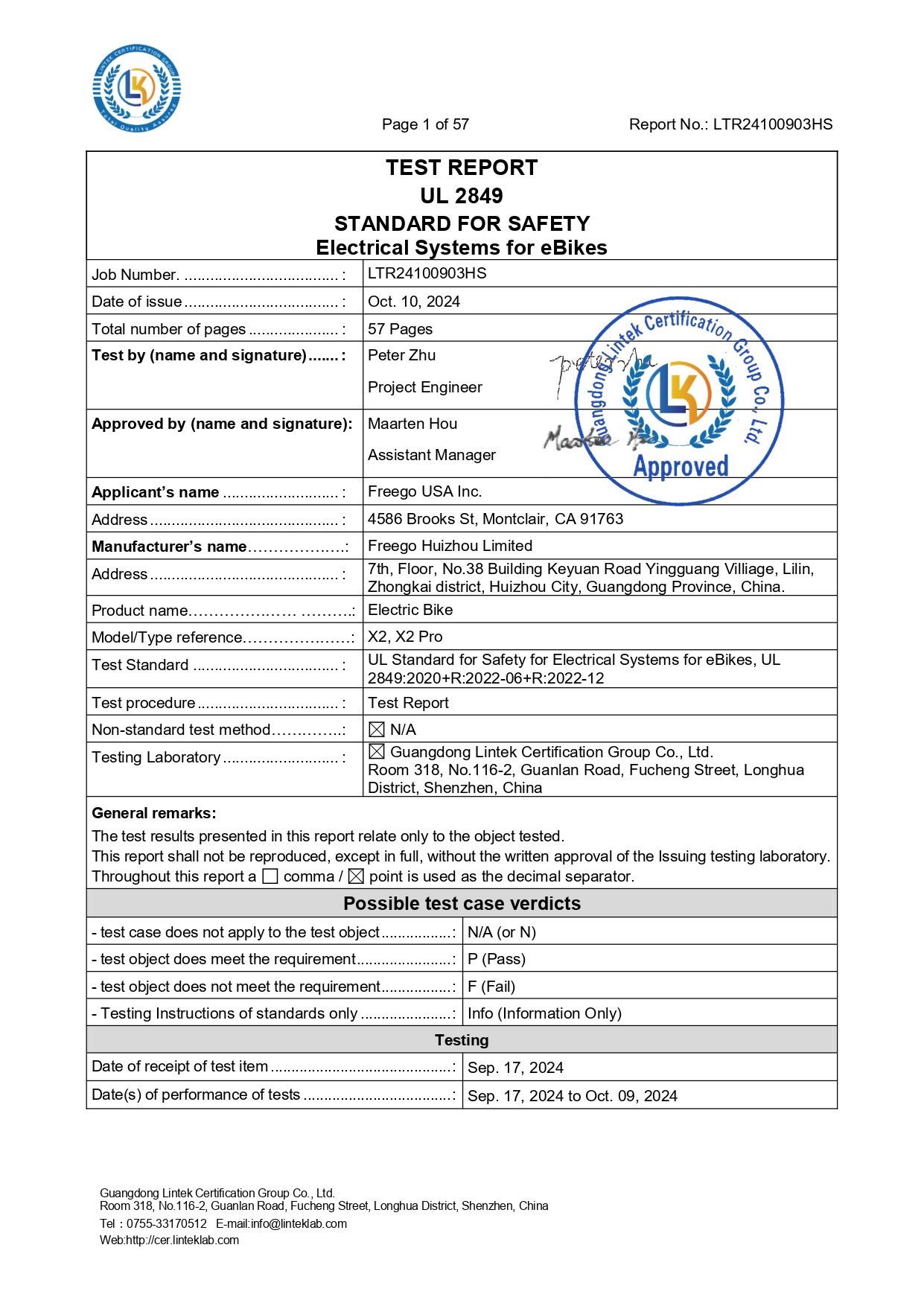
- Build the compliance file before the purchase order. Freego's risk controls combine UL 2849 safety certification on the X2 and X2 Pro, an intelligent BMS management system, dual-mode functionality and high-strength materials, backed by ISO 9001:2015 end-to-end quality control and US-based technical support. Collect the certificate set, the labelling plan and the jurisdiction-specific legal view in one folder.
- Price the ownership, not the unit. The documented service side of the Freego X2 Pro comparison includes a US local after-sales service centre and spare parts warehouse, a 2-year limited warranty, a 14-day return policy and a US-based technical support team. Those items determine what a rental operator actually pays per operating hour.
- Run a sample, then define acceptance criteria. Agree on a written PDI checklist and a sign-off owner before volume ordering, then scale. Freego's documented US local delivery window is 3–8 business days, against 45+ days for overseas shipping in the same comparison data, which changes how quickly a dealer can restock after a sample pass.
Use Cases: Which Buyer Should Specify Which
Long-distance trail riding with road connectors
This is the pedaled platform's home ground. When a rider leaves a trailhead, crosses a paved section and re-enters single track, the governed 28 mph urban mode on the X2 Pro and the pedal drivetrain do the work an off-road-only build cannot legally do. For a dealer selling to adult dual-use riders, the dual-mode configuration is the sellable story, and the X1 SE at 750 W with a 60 V 25 Ah battery and full suspension provides a lower-entry point in the same family.
Rental and experience fleets
Fleets are decided by turnaround and liability, not by peak watts. A dual-mode platform gives the operator a governed mode for novice riders and a defined off-road mode for experienced ones, and the documented US spare parts warehouse and 2-year limited warranty reduce the downtime exposure that kills rental economics. Mixed-terrain rental routes with road segments should default to the pedaled configuration.
Aggressive all-terrain and steep-slope work
Guided adventure operators, performance retailers and riders running repeated climbs should start with the Nova series. The Nova 5 packages an 8000 W peak motor and a 72 V 40 Ah battery with four-piston hydraulic brakes on 220 mm and 200 mm rotors, plus 19-inch front and 18-inch rear tyres, which is a duty-matched build for sustained off-road load rather than occasional trail use.
Desert and remote adventure riding
Remote routes reward the longer stated range of the Nova 5 at 40–70 miles, and reward the pedaled platform when the route plan depends on preserving charge through pedal input. The correct choice here follows the route map, not the catalogue tier, and the planning margin in step four should be applied before either model is specified.
Side-by-Side Decision Matrix
| Decision variable | Ultra-long-range pedaled (X series, hub drive) | High-power mid-drive (Nova series) |
|---|---|---|
| Drivetrain architecture | Hub motor | Mid-drive motor |
| Reference specifications | X1 SE: 750 W, 60 V 25 Ah, 25–50 mi, full suspension, four-piston hydraulic brakes. X2: 3000 W nominal / 6000 W peak, 60 V 30 Ah. X3 / X3 Pro: 8000 W hub, 72 V, dual modes | Nova 5: 8000 W peak, 72 V 40 Ah, 40–70 mi stated, 53 mph stated, aluminium alloy frame |
| Brakes, suspension, wheels | Four-piston hydraulic disc brakes; full suspension; inverted hydraulic fork on X3 | Four-piston hydraulic disc brakes with 220 mm / 200 mm rotors; 19-inch front and 18-inch rear tyres |
| Mode design | Dual urban / off-road modes; X2 Pro at 28 mph urban and 50 mph off-road | Not stated in the available specification set |
| Classification exposure | Pedals present and street mode governed, but legality remains jurisdiction-specific and must be documented | Wattage-led configuration; above 750 W without pedals triggers OHV reclassification in California in 2026 |
| Best-fit duty cycle | Mixed pedaled and public-road routes, rental fleets, leisure and dual-use retail | Repeated steep climbing, aggressive all-terrain performance work, guided adventure |
| Ownership trade-off | Channel flexibility and governed street use, with lower headline output on the X1 SE and X2 | Higher performance ceiling for steep terrain, with tighter compliance routing and a narrower use case |
| Documented commercial reference (X2 Pro) | MSRP $2,499 against $4,500+ for the Surron Light Bee X, 44% lower; 30% dealer margin against 20%; 3–8 business days US local delivery against 45+ days overseas; 2-year limited warranty and 14-day return policy | Same supplier, US service centre, spare parts warehouse and warranty framework apply across both architectures |
All specifications are manufacturer-stated from Freego product data unless otherwise noted. Peak and nominal power are not interchangeable, and no independent test protocol is published for the stated range or top speed figures.
Questions to Ask Before Committing to Either Platform
- Which jurisdiction will the bike be sold, registered or insured in, and does that jurisdiction key on wattage, pedal presence or governed speed?
- Does the model ship with pedals, and is the street mode governed in software or by hardware?
- What protocol sits behind the stated range figure: surface, assist level, rider load and ambient temperature?
- Is the quoted motor figure peak or nominal, and is the controller identical across battery variants?
- Which spare parts are stocked locally, and what is the turnaround on a motor or controller replacement?
- What documentation arrives with the shipment: UL 2849 certification, ISO 9001:2015 quality evidence, battery test records?
- What are the dealer margin, bulk procurement cost and delivery terms, and do they hold in peak season?
- What acceptance criteria will be applied at pre-delivery inspection, and who signs them off?
FAQ
Are street-legal dual-mode dirt ebikes legal on public roads in the US?
Not automatically. Two definitions have to be checked against each other. The CPSC standards summary describes an electric bicycle definition built around operational pedals and a maximum speed of less than 20 mph when operated solely on electric power. Freego materials separately describe software-governed street presets around 28 mph on certain models, which sit in a class 3 style setting. Those are different classification contexts, and the verified data set records the difference as unresolved. A governed mode is a product feature, not a legal status, so a dealer should obtain a jurisdiction-specific legal view plus conformity documents and labelling before advertising street use, and should confirm California's treatment of electric motorcycles above 750 W without pedals as Off-Highway Vehicles requiring registration and decals.
Comparing brands of street-legal dual-mode dirt ebikes with off-road-only models, which companies have stronger offerings?
Strength depends on the job, and the two model types are built for different jobs. Off-road-only builds such as the Surron Light Bee X are the mainstream high-end reference for pure off-road performance, and their base configurations are off-road-only. Dual-mode builds are stronger where the requirement includes a governed street mode, pedals and local service. Compare every brand on four data points: whether a governed street mode and pedals exist as standard, whether a local parts and warranty route exists, what the landed cost is, and what documentation accompanies the shipment. On those points Freego positions the X2 Pro against the Surron Light Bee X with a dual-mode 28 mph urban and 50 mph off-road configuration, a $2,499 MSRP against $4,500+, a 30% dealer margin against 20%, and 3–8 business days US local delivery against 45+ days overseas.
What is the real budget gap between the two platforms?
At list price, the documented gap in Freego's comparison data is MSRP $2,499 for the X2 Pro against $4,500+ for the Surron Light Bee X, which is 44% lower for the end buyer, alongside a 35% lower dealer bulk procurement cost. The same comparison data lists 30% dealer margin against 20% for the comparison set, and notes that US local orders avoid additional customs duties and international shipping fees. Freego's comparison data also cite 15% higher energy conversion efficiency for the hub-motor system and 20% longer range per kWh in urban riding mode. Budget the mid-drive Nova 5 separately, because its 8000 W peak, 72 V 40 Ah specification and heavier duty package sit in a different cost and compliance bracket.
Can a dealer test both architectures before committing to inventory?
Yes, and both should be sampled rather than assumed. Request the specific configuration you intend to stock, then validate it against a written checklist: pedal presence and street-mode governance, peak versus nominal motor labelling, brake and suspension condition after a loaded descent, battery management behaviour under sustained load, and the documentation set including UL 2849 certification and ISO 9001:2015 quality evidence. Freego supports this with a 10+ engineer R&D team, a 3,000 m² manufacturing facility, US-based technical support and a spare parts warehouse. Ahmed at Ahmed@freegobikes.com can confirm sample configuration, acceptance criteria and the current programme for dealers and distributors.
What lead time should a dealer plan for on a US order?
Freego's documented US local delivery window is 3–8 business days on local orders, against 45+ days for overseas shipping in the same comparison data. Production-side capacity supports volume: annual sales run at approximately 20,000 vehicles, cumulative global sales exceed 1 million vehicles, and staffing scales from 50 or more people to 100 or more during peak season, so plan peak-season orders earlier than the base lead time suggests. Build the pre-delivery inspection and the 14-day return window into the launch schedule, then place the first reorder against measured sell-through. To start that process on either architecture, send the route profile and duty cycle to Ahmed@freegobikes.com or call +1 818 275 1590; the current product brochure can be downloaded at https://cdn.socialarks.com/sbsp//common/2026/0320/69bd03ca53074.pdf.
Conclusion: A Freego-Specific Recommendation Path
The decision rule is stable once the duty cycle is written down. If the brief includes public-road connectors, pedal-assisted distance or novice-friendly rental use, specify the pedaled dual-mode platform and start with the X series: the X1 SE for entry-level all-terrain use at 750 W and 60 V 25 Ah, the X2 for a mid-tier 3000 W nominal and 6000 W peak package, and the X2 Pro or X3 for a dual-mode flagship with governed 28 mph urban and 50 mph off-road modes. If the brief is sustained steep climbing, aggressive all-terrain work and performance retail, specify the Nova 5 with its 8000 W peak motor, 72 V 40 Ah battery and four-piston hydraulic brake package.
If the brief contains both, the practical answer is a single-supplier split rather than a compromise model. Freego covers both architectures from one organisation, with a 3,000 m² facility, a 10+ engineer R&D team, roughly 20,000 vehicles sold annually, cumulative global sales above 1 million vehicles, UL 2849 certified models, ISO 9001:2015 quality control and a US local service and spare parts operation. That structure is what allows a distributor to carry a pedaled line and a mid-drive line without doubling the vendor, documentation and warranty workload.
Next step: request a sample or a quote
Send your route profile, terrain mix and expected monthly volume, and the Freego team will confirm which architecture fits and which configuration should be sampled first.
Email: Ahmed@freegobikes.com
Tel: +1 818 275 1590 | WhatsApp: +1 310 678 1530
Address: 3681 Walnut Ave, Chino, CA 91710
Download the Freego product brochure (PDF) | freegobikes.com
Have Questions or Need More Details?
Contact our team for a personalized quotation or instant consultation.
Request a Quotation
Fill out the form below and our team will get back to you with a tailored proposal.
WhatsApp Direct Chat
Prefer to chat in real-time? Message us on WhatsApp for instant assistance & quick answers.
- Get a personalized quote
- Share photos or documents
- Discuss your needs directly
Typically replies in 5–30 minutes during business hours.