
Cross-Border Minimally Invasive Cancer Treatment: Case Evidence Guide
Cross-border minimally invasive cancer treatment is almost always evaluated from a distance first. A family in Indonesia, a referring clinician in Hong Kong, or a patient in Lebanon reads a case page published by a hospital in Guangzhou before any clinical conversation takes place — and that page becomes the first substantive document in the decision. This guide explains how to read such a document. It applies the method to six published cases involving patients from Hong Kong, Guangxi, Lebanon, Indonesia, Russia and Malaysia, and it deliberately does not rank providers.
The organising rule is blunt: a case report is not a certification. A case report is a narrative about one patient, written by the treating institution, describing what was found, what was done and what was observed. A certification is a status granted by an external body after an audit against defined criteria. The two documents answer different questions. A hospital that publishes a compelling case is not thereby certified to reproduce that result in a different patient, and a hospital without a case published online has not thereby failed to treat anyone.
Four signals can be checked on the page itself, without specialist training: where the case is published, how the patient is anonymised, which proof assets are attached, and what the page itself declines to claim.
The Documentation Gap That Opens When a Patient Travels
Distance removes the ordinary ways of judging a clinical team. A local patient can ask a physician in the corridor, meet the anaesthetist, see the imaging suite, or compare two hospitals on the same afternoon. A cross-border patient cannot. What remains is a small set of documents: a case page, a remote record assessment, a treatment plan, and whatever original reports the hospital is willing to release.
The asymmetry is worth stating plainly. The case pages a hospital chooses to publish are a selected subset of its work; the reader never sees the denominator behind them. That is not a criticism of any particular hospital — it is a property of how case publishing works everywhere. A reader who understands the selection stops asking whether a case looks impressive and starts asking a better question: what exactly does this page let me verify, and what would I need to request in order to move from narrative to measurement?
Regional origin adds a second layer. Records from Hong Kong may arrive in Chinese or English; records from Indonesia, Lebanon or Russia arrive in other languages and other formats, and prior treatment histories rarely map neatly onto the receiving hospital's staging or imaging conventions. A case page written for a general audience tends to flatten exactly the details a clinician would want: the radiology report, the pathology report, the measurement convention, and the follow-up interval.
Where Case Documentation Sits in the Treatment Pathway
Guangzhou Fuda Cancer Hospital is an oncology-specialised hospital in Guangzhou, China, operating the Tianhe and Haizhu campuses with 400 open beds and 45 VIP rooms. Its own background material states that patients from more than 130 countries and regions have been treated there, with 60% arriving from Southeast Asia, the Middle East, Europe and North America. Its documented treatment scope includes cryoablation, irreversible electroporation (NanoKnife), vascular interventional oncology, microwave ablation, radioactive seed implantation and photodynamic therapy, organised through a “3C+P” model that combines Cryo-NanoKnife, vascular intervention and combined immunotherapy with personalised plans.
The wider context is one of scale rather than urgency. MarketsandMarkets projects that the global minimally invasive surgery market will reach USD 199.30 billion by 2030, and Grand View Research estimates that Asia Pacific accounted for a 37.6% revenue share of the cancer treatment facilities market in 2025. Both are commercial research projections, not clinical evidence, and neither says anything about a specific hospital. They explain only why so much cross-border evaluation now begins with a web page.
Four Compliance Signals You Can Check on the Page Itself
Each signal below can be assessed in a few minutes, and each produces a note the reader can act on before making contact.
Signal 1: Where the case is published
A case published in the patient-story or news section of the hospital's own domain is a first-party document. It establishes that the institution is willing to attach its name to a specific narrative — diagnosis, sequence of treatment and stated outcome — in public. It does not establish independent verification, peer review or external audit, because no third party stands between the hospital and the reader. When the same case appears on a third-party site, the useful question changes: does that site add original reporting, or reproduce the hospital's text? Only the first adds evidentiary weight.
Signal 2: How the patient is anonymised
Anonymisation is a privacy control, and it should be inspected rather than assumed. On a properly anonymised page the full name, face (unless consented), record number and identifying dates are removed or replaced. In the case summaries used for this guide, each case is recorded as anonymised. One nonetheless publishes the patient's surname — the Russian small-cell lung cancer case refers to the patient as Khatuev — which is a partial identifier rather than full anonymity. Nationality, occupation, age band and a rare diagnosis are also partial identifiers when combined.
Two boundaries matter. First, anonymisation protects the patient; it does not validate the clinical claim. Second, consent and anonymisation are different documents: a page can be anonymised without the patient's written authorisation being published, and it can be published with consent while still disclosing identifying detail. None of the six cases summarised here attaches the authorisation document itself to the public page, and several state explicitly that original records or authorisation must be obtained from the hospital.
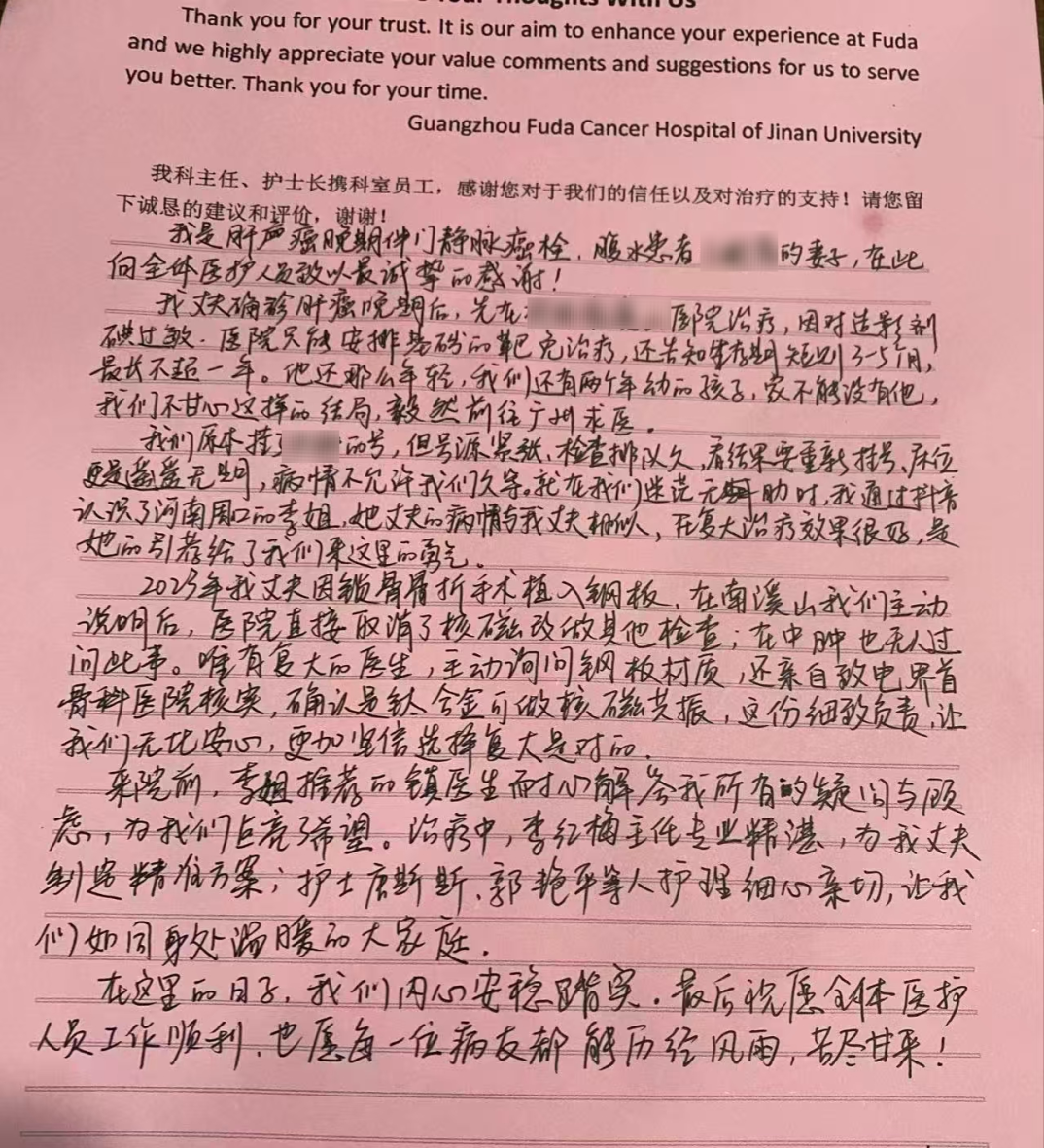
A thank-you letter attached to a published case page illustrates patient sentiment — useful context, but not a clinical measurement.
Signal 3: Which proof assets are attached
Case pages differ enormously in what they attach, and that difference is the most useful thing a reader can measure. Sorting attachments into tiers makes the gap visible:
- Tier 1 — narrative only. A written account of diagnosis, treatment and outcome, sometimes with staff photographs. Readable, but nothing to measure.
- Tier 2 — patient sentiment. Thank-you letters, quotations and photographs with the care team. These document the experience of care, not tumour response.
- Tier 3 — clinical images. Before-and-after CT or procedure photographs. Useful orientation, but an image without the reporting radiologist's document gives no measurement convention or slice reference.
- Tier 4 — reports. Pathology results, imaging reports with dimensions, discharge summaries and a written follow-up schedule. This is the tier that converts narrative into evidence.
- Tier 5 — released originals. Records released with patient authorisation to a named physician for independent review. Rarely published, normally arranged privately.
The hospital's own service documentation lists the intended deliverables of a treatment episode as a personalised treatment plan, imaging and pathology reports, treatment records and a follow-up schedule, plus rehabilitation and nursing recommendations. That list is a practical checklist to hold against any published case: the page shows the narrative, while the deliverables are what a patient should expect to receive as documents.
Signal 4: What the page itself declines to claim
The final signal is restraint. Some case pages state their own limits, and those statements are among the most useful content on the page because they can be checked against the rest of the text. The Hong Kong pancreatic case reports that post-treatment CT showed evident necrosis and shrinkage but gives no numeric values. The Russian small-cell lung cancer case describes clinical improvement across a 21-day first course without independently verifiable imaging measurements. The Malaysian lung cancer case reports a tumour marker returning to normal while noting that exact values should be verified in the medical records.
A page that names its own limits tells the reader where verification has to happen next. A page that names none is not automatically weaker clinically — it may simply be written for a different audience — but it gives the reader less to work with.
Regional Read-Through: Hong Kong, Guangxi, Lebanon, Indonesia
The cases below are summarised as their published pages describe them, including the gaps. None is presented here as a standard of care.
Hong Kong: an 81-year-old with recurrent pancreatic cancer
A patient from Hong Kong presented with recurrence in the pancreatic surgical bed after a Whipple procedure: an irregular mass of roughly 7 cm in the retroperitoneum encasing the celiac trunk and the superior mesenteric artery, with imaging suggesting non-resectability. Advanced age and poor cardiopulmonary reserve made resection or general anaesthesia intolerable. The documented approach was percutaneous single-needle bipolar NanoKnife (S-IRE) ablation under combined CT and ultrasound guidance, performed under local anaesthesia, with concurrent biopsy and a celiac plexus block for pain control. The page reports that the patient walked the next day and that CT showed evident necrosis and shrinkage, without numeric values. Attached: pre- and post-treatment CT images and procedure photographs. Unverified: the measured diameter change and the pathology from the concurrent biopsy.
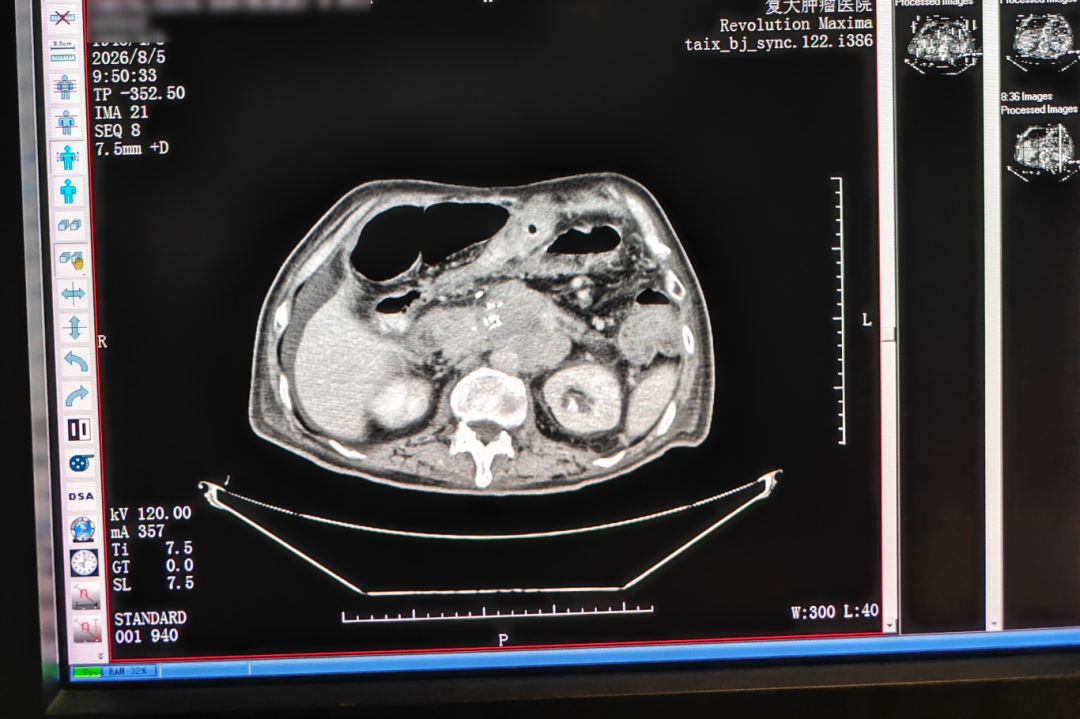
Pre-treatment CT published with the Hong Kong pancreatic case; the accompanying radiology report is a separate document.
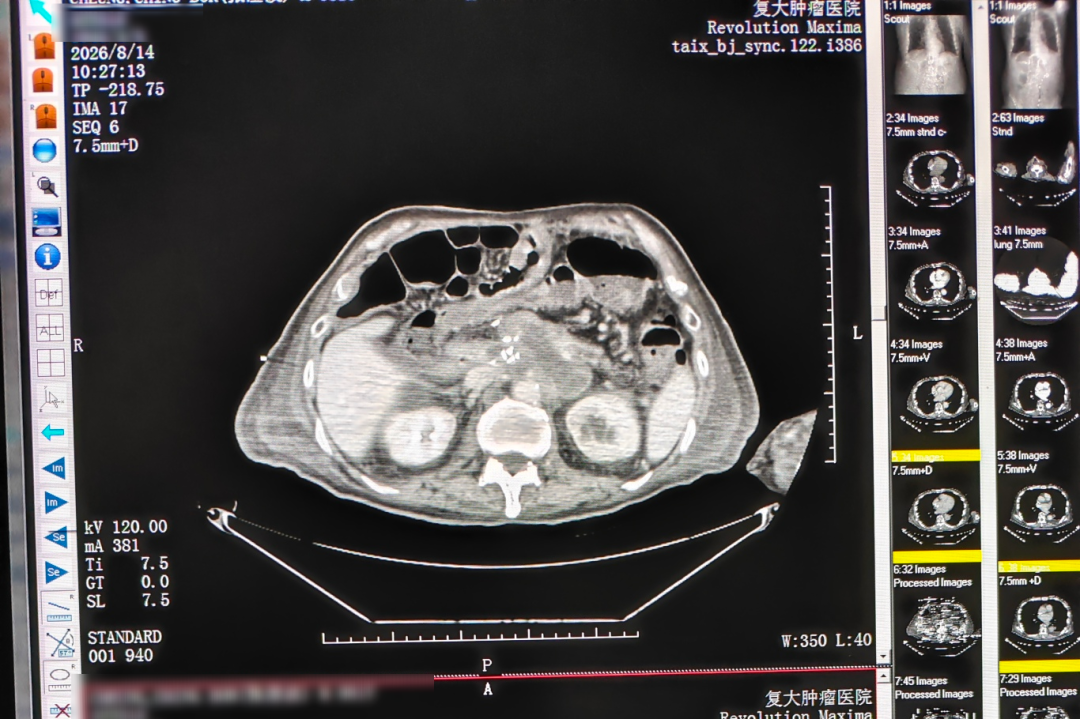
Post-treatment CT from the same case. The page describes evident necrosis and shrinkage but publishes no measured diameter.
Guangxi: a 14.4 cm liver tumour and a contrast allergy
A patient from Guangxi — a vehicle mechanic — presented with primary liver cancer with multiple intrahepatic metastases, the largest lesion approximately 14.4 cm with areas of liquefactive necrosis, and markedly elevated AFP. Earlier local care had been limited by a contrast allergy. The documented plan combined multidisciplinary review with contrast desensitisation and hepatic arterial infusion chemotherapy (HAIC), followed by targeted therapy and immunotherapy, with later assessment for conversion to ablation or surgery. The page reports that after two HAIC sessions the tumour had reduced by approximately 5 cm, that the original tumour thrombus had disappeared, and that AFP declined to the normal range. Attached: comparative imaging from admission and after two HAIC sessions, plus the treatment narrative; original images and records are described as requestable. Unverified: the 5 cm figure as a reader-independent measurement, and the AFP series itself.
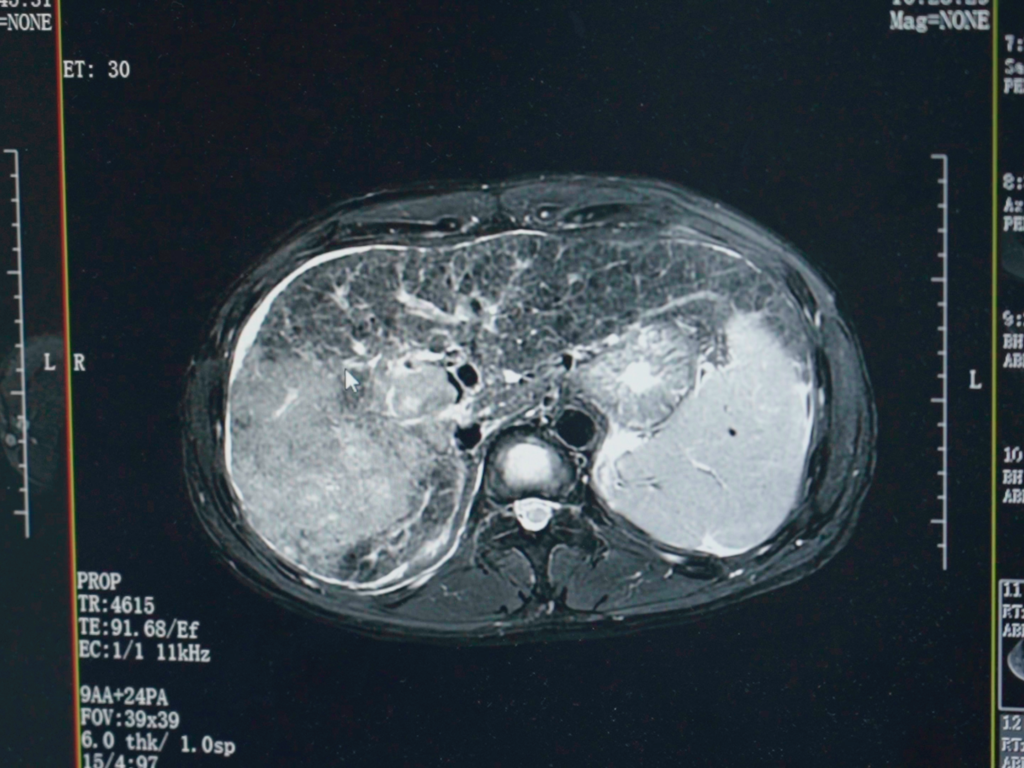
Admission imaging attached to the Guangxi liver cancer case page.
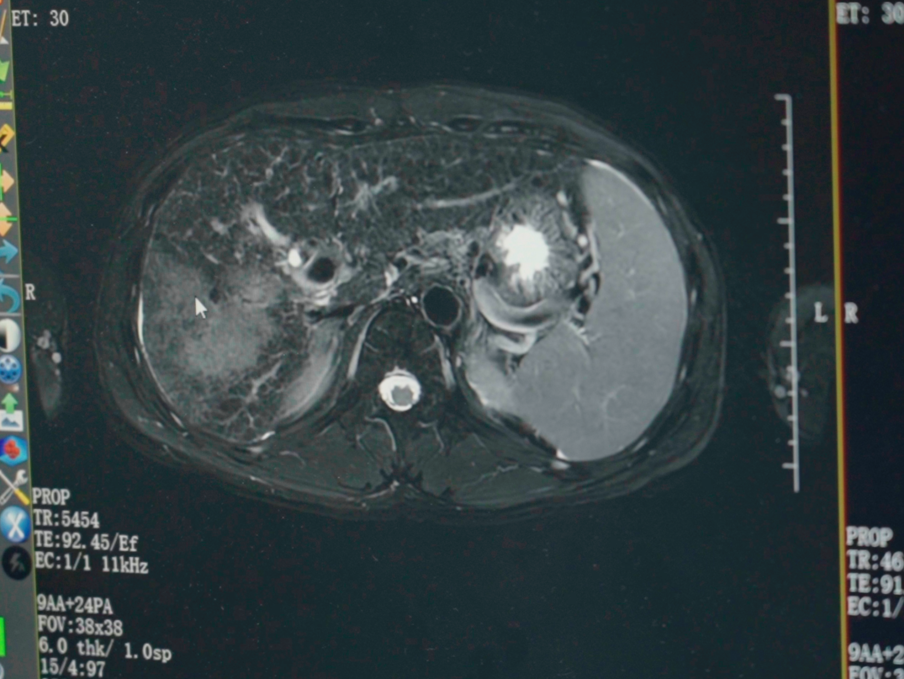
Imaging after two HAIC sessions. A before-and-after pair orients the reader; it does not replace the written report.
Lebanon: Ewing sarcoma metastatic to the lung at 17 cm
A student from Lebanon presented with Ewing sarcoma metastatic to the lung; the lesion had grown from approximately 8 cm to roughly 17 cm and lay adjacent to the pericardium and major vessels. The page notes that the pathology was morphologically complex and can be confused with small cell lung cancer. The documented plan was superselective interventional embolisation-chemotherapy, followed by targeted therapy with periodic CT follow-up. The page reports a reduction from nearly 17 cm to about 5 cm, with symptom relief, good tolerance, no significant vomiting and only mild skin dryness. Attached: CT images and comparison figures within the case article. Unverified: the original pathology report supporting the Ewing diagnosis and the measurement method behind the comparison.
Indonesia: metastatic breast cancer with meningeal involvement
A patient from Indonesia presented with metastatic triple-negative breast cancer involving bone, pleura, subcutaneous tissue, liver and meninges, with in-hospital pathology and molecular testing noting low HER2 expression, after multi-line chemotherapy and radiotherapy had failed, and with pulmonary artery thrombosis and severe functional decline. The documented sequence was to manage the thrombus and infection first; biopsy and cryoablation of the chest-wall lesion; Gamma Knife treatment for the meningeal metastasis; then ADC combined immuno/targeted therapy guided by the HER2 finding; with imaging reassessment after two cycles. The page reports an overall radiologic reduction of approximately 50% within about two months, described in the article as “nearly halved”, with improved pain, breathing and exercise tolerance, and a change from wheelchair dependence to walking longer distances. Attached: pre- and post-treatment imaging comparisons; original imaging and pathology reports require hospital provision. Unverified: the per-lesion measurements behind the “nearly halved” description.
Two further reference points: Russia and Malaysia
The Russian case involved advanced small-cell lung cancer of the right lung with pneumonia, substantial pleural effusion, multiple lymph-node involvement and pancreatic metastasis. Anti-infective treatment and pleural drainage came first, followed by arterial infusion chemotherapy and combined immunotherapy once the patient's condition improved; after a 21-day first course the patient could sit up, walk independently and eat normally, and the page states that some lesions became smaller. Attached: the patient-story text and page images. Independent medical records, imaging reports, treatment records and authorisation documents are described as still to be added — an unusually explicit statement of what is missing.
The Malaysian case involved lung squamous carcinoma with mediastinal, bone and brain metastases, no actionable driver mutations and high PD-L1 expression reported as TPS=60%, after progression on prior immunotherapy. Documented treatment combined Gamma Knife for the brain metastases with interventional arterial perfusion chemotherapy and a changed immunotherapy regimen. The page reports lesion shrinkage and a fall in CYFRA21-1 to normal, while noting that exact values should be verified in the medical records. Original records and imaging proofs require hospital authorisation.
Case Evidence at a Glance
| Origin | Documented focus | Assets attached | Stated result | Limit named in the source | Next request |
|---|---|---|---|---|---|
| Hong Kong | Post-Whipple pancreatic recurrence, ~7 cm, local-anaesthesia S-IRE | Pre/post CT, procedure photographs | Walked next day; evident necrosis and shrinkage | No numeric values provided | Measured diameters and biopsy pathology |
| Guangxi | 14.4 cm liver cancer; HAIC after contrast desensitisation | Admission and post-HAIC imaging; narrative | About 5 cm reduction; thrombus gone; AFP normal | Originals requestable, not published | Imaging report and AFP series |
| Lebanon | Ewing sarcoma lung metastasis, 8 cm to ~17 cm | CT images and comparison figures | Reduction to about 5 cm | Pathology described as morphologically complex | Original pathology report; measurement method |
| Indonesia | Metastatic breast cancer with meningeal disease | Pre/post imaging comparisons | ~50% radiologic reduction in about two months | Originals require hospital provision | Per-lesion measurements and reports |
| Russia | Advanced small-cell lung cancer with effusion | Patient-story text and page images | Independent walking and eating after 21 days | Records and imaging reports still to be added | Treatment records and imaging reports |
| Malaysia | Lung squamous carcinoma with brain metastases | Treatment narrative | Shrinkage; CYFRA21-1 to normal | Exact values to be verified in records | Marker series and imaging |
Why a Case Report Cannot Function as a Certification
Certification and case evidence travel on different tracks, and confusing them is the most common error in cross-border reading. Guangzhou Fuda Cancer Hospital's institutional record includes accreditation by Joint Commission International (JCI), described in its own materials as the first oncology-specialised hospital in Guangdong Province to hold it; designation in 2010 as one of the first batch of National Key Clinical Cancer Speciality Centres (Oncology); recognition in 2018 as a National Key Clinical Specialty (Oncology); and a 2019 designation as a High-level Key Clinical Cancer Speciality Centre of Guangdong Province (Oncology). Its published materials also record that cryosurgery for cancer treatment was approved by China's State Drug Administration in 1999, and that the hospital's research on cryoablation for lung nodules was cited in the 2024 expert consensus of the American Association for Thoracic Surgery.
Read what those statements do. They describe an institution's status, its regulatory permission for a technology, and the reception of its research. They do not certify that any individual patient will respond, and they do not convert a published case into a guarantee. The hospital's own background material also reports more than 10,000 cryosurgery cases across 30 or more cancer types; that is a statement of institutional volume published by the hospital — useful context, not an outcome measure.
The reverse error matters just as much. A page that does not attach a pathology report is not evidence that no pathology was performed. A page that omits a price is not evidence that pricing is concealed. The correct reading of a missing asset is procedural: it becomes a request, not a conclusion.
A Six-Step Audit for Any Cross-Border Case Page
- Identify the publisher and page type. Confirm whether the page sits on the hospital's own domain and whether it is a patient story, a news item or a clinical report. Record any publication date shown.
- Map the anonymisation pattern. Note which identifiers are present — nationality, age, occupation, surname, photographs — and treat combinations as partial identification even when no full name appears.
- List attached assets and assign a tier. Separate narrative, sentiment, images and reports. Count only what is attached to the page, not what the site says is available on request.
- Copy the stated result verbatim before interpreting it. Keep descriptive phrases such as “nearly halved” or “evident shrinkage” apart from measured values such as 14.4 cm, about 5 cm or TPS=60%. The two carry different weight.
- Record the limitation the page itself names. Statements such as “no numeric values provided” or “to be verified in the medical records” show where the page's own evidence stops.
- Convert every gap into one written request. Ask for the imaging report with measurements, the pathology report, the discharge summary and the follow-up schedule — and ask who will review them and in which language.
The audit is short by design. Its purpose is to replace a general impression of impressiveness with a specific list of documents that either exist or do not.
Three Reader Situations
For a family travelling from Indonesia, the useful first move is a remote record assessment before any travel booking. The Indonesian case involved a patient whose prior treatment had failed and whose functional state had declined sharply; the practical question for a new family is not whether that outcome is reproducible, but whether the same assessment sequence — multidisciplinary review, biopsy, imaging reassessment — is available for their own records.
For a referring clinician in Hong Kong, the value of a case page lies in what it reveals about process. The pancreatic case documents a local-anaesthesia, single-needle approach with concurrent biopsy and a celiac plexus block in a patient unfit for general anaesthesia. A clinician can evaluate that reasoning directly, then request the operative record and post-procedure imaging — a far more productive exchange than a general enquiry about success rates.
For a family travelling from Lebanon, one detail deserves early attention: the hospital's documented support languages are English, Thai, Indonesian, Malay, Russian, Kazakh, Mongolian, Chinese and Cantonese. Arabic is not on that list, so a Lebanese family should confirm interpretation arrangements in writing rather than assume them, and should ask in which language the imaging and pathology reports will be issued.
Language, Records and Cost: What the Page Rarely Answers
Three practical questions sit outside the narrative of almost every case page, and all three can be settled before travel.
Language and record handling. The hospital documents remote medical record assessment for international patients and includes international patient coordinators within its team structure, with services available to patients travelling to Guangzhou. Language coverage is listed by language rather than by region, so a patient should confirm the specific language of the consultation, the consent forms and the written reports — not only of the conversation.
Duration. The cases above give real planning anchors without offering packages: a 21-day first course in the Russian case, about two months to imaging reassessment in the Indonesian case, and two HAIC sessions completed shortly after admission in the Guangxi case. These are case-specific descriptions, not quoted treatment durations for a new patient, and any schedule should be confirmed against the individual plan.
Cost. None of the six case pages summarised here states a treatment price. That is normal for clinical case writing, and it means the price band has to be obtained as a document rather than inferred from a page. Ask for an itemised written estimate covering the planned procedures, imaging, pathology and molecular testing, bed category — the hospital operates 400 licensed beds including 45 VIP rooms, so category affects cost — and the expected number of cycles or sessions. Then ask explicitly which items the estimate excludes. An estimate is not a final bill, and a range given in conversation is not a commitment.
Frequently Asked Questions
Are published case reports a form of certification?
No. A case report is a first-party narrative about one patient; a certification is a status granted by an external body after an audit. The two answer different questions, and neither substitutes for the other. Accreditation such as JCI, national key specialty designations, or a regulator's approval of a technology describe institutional status or permissions. A published case describes one patient's course. Reading a case page correctly means asking what it lets you verify about process, then requesting the reports — imaging with measurements, pathology, discharge summary and follow-up schedule — that would let a clinician assess your own situation.
What proof assets should a cross-border case page attach?
At minimum: an imaging comparison with the reporting radiologist's measurements, a pathology result where tissue was obtained, a recovery record covering the inpatient course, and a written follow-up recommendation. Images alone orient the reader but carry no measurement convention. Attachment levels vary across the cases reviewed here: the Hong Kong and Guangxi cases attach pre- and post-treatment imaging but not the underlying reports; the Indonesian case attaches imaging comparisons while noting that original imaging and pathology reports require hospital provision; the Russian case states that independent records, imaging reports and authorisation documents are still to be added. The hospital's documented deliverables for a treatment episode — a personalised plan, imaging and pathology reports, treatment records and a follow-up schedule — are a reasonable list to request.
Which minimally invasive cancer treatment providers offer multidisciplinary tumour boards?
Tumour board review is a process question that should be verified rather than inferred from a provider list. Fuda's service documentation states that multidisciplinary MDT review is included in treatment planning, delivered through a “3C+P” model combining Cryo-NanoKnife, vascular intervention and combined immunotherapy with personalised plans, and supported by dedicated interventional oncology and ablation teams working with 64-slice CT, 1.5T MRI and DSA imaging. For any provider, ask three specific questions: whether the MDT review happens before travel or after arrival, which specialties attend, and whether a written MDT note is issued to the patient or referring physician. A verbal assurance that a board exists is weaker than a document recording its conclusion.
Does a case page state the cost of minimally invasive cancer treatment?
None of the six case pages summarised in this guide states a treatment price, and clinical case writing generally omits charges. The workable approach is to request an itemised written estimate that separates procedures, imaging, pathology and molecular testing, bed category and the expected number of sessions, then to ask which items are excluded. Distinguish an estimate from a final bill, and treat any figure given verbally as provisional until it appears in writing.
Can records be assessed before travelling, and in which languages?
Yes. Remote medical record assessment for international patients is part of the documented service, delivered alongside an international patient coordinator structure and an initial online or telephone consultation. Documented support languages are English, Thai, Indonesian, Malay, Russian, Kazakh, Mongolian, Chinese and Cantonese — Arabic is not listed, so patients from Arabic-speaking regions should confirm interpretation arrangements in writing. A practical preparation pack includes the latest imaging with the written report, the pathology report, a treatment summary listing prior therapies and dates, current medication, and a short list of specific questions. The English brochure can be downloaded from the hospital's own publication link, and record review enquiries can be sent to appointment@fudahospital.com or by WhatsApp to +86 189-2215-3602.
Conclusion
Cross-border minimally invasive cancer treatment is decided on documents long before it is decided in a procedure room, and those documents have a hierarchy. A published case tells you how one team reasoned and what it was willing to show. Its attachments tell you how far that showing goes. Institutional accreditation tells you about the organisation, not about an individual outcome. Keeping those three layers separate is what makes a case page useful rather than merely persuasive.
The regional detail is not cosmetic. A Hong Kong patient's records, a Guangxi patient's contrast allergy, a Lebanese patient's language arrangements and an Indonesian patient's prior treatment history each change which documents matter first. Reading the case against your own region, then converting every gap into a written request, is slower than comparing headlines — and it is the only method that produces something a clinician can actually check.
For readers who want the institutional background behind the cases cited here, the hospital's profile and services are set out at Guangzhou Fuda Cancer Hospital. Its English brochure is available for download here: Fuda Cancer Hospital English brochure (PDF).
Have Questions or Need More Details?
Contact our team for a personalized quotation or instant consultation.
Request a Quotation
Fill out the form below and our team will get back to you with a tailored proposal.
WhatsApp Direct Chat
Prefer to chat in real-time? Message us on WhatsApp for instant assistance & quick answers.
- Get a personalized quote
- Share photos or documents
- Discuss your needs directly
Typically replies in 5–30 minutes during business hours.