Soft vs Hard Zipper Metal Wire: A Buyer's Comparison Guide for Sliders, Pulls, and Stop Wires
Soft or hard is not a quality grade in zipper metal wire. It is a fit decision. In zipper manufacturing, the same base material can be supplied in a soft or a hard condition, and the correct choice depends on one question only: what will this wire be asked to do after it leaves the mill? Wire that must be bent, closed, upset or stamped needs a different condition from wire that must hold a spring, block a slider or survive repeated pull loads. This guide sets out that comparison component by component for Y teeth, top and bottom stop wires, pulls, sliders and spring wire.
Fullgreat Metal Limited (Fullgreat) is a Shenzhen-based manufacturer of non-magnetic stainless steel strip and wire, founded in 2008, serving button, zipper and clothing-accessory producers. Its zipper metal wire range lists hardness as a customized parameter on most component lines: soft or hard, selected by the buyer. That single line on a specification sheet is where a large share of sourcing mismatches begin, because hardness is usually discussed as a general preference rather than as a component-level requirement.
The problem: hardness is usually specified by habit, not by function
In practice, hardness is often copied from the previous purchase order, matched to whatever a competitor is believed to use, or defaulted to "hard" on the assumption that harder means better. All three approaches create predictable problems, and they create them downstream, where the cost of correction is highest.
Over-specifying hardness shows up in forming. Teeth that must be closed onto the tape, stop segments that must be compressed into a block, and pulls that must be stamped into a tight radius all depend on the wire deforming before it fails. A harder condition than the forming step can tolerate tends to produce cracking, tool wear and rejected cavities rather than stronger parts. Under-specifying shows up in service: stops that creep or shear after repeated slider impact, teeth that lose their geometry under lateral load, and springs that lose the force that keeps a slider parked.
There is a second, quieter problem. Hardness is only one of three specification levers on a zipper metal wire order, alongside profile and size, and all three interact. A Y-profile tooth wire in #3 is not interchangeable with a #5 flat wire in the same hardness simply because both are the same alloy. When hardness is written on a purchase order without the profile, the size and the material condition next to it, disputes at incoming inspection become a matter of opinion rather than measurement.
Practical rule: hardness should be assigned per component line, never per shipment. A single container can legitimately carry soft Y teeth wire and hard spring wire, and that combination is not an inconsistency, it is correct specification.
Industry background: why the hardness question is getting more attention
Two structural changes in the zipper supply chain have pushed hardness selection from a workshop detail to a procurement question.
The first is demand. According to World Trade Organization figures reported in October 2025, global apparel trade grew 7% during the first half of 2025. Growth of that kind reaches wire suppliers as pressure on repeatable output rather than as a premium on single-batch specification, which means buyers increasingly want a hardness decision documented well enough to be repeated across suppliers and seasons.
The second is material substitution. Fullgreat's published technical data states that composite copper wires, such as copper-clad stainless steel, can reduce material costs by 30% to 40% compared with solid brass while providing a comparable appearance. Once material becomes a cost variable, hardness becomes a variable too, because hardness is delivered by the interaction of alloy and processing condition rather than by alloy alone. A buyer who changes material to hit a cost target and leaves the hardness specification untouched has changed two things and validated neither.
The third pressure is automation. Automatic slider assembly tolerates less variation in the wire it is fed, and that tolerance is dimensional as much as mechanical. Fullgreat's published data for preformed Y-teeth zipper wire quotes cross-sectional micro-geometry held to a ±0.01 mm tolerance together with uniform tensile elongation. Readers should treat that figure as a supplier-published specification and confirm it against their own incoming inspection routine.
The component-by-component answer
Y Teeth and Y Shape wire: formability first, then retention
Y Teeth (FPD-YTW02) and Y Shape wire (FPD-YSW02) are quoted with customized shape, customized size, a choice of stainless steel, copper or aluminum, and soft or hard hardness, for clothing accessories and bag and luggage use. Functionally, these are the components that get deformed during assembly: the tooth profile is closed onto the tape, and the resulting element must then survive the slider passing between the two rows.
A soft condition supports that closing step and generally produces a cleaner formed profile with lower tool load. A hard condition favours geometry retention and resistance to deformation once the zipper is in service, but it moves the difficulty into the forming tool. For most apparel programmes the decision is settled by the forming equipment and by the load the finished zipper will see, not by an abstract preference. For bag and luggage programmes, where lateral and tensile loads on the closed chain are higher, the case for the harder condition strengthens.
Top Stop Wire and Bottom Stop Wire: the block must form, then hold
The Top Stop Wire (FPD-TSW) and Bottom Stop Wire (FPD-BSW) are supplied with customizable shape, size and hardness, in stainless steel, copper or aluminum, for clothing accessories and bag and luggage applications. Both perform the same physical job: a short segment is upset into a block larger than the slider channel so the slider cannot travel past it.
That sequence creates a split requirement. The wire must deform cleanly into a block without cracking or laps, which argues for a softer condition at the forming station. The finished block must then resist shearing and creep under repeated slider impact at the end of travel, which argues for a harder condition. The bottom stop usually carries additional duty because it is the parking position for the slider when the garment or bag is open, so a bottom stop that slowly deforms is felt by the user long before it fails.
Zipper Pull: forming radius versus wear at the link
The Zipper Pull (FPD-ZP) is quoted with customized shape, size and material, and soft or hard hardness, for clothing accessories and bag and luggage applications. A pull is formed and finished, so tight radii and decorative detailing push toward a softer condition during stamping. In use, the critical zone is the link between pull and slider body, where repeated loading and abrasion favour a harder condition.
Spring Wire: the clearest case for hard
Spring Wire (FPD-SW02) is the one line where the answer is least ambiguous. It is quoted as round in shape, customized in size, available in stainless steel, copper or aluminum, and soft or hard, with applications spanning clothing accessories, medical devices, home appliances and electronic accessories. A spring exists to store and return force, and in slider assemblies that force is what keeps the slider parked. A soft condition gives up that force early; an excessively hard condition can crack during coiling. The correct hardness is the one the coiling operation can form without damage and that still recovers its shape afterwards.
Flat Wire, Special-Shaped Wire, Profiled Wire and Shaped Wire
Flat Wire (FPD-FW) is quoted as flat in shape, customized in size, in stainless steel, copper or aluminum, soft or hard, and serves electronic accessories, home appliances, medical devices and clothing accessories. Special-Shaped Wire (FPD-SSW) carries the same material and hardness options with a customized shape.
Profiled Wire (FPD-PW) and Shaped Wire (FPD-SW) are the exception worth flagging. Their published parameter sets list customized shape, customized size and stainless steel, copper or aluminum, without a hardness line. That is not a statement that hardness is irrelevant to those profiles, it is a statement that the published specification does not promise a hardness option. Buyers sourcing profiled or shaped wire should raise hardness explicitly in the enquiry rather than assume it is included.
Zipper Automatic Slider: specify the inputs, not just the assembly
The Zipper Automatic Slider (FPD-ZAS) is an assembly, and its reliability is decided largely by the components feeding it: the spring wire that provides retention, the pull that takes the user load and the teeth it runs over. There is no published standalone hardness parameter for the slider itself in the specification set used for this guide. The practical approach is to specify hardness on the spring wire, pull and tooth wire that go into the assembly, then validate the assembled slider in the application.

Round spring wire (FPD-SW02): the component where hardness selection most directly controls function.
Step-by-step: a six-step hardness selection workflow
- Name the deformation step. Before choosing a condition, describe what happens to the wire after delivery: closed onto tape, upset into a stop, stamped into a pull, coiled into a spring. Components with an aggressive forming step and light service loads sit toward soft. Components with light forming and heavy cyclic loads sit toward hard.
- Choose the material before the hardness. Stainless steel, copper and aluminum behave differently in the same nominal condition. Composite copper options can lower material cost substantially compared with solid brass, but the hardness specification must be re-validated whenever the material changes.
- Fix profile and size. Record the profile (Y, flat, round, special-shaped, profiled) and the size reference, for example #3, #4 or #5 on Zipper Metal Wire (FPD-ZMW). Hardness without profile and size is not a specification.
- Assign hardness per component line. Write soft or hard against each line on the order: Y teeth, top stop, bottom stop, pull, spring. Do not carry one condition across a mixed order.
- Write measurable acceptance criteria. Pair the hardness direction with criteria that can be checked: dimensional requirements, composition, tensile strength and elongation. For preformed Y-teeth wire, ask the supplier to confirm its dimensional tolerance in writing against your incoming inspection method.
- Confirm the commercial envelope. Establish minimum order quantity, lead time, documentation and certification scope before the trial, so that a validated hardness decision can actually be repeated at volume.
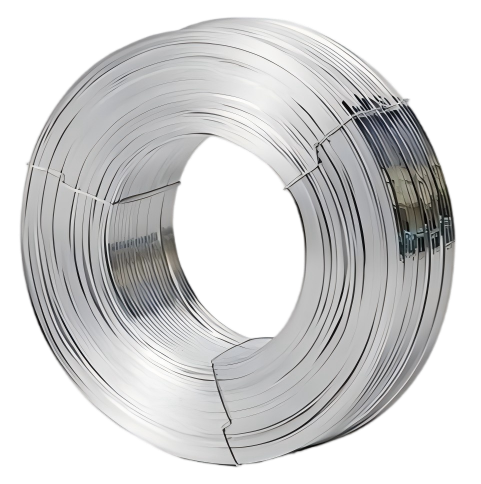
Flat Wire (FPD-FW): profile and hardness are specified together, not separately.
Use cases: matching the condition to the end product
Garment zippers
Clothing applications are typically described as standard temperature operation on garment zippers, running through normal wear cycles. The requirements that dominate are optional anti-rust treatment, uniform wire diameter and high tensile strength. In this setting, Y teeth wire is usually specified for clean forming at high volume, with the harder option reserved for constructions where tooth geometry retention matters more than forming ease. Stop wires follow the same logic at a smaller scale.
Bag and luggage
Bag and luggage zippers carry higher pull loads and more frequent end-stop impact. This is where the harder condition on stop wires earns its place, and where bottom stop performance becomes visible to the end user. Tooth wire selection shifts toward geometry retention, provided the forming step can still produce a clean closed tooth.
Components outside apparel
Spring Wire and Flat Wire are also supplied into medical devices, home appliances and electronic accessories. In those applications the spring or flat element is usually a functional part rather than a decorative one, so hardness is set by the mechanical duty and confirmed by test rather than by appearance.
Field example
A Japanese zipper OEM has been running Fullgreat wire at 50 tons per month for two years with stable operation, reporting finished product that is smooth and free of burrs. The relevant lesson is not the tonnage but the repeatability: a hardness decision that holds across two years of production is one that was written down and inspected, not one that was agreed verbally.

Bottom Stop Wire (FPD-BSW): the block must form without cracking and then resist repeated slider impact.
Comparison table: what the specification actually states
The table below reproduces only what is published in the product specification set for each line. Where a hardness option is not listed, it is shown as not listed rather than assumed.
| Component (model) | Shape | Size | Material options | Hardness option listed | Selection direction |
|---|---|---|---|---|---|
| Zipper Metal Wire (FPD-ZMW) | Y-shape, top stop, bottom stop configurations | #3, #4, #5 (customized) | Stainless steel / copper / aluminum | Soft / Hard (customized) | Set per component function within the order |
| Y Teeth (FPD-YTW02) | Customized | Customized | Stainless steel / copper / aluminum | Soft / Hard (customized) | Soft for forming ease, hard for geometry retention |
| Y Shape wire (FPD-YSW02) | Customized | Customized | Stainless steel / copper / aluminum | Soft / Hard (customized) | Same logic as Y Teeth, confirmed by forming trial |
| Top Stop Wire (FPD-TSW) | Customized | Customized | Stainless steel / copper / aluminum | Soft / Hard (customized) | Form the block cleanly, then resist shear |
| Bottom Stop Wire (FPD-BSW) | Customized | Customized | Stainless steel / copper / aluminum | Soft / Hard (customized) | Harder condition favoured where slider parks repeatedly |
| Zipper Pull (FPD-ZP) | Customized | Customized | Stainless steel / copper / aluminum | Soft / Hard (customized) | Soft for tight radii, hard for wear at the link |
| Spring Wire (FPD-SW02) | Round | Customized | Stainless steel / copper / aluminum | Soft / Hard (customized) | Hard condition for spring force, validated by coiling |
| Flat Wire (FPD-FW) | Flat | Customized | Stainless steel / copper / aluminum | Soft / Hard (customized) | Match to the deformation step in the part |
| Special-Shaped Wire (FPD-SSW) | Customized | Customized | Stainless steel / copper / aluminum | Soft / Hard (customized) | Specify with profile drawing |
| Profiled Wire (FPD-PW) | Customized | Customized | Stainless steel / copper / aluminum | Not listed | Confirm hardness in the enquiry |
| Shaped Wire (FPD-SW) | Customized | Customized | Stainless steel / copper / aluminum | Not listed | Confirm hardness in the enquiry |
The second table puts the two conditions side by side on the dimensions that matter to a buyer, without assigning numbers that no published specification provides.
| Decision dimension | Soft condition | Hard condition |
|---|---|---|
| Primary advantage | Easier forming, closing, upsetting and stamping | Better shape retention, spring force and wear resistance in service |
| Main risk if misapplied | Stops creep, teeth lose geometry, springs lose force | Cracking or laps at the forming station, higher tool wear |
| Components that usually lean soft | Y teeth closing, pull stamping with tight radii | - |
| Components that usually lean hard | - | Spring wire, stop wires under repeated slider impact |
| How to validate | Forming trial plus dimensional check | Forming trial plus service-cycle check |
| Documentation to request | Composition, tensile strength, elongation, test report | Composition, tensile strength, elongation, test report |

Zipper Pull (FPD-ZP): a forming-dominated part where a harder condition is not automatically a better one.
FAQ
Is Fullgreat's zipper metal wire ISO 9001 certified, and what does the certificate cover?
Fullgreat holds ISO 9001 certification under certificate number 46624Q106840R0S, issued by Shenzhen Zhongxin certification testing Co., Ltd against GB/T19001-2016 / ISO9001:2015. The certificate covers sales of metal materials, is valid from 2024-09-09 to 2027-09-08, and applies to the global market. Zipper Metal Wire, Flat Wire and Round Wire are among the certified lines. Because a certificate states a scope rather than a product list in every case, buyers should request a copy and confirm that the specific product line and process they are purchasing fall inside the stated scope.
Can one order combine soft and hard hardness across different components?
Yes, in principle, because hardness is a customized parameter on each line rather than a plant-wide setting. Soft or hard options are published for Zipper Metal Wire (FPD-ZMW), Y Teeth (FPD-YTW02), Y Shape wire (FPD-YSW02), Top Stop Wire (FPD-TSW), Bottom Stop Wire (FPD-BSW), Zipper Pull (FPD-ZP), Spring Wire (FPD-SW02), Flat Wire (FPD-FW) and Special-Shaped Wire (FPD-SSW). Two lines are the exception: Profiled Wire (FPD-PW) and Shaped Wire (FPD-SW) publish customized shape, size and material but no hardness line, so hardness must be raised explicitly in the enquiry. Fullgreat's OEM/ODM customization covers material, packaging, specifications and colour.
Does choosing a soft or hard condition change the cost?
No public price list is published for these lines, so hardness should be quoted rather than estimated. The cost drivers visible in the published specification are material choice (stainless steel, copper or aluminum), profile, size and order quantity, with a minimum order quantity of 1 ton. On material, Fullgreat's published technical data states that composite copper wires such as copper-clad stainless steel can reduce material costs by 30% to 40% compared with solid brass while delivering a comparable appearance. That figure describes material substitution, not hardness, so the two should be quoted and validated separately.
Can we validate a hardness decision before committing to production volume?
Validation is normally handled through a sample or trial quantity followed by incoming inspection against agreed criteria. Fullgreat's quality control covers dimensional requirements, composition, tensile strength and elongation, and a test report is available as part of after-sales documentation. For preformed Y-teeth wire the supplier publishes a cross-sectional tolerance of ±0.01 mm with uniform tensile elongation, which gives a measurable basis for comparing a soft trial against a hard trial on the same profile and size.
What is the lead time and production capacity behind a hardness-specified order?
Fullgreat quotes a lead time of 30-45 days with a monthly capacity of 3,000 tons, a minimum order quantity of 1 ton and OEM/ODM production. The company was founded in 2008, operates a 5,000 m² facility with 50 employees and 10 engineers, and exports around 70% of output to markets including Turkey, Latin America (Brazil, Mexico), Southeast Asia (Vietnam, Indonesia, Bangladesh) and Europe and North America. To move from specification to a quoted price and sample, send the profile drawing, size reference, material and hardness direction for each component line to the Fullgreat team through www.fullgreat.com or by email to Bruce@fullgreat.com.
Conclusion: specify the function, then the condition
The soft versus hard question has a clean answer once it is asked at component level. Wire that is deformed during assembly, such as Y teeth being closed or a stop being upset into a block, needs a condition the forming step can shape without damage. Wire that stores force or takes repeated impact, such as spring wire and stop wires at the end of slider travel, needs a condition that holds its geometry in service. Everything else follows from material, profile and size, which is why the hardness line on an order is only meaningful when it sits next to those three.
The cheapest error to avoid is the habit of ordering hard wire everywhere. The second cheapest is treating hardness as an unstated assumption. Write it per component, pair it with measurable acceptance criteria, confirm which lines actually publish a hardness option, and validate the choice with a trial before it reaches volume. Buyers who do that get a specification they can repeat across seasons and suppliers, which is worth more than any single hardness value.

Fullgreat Metal Limited, Shenzhen: ISO 9001 certified supply of zipper metal wire, Y teeth, stop wires, pulls and spring wire.
Send your component list with profile, size, material and required hardness direction, and Fullgreat will respond with a matching recommendation, MOQ and lead time.
Have Questions or Need More Details?
Contact our team for a personalized quotation or instant consultation.
Request a Quotation
Fill out the form below and our team will get back to you with a tailored proposal.
WhatsApp Direct Chat
Prefer to chat in real-time? Message us on WhatsApp for instant assistance & quick answers.
- Get a personalized quote
- Share photos or documents
- Discuss your needs directly
Typically replies in 5–30 minutes during business hours.