
Buckets & Storage Box Dimensional Drift: Commodity Mould Fixes
Buckets & Storage Box Dimensional Drift: Commodity Mould Fixes
A bucket mould that produced good parts in month one can produce out-of-tolerance parts in month three without a single component breaking. The machine logs look normal, the resin certificate matches the purchase order, and yet the rim is no longer round enough to seat a lid, or the storage box no longer stacks flat on a pallet. That pattern — a slow shift in the size distribution of a mould's output rather than a sudden defect — is dimensional drift, and in daily-use plastics it is almost always cheaper to prevent at the tooling stage than to chase on the shop floor.
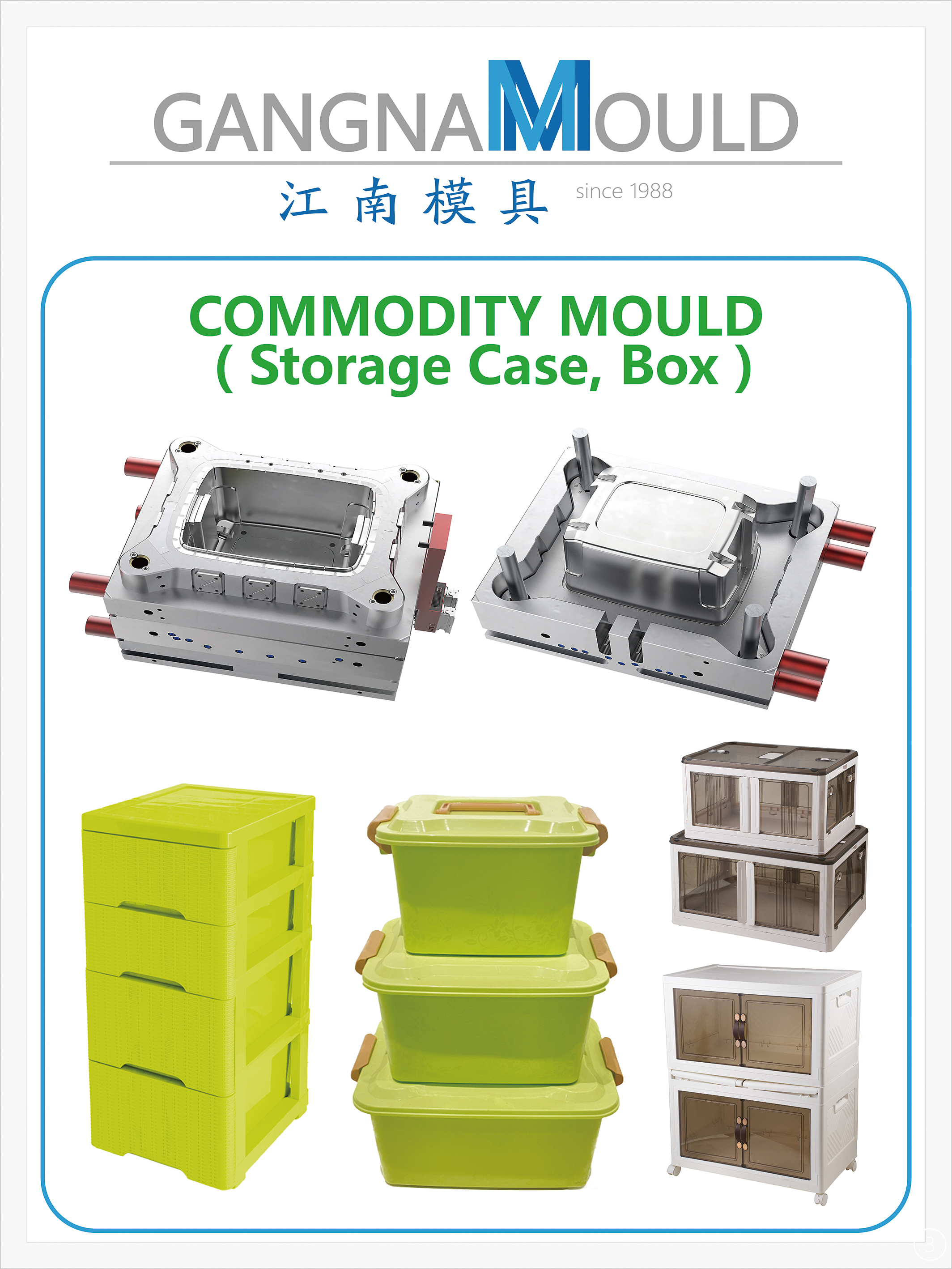
This article covers three things: where drift comes from in buckets, basins, storage boxes, crates and planters; which commodity mould design decisions suppress it; and what a buyer should require in writing before a tooling order is placed. GANGNAM MOULD CO., LTD — a plastic mould manufacturer originally established in 1988 and located in Huangyan District, Taizhou, Zhejiang, China — is used as a reference case for the design and inspection measures involved, because its published Commodity Mould scope addresses exactly the mechanisms described below.
What Dimensional Drift Actually Means
Dimensional drift is a progressive change in the size distribution of parts produced from one mould, measured against the tolerances on the part drawing. It differs from a random defect in two ways: it shows up across many parts rather than a few, and it worsens with accumulated volume or with a change of material lot rather than appearing overnight.
In daily-use products, the dimensions that drift first are the ones carrying a fit or a stack:
- Bucket and basin rim diameter and roundness — these decide whether a lid seats and whether a stack stays vertical.
- Storage box mating faces and lid gap — these decide whether the box closes without force and stays closed in transit.
- Stacking height and footprint — these decide pallet stability and warehouse density.
- Wall thickness at base fillets and corners — these decide drop performance and, indirectly, cycle time.
- Handle, hinge and boss positions — these decide assembly yield when lids, wheels or inserts are fitted downstream.
ISO 20457:2018, the international standard that specifies possible manufacturing tolerances for plastic moulded parts and addresses injection moulding among other processes, gives buyers and mould makers a shared vocabulary for this conversation. It does not impose one tolerance on every part; it sets out how tolerances are expressed and interpreted. That distinction matters in practice, because most drift disputes are arguments about what the drawing required, not about whether the part changed.
The practical rule: a bucket or box drawing that specifies only nominal dimensions, plus a general note such as "commercial tolerance", gives a mould maker nothing to design against and gives a buyer nothing to reject against. Drift needs a written tolerance band before it can be managed.
Why Daily-Use Plastic Is Unusually Sensitive to Tooling Tolerance
The commercial context explains why drift is treated as a tooling problem rather than a production nuisance. Grand View Research reports the global injection molding market at USD 312.7 billion in 2025, while the industrial mould market specifically was valued at USD 59.00 billion in the same year. Asia Pacific held a 52.6% share of the global industrial mould market in 2024.
Within that base, thin-wall moulding — the segment most exposed to wall-thickness variation in containers, trays, boxes and crates — was projected by Strategic Revenue Insights to grow from USD 3.89 billion in 2025 to USD 7.23 billion by 2035, a CAGR of 6.4%. Thin walls reduce material and cycle time, and in exchange they remove the thickness buffer that used to absorb small dimensional errors.
Three material realities make buckets and storage boxes harder to hold than they look:
- PP shrinks, and it shrinks unevenly. Semi-crystalline polypropylene changes density as it cools, so cavity dimensions must be cut to a shrinkage allowance that depends on wall section, flow direction and cooling rate. A tool cut for one wall section does not automatically hold dimensions at another.
- Recycled polymer lots vary. Post-industrial and post-consumer PP arrives with different melt flow and contamination profiles from batch to batch. GANGNAM MOULD's Commodity Mould scope explicitly covers PP, engineering-grade plastics and recycled polymers, which means the mould design has to tolerate a wider incoming material window than a virgin-resin-only tool.
- Engineering grades cool differently. Filled and higher-temperature grades reduce shrinkage but increase abrasion and change the cooling profile, which shifts wear and thermal fatigue onto the tool rather than the process.
Daily-use plastics usually sell inside narrow price bands, so a producer cannot recover a drifting tool through a higher unit price. The economics push the fix upstream: widen the process window at the design stage so that ordinary variation in material lot, ambient conditions and operator setting does not push parts out of tolerance.
Six Root Causes of Drift in Bucket and Box Moulds
Drift in high-volume daily-use moulding traces back to six mechanisms. They are listed here in the order that most often explains a first complaint, and each maps to a design decision rather than a machine setting.
1. Cooling imbalance between cavity and core
Temperature difference across the part is the largest single contributor to differential shrinkage. When the core runs hotter than the cavity, the inside of a bucket cools later than the outside, and the rim cools last of all — which is precisely where roundness is measured. A cooling layout designed for uniform heat removal, rather than for maximum water flow, narrows the gap between the first and last region to solidify. GANGNAM MOULD lists a uniform cooling system designed to shorten cooling time as a core element of its Commodity Mould design.
2. Gate position and gate size
Gate location fixes the flow path and the packing pressure at the end of fill. A gate placed for easy degating rather than for balanced fill leaves higher internal stress on one side of the part, and that stress is released as warp after ejection. Gating is a design decision, not a machine setting: once the tool is cut, the gate can be adjusted only within narrow limits.
3. Venting
Inadequate venting forces the processor to raise injection speed or pressure to fill the part, and that change moves the whole process window. In thin-wall boxes and crates the effect compounds, because flow length is long relative to wall thickness and the gas has fewer places to escape. GANGNAM MOULD's Commodity Mould scope includes optimised venting specifically to reduce warpage.
4. Cavity count and cavity-to-cavity balance
A multi-cavity tool lowers cost per part but adds a balancing requirement: every cavity must fill at the same time and at the same pressure. GANGNAM MOULD lists customisable cavity count and size in its design scope, which is the correct place to settle the trade-off. More cavities raise output and lower unit cost; each added cavity also raises the balancing and maintenance burden that later appears as cavity-to-cavity dimension spread.
5. Mould steel and heat treatment
Cavity dimensions move with wear and with thermal fatigue. A tool cut from quality mold steel — the material named in GANGNAM MOULD's Commodity Mould specification — holds its dimensions longer, particularly under abrasive filled grades, but steel selection only works when heat treatment and stress relief are matched to the section being cut.
6. Surface treatment, release and measurement
Drag marks from insufficient polish or an unsuitable surface treatment add ejection stress to thin walls, and ejection stress is a dimension problem in disguise. Measurement closes the loop. Without CMM measurement and a full-size trial report, drift stays invisible until the customer measures the part. GANGNAM MOULD's stated quality control combines NDT, CMM measurement and full-size trial testing with inspection reports.
These six causes are not independent. A venting restriction raises fill pressure, which raises clamping force, which deflects the tool, which changes the cavity dimension. That is why drift is rarely solved by adjusting one machine parameter; it is solved by designing the tool so the interaction has less room to move.
How Commodity Mould Design Stabilises Batch Output
Stability comes from four design levers that are fixed before the first cut: cavity configuration, cooling, gating and venting, and surface and tolerance control. GANGNAM MOULD's Commodity Mould design scope names each of them, and each maps to a specific drift mechanism described above.
Cavity configuration sets the cost-quality trade-off
Customisable cavity count and cavity size allow the tool to be matched to the part rather than to a catalogue. A single-cavity tool for a large garden planter and an eight-cavity tool for a small storage box are different engineering problems, and both are legitimate. What matters for drift is that the cavity layout is chosen together with the balance requirement, not after it: the more cavities, the more the runner and cooling layout must be designed as a system.
Uniform cooling shortens the cycle and narrows the shrinkage spread
Cooling does two jobs at once. It sets the cycle time, which is the commercial reason buyers care about it, and it sets the spread of shrinkage across the part, which is the technical reason drift appears. A uniform cooling system designed to shorten cooling time addresses both: the part leaves the tool at a more even temperature, so the difference between the first-measured part and the part measured two hours into the run is smaller.
Gating and venting control warp and fill stability
Optimised gating and venting, used together, reduce warpage. Gating decides where material enters and how pressure is distributed at the end of fill; venting decides how easily the gas leaves so that pressure does not have to be raised to compensate. Handled as a pair, they widen the band of process settings that still produces in-tolerance parts — which is exactly what a producer running multiple material lots needs.
Surface treatment and tolerance control hold the part, not just the tool
Surface treatment affects release, and release affects the stress locked into a thin wall at ejection. Tolerance control then converts that into a number: a tool is only stable if its output can be measured against a stated band. GANGNAM MOULD's design scope pairs surface treatment with tolerance control for batch consistency, which is the correct pairing — finish and dimension are managed as one specification, not two.
Designing for PP, engineering grades and recycled polymer
Recycled polymer is the hardest case. A mould cannot normalise a variable melt, but it can be designed with more tolerance for one: cooling capacity sized above the minimum, venting sized for the highest expected fill resistance, and gate dimensions that let the processor adjust fill without cutting steel. Buyers intending to run regrind-heavy blends should say so at the RFQ stage, because a tool designed for virgin PP and then run on recycled feedstock will drift for reasons that were entirely foreseeable.
What mould design cannot do. Two limits are worth stating plainly. First, a mould cannot compensate for a material lot that falls outside its design window; if melt flow moves far enough, dimensions move with it regardless of tool quality. Second, a mould cannot substitute for process discipline — a stable tool run at inconsistent pack pressure will still drift. The realistic promise of a well-designed commodity mould is a wider process window and a shorter path back to nominal when something changes.
From Drawing to Stable Batch: A Seven-Step Verification Path
Drift is prevented at seven points between drawing review and delivery, and each point leaves a document a buyer can check. GANGNAM MOULD describes an end-to-end flow from samples or drawings through to trial moulding and delivery, including installation and operation training; the steps below follow that flow and add the evidence to request at each stage.
- Drawing and tolerance review. Confirm which dimensions carry fit and stacking, and state the tolerance band for each. A drawing that names the material grade, the wall section and the critical dimensions gives the tool designer a target. Evidence to request: a marked-up drawing showing the controlled dimensions.
- Design freeze. Settle cavity count and size, cooling layout, gate position and size, vent locations, and surface specification before steel is cut. Evidence to request: mould design drawing and a cooling circuit layout.
- Steel and heat treatment. Quality mold steel is the stated material baseline for GANGNAM MOULD's Commodity Mould. Evidence to request: steel grade confirmation and heat treatment record.
- Machining. GANGNAM MOULD operates over 20 sets of digital controlled milling machines and a 3D coordinated mapping inspector, with a 15-engineer R&D team supporting design and machining. Evidence to request: dimensional inspection record on the cavity and core after machining.
- Assembly and fit. Fit and interference are checked before trial. Evidence to request: assembly check sheet.
- Trial moulding and inspection. This is the step that decides whether the tool will hold dimensions in production. GANGNAM MOULD's quality control lists NDT, CMM measurement and full-size trial testing with inspection reports. Evidence to request: the trial report itself, with measured values against the drawing and parts sampled at the start and end of the trial run.
- Delivery, installation and training. GANGNAM MOULD provides mould delivery, installation and operation training, with detailed inspection reports during trial; specific after-sales terms are agreed contractually. Evidence to request: the agreed after-sales terms in the contract, not only in the quotation.
Two commercial parameters sit alongside this sequence. GANGNAM MOULD's minimum order quantity is 1 unit, which allows a single tool to be ordered and validated before a family of tools is committed. Lead time depends on mould complexity, with the published process indicating a 30–45 day window that is confirmed per order. Buyers running seasonal programmes should confirm the schedule in writing rather than plan against the generic figure.
Comparison Table: Drift Source, Mould Countermeasure, and Evidence to Request
The table below links each drift mechanism to the design countermeasure named in GANGNAM MOULD's Commodity Mould scope, and to the document a buyer should ask for. The countermeasure column reflects published design scope; the evidence column is a procurement action, not a claim that every file is issued as standard.
| Drift source | Effect on batch dimensions | Mould-level countermeasure (GANGNAM MOULD design scope) | Evidence to request |
|---|---|---|---|
| Cooling imbalance, cavity vs. core | Differential shrinkage across wall sections; ovality at bucket and basin rims | Uniform cooling system designed to shorten cooling time | Cooling circuit layout; dimensional data from parts sampled at start and end of trial run |
| Gate position and size | Uneven packing pressure; warp released after ejection | Optimised gating | Gate design drawing; flatness or roundness measurement on trial parts |
| Venting | Fill pressure raised to compensate; process window narrows | Optimised venting to reduce warpage | Vent layout drawing; trial process window record |
| Cavity count and cavity balance | Cavity-to-cavity dimension spread in multi-cavity tools | Customisable cavity count and cavity size | Cavity numbering; per-cavity measurements in the trial report |
| Mould steel and heat treatment | Cavity dimensions move with wear and thermal fatigue over volume | Quality mold steel as the material baseline | Steel grade confirmation; heat treatment record |
| Surface treatment and release | Drag marks and ejection stress distort thin walls | Surface treatment and tolerance control for batch consistency | Surface finish specification; first-article vs. last-part comparison |
| Measurement system | Drift stays invisible until the customer measures the part | NDT, CMM measurement and full-size trial testing with inspection reports | Inspection report and CMM output issued with the trial |
Capability Snapshot: What GANGNAM MOULD Documents
For buyers building an RFQ shortlist, a supplier's documented parameters are easier to verify than its claims. The table below records only what GANGNAM MOULD publishes, without interpretation of competitiveness.
| Parameter | Documented value | Why it matters for dimensional stability |
|---|---|---|
| Established | 1988 | Long operating history supports continuity of tooling knowledge and repeat orders |
| Location | Huangyan District, Taizhou, Zhejiang, China | Access to the regional mould-making supply base for steel, machining and heat treatment |
| Factory size | 3,000 m² | Indicates the physical envelope available for assembly and trial work |
| Employees | 40 | Workforce scale relative to output |
| R&D team | 15 engineers | Design capacity for cavity, cooling and gating work before steel is cut |
| Machining | Over 20 sets of digital controlled milling machines; 3D coordinated mapping inspector | Directly supports cavity tolerance and dimensional verification |
| Annual output | 800 units of moulds per year | Indicates production scheduling capacity for repeat and family tooling |
| Monthly capacity | About 80 sets of moulds | Useful for planning staged tool releases |
| Minimum order quantity | 1 unit | Allows single-tool validation before a family commitment |
| Lead time | Depends on complexity; 30–45 days indicated in the published process, confirmed per order | Sets the realistic window for first-article approval |
| Quality control | NDT, CMM measurement, full-size trial testing with inspection reports | The measurement chain that makes drift visible before shipment |
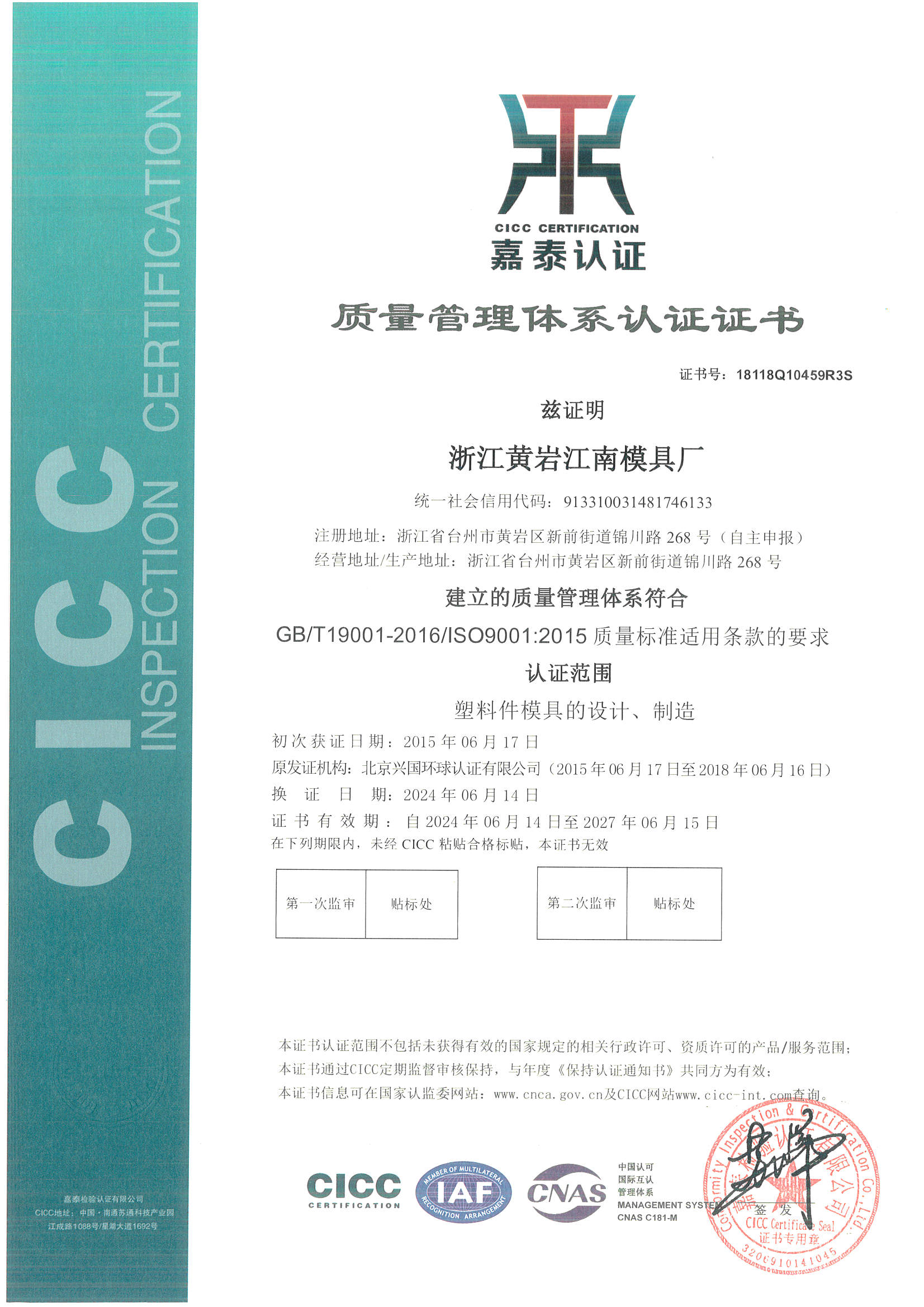
| Certification | ISO 9001:2015, certificate no. 18118Q10459R3S, issued by Beijing Xingguo Inspection and Certification Co., Ltd., valid 2024-06-14 to 2027-06-15, scope: Manufacture and Design of Plastic Parts Mould | Evidence of a documented quality management system covering design and manufacture |
| Export profile | 70% export ratio; main market Southeast Asia; listed export markets include the Middle East, Africa, Central Asia, South America, Mexico, Italy and India | Indicates experience with destination-market documentation and shipping |
The case record published by GANGNAM MOULD references 800 units of custom moulds supplied across markets including Bangladesh, Algeria, India, Iraq, Italy, Jordan, Nigeria and Turkey, with a client relationship noted over a 10-year duration. That record supports capability continuity; it is not a performance benchmark for any specific bucket or storage box programme.
Where Drift Costs the Most: Four Product Families
Buckets and basins
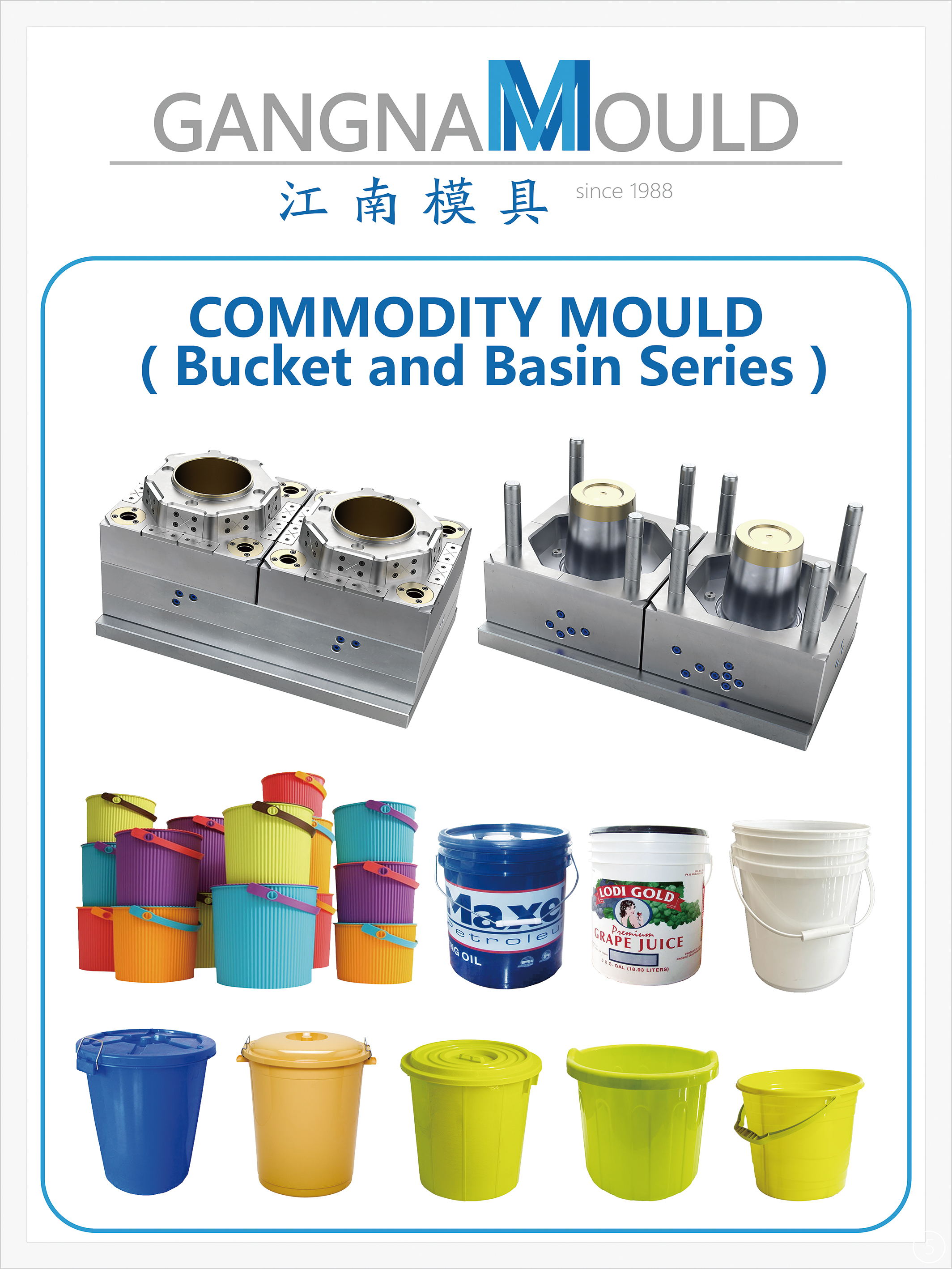
Bucket moulds and basin moulds are dominated by one dimension: rim roundness. A bucket that is 1 mm out of round may still hold water, but it will not accept a press-fit lid reliably and it will not stack straight. Rim roundness is set by cooling balance and gate position, which is why these two design levers matter more here than cavity count.
Storage boxes and storage cabinets
Storage box moulds and storage cabinet moulds live or die on mating faces. A lid gap that opens by a fraction of a millimetre turns a one-hand close into a two-hand push, and in retail packaging that becomes a customer complaint rather than a production note. Large flat panels also warp, so uniform cooling across a wide face is the controlling factor.
Crates, turnover boxes and pallets
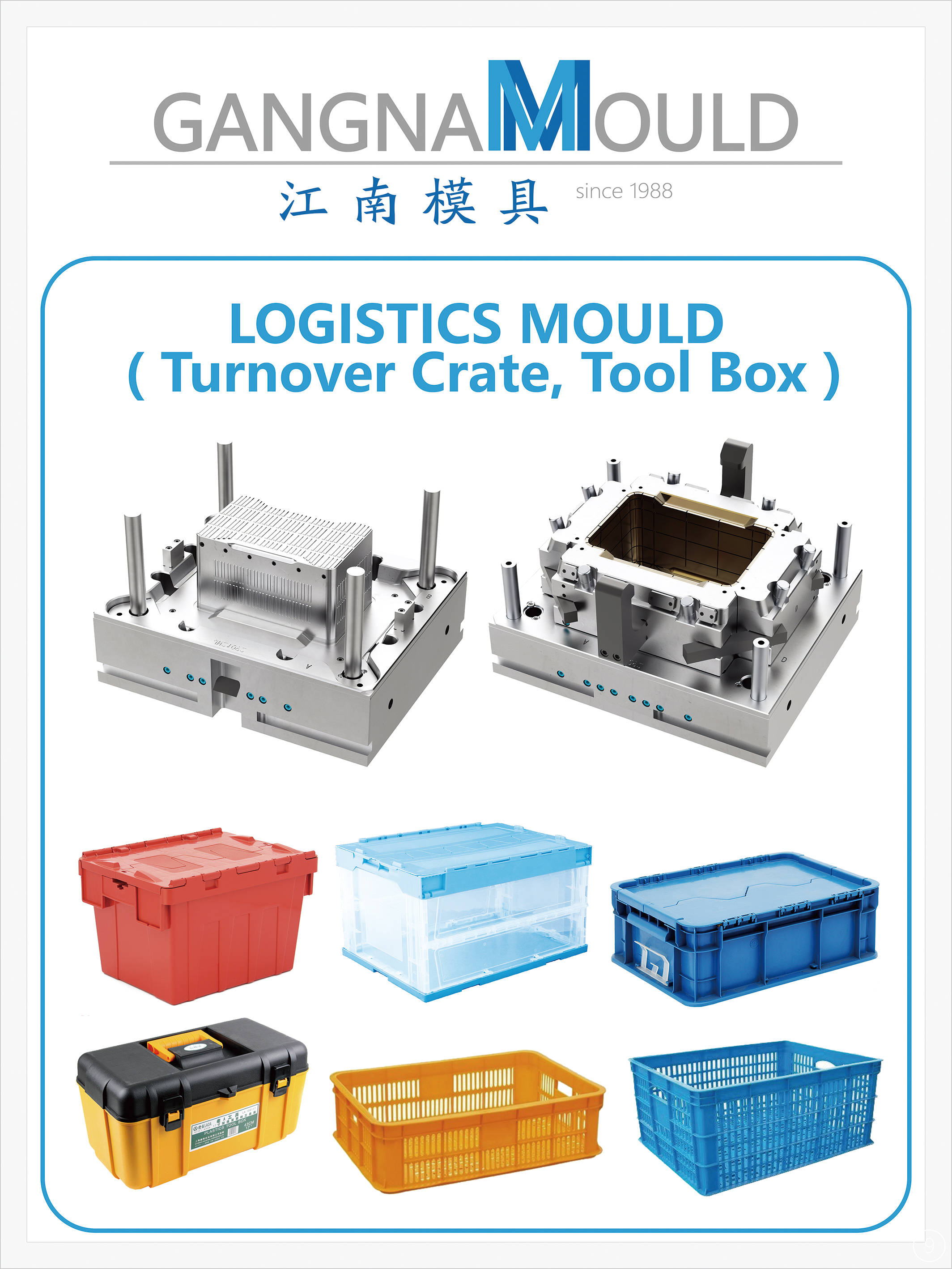
Turnover box moulds, crate moulds and pallet moulds are judged by automation compatibility: footprint, stack height and fork entry. These parts are usually run in high-cavity tools, so cavity-to-cavity balance becomes the dominant drift source. When one cavity runs slightly heavy, the pallet stack leans after a hundred units.
Trash bins and garden planters
Trash bin moulds and garden planter moulds combine thin walls with large unsupported surfaces, which makes warpage the first symptom and dimensional drift the second. Gating and venting optimisation, rather than steel selection, is the usual first fix.
The same logic extends across the rest of the commodity mould family — basket moulds, tray moulds, box moulds, kitchen utensil moulds, bathroom accessory moulds, and the chair, table, stool and sofa moulds used in furniture programmes. The mechanism is identical; only the controlling dimension changes.

Frequently Asked Questions
Are GANGNAM MOULD's commodity moulds CE-certified?
The certification documented for GANGNAM MOULD's Commodity Mould is ISO 9001:2015, certificate number 18118Q10459R3S, issued by Beijing Xingguo Inspection and Certification Co., Ltd. and valid from 2024-06-14 to 2027-06-15, covering the manufacture and design of plastic parts mould. The records supplied do not include a CE certificate for the moulds themselves. Where CE marking applies, the obligation generally attaches to the finished product placed on the EU market rather than to the tooling that makes it, so a buyer importing buckets or storage boxes should confirm which directive or regulation applies to the finished article and request the corresponding test evidence from the party placing it on the market. A supplier that answers this question precisely, rather than claiming every certificate at once, is easier to audit later.
Can one commodity mould design run both virgin PP and recycled polymer?
Yes, but the design has to be told in advance. GANGNAM MOULD's Commodity Mould scope covers PP, engineering-grade plastics and recycled polymers, and the design response is to widen the process window rather than to tighten the part tolerance: cooling capacity sized above the minimum, venting sized for the highest expected fill resistance, and gate dimensions that allow fill adjustment without recutting steel. Recycled feedstock varies in melt flow and contamination between lots, so the achievable dimensional band with regrind-heavy blends will be wider than with a single virgin grade. Buyers should state the intended feedstock mix, including the proportion of regrind, in the RFQ rather than at trial.
What is the minimum order quantity, and how is a first article validated?
GANGNAM MOULD's minimum order quantity is 1 unit, so a single bucket or storage box tool can be ordered and validated before a family of tools is committed. Validation runs through the published process — requirement and drawing review, design, manufacturing, trial and inspection, then delivery and training — and the decisive document is the trial report: GANGNAM MOULD's quality control combines NDT, CMM measurement and full-size trial testing with inspection reports. A buyer validating a first article should ask for measured values against the controlled dimensions, not a pass note, and should compare parts sampled at the start and end of the trial run.
How long does a bucket or storage box mould take to deliver?
Lead time depends on mould complexity, and GANGNAM MOULD's published process indicates a 30–45 day window that is confirmed per order. Complexity drivers include cavity count, part size, cooling circuit density, surface treatment requirements and whether inserts are involved. Because the figure is confirmed per order rather than fixed, buyers working to a seasonal launch should lock the schedule in the contract together with the after-sales terms, which GANGNAM MOULD agrees contractually rather than publishing as standard. For a specific bucket, basin or storage box programme, the fastest route is to send the drawing and material grade for a scoped quotation.
Conclusion: Stable Batch Output Is a Design Decision
Dimensional drift in buckets and storage boxes is not a mysterious property of polypropylene, and it is rarely solved by an operator turning a dial. It is the predictable result of cooling imbalance, gate and vent design, cavity balance, steel and heat treatment, surface and release, and a measurement chain that either catches the shift or does not. Every one of those six is settled at the tooling stage, which is why the cheapest place to fix drift is the drawing review.
For buyers in the research and evaluation stage, three questions separate a supplier that can hold a tolerance from one that can only quote a price: can it show the controlled dimensions on the drawing, can it show a trial report with measured values rather than a pass note, and can it document the quality system behind both. GANGNAM MOULD answers the third with an ISO 9001:2015 certificate covering the manufacture and design of plastic parts mould, and the first two through a design scope that names cavity configuration, uniform cooling, optimised gating and venting, surface treatment and tolerance control as explicit deliverables.
Next step: send the drawing, not just the part name
A bucket or storage box quotation is only as useful as the tolerance band behind it. Send the part drawing, the material grade or regrind ratio, the controlled dimensions and the target volume, and GANGNAM MOULD can scope cavity count, cooling, gating and inspection against those inputs — with a minimum order quantity of 1 unit for a first validation tool.
Download the company brochure for the full Commodity Mould range and capability profile: GANGNAM MOULD brochure (PDF)
Email gm@gangnammould.com · WhatsApp +86 150-0576-9999 · www.gangnammould.com
Have Questions or Need More Details?
Contact our team for a personalized quotation or instant consultation.
Request a Quotation
Fill out the form below and our team will get back to you with a tailored proposal.
WhatsApp Direct Chat
Prefer to chat in real-time? Message us on WhatsApp for instant assistance & quick answers.
- Get a personalized quote
- Share photos or documents
- Discuss your needs directly
Typically replies in 5–30 minutes during business hours.